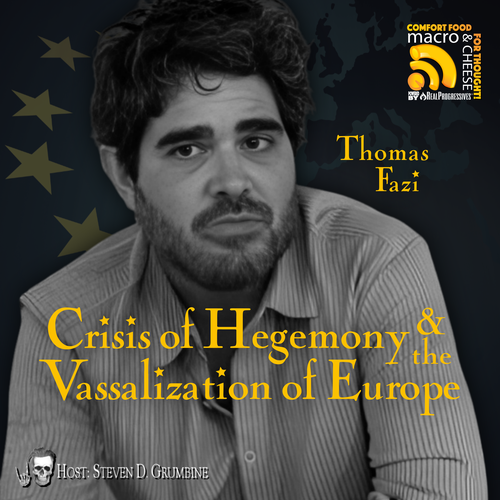
Episode 372 – Crisis of Hegemony & the Vassalization of Europe with Thomas Fazi
FOLLOW THE SHOW
Thomas Fazi joins Steve to expose how NATO, elite censorship, and the ideological transformation of the Left have rendered Europe a vassal of US empire, sacrificing sovereignty, fueling war, and deepening a global crisis of capitalist hegemony.
** Tuesday evening, March 24, we’ll be listening to and discussing this episode in our online gathering, Macro ‘n Chill. Register here: https://us06web.zoom.us/meeting/register/DeGM2oAyRt2O-Xsj1nc4IQ
Thomas Fazi joins Steve to dissect the geopolitical and ideological structures that have rendered Europe strategically subordinate to the United States. Thomas argues that NATO’s true purpose, from its inception, was not to defend Europe but to ensure its vassalization by keeping “the Americans in, the Russians out, and the Germans down.” He contends that the war in Ukraine was a deliberately provoked conflict designed by US planners to sever Europe’s economic and energy ties with Russia, forcing the EU into deeper dependency on American energy and military infrastructure.
The conversation goes into the weaponization of media narratives and the management of dissent through censorship and “acceptable” politics, connecting the cultural Cold War to today’s crisis of hegemony. Ukraine, Greenland, and Europe’s energy self-sabotage aren’t anomalies, they’re features of an imperial system that requires subordination abroad and confusion at home.
Thomas Fazi is a “journalist/writer/translator/socialist.” who lives in Italy. He is the co-director of Standing Army (2010), an award-winning feature-length documentary on US military bases featuring Gore Vidal and Noam Chomsky; and the author of The Battle for Europe: How an Elite Hijacked a Continent – and How We Can Take It Back (2014) and Reclaiming the State: A Progressive Vision of Sovereignty for a Post-Neoliberal World (co-authored with Bill Mitchell, 2017). His articles have appeared in numerous online and printed publications.
Find his work on Substack: thomasfazi.com
@battleforeurope on X
Steve Grumbine:
All right, folks, this is Steve with Macro N Cheese. I’m going to Europe today, well, at least figuratively here.
We’re going to discuss the concept of the vassalization of the European countries and really kind of taking a look under the hood at what the Trump administration has done. It’s hilarious. When in doubt, blame it on Russia, right? And when in doubt, blame it on China.
And lo and behold, just about everything that we’re hearing these days from Trump’s motive of going into Greenland and trying to take over Greenland, a lot of the tariffs and on and on and on, it always comes back to, “China bad, Russia bad.” Geopolitics is crazy, right? And when you think about it, it’s important to have, you know, an understanding of history.
It’s important to understand how things come to be. Just like Gaza didn’t start October 7th.
This whole concept with England and Europe as a whole and the role of the United States in this kind of new geopolitical world didn’t happen overnight either. So with that, I’m going to be talking to my friend Thomas Fazi. Thomas Fazi has written for Substack. He’s also written on Compact and UnHerd.
He’s written books, one of my favorite books with him and Bill Mitchell, which is Reclaiming the State. And he’s also written other books about the COVID era, and I’ll let him touch on that in a minute if he’d like.
But, what I want to do is make sure that today what we’re talking about is the empire, and we’re talking about Europe and how it has subjugated itself to United States political whims and has really, really harmed itself in the grand scheme of things and the absolute oppression of free speech and the censorship that is going on in Europe, all basically to allow it to take a knee to the United States, amongst other things. With that, Tom Fazi, welcome to the show, sir.
Thomas Fazi:
Hey, Steve, it’s a pleasure to be here. Thanks for having me.
Steve Grumbine:
Absolutely. Hey, look, I want to get this out of the way.
First and foremost, I take deep offense when people call the Left what Democrats are basically, you know, in the United States, just basically shitlib kind of liberals that are kind of okay with state power and okay with state violence, and are okay with all the things that they claim to be against in reality when push comes to shove. So I don’t see that as the Left. So I don’t consider myself a member of that group when I say I am in the Left.
And I wanted to hear just quick as it’s kind of more tongue-in-cheek. But just what is the difference, man? Why do people conflate “Left?”
Is it because there’s so few of us or whatever and shitlibs as a group of the Left? I guess. How does that even come to be?
Thomas Fazi:
Well, I think this is by design.
It’s not by accident, and it’s part of a pretty long historical process which was aimed at essentially deeply transforming the nature of what the Left used to be throughout most of the 20th century and before that, but especially in the 20th century. And the Left was rooted in working class and socialist politics.
It had very little to do with liberal progressivism as we understand it today, which is what the Left is associated with today. Ideas of individual freedom and, you know, identity politics and all that. That was not part of the baggage of the old Left.
The old Left was very much rooted in a class-based understanding of politics. It was rooted in an anti-imperialist understanding of geopolitics, of international relations.
And this Left was a real threat to the capitalist ruling classes. Now this was the grand ideological struggle that to a large degree defined much of the 20th century and especially the Cold War.
And it’s important to understand that huge efforts and resources went into destroying the old Left.
So this kind of anthropological transformation of the Left was of course, a result of a number of, you know, factors, including structural factors, the change in nature of labor, the decline of mass industry, etc., etc. So there were of course, sort of “objective factors” at play.
But this was also a process that was very much driven by the transatlantic elites, by the globalist elites, which poured a lot of money into the new Left, especially beginning in the ’70s. And so the new Left that emerged around that period was a very different, you know, left to the one that had defined Left politics until then.
It was one that was increasingly less focused on class, it was increasingly less focused on labor and labor-capital relations that was more and more focused on questions of discourse, of narrative, of individual identity. This was kind of the postmodern Left that was very influential, especially in France, but elsewhere as well.
And you know, the CIA and other intelligence bodies actually poured a lot of money into supporting this new Left as a way of countering the old Left. The old Left was a threat that needed to be neutralized.
It needed to be counted, especially in Europe, when at the time the old Left was still incredibly powerful, incredibly influential.
In my country, Italy, in those years, you could say that almost 50% of the Italian population would define itself in one way or another as communists, as socialists. And the situation in other countries such as France, was quite similar.
So this was a very powerful force, and it was rightly so, seen especially by US planners as a key obstacle to the entrenchment of Europe’s subordinate role within the global hierarchy of power within the US-centric empire.
And the Americans understood that to achieve this subordination of Europe, it wasn’t enough to resort to violence and coercion, even though all of those things occurred through, for example, stay behind secret armies, NATO armies like [Operation] Gladio, which engaged in acts of terrorism, false flag terrorist attacks, which were then often blamed on far-left elements in order to curb the power of the socialist democratic Left movements and parties. So all that happened, but they also realized that they had to go on an ideological and cultural counter offensive as well.
And there’s a great book about this which is called Who Paid [the] Piper[s of Western Marxism]?
Steve Grumbine:
We just interviewed Gabriel Rockhill a couple weeks back.
Thomas Fazi:
Right, yes, that’s a fantastic book as well as a similar book. In fact, I’ve read a lot about this more recent book and I look forward to reading it.
But it’s also another great book by a British historian called Frances Stonor Saunders, who also wrote a book about [The] Cultural Cold War, which is a lot about this story, a fascinating story, but I absolutely look forward to reading Rockwell’s book. It seems absolutely amazing. Actually.
I’ve been waiting for a copy to reach me here in Italy, but it’s taking a while, so hopefully it will reach me soon. But yes.
So this is a key part of this story and it explains not entirely, but to a large degree, the decline of left working-class socialist politics and the ascendancy of liberal-left progressive politics, which essentially replaced the old Left’s focus on the primary contradiction of capital, the labour-capital conflict.
It replaced that with a whole wide range of secondary contradictions, you know, which to a large degree a byproduct of that primary contradiction.
And so you have gender politics, you have environmental politics, you have more recently climate politics, you’ve got now the whole never-ending, ever-expanding range of identity politics.
So it’s sort of replaced that primary contradiction with these secondary contradictions as a way of effectively weakening that underlying class conflict that had defined much of Western, especially Western European, history up until that time, up until the ’70s and ’80s. So that’s when you have neoliberal counteroffensive. So that neoliberal counteroffensive took a number of forms.
You know, economic, political, the rollback and the attack of unorganized labor, the steady erosion of democracy by transferring national prerogatives from the national and relatively democratically accountable level to the intrinsically anti-democratic supranational level, especially in Europe, through the process of European integration and the European Union, you know, creating “independent central banks and independent technical bodies” to replace democratic decision-making processes and so on and so forth. But there was also a cultural offensive which had been ongoing for quite some time, and which was further radicalized from the 1980s onwards.
The rise of individualism, the culture of the self-made man. And this further sort of drove into the ground the old left politics.
And so what we have now, what passes off as the Left today is the result of this decades long process of essentially social engineering, a social re-engineering which has ended up creating a Left which is totally compatible with capitalism, with the current structures of power and with empire ultimately.
And I think when you look at some of the leading figures of the, you know, contemporary new Left, someone like AOC for example, I think this becomes manifest. And so I think, you know, this is what has happened.
And I think it’s pretty ironic how today, especially people on the Right, tend to conflate the Left with socialism and Marxism and all these notions of cultural Marxism or globalism being some kind of Marxist/socialist conspiracy.
What we’re witnessing is in fact the result of and largely the consequence of a war that was in fact waged on the old Marxist, on the old socialist Left.
Yeah, there’s definitely a lot of confusion today when it comes to, you know, just the way people use and think of these terms, you know, left and right. And I think these terms have become largely an obstacle to our understanding of reality. Initially, humans invented words to illuminate reality.
That’s what words are supposed to do.
When you have words that don’t explain reality anymore, but in fact tend to obfuscate it, tend to conceal it, then I think maybe one should simply stop using those words. I mean, the reality is that when it comes to a term like Left, it means different things to different people.
But what it means to most people has very little to do with what that term used to mean in the old working-class, Left tradition.
So, you know, I think we maybe need a new political vocabulary, because the old one, the kind of old 20th century vocabulary, the old 20th century political compass, has really become, I think, quite obsolete. I mean, I try to avoid using the terms “Left and Right” in general as much as possible. I don’t think they’re very helpful.
They trigger kind of knee jerk reactions on both sides. And I think they tend to obfuscate what in fact, people who both define themselves as being on the Left and on the Right actually have in common.
And I think in fact, today those terms are used very much as a tool to divide and conquer the body politic, the working classes, by keeping these two tribes eternally divided.
Steve Grumbine:
Let me ask you a question real quick on that same note. You know, obviously terms matter, words matter, and being able to disseminate information to people is incredibly challenging.
I mean, you’re a content creator, you write, you know, you have a distribution, but you obviously know what distribution looks like for the big dogs that get huge play and, you know, it only takes them a few minutes to get a concept out to millions of people while we’re struggling for thousands. And ultimately that monopoly on how you get your megaphone out there drastically impacts what people hear, what they think.
You know, manufacturing of consent through these kinds of institutions that are set up to exactly be that: a bulwark against popular sovereignty, against working-class solidarity, you name it, the ability for the state and for these arms of the state that are empire-friendly or oligarch-friendly, tend to be obfuscated. You know, we tend to not hear what we need to hear because the voices we need to hear are drowned out behind algorithms.
They’re drowned out behind weird little petty skirmishes across the Internet, whatever. But the real heavy lifting of getting people to believe a certain thing is still done through these official channels.
And you know, the view of many people, like “in support of Ukraine” and the “Putin puppet,” this and all these other concepts, never taking into account the role of NATO, which I want to dive into. And what actually is NATO today and understanding where NATO came from and why it came to be and is it even valuable today.
But the point is that people believe they’re the Left or they believe they’re the Right based on popular narratives told by “official, you know, sources”, sources that have, like, almost unfettered access to the brains and, you know, headphones and readers of most people, honestly.
So the hegemony, if you will, of the ruling class is pretty astounding. Their ability even today, to maintain enough people believing what they’re saying and staying in those wagon ruts that they create for us so that we don’t think that there’s another alternative. It seems to pollute everything. And I’m going to take it one step further.
A lot of folks really take great issue to this, but I see the elections in the United States as merely a tool for factions of the oligarchy to manufacture consent.
And then people somehow or another adopt an oligarch and become mouthpieces for an oligarch, as if the oligarch somehow or another is speaking to them and working for them. Completely lacking any sense of class struggle, completely lacking any sense of real, meaningful thought.
The state is so powerful in how it can, you know, program our brains.
And this really has a deep effect on the way US folks see what’s playing out from the Trump administration in Europe and what’s happening in Greenland, etc. So what I’d like to do is with you, I’d like to talk a little bit about NATO.
Let’s get started with why NATO even came to be and what its role has become.
Thomas Fazi:
Right.
Well, look, I think NATO’s real function, its actual function, was summarized quite well by its first Secretary General, Lord Ismay, as that of and I quote “Keeping the Russians out, the Americans in, and the Germans down.” Lord Ismay’s own words. And there you have it.
That really tells you everything you need to know about what NATO was and what NATO is today.
So the alliance’s original purpose was to prevent the emergence of an independent, autonomous Europe.
It was to ensure the continent’s strategic subordination to the US and it was to impede/forestall any geopolitical rapprochement between Europe and Russia. So this was NATO’s original purpose. It had nothing to do with defending Europe from the Soviet Union.
In fact, that threat was largely a byproduct of NATO’s very existence.
And of course, when we talk about NATO, even though it’s presented as an alliance among equals, it’s well understood that NATO is an organization that is structurally dominated by Washington.
So it’s a profoundly hierarchical “alliance,” but it’s in fact a tool totally controlled by Washington and by the American imperial state or the national security state. And so during the Cold War, far from defending Europe, it actually played a key role in systematically exaggerating the Russian threat.
And the aim there was the idea was that NATO, essentially, and the US needed this threat to justify this permanent US military presence in Europe as a way of exerting de facto control over the foreign policies of its European “allies” through NATO, and also, as I said, to keep Europe as divided as possible, as politically and economically distant from Russia. This was NATO’s key purpose, but it wasn’t its only purpose.
In a sense that, as I mentioned earlier, NATO wasn’t just directed outwards towards the Soviets, but it was also directed inward towards European societies themselves.
I mentioned earlier Operation Gladio, which was essentially a clandestine NATO-run paramilitary network that became involved in several acts of terrorism which were often blamed on left-wing terrorist groups.
And this was done to delegitimize the wider democratic left in Europe, especially in countries where the class conflict was particularly intense, such as in Italy. So NATO’s purpose was never defending Europe from an external enemy.
It was really a way of disciplining Europe and keeping it sort of subordinated and keeping it within the US-led imperial order as essentially a vassal, a vassalized continent.
And I think this becomes apparent when we consider the fact that NATO was not dissolved, you know, when what was officially its raison d’etre, the Soviet Union, disbanded in 1991. If that was NATO’s real purpose, then once its reason for existing disappeared, it should have disbanded, but this didn’t happen.
And in fact, from that moment onwards, a whole series of processes are put in motion to actually expand NATO. In fact, beginning in the late ’90s and early 2000s, what we see is an effective merger between the European Union and NATO.
For example, by making the accession of new eastern member states, former Warsaw Pact states, into the European Union. This was made contingent on prior entry into NATO. So if a country wanted to join the European Union, it first had to join NATO.
And this was a very clever move on America’s part.
It was an incredibly sort of self-defeating move on the European’s part because it effectively meant that the EU would never achieve geopolitical autonomy because it was effectively further entrenching itself within the NATO framework, ensuring that continent would be, you know, geopolitically aligned with the American strategic agenda.
And so, you know, the formula that the first Secretary General used to describe NATO remained true after the Cold War, and it remains true to this day. And I think the war in Ukraine is a perfect example of that.
That war was clearly, it wasn’t just provoked by NATO in the sense that the historical record on this point is unequivocal.
No one who, you know, looks at the historical record with an open mind can come to any conclusion other than the fact that NATO’s eastward expansion towards Russia’s border, and especially NATO’s progressive and de facto, even if not formal integration of Ukraine into NATO, beginning in the aftermath of the 2014 US-led coup in the country, is ultimately what provoked Russia into invading Ukraine. Because Russia saw this as an existential threat to its territorial integrity, to its national security.
And, and I think from a sort of great power perspective, this was a perfectly rational response.
The US would have responded in exactly the same way if, say, Canada or Mexico entered into a military alliance and started deploying missiles on their territories. And like Russia, the US would not have waited eight years to actually intervene after this had happened.
But I would go a step further and say that not only was this war provoked by NATO and by US planners, but it was in fact deliberately provoked. So I think it was the deliberate goal of US planners to provoke Russia into invading Ukraine because they wanted this war.
They saw this war as being key to their geopolitical strategy of using Ukrainians as cannon fodder to weaken Russia.
The idea was that, you know, if we draw Russia into a protracted conflict, this will weaken Russia economically, militarily, and that this will ultimately sort of, you know, bring about regime change in Russia, which has always been the long-term goal of US planners. They cannot accept the existence of an autonomous, independent, sovereign Russia.
This huge country sitting right at the center of Eurasia is something that not only US planners, but even British planners way back in the 19th century couldn’t accept. So this has always been sort of a psychological sticking point for Western elites.
And this explains the countless aggressions that the Europeans first and then the Americans have, even though the Americans were more subtle in a way that went about it, but especially, you know, the countless aggressions that came from Western Europe beginning in the 19th century from the Crimean Wars onwards. And so this was one of the key sort of strategic aims in deliberately dragging Russia into this war from the US standpoint.
But that wasn’t the only aim.
I think another key aim from the American perspective was precisely to drive once again a deep wedge between Europe and especially Germany, and Russia.
Because the fact that in the beginning, in the 2000s and early years, 21st century, Germany had started strengthening its economic, and not only Germany, but especially Germany has started strengthening its economic and especially energy ties with Russia and importing more and more gas from Russia was seen from the American standpoint as a primary threat to US hegemony. Because as I said, you know, one of NATO’s key purposes was precisely to keep Europe and Russia separated.
There’s nothing that terrifies American planners more than Europe and Russia coming together and forming a Eurasian geopolitical bloc, because that would essentially render the whole concept of, you know, the need for American security, or “security”, the need for an American presence in Europe, and it would weaken America’s grip over Europe.
And, you know, especially when Germany started building a Nord Stream 2 pipeline in the early 2010’s and the Americans really started freaking out. Trump, during his first term, even slapped sanctions on the building of that pipeline.
So several attempts were made to stop that pipeline, which eventually went ahead anyway and was in fact about to be inaugurated shortly, more or less around the time of Russia’s invasion of Ukraine.
And so I think a key goal for America was also to, to use this war to a) divide Europe from Russia geopolitically, economically, once and for all, and b) there are also economic considerations, but of course, they’re also geopolitical in a sense that the idea was to replace Europe’s heavy dependence on Russian gas with a dependence on US gas. This has been openly stated by several American politicians over the years.
And this is exactly what was ultimately achieved as a result of the US dragging Europe into the NATO proxy war against Russia, which result in the EU’s suicidal decision to decouple from Russian gas.
With the result of that, now Europe, you know, pays way more than it used to pay for Russian gas to buy American gas, and now is, in fact, totally dependent on a country that is actually much more politically volatile and much more likely to weaponize those supplies than Russia ever was. So, again, NATO was key to all this.
And so, you know, NATO continues to play the role that it was originally intended to play when it was created almost 80 years ago. And it continues to do so very effectively. Unfortunately for European citizens.
Steve Grumbine:
You know, when I think about this, they obviously have to demonize the leaders. I’m not here to tell you Putin is an angel. I’m not sure that he’s good, bad, whatever. I don’t know. I don’t know.
You know, I mean, like, I do know that the actions taken by NATO, the stuff that is obviously understood about the Maidan and CIA-led coups around the world, these are things that we all know.
And, you know, when you think about what would be a logical response to a foreign country surrounding you with weapons, surrounding you with military bases, and then provoking you this way, I just find it difficult to understand how people can, like, flush realism from their face, flush the things that they can see clearly and adopt this kind of weird pro-NATO, anti-Russia, “Putin puppet” kind of mentality. And then I stop and I think to myself, [Antonio] Gramsci had something to say about this.
And you start realizing that the powers that be within the state have so much control on the public and what they believe and how they believe it and what they think is possible and what they think is true.
And the narratives that, you know, pass the sniff test with these folks, and I shouldn’t say these folks because I’m sure I’m as much a victim of cultural hegemony as anyone. You know, I mean, it’s very powerful.
It’s the most powerful military, most powerful network ever, pumping thoughts into your head, pushing you to believe a certain thing.
And then by the time it’s all said and done, you actually believe it’s your idea, that you are the one championing this and you’re so grateful that these politicians or whoever are doing the thing. Being from Italy, I just find it fascinating, the Gramscian angle. Do you have any thoughts on that?
Thomas Fazi:
Well, yeah, I mean, I think Gramsci’s insights are key to understanding how power works, especially in Western so-called liberal democratic societies.
And Gramsci’s basic idea was that power, the state, doesn’t just control essentially doesn’t just wield control and control societies via a monopoly on the use of force, i.e., by controlling the police and military apparatuses and so on. But it also maintains power by shaping ideas, by shaping even the values of a society, what he called the “common sense of society.”
And this is a process that Gramsci called hegemony.
And that’s where the worldview of the oligarchy of the ruling class essentially becomes internalized, becomes accepted as natural and normal by all of society. This is in a nutshell, what hegemony is.
And of course this historically has been achieved, especially in Western “liberal democratic societies” through propaganda. And again, there’s a huge literature on this.
You know, [Noam] Chomsky has written countless masterpieces on how power in Western societies manufactures consent, as the title of his most famous book on the topic goes. And this historically has been done by controlling the media. So in the West the media is formally independent, is formally separate from the state.
But in fact the mainstream media has always been a tool of the corporate oligarchies. This is self-evident and this has historically been very effective.
And again, there’s a very wide literature from the early post-war years, people like Edward Bernays and others who theorized on the importance of propaganda to keep populations in check.
To keep them in line, to keep them aligned with the ideas and the ideologies of the ruling classes, and to essentially indirectly control the outcome of elections, which have always been rigged at various stages of the process. But ultimately, propaganda has always been a key way of ensuring that the people vote in the right way.
But more than that, in a more general sense, I would say that they believe in the democratic process in the first place. So that’s an element of meta-propaganda.
You know, it’s not just about getting you to vote for this or that party, but it’s about getting you to believe in the process in the first place. And this historically has been incredibly effective.
That is that old joke of, you know, a Russian and an American sitting on a plane, this was at the time of the Soviet Union, sitting on a plane headed to Washington. And the American asks the Russian, “Okay, why are you going to America?” And he says, “I’m going to America to study propaganda.”
And the American says, “What propaganda?” And the Russian answers, “Well, exactly.”
So propaganda in the West, historically has been so powerful, but precisely because it was hidden from the view of most people, most people weren’t aware of the fact that they were being propagandized.
Now, of course, the situation in recent years has shifted quite a bit as a result of the rise of social media, which has allowed a much more sort of diffusion of information. So it’s weakened the stranglehold that historically corporations and the state have had on the transmission of information to the public.
And this in itself is positive.
But it has also resulted in the state taking a series of actions to increasingly control the flow of information on the internet as well, and especially on social media, which is where most people today, especially young people, get their information and their news.
And so we’ve seen sort of a growing crackdown, an alliance of big tech companies in the state to crack down on the free exchange of information on social media.
And then this really kind of escalated in the mid-2010s as a result of a series of events that essentially all pointed to a widening discontent among the Western public, largely as a result of the economic and social fallout of the financial crisis.
Intermission:
You are listening to Macro N Cheese, a podcast by Real Progressives. We are a 501c3 nonprofit organization. All donations are tax deductible. Please consider becoming a monthly donor on Patreon, Substack, or our website, realprogressives.org. Now back to the podcast.
Thomas Fazi:
And in Europe of the subsequent euro crisis. You have Brexit, Trump’s first term. You have the yellow vest protests in France. So, you know, shit was kicking off in a number of Western countries.
And from an elite standpoint, they put this down largely to social media. And of course, it wasn’t just driven by social media, it was driven by the fact that people were angry.
But from their standpoint, social media played a key role in sort of enabling people to access alternative sources of information, unorthodox source of information, information not aligned with the mainstream, and that this problem needed to be addressed. Then it was done through, you know, a series of increased crackdown on sort of online censorship, essentially.
And again, NATO played a key role in this entire process.
And in fact, when talking of the censorship industrial complex, one should maybe speak of the censorship security complex, because the intelligence agencies and the sort of the apparatuses of the permanent state, which are the hidden hand of the oligarchy, played a key role in the rollout of these various censorship mechanisms. And in general, of this sort of shift towards the idea of the need for NATO to increasingly resort to forms of cognitive warfare.
So kind of information warfare that historically was directed against foreign populations and foreign adversaries was increasingly redirected inwards toward Western populations. And that this has escalated ever since then.
And, you know, I would say that these are interesting times because I think what’s clear is that on the one hand, you know, the more elites see that they’re losing the control of the narrative, the only response they have is to double down on the propaganda and double down on the censorship.
We see this very clearly in Europe, but in fact, that simply makes people more and more aware of the fact that it makes the propaganda more and more obvious. Right? So this is a sign of weakness in a way.
As I said, propaganda in the West historically has worked when it was invisible, when most people were unaware of it. But people nowadays are wisening up to the fact that the mainstream media is not objective, it’s not neutral, and it’s not working in their interest.
This is why newspaper readerships are tanking. You know, the mainstream news channels viewerships are tanking. People trust the mainstream media less and less.
So, you know, this is, I think, a sign that this hegemony is in crisis. I would say we have a very serious crisis of hegemony in the West. You know, crisis from their standpoint, they’re incredibly concerned about this.
They know about this.
We know that throughout the West, with very few exceptions, political leaders and the political establishment more in general, enjoys record low levels of public support, record low levels of consensus. And this is a sign of weakening hegemony.
So what we’re seeing is, in fact, elites increasingly resorting to openly coercive and openly repressive measures, including in Europe, intervening directly in elections, such as what they did in Romania just over a year ago, when, under the guise of or on the grounds of an alleged Russian foreign interference operation, which was never proved and likely never happened, they canceled an entire election where an independent populist candidate had come out first, and then they eventually barred the guy from running in future elections altogether. So this is kind of where we’re at in Europe, but this could be applied to the West more in general.
But Europe is an extreme example of this crisis of hegemony.
Once propaganda, once hegemony starts to collapse, that’s when regimes become increasingly authoritarian, openly authoritarian and repressive, which is what we’re seeing now in Europe.
We’re also witnessing really insane things, such as the use of sanctions, which, you know, which were originally developed to target foreign companies, foreign entities being against European citizens, European critical journalists, critical analysts, on grounds that They are, you know, “spreading Russian propaganda,” or whatever. And the implications of being sanctioned is that essentially you are depersoned. You lose a lot of your basic civil and even human rights.
You can’t travel throughout Europe, your bank accounts are frozen, you can’t access your money. I mean, you are essentially deprived of many of your basic civil and human rights. And this is not even decided by a court. It’s decided by a completely unaccountable supranational executive body, which is the Council of Europe.
So what we’re witnessing now is really an escalation of authoritarianism in Europe especially, but I would say in the West more in general as a result of this crisis of hegemony.
And I think we see this crisis of hegemony also at the international level, in the way the Trump administration doesn’t even seem to care about manufacturing consent at both the international and domestic level for its military actions. It just doesn’t care anymore. It doesn’t even try to come up with, you know, liberal or humanitarian or legal justifications for its actions.
It’s just pure unbridled exercise of naked power, naked imperialism, which isn’t even cloaked anymore in any, you know, veneer of liberal values or whatever. And again, it’s a sign of, in this case, a crisis of imperial hegemony.
So it also points to, you know, not just a weakness of Western elites in general in Gramscian terms, but also weakness of empire in general, weakness in sort of discursive hegemonic terms.
But of course, this also sets the stage for a very dangerous phase, which is what we are witnessing now, which is just, yeah, the complete unbridled exercise of imperial power, of oligarchic power, directed both at Western domestic populations as well as non-Western countries around the world.
Steve Grumbine:
So, you know, when I think about this, I don’t want to bring up Trotsky because he’s not my guy, but let’s just say Trotsky framed fascism pretty well. He talked about it being a temporary tactic of the ruling elite, not really necessarily a permanent state.
And you can see fascism through scapegoating, through all kinds of demonization and divisive rhetoric. You can see it through a host of police state type tactics. You can see it in just about every meaningful way you can see it happening before our eyes. And it feeds something.
You know, when you’re downtrodden, when life isn’t working for you, it’s always nice to have somebody to point to and blame it on. It’s always nice to have that kind of feeling. And you can see that these tactics are oftentimes married with austerity, extreme austerity measures.
We have a left wing that has not taken on the anti-austerity rhetoric of the past. They have kind of bought into the austerity message, not understanding the world in which they live, but they are fully convinced that they’re right.
I want to bring that same thinking now to what is happening with the Trump administration and Greenland and the fact that, I mean, if anybody else would have done what Trump has said even, forget done, we aren’t even not done yet. I mean, you see what was done in Venezuela to democratically elected Maduro. But when we look over there at Greenland, this is naked empire.
I mean, this should be a war, right? Like Archduke Ferdinand was all it took for, you know, World War I. You would think Greenland would be a red line, but clearly, it’s not.
But then again, neither was a genocide in Gaza. That wasn’t a red line for any of these folks.
This is clearly an act that should be bringing everybody together against the empire, but instead they’re tripping over themselves to find a way to make an excuse for it. Your thoughts on Greenland?
Thomas Fazi:
Yeah, well, before that, just very briefly, I think the term “fascism” is, I think, just as unhelpful as the terms “left and right” are, [sure] in a sense that it’s been completely emptied of any reference to its original historical meaning.
I mean, if we are to believe the liberal elites, fascism is essentially, you know anyone who’s on the right, anyone who’s racist, anyone who doesn’t buy into the liberal propaganda. But in fact, historically, fascism was something fairly specific.
Fascism was understood as well, effectively was the fusion of corporate and state power. It was the neutralization of democracy by the oligarchy, essentially taking direct control of the state.
It was the widespread use of censorship and repression of dissent. It was imperialism and colonialism.
So if we understand fascism to be this, then I can’t imagine anyone that’s more fascist than the liberal, centrist transatlantic establishment. They are the ones that have been destroying democracy for years. They’re the ones that have been accruing more and more power to the oligarchy.
They are the ones that have been resorting to censorship. They are the ones that have been waging imperialist and colonialist wars across the world for years.
So, you know, and if you look at the European Union, the European Union is the closest thing to a sort of contemporary embodiment of fascism. This kind of supranational, anti-democratic, oligarchic, controlled, warmongering empire, de facto, that’s pretty fascist.
So those that claim to be defending us from fascism are in fact the real fascists in this play. I think there should be no qualms about that. And of course, Trump fits perfectly within this dynamic.
So, of course, fascism isn’t the preserve of liberals, of course, it’s a way of organizing and waging power.
And it has very little to do with what the individual ideological preferences of this or that politician might be.
Steve Grumbine:
Agreed.
Thomas Fazi:
I thought this was sort of an important premise to do.
When it comes to Greenland, look, I’m not surprised in the least by the absolutely pitiful reaction of European leaders at an American president essentially threatening to militarily invade and annex a European territory, a huge chunk of a European country, because the European leadership, the current European leadership, the European establishment, stopped thinking in terms of the national interest of their own countries, of their citizens, or of Europe as a whole a very long time ago. The European elites are simply tools of the transatlantic globalist establishment.
They are, you know, it’s what Marxists used to call a comprador elite, an elite that is serving foreign interests, essentially.
And it’s laughable to see now European leaders clutching their pearls at Trump and saying that Trump is a threat to Europe and to Europe’s autonomy and saying, “Now we have to stand up and defend European autonomy.” I mean, this is. It’s a joke. It’s a joke.
This is the same political class that essentially has led Europe into a situation where it is more politically, economically and militarily vassalized to the US than it’s been at any moment since the Second World War.
This is a political class that has aligned with Washington’s strategic agenda under Biden and even before that and in fact even out with Trump, virtually every major issue: trade, energy, defense.
We mentioned the NATO proxy war and the way that it was used to re-vassalize Europe, to make Europe dependent on US energy exports, you know, thereby essentially sort of driving Europe into a very deep economic crisis, into de-industrialization as a result of the sky-high prices that companies and households are now paying for energy.
This is the political cross that had absolutely nothing to say about the terrorist attack on its most important energy infrastructure, the Nord Stream pipeline, which was an act that was carried out with at least indirect U.S. involvement. And we now know, even according to mainstream sources, foreknowledge by US and like the other Western intelligence services and governments.
So some European governments, and most likely even the German government probably knew about this terrorist attack on a key European energy infrastructure beforehand and allowed it to happen and then even had the gall to blame Russia for it when it was clearly carried out either directly by US or UK operatives or by some NATO proxy. It might even be Ukraine as they claim to be. But clearly this was not an act that Ukraine carried out on its own.
At best they acted simply as the proxies for NATO and for the US. So this is the kind of political class that we are talking about.
This is a hyper-vassalized class that has completely jeopardized Europe’s core objective economic, political, geopolitical interests that has sacrificed the interests of its citizens and has been doing for years to please the transatlantic and US-led imperial oligarchy. It has plunged, you know, it has led us to a situation where we are on a brink of a potentially catastrophic nuclear war with Russia.
I mean, it’s hard to imagine a political class that cares less about Europe’s interests in European history. This is something that really one can only…
One needs to hark back to the kind of dynamics of traditional colonial rule to find something similar to what has happened in Europe over the past decade, essentially.
But even before that. Now the idea that this political class is suddenly capable of championing European autonomy and sovereignty is absolutely laughable.
So all this talk of a supposed, you know, rift between Europe and the US and all this rhetoric that we’re hearing in Europe from [German Chancellor Friedrich] Merz and [French President Emmanuel] Macron and others and even [European Commission President] Ursula von der Leyen about the need for Europe to become more independent and strategically autonomous from the US. It’s all theater. It’s just purely performative.
In fact, they are so embedded within transatlantic system that they just want that system to return to what it was.
So now that they’re adjusting to the political consequences of the tensions between the factions within the US oligarchy that, you know that in a way, Trump’s foreign policy expresses, but that’s pretty much it.
I mean, if we look concretely to what they’re doing, look at Greenland, not to mention the fact that they’ve accepted Trump’s threats over tariffs and everything else, they’re continuing to buy more and more US energy, thereby making themselves more and more dependent on the country that they supposedly want to make themselves more independent from. It’s a joke.
But even if we focus specifically on Greenland, what was their response to Trump saying, “I need Greenland, I need to pull more troops there. I want to militarize Greenland.” Their response was, “Okay, but we will help you do that within the framework of NATO.”
That’s pretty much what the agreement that they come to. “Yes, you will get exactly what you want. You will be able to place more troops. You’ll get…
You can have what you want in Greenland, you can deploy all the troops you want. But let’s pretend that we’re all in this together, so we’ll do it in the context of NATO.” And so this is what’s happening.
So you have this European posture that speaks the language of autonomy while in fact, fully accepting the…
Actually, the deeper and deeper material subordination of Europe to the US including by expanding the NATO command structures in Europe, such as what Germany is doing at the moment, essentially transforming Germany into little more or even more of a sort of forward operating base or a launch pad for US wars than it already is.
And look, it’s enough to look at the flight trajectory of the planes and of the military material that the US has been in the process of deploying to the Middle East in preparation of an attack on Iran. If you look at the trajectory of those planes, they all stop over in Europe before moving over to the Middle East.
And I think this is, you know, a picture often speaks louder than a thousand words. And I think that picture tells you all you need to know about Europe.
Europe today is little more than a launch pad for, you know, US aggression throughout the world, but especially at the moment in the Middle East and, of course, against Russia in the context of the NATO proxy war, which Europe is now continuing to wage, and in fact, happily taking full financial responsibility for it by essentially buying more and more weapons from the US to send to Ukraine.
So once you understand what the current European elites are, then all these decisions and all these policies that appear to be irrational start to make sense.
Steve Grumbine:
I guess as we wind up here, you know, Israel has been large and in charge, at least it looks that way, you know, that Netanyahu is kind of pulling the strings.
But we see with the recent Jeff[rey] Epstein files that have kind of come out, how the, you know, I guess you could call it blackmail business, the blackmail industrial complex, I don’t know. We’ve used it so much. But there has been a concerted effort to get dirt on people, to keep them manageable. You know, if in fact that’s the way it is.
I am curious, what are your thoughts on Israel’s role in these things? I mean, we got Iran going on right now.
I mean, all indications are that between the US and Israel they’re going to provoke this into a war with Iran as well.
Thomas Fazi:
Yeah, well, look, I mean, I think the endless debate about whom controls who, you know, whether it’s Israel that controls the US or whether Israel is simply a tool for projection of US power in the Middle East, I think this is a debate that will never be fully resolved because I think both things are true.
Obviously the Israel lobby does exercise a huge influence over the American political and economic establishment and not just in America, in Europe as well, and other Western states.
But at the same time it is also clearly true that Israel has historically served as a bulwark for and as a tool for the projection of US power in the Middle East. And so both things are true.
And so I think, you know, we’re going to have very long and detailed debates about this and maybe we can have it on some other occasion. But I think it’s more useful to just see the US and Israel as [co-equal shit stirrers?] pieces of one single system essentially.
[Yes] They are essentially one entity, one political imperial entity. It’s no coincidence that Israel’s rise coincided with the rise of the American imperial state after World War II.
This is what allowed Israel to become what it’s become.
And so I think, you know, Israel rose along with US imperial power and it will decline and is declining along with US and Western hegemony more in general.
And so I think the increasingly the resort to almost inconceivable levels of violence by Israel, you know, a live stream genocide that’s been going on for two and a half years is again, I think it’s also a sign of weakness. You know, Israel has historically gone to very great lengths, you know, to try to present itself as the good guy.
And the fact that they just completely let rip and, you know, just started slaughtering children and babies in front of the world’s eyes, I think shows how desperate they are, because they realize that this is a final window of opportunity for them to try to seize as much land as they can, insofar as they still have the backing of a Western bloc that can still act with an almost complete lack of restraint, allowing Israel, therefore, to act with a complete lack of restraint, because there is no power yet that is willing to intervene militarily in defense of the Palestinians, because that would mean facing up to not just Israel, but to the Western NATO military establishment more in general. And no one is ready for that, because it would likely mean World War Three.
And so they see that they have a closing window of opportunity, and they’re using it at the expense of Palestinians. And I think the US establishment or the US wing of the imperial establishment under Trump is very much doing the same.
You know, “Let’s just go out there and take control of as much oil as we can without even pretending, you know, that we’re the good guys anymore,” because they realize that Empire’s days are counted in a way. So I think this is pretty much what is happening.
And I think, yeah, the Epstein files, I think, you know, aside from the gruesome details of sexual abuse and criminality and what they show about the complete moral degeneracy of the Western ruling classes, I think they also offer a very useful glimpse into how power really operates today in the West, into how these elite power networks actually are the ones pulling the strings of Western countries behind this facade of democratic procedure. And the real power doesn’t lie in parliaments. It doesn’t lie in elected governments, really.
More it lies in this interlocking web of financial and corporate and military industrial interests, which essentially sum up what the Western oligarchy is.
And then what you have is these interests are synthesized in a way, and administered by the apparatuses of the permanent state, first and foremost, the intelligence agencies. And I think what the Epstein files show is exactly how this system operates.
I mean, aside from likely being an intelligence asset, an Israeli intelligence asset, Epstein was also clearly a middleman within this network.
You know, he was a broker which was connecting all these powerful actors together to maximize the political and economic interests of this transnational superclass at the expense of everyone else. So this is how power operates in the West today. And so I completely agree with your kind of disheartening analysis of Western democracy.
I agree that in this context democracy is largely illusory. You know, the technical procedures might remain in place. You know, we still have universal suffrage, multi-party elections.
Well, not so much multi-party in the US but in Europe.
And you have, you know, so-called “constitutional guarantees” that are still in place even though these procedural norms have been increasingly challenged. I mentioned the cancellation of the elections in Romania recently.
But it’s clear, I think, increasingly clear to a growing number of people that the public’s capacity to challenge power, to change the status quo through the ballot box is almost zero. [Yes] Because the elites have a very wide array of tools through which they can neutralize popular power.
We’ve mentioned propaganda, censorship, we’ve got intelligence campaigns, I mean, all the way up to assassination campaigns if necessary. I think it’s also important to understand we have no democracy in the West today, if I have to sum up my view.
But I think it’s also important to ask ourselves whether we really ever truly had [amen] popular democracy. And I would argue that not really.
I think for a brief phase in the post-war period, as a result of the spread of the integration of the masses into political life, the existence of mass parties, the existence of mass parties rooted in a class understanding of politics, rooted in socialism, the masses were able to relatively constrain the power of capital to a certain degree. And this made democracy relatively more substantive than what we have today.
But it still wasn’t true democracy, because we know that the so-called “deep state” or the permanent state has always resorted to every possible, you know, I mentioned Gladio, I mean, terrorism, assassinations, political killings, to mention just the worst tools that they’ve deployed.
But I mean, just this concentration of economic and political power within the apparatuses of the permanent state has always been a feature of Western liberal democracy. But one might say that, you know, essentially what we’re talking about here is capitalism. [Yes!] Capitalism is intrinsically oligarchic.
It’s essentially a dictatorship of capital, which over the past century more or less has been operating under a veneer of democratic rituals. I think this has always been a case. Capitalism to a large degree is a dictatorship of capital.
It has now become increasingly so for a number of reasons, because of the decline of mass democracy and of course, the way in which the neoliberal era has produced an historically unprecedented concentration of wealth and with it an historically unprecedented, and I emphasize historically unprecedented concentration, of political power within the elite. I think Epstein, or what we might call the Epstein class is largely a product of this development. Where we go from here.
I guess this will be the topic for some future conversation.
Steve Grumbine:
Yes. I want to just say this because I have pushback from people all over the place because, you know, it’s like, “What are you saying? Don’t vote?” You know, for what it’s worth, our organization is not a political organization. We do not champion candidates.
We’re not running around trying to sell you on voting for this person or that person. That’s just not what we’re about.
But the purpose of this particular podcast is, in fact, to say tough things out loud that maybe make people uncomfortable, make them question what they think is reality, and really help center the conversation on what matters. And that is, we as workers, we as people are in an existential crisis against the tyranny and dictatorship of capital globally.
And it’s elite, all the tools and tactics that they deploy to maintain hegemony. And I love the way you brought in crisis of hegemony, because I was going to ask you that, but you did it unprompt[ed]. It was a beautiful. Well done.
But for me, they think of me as the bad guy. I’m like, “Hey, dude, I’m the messenger,” you know, and I’m not particularly profound here. I mean, let me be fair.
Whatever I’ve stumbled onto, I’ve stumbled onto on my own, with help from all of you guys that I bring onto this podcast with all the books that I’ve read, all the theory that I’ve read and stuff. You get to a point where the contradiction of believing a lie and trying to come into agreement with the facts becomes absolutely paramount.
No amount of, “Well, what do you want everybody to not vote? You’re gonna. You’re gonna. You’re gonna take away their energy, their desire to go forward.”
And I’m like, “No, the thing that’s gonna kill people’s desire to go forward is continuing to lie them into these elections and lie them into these candidates and make them think that by putting an ‘I voted’ sticker on their forehead that they have somehow or another put up the boundary, if you will, against oligarchy.” They have really “No Kings” there, you know?
And at the end of the day, I think history has shown us that if you can’t vote your way out, you gotta wait till the contradictions get so right that there’s a tipping point. And I think that those tipping points don’t come because somebody speaks the truth.
They come because the material conditions of everyone’s lives become such that there is no alternative but to revolt. And I think that otherwise people are fooling themselves into believing they’re voting this away. I think that.
And you know, I beg to differ with a lot of folks that just your champion. “Hey, we got this new progressive dude that’s saying a couple things about sovereign currency that makes we’re going to change the world now.”
I think that’s extraordinarily naive and quite frankly dangerous because it pulls people’s attention away from the true nature of the dictatorship of capital and it puts them back into official channels. The approved Left, the approved version of how to fight back, the non-class struggle version of how to fight back.
This performative nature that I believe ultimately leads to all of our demise.
And I appreciate you helping me ferret this out and sort of talk it through because, you know, you can think these things in your head, but until you share thoughts with somebody and you hear them echoing some of the thoughts you had as well, it’s incredibly validating. And it does keep you from feeling like you’re crazy, right? I mean, they want you to feel crazy.
They want you to feel like, “What are you talking about? You’re a nutter, man.” I’ll give you the last word on this before we go.
Thomas Fazi:
I’ll just say you’re not crazy. If you’re crazy, I’m crazy too. And virtually every major critic of capitalism that’s ever existed throughout history was crazy.
I think what’s crazy is to continue to believe something even when your eyes are telling you something else.
Steve Grumbine:
Amen. I appreciate that. All right, Thomas. Folks, check out his Substack @Thomas Fazi.
I mean, obviously writes it UnHerd and Compact, but his Substack is excellent. With that, Thomas, I want to thank you. I know it’s hard to get on your calendar and I appreciate you making time for me.
I think this was a wonderful conversation. I’m going to go ahead and take us out. Folks, my name is Steve Grumbine.
I am the host of this podcast, Macro N Cheese, and the founder of Real Progressives. We are a 501c3, not for profit, and we survive on your donations.
I know everybody asks for it, but I’m genuinely telling you the big platforms don’t have to beg. We do. We’re overlooked and overthought, but we are putting out good content.
We are hopefully causing you to have awakenings and with that comes costs. And we need your help. Please consider becoming a monthly donor at patreon.com/realprogressives.
Go to our Substack become a donor there as well.
Or you can go to our website and become a monthly donor@realprogressives.org. With that, on behalf of my guest Thomas Fazi, the podcast Macro N Cheese, we are out of here.
End Credits:
Production, transcripts, graphics, sound engineering, extras, and show notes for Macro N Cheese are done by our volunteer team at Real Progressives, serving in solidarity with the working class since 2015. To become a donor please go to patreon.com/realprogressives, realprogressives.substack.com, or realprogressives.org.
Extras links are included in the transcript.
Related Podcast Episodes

Related Articles


Leave a Comment
You must be logged in to post a comment.