
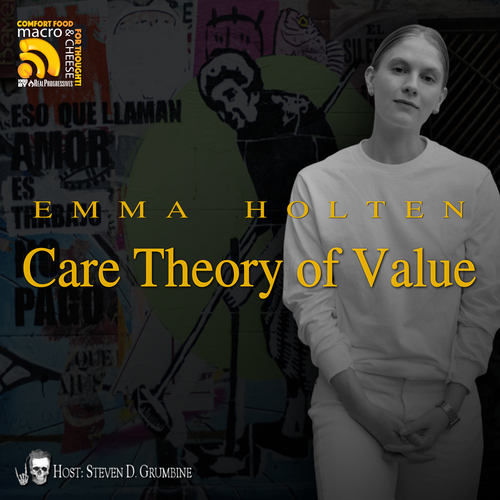
Episode 360 – Care Theory of Value with Emma Holten
FOLLOW THE SHOW
Political economist Emma Holten talks with Steve about how mainstream economics erases care work and social reproduction, even though all economic activity depends on them. Emma is author of Deficit: How Feminist Economics Can Change Our World.
Let’s face it, even “good” macro talk can fall into the trap of treating the economy like a tidy spreadsheet while real lives get crushed in the margins. To help us peer beneath the covers, Steve invited Emma Holten, a Copenhagen-based political economist to talk about her book Deficit: How Feminist Economics Can Change Our World. We often discuss deficits around here, but Emma is looking at a different kind. She reframes deficit as what societies rack up when they systematically undervalue care: the paid and unpaid labor (still disproportionately done by women) that keeps people healthy, capable, and alive.
Emma and Steve discuss the way mainstream economics has long treated the home, the body, and the mind as a black box, as if workers spring fully formed from the soil and arrive at the labor market already fed, healed, soothed, socialized, and ready to produce.
They talk about measurement and the way the GDP counts a $3,000 ambulance bill as added value instead of predatory extraction. They also look at power and social cohesion. Steve connects Emma’s thesis to MMT’s real-resources focus and the Job Guarantee as a way to fund socially necessary work that markets underprovide, while also admitting the hard question: even if policy is sound, capital and its political machinery never volunteer to be disarmed.
Emma Holten is a feminist activist and gender policy consultant. Since 2018, she has worked with feminist economics. In 2024 she published her first book “DEFICIT – On the value of care” in Danish. It is available in English, Swedish, Norwegian, German, Dutch, and Italian – and forthcoming in 6 other languages. It has won the Politiken Literature Prize, The Library Reader’s Prize, The Sara Danius Prize, The Sprout Prize and was shortlisted for the Montana Literature Award.
Steve Grumbine:
All right, folks, this is Steve with Macro N Cheese.
Folks, we talk frequently in very, very nondescript, macro kind of ways about economics. Sometimes we just look at aggregates and impersonal without thinking about the people that it encompasses.
Think about how many people talk about the net financial assets of the private sector. What about stratification? If the billionaires have all the money and the little people run around, what does that do to us? I mean, think about it.
It’s a nondescript metric that doesn’t really say much of anything.
And so frequently, people, when they’re talking about economics, they skip whose interests are at play, who is getting harmed, who’s getting bypassed, who is having harm done to them. And we’ve talked to many, many female economists. Some of them are really in our wheelhouse, like Pavlina Tcherneva, who talks about the Job Guarantee.
And we’ve talked to Stephanie Kelton, and we’ve talked to many, many others. Yeva Nersisyan, who comes on frequently. But we’re opening up the door to a new voice, a new name.
Some of you may have heard of her, others maybe not. I am fascinated by her book. Her book is called Deficit. No, it’s not The Deficit Myth which Stephanie
wrote. It’s Deficit: How Feminist Economics Can Change Our World. Her name is Emma Holten, and Emma is a political economist. And her book that we’re going to be discussing today is, I think, a real eye-opener.
So with that, Emma, welcome to the show, and thank you so much for joining me today.
Emma Holten:
Thank you so much for having me.
Steve Grumbine:
Absolutely. When I saw your book out there, it was weird.
I stumbled onto it, I found it and I read it, and then I sent it to a bunch of the people on my team and was like, “This is really good. What do you guys think?” And everybody’s like, “Yeah, bring her on. This is fantastic. I love this.”
And just to give a quick spoiler, I think the thing that I like the most about it, aside from the fact that it was just good, plain economics, was the fact that someone like my wife, who is of absolutely zero interest in the things that I talk about on this podcast, actually listened to the audiobook of this, and she was like, “Okay, I’ll give you that one. That was good.” And I was like, “Wow. Okay.” So it really is a fascinating book.
I love the way you laced in kind of pop culture and things that will make people like my wife pay attention and find themselves in the words. But this is something I think is really important.
We talked a little bit offline about the fact that sometimes an indirect association between why feminist economics matters to a man or to society as a whole. I think people just think, oh, that’s feminism. That that’s just another, “I am woman. Hear me roar.”
You know, all the other tropes that are kind of soup du jour today, I found it to be fascinating, and I found it to be really important, and it really goes along with a lot of the work that we’re trying to do here. So I want to let you introduce yourself, first off, Emma, and then I want you to tell us a little bit about the book.
Emma Holten:
Sure, yeah. Thanks again for having me on. And I know I got you up a little early. I’m in Copenhagen, so thank you so much for that.
The reasons that what I work with is called feminist economics is because we are interested in the parts of the economy where women have traditionally been overrepresented. And when you look historically and still today, what women tend to do is keep people healthy, happy, and alive.
So both at home for no pay, they spend much more time with children, with the elderly, with the sick, to take care of husbands, making food, all that kind of stuff. But they also, in their paid work, tend to be overrepresented in nursing, in elder care, in places where you take care of the body and the mind.
So we’re interested in those parts of the economy. Like, are there enough resources there? Who’s doing this work and what’s the meaning of it?
And what I track in my book is that from the very beginning of economics, and I know you’ve been interested in this as well, from the [Age of] Enlightenment on, from Hobbes, Locke, Adam Smith, all these guys, there is a movement where the economic individual is kind of isolated. We look at the economic agent, and what falls out of the equation is what does it take to make a person and maintain a person?
What do we need to be able to go to work and produce and consume and whatever? And what I show is that the home and the body and the mind becomes a little bit of a black box in economics.
They just don’t spend that much time thinking about it.
And I show that they still, for all their beautiful mathematics and their beautiful models, the relationship between something like chemotherapy, children’s care, physical therapy, psychology, all these things that we need to maintain our bodies. It doesn’t really have that central of a place in economic theory.
And what I show is that means that when economic theory becomes as influential as it is now, those areas of the economy tend to be severely under prioritized, invisibilized. And that’s because they have very little value in the way that we talk about economics today.
So I think in a way, I’m trying to show why we have a vibe session, why it looks like we’re getting richer in a lot of indicators, but it just doesn’t feel that good.
Steve Grumbine:
Well, you nailed it. The title Deficit is perfect. At first I was like, what does she mean here? Where is she going with this?
In reality, though, it’s the things that we don’t value as profit that women have been traditionally lumped into.
I don’t know whether they gravitate toward it because this is just the way they are, or whether it’s the way society has decided this is what you’ll do. Because the hegemony that creates social relationships is so powerful. There’s so many things that we just assume are common sense that are just, “This is the way
it is. Of course that’s the way it is. What do you mean? How dare you question what is normal?”
And yet at the same time, it’s quite clear it’s not working for anybody. Well very few, I should say. It’s not anybody, because there are people that are winning hand over fist. But within this space, I felt a lot of guilt.
I’m not going to lie when I read this book, because I thought about it. You know, I have a child with special needs and I get to work remotely.
I’m a senior project manager in my real world, and my wife works as a paralegal. When she comes home, the kids latch onto her. They love me, but they love her. And it’s not like she’s off work and suddenly she gets a break.
It’s like she’s off work and now she’s back on work. She just punched back in. And I’m tired because I got up earlier than her per se, because I’m working right there from home. It’s real work.
I’m working right? But when she comes home, I’m like, “Oh, thank God, I can take a break now.” And. And I even realized how much of that. And you. You pounded that. It was really on time, but it really made me realize that she does so many uncompensated things in my life. Personally. It’s just anecdotal,
but when you extrapolate this out to a larger economic understanding, it really is eye-opening.
And I think you went to great pains and you were delicate in how you put it out there, but it was straight truth. Can you talk about that?
Emma Holten:
Yeah. So I think, yeah, obviously this is an anecdote, but I think your life is very symptomatic and by far the most common one.
There is no single place on earth where men do more care work at home than women. So in Denmark, that has one of the most gender-equal statistics at home of the entire world, women still do an hour more a day.
And you know, you can count that up by 365 and it ends up being quite a lot of time in a year that is spent this way.
And I think that the issue that I’m raising in this book is that I think many of us have maybe a visceral or a subconscious sense that this is going on. But what happens when we use economic tools to talk about this work is that economic tools to measure value tends to be market price.
They’ll use GDP and they’ll count prices and they’ll say this is economic activity.
Unpaid care work, as we call it, as what you just mentioned that your wife does quite a lot of, is right now seen still in most economic measures as unproductive work, meaning it is registered as free time. And I think we cannot call it the same as paid work, but I don’t think we can call it free time either.
It’s quite exhausting, difficult, complex work that is extremely physically and mentally demanding for the person who is doing it. And of course, something that takes time out of their ability to do paid work or be with friends or whatever.
And I think that thinking about this type of work and what it means for human beings’ ability to function in the economy and what they contribute to the economy has just not been an area that has gotten that much attention in economics. No one has really cared that much about it.
And I know now some economists are going to come out of the woodwork and say, “Oh, Claudia Goldin got the Nobel.” And I’ll say, “Yeah, and it’s about time.” Because it’s so clear that for an economy to function we need new labor power.
We need labor that is healthy, well-functioning, socially competent, productive, that is able to learn. And all of the time that goes into keeping people functioning.
It is just a gravely understudied part both of economics in the terms of what does it mean for the private sector, but also what does it mean for a functioning society?
And I think obviously MMT is not my specialty, but I think where feminist economics and MMT really can learn from each other is in the concept of focusing on real resources.
Steve Grumbine:
Yes.
Emma Holten:
Instead of the amount of money, we need to focus on real resources. And what I’m interested in in an economy is, are people getting healthier? Are they getting smarter? Are they living longer? Are they more capable?
And those types of questions are so rarely asked in economics because most models deal with human beings as just these human capital robots almost. There’s no conceptualization in a DSG model of something like chronic illness or mental health problems or having a disabled child.
These things just disappear. And what I’m trying to do in Deficit is to kind of show that economics is about our real lives.
It’s about how do we organize our time, what are we capable of doing?
And I think in some economic theory we’ve gotten lost in all these concepts of utility, welfare maximization, optimal processes, and they have removed our lens from real resources. Are we getting more capable as human beings to solve tasks?
And I think as soon as you lose sight of human capability and human well-being, you lose sight of what is the most important thing in an economy, which is social cohesion, the feeling of safety and the development of human faculties.
Steve Grumbine:
Now watch out. You just sat there and made common sense, real sense.
Emma Holten:
Oh, they’re going to put me in jail for that.
Steve Grumbine:
The hegemonic view of this is, well, where’s profit for capital? How does capital profit off this model of feel good? You’re just talking about feelings and feel good and…
But no, these are outcomes that we stop caring about. We stop focusing on if we ever did.
And I think the other thing that jumps out at me that’s screaming at me is when we say this is what an economy should do. It’s like, the interests of whom? Who are we talking about? Are we talking about all the billions of people on the planet Earth? Yes.
But if we’re talking about capitalism and capital, we got to look at who the ownership class is and who what their interests are. Because they’re not here to make our lives better. They’re here to make money and accumulate wealth.
So the idea of all these things butts headfirst into what I call, or Clara Mattei calls The Capital Order, which I think is a fundamental breaking point where we’re sitting there screaming out from down below, you know, “Hey guys, we’re not maximizing our lives.” I had a weird event- I’ll throw this at you just so we can tie it into the rest of it-where I think I woke up at 1:30 in the morning and my entire left side of my body was numb. And I mean numb.
Emma Holten:
Oh my goodness.
Steve Grumbine:
I’m talking about no feeling, no tingle, no nothing. And I felt like my mouth was drooping. I was scared to death. I was like, “Oh my goodness, I’m having a stroke.”
So I go upstairs, wake my wife up, I’m like, “Babe, I think I’m having a stroke.” And she’s “Call 9 1 1.” And so I’m like, okay. So I call 9 1 1 and by the time the ambulance gets there, I’m asymptomatic.
They’re gone, there’s no more symptoms. And they’re like, “Look, Mr. Grumbine, we think you should come with us. You know, we’ve come out here, I’m here, doesn’t matter to us. We think you should go.” So after them going back and forth, I said, “Okay, I’ll go.” Well, just the other day I got a bill, and that bill
was $3,000 after insurance.
And I’m like, how in the world am I going to pay this random $3,000 bill that just shows up out of nowhere? And you think about it, it’s like, that is the kind of stuff that people, we the people have to live with. That’s the real life.
So what do you, “Oh, you didn’t save up for a rainy day there, you know, what are you talking about? Blah, blah, you’re just a drag on the system, Mr. Unhealthy Guy. What were you not eating properly?”
It turns out that it was just a simple mix up because I was taking curcumin, which is for inflammatory things, and it was clashing with my blood pressure medicine.
And it was this weird little side effect that if you don’t pay attention to your over-the-counter supplements, it’s one of the ones that could happen. And I think to myself, that’s real world. My wife is sitting there, she was going to have to take care of the kids, it’s in the middle of the night.
We have school the next day, I got to jump in an ambulance, go to the hospital, all this and then we get a huge bill for what? And I think people are screaming about that. But to the capitalists, they’re like, “Hey man, there’s a cost for that ambulance. There’s a cost for these guys. We’re going to get every penny of that. Whether or not you had a stroke or not, you’re going to pay big money through this.”
And at the end of the day, what would have been the fallout, would have been those connective tissues? What would have impacted family and job and life and housing? And if I don’t have the money, what’s going to happen? I don’t know. What are your thoughts on that?
I mean, again, anecdotal, but in my opinion, you can’t look at things in isolation. They have a domino effect on all the other parts they touch.
Emma Holten:
Yeah.
I think one of the things I point towards in the book is that in many, many ways we have made the concept of value a bureaucratic question instead of a political question. So if you ask an economist, you know, if you pay those $3,000, that’s $3,000 contributed to GDP, that is value creation per se.
But is it really valuable or does it actually take value out of the economy? Are we losing something? And I think what has happened?
In economic language, there’s a fantastic book called Thinking Like an Economist that’s been very influential to me. That’s actually American by Elizabeth Pop Berman, and she describes how economic language in the ’70s and ’80s entered policy.
So what economists saw as being optimal was seen as functional and the best type of policy. And that meant that political priorities like equality, health, less poverty suddenly fell to the background.
And what was seen as value creating in a strictly economic sense became highly prioritized, which means commerce and increased market activity.
And what I show in my book is that the types of things that women historically have done, for example, being nurses or elder care, it’s just something that the market has struggled tremendously to understand what it does. And the economic science has struggled tremendously with it. The market in America has done something.
Obviously, you are in a very unique situation in your country where it is tremendously overpriced. But the money is not going to the overpriced nurses, they’re going to insurance companies and very, very wealthy hospital owners.
But in most other countries in the world, as in your country, you know, people who work in care are pretty severely underpaid. And I think what you’re saying with relationships is exactly right.
Because in most economic theory, we treat a service like healthcare exactly as we would treat any other product.
But a service like healthcare is quite unique compared to another product because it maintains your ability to be able to participate in the entire rest of the economy.
So that means that if you were to have had a stroke and those doctors and nurses saved your life, every single dollar that you would earn for the rest of your life would be a direct function of those people’s work. But obviously, that is not how we price things. We price things, you know, as products, as individual products.
And I think this is what I show in economic theory, is that the way that human beings relate to each other, the fact that one agent cannot exist without the other. I cannot exist if my mother had not given birth to me, if a midwife had not helped me survive my birth. All these people contribute to my existence.
And in most modern macroeconomic theory, that relationship between people is just made completely invisible. And that means that it is severely undervalued.
And in my opinion, in most economic debates, you mentioned it yourself on a program like this, healthcare or care work is not right front and center in most economic debates. Yet care work is the work that makes all other work possible. There would be no other work if it wasn’t for that.
It is the core of the economy, but it is treated as marginal in the economy. And that, in my opinion, has to do with the historic devaluation of the parts of the economy where women have been overrepresented.
And we are suffering for it because we’re creating economies where getting the care you need and having the time to care for others in a way that you want is simply not prioritized.
There’s not made any time for it. And it actually, when you look at the economy today, it seems like the less care there is, the richer we are. But I would say it’s the opposite.
Steve Grumbine:
You know what? Absolutely. Now I want to pivot back to my anecdotal story about the hospital momentarily.
Want to try and set up one of the other factors that come with that, based on your book. And I just felt like the idea of parental leave [right] What happens if I’m incapacitated? Now what does she do? Does she lose her job? What about her pay? What?
She now suddenly has the burden of the children, and she’s got the burden of maintaining her employment, and she’s got the burden of taking time away that a business is going to say, “Hey, wait a minute, that’s not profitable for us.” Maybe there is some legal thing for family medical leave in the United States. It’s not great, but it’s something.
But in general, though, parental leave, that’s a big deal.
I know for a fact that when my kids have an illness and I end up staying with them because I work from home, but she ends up being the one that takes them to and from the doctor’s appointments and has to leave work. There’s a lot of coordination that goes on in that.
And again, I hate to use my own anecdotes here, but I think they’re valuable to demonstrating what I think a lot of people go through and maybe don’t consider, maybe haven’t thought of through an economic lens. Anyway. Can you talk about parental leave and the imbalance of this care? To me, it seems like plantation mindedness.
Nothing that matters to us really matters to an employer because in the end, they’re there for profit. What are your thoughts on the parental leave element?
Emma Holten:
Yeah, I want to start by saying that I love that you bring in anecdotes. I think we have too few conversations about how the economy feels and how we experience it in our everyday lives.
I think that’s one of the things I really love about working with care work is that everyone does exactly what you do, which is tell me examples from their own lives. And I think these things teach us a lot about how the economy feels and works.
And I think when it comes to something like parental leave, you know, for many years, feminists and economists were the best of friends. We wanted the same thing. We wanted women in the labor market.
Feminists, of course, we wanted women in the labor market because we wanted women to make their own money as much as possible. So we were pushing them out of the home and trying to get their lives to look as much like men’s lives as possible.
That was our big goal because we wanted independence. We wanted women to not be enthralled with father’s income or their husband’s income, and we wanted more.
Yet economic gender equality and economists wanted women out because they wanted women in the productive part of the economy. They wanted them in offices, they wanted them in factories, et cetera.
But I think now some feminists are asking ourselves, how happy do these men really feel? Do we really want a feminism that is wedded to the idea of work as liberation and that has no critical stance toward work as liberation?
So I think now I’m much more tempted by a vision of society where men’s lives look more like women’s than the other way around, and where the understanding that every person who works has dependence, even if you don’t have children, you might have elderly parents, you might have a disabled brother who needs you, you might have a friend who has a depression. We all have lives outside of that demands something of us. And I think it’s so interesting.
A quote I have in the book is that Thomas Hobbes that I know you’ve mentioned before on the show, this Enlightenment thinker, he wrote, when he started theorizing that individuals in their natural state were competitive and dominant for power, he wrote that in his philosophy we should perceive as human beings as springing up of the earth like a mushroom with no dependence. And I think this is still how we look at the employee, at the citizen. We see them as an isolated figure, the economic agent we call it.
And I think this just invisibilizes so much of what it means to be a human.
So every time we enter the workplace, we are living a little bit of a lie because we are actually not disclosing all the people who are dependent on us, the care that they need and the care that we ourselves need.
And I think this is something that I spend quite a lot of time on in the book, is that I think one of the reasons that care is so invisible is that in Western culture, the mere fact of having a body with needs or people with needs around you is perceived as emotional, unprofessional, feminized, as not something that successful people have. So we hide away bodily needs, care needs.
And I think that this is a very strong current in Western culture, that the professional and intellectual person is a person that almost deny that they have a body. And that means that we hide away care and we create workplaces that in many, many ways are incredibly hostile to human needs.
And of course, this is great news for a person running a company, right, that no one is talking about the fact that they have a daughter with cerebral palsy or a husband with depression, because then no boss has to deal with that stuff. They can just treat every person like a mushroom with no dependence.
And I think that what I really wanted to reintroduce into the conversation around the economy is our interrelatedness. And…
Steve Grumbine:
Are you going to bring up mycelium?
Emma Holten:
But that’s the thing. Even mushrooms need each other. And I think that Hobbes was even wrong about that.
And I think what bugs me is that, you know, one thing is what a profit-seeking capitalist would want. I think in a way they’re quite upfront with what they want. They want to earn money. That’s what that is.
What bugs me is when the science of economics, the science that is, you know, the king of all sciences, that gets to have much more influence in policy than all other sciences combined, when they then, in their methodology, in their way of working, enter into the same type of view of the human being as isolated as a mushroom with no dependence, then we get in trouble because then the science that is supposed to scrutinize the human condition and the economy and show it for what it is, give us clear answers to how our lives are looking, then that science is failing us because it is adopting the language of the capitalist and masking it in some ways as a scientific view of the human being.
Steve Grumbine:
You know, I’m. I’m a bit of a mycology geek and I really enjoyed reading about the mushroom. And one of the most fascinating aspects-
If you have ever looked at a petri dish where you’ve dropped spores on it and you’ve watched the mycelium grow in the agar, and you watch how the ropes get thrown, these ropes, these mycelium-based ropes, these communication paths, and then those generate pins, little pins for the mushrooms. And those pins are what we see. Those are the fruit, so to speak, that we all think of as a mushroom.
But if you’ve ever taken a shovel into the ground and turned over the soil where there was a mushroom, you will see a network of millions of little ropes that are the mycelium beneath the surface connecting all the mushrooms.
And so your thinking on this was absolutely so powerful to me because this to me is one of the metaphors that I use when I think about society and labor and we as people and solidarity and so forth. I consider the answer to so many of our problems.
Viewing the world through the lens of fungi and the world of fungi and how those communication paths is neural networks beneath the ground that are out of sight, out of mind, but we could never survive without. I think that is so important. It’s the unseen in your book.
Your entire thesis, behind your book is about all the unseen labor that goes in to support that fruit at the top.
Emma Holten:
Exactly.
Steve Grumbine:
The thing anybody pays attention to is the fruit. But the mycelium below, that’s it. That is where the fruit comes from. That fruit will die, it’ll get picked, somebody will eat it, whatever.
But at the end of the day, the mycelium stays there. And when the conditions are right, it’ll produce more pins, it’ll produce more fruit from that mycelium. I just, I thought it was amazing.
I really love that you incorporated that into your book.
Emma Holten:
Thank you so much. I think this is so useful because Western culture is such a broad concept, but I think all cultures are very, very influenced by American culture.
And I would say Northern Europe, where I’m from, are very much. And I think we very much have an individualistic ideal. Right? We are born and we grow up thinking I can become a self-made whatever.
We look at ourselves as having complete, perfect agency in our lives. We’ll say, “Oh, I choose this education, I choose this job.” We want this idea of ourselves as independent of others and it gives us a sense of power.
And we live in a culture that fetishizes the idea of the self-made billionaire and the entrepreneur and these people who are not dependent on anybody. And I think we tend to invisibilize dependency. I think that’s why so many of us have difficult relationships to our mothers, right? That we [yeah] it is difficult to face the fact that you are so dependent on another person.
But I think for anyone thinking about the economy, whether you work in Bitcoin or MMT or whatever you’re doing, if you’re studying car factories, think about your dependency on other human beings of the paid and unpaid people who are the reason that you have learned to eat, learned to speak, learned to walk, learned to work in a group, learned to play football, all these types of things that make up who you are.
Suddenly you will get a transformed vision of the interconnectedness of human beings and you will see very clearly that there is no such thing as an economic agent. There is a system of relationships.
And what has happened in the way that we’ve structured our economy is that we have completely neglected that taking care of others is a skill, it is an infrastructure, it is an institution.
And if it is not nurtured, if it is not taken care of, if there aren’t the close relationships that makes people feel good, then they won’t be able to do much at all.
Intermission:
You are listening to Macro N Cheese, a podcast by Real Progressives. We are a 501c3 nonprofit organization. All donations are tax deductible. Please consider becoming a monthly donor on Patreon, Substack, or our website, realprogressives.org. Now back to the podcast.
Emma Holten:
There was such an interesting study in the UK last year that showed that in small UK towns where what they call the High Street, there used to be like a High Street in every town that would have different stores.
But now many of the High Streets have completely closed down and been replaced by a more American setup with these big box stores outside town right, where you go by car. And you know, most economists would say, you know, if it’s cheaper, if you’re getting the products cheaper, we’ve increased your welfare.
You’re able to buy things you couldn’t before.
But what they showed was that there was a direct relationship between living in a city or a small town that had lost its stores and voting for extremely right-wing parties. So feeling left behind, frustrated, invisible in politics and left, yeah, invisible.
And I think that shows that even the people who were not wealthy who had actually gotten things cheaper, they did not feel that they had, you know, gotten a leg up. They felt that they had lost something.
And what the research showed was that was because those High Streets created incredibly important social relationships, dignified community relationships, a sense of belonging that meant much more to people than you could actually understand from purely economic calculation.
Steve Grumbine:
You know, we have a lot of technocrats and autocrats that are just sort of wrapped around zeros and ones blocking and tackling, black and white. Is it profitable? Is it not? And outcomes are irrelevant as long as there’s a profit at the end, it’s good. GDP went up, it’s good.
It doesn’t matter if it was all about cleaning up an oil spill or something like that. It’s just, it’s good, it’s economic activity, it’s good.
And so therefore, regardless of whether or not the fabric of a local community has been shredded by Walmart coming and destroying all the small mom and pop shops, yeah, you got it cheaper, but how many people are now unemployed or underemployed as a result of it? And now you see everyone’s general gaze and their feelings towards one another become much more about me, myself and I. This is the neoliberal lens.
This is all about the self-made man, like you were saying. The self-made individual, I should say, because it’s now equal opportunity in terms of people becoming selfish.
Emma Holten:
Yeah, now we’re all getting screwed equally by gender.
Steve Grumbine:
Exactly.
So as we dig deeper into this, I guess one of the things that I want to throw at you to get into a little bit more meat and potatoes here is that, you know, you spoke about MMT and that that’s not your focus per se, but you see the value and the resources.
From my vantage point, I’m trying to incorporate all these things into a class-struggle lens as well as incorporating feminist economics into our thinking. And you know, our bag of tricks we’re trying to make holistic, all encompassing. And I know that’s challenging.
MMT is not the theory of everything, as they say, but one of the things that MMT talks about, the MMT theorists such as Bill Mitchell and Pavlina Tcherneva are a Federal Job Guarantee. Fadhel Kaboub as well. I mean, it’s core essential to the MMT framework is a Federal Job Guarantee.
And one of the things about a job guarantee is that it’s not competing with profit-seeking enterprises, it’s there to serve the local community.
So one of the thinking back then was well, what if I’m a stay-at-home mom with you know, a child with special needs, could that be compensated work? Maybe, right? What if I am an artist or guitar player? Is there a way to have a job guarantee there?
And Bill Mitchell came up with little things like, you know, hey, if you’re a surfer, what if we say hey, while you’re out there surfing, maybe you could pick up water samples for us. Or what if I am a guitar player and a musician, maybe you could teach the local kids how to read music or how to play guitar.
And in the case of care work and stuff like that, the job guarantee, I always thought of it as a democracy enhancer. The ability for people to come and say what really matters to them.
Create their own job, have it locally administered and federally funded because the currency issuer is the nation state, in this case the United States. But it’s different around the world because euro is done by the European Central bank and so forth.
But there is a way of prioritizing and compensating these types of things. It’s just a matter of having the vision and the willingness to see the need and then execute it.
Now, I am a socialist, so I don’t believe that we’re going to be voting that into existence. I think capital has got institutions it serves. I think the ruling class is served by these arrangements. And I don’t know that they see a value in it.
I don’t know that they’re out to help us. I don’t think that they think about it like that.
I think if you go back to Sparta, they would throw the babies that were deformed or maybe were weak or small, they’d just throw them off the cliff.
The idea of eugenics and things like that going back to Nazi Germany. I mean Nuremberg trials, we got to see how little they prioritized, weakness and so forth. And they mocked and criminalized not being the perfect person. A lot of that still exists, a lot of that still crosses through employers’ minds.
Back to what you eloquently said about how, you know, employers don’t have to worry about if your kid has cerebral palsy, they don’t give a crap, they don’t give a shit. They are literally there to make money. I mean that was a lot there.
I don’t know if you can find a nugget, but I think it ties to what you were saying.
Emma Holten:
Yeah, I think so. Obviously, one of the interesting things is I grew up in Denmark, where we have a lot of what you’re describing there.
For example, in Denmark, if you have a child with like a developmental disability or a physical disability, it is possible to get support from the state to take care of that child at home.
And I think some neoclassical economists, they call an economy like the Danish one, they call us a bumblebee because they’re like, we don’t know how this economy flies, but it does because we shouldn’t be able to fly because we have such a generous state. We have such generous support for people who are unemployed.
It is getting hollowed out now and has been getting hollowed out since the introduction of DSGE modeling in the 1990s. But it is still standing thanks to a lot of hardcore fighting.
But what an economy like the Danish one shows is that actually public investment in care increases the capabilities of the society. Denmark is an incredibly successful economy, despite using a lot of money on care.
And I think this is the fundamental thing that becomes very difficult when we have these discussions on MMT.
It is that in most neoclassical economic theory or neoliberal economic theory, as some call it, they would say, you know, “The public sector takes value out of the economy. They do not produce anything of value.”
I have a quote from the former head of the Bank of England, [Mark] Carney, who’s now the Canadian Prime Minister, who said that “We shouldn’t be working on how much value the public sector is creating. We should be looking at how much value it’s taking away from the productive economy.”
And I think this is something that really changes and I think in the ’70s and ’80s, and I think this is where MMT and feminist economics can really meet. Because we’re saying there’s no problem taking on debt or investing in public services if it increases the real resources in society.
So that can of course mean factories or whatever, but it could also mean care, education, sick leave, stuff that makes it possible for people to work in a more creative and flexible way. And I think that is something that we’ve lost sight of the fact that the state can actually be a great support for a dynamic economy.
And I find it very destructive to look at the state as something that is in opposition to innovation, for example, or something that is in opposition to efficiency. Because what my country shows is that is not the case at all. We have incredibly incredible…
And I’ve lived in America, as you can probably hear from my accent, for over a year, where I became sick. It’s not only watching television. That’s the reason for this. And I was just stunned by the inefficiency of your system.
Like, it was just, [awful] so inefficient and so expensive.
And I think this is because, and I describe this in the book, there are some fundamental ideas in economics which is that competition increases efficiency, that having an open market where you can shop for different services is the most efficient way of, you know, allocating resources.
And even though you can find many economists saying, “Yeah, this is what the theory says, but we know it’s not true in practice,” it becomes true in politics.
And I think this is what’s so interesting about economic theories, power and politics, is that even these ideas that you know on Twitter or whatever, an economist will say, “Oh no, we don’t believe that competition is always best.” That is still the idea that gets to dominate policy.
And I think what I really wanted to do in Deficit was to get people who work as nurses or as paralegals or whatever, as your wife does, or who are stay-at-home moms. I wanted them to get a chance to advocate for their economic value and for their contribution and understand the system that they’re living under.
Because economics is the most powerful language in politics. It shapes absolutely every second of our lives. And there are substantial parts of what is the most important to us that are getting so, so neglected.
And I think paradoxically, this incredible prioritization of the private sector and looking at that as the only place that can give people what they need, it is creating incredibly undynamic lagging economies where people mentally feel terrible, where they don’t have time to take care of their children, where their children are given a screen every day because their mother has to work constantly or their father has to be away to do something, whatever. And I think the fundamental question is here, who gets to decide what is valuable?
And for a long time we have let GDP or productivity measures or questions of efficiency or optimality decide what was valuable.
And I think where I can meet with many people who are also engaged with MMT is that the question of value should be a fundamentally democratic question. It is not something we can ask a bureaucrat or an economist. It is something that we must ask the population.
But big parties all over the world, Democrats and Republicans in Denmark and Europe, the big center left and center right parties, they have completely bureaucratized the question of value. They’re all the same. They’re all saying the same, “We want a healthy economy.” But what a healthy economy means is a thousand things.
And when they use a language that devalues care, we get cold, individualized atomized societies.
And I think the democratic crisis that we’re seeing now, the polarization, the mental health crisis, the care crisis, also the fertility crisis as they now call it, which I would call a trust or family crisis, all these things are results of not prioritizing that people need to feel safe and good in order to function. And then they try to say, “Oh, abundance-ashmundance.” But a factory will not fix this.
Long term investment in social relationships, in mental and physical wellbeing will fix this. And what we’ve seen historically is that is a public and collective investment.
It is not something that can be solved by making these things more accessible as a product. It is about investing in the capabilities of an entire nation.
Steve Grumbine:
A couple things here. Jason Hickel, I always jokingly call him my spirit animal.
Emma Holten:
Oh, I’m a big fan of his, yeah.
Steve Grumbine:
He’s such a great guy. He’s also not a coward, which is why I really love him.
He says the tough parts out loud, but he talks about universal basic services, de-commodifying our existence.
Really, really powerful stuff, informed political economy while simultaneously MMT-oriented, which he wasn’t always that way, which was really a beautiful thing, seeing kind of degrowth and social well-being baked into his analysis completely. Like really ripping the band aid off of any of these fraudulent macro lenses that cause us to see, “Hey, it’s a non-governmental surplus.”
Guess what, billionaires are non-governmental and they got all the surplus. Stop telling me these descriptions of macro elements that are idiotic, quite frankly.
But I just recently interviewed Vijay Prashad, who’s a Marxist thinker as well. We talked about Antonio Gramsci.
And one of the things that was really important about that conversation, because this is where my brain has been at lately.
I mean, years and years and years we’ve been doing this thing here for I think we’re in the 360 episodes now of weekly, never missing a week episodes of this podcast. And it’s been seven years of hard-fought volunteer work to put this thing together.
And we started out being big Bernie supporters and Bernie Sanders is kind of a real motivating factor and he’s really not been anymore. He’s really fallen out of our lens. And part of that is because of the willingness to sidle up to those soulless centrist groups.
You can tell me he’s playing 40-dimensional checkers or chess. You can tell me he’s got some grand strategy, whatever. But in the end it’s always capitulating to narratives that don’t serve us.
It’s always, “Hey Hillary.” Well Hillary’s out there saying the little people are fools for watching TikTok and believing that there was a genocide in Gaza.
This represents Democratic Party in the United States. It’s disgusting.
And when I think about what Vijay was bringing up, we’re talking about cultural hegemony and how things that we just believe and the power that the state has over institutions and the institutions serving whoever that elite ruling class is. And in the case of the United States, it’s these billionaire donors that really, really have massive control over what the state does.
And there was a Gilens and Page Princeton study back in 2014 that showed that public opinion had precisely zero impact on public policy. Zero. I mean, we’re not talking about like 1 or 2%, we’re talking 0%, no perceptible impact on public policy.
So as I think about this stuff and I, you know, I want to be a basket of policies guy, I want to be like, “Hey, look at this great basket of policies we can do to make your life better and let politician ABC run on this, blah blah, blah.”
But in reality, you don’t have to go far back in time to realize that a lot of these great social thinkers, once they get into office, they become basically bureaucrats controlling the capitalists’ ledger, nothing more. They cease to be what they once were.
They start justifying the capital order, they start justifying the way things are and they play tepid and they’re fearful and they don’t make the bold moves that people need.
I’m curious, economists like to say, and I know this because I talk to them all the time, “Hey Steve, I’m just an economist, I can’t tell you how to get there. I just tell you what I think would be good policy.” I’m bridging the gap between, well, how do we get there?
Dude, I love what you’re saying, but how do we get there? How do we make that happen?
And Vijay spoke extensively about Gramsci and the hegemony of thought, the ideas that emanate from the ruling class that define how we view and the kind of that Margaret Thatcherism of “There is no alternative.” I know you’re a political economist, which I think is great because that allows you to talk politically here.
What are your thoughts on that hegemonic role and the fact that most people just accept whatever is thrown at them as well. This is the acceptable parameters from which I can operate. I can’t think beyond that this is the narrow 1 degree of world that I can see.
Emma Holten:
I think it’s quite interesting because this book came out in Danish in 2024 and it’s come out now in eight different languages and then coming out in some more. And I’ve had the privilege of traveling around Europe speaking to people about this book. Now I’m speaking to you.
And obviously many of the people who are interested in my book are not by nature political people.
We’re talking people who work in elder care, stay at home moms, nurses, people who work in childcare, people who are just like working-class women basically are many of my main readers. And they’re the readers that I’m the most proud of.
And what I realize when I talk to them is that they hold political positions that are quite radical.
And it’s been very heartening and interesting to realize that even people who identify as more right-wing or more left-wing, when we talk about something like the value of family, the value of mental health, the value of local community, suddenly we see eye-to-eye. Suddenly we meet. And I think that there are a lot of voters in America that I’m very interested in.
And some of them are the ones who wanted to vote for Bernie but ended up voting for Trump.
And I think it is very important to see some of those people, many of them also voted for Barack Obama, to see them as protest votes, as anti-bureaucratic, drain-the-swamp votes.
And I think sometimes when you’re up in the ivory tower or whatever, you’ll look at Bernie and you’ll look at Trump and you’ll say, “Oh, these people are opposite.” I don’t think that’s true. I think in some ways they are speaking to a rage against the de-ideologization of politics.
And I think that one of the reasons that I find care to be such an important organizing principle for where we are politically now is because it is close to people’s lived experience and it is a place where we can meet across political differences. And right now what is happening is that conservatives are running with the family agenda.
They are running with community in mind, with local government in mind, with the idea of prioritizing closeness. And in my opinion, progressives, we are losing that fight a little.
Steve Grumbine:
Oh yeah.
Emma Holten:
And I think that what I wanted to do with Deficit was to have a progressive vision for we can talk about the value of family without saying that the father should be the head of the household. We can talk about the value of family without saying that women belong in the home.
We have to have a progressive vision for people who prioritize family politics. And I think it really surprises me.
And I think this also has to do with, in some ways, the male dominance in left-wing circles that we so rarely talk about. What does it mean to have children? How does that impact your life? It is the most deciding factor in most people’s lives.
It is something that impacts absolutely every part of the economy. Yet we talk about it as a fringe issue.
And I think that is why I wanted to talk about care, because I found it to be a great way to start talking about politics with people who conceive of themselves as apolitical. But when I say to them, you know what, the amount of time you have with your child, that is an economic issue.
The school she’s going to, that’s an economic issue. Your disabled brother, that’s an economic issue. We can talk about that in terms of macroeconomics.
We can talk about it in terms of priority, in times of terms of ideology. And suddenly it becomes like a bottle opener. Everything is streaming out. You heard it yourself.
Suddenly your personal anecdote about living in your current economic situation becomes concrete. It makes macroeconomics concrete to just a working woman.
And I think that this is a place where we can organize around, where we can bring macroeconomics into the everyday life and the home.
And I think what I’ve experienced talking about Deficit with people in southern Italy, in northern Finland, you know, across the European continent, I’m finding that actually most people are just frustrated with not being able to see and care for the people that they love in the way that they want. And the way it’s been framed now is as if that is an individual issue. And I’m telling them, this is a political issue. We can organize around this.
Steve Grumbine:
Yes.
Emma Holten:
And I think as soon as you start thinking about it like that, you make politics concrete. And I think that is so important for our current moment.
And I think it is 100% possible to mobilize people from across the spectrum in talking about care and of feeling healthy, happy and alive.
Steve Grumbine:
I love that. I want to say I was invited back in 2015 to a rally in Washington, D.C. to be a speaker. And I was like, “Sure, yeah, I’ll do it.”
So I go out there, I have my Real Progressives, black hoodie with the fist in the air and the star and all the stuff. And I show up and there’s all these weird red hats around me. I’m like, what in the world is going on?
And they’re yelling at me and they’re pointing at me and I’m like, what? I’m at a MAGA rally. I was invited to speak at a MAGA rally. I’m like, what am I doing at a MAGA rally? And so I’m like, I’m like, what do I do?
And I’m like, you know what, I have a message. So I got up on the, this, the platform and they’re all, you could see them all, huh? And because I’m bold, I’ve got the RP, you know, stuff on.
And I said, “I bet you’re wondering why a progressive is standing here talking to you.” And they’re all laughing and all. And I was able to mold an MMT message based on care based because, you know, I have a son that’s autistic.
So I’m looking at this woman, I see she’s got a son that’s she’s holding a sign about autism. And I said, “You know, we can do something about that.
If you understand the way the currency works and you understand that the government is the currency issuer, there’s nothing standing in the way of us taking care of children with autism, making sure parents aren’t like at their wits end, dealing with this really all-consuming situation.” And somebody else brought up veterans you guys don’t want to support. I’m like, let’s stop making more veterans.
But the veterans that we have made, why don’t we provide them and every human being full access to health care? We can do that, we can afford that. And it isn’t your tax dollar. It isn’t. And I’m not even joking.
When I got off the stage, it was an extremely left-wing message that I was presenting. They were hugging me. They were literally like, “Oh, thank you so much. That was so blah, blah, blah. I didn’t realize blah, blah, blah.”
And I don’t know if I changed a soul that day.
Emma Holten:
It’s a conflicting feeling, right?
Steve Grumbine:
It is a conflicting feeling to know that they heard what I had to say. And see, this is the delta between knowledge and awakenings. We always talk about how important it is to educate.
But there’s something that happens when you’ve internalized information and it goes from just, you know, a good thing for playing some sort of a trivia game where you can answer the questions, right?
To actually integrating it into your analysis and integrating it into your life and your politics and how you view the world with that little anecdote. I would like to give you an opportunity to respond to that and take us out.
Emma Holten:
I think doing something like that is very difficult. I’ve often found myself in situation where I was supported by a big group of, you know, tradwives here in Denmark.
But I think there is simply no way we will transform society if we cannot enter into those conversations. And of course that does not mean supporting the entire MAGA agenda or converting to conservatism.
But it does mean that I think what conservatism and neo-fascism is doing is that it serves people a very clear vision for how life could be different. And they’re very clear about how life could look. Are they fighting for it? Will they achieve it? Does it matter? I don’t think they will.
But what I’m trying to do with care and focusing on care as a political organizing center is to say I am interested in some very basic ways to improve your quality of life, to improve your relationships to the people that you love and your relationship with yourself. And that is a political issue that we have political tools to better. One of them is monetary policy. Another is labor organizing.
A third is education and health care. There are so many things that we could be doing better. We have so much research that could help guide us in that direction.
And I think with that message we could organize in a way that would make politics seem close to real life. And I think that’s what’s happened, that the idea that actually politicians are working for your life is not present for a lot of people.
And that’s not because they’re stupid, because they are completely right. Many politicians have not been working to better their quality of life.
But in order to do that, in order to get engaged in that conversation, they need a language to understand how they’re being wronged right now, what is going on in the system. And it was so important to me writing the book that it was non-academic, that it was in an accessible language.
And it’s been such a joy to see that it’s being given to, you know, grandmothers who didn’t finish ninth grade.
And I think that the more we can bring politics close to our bodies and minds and our well-being, the more we’ll get a sense that actually economics, it’s just about our lives.
Steve Grumbine:
You have made me a believer. I was already a believer, but you really, really locked me in.
This ability to make something that seems like, “Hey, this is just for women,” be so universally important, so absolutely vital to everyone being able to move forward. And it benefits men. Guys, get your head out of your rump, man.
Emma Holten:
Yeah, men are not feeling mentally that well either is my impression.
Steve Grumbine:
That’s right. We’re not. And 100%, I loved your book. I really did. And I think you nailed it when you said that it wasn’t all jargon-y and academic-y.
It had elements of that. There’s no way that an academic would read it and say, “Oh, this isn’t it.” It definitely fits that bucket. But you used great analogies and great references.
And I recommend the book Deficit to anybody that listens to this podcast. Go out and get it. It’s really worth your time. Emma, I want to thank you for being with me today. Where can we find more of your work?
Emma Holten:
I have started writing a little bit again, but not in English yet. I’m on Instagram for now there you can follow my work and that LinkedIn. Actually, I’m an old woman, but I’m very hopeless about social media.
I find it to be such a downer. But for now, Deficit and Instagram and LinkedIn. That’s where I’m at.
Steve Grumbine:
Excellent. All right, well, with that I’m going to go ahead and take us out. Emma, thank you so much for being with me today. I appreciate it.
Emma Holten:
Thank you so much.
Steve Grumbine:
Folks, my name’s Steve Grumbine. I am the host of Macro N Cheese and the founder of the nonprofit Real Progressives that supports this podcast. Please consider supporting us.
We are a very, very small group of volunteers that try and punch past our weight class. We’re trying to do big things with small amounts of money and small amounts of volunteers. If you consider the work we’re doing worth supporting.
We’re a nonprofit. You can donate to us and it’s tax deductible. And it is that time of the year, right around Christmas time when this podcast will be coming out.
So please consider becoming a donor. You can do a one-time donation. You can do a monthly sustainer. We need the help.
So you can go to our website realprogressives.org and in there is a link for donations. You can also go to Substack where we put our content out and become a donor there.
And you can also go to patreon.com/realprogressives and become a monthly donor. We will be having Emma’s book in our RP bookshelf which is in our website as well.
Please when you go to our website and you look at the podcast, just know that we have extras in there. We put hyperlinks in the curated transcripts that we do for each episode. So there’s a lot more to this podcast than just the audio.
So check it out. And also Tuesday evenings every week, we do what we call Macro N Chill. Macro N Chill is a webinar where we all get together.
We listen to the podcast in video format where you can read along with the words, and, you know, we talk about it as a community and we figure out what are the salient points, what are things that we can incorporate in our own lives, and we discuss and we disagree and we agree and. And it’s really nice you could come. We would love to have you there. It’s free.
Everything we do here, we don’t paywall anything because we just believe in the work that much. So that means we depend on your donation. So please consider becoming a donor.
And with that, on behalf of my guest, Emma Holten, myself, Steve Grumbine, the podcast Macro N Cheese, we are out of here.
End Credits:
Production, transcripts, graphics, sound engineering, extras, and show notes for Macro N Cheese are done by our volunteer team at Real Progressives, serving in solidarity with the working class since 2015. To become a donor please go to patreon.com/realprogressives, realprogressives.substack.com, or realprogressives.org.
Extras links are included in the transcript.
Photo of Emma by Claudia Vega
Background image for promo art by Ailén Possamay-What they call love is unpaid labour-Buenos Aires-2019
Related Podcast Episodes


Related Articles
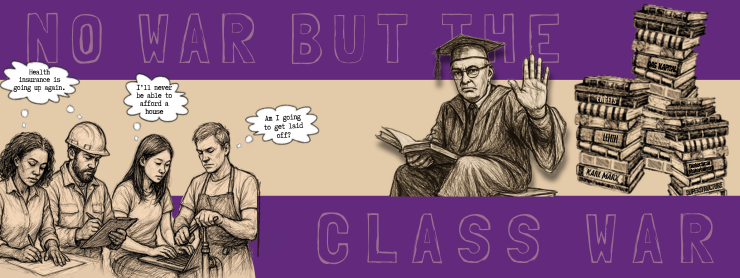
The High Intellectual Barrier to Socialist Consciousness

How to Make a Po’boy

Modern Monetary Theory Without Class Struggle is Just Accounting


Leave a Comment
You must be logged in to post a comment.