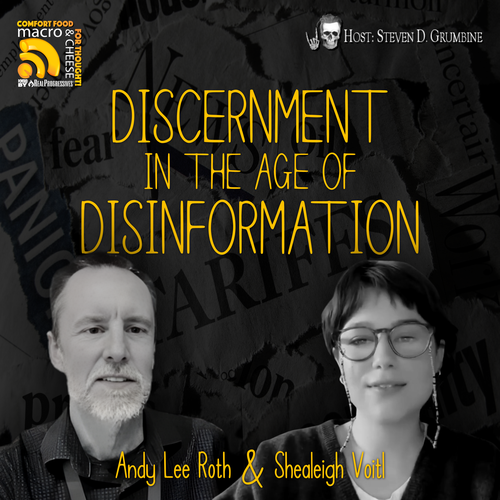
Episode 361 – Discernment in the Age of Disinformation with Andy Lee Roth & Shealeigh Voitl
FOLLOW THE SHOW
Steve talks to Shealeigh Voitl and Andy Lee Roth about their annual book, Project Censored’s State of the Free Press 2025, uncovering the year’s most vital news stories that corporate media ignored or distorted.
Shealeigh Voitl and Andy Lee Roth join Steve to talk about Project Censored’s State of the Free Press 2025. The book – an annual publication – compiles the year’s most important yet underreported or misreported news stories, which they’ve identified through a student-led research process.
Andy highlights the point that corporate news focuses on what went wrong today but ignores what goes wrong every day. “It’s the difference between dramatic events and systemic problems.”
The #1 underreported story is that of ICE soliciting private contractors to monitor social media for critics and assess their “proclivity to violence,” a move toward normalized surveillance that received little corporate media attention.
Steve and his guests also discuss broader themes, linking media patterns to cultural hegemony and manufacturing consent, where state and oligarchic interests align to shape public perception. Examples include coverage of Israel-Palestine, university crackdowns on pro-Palestinian speech, and the hiring of figures like Bari Weiss.
Andy Lee Roth is editor-at-large for Project Censored and its publishing imprint, The Censored Press. He is co-editor of Project’s State of the Free Press yearbook series, and a coauthor of The Media and Me: A Guide to Critical Media Literacy for Young People.
Shealeigh Voitl is Project Censored’s associate director. She helped develop the State of the Free Press 2024 teaching guide, the Project’s Beyond Fact-Checking: A Teaching Guide to the Power of News Frames, and The Project Censored Show’s forthcoming segment Frame-Check.
Find their work at https://www.projectcensored.org/
@ProjectCensored on X
Steve Grumbine:
All right, folks, this is Steve with Macro N Cheese. And today’s guests are returning guests Shealeigh Voitl and Andy Lee Roth of Project Censored. And we are going to be discussing the new release.
And this is a completely, let me just say this right up front, a completely new book.
Each one of their State of the Free Press books that they release is a completely researched, rewritten new book every year on the stories that were underreported, stories that were either underreported or poorly reported, and some of the various elements of those stories that really are important to keep in mind, but they tend to just get glossed over or ignored outright.
So real quickly, Shealeigh, and I’m going to embarrass her momentarily, but I didn’t realize this, but Shealeigh was a phenomenal singer, probably still is a phenomenal singer, but she was on Disney and she was on Ellen DeGeneres. And I’m sitting there watching this young spark plug singing away, and I was like, “Oh, my God, that’s her.”
And that was all in preparation for this interview today.
Even though I’ve spoken to her before, I didn’t realize it before, and my team laughed at me and they go, “Yeah, I went down that rabbit hole last time, Steve. You didn’t know?” I was like, “No, I’m an idiot. What can I say?”
But she has now moved on from that child singer fame to being Project Censored associate director. And she focuses in on Junk Food News and things like that.
So it’s going to be exciting to talk with Shealeigh today and also Andy Lee Roth and not to be confused with David Lee Roth. There’s my punchline for the day. And he is the editor-at-large for Project Censored and its publishing imprint, the Censored Press.
He is co-editor of Project Censored, State of the Free Press yearbook series, and Critical Media Literacy for Young People. I probably butchered that up. But I’m going to get us right into this. Both you guys, thank you so much for coming onto the show.
And let’s jump right into this. Really appreciate you being here.
Shealeigh Voitl:
Thanks so much for having us, Steve. It’s a pleasure to be back.
Andy Lee Roth:
Yeah, agreed.
Steve Grumbine:
Absolutely. All right, so we have a parallel universe where we have similar focus.
Although you guys go the extra mile of putting this stuff into a book, I wish we could do that.
We focus heavily on economic stories that are missed, that are underreported, that no one pays attention to, or if they do, they get it completely bastardized and wrong. You guys focus on a lot more than that. And I’m really grateful for you doing this.
But one of the stories that jumps out right up front is the ICE [Immigration and Customs Enforcement] story, the story of ICE. Because I think everybody was kind of buried in fear.
I know that friends of mine, people that are here working legally, that are legally in this country to work, terrified of what the Gestapo-like, tactics of this administration were and these stories. You know, there was a whole segment of the population that was cheering this on.
I mean, even Bernie Sanders came out and frigging patted Trump on the back saying, “I think Trump got it right,” which is just ridiculous. But you guys cover so many stories like this. Let’s just start there because I think a lot of people be very interested in hearing about that.
I want to get a first shot at why do you do the book? What is the point of this is the 50th anniversary of this book, which I think is fantastic.
But then I want to dive into the ICE story, because I think that’s really important. Go ahead, Shealeigh.
Shealeigh Voitl:
Yeah, absolutely. I’ll backtrack a little bit about your last question about why we do the book.
Every year we publish State of the Free Press, and Andy mentioned this briefly before we started recording, but it is a brand-new book every single year because there are so many underreported stories by the corporate media. Unfortunately, we see those same patterns of environmental stories, labor rights.
Now we’re seeing a lot of Big Tech stories, but every year they’re brand new.
We talk about junk food news, which is, you know, the sensationalized celebrity gossip that gets maybe favored by the corporate media over some of these stories that affect our daily lives.
We talk about media democracy in action, deja vu news, where we reflect on past censored stories and the coverage they’ve received in the years after. But ultimately, our mission is still to expand media literacy education, combat this modern media crisis, and champion independent journalism.
I think we’re living in a world now of news fatigue, where people are consuming news, maybe not processing it in the way that they should, and understanding it as something that could affect themselves and their loved ones and their communities. And I think, yeah, now it’s really easy to get into that space of burnout.
And also there are entire regions of the country that have little to no local reporting infrastructure. And so that’s also, you know, people are at a disadvantage in that way.
And censorship today, I think, looks less like a door slammed shut and more like a very square, slowly collapsing ecosystem. And that’s where, like, misinformation runs rampant. So I think those are all reasons why we continue to do the book.
And every year we have this list of censored stories. And it starts with a cohort of students.
This year was our 50th cohort of students, which includes more than 250 students from eight colleges and universities. And they work on what we call a validated independent news assignment alongside their faculty mentors.
And so they write a summary of a news story they identify as underreported by the corporate media. They search for news stories, and then they assess them for importance, timeliness, quality of sources, inadequate news coverage.
You know, sometimes these are stories that are covered by the corporate media, but they provide a very different angle than independent media. And then we vet those stories and assess if they’ve been covered by the corporate media.
Those stories are then shared with our judges to narrow them down. Project Censored interns will then research them again to see if anything has changed or developed.
And then finally, those stories are then resubmitted to our judges to determine the order. But you mentioned our top story this year. And Big Tech and Data Privacy were well represented on this year’s list. This was no exception.
This was our number one story that was based on reports by the Intercept and Common Dreams. And it talked about ICE soliciting social media surveillance contracts to identify critics.
So the reports explained that ICE planned to hire private contractors to, quote, “monitor” and locate negative social media discussion about the federal agency.
The call for proposals specified that for any social media content the contractors deemed hostile to ICE, the content creators proclivity to violence should be assessed using social and behavioral sciences and psychological profiles.
And Steve, you’re also probably not surprised that this was entirely absent at the time we reported on this story in the book from the corporate media. And this kind of surveillance is becoming more normalized.
And yeah, it’s scary, but I celebrate the independent journalists that refused to keep silent and that make sure that people knew what was happening on these platforms.
Andy Lee Roth:
[Andy] That story is a great one. You know, our judges upvoted that story as the most important story on this year’s report of important but underreported stories.
And I think that story is interesting to stepping back from the details, as Shealeigh’s described them, to notice, like what this is a story about, because this gives insight into the question you asked Steve to start us about why do this work? Right. Why invest a year digging stories and vetting them and looking for patterns of omission? And this is a story not about a single dramatic event.
This is a story about a kind of systemic social issue.
And what we know, what Shealeigh and I know from our work with the project and with our colleague Mickey Huff, the director, who’s the co-editor of this year’s volume, and what we know from looking back at 50 years of Project Censored story reports is that for corporate outlets, the news is typically about what went wrong today rather than what goes wrong every day. Right. It’s the difference between dramatic events and systemic problems.
And I’m virtually quoting there from one of Project Censored’s esteemed judges, Bob Hackett, in a book that he and a colleague published called the Missing News.
It’s several decades ago now, but the point about corporate news focusing on what went wrong today but ignoring what goes wrong every day is, I think, core to the alternative perspective that Project Censored aims to highlight and that many independent news outlets, like the ones whose work we celebrate in this year’s book, that they exemplify on a day-by-day basis.
Steve Grumbine:
So let me just ask, obviously you have students digging through this. What is the criteria that they’re given for finding these stories? What specifically is it just something of interest to them?
And then they go down the rabbit hole and use some sort of criteria you guys have set out for them to score it or how does that work?
Shealeigh Voitl:
Yeah, it’s a great question and one that I’m happy to answer because I did this assignment myself when I was in college. That’s how I became involved in the project.
But really, I mean, when I was a student, my professor explained the idea of what it means to find a censored story and gave us a bunch of news outlets. All of those, by the way, are available on Project Censored’s website, defined what an independent news outlet was, you know, reader supported.
And my story was about Raytheon sponsoring a teen math competition. I found it completely absent from the corporate news, but I felt it was really timely with the militarization of tech in general.
And really that’s what we look for. You know, timeliness, quality of sources, who are these journalists talking to? And ultimately inadequate news coverage.
And as I mentioned before too, some of these stories can be covered by the corporate media.
Some of these stories that we include on our website as a validated independent news story might have been covered in some way by the New York Times or the Washington Post or CNN or Fox News, but in a different way and from a different angle. And maybe they weren’t talking to community members. Maybe they were talking to only people that had, you know, bureaucratic statuses.
And so in that way it becomes eligible for our assignment.
And obviously too, it’s gratifying and also annoying, I think, you know, when you see a really great story and it’s wonderful when it gets picked up finally by the corporate media and then ultimately it gets disqualified from our list. But I find it so interesting what people gravitate toward.
We have one professor, Alison Butler, who teaches at the University of Massachusetts Amherst, and she has her students do these assignments in groups and focused on education.
And so some of the stories that these students are drawn to, I mean, I know personally I learned so much reviewing these stories and I’m someone who reads independent news often and I find that I’m constantly learning. But it is really interesting to see what people gravitate toward every year. For me, I was surprised at what I ultimately chose.
And I think that’s what’s really cool about the validated independent news assignment. It expands our idea of what censorship is and it allows students to explore beats and coverage that they may not be typically looking further into.
Steve Grumbine:
One of the things that I noticed when going through the book, and this for me is calcifying, this kind of centers things to me a little bit anyway.
It seems like almost all the stories that are really, really, really, really hosed up tend to be about things that involve a tightening of the police state more, you know, observing us, and invasions of privacy that they don’t let us see clearly, that they obscure. It’s always something punitive, it’s always something they’re doing to society.
And I come back to ICE and I think to myself, all the AI each step through this process, there is a tightening down of society through oligarch-driven platforms, through tactics used to intimidate and frighten people. What happened in Israel and the lies that made it out, but the truths that never escaped, but we had to find on TikTok.
I mean, it seems like no matter what angle you’re coming at this with, these stories seem to be really owning around, making us not realize that they are observing us, that they are attacking us, that they are making life more frightening for us. And I’m a huge believer in the term cultural hegemony, which Antonio Gramsci was really instrumental in synthesizing.
And I do believe that the state works collaboratively with oligarchs because I don’t believe we live in a democracy. And I don’t even believe that’s debatable at this point.
And so when you see what is there, like five major outlets maybe out there and owned by billionaires, and even like when you look at the Washington Post, a lot of writers left the Washington Post because Bezos declared that, “We’re a capitalist organization. We’re not going to be reporting these socialist things, we’re going to be reporting capitalist things and we’re capitalists.
So this is what we’re going to do.”
And so the more you look at the stories you did cover, not to mention the stories that didn’t make it in here, I see a synergy between a state that represents oligarch interests, the real story of fake democracy that people hold on to dear and eat like mother’s milk, slurp it up and just, “Thank you. Can I have another?” kind of thing. And in reality, nobody would vote for these things.
When you look at the types of things that they’re doing, nobody would vote for them with an honest, media-driven narrative that was focused on truth. And given the full story, very few, I should say. I mean, I’m sure there’s a sadistic, masochistic person out there that would.
But it is always these horror stories that are obscured.
I know that there’s a junk food element here, but I see a collaboration between state and oligarchy and I see the outcomes of those things being relative to manufacturing consent. What are your thoughts?
Andy Lee Roth:
Yeah, I’d love to jump in on that, Steve. Thank you. We could probably spend the rest of the hour talking about just the hairball of issues that you’ve identified there.
Your identification of them is crystal clear. The hairball is the challenges they pose for us.
That tightening down, as you’re describing it, we’re living in a period of cultural hegemony like never before, arguably. So Gramsci is definitely relevant here.
Shealeigh and I have reflected a lot about that in the past year in terms of thinking about narrative and framing.
And we actually put together a whole publication intended primarily for classroom teachers, but really open and available to anyone interested, called Beyond Fact Checking about the Power of News Frames and News Framing. And that guide is available on the Project Censored website at no charge. And it goes to what you’re talking about.
You know, when we talk about Gramsci and hegemony, we’re talking about power that is unchecked because of the consent of those who are governed by it. And so framing and official narratives are a key component of that.
And the other thing that we talk about that I think we’ve talked about in previous years, Censored Yearbooks, and Project Censored is written about elsewhere, is the idea of censorship by proxy.
So a lot of people in the United States think we don’t have a problem with censorship here because we have a First Amendment that protects freedom of the press. And that’s true.
But the protections in the First Amendment on freedom of the press are protections against what’s often called prior restraint by government entities. Right. And the First Amendment does not cover corporate censorship.
So, for instance, another colleague of ours, Avram Anderson, and I have done reporting on algorithmic driven censorship on platforms like YouTube and Facebook, where there have been class action lawsuits by Facebook content creators, especially LGBTQ Facebook content creators, bringing class action lawsuits against YouTube. And the courts consistently rule in favor of YouTube, saying, “YouTube isn’t constrained by the First Amendment, they’re a private entity.”
Steve Grumbine:
Mm. Wait, can I jump in real quick? I want to just say this.
What you just said is the exact words, not exact words, but really close to exact words for what the Florida federal court said when the DNC was sued for trying to rig the primary to Hillary and stealing it from Bernie. And they said, “They’re a private corporation. They have no responsibility whatsoever to the public.”
Andy Lee Roth:
And actually, [I was blown away] the year the independent journalists broke the DNC rigging story. And that was a top story in whatever year of the censored yearbook that was. I can’t recall the yearbook number.
And yeah, we had a quote in that report, again from independent journalists talking to DNC people. This is still a sore spot for me.
Years later, DNC lawyers basically saying if they wanted to go in the back room, cut the tips off some cigars and smoke and decide the candidate on their own, they could do that, it would be their legal right. Yeah. So in this case, I mean, I want to bring this back to the idea of narrative and framing.
And one of the things we talk about in the introduction to the book that Shealeigh, Mickey and I wrote is we quote author and activist Rebecca Solnit an essay about the climate crisis in her latest book, No Straight Road Takes You There, where Solnit says, every crisis is in part a storytelling crisis. Right. And we riff on that in the book’s introduction to talk about what are the crises in journalism.
But if we’re talking about cultural hegemony more generally, and this just tightening down, as you so aptly put it, like part of what we’re talking about, there are real crises, like physical crises, in terms of physical assaults on journalists and ICE showing up in communities and kidnapping people. Those are first order crises.
But then I think where Project Censored comes in and independent journalism comes in is at the level of we need better stories about those crises because the stories we’ve been telling and the stories that the corporate media have been telling for the entire duration of the project’s existence are inadequate to the task. They’re inadequate to the face of the problems, the face of the crises that we’re confronting. Right.
And so this is one place where I think Carl Jensen, who founded the Project at Sonoma State, it was college then, now Sonoma State University in California, had this novel definition of censorship that focused on its consequences. Right. I won’t read you the full Jensen definition of censorship, which Project Censored is still guided by today.
But the key point here for this purpose, when we’re talking about tightening down in hegemony, is that censorship prevents the public from fully knowing what’s happening in society.
So Carl was concerned not so much about what elites were trying to do when they censored stuff as to what the impact was on ordinary, everyday people when censorship occurs. Right.
And so the core idea there is that the free flow of information is a necessary condition for the public to protect itself, to protect itself from individuals and groups that threaten democracy.
And so a lot of the discourse that you’ll see around these issues, even if you look at, like, the op ed pages of the Post or the Times, are focused on kind of like, well, what do elites need to do to protect democracy? Jensen’s focus was really on, you know, empower people to protect themselves and to protect democracy themselves.
And the definition of censorship reflects that. Right? So I think you’re, you know, bullseye, hitting the nail right on the head when you talk about this tightening down.
And in some ways, you can read State of the Free Press 2026?? and look at the project’s 50-year history as an effort to say there are alternatives to that. It doesn’t have to be that way. Right?
The way that government officials and corporate spokespeople frame the world is a corporate or governmental official world view. And it’s a view, it’s not the view. Right? And there are alternatives.
There are alternatives to it, but those alternatives tend to be buried by the sheer deluge and the blinding spotlights of official government or corporate outlets. Right? And meanwhile, the work Shealeigh and I do, we’re in touch on a daily basis with people who work at these amazing small independent news outlets.
Right? Or people who host programs like Macro N Cheese, like you do.
And I believe fully we live in a kind of golden age of independent media and independent journalism, for sure. But it’s being drowned out by a 24/7 fire hose of junk food news and news that abuses the public’s trust in the free press.
And that’s what we’re battling.
Steve Grumbine:
Absolutely. Shealeigh, I want to read something from your book here and have you comment on it, because I think this is where your specialty lies.
And this is on page 118 for those of you who get the book. You’ll know where it is, but it says “…50 years of non-stop junk.
In a year when dystopian satire blurred uncomfortably with reality, junk food news wasn’t just a sideshow. It was the main event, distracting us”- And see, this is why this matters to me.
This particular segment really hit hard- “distracting us while real power was seized, rights were rolled back, and fascist policies found bureaucratic footing.
Shealeigh Voitl:
Yeah.
Steve Grumbine:
As Trump and Musk played tag team autocrats, the corporate press focused on clickbait scandals and celebrity sideshows, failing spectacularly to confront the magnitude of democratic backsliding.” And you go through a bunch of other stuff. But I think it’s really important because I see that as a system, right. I see not a, just sort of a randomness. I see that as a coordinated system. And you can see this when you look at Twitter, for example, X. And you can see the same garbage.
Insiders tweet relatively the same exact message at exactly the same time. Timestamps line up almost exactly.
And if you do a search on a keyword, you can see all of them in that hashtag search and see all of them literally say the exact same bullarky. Right? Just crap. Tell me a little bit about your view of how they use the junk food news to keep us from seeing the world as it is.
Shealeigh Voitl:
Yeah, I’ve been working on the Junk Food News for the past two to three years, I think, and I’m coming in as someone who does read and watch and listen to, you know, these entertainment stories and celebrity gossip.
And I think what’s really important about this chapter is not finger-wagging and scolding people for indulging in those things, but rather allowing them to understand and pointing them toward the fact that these stories are overrepresented in the media, while all of these other stories and, you know, these are used as sort of a distraction from what is happening all around us.
And there are many obvious explanations for that, given the corporate interests of the establishment press and what they have their hands in and what they don’t want you to see. I mean, great example of this. And I think I mentioned this the last time I was on your show.
Obviously, you mentioned already, like, Washington Post being owned by Jeff Bezos. So they’re probably not covering, you know, the Amazon workplace violations like some of the independent media.
And our top censored stories list this year actually reflects that. There was a story about Amazon surveilling and tracking their employees and their warehouses.
And so these are all of the kinds of things that we talk about.
But what’s special about the Junk Food News chapter is we sort of pair these celebrity stories with, you know, stories that are maybe related in some way that were neglected from the mainstream press.
And this year, my research in the chapter really focused on federal government and colleges and universities across the country censoring and punishing students that were engaging in pro-Palestinian activism. We talked about Tufts [University] grad student Razmena Ozturk, who was abducted by ICE agents on her way to dinner with friends.
She published an article a year prior that was critical of Tufts ties to Israel. And then she was detained in a facility in Louisiana for more than six weeks.
And the Independent Florida Alligator, which was the University of Florida’s student newspaper, broke a story that found that the university was collaborating with ICE to enforce immigration policies on campus, effectively selling out their students. And we talked about Trump terminating more than 4,700 student visas within the Student and Exchange Visitor Information System.
And many of these were challenged in subsequent lawsuits. And it forced the administration to temporarily reverse its actions. But the chilling effect, particularly for student journalists, persisted.
Intermission:
You are listening to Macro N Cheese, a podcast by Real Progressives. We are a 501c3 nonprofit organization. All donations are tax deductible. Please consider becoming a monthly donor on Patreon, Substack, or our website, realprogressives.org. Now back to the podcast.
Shealeigh Voitl:
But meanwhile, in the backdrop of all of that, you know, maybe these stories were getting minor coverage, certainly not as in depth and certainly not as critical in the way that, for instance, the Independent Florida Alligator was of the campus for collaborating with ICE.
But the backdrop of this was, you know, a pop culture moment, which was a supposed feud between Rachel Zegler and Gal Gadot, who starred in the Live action Snow White movie. Zegler said on X tweeted that she supported a free Palestine. And Variety claimed that it put her Israeli co-star Gadot in danger.
Variety framed Zegler’s support for the people of Palestine as controversial, as misguided, and Gadot’s advocacy exclusively for the Israeli hostages as noble.
And you know, this cements a narrative in people’s minds wherein pro-Palestinian activism is cast as disruptive, as career jeopardizing, and inherently anti-Semitic. But we know that this coverage encourages silence and it shapes cultural values. And I think that’s going back to your original question.
This kind of shaping undermines systemic progress and keeps us silent and scared.
But fortunately, you know, there are public figures like Zegler and I think that’s what’s cool about junk food news is there is something to be learned from this corporate coverage. Even when it’s inadequate, even when it’s focused maybe on the wrong thing.
There are figures like Zegler who refused to be silenced when it comes to voicing her support for Palestine.
And it also showed us that there were others that were less protected when advocating for Palestinian liberation, including the countless international students who faced these consequences, who were waiting in limbo for exercising their right to free speech.
And because of, you know, the corporate media focusing on these entertainment stories, celebrity gossip, junk food news, we may never know all of their stories. And so, yeah, I think that analysis is really important for everybody, not just people who are maybe interested in some of the junk.
But it’s really important to zoom out a little bit. Always, not just for junk.
Anything that you read, it is always really important to zoom out and think about what’s missing, what am I not hearing, what am I not being exposed to and why, you know, who owns this, who’s reporting on this, who is benefiting from this kind of coverage, this kind of angle being pushed? And yeah, all of those questions are really important to consider and not even just in junk food news.
Those are the kinds of challenging questions that we encourage readers to ask.
Steve Grumbine:
So let’s take a look in the book. I can’t say for sure. I do know I’m on page 204. Woohoo Grumbine in the book. But I do want to make mention the Bari Weiss hiring, right?
This is, in my opinion, seeing someone go to a traditional liberal outlet. Now, mind you, I’m not a liberal, I’m a leftist. And there is a distinction to be had there.
But when you look at Bari Weiss’s rise up into that area, we are seeing like the outright monopolization of the narrative with Zionists, it’s not even hidden.
But because going back to that Antonio Gramsci moment where these things, you know, represent a crisis of hegemony, we see that the establishment order is cracking in terms of people seeing through the veneer.
They’ve gone to the Wizard of Oz, they’ve pulled the curtain back and they see nothing but a little toadstool behind a screen and “Oh, wow, okay, we’ve got to change. We got to shift up, baby. We got to move this around.”
You know, we got Hillary Clinton out there saying “The only reason why kids care about Palestine is because they’re idiots and they’re brainwashed and they’ve been watching too much TikTok. And if they were only smart like me, they would be Zionist scum rooting for New York yuppies to friggin take over houses and people in Gaza.” Right?
You know, the ridiculousness.
But this seems to represent, you know, you got Larry Ellison buying TikTok, you’ve got, like I said, Bari Weiss being promoted up without crossing over from just reporting into something a little bit more salacious. What describes that? I mean, there is a real concerted effort at narrative control and it is not cheap.
I mean, to get that kind of stuff, you got to have some money to be able to make that kind of coordinated, collaborated messaging. Help me understand that.
Andy Lee Roth:
I’ll answer it: two levels. The first kind of general, almost said macro.
Steve Grumbine:
Appropriate.
Andy Lee Roth:
And it’s why Project Censored talks about the corporate media and not the mainstream media. And this was an argument that the project’s second director, Peter Phillips articulated.
And it represents something in terms of change in the media landscape within the lifespan of Project Censored as a media watchdog. Peter wrote a chapter, it’s actually posted on the Project Censored website if people want to read it in full detail.
But he wrote a chapter justifying the use of corporate media rather than mainstream media. And I’ll summarize the argument here by saying it’s a more descriptive term. Right? Mainstream media gets batted around in all kinds of ways.
And whether it reflects mainstream interests or not, it’s clear that corporate media reflect corporate interests and corporate worldviews. And those interests and views are of course tied up to some extent with governmental interests and views. Right?
So I think one thing you can see there when we see these kinds of acquisitions and partnerships and promotions and hirings is that’s part of a coherent and unofficially but consequentially organized set of power relationships. Second, getting more specific, Shealeigh’s been talking some about junk food news.
Its counterpart is “news abuse” which is a term that Peter Phillips developed to complement the analysis of junk food news. And the key concept of news abuse is unlike the junk food counterparts, news abuse stories address genuinely important issues.
But the coverage becomes abusive when the story is so spun that the main point of the story gets lost for most readers. And so every year, in addition to having a junk food news chapter in the yearbook, we have a news abuse chapter.
And this year’s chapter is written by John Collins of Weave News, an outstanding independent news outlet based out of New York. And Collins writes about Stefanik, Israel and antisemitism and the long shadow of news abuse. And this is a case study.
It’s been such a parade of madness coming out of the Trump White House this year.
But way back early this year, Elise Stefanik, a far-right MAGA cheerleader and supporter, was nominated by Trump to be the United States Ambassador to the United Nations. And John Collins does a kind of case study of the news coverage of that nomination and what happened with it.
Where the key point that he notes here now people can read the full analysis.
Collins is brilliant at dissecting news tropes and frames is that when it came to covering Stefanik’s out there views about my terms, not Collins out their views about Israel’s biblical rights and how those conflict with international law, the establishment press as well as the North County Public Radio, which is the NPR affiliate that had been covering Stefanik in her more local governmental capacities for years, they both were relatively silent on those matters. Right? So they buried the lead and therefore left the public less informed about what was actually happening.
They buried Stefanik’s attacks, her unfounded attacks on the UNRWA, the UN agency that’s provided essential services to Palestinian refugees ever since they were driven from their homes in 1947, ’48, they buried the lead on how Stefanik’s perspectives would shape the treatment of Palestinian refugees today.
And basically the coverage of her nomination defaulted to what Collins describes as the dominant ideologies of, in this case, the administration’s view on Israel, Palestine. So that’s documented in detail in the news abuse chapter by John Collins in this year’s book.
But I want to say, and Collins does a great job of this himself, of saying this is a case study, but the point of looking in detail at this nomination which failed, but it’s worth looking at anyway because it exemplifies so many things that are systemic and deeply patterned in terms of how US News coverage of US interests in US alliance with Israel, Israeli lobbying of American politicians, and ultimately the plight of Palestinian peoples are all subject to kind of distorted and misleading coverage in the establishment press.
Steve Grumbine:
I really appreciate the way you said that. What I am trying to wrap my head around is I don’t watch much television news at all. I don’t really watch any of what I would call…
I mean, you all may have a different name for it, but establishment news, whether it be FOX or CNN or MSNBC, I don’t really watch those ever.
But when I see the outcomes, because I see other people that do watch them, unfortunately, there is a pattern that I’ve noticed, and it’s on both, quote, unquote, “sides of the aisle.” I hate that because I think they’re all one big capitalist, lying group of people.
But not withstanding, I do notice that there’s like these inside jokes that the talking heads on these shows do. They reference “the common sense” and one of the keys, like, for example, “The rise in crime in the District of Columbia.”
And they’re all looking at each other with like, “You know what that means, right?” There’s all this innuendo. There’s like this kind of a “This is common sense. Of course, you know, it’s those Black people in there.
You know, it’s those gay people in there,” and they just sort of have those knowing exchanges with one another on camera that develops a kind of either A, it reinforces someone’s preexisting beliefs that’s watching it, or B, it makes someone who maybe doesn’t feel that way feel like in order to be part of this, I’ve got to shift how I feel. All these different outlets do it in different ways. But I am curious when you see the kind of, “Of course this is the truth.
Of course this is the narrative. Whatever would you think otherwise?” Kind of thing. Is that part of your ability to crack through the media literacy, to be able to see past those kinds of…
I consider that to be manufacturing consent.
Shealeigh Voitl:
Totally.
Steve Grumbine:
I consider that to be part of developing the monolith that watches Fox News or the monolith that watches MSNBC. And you could tell who’s a regular watcher because they are bought in hook, line and sinker.
Their worldview aligns almost as if they sat there, they unplugged their brain, they put it into a charger, and they just poured Fox News and they just poured MSNBC crap in it. And you could literally see. Because they spit it out at you as if it’s just of course, course this is the truth.
How do you all represent that Project Censored. I mean, whatever that dynamic is, however badly and poorly I explained it.
Shealeigh Voitl:
It’s a really valuable observation. And I think we treat it sort of as an issue of framing, a very condescending one too.
You know, when you’re kind of talked down to like that by the news or news figures or even Hillary Clinton when she said what she said about young people and TikTok learning about Israel, just so ridiculous. But I think recognize that as, you know, framing for a specific agenda, framing for a specific kind of news angle.
And I think that’s what’s interesting when we think about like, is the media more or less free than when we began in 1976?
Because, you know, many of the traditional protections remain in place and these digital platforms have perhaps made it easier for independent voices to publish.
But structurally, you know, consolidation of media, we now have to consider algorithmic filtering, surveillance capitalism, the erosion of local journalism have created these new forms of control and invisibility. And I think, you know, it’s really bleak to recognize that the so-called information age somehow now coexists with less-informed communities.
And that’s not necessarily their fault. So the challenge now is not only uncovering censored stories, but helping people navigate a media environment that is often really noisy.
And then the truth kind of feels really difficult to access.
And so I think that’s been our mission for these last 50 years, is understanding the tools of media literacy that allow you to ask those questions, to interrogate your own understandings of things and the way that you’re reacting to things, what emotions are being provoked by this kind of coverage. Is that intentional?
And that kind of critical inquiry is so important, especially now where we have complete access to news every hour of the day via a device that we carry around in our pocket. You know, and sometimes that coverage is on Twitter, it’s on Instagram, it’s on Facebook.
And we need to be practicing those tools of critical media literacy because they’ll prevent us from sharing something impulsively and be more responsible media makers ourselves.
And so these are like the proactive solutions I think that we’re trying to cultivate for a culture that is sort of in some ways forgetting how deeply important a healthy press is to democracy.
Steve Grumbine:
If you don’t mind, Andy, I want to touch on something that I think hopefully you’ll be able to add to because I think this is something I’d like for us to go out on. I’m very concerned about another element of this. We’ve talked about media literacy and we’ve talked about media and unreported stories and so forth.
But one of the things that I think we have lost over many years, I’m old enough to remember. Andy, I’m not going to speak for you. I know Shealeigh is definitely not of that era, but she is of the musical background. Okay?
And I know when I was growing up, music was a great way of conveying what’s going on in the world.
Shealeigh Voitl:
You bet. Yeah.
Steve Grumbine:
People knew they would go to concerts, there would be festivals all day. You would hear the stories.
The music was, you know, really, really pushing the boundaries of what the youth were experiencing and what the norms were. I mean, real bold songs about anti-war and the pain and suffering of returning soldiers. And so much truth came out in music.
And now music is sanitized down to a 2 minute and 45 second song. It’s test driven in a media focus group. And now they’re about as valuable as, you know, a fart joke on TikTok.
Help me understand how we got away from. I mean, I think of that as media, by the way.
I think of that as I learned so much about my world through music, through interviews, through concerts, through the cultural aspects of that, and we’ve lost that. At least it feels like it. If that takes us too far afield, Andy, my apologies, but it was just nagging on me.
Andy Lee Roth:
I mean, Shealeigh’s gonna need to jump in on this question for sure, but I’ll take a few swings in its general direction first. I think the same things that we say about independent journalism versus its corporate counterpart part hold true for the music industry too. Right?
So if we could have a special backstage Macro N Cheese episode where the Project Censored staff was hanging around. When we’re not talking about work, chances are we’re talking about music. And it’s no coincidence, I think that a bunch of the people that Shealeigh and I work with came up through listening
to and playing in punk rock bands or the East Bay speed metal scene. Like, music that was all about dissent and the importance of expression.
And I know there are ugly sides to hardcore punk rock and certain, you know, types of heavy metal music. We don’t need to go all PMRC here. I’m probably dating myself that way. But I think, like, music is such a form of, of communication and inspiration, and behind the scenes, we’re all listening to and sharing
with each other whatever is the latest. So Adam Armstrong, who is one of our key web design people. He’ll send me some, “Hey, I think you’re going to like this.”
And I think some of that is overtly political. Some of it is just maybe the musical equivalent of junk food news. It just sounds good and sometimes that’s what we need.
And yeah, here I better, as a person who’s most musical claim was trying to convince people in high school that David Lee Roth of Van Halen was my uncle and that I partied with him in Pasadena every weekend. I had coke bottle glasses and braces and no one really believed that.
I probably better pass the mic to Shealeigh, who actually writes on a regular basis for the Project Censored Dispatches series about pop cultural issues.
Shealeigh Voitl:
Yeah, I mean, I noticed the same patterns as well of like artists pandering to what might be marketable as a 10 second, 12 second, 20 second clip on TikTok and you know, marketing it as a dance. And I don’t want to talk trash because I do listen to some of that like a lot of that pop music.
But I think a really key example of like Billionaire Brain is like Taylor Swift releasing the same album, you know, per editions.
And I’m not even talking about Taylor’s version, but one album over and over and over again with different designs on the vinyl, just putting more plastic and selling it as a different thing. The commodification of art and making it into something that is less about connecting with yourself and with audiences does make me really sad.
But it’s also, I mean, I would say that it’s certainly not something that is nonexistent, at least like Andy said, I think in the music that we all listen to, we hear those same sentiments. Maybe it’s not on the radio, but that storytelling still exists.
But I think the music industry, having brushed with it as, you know, a young person, it was ugly. And especially as a child, I think it was such an interesting and unique experience.
And I can’t imagine being an adult navigating it even and being pressured to release things at a pace that is sort of inhuman. And I think that personally, just from my experience was just something that like I knew wasn’t for me.
I haven’t given up on music, but there were a lot of situations that didn’t seem compatible with the art that I wanted to make or the messages I wanted to be in my music.
So I think there are a lot of battles internally for artists when it comes to making money via the way that artists can make money via streaming platforms, which is not anything at all. And you know, touring and exhausting themselves beyond anyone’s capacity. And so I think that is all part of it. It’s just a different culture.
And I think these platforms encourage all of that, of course, and want these viral moments. Ultimately. Yeah, it doesn’t say a lot for art, but there are those messages still out there. But maybe you shouldn’t find it on Spotify.
Steve Grumbine:
Fair enough. Fair enough. All right, well, listen, we are coming up on time here, and I am sure that I missed important things that you guys would like to cover.
So what I would like to do is give each one of you a chance to touch on something to take us out here that maybe we didn’t cover enough or we should have covered and just give you the last word.
Andy Lee Roth:
Steve, I love that you’ve been reading from the book and quoting page numbers. I’m going to take the liberty to do the same thing quickly.
This is a line from the introduction to State of The Free Press 2026, which Shealeigh, Mickey and I wrote. But Shealeigh gets the credit for writing this line. It’s one of my favorite. I have two favorite lines from the book. This is one of them.
“If censorship today is more insidious than ever, then the resistance must be more interconnected, more imaginative, and more committed to collective truth telling.” And I think that’s, in some ways, for me, the takeaway point of the book and what we hope the book inspires in people.
And I love that we’ve ended the hour by talking some about music, thinking about the world we want to live in is a world filled with justice and beauty.
Shealeigh Voitl:
Yeah, I echo all of those sentiments.
And I also just want to quickly say too, in this year’s book, we dedicate it to every one of the students that the project has worked alongside these past 50 years. And we name them as the heart and future of Project Censored.
And I remain hopeful precisely because of the independent journalism they champion in their VINs (Validated Independent News Stories) assignment. And also I celebrate their curiosity and their vision for a more fair and equitable media ecosystem. And that’s why I, like, truly love my job.
Because I think more than maybe people that maybe have become disillusioned with media for good reason. I see the curiosity, I see the introspection, and I am hopeful because of that.
Steve Grumbine:
Well, that’s great. I appreciate you taking us out on a positive note there. I just want to say from my vantage point, this offer stands.
I mean, we feel like economic issues are the most censored subject of them all. And because of that the military drives society more than economics.
Everybody’s, you know, cost of living, gas prices, interest rate hikes, all these things that they use to confuse people and breed precarity into the world. The average person isn’t fit to read. They don’t know what they’re reading. They have no idea. So I would, as an ally and lover of Project Censored, I beseech you
all to cover economic news if possible, because it fits so neatly into the bucket you guys so aptly inhabit. And without further ado, let me just say thank you all both for coming. This is a great way to end 2025, going into 2026.
Really appreciate the fact we’ve worked with so many Project Censored folks. I mean, we just talked to Nolan Higdon. We’ve talked to so many people within your particular group. One of my favorite interviews was with Omar Zahzah.
So many great things. And of course, I’m so bad with the name here, but Peter Byrne, I think it is that with the AI series. [M A I W. Yeah.] You guys: so many
amazing things coming out of Project Censored in general. And this book here, State of The Free Press 2026, I think is just one more great piece of work you guys are doing.
I really love the fact that we have a relationship and glad to be able to talk to you all again.
Shealeigh Voitl:
Thank you so much, Steve. We really appreciate it. It’s just wonderful getting the chance to talk to you again.
Steve Grumbine:
Absolutely. And if you all want to read a good page, read down at the bottom of page 204. You’ll see my name.
Wham.
I’m a star now. A star is born. All right, enough jokes. Thank you guys very much. Folks, my name is Steve Grumbine.
I am the host of Macro N Cheese and the founder of the nonprofit Real Progressives. We are a 501c3. That means your donations are tax deductible. We live and die on them. Folks, we are not a big shop.
We don’t have the kind of coffers that others have. We need help. So please consider becoming a donor. You can go to our Patreon at patreon.com/real progressives.
You can go to our website, realprogressives.org. Go to the donate button. You can also go to our Substack which is realprogressivesubstack.com Please consider becoming a donor. We need you.
And also, on Tuesday evenings every week we do something called Macro N Chill. It is a one-to-two-hour webinar where we cover the podcast that week.
We break it into 15-minute segments and you know, 20, 30, 40, 50 people come sit there and discuss it together, build community, share experiences, and hopefully have a great time doing it. So please consider doing it. You can always go to our website. The link is always at the top in the header. Click on it, register and join us.
And without further ado, on behalf of my guests Shealeigh Voitl, Andy Lee Roth, myself Steve Grumbine, the podcast Macro N Cheese. We are out of here.
End Credits:
Production, transcripts, graphics, sound engineering, extras, and show notes for Macro N Cheese are done by our volunteer team at Real Progressives, serving in solidarity with the working class since 2015. To become a donor please go to patreon.com/realprogressives, realprogressives.substack.com, or realprogressives.org.
Extras links are included in the transcript.
Related Podcast Episodes
Related Articles
Sex Work & Vice City

Where There’s Smoke, There’s Fire
State and Revolution Book Club