
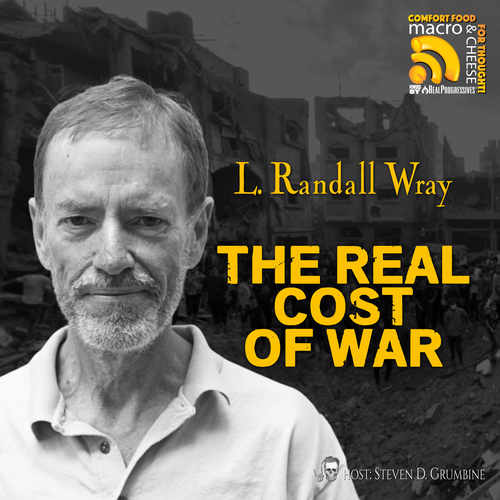
Episode 379 – The Real Cost of War with L. Randall Wray
FOLLOW THE SHOW
MMT economist Randy Wray exposes the real cost of Trump’s war on Iran – not dollars (which the federal govt can always create), but stolen labor, gutted social programs, and a starving Global South. Steve warns that neither party will ever reallocate resources from bombers to bread.
** This Tuesday, May 12, come to Macro ‘n Chill, our online gathering where we listen to and discuss this episode. Bring your questions and insights. 8pm ET/5pm PT. Use this link to register: https://us06web.zoom.us/meeting/register/rn_HAqgaSRGdj8W2UX9aKw
Did you think we had abandoned MMT? Well, after a few weeks of tackling some rather prickly topics, we’re back to strictly non-controversial macroeconomics. Heh heh. Just kidding. Don’t get too comfortable.
Our old friend Randy Wray is back, bringing his somewhat optimistic belief that a sound reality-based agenda might possibly succeed in the upcoming Congressional elections. But more on that later. First, he and Steve need to dissect Trump’s latest imperialist venture against Iran and expose the bipartisan lie that there are just enough of your tax dollars to pay for war; when it comes to affording social programs, the cupboard is bare.
Claims of scarcity are pure ideology. MMT has taught us that the federal government faces no dollar constraints. The real cost of war is measured in diverted labor, wasted resources, destroyed infrastructure, and the steady cannibalization of society’s productive capacity. Not to mention human lives, disabled veterans, and a chain reaction leading to starvation in the Global South.
Back to Randy’s guarded optimism, which Steve does not share. Rather than smooth over their differences, they lean into them.
Randy believes an anti-neoliberal program could win congressional seats. It would require candidates to break out of the fiscal austerity frame. Steve counters by referring to the Gilens and Page study – showing policy has near-zero correlation with popular will – and a class-lens analysis of manufactured consent. He sees a theatrical oligarchy, not a reformable political system. Since both parties serve capital, there is no electoral path. No possibility of reallocating resources from bombers to bread.
The conversation represents an unresolved, essential tension inside the MMT-Marxist synthesis: is monetary sovereignty a tool for working-class liberation blocked only by bad ideas, or is the entire political theater designed to ensure those ideas are never acted upon?
L. Randall Wray is a Senior Scholar and Professor of Economics at the Levy Economics Institute of Bard College, and Emeritus Professor at University of Missouri-Kansas City. He is one of the developers of Modern Money Theory and his most recent book on the topic is Understanding Modern Money Theory: Money and Credit in Capitalist Economies (Elgar, 2025).
Find his work at https://www.levyinstitute.org/people/lrandall-wray/
Steve Grumbine:
All right, folks, this is Steve with Macro N Cheese. Today’s guest is a longtime returning guest, Randy Wray.
Everyone knows Randy, I mean, that’s been following this program, but Randy is a professor of economics at Levy Institute and recently put out a white paper, policy position paper, on The Real Cost of War. And it’s targeting, let’s just be fair, Donald Trump’s war of convenience, his latest whimsical endeavor in empire building.
And we’re going to talk about Iran and the war in Iran, and we’re going to talk about something most people don’t pay attention to, and that is the actual understanding of funding this silly, ridiculous, murderous war that Trump has got us into yet again. And I want you all to pay special attention to the things you probably never thought of as it pertains to what the real costs of war are.
It’s not going to be the fiat system that you’re so used to hearing us talk about. There’s a lot of other costs that we’re all going to bear the weight of.
With that, I’m going to bring on my guest, Randy Wray, to talk about his policy note 2026-3, The Real Cost of War. Randy, welcome to the show, sir.
Randy Wray:
Thanks.
Steve Grumbine:
Yeah, I wish you were under different circumstances. I mean, as much as I’m grateful for this paper, I’m pretty disgusted.
I mean, once again, this buffoon that’s running the country right now has got us into yet again, another war. I’m not going to excuse the last buffoon who couldn’t tie his shoes and got us funding a slaughter, a genocide in Gaza.
But Donnie Tiny Hands has managed to maintain the funding for that war as well as get us into snatching a democratically elected, you know, leader of a country in Maduro and now dealing with bombing Iran and with lots of insane “ending civilization” and all kinds of hyperbolic tweets reminiscent of 1930s Germany here. Tell us about this war, Randy. I mean, you obviously are an economist and focusing on the costs of this latest endeavor is your specialty.
So walk us through your paper, tell us first of all, obviously, what got you to write it, and then let’s break down the paper piece by piece.
Randy Wray:
Well, I’ll admit that I was wrong about Trump when he was running. I thought that he would find plenty of enemies in the United States and he would be attacking them.
I believed the story he was telling, that no more wars and we’re going to make America great again. Of course, I didn’t believe that, but I did believe that his focus would be on the United States.
And so I am very surprised at how this has all turned out. And yeah, I’m an economist, but I have followed the war in Gaza and now the war of choice against Iran, which obviously was extremely poorly planned.
It’s hard to believe that the circle of advisors around him are this incompetent, but apparently they must be, that they couldn’t foresee the likely response by Iran. So it is absolutely shocking. But what spurred this paper? Of course I’ve been reading the news. I would love to avoid it, but I just can’t.
I keep reading the news, but what spurred this was some statements by Henry Paulson and the very nice episode was it [NPR talk show} On Point that I heard and I just, I wrote this thing and I mean, literally half of one sitting had just spilled out. It was very easy thing to write and glad that you enjoyed it and I hope other people did.
So I, I’m happy to, to talk about the main points that I was making from the perspective of MMT, but I, I would also say that even mainstream economists should agree that we should be focusing on the real cost, not the dollar costs. And the real costs of this are going to be huge.
As we’ve already seen, the war is going on much longer than Trump and others had claimed it would go on, which is typical for our wars. And the costs are building all the time.
Steve Grumbine:
So obviously we’re told constantly that we can’t afford domestic spending, we can’t afford benefits for people, we can’t afford to subsidize education. We stripped away the rebates for renewable kind of investments for the homeowners.
We stripped away the SAVE Program for people that were in student loan hell. We stripped away all these things.
We fired so many people that worked in government, so many federal employees were stripped of their employment based on this idea that we couldn’t afford it and that we had to pinch pennies.
And he had the DOGE gang coming out there slashing and burning and digging into people’s lives and all under the auspice that we were broke and government was bloated and that we couldn’t afford anything. Now all of a sudden he’s coming back and asking to pretty much double, I think it’s like $1.5 trillion, to fund the military efforts.
We’ve depleted so much of our stock by playing games in Ukraine, playing games with Gaza, playing games all around the world. And now all of a sudden, we are stripping whatever defensive capabilities we had by yet another war. So what are your thoughts here?
I mean, obviously, you know, they’re saying that it’s $2 billion a day for this war. Walk us through this.
Randy Wray:
Yeah, well, what really got me going was Trump coming on and saying, and he did this on April Fool’s Day, ironically, he said, “The US can’t afford daycare. We have 50 states to take care of, and we’re fighting wars. We can’t take care of the scams like daycare for our children.”
He said the states have to do that.
He said, “Maybe we can give a little tax cut to compensate, but states have to take over all these scams around the country because the federal government can’t afford it because we’re spending on the war.”
Okay, so we can see what the priority here is, but also we can see the complete misunderstanding of the financial position of the federal government versus the financial condition of state and local governments. I don’t think there are any state governments or local governments in America that are not already overburdened with responsibilities.
And a big part of the problem has been, since the days of Nixon, what is called devolution, which is the federal government abandons responsibility for mostly social programs and puts those on state and local governments, which had been raising taxes and had been increasing spending relative to the size of the economy since about 1960 until about 1975.
And maybe some people here from California are old enough to remember a proposition that was passed at the end of the ’70s that essentially froze the property tax. There was a tax revolt in Massachusetts, too.
The population started revolting against the ever higher taxes that were imposed by state and local governments that had more and more responsibilities because the federal government was devolving those to their level. And what Trump is doing is, I mean, at least planning to do, saying he’s going to do is to abandon more and more federal responsibilities.
And that’s perfectly consistent with what you were saying about DOGE and putting them on state and local governments, which already cannot possibly afford the responsibilities they’d already got.
And then to add insult to injury, so we’ve got up here in Washington and over in New York state and city, there’s real movement to tax the billionaires. And so Trump attacks them because they’re trying to raise revenue to cover the kind of spending that he says is their responsibility.
Add insult to injury there.
So he’s lashing out at them for trying to take over responsibilities for things that really should be provided on a national scale by the federal government.
And the final point related to this, and all of your listeners know this, the federal government, unlike state and local governments, issues the currency. It cannot possibly run out.
As long as there are idle resources that can be put to use, the federal government can spend, put those to use with no negative consequences of that. They don’t need to raise taxes to do it. We don’t need to worry about the possibility that the deficit might increase a bit.
That just means the government is putting more money into the economy, making it work better than it is pulling out in tax payments. The only time the government would need-the federal government I’m talking about- need to raise taxes if we didn’t have the spare resources to undertake whatever the project is.
And that really hasn’t happened in the United States since World War II.
That was the last time where we actually needed to raise taxes or use other methods of getting the population to spend less because we needed to devote 50% of our productive capacity to the war effort.
But ever since then, we’ve never had a situation in which there weren’t idle resources, which means we never had a situation in which we needed to raise federal taxes in order to release resources. Now, I’m not saying that we shouldn’t collect federal taxes, okay?
But I’m just saying, could we have a national daycare program funded by the federal government without increasing taxes? Yes, I think we can. Now, finding enough qualified daycare workers is going to take some time and we’re going to probably have to train some.
So we’re going to have to find the resources to do that. We couldn’t do it tomorrow. We don’t have enough daycare centers, so we’re going to have to start creating those. But we’ve got the resources.
We can do it.
Steve Grumbine:
That’s… It’s exactly the point. I want to hover on this spot here for a minute before we get deeper into the war element of this.
I genuinely believe that a lot of even moderately informed MMT activists haven’t really put that piece of the puzzle you just laid out together. The idea of raising federal taxes during World War II was not a fundraising operation.
It was really to prevent, to tie up purchases through bond sales, to kind of defer interest in buying things when they needed the productive capacity to put real resources toward the war machine, not to fund this thing.
And it’s that relationship between available goods, services, cars, houses, wood, metal, fuel, whatever, that literally is the key to the ability to spend. If we have access and it’s available for purchase in the currency of the US Government, then we can get it. And it’s not an issue.
However, when you’re competing for resources, the idea of clearing fiscal space, which may sound like a funding operation, but it’s not, is shifting priorities by de-emphasizing one or making one more expensive and pushing resources towards another.
Like if we did Medicare for All, which I don’t want to get sidetracked on, but Medicare for All might require us to invest in more hospitals, more gurneys, more phlebotomists, more resources in general, whereas it’s not a funding operation. And I think that the vast majority of folks don’t quite understand that taxation is a tool.
Like when you’re listening to music on an old school stereo and you got the equalizer. It’s not a funding operation.
It is a fine tuning mechanism to either push taxes up somewhere else to make it less desirable, or to lower taxes, or to incentivize with rebates or even subsidies to facilitate growth in an area.
So if we wanted all those new providers of daycare, we would shift our focus and either free up resources through one means or another, or if we don’t have enough people, maybe we incentivize by offering free training or fund[ing] training or whatever. But would that be a fair way of saying, because states themselves, and I think you said it very well, states themselves cannot do this.
I mean, not at the level that the federal government can. States are forced to either have bonds, some form of income to finance their operations.
Where the federal government is the finance center, it is the dollar creator, it is the source from where all dollars flow. Can you talk a little bit about that momentarily?
Randy Wray:
Yeah. State and local governments can go into debt.
They can issue bonds to finance activities, but the problem is they’re subject to credit ratings, agencies, and if their debt ratio increases, they get punished with higher interest rates. And so the costs of funding go up. And furthermore, 48 states, I believe it is, have constitutional requirements.
So their own state constitution says that they must balance their budget.
Now that doesn’t mean that at the end of the year, every single state in the United States has ended up with a balanced budget, but they have to submit a balanced budget. And the consequences of not doing that, again, is in the bond markets. So they do get penalized if they spend more than tax receipts.
Now, there’s a little bit of a complication because they can have capital budgets.
So if you’re building a football stadium that is partially financed by the local governments, obviously they don’t have to pay for all of that in one year. So they have a capital account and they just have to make payments on the bonds over the 50 year life or whatever it is.
But anyway, they really are subject to budget constraints. The federal government is not like that. It is the issuer of the currency. All of its spending takes place through the Fed[eral Reserve].
State and local governments don’t have that advantage. They don’t have a central bank that stands ready to make all payments for their treasuries, but the federal government does.
The Fed makes all payments for the Treasury and they do that simply by crediting bank accounts. And you can’t run out of keystrokes. So there’s no limit to the federal government’s ability to spend.
The third thing that set me off was Henry Paulson, who was Treasury Secretary back under Bush Jr. And he came out with this statement saying, “Well, get ready for doomsday in the treasury bond market. We’re at $31 trillion and this war and other spending is increasing the deficit.
And, you know, we might wake up tomorrow and find out that the bond markets are on strike and the government’s not going to be able to sell any more bonds and we’re not going to be able to spend any more with the bond strike.” He did go on to say that the Fed would be the only buyer.
Okay, so he seemed to understand that part, that if the bond markets went on strike, the Fed could buy the bonds, but he said that the Fed would lose control over the interest rate. And so the Treasury could still issue bonds. The Fed could buy them, but it would be at ever higher interest rates.
Okay, well, now this is a fairly dumb thing to say, especially by a Treasury official who supposedly understands how the government spends and how the bond markets work. How on earth could we have someone in charge of the Treasury who doesn’t understand these things?
And let me say, Trump has far more incompetent people as appointees than Bush Jr. did. So anyway, it cannot happen. The central bank is the interest rate setter. And so in the paper I pointed to [Mario] Draghi, who was the head of the ECB [European Central Bank].
And we had this crisis in the bond markets in Euroland [where Euros are the accepted currency], especially in Greece. And what happened in Euroland was each individual nation that joined gave up their own currency.
They adopted what was a foreign currency for them, the Euro. And The ECB was the ultimate, the equivalent of the Fed for the union as a whole.
But it was not supposed to operate in the interest of any individual member. And in fact, it was prohibited from bailing out any individual member by buying their bonds if they had trouble selling them.
So the Euro members were more like, say, California, New York, Louisiana. They were subject to bond markets, they were subject to credit raiders. And so Greece gets in trouble.
And their interest rate on their bonds was something like 10 percentage points higher than the interest rate of, say Germany, on their bonds, because the bond markets thought that Greece was far more risky than Germany, and Greece might default on its debt. Greece might even get kicked out of the Euro, okay?
And, you know, at a 10% interest rate, their deficit is exploding just because of the interest payments. So finally Draghi decided, we’ve got to rescue them.
And so he said, “Whatever it takes, we will stand ready to buy the bonds to get the interest rate back in line with the other interest rates”. And ever since then, the ECB has done that, okay?
And so what he proved is that the central bank can, of course, set the interest rate on bonds anywhere it wants. In the case of the United States, we have no prohibition on the Fed operating, you know, to prevent a financial crisis of the United States.
And it stands ready to be the buyer of last resort, which is what Paulson said. And the buyer of last resort can always set that interest rate. So the idea that the Fed would lose control of the interest rate is just crazy.
Everyone knows the central bank can have the interest rate it wants.
And so in the case of Japan, it was called the widow makers trade, betting that the bank of Japan couldn’t keep the interest rate low on Japanese bonds. Even though their debt ratio goes above 200%, they can keep it as low as they want.
And anyone dumb enough to bet that the Bank of Japan can’t do it becomes a widow. Okay? So it cannot happen. His scenario, the doomsday scenario, is literally impossible.
Steve Grumbine:
Hilarious. Unless politically they decide to do it just to make the charade look real. You know, by. I mean, they’re…
No country can go bankrupt, if you will, on debts denominated in their own currency unless they politically decide to do something moronic. I have no idea why they would do it other than to keep the ruse alive. I don’t know. How far are they willing to go to keep that lie alive?
They continue to baffle me. Let’s jump to the next part you talk about. Can America avoid a catastrophic debt crisis? Can America afford Trump’s extravagant spending on wars?
And I think it’s important to get into the real cost of war. And you start off with a warning. The warning everyone should be aware of from Eisenhower. Take us through this.
Randy Wray:
So I think everyone knows that Eisenhower took a parting shot at the military industrial complex.
And he warned that they were in control of Congress and all they wanted was for military spending to keep climbing because they were making lots of profits off it. And the problem- there’s a twin problem. One is, of course, it’s a tremendous waste of resources.
And the other is that there’s a tendency, if you have a tremendous amount of firepower, you might want to use it. And so he was very worried about this.
Well, what they don’t know is he went on in that speech and in another speech arguing that the real cost of this is not the dollars, he says, for every gun that we produce, for every aircraft carrier, warship, for every bomber, what we’re getting in return is fewer schools, fewer power plants, fewer roads being built, fewer homes.
Of course, all of those things were important because of the baby boom.
And so he recognized that if we’re devoting all of our resources to building up this huge military, we are giving up the kinds of things that would make American lives better. So that was the part of the warning that for some reason doesn’t ever get talked about. And that’s the important part of the cost of war.
It is the use of resources to produce things that will make American lives better, that will provide for the child care that Trump claims we don’t have the money to afford. So measuring in terms of the resources that are lost that could have been used to benefit us.
INTERMISSION:
You are listening to Macro N Cheese, a podcast by Real Progressives. We are a 501c3 nonprofit organization. All donations are tax deductible.
Please consider becoming a monthly donor on Patreon, Substack or our website, realprogressives.org. Now, back to the podcast.
Randy Wray:
Recently, especially Democrats have been picking up on this.
Elizabeth Warren said we had already spent $12 billion on the war, and she said that would pay for the entire National Park Service for three years and housing assistance and lowering the drug costs. And other people said it would provide food stamps for 42 million Americans for two years, free school lunches for five years.
Okay, so again, this can be confusing because they are talking about the $12 billion as the cost. And $12 billion could provide these things and stood for us.
But what we really need to focus on is the resource use, the plant and equipment that will be necessary. By the way, Trump has already asked the auto companies to reduce their production of automobiles and to ramp up production of military weapons.
You know, that gives you some idea of what the true cost is.
Fewer cars are going to be built, fewer houses are going to be built, because we’re going to have to move the resources into the war effort for whatever the next war is going to be. I don’t know where. And of course, this war is going to go on much longer than what they were talking about in the beginning.
Just as the war against Iraq. It was supposed to be- Rumsfeld said the war in Iraq, it’s going to go somewhere between six days and six weeks and it’s only going to cost $40 billion.
It lasted until 2021. It cost $8 trillion, okay? So the wars go on much longer than they proclaim.
They cost much more in dollar terms, but more importantly, in terms of the resources that are devoted to it and the other costs of war that I also talked about in the paper, which is the tremendous cost in terms of disabilities of the people who were involved in the actual fighting. Half of all of the service members who fought in the wars in Iraq and Afghanistan came home with disabilities.
Many of those lifelong. They are still suffering. We still have to support them. That is adding to the long term resource cost that we have to devote.
And of course, we have not put enough resources into taking care of them.
But in any event, the resource costs of taking care of the veterans, the estimate is that one third of the veterans from this war are likely to come home with disabilities too.
Steve Grumbine:
You know, I want to really pound on something here that I think is important. And you do cover this.
I want to be clear, I’m not stepping out from what you’re saying, but I want to add a little flavor to it and that, you know, every time someone like Elizabeth Warren or someone else that people listen to, especially in the very, very slightly left of center establishment Democrats, they always make it a weird bargain like, “This money. They’re wasting this money over here and therefore we don’t have the money to spend over there.” And unfortunately, folks never ever get with this.
It’s like it’s so permanently baked into their brain, so hegemonically stuck in their skull that they never shift to the resource view. They always are panicking about, well, we had to deal with less because we spent over there.
When in reality, if we suddenly had all of our men and women serving overseas in a war and we didn’t have enough people here to fill these roles then, sure.
But we saw, case in point when DOGE was laying off all of those federal workers, that there are tons of workers out there, many of them older people that got degrees and stuff, based on an economy that never showed up, based on ideas for jobs that never came true.
These are people that are going to be competing even more so to drive down wages, to drive down labor power, and to create a mad dash to fight to survive clawing out of the crab barrel. And what I think is really important is for folks to understand that if we have unemployment, we can employ them via the federal government spending.
We could talk about a job guarantee, but we could just simply talk about these really, really robust programs that are permanent level jobs that people could have that would soak up those unemployed people and stabilize the economy.
But instead, people like Elizabeth Warren, whether or not they’re, oh, they’re scoring points because they’re poking at Trump, they’re inadvertently setting the stage for austerity, making it seem like the money is scarce, they’re playing the role too. They’re not the good guys necessarily in the space.
And I think that for the larger group of people that they represent, unfortunately, they are recalcitrant and stuck like cement in this idea that taxes are funding this stuff. What are your thoughts on that? Because for me, I don’t expect anything from Republicans. I expect them to be bed-shitters. Excuse my French.
We typically cast the Democrats as the good guys, but they’re still preaching an austerity message, whether they want to admit it or not. What are your thoughts on that?
Randy Wray:
Yes, I think in practice, I agree with everything that you’re saying. They play the game of it’s all about the dollars and we have a limited amount of dollars and we’re fighting over these dollars.
Where are we going to spend them? Rather than recognizing that dollars aren’t our problem, that we should be focused on the resources.
And I really don’t understand why Democrats, and especially progressive Democrats can’t just jump off that bandwagon. I don’t know the answer to that. But let me say this.
The Republicans figured out in the ’70s, and this isn’t my opinion, Bruce Bartlett has been sort of releasing draft chapters of a book that apparently he’s writing. He worked in the Reagan administration and he was working with [conservative, [Jack] Kemp even before Reagan got elected.
And so I’m paraphrasing my understanding of his history of the creation of the Reagan Revolution, which really changed American politics. The Republicans realized in the 1970s that the public viewed them as the Party of small government.
And so they decided, let’s make the government as inefficient as possible. Let’s have it screw up everything that it tries to do. Let’s make the population really hate the government because we’re the small government party.
The worst job the government does, the more votes we will get. They figure this out.
And so Reagan comes in and he sets the pattern that’s been followed by every Republican administration on purpose, maybe less so by the Democrats when they appoint incompetent people, maybe it’s a mistake, but anyway, so Reagan comes in and he purposely appoints incompetent people. This continues. Remember George Bush Jr.?
He put an Appaloosa horse expert in charge of FEMA. And then Hurricane [Katrina], the hurricane hits and they screw up the rescue. Well, that was good. That was very effective. And now Trump and you mentioned DOGE.
Let’s make it impossible for the government to do anything correctly by getting rid of anyone who is competent. So, you know, these weren’t appointees, these were employees. Any employee who was competent, we’re going to get rid of.
Make every agency of government completely incompetent and understaffed so that, you know, when people reach the age of retirement and they need to go down to the Social Security office and start getting their Social Security payments, there’s nobody there. They can’t get any help. This is great because it makes people hate the government even more.
So I think that there is this plan and one way to make the government less confident is to constrain it in terms of the spending. So there’s always got to be cutting. Oh, think about the U.S. Post Office. Let’s close a whole bunch of the branches to really piss people off.
Make the mail system work much less efficiently. Don’t let them buy new modern electric mail trucks. Cut the spending there.
Slashing the budgets and constraining the budgets works right into the hands of the Republican Party. It’s a long term, 50-year, very successful plan.
Steve Grumbine:
You guys talked heavily years and years ago about the Bill Clinton fiasco with the balanced budget and the surplus.
And every Democrat under the sun, even to this day celebrates the Bill Clinton surplus like it was the single greatest achievement [of] the party because they’re fiscally responsible and so forth. Did the two parties kind of take on the same neoliberal logic going back, probably, I want to say at the end of Tip O’ Neill, and really going into the Clinton era, some real serious shifts occurred. I mean, there is no haven for the raven. Every time you look left, something happens, right.
And it seems like instead of clawing things back, you know, for example, and I’m not here, I don’t usually like talking politics because I honestly believe that they serve the purpose of manufacturing consent amongst the people, not actually serving it.
I’ve talked extensively about the Gilens and Page study from Princeton in 2014 that demonstrated that the people’s perspective and desires have a near statistical 0% impact on policy. So I don’t see either of them as serving people in general.
But that narrative, that shift that occurred under Bill Clinton, the triangulation, the new Democrat, that third way Democrat that occurred back then, it really basically said, “Hey, let me, we’re going to out-Republican you.” And then I believe that was the start of the next phase, which was the Tea Party, and then we lead to Trump.
I could be wrong, but that’s my telling of the word.
Because you saw Obama, I mean, Obama, he did so many things that sound like if you didn’t put the name Obama there and you just said the President did this based on the things you even said, I would look at Obama and say, “Oh, that was a Republican president.” You know, could they just seemingly…
And I don’t know whether this is a function of the institutional arrangements based on the elites that run this country or what, but I haven’t seen anybody do the things that we frequently talk about would be good to be done by anyone. I’m frequently left with a very, very sad feeling for my kids and everyone else that there is no way out of this.
My love for MMT is the one thing that sustains any hope whatsoever. But even that is fleeting.
With all these years later, these same people who we’ve talked to extensively, I mean, I’m nobody and we’ve talked to them and you’re somebody and you’ve talked to them and they just, they don’t. Either they don’t get it or they’re paid not to get it, and I’m not sure which one is which.
But it’s extremely frustrating to know we could save lives, we could deal with this climate crisis. We don’t need to do the things we’re doing and yet we do them every time like it’s our job.
I fundamentally don’t understand, but the more I dig in and stuff, the more I feel like I’m coming up with a theory of why. I’m not asking you to weigh in on it. You feel free to, but I just wanted to make that statement for my own sanity.
Randy Wray:
Okay, so first, just anecdote. Yes. Over the years we’ve had opportunities to sit down and talk to elected representatives, both parties.
And I would say most of the time, whether Republican or Democrat, when we explain how the government really spends, we can reach the point where they will agree that to the best of their understanding, they say what we are talking about makes sense. And then they will say, “But I cannot say that in public.” Okay? So that is the problem. Now I’ve never sat down and talked to Elizabeth Warren.
I can’t say for certain that’s the barrier there. I do not know, but I think it is a huge barrier. Politicians are not leaders, they are followers.
And it’s up to their followers, I think, to stand up and say, “You’re lying.” Anytime they say, you know, that money is the problem. We’re running out of money as Obama said, said, “Oh, we would love to do more.”
Yeah, we are in this global financial crisis-induced long term recession that took us 10 years to recover from. “We’d love to do more but you know, the government ran out of money.” It’s gone.
And again, I never talked to him, but I suspect that he was told that this is the position you have to take. No one will take you seriously if you say, well, you know, actually it’s okay to run a deficit. They play the game.
They think they have to play the game. Going back to Clinton, you have to remember the Republicans had the White House since Nixon.
Now I know Carter was there, he was an exception [a liberal] he was very ineffectual as a president. So in a way he hardly matters. Now he became our best post-president ever. But as president he was not effective and he came out of the peanut farm.
It was a very strange administration. But otherwise they were all Republican. And the Democrats, I’m sure were really at a loss. They just, they could not put forward someone who could win.
And this guy Clinton comes along and he manages to come up with a vision that could appeal to fairly conservative people, such as we got to “end welfare as we know it,” but also that provided some kind of hope. And so he was able to win. And yes, the budget got balanced because we had bubbles. The first [Clinton] administration, the economy didn’t do very well.
But the second term the economy was booming in some areas and that produced enough revenue to produce a surplus.
And I encourage everyone to go look for the, the video of him announcing this and getting out his big marker pen and continuing the line for the declining deficit until all the government debt was going to be retired. And the audience, which was Republican and Democrats, stood up and cheered.
They were cheering hysterically because the government would no longer be in debt. So, yes, it was both parties. It’s sort of, well, we, we can’t beat them, so we will join them. I think it was the Democratic position.
And so we got Clinton and then we got Obama. And yes, it was the era of neoliberalism. The Democrats joined them and became neoliberal. The economy performed poorly under Obama.
Biden, the first two years, it looked like Biden was doing something different. He did have, I think, a vision of the government doing things for us, but in the second half, he pretty much gave it all up and, and, of course, lost the election. And now we got Trump.
Steve Grumbine:
You know, isn’t it wild to think about this? I mean, like, just spitballing momentarily. Trump’s been impeached, not once but twice.
He’s been convicted of a felony, and he’s midway through another term as the leader of the United States of America. I find that alone to be not even thinking partisanly, right? Because I think it’s all a big old charade.
But the idea that we’ve all been so desensitized to both genocide in Gaza, to corruption, from the great financial crisis to, you know, you name it, that, you know, here we are with the Epstein files and absolute disgusting revelations straight out of the State Department, right out of these Freedom of Information. Show these people are disgusting pedophiles. And here we are, I mean, even our great Noam Chomsky, right up in there defending fricking Epstein.
And just the entire thing. We are so desensitized to the perversion of the state, the perversion of these “leading voices and elites” that someone like Donald Trump is sitting here after being a felon. It just…
It makes me feel like I’m watching a Broadway theatrical production, or better yet, the WWE and the kayfabe that they put on when they put on their show, that everybody suddenly suspends reality and buys into the show. I feel like that’s what’s happened. And who am I? I’m nobody. But my lying eyes say that’s what the world is now.
Because there’s no other explanation that meets any kind of sane outcome. To say how a guy that’s been impeached twice and convicted of a felony is serving once again and driving us into an absolute cesspool.
Unfathomable to me. Unfathomable.
Randy Wray:
There may be an opening in the next election. I think neoliberalism may finally be dead, at least as far as the Democratic Party goes.
But I think also as far as the Republican Party goes, I think that we are going to take a different path. I’m not sure what it is.
Steve Grumbine:
Well, I could tell you right now, looking at Gavin Newsom, like, fist pumping as he strips away homeless encampments, showing off for the rich, and once again proving to be a class traitor, or actually not a class traitor because he’s perfectly in line with his class. I see that. And I say to myself, I don’t see any hope.
And I see folks just kind of giving the big ole, always the rotating villain, to allow Trump to continue his maniacal wars and nobody stepping up, nobody thinking it’s worthwhile to stop the action. Again, Randy, I mean, I’m the cynic here.
I admit that I am way more pessimistic than the vast majority of the people that we talk with, but I’m just, I don’t know how to justify any of that. I can’t, I can’t process any of that and come out with, “yeah, we voted for that. Of course we did. Yeah, that, yeah, sure.”
I mean, and I cannot divorce myself of the outcomes of that Gilens and Page study that stays front and center in my mind. I have an MMT lens. I have a Gilens and Page lens, and then I have a class lens.
And those three things are telling me a whole bunch of things that are like, nothing makes sense as a result of that.
And, you know, I, again, I value your insights because I know that you guys are looking at this at a level that people like myself don’t have the luxury to look at it. But I do have the luxury of speaking to a great many academics and scholars and other people that are touching these things.
And, you know, I’ve come up with this analysis. I don’t know if I’m right or not, but I feel right. I feel like I’m onto something. I feel like I’m over the target.
You know, the MMT lens has been instrumental in helping me understand things that were truly cunning, baffling and powerful before, and able to put it into some sort of logical sense, but the political sphere and keep going back to the well for that and watching these people serve wealth and not serve the people. I mean, I don’t know that that’s reformable. I don’t know that we can fix that. But I’ll give you the final word on this because, you know, we’re, we’re in the middle of a war, another war. We’re funding it like crazy. People are getting laid off by AI and other things like crazy. There’s no relief for the people anywhere in sight.
And you know the worst of it? The food shortages coming, the absolute destitution coming, the increased inflation coming.
I think there’s a tsunami coming and I think the people are going to get swept out the sea. I’ll leave you with the final word on that.
Randy Wray:
Well, yes, I think this next year because of the war and the inability to get the fertilizer out because of the green revolution. Fertilizer is essential to producing enough food to avoid massive starvation in the poorest countries.
This is going to be one of the costs of the war. I think that is, that is pretty much a certainty that there will be big problems in feeding the world’s population.
And, you know, America’s going to suffer, too, but not like that. We’re going to suffer from higher prices, canceled flights, much more expensive flights.
You know, we’ve seen Spirit Airline is going to need a bailout and United and American are probably going to be allowed to merge on the argument that, you know, they can’t make profits, which means we’re going to have higher airfare forever with less competition. So we’re going to suffer, too. But just looking a bit farther, I think it’s too early to look to the presidential election.
We’ll see what happens in the midterms. I’m more hopeful about the midterm elections.
We will see if at least some of the Democratic candidates are going to offer up something different from neoliberalism. And I think we’re going to see that and I think they are going to win. Pavlina [R. Tcherneva] and I are finishing up a book on a vision that will win.
And we’re not writing this for the Democrats. We’re writing it for candidates who want to appeal to working class Americans.
They used to be in the Democratic Party, but the party abandoned them and they shifted over to Trump. Or actually most of them probably stayed home because they couldn’t hold their nose and vote for either party.
So I think there is a vision that will bring them back and that can win perhaps enough seats in the midterm to make a difference. And then maybe for the presidential election the next time around, this can be the alternative to the neoliberal vision.
It’s a vision that will rectify all the problems created by neoliberalism and by the Republicans attempts to destroy government capacity. So I’ll just leave it there. I hope the book will be out before the midterms.
Steve Grumbine:
Well, Randy, I am nowhere near as optimistic as you.
But I’m glad that somebody’s putting something out there to help people see, even if it can’t come true, the fact that they could see that it could be. And then they can start asking the right questions, why the hell aren’t you doing this?
And if I’m right, and it’s just a big old theater to manufacture consent for oligarchic desires, it’ll be exposed there. And if it’s an opportunity to do something electorally that I don’t envision, I’ll be thrilled. I don’t want to be right.
You know, I mean, like, the last thing in the world I want to do is actually be right on this. I would rather eat my, you know, eat my hat and say, “Guys, I was wrong here I was Mr. Pessimist, and, and I was talking all this, you know, cultural hegemony and talking about how the elites are forming these institutions
to reinforce their stranglehold on power and disciplining labor and all these other things.” But if there’s a way forward and they can pull it off, I’ll be there to clap for it.
I’m happy to say I’m wrong when I’m wrong, Randy, and I’m not wrong about this: you are an amazing economist. You’ve been a great friend of the show, and I thank you so much for your work.
Please tell Pavlina I said hello, and I wish you all the best in that effort.
Randy Wray:
Okay, thanks. Will do.
Steve Grumbine:
All right, folks, my name’s Steve Grumbine. I am the host of Macro N Cheese. This podcast is part of Real Progressives, which is a 501c3 nonprofit.
We operate in that space of MMT and class analysis, and we are dependent on your donations. So if you consider the work we’re doing valuable, please consider donating something to the cause. No amounts too small, no amounts too much.
And if you have an interest in volunteering, we are a volunteer-led organization. Folks have been here volunteering, literally volunteering week in and week out now for over 10 years. If you can imagine, this place has really…
People invest themselves in it because they believe in the cause. So if you feel the same way, there’s a lot of ways to get involved.
And without further ado, on behalf of my guest, Randy Wray, myself Steve Grumbine, the podcast Macro N Cheese, we are out of here.
End Credits:
Production, transcripts, graphics, sound engineering, extras, and show notes for Macro N Cheese are done by our volunteer team at Real Progressives, serving in solidarity with the working class since 2015. To become a donor please go to patreon.com/realprogressives, realprogressives.substack.com, or realprogressives.org.
Extras links are included in the transcript.
Related Podcast Episodes

Related Articles
The Truth About “Printing Money”

Why Didn’t the Chicken Cross the Road?


Leave a Comment
You must be logged in to post a comment.