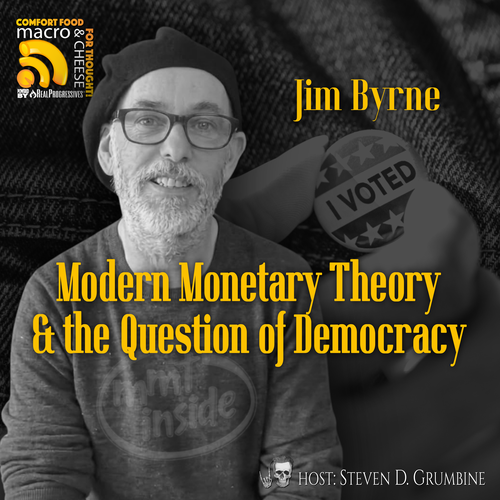
Episode 376 – Modern Monetary Theory & the Question of Democracy with Jim Byrne
FOLLOW THE SHOW
If governments can create money, why can’t they deliver for the working class? Jim Byrne of MMT101 joins Steve to expose a democracy that stops where capital’s interests begin.
** Questions about MMT? Thoughts about the episode? Come to our online gathering, Macro ‘n Chill. Tuesday, April 21, 8pm ET/5pm PT. Use this link to register: https://us06web.zoom.us/meeting/register/RkspaP0RSNajdc69bqUmkA
Jim Byrne of MMT101 is back for a conversation that moves beyond the technical mechanics of Modern Monetary Theory to ask the tough questions. While affirming MMT’s core insight that a currency-issuing government doesn’t face financial constraint, only real resource limits, they argue that this knowledge is politically neutered by the structures of capitalism.
Jim lays out a clear, accessible primer on how money actually works and breaks down the scarcity myth. But the real question isn’t can governments act, it’s who they serve when they do.
Looking at the failure of bourgeois democracy, they talk about cultural hegemony and neoliberal ideology as well as class struggle vs. gradualism. The discussion touches on Scotland as a colony of Westminster and the limits of referendums under an imperial state structure.
Ultimately, this is a dialogue that pushes beyond MMT’s insights and asks whether those tools can mean anything without a rupture in the underlying political and economic order.
Jim Byrne has developed an MMT foundation course aimed at beginners and intermediate learners as well as people who already know about economics but are curious about Modern Monetary Theory.
Follow his work and the MMT101 podcast at mmt101.substack.com
@MMT101DotORG on X
Steve Grumbine:
All right, folks, this is Steve with Macro N Cheese. My guest, Jim Byrne, MMT101. This guy is prolific, writes constantly.
If you want to read and learn about Modern Monetary Theory, my guy is out there on Substack. Strong recommendation. He’s also put together a class that was on Udemy. Very good class. I recommend it highly.
This guy is always driven to write more because his heart and his spirit is about teaching people Modern Monetary Theory.
Now, as far as this podcast goes, you all know we have been an MMT shop now for a very long time, but we have begun to integrate class into our discussion because we feel like there’s been far too much hand waving, you know, that we can just vote our way to the promised land in these systems. There’s been very little analysis as to why governments aren’t doing what they’re supposed to do. And it’s not just that they’re stupid, folks.
That’s the problem. We have reached out to people like Clara Mattei, who you’ve just recently heard on our podcast.
We have reached out to many others to discuss the way capitalism and the way governments work, especially in these times of fascism, where you see that blending of corporate power and state power and the people are left high and dry. The concept of democracy has never been more important to understand. And by understand, I don’t mean Pollyanna this, okay? There are folks out there that like to Pollyanna this democracy stuff. “Oh, we’ll get a few more progressives in. Everything will be A-OK.” They are not, repeat, not looking at the system.
They are not looking at the way the system was created. And they are not really giving you straight answers on why we would have 70% of the people in America that want Medicare for All. And yet there’s not an ounce of prayer that Medicare for All is going to go through the electoral process. So without further ado, let me bring on my guest. Jim Byrne. Welcome to the show, sir.
Jim Byrne:
Good to hear from you, Steve. And thanks for inviting me on again. I’m always happy to speak to you.
Steve Grumbine:
It’s very much my pleasure. Hey, real quick before we dive into the meat of what we’re doing-
I saw you guys out there in Scotland having yourself a bit of a festival here with Willie Thomson, who we had on not too long ago. [Yeah.] Tell me that was quite a showing out there.
Jim Byrne:
Yeah, absolutely. I mean, William does a great job.
I mean, I was only there for the one evening because I had a lot of other stuff on that week, but it was a great turnout. It’s actually a fantastic atmosphere that he’s managed to develop. A lot of really fantastic people there talking, including Steve Keen.
That night, I was there with Steve Keen and John T. Harvey, who are both, you know, folk who I’m big fans of and are intelligent. What’s the word? Intelligent economists that I respect. So, yeah, it was a great night.
And some of the stuff he was talking about on that night is some of the stuff I’ve been writing about recently. He’s a big sort of talks about education for economists.
The book that he’s written I’ve also recommended in the past, if I could remember the name of it. It’s about all the different schools of economics and how, you know, basically we don’t, we only teach the one, but there are many more.
If I had a memory, of course, Steve, I could tell the name of the book. But if you type in John T. Harvey.
Steve Grumbine:
We know what that one is, we’ll throw it into the show notes. Contending Perspectives [in Economics].
Jim Byrne:
I think that’s the one he was talking about basically, some of the stuff within academia that makes neoliberal economics so sticky as the only default thing that’s taught in the academic world.
And some of it’s just to do with the ways things are set up and to do with the value that’s given to publishing in particular journals, which, of course are neoliberal by nature, these journals, and the lack of value that’s given to publishing in anything else, whether that be Post-Keynesian or Marxist or whatever. So if you want to have, I mean, I’m summarizing…
I’m sure you spoke to him yourself, but the summary is that if you want to have a career, an academic career in an economics department, then you better be an advocate of neoliberal economics, otherwise your career’s over. I’m sure he wasn’t as blunt as that, but that’s my message from that.
So that’s one of the things, in some sense, in context of what we’re talking about today, it’s the structures that make things quite difficult, whether it be the democracy or whether it be the school of thought that has imposed upon us and all our economists tell our politicians what to do. There’s many reasons why we can’t get beyond it.
Steve Grumbine:
You know, it’s funny because that was one of the questions that I have been digging into. And, you know, I will bring it up because it’s going to come up as often as I can bring it up.
And that is Antonio Gramsci’s view, if you will, of cultural hegemony and the whim and the desires of the ruling elite. And these institutions that make up the framework of what is common sense are direct extensions of the ruling elite.
And we live in a capitalist society. And I have a Master of Business Administration. Guess what I learned all about?
Maximizing shareholder value, not being a good global citizen, not ensuring the planetary boundaries are intact, not making sure that workers have decent pay, but to make sure that by legal definition, we have maximized shareholder value.
And so these things are baked into every institution, every sitcom, every newspaper article, the founding documents of my country, which is just a terrible place to be, by the way.
And then I imagine all around the world, many of these things are baked into the structure of what we consider to be the deliberative democracies that we supposedly live within. But if you think about it, having cultural hegemony, having the power to influence and create institutions, and MMT is an institutionalist framework- institutions are the will and the whim of the ruling elite.
So if you think about it, those education classes, the framework for those institutions, the universities, et cetera, they are funded by huge amounts of money by oligarchs and wealthy people. And the whim of those people is, in fact, to maximize shareholder value.
So it’s not hard to figure out that capitalism is at the top of that food chain, and the ruling elite putting their thumbprint on all of our view of what common sense is. Anyway, Jim, I want to get to your writing here. I mean, we have some very similar understandings of the broken systems that we call “democracy.”
I don’t know that we’re one for one, and we’ll get to that. But I would like very much for you to explain.
I mean, particularly, let’s start with this paper that you’ve written about MMT and democracy, wealth and power and influence. Let’s just dive right into that, because I think your words are important.
And I believe that I may have some differences of opinion throughout, but for the most part, I think that we understand the system’s broken, we’re not getting what we want out of it, and the how and why may be different. But we can talk about that. Your thoughts, sir?
Jim Byrne:
Yeah, well, as you know, I’m just…
I was just writing that article just in the last couple of days, and to be honest with you, it’s influenced by the zeitgeist, if you like that word, a zeitgeist which includes people like yourself talking about the same subjects and about the pressure that the world is on at the moment. And we’re all under at the moment because of the various systems that you’re talking about.
So I’m starting writing about things lately which are slightly out with the MMT framework because everything seems so urgent to be fixed. We need to talk about these things. We need to put some kind of pressure on.
We need to look at what are solutions, not necessarily look at solutions, because I’m no, you know, I’m not the man that’s going to ride in on the white horse and sort everything. And I don’t claim to be, but we need to be at least talking about it and putting it out there, and getting some kind of debate.
So that’s why I started writing this particular article. I wanted to look at the idea. Okay. Yeah. I’ve been studying MMT for quite a few years now. I’m a believer, so to speak.
And the insights that gives me about how governments spend, what that means for policy, what the structures within governments are that prevent that, or the type of democracy is what I would say that the UK and the US have at the moment are a roadblock to change. So that’s the kind of crux of the article.
So what I’m saying is, okay, MMT teaches all sorts of things about the monetary system, and it teaches all sorts of things about what we can do once we learn that as far as the US currency, the US dollar, or the UK pound is concerned, it’s not scarce.
Steve Grumbine:
I want you to do me a favor. Before we go down this pathway, why don’t you tell everybody, as the ultimate MMT 101 guy, why don’t you give a quick primer?
Because we have people that maybe have never heard of MMT listening to this podcast and we throw MMT or Modern Monetary Theory, or Modern Money Theory, depending on which person you talk to. Why don’t you give your version, an elevator pitch of MMT for those that maybe who have never heard it before?
Jim Byrne:
Okay, well, clearly there’s lots of different subjects within it, but essentially I think it’s an incredibly simple school of thought which is founded on what money is and how governments operate in terms of the way they use money. In other words, there’s something called a fiat currency that both the US and the UK have as a system. What does that mean?
Well, it means the money is not a commodity.
It doesn’t have the value because it’s got gold behind it or because it’s got, you know, big sort of pile of things in the government’s basement that says, “All right, if we spend this, it’s got to equate to this amount of gold because it’s all backed up by something.” No, the US government and the UK government, they just decide to spend. The money has only got value because of two things.
The government’s law is behind it and the government sort of backs it. And two, you’ve got to pay your taxes in it. These are the things that give the money the value, right? So that, so that’s the kind of first thing.
And I think money is a concept. It’s not a commodity, is the way I tend to sum that up. It’s an idea, not a commodity.
And often I would illustrate that by saying, “Okay, how does money, how does government money come into being?” Comes into being when a politician
stands up and says, “I think we should spend something or money on this thing, this project”. Everybody in the room says, “Yes, that’s a good idea.” They vote for it. And then the next step, there’s lots of obfuscation between that step and the step I’m going to describe now.
The next step is that the central bank writes the money for that project into a commercial bank account. And the money comes into existence at that point. It’s not backed by anything they didn’t need to collect taxes to spend.
It just comes into existence at that point.
And that’s real money that everybody can use in the economy didn’t come from anywhere other than that politician standing up and saying, “I think we should spend money on this.” So that, to me, that seems like a very simple way of describing how MMT has then built a kind of school of thought around what money is.
Money is just a concept. It comes into existence without having anything to back it up. Now, clearly there’s a big story about where money came from in the first place.
And there’s all that barter story and all that, which I’m not going to talk about. But it didn’t come from barter. It comes from some central organization taking note of who owes what to whom.
The money’s always been a concept in that sense. What is the value? The values, as I say in terms of government is the fact that you’ve got to pay your taxes in it.
So that’s the first thing, which is an idea. I don’t know if that tells us anything or if I’ve confused you, Steve, with that one.
Steve Grumbine:
No, I think you’ve done good, man.
I would say this from, you know, from my vantage point and listening to guys like Rohan Grey who have really, really put this into my brain in a certain way, that money is a creature of law, and that money is a legal arrangement as much as anything. And as a legal unit of account for a country, for a state, unfortunately, the euro [European unit of currency] violates this to some degree.
But we can get into that if it’s comes up.
But with that in mind, the power comes from the currency issuer, that whoever that is, and there has to be something there to make that money be acceptable. And that thing that makes it acceptable is you must pay your taxes in it. It’s not that taxes fund anything.
It’s that taxes serve as a unique obligation that creates the monopoly power of the government’s unit of account. And I think that for me was what set everything straight.
That was what helped me understand the difference between currency issuers and currency users. And for people out in the world, I think that’s a good place to start. Go ahead, Jim.
Jim Byrne:
Yeah, so that’s a good. That’s one side of a kind of very big equation, which is where does the money come from? Well, it comes from the government.
They just sort of decide it into existence.
But that’s not the most important or the only thing that we should be considering because one of the things that prevents us from doing things within government is that somebody stands up and says, “Actually we can’t spend it on that because we can’t afford to.” So they have a kind of scarcity mindset around money.
They think that governments are just like businesses or households and they can’t spend money unless they brought taxes in. You know, enough taxes in that allows them to spend it just like a business would or a householder would. So that’s their story.
But the story that is important from an MMT 101 perspective is it’s all about resources. It’s resources that are scarce. So the reason that the governments invented taxes in the first place is because they wanted things done.
They wanted people to join their army. They wanted people to build the palace.
They wanted people to turn up at the door with the food and the drink that they’re going to use for that royal party they’ve got next Thursday.
They invented taxes in order to force people to work, to bring in things for the central authority, whether that was the king in the past or whether that is the government today that needs an army, right? On the one side we’ve got the story about what money is.
On the other side we’ve got the story of it’s about using resources and it’s resources that are scarce. So the government is competing for those resources with the private sector. So how does the government ensure that people do things for them?
Well, they say, “Oh, you’ve got to work for our currency. How do we get our currency? Oh, you do a job and we’ll give you our currency. You do a job for us and we’ll give you your currency.
You come along and work to build that palace. You come along and serve in the military. You come along and become a teacher in our national education system.
And what will we do? We’ll give you the money that will allow you to pay your taxes, right? Because if you don’t have that money and you don’t pay your taxes, we will put you in prison.”
So there is a good reason for working for the government’s money.
So that’s the other side of the equation within MMT is it’s actually not so much about the money itself, it’s about the resources out there and the management of those resources if you’re a government.
If you’re a government, you have to make sure that when you spend stuff, just as an example, you don’t push up the prices and end up with inflation. So you have to look and say, “Okay, what are the resources out there? Oh, there’s plenty of free resources. We can spend that money on that.”
Or what are the resources out there? Well, I see that there’s now scarcity of this particular commodity, so we better hold back on that.
Or perhaps we could take some money back out of the private sector by bringing more taxes.
So their job, from my perspective, this is the way I’ve told folk, and I’ve written about in the past, I think the job of government in relation to the economy is about managing the resources, not about managing the money. That’s kind of my summary of it.
Steve Grumbine:
You know, I was going to say there was one more element there that I thought was worthwhile mentioning, and that is that if there aren’t the real resources, and it could be finished goods, it could be goods that require other resources to be put together to build, to manufacture, etc.
So the government, even in the face of scarcity, can actually create the conditions that alleviate scarcity by investing to bring about those conditions as well. I think that was one of the tough things that people struggle with is realizing that like, you know, inflation based on, or price hikes based on a scarcity model, the government can go in there, acquire real resources and create programs if they have the will to actually generate the thing that was scarce before, like for example, refined oil. You know, it starts with crude or maybe it is we’re out of semiconductors.
Well, you need all the different piece parts that come to make semiconductors. Or maybe it’s a matter of building roadways to unjam bottlenecks in supply chains. I just thought that was worthwhile mentioning.
Jim Byrne:
Yeah, I totally agree with you, Steve, on that. And again, that’s something I’ve said in the past, that and it’s something that tends to get missed out, as I’m sure, I’m sure you’re aware.
There’s this idea it’s all about spending money, it’s all about using resources, but they tend to forget, you know, like if for example, there’s supply side inflation because some distant country is where all the oil comes from or all the energy comes from and you don’t have any facility to generate that energy yourself. Fadhel Kaboub would have a lot to say about this, this aspect of it.
Perhaps you should be spending your currency to develop the resources that you don’t have, as you say, so that you don’t have to go and buy that energy from somebody else and be in the pockets of those folk in terms of what you have to pay for it and be worried about the cost of that driving up the inflation in your own country. Perhaps you should develop your own energy.
Scotland, for instance, has already got 100% or more of what it needs in terms of electricity from renewable energy. Why is that? Because in Scotland, as you might know, we’ve got a lot of wind. We have a lot of wind and we’ve got a lot of rain of course as well.
So we’ve got lots of windmills here. They don’t call them windmills these days, of course, wind turbines. So we’re already self sufficient in electricity from renewable resources.
We don’t need to buy that, but of course we are not in control of it. Westminster [British Parliament] is in control of that.
And ironically, for a country that has 100% of its own enough of electricity that it can generate itself, we have the highest bills in Europe for energy. A wee granny in a council house in Glasgow is paying energy bills which are the highest in Europe.
In a country that is 100% self-sufficient in electricity. There’s a bit of politics there.
Steve Grumbine:
That’s insane.
Jim Byrne:
It’s insane, actually. It’s insane. I don’t know how I drifted off into that. So I apologize, Steve.
Steve Grumbine:
Oh, no, it’s a valid point. All right, let me bring us back to the topic at hand. I mean, there’s so much to say about MMT.
And, you know, folks, you can go and listen to 300 plus episodes of Macro N Cheese to find any other stories of MMT. All of our episodes, we try to make evergreen. They’re usually not current events oriented. They try to be based on things that are evergreen.
So please, you can listen to them and find out more about MMT. And please go to Jim’s Substack. All right, with that, there’s a plug right in the middle of a pod.
Why don’t we go ahead and pivot back to the concept of democracy and the neoliberal thought processes that hinder an educated electorate? You know, we can get into whether or not we can vote our way out of this, which I’m well on the record of saying we cannot.
But with that in mind, let’s just talk about, you know, what the neoliberal framework has done to pollute the minds of voters and citizens and how it works against their ability to demand what really needs to happen.
Jim Byrne:
Okay.
Well, I mean, I’ve been reading a lot about and listening to a lot of books about neoliberalism recently and about how it’s kind of taken over the agenda and taken over the world, and governments are all sort of soaking up eagerly and using neoliberal policies despite the fact they don’t even know that they’re using them. They think they’re just, that’s just the default way of working. Of course it isn’t.
It’s propaganda that’s eventually got that into their heads that makes them think that way. So they are doing stuff based on false premise about scarcity of currency, etc.
You know, they’re putting austerity policies out there that make people poor based on, again, false premises about how the money system works and all sorts of things.
The privatization, which is privatizing things like care, it’s privatization of things like energy, privatization of things like, you’ll know more than me. I can’t think. I can never remember the names of anything. Anything you can think of is getting private- health. Health service.
In Scotland again, we’re kind of lucky with a lot of these things. We don’t have privatization of our health service, although it’s coming, of course, it’s always coming.
So the neoliberal agenda, which is based on this idea that governments don’t know the best because the market knows best. I’m sure this is not an alien concept to you, Steve.
The market, which is based on this idea that people will buy things that they need and they will make the choices. And it’s the people’s choices that say what works and what doesn’t work and what gets sold and what doesn’t get sold.
And the people’s choices are much more powerful than any decision any government could make. So that’s the kind of basic idea. It’s the primacy of the market, and that’s the thing that then pollutes everything else.
I mean, one of the things I talk about briefly in the current article is that it also pollutes education and what people get taught. I’m sure you are aware of what’s happening in the US with Trump telling colleges and schools what they’re allowed to teach their students.
The same thing has happened here. It’s been happening here for decades. Schools are being told that they are there to prepare school kids, and therefore adults, for work.
They’re not preparing them for being good citizens. They’re not preparing them for being fully realized human beings that can exist within a community. They’re preparing them for work skills.
So what does that mean? That means things like they get rid of the arts.
There’s very little music gets taught in schools in the UK these days, and it’s getting down further and further. Very little art. It’s the thing that people get encouraged to do.
It’s all about learning something that’s going to help you to get a job so that you can then participate in the marketplace.
So this kind of marketplace idea pollutes everything, and it’s polluting the government in terms of what choices they are making and what policies they are implementing. It’s the market that says, “Privatize the energy because the market can manage it better than the government.
Privatize health because the market can manage your health better than the government,” and so on for every area. Privatize health and care so that carer that goes into an old person’s home, in the past, they may have spoken to that person.
They may have asked them about the weather, they may have asked them about their kids and how they’re getting on, and they tailored their care to that person. Now when they go in there, they look at their watch and they say, “Oh, I’ve got 10 minutes, because I’ve got to be busy.
I’ve got to make sure that I’m making profit for the organization I’m working for as a care worker.” Profits are determining how long that person can stay and care for that old person. Is that appropriate?
Is that something that the market could do better? I don’t think so. That’s a pollution of that particular profession as far as I’m concerned.
And that pollutes so much, it’s become the default that it’s a problem. So that’s why I was talking about it.
If I talk about it in relation to democracy, what I’m saying in that article is that I’m a believer in democracy. I believe that citizens should vote and should have the power to make the decisions about what the government is going to do on their behalf.
So I’m a believer in democracy.
But that’s not the democracy we’ve got in the UK and in the US. There is a particular type of democracy which means that whatever that person that’s ended up getting elected was telling the story before they got elected; there is no law that says they have to carry that through. It’s not that type of democracy. They make decisions on behalf of the voters.
They don’t make decisions based on what the voter wants, or the voter said to them or even based on what they said they were going to do. Both-
a slightly different democracy in the US and the UK, but both of these democracies are based on that idea that when the politician gets into power, the politician decides what they think is the best thing for them to do. And one of the things I say in my article is that that human being is the weak point in the chain of democracy when they get elected.
Because that human being can be swayed by the propaganda, by the lobbyists, by the pressure that’s put upon them to do certain things, some of it just to do, because of the fact that their default thinking aligns with what they were educated and what their economists, their economic advisors are telling them. But they’re a weak point in the chain of democracy.
And I think an example I said to you before we spoke, some lobbyists can come in and say, “Okay, I know at some point you’re no longer going to be a politician. Now, how would it be if I assured you that I could get you a good job after that? What could you do for me?
What would make your future and the future of your family?” I’m not saying everybody does this, of course, not saying that. Humans are human and they’re weak when it comes to temptation.
So the human, that’s the politician in that circumstance is the weak chain within the democratic system that exists at the moment. I then argue from that and say that’s not the only democracy out there, the only model.
There are other models of democracy which put the power closer to the voter, closer to the citizen. And there are examples out there already.
Switzerland is one of the most kind of common example that people cite when they talk about different types of democracy. It’s a more direct democracy.
Citizens themselves can trigger referendums to challenge laws, they can propose new laws, and they have an ongoing formal role in shaping policy between elections. Democracy in the US and democracy in the UK don’t have that type of democracy. So there’s two things I’m saying.
I say we can change the type of democracy, or we can work to change the current democracy by unwinding many of the things that have been put in place by neoliberal thinking. So that’ll be things like outlawing certain types of lobbying.
That would be things like putting back in place the regulations that they have taken away.
Along things like safety at work, along things like, you know, I can’t think of any specific things in my head about regulations at the moment, but you know what I’m talking about. Unwind those things, put them back in place. Financial. Financial areas are one dangerous area. Why did the 2008 crash happen?
Because the Glass Steagall Act was repealed.
Which meant that. [Elite control fraud.]
Yeah, exactly. So they managed to get to the point where financial institutions can more or less do anything they liked. And it became a very fragile system.
And as a result of that, we had the 2008 crash, which of course was a hell of a thing for a lot of people. People lost their homes. Lot of poverty come out of that. And that was about taking regulation off the books.
Because they wanted the free market idea, they went “Well, let’s make sure that the market works even better than it does at the moment. We know how to do that. Get rid of the regulations.”
So there’s lots of things you can do, you can put in place to put a sticking plaster [band-aid] to a certain extent on our current system. But ideally, you want to move to a different type of democracy.
Intermission:
You are listening to Macro N Cheese, a podcast by Real Progressives. We are a 501c3 nonprofit organization. All donations are tax deductible. Please consider becoming a monthly donor on Patreon, Substack, or our website, realprogressives.org. Now back to the podcast.
Steve Grumbine:
I think it’s very important because, like what we want and how we get there is the delta folks don’t want to discuss. They avoid it.
It’s like a black hole curving the time-space continuum that they can’t see straight. They have to curve around this black hole. How do you do it? Right? And to me, that’s the one area that I don’t curve around.
I go straight to the point on.
And so if we’re saying we don’t have the kind of democracy we need to make these kinds of changes, but then we say, “Well, here’s the change we need to make to get the kind of democracy we want. But you have to have the democracy you want to be able to make the changes you’re claiming.”
Otherwise, you’re left with a series of unfortunate or scary possibilities. And people, it’s weird. It’s almost as if, like they have a magnetic field blocking them from going to that point to answer that question.
It kind of repels and keeps them away from telling the truth there.
And one of my favorite quotes by Rosa Luxemburg, and she has been a frequent quote, you know, of mine, is “The most revolutionary thing one can do is to always proclaim loudly what is happening,” and not hide, not play for access politics, not to keep in good graces with wealthy people.
Because another one of her favorite quotes, my favorite quotes from her is “What presents itself to us as bourgeois legality is nothing but the violence of the ruling class, a violence raised to an obligatory norm from the outset.” So there’s a bunch of things going on there that preclude us from just saying, “Oh, we don’t have the democracy we want, we should do these things.”
But to do those things, you need a democracy or you need to be willing to take extraordinary steps outside of the official channels. And I’m not entirely sure why people avoid this conversation, but I can only assume it’s because they’re afraid.
Or maybe they’re in positions of power themselves where if they say these things, they’ll be ostracized. Like what you said about why economists must learn neoliberalism, because if they don’t approach that, then they won’t have a career.
I think sometimes people’s jobs depend on them avoiding the truth about if you don’t have a real democracy and we don’t have the type we want, but here’s what we want, and we want the people to be the ones that get us there. There’s no official channels within that lack of democracy to get to the kind of democracy we want.
And this is a frustrating thing for me, I’m not telling you I have the answers. I’m just telling you that it’s insufficient to say, “Well, well, we’ll vote on it.” Well, you just said. I mean, not you. I’m talking in general.
I’m kind of having a debate with myself here. We don’t have the kind of democracy we want to change it, but yet we need to change it so that we can have the democracy we want.
And to me, it’s that detail right there that good friends, many people that I know and love won’t tackle, and I’m not sure why, but that is the delta. That right there is the delta that prevents progress, in my opinion. What are your thoughts on that? Because I don’t see a pathway to…
If we don’t have the democracy we want to get those regulations there, then [Yeah] what are we saying? Let’s put it out there. What are we saying? How do we do it?
Jim Byrne:
I mean, I can’t, other than agree with you, Steve. It’s a difficult one. Yeah, I mean, I think I know, I know for instance, if you ever caught me using the word “gradualism,” you’d probably come to Scotland, beat me up.
Steve Grumbine:
Yes, I would.
Jim Byrne:
But one of the things I do, I can’t, my memory is so bad.
But I have put some things in that article which we can do now within the current system, which are about changing access and changing influence within government.
I haven’t got the article in front of me, so I can’t tell you the list of things I said, but it’s about lessening the influence on government of these oligarchs and these corporate spokespeople. And it’s about making laws and winding back.
One of the things I suggest in my article is that we should be winding back some of this privatization because we can look at the results. It’s not difficult to look at the statistics and look at the data and say, “Actually, Mr. Neoliberal Economics, this doesn’t work.”
These promises you made in 1978 or whatever, and I look at the last 40 or 50 years and I can see that it hasn’t worked. Now, if it’s not working, don’t you think we should change this?”
So, you know, Steve Keen, for instance, will show or demonstrate to you with his lovely graphs that it doesn’t work. I can demonstrate to you by citing the increase in poverty and inequality that it doesn’t work. Well, I say it doesn’t work.
And you would come back to me and say, “Well, it works for some people, Jim. It works for those at the top of the tree, they’ve been getting wealthier. While you’ve been getting poorer. Who’s in power?
Those at the top of the tree. So it’s working for them. Why would they want to change it?” I take all that on board and I say, “Yes, that’s correct.”
But somebody’s got to sit down and say, “Look, here’s the things that we should try and do. We should try and work toward doing these things.” For instance, bring things like energy, health, education back within the control of government.
It’s not correct that I know these people are already polluted in some sense, but it’s not correct that schools and universities and colleges are being dictated to about what their curriculum should be.
They should be given a mandate, which is to create rounded human beings to start with before they start specializing and teaching them how to be the next AI engineer, or teaching them how to be an engineer and making sure that the chips get manufactured. All of that, of course, we need in the modern world. I need an education system in a modern world that does that.
But first of all, what we have to do is educate people in a way where they are rounded human beings and the education is about them and allowing them to fulfill their potential as human beings and allowing them to work within a community, their own community and a work community, because they’ve got the skills to do that. You can only get to that point if somebody’s not saying, “Well, I’ll tell you what you’ve got to teach the kids.
You’ve got to teach them the skills that they’re going to need for a workplace. Anything beyond that, it’s just a complete and utter waste of time, and we’re not going to fund you to do that.”
So we need to look at these things and we say, “Okay, it’s very, very difficult, and I agree with you 100%.”
But we’ve still got to write this list down and say, “Look, before we can get our own a better democracy, we should be trying to sort at least the things we can sort within the one we’ve got.” And somebody’s got to write something down and say these are all things we should work towards fixing.
At least if they’re out there, that’s an opportunity for people to say, “Yeah, Jim, I think that’s a good idea. I agree with that. I’m now going to write about that. I’m now going to talk to my politician about that. I’m going to get onto Steve’s podcast and I’m going to say, ‘Yeah, Jim was right on that. You know, there are some things that we should be forcing these politicians to do on our behalf because we said that we want them.'”
So somebody’s got to come up with that. I haven’t, as much as I agree that you don’t have the answers, all the answers. I don’t have all the answers. But we’ve got to make some kind of…
Got to say something. We’ve got to say something positive.
Steve Grumbine:
Let me throw another quote at you, brother. And this is once again my girl, Rosa Luxemburg. And if you have not read her book, Reform or Revolution, it’s really worth reading, okay?
But what she says, and I think this goes to the heart of what we’re talking about here, she says, “Democracy is indispensable to the working class because only through the exercise of its democratic rights in the struggle for democracy can the proletariat become aware of its class interest and its historic task.” Now think about what that said there.
If you find yourself going up against the machine, you’re educating and the working class is putting its muscles into demands and working for what it needs, and you realize the resistance you feel, that resistance is coming from someone else’s class interests. And those class interests are at loggerheads.
Business has one goal and one goal only: and that is to maximize shareholder value, to increase profit and to minimize expenses. And they see labor as an expense. They don’t see labor. And with this AI influx, you see them using that cover, that air cover to lay people off.
In fact, there was one guy that went out there and said, “AI is just cover for these layoffs.” Really, businesses are bloated by 70%. 75% is excess overhead that they don’t need. Think about that.
If they’re saying they could lay off 75% of their workforce force and the government is putting its hands in the air going, “I don’t know what to tell you. Nothing we can do here. We can’t afford to hire anybody.” Government should be the employer of last resort.
We should have a public option for employment, and yet we don’t. And there’s no one that’s going to do that because…businesses need us desperate, weak
and willing to take whatever they give us and in a position where we cannot bargain for better wages. And being a wage slave to begin with is a terrible place to be. Trading ourselves as a commodity, not even as a human being.
But if you think about it, once you do flex your willingness to exercise your democratic rights, which rights aren’t really rights if they can be taken away, right? But within that space, once you feel that resistance, you know, the struggle, you understand, you begin to develop a class consciousness.
And I think that right there, in spite of some folks that maybe push back on that for God knows what reason, I think that is a really important thing.
And I think we’ve witnessed, like for example, I know for a fact in the United States, the working class of this country, which is heavily propagandized and divided in the United States, literally found a way to put Donald Trump, who had been impeached twice, impeached two times, the man had been impeached. And that’s not even close to the big one. The man is a convicted felon.
A two-time impeached, convicted felon has somehow or another become the President of the United States one more time.
You have to ask yourself, no one was busted for the thing that you brought up earlier, which was the great financial crisis where all those elites jacked up the mortgage industry and brought the whole world to its knees. Nobody was arrested, not one. And so why is that? Why in the world weren’t rich people that were destroying the country put in jail?
You don’t have to take long to think it through. But, for those that do require a lot of hand wringing and navel gazing to think it through. You don’t live in a democracy.
You don’t live in a democracy.
You know, this is my oft quoted, you know, study which is Gilens and Page from Princeton that in 2014 identified and I’m talking only for the United States, but I believe this goes beyond the United States.
But in the United States there is a 0% impact of public interest and public opinion and public desire on what policies are instituted in the United States. There is a significant correlation to the wealthy getting what they want. That is not a democracy by any…
Call it a bourgeois democracy perhaps, call it the oligarch Olympics perhaps.
But when people in our own MMT space do not speak truth to that, do not say that, do not lead with that, as they say, “source the vote” they are doing the world and our country a grave disservice. And they’re making people have a fake belief, a fake hope in things that should not be hoped in, but instead should be hoped in the people rising up to fight back and demand their democratic rights which are non-existent today. And that’s empirical. The study was done in 2014 by Princeton’s Gilens and Page. Look it up. I will put it in the show notes as always.
But Jim, I don’t know what it’s like in Scotland, for example, I know in Scotland you guys are trying to become independent, but I’ve heard this for a long time. I wonder what it would take to have an independent Scotland. Do you think you could just vote yourself out of it and it would just happen?
Or would you be able… Is there some way that could happen? I ask these things because genuinely, I don’t know. I don’t have an idea even.
Jim Byrne:
Yeah, well, that’s a good question, Steve.
Yeah, I mean, one of the things that’s happening at the moment in Scotland is that there’s been a kind of a group of people went to the UN because they want to get Scotland recognized as a colony of Westminster, because that brings in all sorts of other legal things about the ability to become an independent country again in some sense becomes much easier because it disarms Westminster in some way. I don’t know all the details, but… So that’s one of the things that are happening.
The other thing that’s happening is there is still a belief from most people in Scotland that they can vote for independence.
There’s still a belief that that’s possible and there will be another referendum at some point, and Scotland at that point will vote for independence.
I mean, there’s lots of things to say around that, and I’m not absolutely convinced that that is possible or will be the route, because, of course, it’s not in the interest of Westminster to grant a referendum, and unfortunately that’s, it’s them that has that power. They’ve made the laws that have made that the case.
But certainly there has been a majority in polls for independence for quite a long time now, and there is a vote coming up in the next few weeks, which is about the Scottish Parliament.
And it’s expected that the SNP, which is the Scottish National Party, will win that vote, and they may even get a majority in a parliament which is not designed to have a majority. It’s not like the Westminster government’s not first past a post. It’s supposed to be a parliament which allows proportional representation, it’s called. There should be more parties allowed to get in there by the proportion of votes they get overall. But in the past, SNP has actually had a majority.
When was that? Well, that was just before the last referendum.
So the current SNP plan is to get another majority and then force the Westminster government to have another referendum. I’m not convinced that’ll happen, but I don’t know. It depends on all sorts of things. It depends who happens to be in government in Westminster at the time and all sorts of things. It may happen. Who knows? Who knows? I hope it does, because a vote is probably the strongest thing we can have in Scotland.
A referendum, strongest thing we can have because that also will be important for international recognition.
We’ve got to have the credibility and we’ve got to not fall out with Westminster to a certain degree for it to be credible in the eyes of the other countries, that we need them to recognize us. So it’s not a simple thing.
Even with a country where the majority of people want to become independent and Scotland is a much older country than England, so there’s things related to that which in terms of the UN are all very important. Scotland’s a country with its own culture and has been its own country for centuries before.
So there’s all sorts of things which are in the mix at the moment because I think more and more people in Scotland are realizing the mess that we’re in at the moment. They had 14 years of Tory austerity. The Labour Party, the so-called “Left party” have basically just continued with the same policies.
We knew that would happen anyway.
But what’s happened there in it, which is good for Scotland, is that the Scots that supported the Labour Party are now realizing that they’re no different.
And some of those have thought, “Okay, why the hell are we staying here when we thought that these people were going to come and save us by getting into Westminster power. They get into Westminster and they just turn out to be just the same bunch of numpties that were in previously and enacting the same policies.”
Which is no surprise, I’m sure to yourself, Steve, because all of these parties all come from the same, you know, they all went to the same schools. They all basically have the same sort of views about how things work. They are still both consuming the same neoliberal creed.
They are both probably even getting the same economists advising. I don’t know if that’s true, but certainly the economists probably come from the same school of thought.
So there’s been no change from the last Westminster election. So a lot more people are now supporting Scottish independence. That can be nothing but a good thing as far as I’m concerned.
I think Scotland will become an independent country. I don’t know what the route will be yet. I can’t say.
Steve Grumbine:
Can I read yet again another Rosa Luxemburg quote? I’m on a roll with her. She’s really got some great ones. But this kind of plays to the point of what you said. Hey, they’re gonna…
We put them to Westminster. And we were looking for them to save us. And daggonnit if they just did the same old thing, right?
But she said, and this is 100 plus years ago, she said, “The character of a bourgeois government isn’t determined by the personal character of its members, but by the organic function in bourgeois society.
With the entry of a socialist into government and class domination continuing to exist, the bourgeois government doesn’t transform itself into a socialist government, but a socialist transforms himself into a bourgeois minister.”
And that is, in my opinion, the word, the law right there, if you will, in terms of why these things happen, we see in the United States with AOC, and I am no AOC fan, I know that’ll burn some people’s ears, but I’m not, you know her, she went to bring the ruckus. She was standing on tables. She was trying to bring Sunrise Movement kids into bringing a ruckus. And what did she do?
She fell right in there and started calling Nancy Pelosi, the biggest rich neoliberal scumbag on the planet, calling her “Mama Bear,” and fought to block anybody from moving against her. And I got to tell you, she’s been one of the biggest disappointments I have ever seen in my entire life.
Next to Bernie Sanders, who I believe every single time he had the opportunity to lead the Left, to really have a political revolution, as he says, he would back down and go, “You got to support my good friend Hillary Rodham Clinton. You got to support my good friend Joseph Biden.
You got to support my good friend Kamala Harris.” All people that supported genocide in Gaza, all people who support neoliberalism and war, all people who I feel are honestly just absolute trash. Anyway. Your thoughts, sir?
Jim Byrne:
Yeah.
Well, you’ve made me think of something I mentioned earlier on, which I see as the weakness and the type of democracy that we’ve got in the US and the UK, which is this idea that the politicians themselves can decide what’s best for us. And I think, if you remember I was saying that, as far as I’m concerned, that is a weakness because human beings are the weakness in this system.
The politician is the weakness in this system. The politician that is allowed to decide is the weakness in the system.
A strong system is a politician that’s been told by voters what they’re supposed to do. That’s my kind of crux on that one. If the voters say, “Well, actually, as I said when I put my vote in, we want a health system that looks after us.
We want clean water instead of the polluted rivers that we’ve got at the moment. We want cheap electricity, which we can have because we’ve got all these windmills making it.”
If he’s got to take his instruction from the voter, he or she is no longer the weak link in the chain of democracy. At the moment that human being, which is a
politician that’s allowed to make decisions on behalf, not under instruction of the voter, is the weak link because he’s there and she’s there getting, as I say, all these other folk telling them, “Oh, you must do this, you must do that. Oh, you’ll not get away with that. No, nobody will support you on that one. No, wait a minute. That’s not how we work.”
All of that stuff impacts that human being. And as you say, they go in there, and before they went in there they were determined, “I’m going to change things.” They’re in there, within a few months, they forgot all about that. Or they’ll say, “Oh, I understand how this works now. I see how this works, right?
Okay, so I work towards my aims, but at the moment, you know, I’ll see what I can do in terms of what you were saying to me there.” So the system itself is not set up to allow people to do the right thing, you know, if that’s one way of putting it.
Steve Grumbine:
Absolutely. You are one of my favorite people because- and we’re getting to the end, so I want to put an exclamation point on what we’re doing here real quick.
One of the things that I love about you is that you’re a musician and you think musically and, you know, for me, I live for music.
I have a weird physiological reaction to certain chord progressions and all kinds of weird things that occur to my body because I really immerse myself. The sound. I… There’s a proper name for what is synesthesis [synesthesia] or something like that. But I… Regardless, it is really powerful to me.
And one of the bands that I like, and this goes back to an era where I think you and I both hearken from. The band’s name is Rush, and there was a song they wrote called Witch Hunt.
And I just want to read these lyrics to you real quickly and kind of get your take on this as far as it goes with the concept of the people saving us and so forth.
It begins with a different part, but I’m going to start in the middle, and it says “The righteous rise with burning eyes of hatred and ill will. Mad men fed on fear and lies to beat and burn and kill,” and it says, “They say there are strangers who threaten us. Our immigrants and infidels they say there is strangeness too dangerous in our theaters and bookstore shelves. Those who know what’s best for us must rise and save us from ourselves. Quick to judge, quick to anger, slow to understand. Ignorance and prejudice and fear walk hand in hand.” Really powerful song. I mean, really super powerful.
But it kind of speaks to that whole, you know, that group mob mentality and the ability of these certain groups to ratchet up the fear and prejudice that we see prevalent in the ruling elite’s use of divide and conquer amongst the working classes. I’d love for you to take us out on this. Your thoughts?
Jim Byrne:
Yeah. I am a musician and absolutely love music, and I’ve been doing it since I was a teenager.
And I write some songs and I’ve written some political songs, and I write some things which are in Scots because I’m trying to change culture as well as the politics. For instance, when you are under the cosh of another country, one of the things that they always do is suppress the culture.
You’re not allowed to speak a particular language. You’re supposed to speak in English. You’re not allowed to do certain cultural activities. All of these things.
It’s about integrating you with the dominant culture. So my activities in music are in some ways trying to break that down, as well as just the enjoyment of playing songs and listening to music, etc.
So I’ve written some stuff in Scots with my friends which are about that. I’ve written some songs which are about stirring people’s emotions up in terms of independence.
So I understand the power of music, and I understand the magic of music. And one of the things your quote there makes me think of the power of arts itself, not just music, the power of art to make changes.
That’s another thing which is happening in Scotland at the moment.
The people who are not so much political leaders, but cultural leaders within the country realize the power of art and the power of music and the power of culture to make changes. And what you’re saying is you’ve quoted something which affected you and it’s affected other people. That is the power and the magic of music.
Can I just say something else before we leave?
Steve Grumbine:
Yeah, please. Yes.
Jim Byrne:
Simply because I run the organization MMT101, and you think, “Okay, Jim, where did this MMT fit into the story that you’ve been telling us? Well, where does MMT fit in?” Well, it fits in the same way as all the other things fit in, which I say in my article.
MMT gives us all these things and say, “Okay, we’ve got the tools, we’ve got the money. We can do this. We can spend the money to make people’s lives better. Because money is not scarce. The resources are there, the people are there.
We can do it.”
My argument there is that the system itself is not allowing us to do that at the moment, as you well know, and you’ve cited many examples of people who are in politics who know MMT. But they hide it as if it’s a secret.
So what I say in my article is, well, we have to change some things, or MMT has no effect whatsoever because there are no policies that have been built based on MMT insights. There are no policies that governments are putting through the process based on the fact that some politicians realize, “Oh, I see how this works now.
All of a sudden I realize how the monetary system works and I know how government spending works. Now we’ll put this policy to try and decrease the unequal society we’ve got here and eradicate poverty.”
Nobody’s saying that because MMT is making no actual political impact. It’s got great ideas. And you can stand up and say, “Oh, that we ‘can’t afford.’ That phrase is a load of nonsense. And then here’s why.” It’s a load of nonsense.
But has it had any impact on the actual politics? Has it had any impact on people’s lives yet? Not that I can see.
I mean, maybe you’ve got another story, but not that I can see. So the story in the article is saying, okay, here’s what MMT is about and what it can do.
But we’ve got a system that acts as a roadblock to doing anything out with what’s allowed. They have narrowed the agenda to include only the things that are consistent with the neoliberal approach or school of thought.
So we need to make some changes. And it’s not until those changes are made, I can posit, if I can use that word, that MMT can then make an impact unless one thing happens.
And that one thing is that the right wing themselves suddenly decide that they understand MMT and they suddenly realize the power of understanding MMT. Then we will see a change, but we won’t necessarily see a good change.
So that’s the one thing I wanted to say about what’s in the article and what I’m wanting to focus.
Steve Grumbine:
Absolutely. All right, Jim, listen, this was amazing. I would love to talk to you, and believe me, you’re not going to get to hear this conversation, folks.
But I want to talk to you offline because I have some ideas based on some things you’ve been trying to do and I’d love to work with you on some of them and we can talk more offline. But brother, I love you man. Thank you for coming on here.
It’s a pleasure to have you on as you’re a good friend, fellow traveler, and I count all my time with you a blessing.
Jim Byrne:
Same back, Steve. Thanks for inviting me on and hopefully some of my nonsense made sense.
You know, at times they say you’re talking to a 64 year old man here whose memory is not good. So I may start a sentence and by the end of it I forgot what it was I was trying to say. So I apologize if that’s been the case at any point.
Steve Grumbine:
It was amazing. Absolutely. All right, well listen, I’m going to take us out. Thank you so much, Jim. Folks, my name is Steve Grumbine.
I am the host of Macro N Cheese and the founder of the nonprofit Real Progressives which sponsors this podcast. We are a 501c3 not for profit in the United States. Our organization is volunteer driven. We rely on donations.
Monthly donations, weekly donations, one time donations, any kind of donations. We rely on them to survive. So if you’re interested in supporting the work we do, please go to our website realprogressives.org, donate there.
Or you can go to our Substack which is at Real Progressives and you can also go to our Patreon, which is Patreon.com/Real Progressives. We are very much the low man on the totem pole. A lot of other folks out there definitely get the big dog donors.
We don’t have any of those big dogs throwing money our way. We’d love it, but we don’t get it. So anything you can give is very much appreciated.
And if you have an interest in volunteering and becoming a part of the work we do, please consider going to our website, going ahead and submitting a volunteer request and we’d love to have you join the team. We release this podcast every Saturday at 8am. It’s free to listen to. We don’t paywall any of our work.
So if you’re interested, please go ahead and check us out with that. On behalf of my guest Jim Byrne of MMT101 on Substack, myself Steve Grumbine, the podcast Macro N Cheese we are out of here.
End Credits:
Production, transcripts, graphics, sound engineering, extras, and show notes for Macro N Cheese are done by our volunteer team at Real Progressives, serving in solidarity with the working class since 2015. To become a donor please go to patreon.com/realprogressives, realprogressives.substack.com, or realprogressives.org.
Extras links are included in the transcript.
Related Podcast Episodes

Related Articles
The Truth About “Printing Money”

Why Didn’t the Chicken Cross the Road?

Leave a Comment
You must be logged in to post a comment.