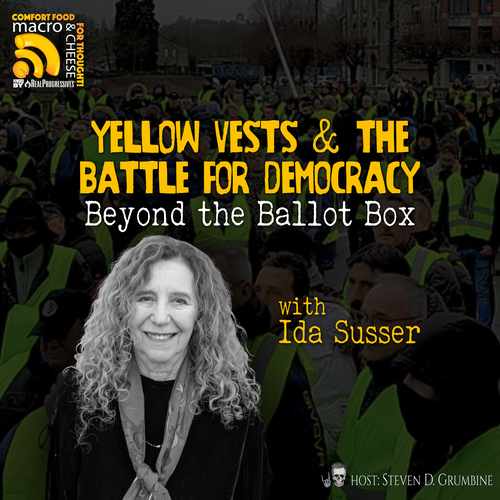
Episode 382 – Yellow Vests & the Battle for Democracy: Beyond the Ballot Box with Ida Susser
FOLLOW THE SHOW
What happens when the people stop waiting for elections to solve their problems? Steve talks with anthropologist Ida Susser, author of The Yellow Vests and the Battle for Democracy: Taking to the Streets of Paris in the 21st Century. They look at both the possibilities and limits of grassroots activism.
**Every Tuesday we hold an online gathering where we listen to and talk about the episode while building community. Share your insights and questions as we educate ourselves and each other. Macro ‘n Chill, June 2, 8pm ET/5pm PT. Register here: https://us06web.zoom.us/meeting/register/OEYtu7v-SciBITwiIWwdzw
A frequent theme of our podcast revolves around the contradiction between formal political rights and the material realities of the working class. This week, our guest Ida Susser talks to Steve about the French Yellow Vest movement as a reaction to the contradictions of late-stage financial capitalism which has systematically gutted the welfare state, dismantled public services in the provinces, and further abandoned the universalist promises of the French Republic.
Ida, an anthropologist, is author of the book The Yellow Vests and the Battle for Democracy: Taking to the Streets of Paris in the 21st Century.
Moving beyond the liberal fetish of the ballot box, the conversation explores how the Gilets Jaunes, or Yellow Vests, built horizontalist, leaderless power from the grassroots. They blockaded traffic circles, constructed makeshift commons, and forged bonds of class solidarity across regional and ethnic lines. Ida contrasts this bottom-up mobilization with the top-down, cultish nature of MAGA; she points out that the French movement’s refusal of vanguardism did not prevent it from “thresholding” into a broader, anti-neoliberal bloc.
Steve introduces the MMT lens to expose the ideological confusion around taxation and public spending.
Is it possible the Yellow Vests’ defense of the social wage and their rage against the Macronist oligarchy represent a necessary, if incomplete, rehearsal for working-class power?
Ida Susser is Distinguished Professor of Anthropology at Hunter College and the Graduate Center, CUNY. She has conducted ethnographic research in the U.S., Southern Africa and Puerto Rico, France and Spain with respect to urban social movements and the urban commons, gender, the global AIDS epidemic and environmental movements. She is the author of numerous books, chapters, and articles, including The Tumultuous Politics of Scale (Routledge Press, 2020) co-edited, and Norman Street: Poverty and Politics in an Urban Neighborhood (Oxford University Press, 2012. Her most recent is The Yellow Vests and the Battle for Democracy: Taking to the Streets of Paris in the 21st Century. (Routledge, 2026).
Steve Grumbine:
All right, folks, this is Steve with Macro N Cheese.
I am going to be talking about a subject that I think captured most of our imaginations a few years back with the Yellow Vests.
Right now we are going to be discussing a book called The Yellow Vests and the Battle for Democracy: Taking to the Streets of Paris in the 21st Century by my guest, Ida Susser. And let me just introduce you to Ida Susser.
Ida Susser is a distinguished professor of anthropology at Hunter College and the Graduate Center, City University of New York, has published on popular mobilization, social movements, and the urban commons in the United States, Europe and Southern Africa.
Her books include: Norman Street: Poverty and Politics in an Urban Neighborhood in 2012 and co-edited volumes Rethinking America in 2009 and Wounded Cities in 2003.
Now, I want to stress, because she went to great pains to do this, that a PDF version of the book we’re going to be discussing today [Yellow Vests] is available at no charge. The book is available for free on open access at www.taylorfrancis.com.
So I do hope that you will take the time if you can’t buy it, she’s made it available for free. So definitely download this book. And without further ado, let me bring on my guest, Ida Susser. Welcome to the show.
Ida Susser:
I’m very happy to be here.
Steve Grumbine:
I am very happy to have you here. And folks, for those that don’t know this, I want to let you know we tried to do this last week.
We had some bad technical problems, but Ida was kind enough to reschedule.
So, Ida, the book that we’re talking about today, I mean, I remember the interests of my friends here in the US who had seen this happening, and they got into their head that we’re just going to take to the streets and everything’s going to change. And I warned, I said, you know, you gotta have more than just an interest in taking to the streets.
You gotta have demands, you gotta have support for one another.
There’s gotta be the ability to stay on strike or these things don’t really carry the kind of weight you’d think they do if, you know, coming from a union background. I remember what it was like when the CWA Local 2222 was on strike with Bell Atlantic at the time.
And how after about the first week of being on strike, you started seeing strike breakers crossing the lines.
And it wasn’t that they weren’t in solidarity necessarily, but they were desperate and their families were hurting and so they ended up crossing, you know, the picket line.
And, you know, Yellow Vests in France, the entire, the entire place in France is so different than the US. I mean, they have a history of labor, they have a history of struggle, they have a history of really going from phases in development.
You know, we kind of started in the US as a slave owning country and so forth, but we didn’t have the same kind of rising from monarchy to, you know, so called democracy, etc. that they did in France. Tell me what drove you to write this book.
What about the Yellow Vests captured your mind and captured your attention and made this something you wanted to pursue?
Ida Susser:
Okay, well, you gave a really detailed, good intro to the sorts of ideas of the book, which tries to follow through history and up to the present to try to understand why these things were happening in France and what were their consequences.
And I was in France already or going to France a lot because as an anthropologist, I was trying to do field work with popular mobilizations like Occupy Wall Street, like in Spain, the 15-M or Indignados. I was interested in looking at what were the contemporary social movements and how are they different?
As we had passed the terrible crisis, recession of 2008, did people protest differently? Did they look at the world differently? And anyway, what could we do about it?
What could be a transformation in the direction of social justice under the current conditions, which I began to call and other people were calling, it became a regime of financial capitalism, not industrial capitalism.
So you couldn’t just rely on the wonderful unions that you were talking about, the way, you know, you could shut much down if you were at the point of production. But many people were in flexible jobs, part time, separate places, at home, commuting.
So I wanted to understand, like in this era, what could be the kinds of mobilizations that we saw and then what were their consequences? So I was in France, I was also in Spain because of what had happened there. And as you mentioned, I had long. I’d been working on since the late 1970s.
I had been studying worker and neighborhood struggles in the, in New York City. So I wanted to understand what was going on in these other global cities like Barcelona, which was all tourists, even more now.
But even then, more tourists than residents. And what was happening in Paris, another global city. So here came the Yellow Vests. And honestly, everybody was astonished.
I mean, it was absolutely unheard of in Paris that people from the provinces, hundreds of thousands, showed up on the Paris streets on Saturday, November 17, 2018. I mean, the Parisians were terrified. The government was in shock, traumatized, and nobody knew what this movement was about.
And as you said, they were not organized like a union movement. So it was a mystery. And the first I went, I flew, I flew to Paris, although I had meaning to go to Barcelona.
But I had to come and see this new movement. And it was just mysterious. It was an enigma.
I went to a debate between or conversation panel with Antonio Negri and Etienne Balibar, who is an anthropologist, French anthropologist, and they were looking at it.
And of course, Negri had been at the first demonstrations in Madrid, which was the Indignadas, the first European squares movement after Tahrir Square in 2011. And he had been there and I interviewed him later and he said to me that was the most amazing experience of his life.
And so when he gave the talk in Paris in I think in early 2019, when I arrived, he said, “This is exciting. It is spontaneous. It follows the ideas that we’ve always had about mass demonstrations. Just follow them, join them, be with them.
They know what they’re doing or they will know what they’re doing. Spontaneity.” So Negri was very excited and very supportive and thinking of it as a movement towards social justice transformation.
Balibar, who probably was more informed of the history of France, said, “Yes, yes, it could be just what Negri’s saying, but it also could be a right wing movement, because we had experience in France of right wing movements from the provinces around the same issues and which had been actually supported by large corporations after a while and had become very nationalistic. And what I call exclusive or groups that are exclusive are things like racist or antisemitic or hating certain groups. That’s an exclusive movement.
Whereas an inclusive movement, which I regard as progressive, includes other groups who should have common rights. They fight for the common rights, universalists. So Balibar wasn’t sure. He said, “We have to watch right now, we don’t know.”
So I went to this and I had been seeing this movement in the streets and I thought, this is just so unusual. I really, really have to focus on this movement, which is such a question to everybody.
And that’s why I began to concentrate on what they called the Gilets Jaunes, the Yellow Vests.
Steve Grumbine:
It’s very powerful. One of the things that I’ve noticed in my journey as I move leftward has been that we have lost sight of what class dynamics are.
We have slipped into this identity-based politic that has alienated each other from each other, quite frankly, my rights, my personal this, my personal that, and the entire US version of politics has devolved into that. And therefore, when you hear things like, “Oh, they might be a right wing movement” or whatever, you have to really dig a little deeper here.
And obviously the people that were in the Yellow Vest in France, you know, they were made up of many, many different working class people.
And it was universal, it was a working class movement regardless of whether or not all the demands would have met the test for, you know, what some might consider to be acceptable or what have you. The point was they were all fighting for a common goal, a commons, if you will, for the public.
It wasn’t unique to one ideological frame or the other. It was about the people.
And I think in, in particular, we always look at how, you know, movements abroad might reflect on the United States and then the US we are so hyper-partisan, so bought into the theater of the duopoly that working class people, you know, are judged by, “Oh, are you, are you MAGA or oh, are you a centrist or oh, you’re an ultra-leftist, you know, you’re a nihilist…” Whatever. So there’s all these weird little ways of parsing the working class in the United States in particular, but over there it was, it was universal.
It was about the public space, the public commons, the public in general.
And I wonder if you might be willing to take kind of a step back and kind of contrast that cultural phenomenon that you saw over there with what you see within the United States.
Ida Susser:
Yeah, that’s a very important point.
I did in the book think about this, because I was living in the United States and you know, we had had all kinds of movements and just as you say, they had been very divided, segmented. And I saw this movement in France and let me just say, to begin with, they were people from the provinces.
And in France, you know, when they come from the provinces, they’re sometimes thought of as what you might say. They don’t use words like race, but French origin or French descendant or white in this country.
But there were many people who joined it who were maybe of origin, Arabic.
Because in France, Algerians have been coming to France for a hundred years and have many, many names, you know, those kind of names or also the question might be, you know, was it really, really racist? It just didn’t mention it.
I think as an American or as someone familiar with the United States, I had those questions and I was very, very, very concerned to look at that. And I did follow the Yellow Vests for the next five or six years as they transformed in different ways. And I met people of all different backgrounds.
And this is something I wanted to put into the book because me, myself, I was familiar with something different. I was familiar with the United States, where, you know, the MAGA movement, maybe they appear racist or they are, they are in many ways race whispers we say that Trump has race whispers.
But like among the Yellow Vests, once you put on a yellow vest, and a yellow vest, let me say, is what every French person who owned a car was required by law to have, because it’s what you were supposed to be able to put on your back, you know, like construction workers when your car broke down so nobody would run you over. It was a protection, let me say this, a protection of the state. The government made the law that you had to have a yellow vest. And guess what?
People appreciated it. They used that as a sense of protection. They were not opposed to the welfare state, they were not opposed to being protected by the state.
They were furious and enraged that the government was taking away their government services. They were losing the state, as they said.
But they very much appreciated all the benefits and recognized that their taxes were supposed to go for their benefits. And it was all in together universally for everyone.
So they had a very different attitude about these things than we do or many people do in the United States.
Steve Grumbine:
It’s interesting because one of the core tenets of this podcast and the work we do is based on Modern Monetary Theory.
And within that space we’ve come to understand that currency issuing governments don’t really require an income per se, but they need us to require their currency. So they tax in it.
And that’s the only way that their currency maintains that kind of value and the, the hegemony of their currency within their culture. And when I think of, you know, like in the United States, most people are doing battle over where their hard earned tax dollars are going.
When the good news is your tax dollars are going absolutely nowhere, at the federal level, they’re literally deleted. But as far as it goes, these taxes are what maintains the viability of the currency.
It’s what maintains the monopoly power.
And so when you think about like where the battle lines are, in the US as an example, we are hyper-stressed about not wanting our tax dollars to go here or go there or help this lazy person or drop that bomb.
And reality, the people that run our country, the oligarchy that makes the decisions, I mean, they know this, they understand the way the currency operates, but they keep us divided over that sort of thing. In France, I mean, the French are on the Euro.
And the French, you know, while they don’t control their own currency anymore, they’re no longer on their own currency or on that Euro, that shared currency.
It is still the idea that their tax dollars are going to X, Y, Z, that sense of ownership of what’s happening, and the idea that they were depriving them of things that they had grown not only accustomed to, but had become dependent on as part of the way that they had structured their lives. Can you talk a little bit about the spark, if you will, within that the fuel taxes and describe kind of what kickstarted this?
Ida Susser:
Yes.
So in the spring, in the late spring of 2018, their new president, who’d been just elected six months earlier, Emmanuel Macron, decided to put a tax on diesel. Now, diesel was the only kind of gas in Europe or in France that was not taxed, and it was the gas that poor people used.
They bought diesel cars, cheap diesel cars, in order to avoid the incredibly high costs of gas. Americans don’t have that. Nothing like. So gas was extremely expensive, and they bought diesel and bought diesel cars in order to lower their costs.
So the other thing was that meanwhile, the government had shut down a lot of public transportation, like trains to the village. They had shut down the resources for schools near the village.
They had closed down post offices, they had closed down hospitals so that you had to drive like an hour to get, if you were pregnant for maternity care. If you lived in the provinces, well, if you didn’t have a car, you wouldn’t survive. So everybody, however poor, had to have a car nowadays.
And they had bought these very cheap diesel cars that took diesel gas. So Macron put a tax on diesel. Well, this was outrageous, this tax on diesel.
They’d been steered in the direction of diesel because they were told, this is the only one that’s not taxed. And here they were getting a tax.
So right in the very beginning, a woman who was from Martinique, what we would call a woman of color from Martinique, sent out an email. She was a civil servant, across emails, saying, we must petition, we must start a movement. We can’t have this diesel tax.
And by the end of the summer, it had become on Facebook.
But people were taking their yellow vest and putting it on the front of their cars, on the windscreen, truckers particularly, and normal people on their cars. So they were seeing each other in the provinces with these yellow vests on their cars and waving to each other. And so it became a common recognition.
And then within, like September, October, they started to wear the yellow vest and to build actual cabins in the traffic circles, wooden cabins to occupy the traffic circles. And sometimes the trucks or the cars would block traffic in opposition to this diesel tax.
And as people began to wear these yellow vests and meet at these traffic circles and build themselves cabins, they started to talk about everything, not just the diesel tax.
And they started to talk about how expensive things were, how they couldn’t feed their children, people with disabilities came, people on wheelchairs. I saw one woman who had a hard time talking. She had three children, no job, she couldn’t feed them.
So there were many different groups that came or people that came and families to these traffic circles and these cabins and began to share their very, very, very difficult conditions, economic conditions and personal family conditions in ways that nobody had done before or nobody had done very much with anyone wearing a yellow vest. And very soon it was like the yellow vest was your badge of honor.
If you had a yellow vest, you would talk to and accept and bring in anybody else who was wearing a yellow vest. It was like joining a group where you trust the other person.
So throughout the provinces, people were meeting in these traffic circles and wearing yellow vests and they became a group.
And then, although they had begun to understand that they were angry or they knew they were angry and raged and they were blocking traffic in the provinces, nobody noticed. It didn’t even get in the newspaper. So not in the national. So they decided on November 17, 2018, that they…
That was six months after the movement started, or I don’t know how many from May to we can add up the month. And they decided that they would meet on a Saturday afternoon in Paris. And that was when 300,000 people ran into Paris. [Wow.]
Steve Grumbine:
I mean, it’s amazing to see real mass mobilization. And it wasn’t over in five minutes, was it? I mean, they kind of create. And you place this into the book very nicely.
You talk about commoning and commoning in practice. I mean, were practical actions like barricades and emotional bonds more central to building this alternative democracy…
I mean, to me, when I see things like that, I say to myself, yes, you know, this, this idea that you’re going to just go to the ballot box, slap and I voted sticker on your forehead and call it a day isn’t getting it done. We’ve got proof. We’ve got years and years, election after election after election of evidence.
But over there, they sat there and they showed resolve and they stayed. I mean, this went on for some time. It wasn’t a flash in the pan.
Ida Susser:
It went on till March 2020, when we had the COVID shutdown here and in France, every Saturday.
Steve Grumbine:
It’s amazing, isn’t it? I mean, like, there was a fullness, if you will, of commitment to the cause.
Do you feel like the cause itself was what was bringing people there, or was it more like people were just sort of joining with the flavor of the day? Where do you think the motivations were for people?
Ida Susser:
I think people were really struggling and really angry and in that way, in that way, that rage I think we can see here in this country. But not the same resolve to work together.
Steve Grumbine:
Yeah.
You know, when I see the MAGA movement, you know, I am very much on record on this podcast of literally, like, I have got a placard, you know, encased in glass, that I hang around my neck, referring people to the Gilens and Page study from Princeton. And I’ve got some haters out there that’ll say, “Read a book, Steve. It’s just one study.” It’s one very important study. And your eyes.
Your eyes have the ability to see the truth in the study. History has a way of showing you there’s always a rotating villain. There’s a parliamentarian waiting around every corner.
There is some random [former Senator Joe] Manchin or [Senator John] Fetterman or somebody waiting, a Cory Booker waiting to sabotage something. It’s always there for the taking.
And the US, I don’t know whether it’s because we’re in the imperial core and we’re more comfortable than the rest of the world is simply because we predate upon the rest of the world. Maybe we’re fat and sated with luxury in the sense of comparatively?
But at the end of the day, you know, it’s quite obvious that there is rage and there are some that are tapping into it.
I mean, I am 100% against MAGA and I’m 100% against the Trump regime, but I don’t really know that it matters, because at the end of the day, both of them were funding Gaza, funding the slaughter of the Palestinians. So in my mind, I didn’t vote for that. But yet this is what we got. So I understand the rage.
I think it’s misplaced in the way that they’re going about it. But at the end of the day, an illegitimate government should be more than enough to get us together.
But there’s something fundamentally different between us and France, and there’s something fundamentally different between us and the rest of the world. And I think maybe it has to do with empire, maybe it has to do with being in the imperial core and getting the fruits of everyone else’s labor.
I don’t know.
I put that out to you as a thought, but I also come back to the idea that obviously they created, you know, some form of, I don’t know what the right word for it is, but like they created kind of their own society, they created their own culture within that space, and that became their identity. That became kind of their rallying cry. And they didn’t sit there and say, “Well, are you a this or are you a that?”
They just were like, “Hey, we’re here to fight this thing.” I mean, what are your thoughts on that?
Ida Susser:
Yes, I would say first of all, that the difference I see between MAGA very much, and I talk about this in the book, between MAGA and the Yellow Vests. The Yellow Vests were from the grassroots, as I described it to you. It grew for months and months before they appeared in Paris.
And they had very, very strong feelings of what you might call horizontalism, that you do not have leaders, that you do not follow leaders. So, you know, the MAGA movement has a cult around Trump. And it’s almost like being called from the top down.
He called for that January 6, he had the speech, he called them. So it was called from the presidential level.
And the funding for MAGA has many different, you know, if you go back to the Tea Party, for example, that was often called Astroturf because many senators, Republicans, et cetera, funded the Tea Party. It was a middle class movement. And a lot of people that vote for Trump are not the poor and enraged, they’re the upper middle class.
If you look, you know, where the bases are, they’re very much also people with a lot of money. Like, also look at the current, you know, what do we call them? Tech-feudalists or techno-feudal? You know, very, very wealthy. Paying for the…
So I think that’s a top down. And the Giles Jaune was a bottom up movement. And that’s hugely different. It’s also accessing the same rage.
But what we’re seeing here in America is the use of that rage on the route to building fascism, destroying people’s public voices. You know, like you saw the shooting in Minneapolis of the militant activists and the shooting of people in the street.
So I do not think that the Yellow Vests are like they’re coming out the same rage, but they’re not being led from the top down. And that’s huge. That’s very huge. And they haven’t chosen a populist leader. They’re not followers. And I think that’s really a very big difference.
And why you could see that when they met there and talked about their needs, and first they talked about not having enough food for the end of the week, and then that was more than just the diesel tax. And they recognized that among each other or the end of the month. And they had a slogan about the end of the month.
And then this is what I call “thresholding”.
They crossed with the environmental movement because the President, Macron, had said that they were anti-environmental because this diesel tax was supposed to be for the environment. But as you know, taxes don’t quite go like that.
And in fact, if anything, it was only about a quarter of what Macron was raising that would go anywhere near the environment. But he said it was environmental and that they were anti-environmental. But actually, many Yellow Vests were pro-environmental.
So there was environmental movement one Saturday afternoon in Paris, they had a march. And the Yellow Vests joined that march. That’s what I call thresholding.
Meeting at the door, at the front door, at the lobby, the threshold to join with another group. And after that kind of meeting, they changed their slogan to from the end of the month to the end of the world.
They began to understand many more issues as they joined together, as they came into the central cities, as they began to see the issues in a much broader framework. And that came from the grassroots. It came from hanging out together, from crossing thresholds, from being at the front door with each other, meeting.
And I think it was a long, drawn out process of learning, and interacting, and understanding, rather than a top down, cultish leadership, that led the Yellow Vest in a direction, much broader, universalistic direction of social transformation.
And I think that’s really crucial because when they started, they had never been on demonstrations before. Many of them had never seen Paris. They didn’t know their way around Paris or the main cities.
They came into Paris and they ran straight to the Arc de Triomphe and where the rich people were, the Champs Elysees, the most fancy shops in the world, really, you know, the flag shops or whatever you call it of the fashion world. That’s what France makes its money on. So that’s what they saw themselves as fighting: the wealthy, the elegance, the people who spoke differently.
The people who walked differently, people who ate elegant food. Like you might think of France as gourmet restaurants. But the Yellow Vests never went and could not afford gourmet restaurants or Chanel Number 5 scent perfume, or the kind of bags, all the things that France sells as its most important industry, the fashion industry. The Yellow Vests were nothing like that. And so they came to Paris to show that there were other issues.
And they came in their, you know, in their sneakers and with their sliced white bread and their cheap sausages that they made in barbecues. And they said, “We’re here, we’re here. Listen to us.”
And as they came together in all these different ways, they began to feel a much broader universal battle against the cutbacks which were going on in France, but also elsewhere of the welfare state. The cutbacks in healthcare, cutbacks in transportation, the cutbacks in education.
And the teachers and the nurses and the doctors and the professors all joined the Yellow Vests.
I met a guy who was a hospital administrator who had joined the Yellow Vest because they understood the common cause of the destruction of government entitlements.
The French earn a lot less than we do here in the United States, but they actually have a lot more because they can never go bankrupt from healthcare needs. You know, they have access. Everything they need is free. An operation, appendicitis, you broke your leg, you don’t pay for it.
It’s part of what the government provides, and you don’t worry about it. Everybody has a pension. So there’s a very strong welfare state that was being destroyed. And that’s what they were completely against.
That’s another way. And they were so different than the United States. They wanted to preserve their healthcare free. They wanted to preserve their public schools.
Intermission:
You are listening to Macro N Cheese, a podcast by Real Progressives. We are a 501c3 nonprofit organization. All donations are tax deductible. Please consider becoming a monthly donor on Patreon, Substack, or our website, realprogressives.org. Now back to the podcast.
Steve Grumbine:
You know, when I think about public services in the United States, we have conditioned, and I believe this is a Gramscian moment.
To go back to one of the quotes you used in the beginning of your book.
I mean, we have had the scolding of and shaming, if you will, of “being on the dole” of receiving public support of you wanting free stuff and all these things that go into the way our psyche as Americans operate. And so when you think about what France did and what France is, I mean, I think to myself, wow, what a difference between what we’re sold as democracy and what democracy really looks like in action.
Again, I keep joking around in my day life and other things that I do, talking about slapping an I voted sticker on the forehead, doing a selfie, putting it on Facebook, telling everybody, “Hey, I voted.” These folks understood that they were not being represented, that their interests were not being represented.
And [French President Emmanuel] Macron had taken steps that if he had spoken to the people that he was supposed to represent, and I think showing the fracture of that lack of representation, you know, he would have probably never done that. In the United States we are blind to the very nature of what I just said. The idea that none of our interests, none of the things that we ask for and demand, etc., are even remotely- how do I put it- we are not represented at all. We do not have representation.
So going through the, you know, the cattle run to go to the voting booth and walking out feeling self-fulfilled and wondering why nothing happened, you know, it still hasn’t dawned on people.
And I don’t know whether that’s because they’ve been so guilted into believing that if they want something that it’s just because they’re a moocher or the Ayn Rand objectivist nonsense of makers and takers or whatever. But it’s so indoctrinated in American culture that you’ve got to be the self-made man, that you’ve got to be on your own.
Don’t look to anybody for help because there’s nobody there anyway. Government is only there to put you down. And to be fair, government hasn’t done its job in the United States.
Or maybe it has done its job and we’ve just had a faulty understanding of what we believe government to be.
But over in France, they clearly went out there and said, “Look, whatever happened at the ballot box notwithstanding, you’re screwing us and we’re going to let you know about it. And we’re not going to make life easy on you. We’re going to make life hell.”
In the United States, we tried to do some of that during the Biden administration. We had people at the universities fighting the funding of genocide and they were met with militarized police.
I mean, everywhere you go, I mean, we had railway strikes. I mean, AOC herself voted to end a railway strike or not allow them to strike.
We have in this country a very, very skewed, flawed understanding of what it means to be people, human beings, workers. And we keep looking to these elected officials to just do it out of the goodness of their heart.
When in reality, study after study after study is shown. I mean, this No Kings thing to me is so misplaced. It should be No Capitalists that should be focused on No Oligarchy.
But, hey, fine, No Kings, whatever. But if you look, this is not just a phenomenon under Trump. This has been going on for a very, very long time.
I mean, I think to myself, when Biden refused to stack the court, when he could have preserved Roe v. Wade, if that was his intention, he said, “I’m not going to reform the court.” He could have easily done that, chose not to.
Obama took the public option right off the table, even though that’s what everyone wanted, was the public option. He didn’t even have it. He had a freaking super majority, and he still took it off the table.
Because our government serves Capital, not we the people.
And that’s “good guys” that did that, the bad guys playing the role to absolute perfection are out there doing all the evil things that we know them to do just long enough for us to get so sick of it that maybe, maybe public opinion will say, “Hey, bring back the other guys.” And then you got Gavin Newsom ripping down homeless encampments.
So it’s like, I think people have to get past their idea that going into the ballot box is the be all, end all of democracy, and start thinking about how the Yellow Vests were able to affect change. And, sad that the pandemic stopped what was going on there, because that could have been a wildfire for the rest of the world, honestly.
What are your thoughts on that?
Ida Susser:
I think they already were having an effect, even though they were shut down 2020. And there’s lots of things that happened since then that I think that reflect their movement.
What I would say historically is that a ballot box alone is not gonna work. We’ve seen that over and over.
However, I do believe that movements that, say, there were huge social movements during the Great Depression and unions were formed and Roosevelt floated on that power, and that’s why we have Social Security and that’s why we have help for mothers and children.
We have a lot of things that we may yet lose that came out of the social movements of the 1930s and the Union movements and the votes, you know. So I do think that it’s a combination, and I completely, completely agree with you that the vote alone will get us nowhere. And I think that things like Black Lives Matter in 2020 in the US turned around the COVID treatment, the COVID prevention.
So that in the beginning it was black people and Native Americans who were dying of COVID and after the Black Lives Matter movement, they forced the government and everybody else, neighborhoods and healthcare, to recognize these needs and to provide the care that you needed. And they changed the figures on that.
It stopped being just the poor and the, you know, there was a recognition that the government or whoever was providing healthcare had to focus on groups that had been neglected. And in fact, the whole pattern of COVID 19 changed after that. So I do think that social movements are totally. You have to mobilize.
You cannot rely on your vote, just like you were saying. I really, absolutely believe that.
But in what I talk about in the book, I talk about there being three kinds of commons, which would include unions and political parties. The movements have to work together, and the taking over of urban space as they did things like blocking tolls.
Also, you need to develop, like within the art world, a way in which visions become spread through art, through actors, through painters, through street performances.
So I think I talk about needing all of those ways in order for people to begin to rethink where they’re going and where their government is going and what they need to do. And you are right that in France, even when they voted for the Socialists, whom they believed in, many people did, they lost.
Macron was originally the president, a Socialist, and he was the finance minister. And they managed to destroy many of the labor laws that maintain the Welfare State in 2016, under the Socialist government, with Macron as the head of the finances out of the banks, Macron from the bank. And then Macron was elected in the next round, not as a Socialist, but as a capitalist center.
So what I’m saying is the French could see very clearly that neither party at that moment was defending the welfare state. And that’s why they came into the streets, was very aware that they had to do something. And I think they did form a kind of a bloc.
They forced the Socialists to rethink, as they had in Spain also, to rethink what they were doing, to rethink the kind of turn of destroying, you know, the shrinking state of neoliberalism, and that if they wanted to come forward and have a population that voted for them, they had to also listen to the grassroots movements. So I think grassroots movements are absolutely essential in any democracy. And you have to fight for your right at every level.
But I also think that within that people like, for example, there is a Left political party, there’s a bunch of them in France right now.
And for a while, after all these movements, in 2024, when President Macron called a snap election because the extreme Right, the parties with fascist legacies, were doing well, he called the snap election.
And within three weeks, the Left who support the welfare state, that would be the Socialists, the Greens, the Communist Party, and what they call diverse Left groups, which could be anything… Trotsky… who knows, but there are many of them, in France, got together and called themselves the New Popular Front.
And when the elections came three weeks later, which Macron thought he would win because it was so quick and he was all organized, in that election, it was not the right wing, fascist legacy parties that won.
It was the progressive New Popular Front, which the coalition of the, like I said, the Socialists, the Communists, all the other Left groups, they won the most seats in the Parliament, in the Congress, what they call the national assembly, in that three weeks, they managed to get it together. So I think that was very important in blocking Macron’s forward movement to cut back the state, to do the things he was trying to do.
And after that 2024 election, he could never, ever get his budget passed. He just couldn’t get it through because it was too devastating to the social services that people believed in.
So I think that was a legacy of the Yellow Vests and the cascade of movements that they joined and inspired, including the union movements after 2018.
Steve Grumbine:
You know, it’s very interesting. I think it’s really important to frame these things through a historical lens as well.
And, you know, when we go back to the New Deal and the things that happened during the ’30s and even in the teens and the ’20s in the United States, we witnessed across the pond and then some, the Bolshevik Revolution. And that Bolshevik Revolution created a chasm, a fear, a huge delta between the working classes and the ruling classes at the time.
And there was tremendous fear for the 10 days that shook the the world. And there was great many reactions to that out of fear.
And I believe between, you know, Keynes and FDR, I believe that there was a tremendous amount of, “we better placate these folks before capital loses any sense of control, and we completely fall way to a worker rebellion and maybe even a revolution, you know, for the working class to take over.” So I believe those concessions, even though, you know, I am on the Left of that side saying, you know what?
These were concessions, they weren’t out of the goodness of his heart. These were concessions to fear that was coming based on the world saying, “We’ve had enough of this.”
And the idea that they could see that there was another way. And I think that, that is kind of a, a lighter story, if you will, with the Yellow Vests, and that here we have this situation.
And it wasn’t out of the goodness of Macron’s heart or anyone else’s that change happened. It happened because the people went outside of the officially accepted channels and said, “We are going to make things very difficult on you.”
And the one thing that capital wants is for commerce to take place without a hitch. They want smooth transactions, they want mass accumulation, they want all kinds of transactions.
And we’re going to make it really hard for you to pull that off. I think that there’s a lesson to be learned there. And you could see that from the early labor movement.
Those folks that fought, they didn’t just fight at the ballot box, they died. They went out there and put their lives on the line because they felt like there was something worth fighting for, worth dying for.
And I’m not suggesting that we should all line up to die here. That’s not the point I’m making.
I am making the point, though, that the milquetoast electoral-mindedness that we have allowed ourself to atrophy into is not producing the kind of results that we saw during FDR’s time.
It’s not producing the kind of results that the Russians who had finally, after being thrown to the wolves with czars and having all the death that came from World War I and so forth, we don’t need that kind of tragedy, I don’t think, or maybe we do, to get people to realize that the pathway to making the change that we claim we want and we need is going to come outside of the “acceptable channels.” The channels that oligarchy has prepared for us to, to scream into a pillow are not the ones that actually produce the results.
And I think that, you know, the work you highlighted here, I mean, these folks, I think they realized their power.
I think they realized once they started coming together that they were stronger together than they were as a bunch of separate individuals running around like a bunch of pinkies, behaving like a fist. And you saw change happen. I don’t know. What are your thoughts on that?
Ida Susser:
I absolutely agree. I’ve been studying America for a long time, and I’ve seen many social movements, you know, like in ’68.
And I think that Americans are completely aware, or like I mentioned, Black Lives Matter, completely aware that it’s not only the vote. You know. Yes. You know, you can write a letter to your senator. I’m not opposed to calling your senator.
You know, I have on my telephone that thing, make five calls or something. But I’m totally in favor of anything. And I don’t think Americans are unaware of that.
I think perhaps one reason I wrote this book was that my students seem so discouraged. And it’s not that they didn’t know about social movements, but they somehow didn’t feel that anything was possible anymore.
And I even think that in ’68, when I actually was in college, so then we were so hopeful. We thought we were changing the world. I don’t see our students like that now. And I think that loss of hope is extremely problematic.
I think we need to have a sense of vision that we really can make a difference, like you’re saying, just the way you’re saying. And I wanted to see what was the long term effects of these kind of unruly movements, which seemed to be what was happening in New York City.
It’s what was happening in Barcelona, it’s what was happening in Paris. So why were these unruly movements happening and horizontalist and without clear demands and obviously often not saying their names?
The Yellow Vests wrote messages on their backs so that all the photographs I took and the media took were from the back so that they didn’t want to be exposed, you know, their faces.
And even with Occupy, people would write signs, Occupy Wall Street, they’d write signs on cardboard and they’d hold it in front of their faces for their messages so that you didn’t take a picture of their face, you took a picture of the sign in front of their face.
Steve Grumbine:
I’m a Grateful Deadhead man.
I was born in ’69, so I didn’t get to experience some of the glory during its heyday, but I did get to live on the vapor trails of it going, you know, going through the ’70s and ’80s and into the ’90s. Rest in peace, Jerry and Bob and the gang here.
But, one of the things that I have come to know, notice really, because I enjoy music very much and I enjoy kind of that free spiritedness of the hippie movement and kind of the way that the Dead, you know, pushed away the ideas of corporate sponsorship and whatnot. And then they ended up becoming this monstrous thing because they had created their own ecosystem, they created their own kind of world.
And to this day, people still identify themselves as Deadheads. But if you look, I think what has happened and, you know, I tell my kids this and they think, they roll their eyes at me.
But the reality is, is that things were much freer then, it was freeform. You didn’t have rote. Here’s the way the song goes. The song will be 2 minutes and 36 seconds. It’ll be radio friendly.
We’re going to build you in a lab. We’re going to focus test whether this band should be a thing. I mean, bands had a message back then.
Bands were out there as part of a social movement. And now everything is very much cordoned off. You’ve got more media than ever, but it’s saying the same thing.
You’ve got very, very limited choices in terms of ways to expand your mind. And back then, you know, I am a very, very supportive psychedelic guy.
And the idea of psychedelics waking people up to a different alternative reality. I’m not here to tell people to go rush out and get mushrooms or take, you know, acid or anything like that.
But there was a time of experiment and a time of people not just going along to get along. They were checking out, you know, I mean, they were really, truly saying, “Hey, this matters to me. We want the end of the Vietnam War.
There’s no reason for you to be killing our people. There’s no reason for this draft. There’s no reason to be slaughtering those poor folks in Vietnam.”
And like, there was just a real ability to be free and express those things. And yes, Kent State happened and yes, there was horrible stuff going on with the civil rights movement, but people were ready to fight those things.
And I think to some degree people are ready to fight now, but I think it’s much smaller because the stakes are so much higher now. The economy has become so much more volatile and people are afraid to lose their jobs.
And so that means that they can’t just vanish off and go into the streets because if they do, they’ll lose their home and now their kids and all the other entanglements that I believe capitalism has morphed and virused through to ensure that we are tired, exhausted, that the media that we consume is very, very in line with the messaging they like. And so we have lost a lot of that free spiritedness, that freedom, that willingness to go outside the norm, to not conform.
And I believe that that is a huge difference between what we see in the year 2026 and what was going on in the ’60s and ’70s in this country. And given the fact that you’ve gotten to live through both of them, I’d love to hear your thoughts on that.
Ida Susser:
Yes, I think there was much less… I grew up with the image of Hitler in my head. So for me and my generation, you know, I was born after Hitler, like you were born after ’68.
We’re very close to it, right? So for me and my generation, you had to act. I think some of us went, you know, too far.
And, like, that’s where I think some things are, the murdering, like the bombs that were set off and things like that. But that was a terrible image. Like, if you think that your government is doing bad things, you must act, because otherwise you’ll be like Germany.
That was the image in my head. That was what most of my friends were brought up with.
So ’68 and the Vietnam War, even though they had no British troops, I don’t think in Vietnam, but they had in Europe demonstrations against the Vietnam War before the Americans, because they were, like, closer to what happened in Germany. So there was this sense that you just had to demonstrate it wasn’t all about the draft, is what I’m saying.
But I think that that fear was a driving force for the ’60s. And also this sense that we had freedom and we were not going to lose it and go back to what our parents had suffered.
So that’s something that people today, maybe it’s too far back. And I think people today are not driven by the sense that if you don’t act, you will lose your democracy.
I think that that’s something that is not so urgent and needs to be, because I feel that no matter what, we need to demand our right to vote for something real. We need to demand that our political parties hear us. And I think people are doing that now, but less.
You know, for example, with the Tesla movements, they got rid of Elon Musk.
Now, I heard this why Rachel Maddow cheered me up last night, that those jails that they were building for, no trials, all over America, they’re being challenged so much that the government is beginning to drop the whole idea. You know, the one that we were talking about, alligators in Florida [Alligator Alcatraz], is actually not gonna happen. [Okay]
So I think that the movements that we’re seeing in all these different ways are very, very effective. And what we don’t know among ourselves is how effective.
And part of what I want to show my students with the Yellow Vests and with things that were happening in Europe is that, yes, there are consequences, good ones. If you go and you work out a way to demonstrate, you don’t have to obviously, go to the extremes. In fact, it probably doesn’t work so well.
But, you know, if you go out and I would call it, you know, resist in ways that block the usual forms of life. Like in France, people went and blocked the toll booth so that every driver went by for free, things like that.
Or the Suffragettes who stopped the horse races. You know, one of them [Emily Davison] got killed by a horse running over her.
The Suffragettes broke the rules all the time and they went to jail and some of them died. Those kind of movements are very well known, understood.
But what I don’t think our current, the current generation really understands is how effective they were. And that is what I wanted to be able to show.
Steve Grumbine:
Well, I think your book is excellent. I really appreciate it. I’m a little less hopeful on the electoral side perhaps, than you, but what I want to do is because this book is fantastic.
And folks, again, I want to make sure, you know, you can download this book for free. Again, it’s at www.taylorfrancis.com. A free PDF version of this book is there for you to download as you will.
I want to give you an opportunity, as we’re up against time, to give us the final word on your book and kind of give folks a message of hope or however you want to take us out.
Ida Susser:
Okay, well, for me, I did study the history of France and how these movements came out- the history. But I think America has a very exciting and important history of resistance.
And I think that fitting into that history, people today in this country can really believe and work towards change, obviously, beyond the ballot box. Obviously, we have about a year or so, that’s all I believe.
And maybe we only have till this midterm elections to really be able to talk openly, to be militant openly, to, you know, act and perform resistance today in ways that we will not end up in jail or shot. I think we don’t have that much time.
And I think it’s really, really important to be out in the streets to perform resistance in this next year when we still have somewhat of an open democracy, and to say your words, to make your plays, to make your banners, to block your streets, whatever it is that seems crucial to you and everybody, every society in every neighborhood invents their own creative resistance. I would say that this is the moment that you have free, that we are still living in somewhat of an open democracy and it isn’t going to last.
And I would try to focus on that for the next six months.
Steve Grumbine:
Very good. All right. With that, folks, I want to thank you for joining us today. I want to thank my guest, Ida Susser. My name is Steve Grumbine.
I am the host of this podcast, Macro N Cheese, and the founder of the nonprofit Real Progressives. We are a 501c3 not for profit. So we live and die on your donations. We don’t have some big donor dropping money on us.
We are just a bunch of volunteers following us where the information takes us, following us where our passions lead us. And hopefully we’re educating you through this process. And I consider today’s podcast wonderful and excellent. Appreciate you Ida for joining us.
Please consider becoming a monthly donor at realprogressives.org. You can go to Substack and become a donor there as well. You can also go to patreon.com/real progressives and become a donor.
Every Tuesday night we have what is called Macro N Chill where we discuss that week’s podcast and we’ll be discussing this one after it’s been released. So please consider joining us for Macro N Chill.
You can bring your voice, you can disagree in good faith, you can agree in good faith, you can build community with us. And you’re welcome to join us, Ida. I’ll let you know more about that offline.
But folks, please consider joining us for these this is how we grow, this is how we build knowledge, and this is how we build community and resiliency. So with that, on behalf of my guest, Ida Susser, on behalf of the podcast Macro N Cheese, we are out of here.
End Credits:
Production, transcripts, graphics, sound engineering, extras, and show notes for Macro N Cheese are done by our volunteer team at Real Progressives, serving in solidarity with the working class since 2015. To become a donor please go to patreon.com/realprogressives, realprogressives.substack.com, or realprogressives.org.
Extras links are included in the transcript.
Guest image attribution: By Alex Irklievski – Own work, CC BY-SA 4.0, https://commons.wikimedia.org/w/index.php?curid=186235762
Gilet Jaunes image attribution: This image was originally posted to Flickr by Carmelo DG at https://flickr.com/photos/37974559@N08/46642348481
Related Podcast Episodes

Related Articles
On Comradeship and Revolutionary Solidarity

Why Didn’t the Chicken Cross the Road?


Leave a Comment
You must be logged in to post a comment.