
Money, Class, and the Capitalist State
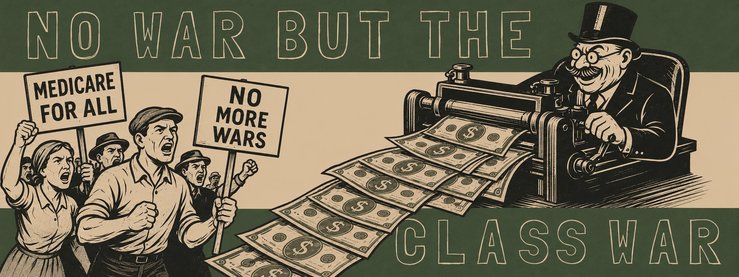
Few phrases have done more damage to public understanding of economics than the claim that the government must first “find the money” before it can spend. The image is deliberately primitive: politicians supposedly crank up a printing press, flood society with worthless paper, and irresponsibly squander money that belongs to taxpayers.
This story is not merely economically mistaken. It performs an ideological function.
It teaches workers to view the public treasury as something naturally scarce while treating the private accumulation of capital as limitless, legitimate, and beyond democratic interference. It tells society that healthcare, housing, education, infrastructure, ecological repair, and full employment are prohibitively expensive, even while the capitalist state mobilizes staggering financial resources for war, bank rescues, corporate subsidies, police power, and the protection of private property.
The question is therefore not simply whether the government can create money. It plainly can. The deeper question is who controls that capacity, which class benefits from its use, and what social relations the monetary system is organized to reproduce.
A currency-issuing government does not ordinarily collect dollars from taxpayers and then redistribute those same dollars through spending. When the federal government spends, it authorizes payments that result in bank accounts being credited. New state money enters the economy. When federal taxes are paid, money is removed from private accounts and extinguished as part of the settlement process. Spending adds dollars to the nongovernment sector; taxation subtracts them.
Money does not circulate through the federal government like coins passing through a household jar. Federal spending and taxation form parts of a monetary circuit. Calling public expenditure “printing money” while refusing to describe taxation as “unprinting money” is not serious analysis. It is a political morality tale disguised as accounting.
That distinction matters because the capitalist state is not financially constrained in the same way as a worker, household, business, municipality, or currency-using government. Those entities must obtain dollars before they can spend them. The issuer of the dollar operates differently. It cannot involuntarily run out of the unit of account that its own institutions create.
This does not mean the government possesses unlimited productive power. It means its limits are not primarily financial.
The real limits are labor, technology, raw materials, energy, infrastructure, ecological boundaries, productive knowledge, and the organizational capacity of society. A government can authorize any dollar payment denominated in its own currency. It cannot purchase resources that do not exist, command skills that have not been developed, or consume beyond ecological limits without consequences.
The phrase “How will we pay for it?” therefore conceals the questions that actually matter: Do we possess the workers, factories, hospitals, materials, energy systems, and technological capacity required to accomplish the task? Who currently controls those resources? What production would have to be expanded, redirected, or reduced? Which class would gain power, and which class would lose it?
Under capitalism, these are explosive questions because production is socially carried out but privately controlled.
Millions of workers collectively produce society’s wealth, yet the decisive means of production remain concentrated in the hands of a relatively small capitalist class. Investment is directed not according to human need but according to profitability. A hospital may be desperately needed and still remain unbuilt. Housing may be scarce while construction workers sit unemployed. Food may exist while people go hungry. Renewable energy systems may be technologically possible while fossil fuels continue poisoning the planet.
The barrier is not necessarily a shortage of money. The barrier is capitalist ownership and the power it gives one class to decide what will be produced, where investment will flow, and whose needs will be recognized.
Private banks also create money when they issue loans, but bank credit is structurally different from state spending. A bank loan creates both a deposit and a corresponding debt. The borrower receives purchasing power but also assumes an obligation that must be repaid with interest. Across the private sector, the financial asset is accompanied by a liability.
Government deficit spending can add net financial assets to the nongovernment sector without imposing an equivalent private repayment obligation. This is one reason public deficits cannot honestly be analyzed as though they were simply enormous household debts. The government’s deficit is, by accounting identity, the financial surplus of some other part of the economy.
Yet even this description remains politically incomplete until we ask who receives those assets.
A deficit created through public employment, universal healthcare, social housing, free education, pensions, and ecological reconstruction would have a different class character from a deficit created through military contracts, bank bailouts, tax reductions for the wealthy, privatization schemes, and corporate subsidies. Both may increase government spending, but they do not redistribute power in the same direction.
Money is not merely a neutral token exchanged among formally equal individuals. It is a social relation embedded within a definite system of property, production, and state authority.
The dollar functions partly because the United States imposes obligations, especially taxes, that must be settled in dollars. People need the state’s currency because the state demands payment in that currency. Taxation helps create demand for the monetary unit and establishes the state’s authority at the center of the monetary system.
But taxation is not only a mechanism for supporting demand for the currency. It is also an instrument of class policy. Taxes could, in theory, reduce inflationary pressure, discourage harmful behavior, regulate concentrations of wealth, and release real resources for public use. They can also be designed regressively, shifting burdens downward while protecting accumulated property.
The issue is not whether taxes mechanically “fund” federal spending. The issue is what taxes do to distribution, demand, resource use, and class power.
This is where liberal presentations of monetary sovereignty frequently stop too soon. They reveal that the state has greater fiscal capacity than conventional economics admits, but they often treat the state as though it were a neutral administrative machine waiting to be given better instructions.
Marxism-Leninism begins where that illusion ends.
The state is not suspended above society. Under capitalism, it is shaped by capitalist property relations and organized to preserve the conditions necessary for accumulation. Elections may change personnel, policies, and the intensity of exploitation, but the permanent institutions of the capitalist state remain deeply entangled with corporate ownership, finance, military power, bureaucracy, and the legal defense of private property.
The capitalist state can spend without first collecting taxes. It routinely demonstrates its monetary capacity when ruling-class interests are threatened. Banks can be rescued. Wars can be financed. Weapons can be produced. Financial markets can be stabilized. Corporations can be subsidized. The supposed fiscal constraints that paralyze social policy evaporate the moment capital requires assistance.
Scarcity is preached to the working class and suspended for the ruling class.
Austerity must therefore be understood not merely as an economic error but as a weapon of class rule. Chronic unemployment weakens labor, suppresses wage demands, disciplines workers, and makes people more dependent on employers. Cuts to social programs force households deeper into markets and debt. Privatization transfers public assets into private hands. Underfunded services are presented as proof that public institutions do not work.
This is not accidental incompetence. Austerity reorganizes society in favor of capital.
Unemployment is especially useful to the capitalist class because it maintains a reserve army of labor. Workers who fear joblessness are easier to discipline. They are less likely to organize, strike, demand higher wages, reject abusive conditions, or challenge managerial authority. What orthodox economists describe as a necessary level of unemployment is, from the standpoint of capital, a mechanism for maintaining domination at the point of production.
Inflation is not caused by government spending in the abstract. It emerges when nominal demand exceeds the economy’s ability to produce, when essential resources become scarce, when supply systems break down, or when firms with market power raise prices to defend profits. The proper response depends on the material cause.
If additional spending mobilizes unemployed workers and idle productive capacity, it can increase output rather than prices. If the economy has reached real limits, further spending may intensify competition for resources. At that point, the solution is not ritualistic deficit reduction. It is the deliberate reorganization of production and consumption.
The United States dollar is not domestically viable simply because oil is traded in dollars, nor does every federal expenditure depend mechanically upon military coercion or foreign demand for Treasury securities. The federal government’s capacity to spend dollars arises from its position as the issuer of the currency and from the institutional structure through which dollar payments and obligations are settled.
But a Marxist-Leninist analysis cannot ignore imperialism.
The dollar’s global reach is reinforced by the size of the American economy, the depth of its financial markets, international dollar-denominated debt, geopolitical alliances, unequal trade relations, sanctioning power, military domination, and the architecture of global finance. These factors are not required for the United States government to create dollars, but they profoundly affect what those dollars can command internationally and how the costs of the imperial system are distributed across nations.
Domestic monetary sovereignty and international monetary hierarchy are related, but they are not identical.
Understanding modern money therefore does not eliminate the need for class struggle. It makes the stakes clearer.
The United States possesses the monetary and productive capacity to provide universal healthcare, rebuild infrastructure, eliminate involuntary unemployment, cancel student debt, expand public education, transform its energy system, and guarantee material security. US society does not lack the dollars to do these things, but doing so would threaten profitable industries, strengthen labor, reduce dependence on employers, expand the public sphere, and weaken the authority of capital over everyday life.
A population with guaranteed employment, healthcare, education, housing, and retirement security is harder to discipline through fear.
That is why the mythology of fiscal scarcity is defended so fiercely.
The ruling class does not require every worker to understand banking operations. It only requires workers to believe that their suffering is financially unavoidable. Once people accept that there is “no money,” every social demand can be dismissed before the struggle begins.
There is always enough money to purchase what society is capable of producing. The real battle concerns what society will produce, who will control production, and for whose benefit its capacities will be mobilized.
We are not confronting an empty treasury. We are confronting a system of class power.
The printing press is a distraction. The ownership of the factory, the control of the state, and the organization of the working class are the real story.
Moving beyond just explaining monetary operations makes the central contradiction explicit: fiscal capacity exists, but under capitalism its deployment remains conditioned by class rule.






Leave a Comment
You must be logged in to post a comment.