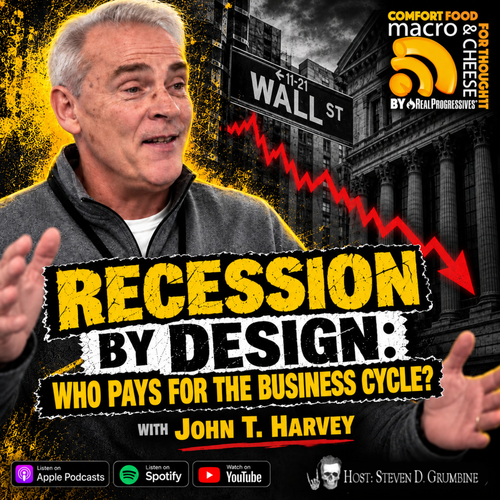
Episode 396 – Recession by Design: Who Pays for the Business Cycle? with John T. Harvey
FOLLOW THE SHOW
Drawing on his book US Business Cycles 1954–2020, John T. Harvey addresses a central contradiction: we have the money, resources, and economic tools to provide full employment and meet society’s needs, yet the structure of capitalism stands in the way.
** Discuss this episode with us at Macro ‘n Chill, our virtual community gathering. Tuesday, September 15, at 8pm ET/5pm PT. Use link to register: https://us06web.zoom.us/meeting/register/jBqKoQB6RtOjQPE8cW17ew
This week we’re having a long-overdue reunion with John T. Harvey, known to our listeners as the Cowboy Economist because of his plainspoken, accessible way of explaining complex ideas. John talks with Steve about his latest book, US Business Cycles 1954–2020. The conversation challenges mainstream economic theory that treats markets as naturally self-correcting, when in fact unemployment, inequality, oligarchy, and recurring crises are outcomes generated by the system itself.
The discussion brings MMT’s insights about money and real resources into direct contact with the question of class power. If the federal government can finance full employment, and a Job Guarantee could give workers a genuine alternative to precarious private employment, why don’t we do it? John and Steve agree on the central contradiction: the obstacles are not primarily economic or technical. They lie in the distribution of power and in institutions structured around the interests of capital. The challenge, then, is not simply figuring out what is economically possible, but understanding what prevents us from doing it.
John T. Harvey is the Hal Wright Professor of Economics in the Department of Economics at Texas Christian University. He is a well-known heterodox scholar who has published extensively, including two books: Currencies, Crises and Capital Flows (2009) and Contending Perspectives in Economics (2020 2nd edition). His most recent book is US Business Cycles 1954–2020, published by Cambridge University Press (December 2025). He has earned numerous awards for teaching and research, and his work focuses on exchange rates and business cycles.
Steven Grumbine:
All right, folks, this is Steve with Macro N Cheese. Folks, it has been a hot minute since I’ve had the Cowboy Economist join me.
And let me tell you, for those that don’t know who the Cowboy Economist is, his name is John Harvey. John T. Harvey, okay? And John T. Harvey is a professor of economics at Texas Christian University.
He’s also the author of several books, including the one that we’re going to be talking about today, which is US Business Cycles 1954-2020. Now, for those of you who have followed me at all, you know I am an accidental MBA.
I got my MBA back in 2008 and subsequently went on to try and unlearn almost everything they taught me in grad school as I developed the MMT side of my thinking and then further developed my Marxist side of my thinking, which kind of throws that whole MBA asunder, doesn’t it? So with that, it was brought to my attention that John Harvey had written this book. And John was kind enough to come and join us today to discuss it.
So with that, John Harvey, welcome to the show, sir.
John Harvey:
Well, thank you. And actually, you’re the one that’s kind enough here to, to host me here today.
And I got to tell you, by the way, I also had to re-educate myself after I got my PhD. I was lucky in that my undergraduate introduction to economics did include things like Marx and Keynes, not Keynesians, not the same thing, Keynes.
And so I knew something was missing. But when I got done with my PhD, I was like, God, this stuff is a bunch of crap. I got to start all over again.
So, you know, you’re into heavy metal and I’m into punk. So it’s a similar route I think we’ve both taken.
Steven Grumbine:
Absolutely. It is very, very, very, very similar. I. Every time I see the pictures of you, I just laugh. I’m like, there. But, you know, we didn’t have.
I didn’t grow up as much in the punk space, right? But I was in the DC punk scene and I was there at the crossover. And so we got a lot of cool stuff that came through the 9:30 club.
A lot of stinking patchouli oil and leather and cigarettes and liquid Rush and all the other things that go with that whole scene. It was a great deal of fun. I had an awful lot of fun. So thank you so much for agreeing to do this, by the way. I mean that, and the honor is mine.
I don’t know what number episode this is going to be, but it is going to be somewhere right around number 400 plus or minus 1 or 2. And…
John Harvey:
You’ve been doing a lot of good work.
I don’t have the energy that you and some others have had to keep pushing and pushing and pushing, and I don’t know, I guess I finally come around to thinking, well, that’s just not my strength. I’m going to write this stupid book and talk about it a little bit and do a couple of cowboy economists [YouTube channel].
But this continuous outreach to the public is so important, and we’re so lucky we’ve got folks like yourself that are willing to do that.
Steven Grumbine:
Well, I do appreciate that. It is a bit of a labor of love.
You know, I think the more you learn, and I’m nowhere near a learned man here, but the more you learn, the more you realize you don’t know.
And one of the challenging things is, is that you have to, at least from my perspective, okay, I’ve done a huge journey from radical right wing to what some might call radical left wing, and I took the full horseshoe. Although I don’t subscribe to horseshoe theory, I definitely went pole to pole here, right. And…
But it’s not been because, you know, somebody left a hot take out there for me.
It really is because of, you know, academics and real great scholars and other theorists and philosophers that have kind of shown me what they have to say. And, you know, little by little, we’ve integrated things into our collective analysis, and here we are.
So it’s tough, man, when you have a mind built to reject information, and especially information that falls outside of what you thought you always knew. [Yeah] It’s a real challenge to pivot, and I’m not immune to that.
But I must say, one of the things that have made this particular podcast interesting, in my opinion, what’s kept it alive is is that we haven’t said the same old thing. As information has been presented to us, as we’ve learned new things, we have pivoted, and we didn’t forget what we knew before.
We just re-analyzed it through a different lens and hey, man, it’s been a journey. Let’s talk about your book here.
You know, there’s nobody I know anyway that is immune from the ebbs and flows of the US business cycles, at least in the United States. And as an empire with huge tentacles around the world, all of these business cycles have a direct impact on geopolitics and the world as we know it.
John Harvey:
Yeah, I guess. Let me say first that it’s almost like four different books. It opens with like, you know, sort of a quick introduction. Why did I write this book?
And then a theory of business cycles which is drawn largely from Keynes. Then there’s chapter four, which is the history part.
You know, okay, here’s what happened in the U.S. given the theory I’ve outlined in the previous chapters, now we can interpret what happened in the US from 1954 to 2020. I picked those years because ’54 was the first year I could get all the data I wanted. And 2020 was our last recession.
And then there’s a chapter on policy recommendations, and then there’s an appendix with the more technical stuff. I wrote the book because of the most boring chapter in the entire book. I can’t imagine that anyone but me is excited about chapter four.
And that’s the one where I go through a sort of history of business cycles from ’54 to 2020.
For some strange reason, I was aching to see something about, okay, Kennedy did this, but then Nixon did that, but then the OPEC oil embargo caused this other thing in a context which I thought made sense, you know, in terms of economics, which, of course I don’t know what the listeners know about, but I definitely reject the mainstream view of the way business cycles work. So I wrote the book because of the most boring chapter, and that was chapter four.
But I needed to have an explanation of what caused the cycles before that. And I guess the bottom line there is that the capitalist system is unstable.
The capitalist system is not only prone to collapse, but also I think probably the more important thing than business cycles is that there’s no guarantee, in fact, there’s likely to be the opposite, that the market system creates a job for everyone who would like to work. That in fact, to the market system, labor is a cost and we try to minimize the use of labor.
So what I’m trying to establish, really, in those first four chapters is that we’ve got real problems in terms of the system that people seem to accept as being natural, that somehow capitalism is this natural system, that, well, gosh, if we’re having problems right now, we need to develop solutions within the context of capitalism. Oh, we have climate change. Let’s increase taxes on, you know, use of carbon, which by Itself might not be a bad idea, but the problem itself is…
There’s a fantastic quote in the environmental literature that I guess the logic of capitalism, growth for growth’s sake, is also the logic of the cancer cell. Yeah, really, really well said.
And you know, and also they argue in the environmental literature we can’t solve the problem with the system that caused the problem in the first place. So you know, I think we have to have a significant shift away from capitalism in the first place.
So it’s kind of funny, you know, I mean I spent all this effort talking about capitalism and I don’t really. Well, I guess I do. I outright say, you know, the system is broken. There’s no way we can solve the problems that we’re facing right now.
Which is not just climate change, which of course is very high on the list, but oligarchy, concentration of wealth at the top. All these things come quite naturally from the system we’ve got. We shouldn’t be surprised that this is what we’ve got.
And so, you know, that’s what I talk about early on and up to chapter four, chapter five is okay, what can we do about this? Which I won’t bore your listeners with any details because it’s basically a Green New Deal type of thing.
But then I, I try to end on a high note that, you know, well, you know, young people today might be in favor of this, but it’s hard to imagine that we can get these changes through. There’s so, ah, to me the solutions aren’t that complicated.
It’s the philosophies that we have and the power structures that we have that prevent us from getting there. I don’t know, I’ll shut up right there. I didn’t exactly answer your question, so, yeah.
Steven Grumbine:
Well, I think you did it just fine and you actually opened the door to a few things that I’m really appreciative of. And number one of them is I think it’s really important for folks to understand capitalism.
John Harvey:
Yes.
Steven Grumbine:
Not because you’re a good capitalist, because let me just tell you right now, as an MBA-er I hate capitalism with my entire everything about me despises this system. And you know, I used to get really angry at Marxists because they would say it’s the system, it’s the system, it’s the system.
And I’d be like, oh my God, you’re just hand waving at the generic it’s the system, it’s the system, it’s system. But lo and behold, when you place your MBA education into the mix.
And you realize that the maximization of shareholder value is el numero uno one priority, and growth at all costs is the priority. And you realize that the government that regulates these things is built on the tried, true tradition of private property, right?
So everything reinforces itself. And I kept trying to figure out why I couldn’t make fetch happen. And it was always the system. This is…
Well, see, now I’ve taken a much deeper review of the system, a more critical view of the system.
And yes, I leveraged our friend Karl Marx for part of that, but I also leveraged my own graduate school education and Master of Business Administration to kind of put together what I saw as what they’re teaching me, teaching me to be a good capitalist and why that is so detrimental to not just my own life, but to the world around me. And it fundamentally changed me, John.
The MMT story that I got hooked on post-grad school really put me into a space of being open to just about anything. And then once I started hitting the limits of what, okay, so now you know, ledgers. And now you understand the state creates currency.
And now you know, now you know, now you know, what does that do for me if I have no agency within the system to make changes?
And that brought me to Lady Rosa Luxemburg, who said, you know, a socialist entering into the government does not transform the government into a socialist government, but instead is transformed themselves into a bourgeois minister of capital. And that broke me. That broke me.
And then as if these theorists and goodness gracious, Lenin said things Marx said things Engel said, so many over a course of time spoke about bourgeois democracy and the fact that we don’t really have a say that it took a Princeton study, and I’m not a Princeton fan, I’m not a Princeton grad, and I’m definitely not a white, aristocratic, Ivy League kind of pom-pom supporter here.
But for those that fit into that space, they had a great study by Gilens and Page 2014 that looked back some 30 years at legislative likelihoods of whether or not people and their interests were served. And they found a statistical near zero impact on anything that the people wanted unless it happened to coincide [right] with what oligarchy wanted.
So, this does not push me away from wanting to learn it. In fact, it makes me want to learn it more. Because how can you fight a devil that you don’t understand?
You know, it doesn’t do any good to rush to a fire with gasoline to put it out if you don’t know what makes the fire burn. You’re just enhancing and making it worse.
John Harvey:
Right. What is the nature of the fire in the first place? Because until you know that. Yeah, yeah.
What feeds it, what makes it get bigger, what makes it get smaller. Yeah.
Steven Grumbine:
Exactly. And your book, in my opinion, for those that are coming from a left perspective, I mean a far left perspective, beyond the progressives, we’re not voting it away perspective, your book is must read for them too.
I don’t want anybody to think that this is not for them because you’re not going to understand capital just by what was written in, you know, 1860 or 1850. You need to understand. Yes, there are some truisms that just he beautifully put out there that everybody should know.
But what you did here I think is really important, even though I know you took a bow here on the policy side, basically.
But I want to be clear, you know, I think it’s important to know what the realm of possibility is and then question the barrier, why you’re not able to make those things happen. So we should be talking about what we could do, but then we should have an analysis of why we can’t do it and not not be Pollyanna.
You know, I mean, I think Pollyanna makes people have, you know, it puts their, their fight away. It kind of pushes it to things that are unproductive. Go ahead.
John Harvey:
Yeah, let me say a couple things about that.
One, the first part of the book where it just goes over the business cycle, one could certainly read that as a supporter of capitalism with great interest. Oh, is that right? That, that’s fascinating. Well, we need to fix that, you know, and make sure that doesn’t happen again.
But my intent was, because the first part of the book is honestly written for like all those MMT people who never had the opportunity to have, or were lucky to not have the opportunity to be formally trained in economics. I wanted them to have something they could read and understand.
And when they’re arguing with some economist who is trying to pull, you know, sort of blind them with science, that they can come back with something, “Well, actually, that’s not true.”
Well, actually, you know, a big deal that Keynes had, which I won’t go into, is the difference between uncertainty and risk. But, you know, it explains all that.
So it explains some technical things, honestly, just so when you are being faced by these authorities that we have in the economics discipline, you can understand what they’re arguing about, what they’re talking about.
And so that was a big motivation for the first part of the book is to give people who didn’t have the opportunity to have a formal economics background, to give them some ammunition and to give them an introduction into the vocabulary and so forth. The appendix has the math and the graphs, but the rest of the book doesn’t.
I tried to stay way away from that so that it would be accessible to anybody.
You said something about when you’re talking about the MBA program and teaching you to be a good capitalist, and it made me think that they never really did that out loud, though, did they? I mean, they [No] I mean, it’s almost a stronger lesson to you and. Yeah, that they were like, we’re all taking it for granted that.
And, you know, by the way, this system is. We don’t have to say the system is great. Here’s how you can make lots of money in it.
And so it must be great if I’m going to be taught on how to, you know, succeed in this wonderful system.
But that’s one of the fascinating things, is that, you know, these deep seated, unquestioned, I guess, feelings that we have weren’t taught to us out loud.
And so this devotion to capitalism, I don’t remember at any point in my entire education, throughout my mainstream economics education, anybody saying, I don’t know if it’s entirely true, but for the most part, they were teaching us graphs and models. And we’re all taking it for granted that capitalism is the best system that’s ever been invented and somehow natural to Homo sapiens.
Steven Grumbine:
You know, it’s funny you say that. I just talked to. And by the way, I want to get to your book here in a minute. I don’t want to lose sight of this.
John Harvey:
No, that’s all right. That’s all right.
Steven Grumbine:
But I just had spoken to an author and professor named Andrew Hartman who, who recently wrote a book called Karl Marx in America. But we in particular talked about a different book that basically talked about the Red Scare taught in the classrooms back in the day.
You know, capitalism is not ideological. Capitalism’s just a thing. But that Karl Marx stuff, that’s ideological. You’re a nutter, right? [right.]
And so the understanding of the way, you know, you are an institutionalist, and I’m going to beg you for my indulgences here momentarily.
John Harvey:
Yeah.
Steven Grumbine:
Know, when I think about institutions, you know, I came into this as an MMTer and they’re all institutionalists as well. And so I always just thought, hey, man, we just got to reclaim the institution. But I didn’t understand the nature of institutions.
And it took digging outside of the MMT catechism into these other spaces to really begin to understand that institutions are a representation of ruling class power and the common sense they want you to have. And the more I dug into that and the more I started learning where power is.
And I don’t want to get too far in this, because those that do listen to this program definitely have heard this once or twice.
But the DNC was one of the biggest wake up calls in 2016 when they were taken to court for rigging the primary against Bernie Sanders in favor of the shill Hillary. And when that all occurred, they fought successfully in court that A, the Democratic Party is not a real party. It is a private corporation.
John Harvey:
Right.
Steven Grumbine:
Number two, they have their bylaws or their bylaws. They can do whatever they want and you have no say so because they are a private corporation.
And as if that’s not bad enough, all monies donated to Bernie Sanders, no one has a claim on them. They go to the DNC and the DNC decides what they want to do with that money.
And when I found that out, and the fact that they don’t even need, they have zero requirement to run a primary, much less honor the results of a primary and hence super delegates and on and on and on. And then you can get into Joe Biden with the parliamentarian, stopping the PRO Act. You don’t need to go too much further, do you? I mean, for me.
And so as I think about that, you know, it really started changing me, literally fundamentally changing me as a person. So I want to dive into your book here real quick.
Start off with the core economic, you know, contradiction that we’ve been kind of already discussing.
But if I’m not mistaken, the way I read this, and I think I’m right, but you argue that unemployment and instability emerge from the structure of our economy itself. Kind of like what we were saying, that capitalism is a system. It’s not about the bad man theory of the world.
John Harvey:
Exactly.
Steven Grumbine:
Whatever. This is the system. See. So you can change bad guys and you’ll still get bad outcomes whether you had the bad guy there or not.
John Harvey:
Precisely.
Steven Grumbine:
Rewards the wrong things. It creates incentives. You can get all blacks, you know, perverse incentives. On and on and on.
John Harvey:
Right.
Steven Grumbine:
The more I think about it, it’s like if we have unemployed workers, unmet social needs and the productive capacity, which is a key MMT framework to address those needs, what actually prevents us from putting those resources together? I think we’ve kind of already discussed this, but putting a focus on that, what are your thoughts?
John Harvey:
Okay, so I have another book called Contending Perspectives in Economics: [A Guide to Contemporary Schools of Thought] where I, you know, have a little chapter on various contemporary schools of thought and economics. And the first edition, I think was 2016, and apparently it did pretty well. So they asked me to do another edition.
And the thing I didn’t do in the first edition was have a chapter on climate. And I really wanted to, and this is going to sound like a joke, but I ran out of energy.
So I was so tired from writing this book is I don’t have the energy to do climate change. So. So anyway, on the next one I did, and I needed a lot of help with this because I didn’t know the ecological economic stuff hardly at all.
A fellow named Richard Norgaard at Berkeley, who is a really awesome climate economist and one of the things he talks about in his research, and by the way, we’d email back and forth, we’d both be so depressed. Well, we’re not going to do anything about this, are we? No, I guess not.
And so one of the things he said is that we now have a religion in our world called economism. And it’s all about the fact that the market system, well, that’s like God. I mean, we must take that for granted. We must work within that context.
And I think that’s the problem.
Well, I mean, we also have problems now that that system has created power structures that are the people who have the most power to make the changes also have the least incentive to do so. But the system itself contributed to this problem in the first place.
And we have this philosophical, not even on a conscious level, I guess, you know, commitment to this capitalist system. And to him, he writes about this, again, he calls it economism.
It’s our new, you know, our new 21st century religion that is preventing us from seeing through what the real problems are. Now, you know, obviously we have other issues as well, but that really, I kind of end the book with that.
I was like, you know, well, why haven’t we done this?
It is absolutely possible to alter our economy in a way that we’re actually solving real social problems and that we are making sure that anyone who is willing to contribute to society, you know, gets to take a handful of the stuff we’re producing and so forth. There’s absolutely no reason we can’t do this. So why aren’t we doing it? Well, because it’s not capitalism.
And again, on top of that, now we have the fact that I just saw that apparently Trump bought a half a million dollars worth of whatever stock it is for the company that’s going to do the catapults on the aircraft carriers. So, you know, I mean, how on earth do you fight against this much power everywhere?
And I wanted to say something about the Red scare that you mentioned earlier. You know, Keynes wrote his book. I’m a big Keynes follower as far as, you know, explaining how the capital system works. A big follower of Keynes.
It took a while for Keynes’ thought to come over across the Atlantic. And the first book was by a guy named Lori Tarshish who was a Canadian.
And he tried to, you know, sort of summarize what Keynes had said and put it into a textbook. And it started off pretty well accepted, but then I don’t know if listeners know who Laura Ingalls Wilder was.
All the Little House on the Prairie books.
Steven Grumbine:
Yep.
John Harvey:
One of her daughters apparently was an extreme right wing libertarian type and belonged to some organization that was trying to protect us from communism. They asked her to look at various scholarly books. She came across Lori Tarshish’s book and honestly, Keynes is not anti-capitalist.
I mean, I think if I were a Marxist, I would probably call Keynes a bit of an apologist for the capitalist system. He’s saying it doesn’t work properly but needs to fix it, but he’s not saying to get rid of it.
So it’s certainly not an extreme volume or you know, as you have pointed out, it’s not, you know, from Luxemburg or Marx or whatever. And yet she got hold of it and absolutely trashed it. I wish I could remember.
I’m writing a book chapter right now that includes the quote from her, but she called it, it’s not even economics. It’s like some sort of religion that he’s trying to push on us.
They did this massive campaign and swamped university presidents with you’ve got to stop this book. And it was pulled. It was pulled.
And this kind of right wing nuttery about this devotion to the capitalist system, even when what the author was actually arguing was to correct the capital system, not to replace it. That’s a lot to fight against. I don’t know how we do that.
Steven Grumbine:
You know what, I agree with you. I mean, I think from my vantage point the fighting against it might involve stepping away from it and working to build resiliency.
So, you know, everybody screams “general strike” and this, that and the other.
But in reality, if you’ve ever been on a picket line for a basic corporate union maneuver, you have scabs within days because they don’t have the money to survive. And so you think about how do you build resiliency and solidarity?
You got to build something outside parallel to prevent them from disciplining labor through various austerity measures and fascist crackdowns and stuff like that. But look, I want to bring you back to economism momentarily. You’re talking about it from the vantage point in the 21st century, the modern sense.
Then you go back to What is To Be Done? by Vladimir Lenin, and he was talking about the opportunists, the economism, right?
Like basically the idea that working class struggle could simply be reduced to ledgers, to simply economics and everything would be okay, not taking into consideration the power dynamics, not taking into consideration the very institutions that prevent the kind of change that we would want to happen. So, you know, it’s not something new. I mean, maybe it’s new. Maybe they’re making what was old new again.
But these things have been around for an awful long time.
John Harvey:
You’re absolutely right. You’re absolutely right. I listened to a podcast about the French Revolution not too long ago, and they were trying to introduce real progressive.
Real progressive changes. And you know, who blocked them? They were the intellectual left wingers. The intellectual left; “Well, I’m not sure we could do that.
That, you know, promising everybody a job. I’m not sure that’s a good idea.” So we’ve got at least a French Revolution.
I’m in the middle of a book right now about Weimar Germany and just the terrible trouble that they were having, the left, in trying to organize any real resistance to what was going on. So, yeah, I mean, I would argue it goes at least back to the French Revolution and, well, since the dawn of capitalism.
Steven Grumbine:
Amen, brother. Amen.
So one of the things that folks that have followed this program for some time might be familiar with is obviously the MMT story, the money story, as they say.
And I know you work with Torrens University and have worked with Steven Hail and Stephanie Kelton and others doing, you know, the world tour, if you will, of educating people in this space. But just for those that may be new to this space, you know, I’m going to ask a question.
I already know the answer to some extent, but not the full extent. So I want to get your take on it. If the United States government issues its own currency, it does.
And therefore isn’t financially constrained like a household or a business.
John Harvey:
Right.
Steven Grumbine:
Which they act like it is.
John Harvey:
Right.
Steven Grumbine:
Shouldn’t we just stop asking how we’re going to pay for it and kind of pivot? You know, Stephanie would say we got to resource.
Stephanie Kelton, for those that don’t know these first name things, Stephanie Kelton would say the wrong question is how do we pay for it? The real question is how do we resource it?
I would go a step further than that and say, by what agency would we mobilize those real resources as democratic citizens here? And I think at that point you find out the limits of MMT.
But, why do we keep this lie alive of how do you pay for very, very nice, kind people running around, “Oh my God, how are we going to pay for it?”
Can you, within this business cycle logic, can you kind of talk about that momentarily?
John Harvey:
Yeah, because that is in fact a big part of my chapter five, the policy chapter, is that, well, look, we don’t have a budget constraint, we have a resource constraint.
And so if I may use, right now everyone’s freaking out about what, $40 trillion, whatever the national debt is right now with Trump and they’re complaining about that. Well, okay, boy, is there a lot to complain about with the Trump presidency.
But you know, in the context of the deficit and the debt, you should be complaining that we wasted our resources on things like a war with Iran and supporting Israel and not, “Oh my gosh, we’re running out of money.” We’re not going to run out of money. That is impossible. And it, it is such a simple argument.
I was at a conference in Edinburgh recently and never been to Scotland before. It was fantastic.
And yes, I drank a lot of scotch, and Warren Mosler was there, who is one of the, I would argue, perhaps the first person who really sort of broke ground on this modern MMT vision.
And he was telling a story about when he was a tourist in Italy and the tour guide was talking about the fact that he had this coin there with the emperor’s you know picture on it, that the government would have to tax these in order to spend, you know, government money. And so of course Warren Mosler says, well, where did they get those coins in the first place?
“Well…. I, I, …” and Mosler’s point being they got them from the government. That’s why the freaking emperor’s picture is on it, right?
The government printed up this money, or I’m sorry, minted it, used it to buy various resources. And governments do that all the time.
One of the good things, if I may say that happened with COVID was that it was easy for me to convince people that we just, and I hate to use this expression, but we just printed that money that we gave people that first summer of COVID. We didn’t borrow it from China. We didn’t borrow it from Europe. We didn’t borrow it from the people who had all lost their jobs in the United States.
We ended up printing the money and giving it out. And we do that all the time. Now. Why do people bother to accept it? Because every April 15, we ask you for some of that back.
And so as a consequence, there’s sort of an anchor demand for this currency. So. So we can’t. World War II. My favorite cowboy economist that I ever did, my YouTube series was on World War II.
Ken Burns is a fantastic documentary historian and creator, and he did one on World War II, and it focused on a series of small towns.
He tried to tell the story of World War II from America’s perspective by focusing on, you know, here’s a small town in Illinois, here’s a small town in Nebraska, whatever. He had an episode where he went on and on and on about how, “Oh, and America paid for the war itself, because what they did was they had bond drives.”
Do you seriously think that when the Japanese bombed Pearl harbor in 1941, when US unemployment was still 9.9%, we’re still recovering from the Great Depression, that the US had to borrow the money to build tanks and planes from the citizens who were still recovering from the Depression, that in fact, had they not been able to borrow that money, we’d have lost the war? That money stopped us from winning the war?
The government printed the money, used that money to build factories, to take resources away from the private sector that might have otherwise been used to build cars, to instead use it to build tanks and so forth. The bond drives were about inflation.
The bond drives were about, if you look at the contemporary accounts, they talked about what they call “dangerous dollars.”
We need to get people not to try to go out and spend their money because we don’t have enough goods and services right now, because we’re using all the resources for the war. They would just bid up prices. We, of course, also had rationing, but they also wanted people to just not spend their money.
So they use the bond drives for that. Also had the second advantage of once the war was over and there might be a downturn in economic activity because we’ve stopped spending for the war.
That’s when these bonds will mature and people will go out and spend the money.
So the basic story is that the government has the ability to print these little pieces of paper that allow them to take command of some of the resources in the macro economy. And they do it all the time. And I have no problem with that if I happen to agree with what they’re spending the money on.
But your other point that you were making, Steven, was that do we really have a channel that allows us as a people to end up really and truly affecting how those resources get captured by the government? Or is the system broken? I don’t know. Did I hit the stuff you were after?
Intermission:
You are listening to Macro N Cheese, a podcast by Real Progressives. We are a 501c3 nonprofit organization. All donations are tax deductible. Please consider becoming a monthly donor on Patreon, Substack, or our website, realprogressives.org. Now back to the podcast.
Steven Grumbine:
How do I say this?
You know how we sometimes attribute motives based on the way we view the world versus understanding what the class interests or the interests of another are? [Right] And when we try to take “Why would they starve kids in school? Why don’t they provide school lunches?
Why don’t they ever have money for the poor instead of for war?” You know, and they don’t ask the right questions. They’re assuming a benevolent motive.
They’re assuming that their interests are in fact making our lives easier versus keeping us in a position where as capital wants to do and needs to do and has a desire to accumulate, etc, needs us to be pliable and accepting of whatever they do.
Because if we’re in a position of strength, just like a union that’s strong, we can make demands, we can shift things, we can become a thorn in their side.
Because like you said, the business interests are in fact to control or eliminate costs, to get rid of things that create friction in the quick accumulation process. [Right] So from my vantage point, I don’t think of it quite that way. I think of it more like the system works exactly the way they’d like it to.
We are just starting to take the shackles off of our eyes and begin to realize that maybe their motives are not in fact to make us lead more happy lives, maybe not make us wealthy and and live prosperously.
Maybe the goal is that a small few, which the iron law of oligarchy shows, you know, really control the wealth and control, you know, and it’s not about the money, right?
When you think about what wealth is, wealth, in my opinion, and maybe it’s even a textbook opinion, is how easy is it for me to survive, to do whatever it is that I’d like to do, whether it be by money, whether it be by simple force or power or institutional arrangements, my ability to survive, I’m not going to worry about when my electric bill is paid.
I’m not going to worry about any of that stuff. I have the freedom to move about the cabin and the rest of society has to look at their bank account and decide, “Oh my God, can I go on vacation?
Can I take a day off from work? Can I do whatever?” These are not the decisions that people who are in power have to make. They are the rule makers. They are the rule breakers.
They’re the rule breakers. Those rules are for us, not for them.
John Harvey:
No, and I missed that part of your question. I didn’t end up going into that. And that’s dead on. I. One of my personal weaknesses is I tend to trust authority.
And so this has been a long journey for me.
Steven Grumbine:
A punk rocker. Give me… No, I’m joking.
John Harvey:
I know. Well, okay, so here’s the story. So I have my jean jacket with all my punk buttons on it and stuff.
And I was going with a friend of mine to the record store and there was a… am I allowed to say the F word on the air here?
Steven Grumbine:
Yeah, you got it.
John Harvey:
Okay. Okay. I’m looking to buy a new button, right? And there’s one in there that says “Fuck Authority.” I was like, hey, check that one out.
And my Buddy says, “You’re Mr. Authority.” And then the record store owner laughed at me and I cried.
So, yes, the only album I’ve ever worn out because I played it so many times was “Never Mind the Bollocks” by the Sex Pistols. But there was still in the back of my head, yeah, but rich people just have a different philosophy. They’re decent.
Meanwhile my wife was saying, “No, they’re greedy bastards.” And it just took me a long time to come to that.
So your point about, well, you know, gosh, if the government can do these things, why don’t we do these things? Why don’t we do these things that actually help the average person?
The things that the vast majority of Americans I would think would be in favor of doing, feeding children, you know, educating children and so forth. I think there’s a couple of reasons. One of them is the power you’re talking… Well, no, no, I think that actually your reason is the only reason.
But I think that it’s interesting that it manifests itself in many different ways. This forcing the desires of the oppressing class, of the capitalist class on others shows up in some really subtle ways.
For example, the entire economics discipline. And by the way, most economists would count themselves as left leaning, but I think they’re more Hillary Clinton left leaning you know.
But they will count themselves as left leaning. And yet, my God, I don’t know if people realize this.
Your typical mainstream macroeconomic model about the way the US economy works has built in as one of its assumptions that the economy automatically tends towards full employment, that it automatically generates enough jobs.
Christina Romer, who was the head of the Council of Economic Advisors under Obama, if you look up right now, people listening, you know, type this in real quick, type in Christina Romer Business Cycles, and you will come across an encyclopedia entry that she wrote where she says about halfway through, “You know, but really and truly, there really aren’t cycles, because the majority of economists believe that the economy could stay at full employment forever.” And yes, the majority of them do believe that. And let me finish this off with an anecdote.
We had a fellow come and present a paper in our department, gosh, a couple months ago, and it was on the impact of AI on the labor market. And I’ve told this story so many times now to people who end up being horribly shocked, as I was at the time… the impact of AI on the labor market.
He assumed away, did not determine through the model that this is the case. He assumed away unemployment. So the thing that people are worried about with AI, he just assumed it away.
Well, it was going to make the math more complicated.
And so, so after the thing was over, I went to one of my mainstream economics colleagues and I said, “Did that bother you that he assumed away unemployment?” And first of all, the guy was like, “Oh, yeah, I guess he did, didn’t he?” Oh my God. That’s what jumped out at me.
That’s what, like I was actually looking forward to the session because I wanted to hear about, you know, how it would affect unemployment. So this colleague of mine didn’t even notice. And he’s like, “Well, but that’s a complicated problem. We can work on that later.” Are you kidding me?
So, one of the many ways that the, you know, desire to keep the working person down to make us believe that capitalism is all in our favor shows up in academic literature. This guy thought it was perfectly okay and so did all of his colleagues to simply assume away the key problem we’re all worried about.
So I’ll stop there.
Steven Grumbine:
You know, it’s horrible, but it’s great that you framed it that way. I want to bring up something related to this and then I’m going to move into job guarantee kind of territory.
I bring this up often because I am obsessed with understanding cultural hegemony. Absolutely beyond obsessed with this and I see it wherever it pops up.
You know, we always talk about the Mark Twain quote of problem isn’t what you know, it’s what you know that just ain’t so. Or something to that effect.
John Harvey:
Yes, yes.
Steven Grumbine:
And I think to myself how many things we believe that just ain’t so. And I sometimes am embarrassed about all the things that I went back through time go, “Wow, I really believed that, didn’t I?”
And one of the things that jumps out at me is the way these things express themselves.
You talked to me earlier about the subtle nature of the way these truths slip into convo, slip into the actual textbook, slip into the theories and all the other things that we know love. And one of them that is really important is sitcoms and other kinds of media.
And when I go back to the rebirth of Roseanne happened right around the Bernie Sanders time. And Roseanne and her sister are fighting because Trump had been elected and her sister had made the grave ill choice of voting for Green Party Jill Stein. The horror, right?
John Harvey:
Yes. Yes.
Steven Grumbine:
And she says, “You know something? The only problem with socialism is eventually you run out of other people’s money.” She said this on TV with 15 million viewers.
Think about this.
15 Million viewers got the big chuckle at how stupid her sister was for voting for Jill Stein. All right. Now whether I think we can vote our way out, I don’t. Whether I think that the election system yields results that are democratic.
It doesn’t, proven right? The point is, is that the cultural hegemonic beliefs of these things are put out in subtle.
You didn’t sign up for this course, but you got it. You’re watching Roseanne and sure enough, you just learned about capitalism. You learned how dumb socialism is, right?
And now all of a sudden you know, “Hey, that pipe dream you had over there, how you going to pay for it, Bernie? Pie in the sky.” That’s Hillary. By the way. The idea that we could do anything is a…
There is a class interest of making us feel like utter morons to think that we deserve anything. And so the job guarantee itself. I used to be so hyped and amped and jacked up about it.
Think of what a democracy enhancer it would be that all these people that have traditionally been X’d out of the political process could suddenly be in their town hall talking about a job guarantee and creating work that is socially beneficial in the community. And it’s such a great idea that it won’t happen. Why? Because it’s not in the damn interest of capital.
Who and give Clara Mattei her flowers, wrote a great book on The Capital Order, how economists invented austerity, and she explains very power dynamics and the rationale for why those things won’t come to be. It’s not some new thing. And yet we keep acting like it’s Groundhog Day with this stuff. But in reality, we have to be able to walk and chew gum.
We have to be able to think and hold two truths at once, multiple truths at once that sometimes feel contradictory. And that brings us to this great idea of a job guarantee.
Why we got to keep talking about it on one hand, but why we also have to explain capitalism and understand the institutional arrangements and the sadly, the enforcement, police, ICE, all these evil things that come after you and destroy your life, but they’re done. “Hey, I stand with the blue. I back the blue. I’m a blue line.” But what is the blue line?
You look back in time at the poor coal workers here in Pennsylvania, where I live, and you know damn well police were brought in to crush labor, not to sit there and defend the mom and pop down the street. It’s about private property, private accumulation, and making sure that the workers do what the master said. Your thoughts?
John Harvey:
Yeah. No.
One of the things that I always hesitate about when I talk about the job program, and I guess maybe listeners are already very familiar with it, but the idea is that the government should stand ready to hire anybody who is willing to work but can’t find a job in the private sector to do something that isn’t profitable, because if it were profitable, the private sector would already be doing it. So we don’t want to take an unemployed person and start a new hamburger stand. All right, well, we already got McDonald’s, right?
So, you know, we could argue about whether or not McDonald’s is doing a good job. But restaurants, we don’t need the government to create restaurants.
We need the government for things like after school programs, elder care, climate change, national defense, education, on and on and on. So we would put them in an area where they could do social good in something that isn’t necessarily profitable.
And unlike the private sector, if they don’t have a skill set that we can use, we train them. All right, so we’re all better off.
In the book I go through, first thing I do is I go through how little this would cost, even though I gave everyone a, what do you call it, living wage, which by the way, is not in the least bit generous.
I did the calculation for the county where I live, Tarrant County, Texas, which is also called Tyrant County, Texas, by the way, because of our Republican leaders, that it was like $8 a day for food on a living wage, not minimum wage, but on a living wage. All right? And so it was not particularly generous. I also included child care. I also included health care.
It was going to cost like an eighth of the defense budget for near zero unemployment from the year 2000 to the year 2020, which includes two of the worst economic downturns since the Great Depression. All right? So extremely inexpensive on top of the fact that the government is not budget constrained.
But boy, oh, boy, will capital not like a job guarantee. Because, by the way, we could get rid of… I’ll use this as an example. We could get rid of the minimum wage law.
You know, pay people what you want at McDonald’s, right? Pay them $2 an hour.
But as long as they’re guaranteeing $25 an hour in the job guarantee sector, along with health care and child care, I’m not working at McDonald’s. I’m not going to go there. So this is exactly what you’re talking about, Steven, in that the worker is no longer scared.
The worker is no longer worried in the context of a world where we have a job guarantee, which is why they would oppose this tremendously. Now, would it cause inflation?
Yeah, a Big Mac is going to get more expensive. If we can’t continue to pay people starvation wages in an industry, then whatever it is that they produce is going to get more expensive.
But you know what? That’s okay. I mean, if an industry has to exist by paying its workers starvation wages, it shouldn’t exist, all right?
So, yeah, a Big Mac gets more expensive. That’s going to be the sector that’s going to really be hit the most, is going to be the service sector because they’re paying so little.
And a job guarantee would offer a much more attractive option. Now, having said, how much capital would be against a job guarantee because it would empower labor so much.
I was at a conference at University of Texas. Jamie Galbraith, very incredible economist and politician, or I guess political mover, if not politician.
And there was the last session of this particular conference and there was a former labor leader there. And my God, I’ve never forgotten what he had to say.
He was the last one to speak and he kept having to ask other people to speak up and say, oh, I can’t hear you. Speak up. And this guy’s a loser. Oh, my God, I was wrong. All right? So he turns. It’s his turn to speak.
He’s like, well, first of all, you have to speak to the working person. You have to speak to them all right? You know, there’s a bunch of intellectuals and policymakers in the room, right?
Then he said, but you have to include them and you don’t talk down to them, you talk with them.
And the thing I want to bring up right now is specifically about the job guarantee is if you can get someone to agree to your policy, it doesn’t matter. They don’t agree for the same reasons.
And so when I have talked about the job guarantee and MMT kind of stuff at, you know, what Optimist Club, that sort of thing, what I find is that you can get your left leaning listeners to be excited about it for. “Oh good. This will be an opportunity for those people that are going without right now.” You can get your right leaning speakers in with you. “Oh good.
They won’t be sitting on their couches watching TV and having babies. They’ll be out there working.” Now, that doesn’t solve your problem, Steven, of capital.
It does address a little bit of those people who might otherwise be against this because they think that the people who are unemployed, it’s their fault and the, they’re lazy and so forth. It does address that to an extent.
We still have the problem though that it’s absolutely not in the best interest of capital and capitalism to have a job guarantee. And how do we get past that? I don’t know. [Yeah, yeah] So…
Steven Grumbine:
No, you’re nailing it. I mean, I’m, I’m not gonna lie. This is, I appreciate where you’re taking this because I mean, you know, these are questions.
I think that I could make a very bold statement and it would certainly be reinforceable by “theory.” But the world is not reproducing the kind of thought that I would like to see people, you know, the kind of awareness, the kind of knowledge.
Because the institutional arrangements are built specifically to manufacture consent. Thank you Noam Chomsky, sans Epstein. But within that space, I think it’s worth noting, right?
When we talk about this stuff, I think there’s like three or four steps of awakening that need to occur and they kind of happen. In my opinion, it’s not scientific.
This is just the way I think, okay, that, you know, let’s present a concept, let’s identify the class interests around it. Let’s identify, would this benefit us? Then let’s identify what the roadblocks will be.
John Harvey:
Right.
Steven Grumbine:
And when I think about the roadblocks, I’m not just talking about, “Well, we got to get AOC to stop mama bearing Pelosi and blah blah, blah.” I don’t mean it like that.
I mean more along the lines of these structural barriers like capitalism and the revolving door of capital inside of our government which we saw during the Great Recession that we went through with the housing collapse. We see these things in plain sight. The J.P. Morgan’s of the world, too big to fail. All this perverse incentives that create the corruption.
But is it corrupt or is this the system reproducing its outcomes? [Right.]
And as I think about it, you know, this is going to sound like we’ve already covered it, but I want to end on this note, as we’re coming up against time here and I guess this is kind of my, this is my ultimate question and I think I already know the answer, but I want to give you berth to go with it. So if we know how to achieve full employment, which we do, job guarantee will get us to anybody that wants a job will have a job, period. Full stop.
And by the way, for those people out there who think jobs are ableist, the job guarantee isn’t saying that you have to do anything.
John Harvey:
Yes.
Steven Grumbine:
It’s saying that you can create your own job. The local communities can work together. People that are disabled can contribute in whatever way they can. This is not an ableist thing in any way.
In fact, it’s the complete opposite. The shattering of work for the sense of profit instead of work for the sense of worth.
John Harvey:
And if I may interject real quick, I also think it should be allowed to include things like I want to be a stay at home parent while my child is growing up. I think that is a job.
Steven Grumbine:
Absolutely. And it eliminates the inflationary tone, if you will. [Yeah.] Of the kind of concept of just a basic income.
Because now all of a sudden, instead what we have is what we have a real… You’re now working a job. You’re at least listed as working a job. So with that we know how to achieve full employment.
We know the federal government can finance it. We know that the real resources exist. Look at all the unemployed people. Look at all the just natural resources in general.
We know that millions would benefit, right? Millions and millions of people would benefit. But concentrated economic power can prevent it from happening, okay?
Our fundamental problem really isn’t economic at all, is it? It really isn’t. It’s really a problem of class and structure, isn’t it?
John Harvey:
You’re absolutely… that’s how I finished the book. I finished the book on…
Look, the things that are stopping us from achieving these goals do not have to do with economic theory, do not have to do with you don’t have enough resources. They are, I think I said philosophical, but it’s more about power and it’s more about the structure of the system.
And people have a difficult time imagining. Well, first of all, I think, and you’ve brought this up a number of times, people tend to think in terms of bad people and good people.
And no, I mean, the whole concept of structural racism is that it doesn’t matter if everyone is literally blind to skin color.
If we have a system, if we have the, you know, results of years of racism with African Americans living in the poorest part of town getting the worst education, so forth. Unemployment is not random. Unemployment attacks the people who are the most powerless. And so what is our obstacle?
Our obstacle is the system and power, which go hand-in-hand. But we could solve the problem almost overnight. Almost. Will we? I have to confess, I’m not real hopeful.
And even though in the brilliant series, I hope everyone watched it Andor, which was a prequel to the Star wars movie. Oh, which one was it prequel to? Rogue One. Absolutely brilliant. You know, rebellions are built on hope.
Well, yeah, I suppose, but I’m willing to fight even without hope. That’s fine.
I know we talked a little bit before we started here, and I think that, Steven, you have more hope than I do, but, you know, everything’s stacked against us.
I think that the easiest scenario to imagine is that it just gets worse and worse along these lines, you know, of course, what complicate this with climate change and so forth. But we at the very least have to let people know there is an alternative, though, out there.
Don’t think to yourself that this is necessarily, “Oh, well, this is just the way the world works.” No, you’re being screwed.
You’re being screwed by the way the system works and by the way the power is distributed because there is a solution out there. So if my book accomplishes anything, it’s trying to say there is a solution. Are we going to get there? I don’t know.
But you are being screwed by the system and by the power structure, not by the fact that we are, you know, there’s not an asteroid coming towards the Earth and there’s nothing we can do about it. No, there’s something we can do about this. We’re just not doing it.
Steven Grumbine:
John, this was fantastic. I must tell you, I didn’t know what to expect. And I entered this conversation with trepidation and fear. And that’s why I wanted to talk.
I was like, we have a call before, but I want to make sure you know who I am, where I’m coming from, because, gosh, I know all the other folks are just like, “Hey, Ro Khanna is going to save us from extinction.” And I’m like, “Nah, probably not.” It’s like, how do I do this? Because I’ve been friends with everybody for so long.
I don’t want to create problems, but I’m not going to be untrue to myself. [Right.] If I see something and I believe something, that’s one of the…
I would say one of the hallmarks of this program and the hallmarks of Real Progressives. And my personal journey has been when there is new information and it contradicts what we believe before, we evaluate it.
And if we come out the other side and realize that this is correct and that is not, then we dump the other and we go with the thing that is.
John Harvey:
Absolutely.
Steven Grumbine:
And I think that it’s really important for folks, you know, I mean, I donated way too much money to Bernie Sanders. I donated way too much money to “Berniecrats.” I donated a lot of time, a lot of energy.
I’m not here to tell everybody that what they did was wrong or anything like that. I’m just here to tell them I have a different understanding of the way power is given and the way you can take power back.
And it isn’t going to be, in my opinion, at the ballot box, unfortunately. And I know that’s hurts some people’s feelings at times, but I think it’s important to be sober. And if…
If I believe that and I stay silent on that, I think I’m… I only got a few years left on this rock. I want to make sure I speak my truth. And, you know, there it is. So…
John Harvey:
Amen, brother.
Steven Grumbine:
Yeah. Hey, thank you, buddy. I appreciate it. Where can we find more of your work? Obviously the Cowboy Economist and your books, but where else can we find you?
John Harvey:
Oh, gosh, in really boring places. Well, other. Yeah… because otherwise I publish a lot in academic journals because I do really enjoy it. Helps you think these things through, you know.
So it’s mostly academic journals, but there is a. I believe www.cowboyeconomist.com does lead you to. Let’s see if I can check it real quick. Cowboy Economist dot com. Yes, that’s it. That’s it. And I used to have a forum or a page on…
On Forbes, Forbes.com which was really handy because leaning the way I do to be on Forbes is really useful. They change editors. We don’t really see eye to eye. I’m not on there anymore. I’m gonna try to do some more cowboy economist stuff.
That’s what I really enjoy, to combine humor with economics. Because we got to be laughing at something here. Yep. And it’s not from the Roseanne Show.
So anyway, go to cowboy… and people can email me j.harvey@tcu.edu or just look up TCU, you know, economics, and you can find me. And I’m happy to converse with people and to send them chapters and articles and so forth if they find it useful. But otherwise, just thank you all so much for listening. I appreciate it a great deal.
Steven Grumbine:
I gotta tell you, one of my favorite things, it drove me nuts when they ripped it out was your book on balanced budget amendment and why it was so dangerous. Your article on Forbes. And I used to share it everywhere. And then it just got ripped down. It didn’t exist anymore. And I’m like, Mother Bleeper.
I mean, that was. That was out of all. I had a whole list of articles and question and answer that I would put out everywhere.
And that was one of the ones that I would to everybody and everywhere. Because people were like, “No, no, we’re just gonna have a constitution convention. Everything’s gonna be okay.” You, they saw you a mile away.
They know what’s coming and they’re desperate for you to do it. So…
John Harvey:
Right, no, I need to find.
I need to set up a Substack or something and pull all those away from there and put them in place where people can find them again.
Steven Grumbine:
Absolutely. All right, well, John, thank you once again for joining me. I’m going to go ahead and take us out here.
John Harvey:
All right, thank you, Steven.
Steven Grumbine:
You got it. My name’s Steve Grumbine and I am the host of Macro N Cheese and the founder of the nonprofit Real Progressives, which this podcast is part of.
We are a 501c3, not-for- profit institution that lives and dies on your donations. So if you consider the work that we’re doing here valuable, if you think that we’re doing good work, we welcome your support.
You can go to our website, realprogressives.org become a donor there. You can go to our Substack Real Progressives and become a donor there. Or you can go to patreon.com/real progressives.
Be a one time or a monthly donor there as well.
And of course, we’re a volunteer organization, so if you have interest in what we’re doing, feel free to sign up on our website to become a volunteer and we’d love to have you. And with that, on behalf of my guest John Harvey, myself Steve Grumbine, the podcast Macro N Cheese, we are out of here.
End Credits:
Production, transcripts, graphics, sound engineering, extras, and show notes for Macro N Cheese are done by our volunteer team at Real Progressives, serving in solidarity with the working class since 2015. To become a donor please go to patreon.com/realprogressives, realprogressives.substack.com, or realprogressives.org.
Extras links are included in the transcript.
Related Podcast Episodes

Related Articles
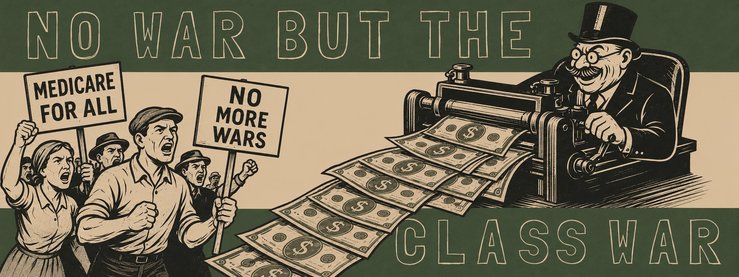
The Truth About “Printing Money”

The Strategic Activist


Leave a Comment
You must be logged in to post a comment.