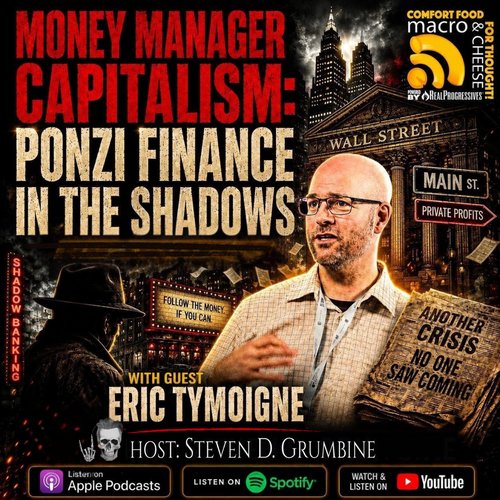
Episode 393 – Money Manager Capitalism: Ponzi Finance in the Shadows with Eric Tymoigne
FOLLOW THE SHOW
Eric Tymoigne examines the rise of private credit and Ponzi finance, and asks what Minsky and MMT reveal about financial fragility, public investment, and whose interests the financial system ultimately serves.
**Join us on Tuesday to discuss this episode in our online gathering, Macro ‘n Chill. August 25, 8pm ET / 5pm PT. Register here: https://us06web.zoom.us/meeting/register/NGxWl6qMTaKXPhR51uHkwA
If public power repeatedly stands behind private finance when it fails, shouldn’t that same power be directed toward employment, productive capacity, and human need? So why isn’t it?
Economist Eric Tymoigne returns to the podcast to examine the rapid growth of private credit and private equity through Hyman Minsky’s theory of money manager capitalism. Eric argues that the expansion of payment-in-kind interest, securitization, layered leverage, and dependence on rising asset prices are signs that Ponzi finance is becoming increasingly embedded in private markets, making the financial system more fragile. He warns that efforts to “democratize” these markets by opening them to ordinary savers will broaden the pool of investors available to absorb risks and losses (which should really be borne by the wealthy.)
The conversation then moves from financial instability to political economy. Through an MMT lens, Eric explains the enormous potential capacity of a currency-issuing government to contain financial crises, sustain incomes, and direct investment toward public purposes. Again we must ask why it doesn’t happen. This raises the deeper question of whose purposes the state serves. Steve and Eric discuss public investment, community banking, the federal job guarantee, the influence of wealth on political decision-making, and the limits of electoral democracy in a capitalist system.
Eric Tymoigne is an Associate Professor of Economics at Lewis & Clark College, Portland, Oregon; and Research Associate at the Levy Economics Institute of Bard College. His areas of teaching and research include macroeconomics, money and banking, and monetary economics.
Find him on Twitter @tymoignee
Steven Grumbine:
All right, folks, this is Steve with Macro N Cheese. And today’s guest is Eric Tymoigne.
And folks, you go back through our history of all the episodes that we’ve done, and Eric has been on here many times.
And Eric is one of my go-tos when it comes to banking and particular this subject that we’re going to talk about today, which is money manager capitalism and basically the Ponzi finance private market version, which is a paper he put out on Levy back in June. And for those of you who don’t know who Eric is, let me just quickly give you his bio.
Eric Tymoigne is an associate professor of economics at Lewis and Clark College specializing in the fields of money and banking, monetary theory and financial macroeconomics. He’s also been a guest on this show many, many times and is a friend. And Yan Liang is his wife and she has been on here many, many times too.
It is a really, really wonderful connection. And today’s conversation, I hope, will be fantastic as well. Eric with that, welcome to the show, sir.
Eric Tymoigne:
Hello, Steve. Thank you for having me.
Steven Grumbine:
Thank you, man. I appreciate it. So listen, I want to talk about this paper you wrote.
I think it’s important, and your central argument in the paper is that explosive growth of private credit and private equity should not be understood simply as a financial innovation filling a useful market niche, but represents another stage in the development of what Hyman Minsky called money manager capitalism. And it’s producing increasingly fragile financial structures.
And for those of us who have paid attention to Bill Black and paid attention to the various crashes that we’ve experienced, this conversation should be of great import. But I want to get us to this paper that you wrote.
I mean, we’ve talked about a Minsky and we’ve talked about financial fragility in the past, but in particular on this one, I think this is probably the most relevant that everybody should be paying attention to right now with so much insanity within the AI space and the investments and the speculation and all the rest that goes into it. Can you tell us about this paper?
Eric Tymoigne:
Yeah. So that paper came out of reading a lot about, well, like everybody else, development in what’s going on in AI.
Also development in the late 2025, where you had businesses that defaulted and went bankrupt and that generated a run on private debt funds. And so that caught my attention, and I decided to look more into it, and that’s how I came to it.
And come to it, as you said, from the point of view of Hyman Minsky, okay, who basically sees capitalism as a financial system and that is prone to instability not from exogenous shocks, but from its internal mechanisms. And so periods of stability generates the seeds of financial instability.
Steven Grumbine:
So with that in mind, I guess the question I have with you is right here. Starting off, how do we even regulate private credit?
I mean, it feels like we’ve talked about it for so many years, and I don’t see a real meaningful way that Main Street has a way of jumping in to do that.
And on top of that, I guess the real question is, for those that are just kind of tuning in, maybe you could start with describing, you know, what money manager capitalism is. You describe private credit and private equity as part of the evolution of what Minsky called money manager capitalism.
And I guess what distinguishes that from earlier stages of capitalism, and why is that distinction important for the economy today?
Eric Tymoigne:
All right, so money manager capitalism emerges, at least if we follow Minsky in the 1970s, okay, out of a previous stage of capitalism that he calls managerial capitalism, okay?
And the idea here is that the golden age of capitalism, so the 1950s and ’60s, okay, were periods of high growth and basically improvement in the standard of living, [for] a large swath of the population. And with that, people started to save and to look for means to put those savings to work by earning more than what you can earn on a savings account.
And so they looked for people willing to manage their money, okay? And so that’s where the money manager comes in, basically. So here we.
By money manager, we mean pension funds, mutual funds, hedge funds, and other forms of funds that pool funds together to try to improve returns on savings, okay?
And so that form of capitalism emerged really in the 1970s and has been taking over and generating a lot of financial instability over the past 50 plus years now. And private credit, so is relatively new, at least in coming to having us paying attention to it, okay? It’s quite old, actually, but in terms of growing fast,
it’s relatively new.
And I guess to define it, what we mean by private credit is credit provided to businesses that cannot access bank credit or cannot access the financial markets to raise funds, basically. And so they have to go through one-on-one relations with someone.
And that someone is a fund, okay, called a private debt fund, that has pooled money from pension funds, wealth funds, hedge funds, insurance companies, and wants to deploy these funds into in higher yielding assets.
One of them being providing credit to credit-constrained businesses that, given that there are credit constraints, cannot access normal channels of financing.
Okay, so of course that means that these loans are of a higher risk, but the carrot here is that you can earn a higher yield if the loan performs properly.
Steven Grumbine:
So is Ponzi finance kind of becoming systemic? I mean, Minsky’s hedge speculative Ponzi framework describes increasing financial fragility.
What evidence convinces you that Ponzi characteristics are spreading through the private markets rather than simply appearing in a handful of badly managed firms? At what point does individual financial fragility become systemic fragility?
Eric Tymoigne:
So I guess first to define Ponzi finance, the idea here is that. I guess. Let me backtrack a bit.
So the main idea of Minsky is that as the economy proceeds during periods of stability, so it’s growing smoothly, the economy becomes more fragile. So now the question is, what do we mean by fragile? And so Minsky defines three stages of fragility.
The first one is called hedge finance, the second one is speculative finance, and the third one is Ponzi finance. So how are each stage defined?
Well, the first one is saying that for a borrower, it’s expected that the income of that borrower will be high enough to cover the entire debt service, okay, meaning the principal to repay and the interest.
In the speculative finance, the borrower is expected to need to refinance the principal so you can pay the interest, but you need to refinance the principal, meaning that the amount, the outstanding debt, doesn’t fall, stays constant. Ponzi finance is a stage where the borrower is expected not to be able to pay the principal nor the interest out of its income.
So in that stage, how do you service the interest? You have to sell assets or you have to find a way to refinance the interest in addition to the principal.
What that means in practice is that the outstanding debt goes up because any interest that is not paid and is refinanced is added to the amount of debt that is owed. So how is that making things more fragile? So for Minsky, of course, hedge finance is less fragile and Ponzi finance is more fragile.
And the entire argument of Minsky is that over time there is a greater share of the economy that moves toward Ponzi finance. So the question becomes now, well, why is Ponzi finance more fragile?
Well, the reason it is thought to be more fragile is because it becomes more sensitive to change in financial conditions. For Ponzi finance to continue, that means for the debt owed to continue to grow, things have to proceed smoothly in the financial industry. How?
Well, rising amount of debt means that you need to have rising amount of collateral available to back up that debt, either in terms of quantity of collateral or in terms of the value of those collateral. And Minsky emphasized more the values of the asset prices, collateral values have to go up in order to permit refinancing to continue.
And any change in financial conditions that does not permit that, doesn’t allow that from happening, will create a problem for refinancing. And if we have problem of refinancing, we’re going to have, well, borrowers who cannot pay their debt.
They’re going to be forced to instead liquidate their assets instead of having refinancing. And so what do they liquidate? Well, first, the most easily sellable items they have.
So if they have some cash on hand, they can use their savings, but after that they move to stocks and bonds and things like that. And so if they have to sell a lot of them, that’s going to depress their price and make it more difficult to service the debt they owe.
And so there we go into what Irving Fisher called a debt deflation process, where the more you try to sell assets, the more prices fall. And as the prices of those assets fall, the less money you can recover, so you have to sell more assets.
And so that creates a snowballing effect where you have a financial crisis. So that’s the idea of Minsky, of Ponzi finance.
So now, as I said, yeah, I use Minsky’s framework that I just described to analyze what’s going on in private markets. And again, I come from that after having observed major of two incidents of bankruptcy that led to a run.
So I come from the viewpoint that can we see clues of increasing financial fragility in the private markets. And so I look for clues of existence of Ponzi finance, okay? And the way I did it is not by looking at.
I looked at the academic literature, which is still pretty thin, but there is some. But more I looked at the literature of the industry itself, okay?
And I look at what their practices are, what they say about what they’re doing in terms of their norms and credit standards when they provide credit. And so what you observe by looking at that is indeed that there’s a growth of Ponzi finance.
So you have a rise in interest rate refinancing, you have a growing reliance on rising asset prices in order to make a financial deal viable. And so that’s the first part you see the growth of that. So one form that takes is what we call interest payment-in-kind.
So interest PIK, okay, the share of interest PIK, P-I-K, payment-in-kind, is growing. Interest PIK is the need to refinance interest. And so we see that going up.
And a larger share of financial contract now includes the expectation that interest will need to be refinanced. So that’s one click, okay, for the growth of Ponzi finance. Now there is also another aspect which is the spread of Ponzi finance.
So not only the players in this, so the borrowers in there use more interest refinancing, but also the participants in these markets rely more and more on the growth of asset price as a means to make deals successful. And one of the way that’s spreading now is the push for what we call the retailization of private markets.
So the idea here is that we want to open private markets to small pension funds, small mutual funds, to democratize finance. That’s a big push by the Trump administration, okay?
We want people to, they complain that people who have money don’t use their savings in “the proper way.” They leave that in the savings accounts where they’re. Whereas they could earn much higher returns if they put them in private markets.
And so we should open that. The problem is for them is that now the law makes it difficult to do that. And so we need to open private markets to basically small individuals.
Steven Grumbine:
This is kind of pulling from your July follow up paper, isn’t it?
Eric Tymoigne:
Right.
Steven Grumbine:
Okay. All right. I just want to make sure, because I was like, I read that one too, but I didn’t know we were. That’s okay.
Eric Tymoigne:
That’s in the first one too, okay? Because the idea is that, remember, Ponzi finance relies on growing asset prices.
Steven Grumbine:
Yes.
Eric Tymoigne:
But to grow asset prices, you need to keep up the demand for those assets. And that means growing the pool of potential buyers.
And so the retailization of private markets is there to help sustain the growth of those asset price. But at the same time it spreads the use of Ponzi finance. Because now that you bring these people in, you and I basically, okay?
That we’re trying to bring us in this market. Well, we really don’t have the expertise to judge the credit worthiness of the underlying businesses that are borrowing.
And these loans are highly illiquid and we don’t like to lend our money for 10 years and not being able to take it back at any time for the next 10 years. And so to accommodate retailization, we have had some innovations in the private markets, to quote, unquote, that’s a direct quote from the business, the industry
“engineer liquidity”, okay?
So we want to engineer liquidity to make sure that we find a mean to make it attractive for us, the small savers, to go in that market so that we see that, oh, looks like actually I can liquidate my positions when I want and I can now pay attention to the asset prices and make capital gains.
And so the logic of entering the market now is no longer providing credit to a small business for an extended period of time, carefully judging if that business can make it, and being a partner if you want, with that business, but rather making a quick gain in and out as quickly as possible. And so we move more toward a speculative approach to investing in those markets using leverage.
And speculative leverage is another way to say Ponzi finance.
Steven Grumbine:
Aha. So private credit defenders typically argue that these markets aren’t dangerously leveraged, as you’re just talking about.
But you describe financial engineering that can hide or embed leverage. And I imagine the.
Let’s just say the regulators, we already know from Bill Black that they are not only understaffed, underfunded, under-mandated, they don’t have the strength and support from above. In fact, they’re basically taught to look the other way. So it’s humorous in so many ways.
It’s horrible, it’s terrifying, but it’s humorous all at the same time, in like a black comedy sort of way. But you talk about it. You know, basically they work it so that they can hide and embed the leverage.
If we’re looking at the entire interconnected balance sheet structure rather than individual firms, where is the leverage actually accumulating and who’s ultimately bearing the risk when things go wrong?
Eric Tymoigne:
Well, so I guess to describe a bit more what’s going on here, what you have here is if you want a return to the financial practice that occurred prior to the 2008 financial crisis, okay, so securitization is growing. I’m sure your listeners have heard about securitization.
You have a return of credit default swaps to try to bet on the failure of the underlying activity. So prior to the ’08 crisis, you had hedge fund managers betting on the failures of homeowners and making everything possible for homeowners default.
Growth of all forms of securitization, a decline in the quality of the underwriting of loans, a decline in the quality of loans themselves. So all this is coming back today, okay? And so that creates leverage in different ways.
So the first leverage of course is the level of the business itself, okay? It’s borrowing money, so that creates leverage. The second layer of leverage come from securities that are tied to the success of that loan.
So we are securitizing those loans. So this one form of that is called collateralized loan obligations [CDOs], okay? So remember those CDOs that we talked about a lot during the financial crisis?
Well, things are coming back, okay? So now we’re talking about instead of collateralized debt, obligation is collateralized loan obligation.
So the backing here is not mortgages, but it’s loans to already highly leveraged businesses. You have another securitized product that is coming on, it’s collateralized fund obligations.
So in here, what’s backing there is basically equity interest in private debt funds, okay? So you create layers. So the idea being here that the success of those securitized products depends on the success of the underlying loans.
And collateralized fund obligation themselves include CLOs. So the success of the CFOs depend on the success of the success CLOs, which depends on the success of the private debts to businesses.
So you create interlinkages of debts and layers of leverage on top of existing leverage. And you go several rounds like this.
The problem of course, is that the more leverage you include, either directly or indirectly, the more fragile the system becomes because leverage increase sensitivity to not only gains but also losses. So if things go wrong, they multiply losses. So that’s one of the problems we see developing in private markets, this increasing layering of debt.
Steven Grumbine:
So, you know, obviously I came to know you as a result of your money banking primer in New Economic Perspectives many moons ago and have talked to you about that many, many times. But our connection is through Modern Monetary Theory.
And you know, obviously there is tremendous power in a currency issuing nation’s ability to offset wrongs, to fix things and make them correct.
When a heavily indebted private financial system begins deleveraging, what does understanding MMT or monetary sovereignty in this case, tell us about what a government could do, can do? And what does the conventional obsession with government deficits prevent policymakers from seeing?
Which, let me just be clear, you know, I think that they’re handed paper from somebody higher up in their order and they’re told what to say. There was a congressman, last name Miller, from North Carolina who spoke at the Economists for Peace a few years ago. Stephanie [Kelton] was there.
Rob Hockett was there. A bunch of people were there. I think Jamie Galbraith was even there. And what he said was these Congress people, they don’t know anything.
And this is coming from one. And he said they’re handed a piece of paper 20 minutes before they walk into a meeting, told what to say and they’re not, they don’t know anything.
So there’s somebody else, way above making decisions. These people are just kind of going with it. The consultants, whoever it is, are telling them basically what to say.
So I don’t really think they’re going to do anything unless it’s in the class interests of their handlers to do so. But that’s my take. What are your thoughts in terms of the MMT perspective on this?
You know, I want to bridge this also real quickly by saying that as you explain that, I think it’s really important to ask the next follow-up question. I don’t want to get lost, but I want to say it up front so you know where I’m going with this.
That, you know, why is it that we socialize losses for business without socializing investment? Why is it that we’re so willing to repeatedly, you know, prop up and see how much the state can stabilize financial institutions?
I know it’s the too big to fail thing, but if public authority ultimately stands behind the financial system when the private markets fail, why should investment decisions remain overwhelmingly private during normal times? I mean, doesn’t make any sense. But add that to the MMT story.
Eric Tymoigne:
Okay, lots to say here.
Steven Grumbine:
Yes, sir.
Eric Tymoigne:
So I guess the first thing to say is that the ideal case would be to try to avoid the crisis in the first place or to make it the least destructive as possible, okay?
So to go back to again, the post-2008 crisis, Alan Greenspan, which I’m sure your listeners know about, came to testify in 2011 in front of Congress and said I recognize I was wrong. I thought that the self interest of market participants would make them regulate themselves to avoid a financial crisis. But that’s not the case.
So we had a credit tsunami in 2008. So the first part is pretty amazing. You recognize that probably laissez faire is not the way we should go.
The second one is, I think he is a bit disingenuous. The idea that we had a credit tsunami. Remember that’s the time where we had tsunami in Japan. So that’s why he made the analogy.
The problem with tsunamis is that, and that’s a problem also in the literature and economics and is they treat financial crises as a random event like nature, through a fit and through the wrong probability. So we had a tail event and boom, we had a crisis.
If you come from the perspective of Minsky, remember the seeds of a crisis come from the internal inner workings of capitalism, the search for profit, okay? And so we can, through regulations, supervision and enforcement, try to mitigate the size of the tsunami.
If you want to have capitalism, you cannot eliminate all crises. And that’s the point of Minsky. If you kill Ponzi finance, maybe you also kill the spark of entrepreneurship, and so that kills capitalism.
So that’s his viewpoint.
So, but what you can do is try to guide market participants toward financial structures and financial norms that limit the damage when the damage occurs through guiding them toward basically using more hedge and speculative finance and a form of Ponzi finance that centers on income, okay?
Some business, like a lot of businesses in private markets, are small businesses or nascent businesses that still don’t have an income now or the income is small. And so given that their income is small, they cannot service the interest of the principal.
But you hope that in the future their income will rise enough to eventually allow them to move toward hedge finance. So if we have this form of what we call income-based Ponzi finance, Minsky is okay with that.
What he’s not okay with is more form of asset-based Ponzi finance where you don’t pay attention to the viability of the business, you don’t look carefully at underwriting and see if the business can make it in the future, but you just care about direction of asset prices. So what we need is beyond just mere buffer, like capital buffer or liquidity buffers.
Or to take the tsunami, the sea walls that protect against tsunamis, we need a more proactive regulation that incentivize market participants to have financial practices that are conducive to stability or at least limited disasters or that contains crisis. Once we have a crisis, how do we go about it? Well, if you take the MMT lens, you have two cases.
The first case is a case where the government is monetarily sovereign and the crisis is occurring in its own currency. So we’re dealing, for example, with a crisis in the United States and most of the debts that are in trouble are denominated in dollars.
Well, in that case, it’s much easier for the government to intervene through two means, basically. One is through the use of the central bank to try to quell or call liquidity crisis.
The fact that financial markets are frozen because nobody wants to make any dealings with anyone. And the second one is a solvency crisis. So for solvency crisis here you need more fiscal intervention, okay? And so here you need to have.
Well, if you go back to the ’08 crisis, it was a TARP [Troubled Asset Relief Program] and other form of equity injections or government buying distressed debts.
If we go back to the Great Depression, it was the government buying mortgages that were unsustainable and issuing back the 30 year fixed rate mortgage.
So the 30 year fixed rate mortgage is basically a government innovation that we have today that is providing much more stable payments debt service that are owed in the future. So it doesn’t lead to large hike in debt service that are conducive to a financial crisis.
So if you go back to the ’08 crisis, if we can try to compare the ’08 crisis to even the [1980s] savings and loan crisis or the Great Depression, we see stark contrast. The ’08 crisis, we basically had handed help to the financial industry without asking for any compensation or any changes.
We didn’t have any major white collar that went to prison, even though we know as you had Bill Black [testify/prove], fraud was rampant and was anchored by the top management. We didn’t have any forms of liquidations of the too-big-to fail-banks. We had perfunctional supervisions through the [bank] stress test.
If you compare that to the savings and loan crisis, for example, we brought 1,000 white collars to prison, okay?
If we go back to the more serious Great Depression, there we not only reform the mortgage industry much more thoroughly, but we also try to act on the income side of the ledger.
Because debt problems comes not only from debt being too high and the debt quality being low, but it also comes from income basically during a crisis, falling. So what you want to do is sustain income.
And so the way that was done during the Great Depression, I would say quite reluctantly, especially initially, but even throughout, is through the rise of the New Deal work programs, okay, that were first seen as emergency program. That’s in the names of the first programs. And then progressively we’re hiring more people and through that you sustain income.
And so they, during the Great Depression they worked on both sides and they, as you were asking before, they tried to basically have a response that is not only on trying to help finance, but trying to help work more generally, okay? So we had hired workers that sustained their income and we worked on reforming the mortgage industry. We also closed banks for a whole week.
Call that the bank holiday, okay?
And during that thousands of supervisors that went through all the banks in the United States and classify them in three categories, A, B and C. The A category. So we look through their books, okay? And looking through their books, we decided in A category, okay? They’re sound.
They can reopen. The B category at the end of the wee they can reopen. But there’s some work to do here. We’re gonna keep watching you, make sure you work on reforming yourself.
And the C category is hopeless. So we’re just going to close them down. Either sell them to competitors or liquidate them. And so that’s what we did there, okay?
At the same time, we also have the creation of the FDIC [Federal Deposit Insurance Corporation] to try to protect, of course, the accounts of households, okay? And to provide guarantees. So all that came together. So we want to be able to reform the financial industry without threatening the payment system.
Because if you threaten the payment system, which is, by that we mean what people, businesses, anybody uses to make payments. That means accounts, money, we have. That means also the payment infrastructure to move money around. If that freezes, then everything stops.
And so we don’t want that to come down. We want to preserve that, but we want to make sure that the actors in that system that are unsound are basically taken out.
And the perspective of some during the Great Depression is that the market will do that by himself, okay? The market will cleans the bad apples by itself. And they selectively decide who is sound and who is unsound, okay?
And so that was the advice to Roosevelt, okay? Secretary of State, I think, said that you should let the market cleanse itself.
So liquidate labor, liquidate farmers, liquidate mortgages, liquidate farms. It will purge the rottenness of the system.
What we know today is that if you let the market play out as it did, what you cleanse is everybody, not selectively. So you need to have government intervention to try to selectively prune, basically.
So that means you need to help, but you also need to make sure that you don’t help or sustain businesses or financial practices that are unsustainable. So that works on both sides. That works on bank side. That works also on the household side. On the household side, we put in housing.
In houses, people could not afford a house in the first place, okay?
So if we want to work on that side of the ledger, we have to work through having housing that is provided through government programs instead of private financing. People need a place to stay. We have a lot. We are short, like 5 million house units today, okay?
And a lot of them could not qualify under the traditional private markets. If that’s the case, then we need to work through government programs that provide housing and help them.
Intermission:
You are listening to Macro N Cheese, a podcast by Real Progressives. We are a 501c3 nonprofit organization. All donations are tax deductible. Please consider becoming a monthly donor on Patreon, Substack, or our website, realprogressives.org. Now back to the podcast.
Steven Grumbine:
You know, if I can jump in here, I want to piggyback off this. This is where I’m going to cross a little bit into a little ideology, perhaps.
But I’m curious.
From a conventional interpretation which treats excess leverage, speculation and financial engineering as distortions of an otherwise productive capitalism, I think from my vantage point, I would like to maybe take a peek back and just ask the silly question, is financialization a pathology of capitalism or a logical development of it?
In other words, you know, when I think about the economy, you know, financialization seems to emerge when capitalism’s accumulation process and relentless search for profit outlets kind of hits a wall. And this is why we see it cannibalizing public services. We see this is kind of the neoliberal world where, hey, we need to grow in the space.
Let’s go ahead and eliminate the NIH [National Institute of Health]. Let’s go ahead and eliminate basic public services and we’ll make it privatized.
Well, we have to find a new way to create profit and accumulate, etcetera.
So does Minsky’s analysis imply that finance can be permanently disciplined through regulation, or does capitalism continually regenerate financial fragility?
Eric Tymoigne:
Yeah, capitalism is prone to instability.
So whatever regulations you put in place, capitalists and more generally, if you don’t want to just go with categories, businesses in general in the financial industry are highly innovative. They want to bypass any regulations you put in place. So you have to keep working at it. It’s a highly dynamic system.
Steven Grumbine:
So we started this conversation off very, very early with the concept of democratizing private markets and so forth.
I guess my question to you is, is that really democratization or is it simply exposing the working class savings to risks previously concentrated among wealthy investors? I mean, they’re literally pushing the risk margin… [that’s exactly right] down to the bottom as far as it goes. Am I right?
Eric Tymoigne:
Yeah, yeah. So in September 2025, okay, you had these two Tricolor [LLC] and what was the other one? The other name escape me.
Anyway, so they were again, credit constrained business that took on debt in private market and declared bankruptcy. And that led to people worrying and say, “Oh, maybe the private debts here are not sustainable.”
So they ask to take their money out of these private debt funds. And so you have large redemptions that start in the last quarter of 2025 and continue in the first quarter of 2026. Losses are taken to.
And who are most of those who take loss? Well, wealthy individuals, of course. Okay. Those are at the moment the one that are involved mostly in there.
And I think the goal of retailization is indeed to try to expand the pool of potential buyers so that now you can pass the hot potatoes to someone else to hold it basically. And so losses will be taken by someone else while I can make money on a capital gain from selling now.
Steven Grumbine:
All right, so this is going to be my final question. I’m going to give you plenty of room to answer this. But I want to bring this to a head because for me, I’m an MMTer, but I’m a Marxist as well.
And that combination is creating a whole new world in my brain as I try to tie things together and better understand one side of the ship, which is the political economy that I subscribe to and the belief and understanding of what capitalism within a government does, and also my understanding of MMT. So I hope you’ll give me a little bit of latitude here. I may not be real precise, but I’m going to give it my best shot.
I wrote this down because I’m hoping that this is really on point here. Suppose we accept Minsky’s argument that capitalist finance naturally moves from stability toward fragility.
MMT’s argument that a currency issuing government possesses substantial capacity to mobilize resources, and Marx’s argument that capital organizes production around accumulation rather than human need. Why should we stop at better financial regulation? What would be a financial system?
What would it look like in a world which credit and investment were treated primarily as a public utility directed toward employment, productive capacity and, and social need rather than private accumulation?
Eric Tymoigne:
Sure. So I guess here I can start with Minsky again, who said that basically the…
We should leave to the market the decisions of figuring out the taste of ice cream, the size of skirts and next fashion. But if we’re talking about growing the capital of the economy, large, long term investment, low profitability, we cannot leave that to the market.
It has to be government led, basically. So you, you find this idea here already in Minsky that there’s a heavy role for government to play to guide the capital development of the economy.
Now more on the financial organization that promotes that. Well, one idea that he had is to have community banking. Okay, so he’s pro community bank.
So more smaller banks that are local banks that are in tune with the needs of their community and so are also willing to listen to problems that may occur by households and business in difficulty of payments and work through the problem. So it’s a bit like, remember [the movie, It’s] A Wonderful Life. Okay? So you have this banker that is well in tune with, knows everybody in the village, okay?
And so willing to work out problems with them. Community banking would be something of that sort. So you have more localized banking. So that is one way you help.
Another way you would help, if you follow Minsky, is of course having more involvement of government in the use of resources toward the development of communities, okay? And where needs are. And so here again, you can have, you can work through that different means.
One of them is the Job Guarantee Program, which is supposed to be a decentralized program where each community decides what they need and send a project to be reviewed.
So if, again, if we go back to the concrete example of the Great Depression, we had a narrow version of the Job Guarantee Program in the 1930s that was quite decentralized. And so what did community need at that time? Well, they needed schools, they needed hospital, they needed all kinds of other things.
So if we want to build the school in the community, we first have to submit a project.
The project is reviewed by architects, engineers to figure out if the size of the school is appropriate for the expected population size and its growth over the next 20 years, if it meet all the requirements in terms of living space, safety. So, and if that passes, well, then in that case the project is funded and the project is funded by the government paying the wage bill.
And we can still given financial incentive for local authorities and local partners to do the job well by having them put some financial stakes in the project by buying the raw material. And so we have double incentive to make the project go well, basically.
So that’s another way through which you can promote the capital development of your economy and that one that is responsive to the needs of your economy and your local community instead of building data centers everywhere.
Steven Grumbine:
You know, let me just ask that question. It’s a little off script, but I am curious, right? You know, the government itself creates these institutions.
I mean, people are the government, but regular people don’t get in government. That’s not really how this works. And you can see the revolving door of industry into important positions.
I mean, so it’s not people making these decisions.
Eric Tymoigne:
It depends on what level of government you’re talking about.
Steven Grumbine:
Sure, sure. Exactly. Well, and that’s where I’m getting ready to head to, right?
Eric Tymoigne:
Okay.
Steven Grumbine:
So the federal government being the currency issuer, it’s kind of got a stranglehold in some ways on the official pathway to funding. And when you say community banks and things like that, the opportunity.
I know that Scott Ferguson and the Money on the Left folks had been talking quite a bit about local means of financing and so forth.
Is there a real meaningful way that we can target resiliency in the community while bypassing what appears to be largely a bourgeois government that doesn’t really have our interests? You know, in. I mean, obviously you talk about community banking, but it feels like there’s got to be a way around this.
If not there, you’re leaving me. What’s that saying? You know, you take away all my peaceful options and you’ve left me with only one, right?
Eric Tymoigne:
Yeah. So here you are going to something we were talking about just before the interview, the Gilens and Page article that analyzes the political theories.
So median voter and all this. So.
And they come out through empirical analysis to the view that, no, we have a political system in which basically what matters is not the interest of the majority, but the interest of a small segment of the population, the wealthiest population, okay?
And so if you look indeed at the data, the probability of a bill passing increases with the probability of the elite being in agreement with it, whereas if a majority of the population is in agreement with it, that doesn’t change its probability of that bill of passing, okay? So here we are dealing with much broader issues of political system. And here the role of money in politics, especially in the United States.
That’s a much more difficult question from, at least from my viewpoint. And that means there’s several things that can be done here you want to, well, open…
First of all, make access to political life much less difficult. What’s that book? I can’t bring it to remember, though Gilen and Page based their approach on that book that looks. It’s a Golden.
Ah, golden or the investment theory of politics. Do you know what I’m talking about?
Steven Grumbine:
I do. I don’t know the. I don’t know the name of it, but I believe it was. What is it?
The origins of whether I. Oh, anyway, this is not one that I know offhand, but go ahead.
Eric Tymoigne:
Yeah. So he. In this book, he basically goes through the history of the political system in the United States and show that elites, okay,
play a major role in shaping the political agenda. Because a democracy really, ultimately is not just about one person, one vote, okay?
It’s about the ability to shape the political agenda and being able to shape what kinds of questions are asked to voters? Being able to put on the ballots issues where you can decide yes or no. It’s not just about deciding on yes or no, but what you vote yes or no on, okay?
And that’s what real democracy is all about.
Steven Grumbine:
It was called Golden Rule [The Investment Theory of Party Competition and the Logic of Money-Driven Political Systems], just so you know. It was called Golden Rule.
Eric Tymoigne:
Yes, that’s right, yes.
So if you want to do that, you have to have a vibrant unions, you have to have the ability of people to participate in local, state and federal elections in a way that is not too costly. In terms of what time will be difficult, it will take time. But in financial terms, okay?
Because as he explains well in that book, the cost of participating in political life are enormous. In financial terms, you have to give up work, you have to pay for advertising.
And this is we’re talking about, for presidential elections, we’re talking about billions of dollars. So it’s very expensive.
Especially in the United States, we only have a two party system, winner takes all, type of framework that’s also make it very difficult. And we have two basically pro business political parties.
Steven Grumbine:
Can I jump in there real quick? I just want to say this. Back in 2016 was when I really had my big awakening. When Bernie Sanders got swept out the the door.
I was still a huge believer in electoral politics. I thought we could vote our way to the promised land. And then some people took the Democratic National Committee to court down in Florida.
And in that court case, the things that came out of that court case were absolutely mind blowing. Number one, the DNC said we’re a private corporation. Our bylaws, it doesn’t matter what you want. We have no responsibility to provide a primary.
We have no responsibility whatsoever to make sure donations for candidate A make it to candidate A. They can go to whomever. We are a private corporation. We can choose to not even hold primaries or to pick our own candidates.
We don’t have to do this in any way, shape or form. And so once you understand like the superdelegates thing, there is all these built in democracy killers that stack up over a course of time.
You mean the Senate is a democracy killer. The Supreme Court is a democracy killer. The parliamentarian is a democracy killer. Every step. The superdelegates are a democracy killer.
Polling, taxes and things like that are democracy killers. Making people take work off is democracy killer.
So they have intentionally done everything they could to prevent any form of popular democracy having any route that would in any way shape or form challenge or hurt capitalism through. I shouldn’t even say capitalism really hurt the predatory nature of things. Unless, of course, those oligarchic powers decide they want to do it.
Because every step through this. I mean, I remember back when Bernie won the various caucuses and the party stepped in and put the kibosh on it.
I even remember when the RNC did the same exact thing to Ron Paul, for God’s sake, years and years ago. So we are not. No matter how much I try to bend and contort myself into a pretzel to make it work, we do not live in a democracy.
Even if you think of a representative democracy or whatever, or a republic or whatever thing they throw up at you. These laws and stuff, the rules that regulate society do not benefit the people. They benefit the wealthy at every level. And it’s just.
I find it unfathomable. I don’t see a path forward, is my point, I guess.
Eric Tymoigne:
Okay. Yeah. I mean, if you. That’s the early… from the origins of the Constitution in the United States, that’s the pattern. We have improved participation.
It’s not as bleak as it was earlier on, but there’s still work to do. It’s a “pessimism of the mind and optimism of the will.” I guess.
Steven Grumbine:
Fair enough. I mean, I. I’m gonna. Right now in. In lieu of other. I. I like every.
I mean, I think back to that Economist for Peace presentation where Congressman [Brad] Miller, you know, really laid it out and it shook me. It really did.
It was like the idea that these people without any training or without any kind of ability to stand on their own two feet, are literally at the whim of powerful people within their party. And you see it all the time. I mean, like, I don’t want to get too far into…
Because this is not really intended to be a political podcast, but when you think about the politics, the political economy of this whole thing, you know, MMT frequently talks as a, you know, a neutral arbiter of the state. We’re thinking about the state’s ability to do X, Y, Z.
But in reality, once you get past the ledger and Congress spends the first dollar into existence, you’re now in political economy. You’re now talking about values, and the lens interprets the outcome. So…
Eric Tymoigne:
Yeah, I think that’s true. MMT. I think if you bring MMT to its essence, the main point is that what matters is not finance.
What matters is what do you want the public purpose to be.
Steven Grumbine:
And that right there, when you push up against that, I think that’s the most important thing, is that when you push up against, what is it you want it to be. Yeah, that’s when you start feeling the resistance. That’s when you start feeling, okay, I’m up against something bigger than my neighbor.
My neighbor isn’t my enemy. It’s something else somewhere else is creating this pressure.
Eric Tymoigne:
Of course, that’s, that’s a. And I mean, we have, as a working class, we have won some major victories.
I mean, the civil rights movement was at least some improvement, but it’s a drudgery. It takes a long time, it can go backwards. So it’s, you have to keep working at it. It’s not easy. We need to kill Citizen[s] United.
That’s another thing that needs to go. I mean, this is a huge work far beyond my pay grade and that involves, [oh hell yes], thousands and millions of people.
This is why you need to organize. I don’t know here we’re completely going offside the topic. But what’s your view about the rise of progressive in the local elections?
Steven Grumbine:
I think it’s a bit of a placebo, honestly. At the end of the day, you know, what I’ve seen is I’m going to be silly here.
You know, we’ve got an extra 15 minute pee break, but we aren’t challenging power really. And to be fair, once you start butting up against the powerful, you start realizing where the limits are.
And I think that, you know, I’m not able, I’m not willing to distract myself.
To each their own, right, but I’m not willing to distract myself at this point with what I consider to be kind of an alliance with capital in a sense where it’s like, okay, we won’t do these things. We’re not going to really do anything that’s going to disrupt the actual power dynamics.
But if we can save an extra $10 on our whatever, then we’ll call that a win. And again, that’s oversimplifying. And that’s me being, dare I say, somewhat cynical.
I try to stay away from cynicism, I try to look at it soberly, but I honestly, I mean, I go back to Rosa Luxemburg’s quote that a socialist entering into bourgeois government where class domination still exists doesn’t transform the government into a socialist government, but instead becomes a minister of capital. And I think that’s what we’ve seen over and over and over again. I mean, remember when AOC stood on the desk with the Sunrise Movement?
Five minutes later she was brought to heel and she was talking about Mama Bear and Nancy Pelosi, one of the scummiest, wealthiest parasites in the world. So I just, you know, I mean, after a while you just start saying, you know, I’m not.
I’m not going to be Charlie Brown falling for Lucy pulling the football back again… doesn’t mean I’m right. But I’m not ready to celebrate my. There’s too much that’s not being said. Like, I look at Gaza as one of the primary examples.
We saw people rising up saying, stop this slaughter, stop funding this murder, stop doing this. And they had no power. In fact, they were beaten by pigs, cops. The universities showed that they had no power because fascism was on the rise.
But this wasn’t just under Trump. This was under Biden, for goodness sake.
So for me, the more I think about, you know, letting my guard down and getting excited about these things, if I saw them truly challenging power, I would probably feel differently. But I don’t see that. I see a lot of window dressing. And again, that’s just me. And I do understand.
I don’t want to poo poo it, you know, I mean, but I also don’t want to get blinded by the ecstasy of, you know, word salad that we’ve got a democratic socialist mayor in New York City. That’s great. You know, I mean, I want to see. I want to see the people’s will be done, and it’s not. So I don’t know. You know what I mean?
Like, I don’t want to be a negative Nancy, but I also want to be. I want to be true to what I think is happening. And I don’t know. I don’t know if that answers the question, but that’s kind of where I am.
Eric Tymoigne:
All right, then.
Steven Grumbine:
Well, Eric, thank you very much for doing this. I know that you wrote a book on this subject, you and Randy Wray, can you talk a little bit about the book?
So people, if they, even though that’s not what we covered, it was covered in it. Tell people where they can get your work and get more of your work.
Eric Tymoigne:
Yeah. So again, after the crisis, we spent some time, the ’08 crisis. We spent some time, Randy and I, working on a book, and it came out 2014.
It’s the Rise and Fall of Money Manager Capitalism[: Minsky’s Half Century from World War Two to the Great Recession]. Okay. And so the idea of the book is to show that the seed of the ’08 crisis goes way back. At that time, we…
The time of the crisis, we talked about the Minsky moment. The point we wanted to make. One of the point we want to make in the book is that, no, it’s a Minsky half century, okay?
And so the making of the crisis, you have to go back decades to understand it.
So we work through the trends and analyze also the what happens right prior to the crisis in terms of not only financial practices, but also in terms of changing the capitalist structure and change in policy that brought us to the crisis at that time. So, yeah.
Steven Grumbine:
Very, very good. Well, listen, Eric, it has been far too long. I’m really grateful. I know you’ve been very busy traveling and stuff, so thank you again for making time once again.
I mean, folks, these guys do this stuff out of the goodness of their heart. I really appreciate it and I can’t wait to talk to you again in the future.
Eric Tymoigne:
All right, thank you for having me. Bye.
Steven Grumbine:
All right, well, I’m going to take us out here. Folks, my name is Steve Grumbine. I’m the host of Macro N Cheese and the non profit Real progressives. We are a 501c3, not for profit.
And if you think the work that we’re doing is valuable, please consider becoming a monthly donor. You can go to patreon.com/realprogressives.
You can also go to our Substack @substack.com/realprogressives. Also consider going to our website at realprogressives.org, go to the dropdown menu and click donate. With that, Eric, thank you so much once again for being a guest as usual.
And with that, on behalf of my guest, Eric Tymoigne, myself Steve Grumbine, the podcast Macaro N Cheese, we are out of here.
End Credits:
Production, transcripts, graphics, sound engineering, extras, and show notes for Macro N Cheese are done by our volunteer team at Real Progressives, serving in solidarity with the working class since 2015. To become a donor please go to patreon.com/realprogressives, realprogressives.substack.com, or realprogressives.org.
Extras links are included in the transcript.
One response to “Episode 393 – Money Manager Capitalism: Ponzi Finance in the Shadows with Eric Tymoigne”
-

Tymoigne does a great job here explaining how capitalism’s internal dynamics generate instability. Ponzi finance is the latest, most volatile stage. Simply better regulation alone (we’ve abandoned that anyway) can’t fix this because not only does capital innovate around rules, but because this is a DICTATORSHIP OF CAPITAL. We can’t reform & regulate our way out of this capitalist hellscape – that SHOULD have been the lesson for the left since the Great Depression.

Related Podcast Episodes

Related Articles
The Truth About “Printing Money”

Why Didn’t the Chicken Cross the Road?


Leave a Comment
You must be logged in to post a comment.