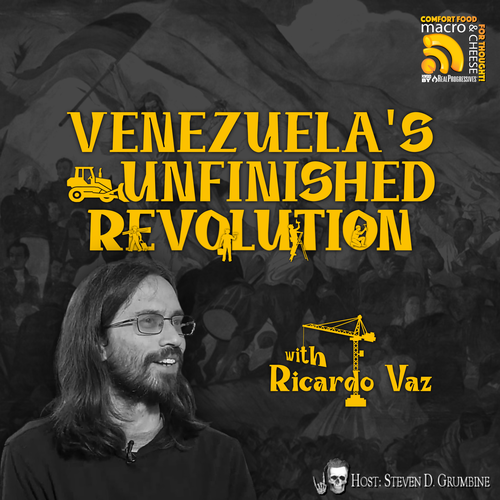
Episode 363 – Venezuela’s Unfinished Revolution with Ricardo Vaz
FOLLOW THE SHOW
Ricardo Vaz of Venezuela Analysis joins Steve to unpack oil, sanctions, and the Bolivarian Revolution, exposing how empire, power, and propaganda actually work.
** Further questions about this episode? You’re in luck. Tuesday evening, January 20th, Ricardo Vaz will be with us during Macro ‘n Chill, our online gathering. Find the registration link at the top of our website: realprogressives.org
Steve opens in a subdued mood brought on by the dizzying speed of ‘current events.’ For this episode he’s stepping back and looking at Venezuela. News reports are working hard to create confusion. On social media US citizens claim that kidnapping a sitting president is justified if you don’t like him. Or if he’s socialist.
To understand a situation, it must be considered historically, materially, and as a connected process. With that in mind, Ricardo Vaz of Venezuelanalysis, joins Steve to talk about what the Bolivarian Revolution actually was – on the ground – beyond the familiar US media caricatures. Ricardo walks through key turning points in the Chávez era and the social gains that reshaped everyday life. But there’s a bigger question that haunts every revolutionary project. How do you build new forms of democratic power while the old state machinery, domestic elites, and hostile external forces push back?
(Does this sound familiar? It will if you took part in RP Book Club’s study of State and Revolution)
From there, the conversation follows the oil thread. It’s not a single-cause explanation, but it’s where sovereignty, development, and imperial pressure collide. Steve and Ricardo unpack how the hydrocarbons industry evolved, what “nationalization” really meant in practice, and why the fight over Venezuela’s resources can’t be separated from US strategy in the hemisphere.
They then look into the Maduro years, sanctions, economic siege, and the constant tug-of-war inside Venezuela between survival policies and revolutionary horizons. This includes a clear-eyed look at opposition figures and the narratives that dominate US talking points. The episode closes with a grounded discussion of why Venezuela matters as a 21st-century political experiment, and what meaningful solidarity looks like when the headlines are designed to mislead and misdirect.
Ricardo Vaz grew up in Mozambique with strong political leanings and a clear anti-imperialist outlook, which led him early on to closely follow the Bolivarian Revolution and Chavismo in Venezuela. After living in various countries and continents, he moved to Venezuela in early 2019. Although trained in theoretical physics, he gradually shifted into journalism and political analysis, joining the Venezuela Analysis staff as a writer and editor in 2018. His main interests include sanctions, popular power organizations, and corporate media coverage of Venezuela. He is also a member of grassroots media collectives including Tatuy TV and Utopix.
venezuelanalysis.com
@venanalysis on X
Steve Grumbine:
All right, folks, this is Steve with Macro N Cheese. And you definitely feel a little bit of a subdued Grumbine voice here because things are a little bit subdued right now.
I am struggling mightily with the current events and there’s so many of them, right? There’s so, so many of them. Part of me would like to be talking about Minnesota right now.
Part of me would like to be discussing fascism in the United States. But things are happening so fast, it’s impossible to stay up on every single one of them. But we’re trying. We’re trying really hard.
And we’re looking also now at one of the most important moves that has happened under this Trump administration. And, and I would like to say right up front before we get into the guest and into the subject matter that this isn’t new.
Biden had talked about Venezuela. This is Trump just finally stepping forward and doing what the US Empire planned to do to begin with anyway.
But today we’re going to talk about Venezuela and we’re going to talk about the Bolivarian Revolution. We’re going to talk about the gains. We’re going to talk about Venezuela as it is from an insider perspective.
We’re also going to better understand kind of the oil industry and how it plays out in Venezuela as well. And really, there’s nothing isolated here, folks. Everything’s connected. I think that’s the most important thing to understand.
You know, having a dialectical perspective I think is really important in understanding the events that are happening fast and furious around us. So today, like I said, we are going to discuss Venezuela. My guest is from Venezuela Analysis.
His name is Ricardo Vaz and Ricardo grew up in Mozambique with a very, very strong political leanings from an early age and clear anti-imperialist outlook. He always felt a very strong affinity toward the Bolivarian Revolution and Chavismo and has closely followed the political developments in Venezuela.
After living in different countries and continents, he moved to Venezuela in early 2019. And I would just read straight from his bio.
Although his background is in theoretical physics, he gradually moved toward journalism and political analysis and joined the Venezuela Analysis staff as a writer and editor in 2018. Some of his main interests are sanctions, popular power organizations and the corporate media coverage of Venezuela.
He’s also a member of grassroots collectives, and I can’t pronounce them, so Utopix is one that I can. But Tatuy TV I think. I hope I said that correctly.
Ricardo Vaz:
Close enough.
Steve Grumbine:
Thank you so much, Ricardo, for joining me. I really, really appreciate it.
Ricardo Vaz:
No, no, thank you, Steve. It’s great to be here and great to have an opportunity to go a little beyond.
I mean, of course there’s a lot going on right now, and we are kind of trapped in the moment, but kind of understand where we come from and how we got here.
Steve Grumbine:
And that’s really, I think, the evergreen portion of this conversation.
People hear things, you know, the scuttlebutt, the word, the common sense they think they know, and little by little, we find out that a lot of things we think we know just ain’t so. And I think the conversation about Venezuela is really an important one.
All right, so, Ricardo, help me better understand how we got to this moment in time.
Give me a little bit of history of Venezuela and the Bolivarian Revolution, and obviously we can discuss the oil industry as well and understand its role in developing the Venezuelan economy.
Ricardo Vaz:
Yeah, absolutely. I’m going to give some kind of historical perspective, but feel free to interrupt me and we can delve into things in more detail.
And talking about oil is inevitable. Even now, I mean, you’re seeing a lot of opposition to what the Trump administration has just did.
You know, this January 3rd military attacks, the kidnapping of the sitting president, Nicolas Maduro. And, you know, the obvious answer is it’s all about the oil.
And don’t take it from me, don’t take it from anyone else, take it from Trump himself and his administration officials when they say “We’re going to get the oil and we’re going to get the oil in the best favorable conditions.” And of course, that’s the big part of the equation. But I don’t think that explains everything, I mean.
I think we’re seeing US repositioning to impose its hegemony in the hemisphere. And if we talk about the obstacles to that hegemony, very close to the top is the Bolivarian Revolution.
In my opinion, the Bolivarian Revolution is the most important and transformative political project of the 21st century. And that’s one of the reasons why it has permanently been in the sights of the United States.
You know, it’s a bad example in the US’s “backyard.” The Bolivarian Revolution comes around at the crucial time.
So we can go back to the early ’90s with the fall of the Soviet Union and this idea of the end of history. And now it’s going to be this unopposed, unipolar world where the US can just throw its weight around and do whatever it pleases.
Perhaps in the beginning, nobody really thought much of it, not even [former Venezuelan President] Hugo Chavez, when he was elected in 1998. He didn’t seem like such a serious threat. But then, you know, history has a way of accelerating itself.
And when everything seemed over, you see Chavez in 2005 and 2006 raise again the banners of socialism.
And that’s, from my understanding, what brings socialism really back into the political discourse here first and then in Latin America and then of course, around the world. So Chavez comes to power in 1998, 1998, at the end of a lost decade, really, in Venezuela.
So this was the heyday of neoliberalism, where you had an economic model that had run into the ground and then there come the neoliberal examples imposed in all Latin American countries.
And here in Venezuela, it was an absolute disaster with a rapid increase in poverty and inequality, as well as, you know, corruption and complete decay of the political class. And Chavez comes as an actual outsider, not like Trump, proposing to re-found the republic. And quite fittingly, where does Bolivar come in, right?
Because it’s a Bolivarian revolution and Bolivar is, you know, I’m sure everyone knows Bolivar is Venezuela’s independence hero. He then played a key role in the independence of other South American countries.
And Chavez brings back the example of Bolivar as kind of the re-foundation of the republic with republican values and a true moral compass as opposed to the decay that had been seen before. So Chavez gets into power and in the beginning, it’s actually a very mild project.
He’s talking about the third way, social democracy and modest reforms. But even that was unacceptable for the Venezuelan oligarchy and the elite.
I mean, there was some kind of a breaking point very early in 2001 when Chavez wanted to pass some very far-reaching reforms. You know, we’re talking about reforming the tenancy of lands, allowing landless peasants to have rights.
And most importantly, and this was the straw that broke the camel’s back, he wanted to change the legislation regarding oil. This was deemed unacceptable by the elites. They tried a coup in 2002.
And this is a really important moment in history because I was 13 at the time and I was watching and I had some historical notions and it looked like Chile 1973 all over again, or any other example you could think of a government that was to the Left and mildly challenging of the US and then it was just crushed by the army and the elites. And the US actually came out immediately in support of the coup. But history was going to be different this time around.
The Venezuelan masses came out en masse, you know, pun intended, and reversed the coup and secured Chavez’s return. This was really a triumph that ignited the Bolivarian revolution.
So Chavez understood that even his idea of advancing slowly and trying to get everyone on board was not going to work.
I mean, if he was going to return the stolen dignity of the Venezuelan masses, then he really needed a project that was going to transform much further.
And so that leads to a kind of acceleration of the Bolivarian Revolution, first by declaring openly its anti-imperialist character in 2003, and then in 2005 declaring that the project that we’re building has a name. This was Chavez in a meeting in Brazil. It has a name and it’s called “socialism.” And socialism has been kind of prescribed from the public discourse.
Maybe. Let me stop here and see if you want to exchange any ideas before I continue.
Steve Grumbine:
Oh, no, I want you to keep going. This story is really important.
Ricardo Vaz:
Okay. So Chavez came to power, and one of the key elements in his discourse was he called it “the repayment of the social debt.”
So you had this huge majority of the population, Afro-Venezuelan, indigenous descendant, that historically had always been forgotten and marginalized. They lived in terrible conditions in these huge urban slums on the hillsides. We’ve all seen the pictures.
I mean, some of them didn’t even have ID cards. They basically did not exist. And this was the base that Chavez wanted to address.
So first granting them basic rights like the ability to vote, but then repaying the social debt, improving living conditions very quickly. So within the first few years of the Bolivarian revolution, poverty was halved from 60 to 30%. Extreme poverty was cut down by three quarters.
The United Nations recognized Venezuela as a territory free of illiteracy after a huge campaign with support from Cuba, of course. There were other initiatives, like Barrio Adentro.
So barrio is these popular neighborhoods that historically never had any access to healthcare.
And Chavez, with again cooperation from Cuba, took healthcare to the furthest corners, in the most inaccessible, either geographically or socially most inaccessible corners in Venezuela. And of course, that made the Bolivarian Revolution really a process of the Venezuelan masses.
And then in 2006, already with the socialist banner and saying, “You know, my project is socialism, and whoever votes for me is voting for socialism.” He had the most historic landslide victory in a presidential election. He had, I think, 65% of the vote.
So this was really the height of popular enthusiasm behind the Bolivarian Revolution. [Wow.] Of course, I mean, there are mistakes along the way, and one of them was the 2007.
It was an attempt at a constitutional reform to kind of recreate the geographical division of the state.
But in the end, Chavez himself recognized that there wasn’t enough of an effort to explain what was going on, what they wanted to achieve with this, and this was narrowly defeated. Chavez accepted the defeat, but it was just a temporary setback, because another key pillar of Chavez’s project dating back to the early ’90s.
So just a small parenthesis, Chavez appears on the political scene on February 4, 1992, as a mid-ranking army officer who attempted a coup. So this was again after the disasters wrought by neoliberalism and this decay of politics. Chavez attempted a coup.
It was very audacious and it failed.
He was arrested, but he instantly became a figure of popular cult because he talked to the press when the coup was defeated, basically telling his comrades to lay down their arms, and he took responsibility for it. And this had become unthinkable in Venezuelan society at the time, that the leader would actually take responsibility for failures.
So he was already showing what the next leap in Venezuelan history was going to be. Then he was released from prison by a presidential pardon in 1994.
And he immediately began traversing the country from north to south, east to west, visiting the most remote villages, and, you know, even having assemblies with 20 people, if that’s what it took. Because he wanted to know the country inside out. He didn’t want to just make up some kind of cheap political project and try and take power.
He wanted something profound that was going to really address the needs of the nation.
But one of the key elements that he mentioned was this concept of protagonistic and participatory democracy, which seemed a bit vague in the beginning, but it was something that actually began to take shape as the revolution itself advanced.
So from the get-go, Chavez was looking for mechanisms to improve the participation of the Venezuelan people in the politics and in the processes defining their everyday life.
So there were things like water committees to decide water supply in neighborhoods, or urban land committees to regularize the tenancy of urban land, because you had all these people building informally in hillsides and there was nothing to show for it legally. And so this was very important. There were also, again, examples that were tried and did not exactly succeed.
One of them was a push for people to create cooperatives.
This was around 2003, but there wasn’t enough oversight, there wasn’t enough of a plan, and there was just a lot of credit given away without any kind of accountability. So it didn’t really work, it didn’t really prosper, and there was some money squandered in the operation.
But Chavez never hid himself from admitting that, you know, we tried this, it didn’t work. And this is what we learned.
Steve Grumbine:
Powerful.
Ricardo Vaz:
He had the weekly broadcast on Sunday, which was called Alo Presidente. First it was radio, then it became television. And it ran for hours, three hours, four hours. I think the longest was eight hours.
And this was Chavez discussing with his minister, discussing with people announcing government projects, really an effort to bypass the usual mediation from the traditional media and reach the people directly. And this is no small factor in understanding why the Bolivarian revolution was so far reaching.
But going back to the issue of how do we create a new kind of democracy? So Chavez understood that it wasn’t just a matter of creating cooperatives. There needed to be a change from the grassroots.
And he finally settled on a winning formula. Let me put it like this- in 2006, with the so-called communal council– so communal councils are political spaces in a given neighborhood.
They bring together from a few hundred to a few thousand, typically a few hundred families in a very delimited geographical space. And the most important thing is that it is ruled by an assembly where everyone over the age of 16 gets to participate.
And this assembly then chooses committees on everything, day to day life- so education, healthcare, public services, sports, everything you can imagine, with the people choosing their own spokespeople.
It’s important to note the distinction. These are not merely representatives, they are spokespeople that actually can be recalled at any time if they’re not fulfilling their duties.
And the communal councils actually began accessing funding directly from the state.
So again, bypassing the mediation of the regional governments and the local governments, and allowing the people to actually decide democratically what were their priorities, what do they actually need on the territory, and executing these projects themselves, rendering accounts, so trying to change the culture of politics altogether. But this was again confined to small geographical spaces. So again, the next step was understanding how to scale it up.
And this was a few years later with probably the biggest, in my opinion, the biggest political legacy of the Bolivarian revolution, which are the communes. So communes, in Chavez’s words, will be the spaces where we’re going to give birth to socialism.
So communes are the Venezuelan road towards socialism.
And communes bring together anything from three to 20 communal councils that are geographically contiguous but it’s not just the sum of communal council, it’s a lot more than that, because communes, crucially, are supposed to hold their own means of production, so have social property, enterprises, that are owned by the commune and which then mean to transform the relations of production in the territory. So, of course, there’s a gap between theory and reality. We’re going to get to that in a second. But beyond these enterprises, other things.
The commons should have their own banks, they should have their own planning instances. And again, you know, mirroring the communal councils, but in a bigger scale, these committees to handle education, healthcare and so on.
So it’s a unit of self-government in the territory. And then, you know, looking towards the end goal, you know, how do you then build from communes?
Well, communes then are supposed to come together and found the communal cities and then communal corridors, communal federations and so on, to eventually replace the bourgeois state with the new communal state. This is a very vague concept that of course, has to be built along the way and through struggles. But I mean, it’s. At least that’s the horizon.
Steve Grumbine:
Yeah, let me stop you real quick. This is interesting to me. Is this, in essence the Venezuelan version of the Soviets?
Ricardo Vaz:
Yes, sorry, if you’re going to add.
Steve Grumbine:
No, no, I just. That was the point I was making. It’s not like he’s just sort of creating random stuff. He’s using theory, he’s using history.
He’s looking at what worked elsewhere and trying to provide Venezuelan properties to it in the design of what he’s trying to create. And it sounds like- based on them bypassing kind of these bourgeois ministers in the middle- it sounds like he’s leveling the class to really, really look like everyone has a say.
Now, whether or not that worked perfectly or not is not really as relevant as the desire and the effort and the design to try to bring that about.
And that’s what I’m hearing you say. Am I close?
Ricardo Vaz:
Yeah, yeah, that’s actually a great point.
And going back to what we were mentioning in the beginning, how you only see in the news or on television where you hear about Venezuela once every few months, and you get a snippet of Chavez.
And Chavez appears like just someone who makes these grandiose speeches, and he’s always attacking Bush and whatever, and you think that he’s just like that. But actually Chavez was a great student of history and politics and he was very eclectic in his sources.
So in one of these broadcasts, he could be talking about, I don’t know, growing tomatoes and then jump to a reference of Gramsci and then come back and sing a popular song and then talk about Rosa Luxembourg. You really had to keep up with him.
And there was actually a sense that many of the things he said weren’t really understood, you know, that their reach wasn’t really understood at the time. I mean, it still happens now that we go back and we listen to a Chavez speech from 2007 or what have you.
And he’s actually making a point that is very deep, but somehow it doesn’t get noticed at the time. So there’s still so much to learn and to understand from that. But indeed, I mean, he was very eclectic in his sources.
And of course, the Soviets are a key one when we’re talking about this kind of transformation and construction of socialism. I mean, he also talked about the Chinese commune under Mao in the 1950s and ’60s.
But there was also an effort to connect to past experiences in Venezuela and in Latin America in general. So, for example, these communities of slaves that freed themselves and they organized here, they were called cumbes.
In other places they were called palenques or kilombos. So these were again self-governed spaces of free slaves, where they also had some concepts like this, of horizontal democracy and so on.
So there was an effort to learn the lessons from history. You know, it is not just making up anything new, or not making it up completely, but actually building on a history.
And again, this is the whole ethos of the Bolivarian revolution.
The idea that there is a continuous struggle dating back to anti-colonial indigenous resistance, and then through Bolivar and then through other efforts to fight back against the oligarchy and all the way to the present. This was something very important for Chavez.
I mean, there was a lot of enthusiasm, a lot of progress, but we’re seeing the construction of history in real time. And there are shortcomings, there are contradictions, there are obstacles.
For example, you were mentioning the bourgeois state, of course, the bourgeois state. And it’s not a matter of ill will or any kind of conscious idea in that regard, but it’s kind of a structural issue.
You have a new construction that ultimately is going to replace the bourgeois state. So the bourgeois state will resist it, right? It does not want to transfer competencies to these communes because that will make itself obsolete.
So you had constant issues of tensions between constituent power from the ground up and the constituted power from top down.
But this was something that Chavez actually embraced and discussed and understood that it wasn’t something that’s going to be solved overnight, but something that really should be present at all times. I mean, there were also struggles related to the Socialist party.
So at one point, on Fidel’s recommendation, Chavez created a political party, a mass party, because before he had the movement, it was a bit loose.
And he created the party and instantly became this huge apparatus that was very useful for things like winning elections, but it also has its internal vices and this instinct to kind of control this popular effervescence from below. So this was always present.
And I think something that’s really worth discussing if you want to understand how constructing something new is going to come about.
Steve Grumbine:
Can we do that real quickly? Because obviously I want to get to Maduro and how things are the way they are today and kind of lay out the empire and its reach into Venezuela.
But I do want to go back to exactly what you’re talking about before we get there.
Because to me, one of the most important things I have always- I guess each of us, right- start from a position of ignorance and, you know, things elaborate and we learn and we grow.
But one of the things that we were always raised to hear was all these, you know, “Communist, socialist dictators and they, they murdered billions of people because zillions, trillions of people were murdered and slaughtered.” And reality is so much different in so many ways than that.
And understanding counter-revolutionary forces and understanding the pressures to steal back winds and to bring capital back in charge and to…
I don’t want to get into the Trotsky-Stalin stuff here, but just the idea that somehow or another a socialist state can survive on its own while the outside predators are trying to isolate and destroy whatever gains the people have made. You know, it’s messy and it’s real easy for people to focus on one aspect of it.
Not ever asking, not ever questioning, not ever wondering why in the world would somebody who’s desperately trying to build an equal society have such problems? And it really comes down- there’s many factors, but one key factor- is that the powers that be want to take back what they gained.
And you can see that in even something like the French Revolution, which was a bourgeois revolution. And you can see the counter-revolutionary forces in China and you can see them in Haiti, and you can see them in Russia even.
I mean, there’s always a counter-revolutionary force and people dismiss that like it’s not a real thing. They don’t pay attention. And it’s easy to say “How come he killed whatever?” And completely is erroneous.
And quite frankly, I think something to learn from. But I think it’s something to contextualize.
Ricardo Vaz:
Absolutely.
I think there’s a tendency to be kind of narrow minded and taking one single element that might not look good out of context, when actually you should understand this as kind of a historical process where, you know, you really have an advancement of class warfare.
So here in the case of Venezuela, you had these masses that had historically been marginalized and forgotten, and now you give them not just their rights, but you give them political agency. So they become, in a very eloquent fashion, they become the owners of their own destiny. Right? They are for the first time writing their own history.
And I mean, its significance cannot be overestimated.
And that’s why I stress that the Bolivarian Revolution is something that should really be studied and defended even, because there’s also a reason why it faced so much backlash. It’s because it was really trying to produce something, produce a new and equal society in these very difficult conditions.
But you were mentioning the previous socialist experiences, you know, the real existing socialism of Eastern Europe and the Soviet Union. And of course there’s a lot to take from there. Again, systems that existed with huge external and also internal pressures.
But Chavez actually talked a lot about it and understanding, you know, where did they fail? You know, we cannot just attribute it to, you know, the constant imperialist onslaught.
And one of the points that he emphasized was this lack of internal and grassroots democracy, you know, something that you saw very clearly with the Soviets, but then gets a bit eroded over time. So this was something that Venezuela had to- or any new socialist project would have- to change. And the communes offer that blueprint.
Of course, that doesn’t always work in practice. You can see vices, you can see, I don’t know, subordinating themselves to the official agenda.
A lot of things happen, especially in times of economic struggles where the communes do not have their own means of production, they do not have economic autonomy, so they become much more dependent on state funding. And that in turn, of course, subordinates them to the state agenda. All of this is happening and we shouldn’t have any illusions about it.
But it’s no less significant because of that.
Steve Grumbine:
Thank you so much for bringing that out. I am curious though, as we move through the gains and kind of understanding how they tried to build these things out locally.
There is an international component here that is always at play.
I don’t know how you can ever look at the domestic without understanding the empire’s desire to undermine and steal the real resources underneath the soil and, you know, structural adjustments with IMF loans and all the other things that have trapped the Global South in perpetual poverty.
Can you talk a little bit about what the international angle was as they were moving through the Bolivarian Revolution and some of these gains that Chavez did?
Ricardo Vaz:
Absolutely. I think that actually allows us to pivot to oil and then through oil, pivot to the present. So Chavez had an international perspective from the start.
I mean, I’ve mentioned how Fidel Castro was a very close friend, a very close ally, and a very strong influence as well. And these gains, in terms of affording people a dignity that had been historically denied, extended beyond Venezuela.
So there were some solidarity initiatives throughout the continent and even beyond with again, very strong presence from Cuba. And one of my favorite examples is Petrocaribe.
So Petrocaribe was a program whereby Venezuela would supply oil and other derivatives to the Caribbean states and islands in favorable conditions.
So it’s not like they were giving them at a discount, but, you know, allowing them to pay over time, or direct barter exchange with agricultural products.
And this had basically the same perspective of freeing these nations that are, you know, very small, very vulnerable, and had historically been dependent on the U.S. and of course, if the U.S. is going to supply them with energy, it’s going to impose political conditions, so creating an alternative environment whereby they can look at their own sovereign path towards development.
This was really a beautiful initiative which again had these issues at corruption that shouldn’t take away from us looking at it from a fair perspective. But then, you know, much later we’ll get to it with US sanctions, Venezuela stopped being able to run this program.
But there were other programs, for example in healthcare, providing eye surgeries, again with very big Cuban expertise. But there was always, as you were mentioning, always this constant U.S. pressure.
You saw the coup in 2002, and then, you know, once the U.S. realized that they could not really overthrow Chavez in a classic style 1970s Condor plan, counterrevolution, they began looking at other avenues. You know, the soft power, USAID funded groups, “civil society”, trying to undermine the revolution from within.
And this was one of the factors that led to this defeat of the constitutional referendum in 2007. But, you know, Chavez ran for reelection in 2012.
He was already quite stricken with cancer, but he did some kind of historic campaign, very, very physically demanding campaign. And he again won in a landslide in 2012.
And so the revolution was really in a very strong position at this point and actually prepared to advance even further. But of course, you know, unfortunately, Chavez passed away a few months later in March 2013.
Intermission:
You are listening to Macro N Cheese, a podcast by Real Progressives. We are a 501c3 nonprofit organization. All donations are tax deductible. Please consider becoming a monthly donor on Patreon, Substack, or our website, realprogressives.org. Now back to the podcast.
Ricardo Vaz:
But actually the final point I want to mention about Chavez and then we can look at oil and kind of bridge to the present.
After he was elected in October 2012, a few days later he gave a speech and this is his final public address. This was a cabinet meeting.
And you would think, you know, after winning reelection for the third time and a very big fashion, a big margin, that this would be kind of a triumphant mood, you know, kind of a victory lap. But it was the opposite, on the contrary.
And this was a meeting where Chavez absolutely scolded his ministers because he was saying, you know, nobody’s paying attention to the communes, you know, everyone is just minding their own business. But this is actually a serious thing, that everyone should be on top of everyone’s agenda because otherwise what are we doing here?
And this is the first and only time where he says the slogan “commune or nothing,” which then became kind of the flag for the communal movement here in Venezuela. So in spite of the progress, Chavez was critical and very self-critical on what the Bolivar revolution had yet to achieve.
He made this analogy that, you know, we have a state-owned company somewhere in some agricultural heartland, but you know, if we don’t change the relations of production around it, then this is just going to be a socialist island in a capitalist sea and it will eventually go underwater. And this became kind of a prediction of what was going to happen later under the economic crisis and sanctions.
So if we go to the final point of Chavez’s tenure, you know, late 2012, the balance is this, you know, a very promising socialist project, but with these structural issues that still needed to be overcome and which Chavez himself recognized needed to be overcome.
Steve Grumbine:
You know, one of the big things that I realized, I don’t think, you know, this was something that came naturally.
This is something that has come to me through intense amounts of reading and talking to smart people like yourself, who have a deep contextual knowledge of various situations. You know, socialism doesn’t happen overnight. It’s not an event, it’s a process. And it doesn’t start at perfection.
None of the theoretical framework starts with perfection. It starts where it starts with the conditions of the time, with the people where they are. And then over time there are gains.
You know, nothing is linear, there’s backwards, there’s forwards, there’s up, there’s down, just like any other thing in life. The difference is, is that whose interests are being served?
Who’s got control, if you will, of not just the means of production, but the means of governance and the means of the political projects that come out of the state? I mean, the state represents class interests. And whose interests are they representing? Well, it depends, right?
In the United States we have a clear hyper-capitalism thuggery that sees the entire world as its own little piggy bank. And that’s really not the case in any way, shape or form with what was occurring in Venezuela.
Venezuela was looking purely to maintain its own, to lift the people within.
And within that space, things can go wrong just like they’re going wrong right now in the grand old United States with all, all the people getting killed by brown shirts called ICE. I mean, we’re dealing with people that just literally have no ability to self-diagnose what is happening in their own backyard.
And they put all their projection on Venezuela or whatever other state is trying to free itself from the predation of capital. I would like your feedback on that before we move into oil.
Ricardo Vaz:
Yeah, absolutely. And I mean, there are many analogies we can make. I mean, one of them is this idea of building a train while the train is in motion.
And I mean, there are many criticisms and in hindsight, of course, you can always be right and saying, “Oh, Venezuela should have done like Norway and created a sovereign fund, save it for a rainy day.” But Chavez had this priority of paying the social debt.
And I like this perspective that you’re making of the state as kind of a mediator in class struggle. You know, which side is it going to take? You know, by default it’s going to take the side of capital.
But here people sometimes said that Chavez was an infiltrator within the state.
You know, someone who would use the power of the bourgeois state, which again had its limitations and its own contradictions, but use it to advance this transformative project. And the other analogy that I like a lot is the idea of a conveyor belt. So you can have a state that actually brings down policies from the top down.
But the Bolivar revolution also had kind of a conveyor belt whereby the desires and aspirations of the people could actually reach the very top in Chavez and allow for this very beautiful retroactive process where Chavez was in real time understanding where the policies were working, where they were failing, where they needed to be changed, and so on.
Steve Grumbine:
Very good.
So one of the other things, because this is where we get involved from our previous work through modern monetary theory is understanding the role of the state as a currency issuer and foreign debt and debts denominated in foreign currencies and so forth.
And one of the big keys to maintaining, you know, sovereignty is to be able to have value-added production and value-added internal production, not requiring imports necessarily.
I mean, imports can serve a great cause when you have surpluses, but they shouldn’t be your primary mode, even though, yes, you’re trading paper in terms of the fiat currency of the state for someone else’s production, for someone else’s services, for someone else’s minerals and, you know, so forth.
But when it comes down to Venezuela, Venezuela being a state that has an incredible amount of oil, but they don’t really necessarily have their own production of the refinement, it’s crude. So they’re competing on a stage with others that have that same crude.
And Saudi Arabia and others are able to drop the bottom out of the price and bankrupt the other states because they’re dependent on exports to survive. That’s one component of it, but it’s also a part of capitalism.
And understand the way that capital works on the international stage, predating and stealing and pillaging and so forth. How did Venezuela go from private industry to nationalizing the oil fields and so forth?
I mean, if you want to bring it to present, the fact is, is that Donald Trump is not acting on behalf of the American people. Donald Trump is acting on behalf of global oil corporations to get their money back, so to speak.
Because once Chavez nationalized the oil fields, if it was Chavez or if it was Maduro, I think it was Chavez. Correct. I mean, I could be wrong, but I’ll let you tell that story. Yeah. So ultimately, there is a little bit of payback here.
The capital order is saying, “Hey, you done took our stuff, man. We want it back.” And reality, though, might makes right in this case, is kind of the message I think Trump is telling everyone.
It’s not a matter of whether or not Venezuela deserves to own its own real resources. It’s a matter of capital says, “No, we want it.
We have a piece of paper somewhere that we made you sign at gunpoint or some other rich class traitor took, you know, and ran with.” Help me understand that point. The nationalization of the oil and the blowback from that.
Ricardo Vaz:
Yeah, it’s actually, I mean, a great perspective and you’ve given me a lot of points to touch upon. There’s a long history here to traverse, so I hope it’s not too superficial.
But in Venezuela, oil was discovered around the 1920s and you had suddenly an economic sector that became really predominant over everything else. And built on top of an economy that was severely underdeveloped.
It was just basically an exporter of some raw commodities, coffee, cocoa and other agricultural outputs. So all of a sudden it becomes this almost mono producer of crude [oil] exporting a lot, at some point even becoming the main supplier to the United States.
You had these refineries in the Gulf that were built and tailored for Venezuelan crude, which is, I mean, right now it’s extra heavy, but before it wasn’t.
But anyway, you had this industry that was developing very fast and it was always a constant source of struggle, struggle within the industry, because this was what decided the destinies of the country. And so you had the first major union strike here in 1936-37, to demand better rights for oil workers.
There was a constant struggle, even from moderate social democrat, US-aligned governments, to impose a bigger Venezuelan presence inside an industry that was very much run by US corporations like Standard Oil, Shell, Texaco, which later became Chevron and others. And then in the 1970s, 1973, there’s the oil crisis after the Yom Kippur War. And this leads to a complete skyrocketing of oil prices.
And here you had again a soft social democrat government that proposed the plan of the Great Venezuela. I mean, at that point it seemed like the resources were infinite and they ended up being a bit squandered.
But there were plans to replace imports to create kind of a domestic industry, but they weren’t followed through. And then of course, oil prices came crashing down.
And this is what led to then the arrival of neoliberalism, which then led to the emergence of Chavez. In 1976. There’s a nationalization of the oil industry and the creation of a state-owned company. But this was always seen as a partial nationalization.
It just left a lot of loopholes which allowed foreign companies to continue extracting oil, paying very little taxes and royalty. So once Chavez comes into power, there are essentially three moments.
So first is the 1999 Constitution which establishes that the Venezuelan state has primacy over the hydrocarbons industry. Then there’s this hydrocarbon law in 2001 which again reaffirms that the Venezuelan state must be a majority owner in all joint ventures.
And then in 2007 it focuses on the Orinoco oil belt, which is home to the largest oil deposits on the planet. And demanding that again the Venezuelan state oil company hold 60% of states in any joint venture. And this is what probably, because, I mean, Trump never speaks clearly, probably what Trump is referring to when he’s saying “They stole our oil.”
So the Venezuelan state imposed that foreign corporations that want to stay are free to do so, but they need to accept these new conditions. And I think there were 33 companies at the time. 31 of them either accepted the new conditions or accepted Venezuelan offers of compensation.
And the two that did not were ExxonMobil and ConocoPhillips. And they pursued international arbitration. And ExxonMobil wanted something like $18 billion.
There was one process in the International Chamber of Commerce, another in the International Court for the settlement of investor disputes. This is under the World Bank. But ultimately Venezuela had to pay 1.6 billion, which was a huge political victory. And this has been paid.
So Venezuela actually owes nothing to ExxonMobil. ConocoPhillips, on the other hand, started to get a bit later and then there was political turmoil.
There was this, I mean, we don’t have time to go into it, but there was this imaginary self-proclaimed, “interim government” led by Juan Guaido that the US recognized. This ended up hampering Venezuela’s defenses in this international arbitration court.
But anyway, long story short, ConocoPhillips has some $10 billion that it wants to collect. It’s going to collect part of it through the organized judicial plunder of Citgo in the United States.
But anyway, all of this to say that these corporations that had their assets nationalized, I mean, they were nationalized first and foremost because they refused to accept the country’s legislation. But beyond that, they’ve already pursued compensation elsewhere. So it’s not like Trump has any debts to settle in this case.
It’s just opening a new page where you he’s going to, at gunpoint, impose new conditions for the US oil corporations. And it’s a very crude image of the US government as a gendarme, policeman enforcing the rights or the privileges of corporations around the world.
Steve Grumbine:
I appreciate that very much. Let’s go to current times here. If we can start with how Maduro came to power, because that is obviously a huge international, you know, there’s a lot of lies about it and there’s a lot of weird US manipulation and propaganda about it. And for the vast majority of our listeners, sadly, I don’t know that many of them know the truth of it all.
And they’ve heard bits and pieces, but none of them have actually, shouldn’t say none of them, I would say probably the vast majority of folks are just taking the official narrative and saying, “Oh, yeah, okay.”
Ricardo Vaz:
Yeah, absolutely.
I think oil gives us a path to the present, because, I mean, it has to be underscored that Venezuela under the Bolivarian revolution, did not overcome its major dependence on oil. And of course, you were mentioning this before.
I mean, we’re talking about a short period, and Chavez, you know, he had this coup in 2002, then there was an oil strike in late 2002. So basically, he had 10 years in government.
And this issue of oil dependence was very much present, but the efforts to overcome it didn’t take off far enough. I mean, I could argue that there were other priorities.
So Chavez passes away in early 2013, and there are elections, and Maduro won those elections narrowly, but without any sliver of doubt. Actually, John Kerry was US Secretary of State, and he actually tried his best not to recognize the results.
But anyway, Maduro came into power and immediately had a storm upon him because there was a collapse of oil prices globally. This was the heyday of fracking. And I mean, there are other issues that Venezuelan oil experts would explain much better.
But Venezuela over time transitioned from the lighter crudes to in the west of the country to this Orinoco oil belt, which has these extra heavy varieties. And these rely on a high oil price to cover because it has higher production costs.
So if oil prices fall below $40 per barrel, then you’re no longer making a profit from selling oil. So this was immediately a hit for the Venezuelan oil industry. In 2015, Obama declared Venezuela–I mean, I still can’t say it with a straight face–declared, declared Venezuela “an unusual and extraordinary threat to US national security.” And while this might seem just like official nonsense, it had an immediate repercussion in terms of raising the cost of credit.
And so it heightened the tailspin that the oil industry was going through. And then it really accelerated in 2017.
We are already in the first Trump administration when the US Treasury Department begins to impose sanctions against the Venezuelan oil industries.
So here, mid-2017, production was around 2 million barrels per day, which was still very much in line with what was produced historically over the previous 30 years.
But under US sanctions, then there’s an export embargo in early 2019, secondary sanctions, all of that, this production plummets all the way to 350,000 barrels per day around the time of the pandemic mid-2020. And then there’s a kind of a slow effort to recover.
But with all these sanctions remaining in place, it still hasn’t been able to surpass 1 million barrels per day. And that’s by design.
And so if we think about what has happened to the Bolivarian revolution, it’s very much connected to this, unfortunately, because this has a huge effect on living conditions.
This drives migration, it erodes support for the project, as you can expect, even though paradoxically, and it’s really a testament to Chavez’s legacy, the project retains a very significant support base.
And popular movement, you know, tying back to what we were talking in the beginning, popular movements and communes first suffers a lot because, I mean, everyone is focused on surviving. They hardly have time to organize. But then they understand that the project is kind of losing its path.
It’s very much tempted to just make concessions to private capital, both national and foreign.
And so the popular movements rise up to fight for the direction of the project, and actually, against all odds, recover and re-emerge as significant players to restate for those who might have stopped believing that socialism remains on the horizon. So that’s more or less what we’ve seen in the past five years, I could say.
But again, with an economy that’s so built around oil, you had historical collapse. I mean, GDP contracted by more than three quarters between 2014 and 2020, and it has since had. I think this will be the fifth year.
I mean, 2025 will be the fifth consecutive year of economic growth, but the fall was so steep that the economies still below one-third of the size it had in 2014. So that gives you an idea of the magnitude of the economic contraction and everything.
I mean, just going to the present now we have this Trump administration trying to impose some real neocolonial conditions on the Venezuelan oil industry.
And I believe, I mean, I hope for people who listen to this in a while that this is going to open a new stage of struggle within the oil industry as again, a starting point for defending Venezuelan sovereignty and again advancing.
Steve Grumbine:
So let’s just call her out, because I know that there’s been several kinds of US props for having a leader imposed by the US intelligence.
And one of the worst, most grotesque things I’ve seen is this Maria Corina Machado, who went out and said “It would be an honor basically, for you to bomb our country to freedom.” She’s just like. I’m looking at her, I’m like, this is a joke, right? This isn’t real. But it is real. And we’ve seen this with others.
It’s not just as they kidnap Maduro and go in there and just act like this is straight out of Confessions of an Economic Hitman, you know, kind of stuff. Tell me a little bit about her.
Obviously, she won the Nobel Prize, but she’s begging people to bomb her country and she thinks she’s the right one to take over. And this whole concept of narco-terrorism, et cetera, et cetera, get us to the current here.
Ricardo Vaz:
Yeah. So, I mean, fortunately, criticizing Marie Corina Machado is not going to get outdated at any point.
So we just saw, I mean, it was already beyond absurd for her to get the Nobel Peace Prize. I mean, this was someone who was lobbying the US to bomb her country for years. But now, I mean, it’s somehow adding insult to injury.
She now wants to award the prize to Trump after Trump bombed her country. So, I mean, it’s even hard to describe. But I mean, it’s also a consequence.
Her efforts to ingratiate herself with Trump are a consequence of her own political shortcomings because the Trump administration just bombed Caracas. And when asked, you know, are you going to put your main surrogate in power?
And Trump basically said, “No, she doesn’t have the support, she doesn’t have the respect of the country.” That’s why she’s trying so hard to please him and ingratiate herself, because Trump apparently is very sensitive to praise. But so Maria Corina Machado has historically been one of the main agents of US imperialism in Venezuela.
She was a very marginal political character for a long time, you know, perhaps in tandem with the resurgence of fascism and the far right around the world and in Latin American, she became the main figure of the opposition. Right now, she appears sidelined.
I don’t know what her plan is, but she had also been making this pitch, you know, before trying to please Trump, she was trying to please the US corporate class, you know, saying, “Venezuela is a land of grace and you’re going to have $1 trillion worth of riches ready for investment. We’re going to privatize anything and everything.
We’re going to privatize the oil industry,” which is a bit of a red line even for the Venezuelan right, because, I mean, we were talking about these governments that nationalized the industry, even if it was partial. But they were US-aligned governments, they weren’t leftist by any stretch of the imagination.
So the ownership of the industry and especially ownership of resources, something that’s very deeply ingrained into the Venezuelan conscience. But she’s, I mean, if it gets her into power, she’s willing to sell everything.
Steve Grumbine:
Just real quick. The libertarian angle here is so grotesque. It’s kind of like, “Yeah, just, you know, there’s no such thing as bad capitalism.
Come on down here and do it.” I, I just, you know, her and [Argentinian president Javier] Milei, I mean, they seem very, you know, it seems very, very similar to one another in various ways.
Just kind of terrifying. I want to pivot momentarily to, who is Delcy Rodriguez?
Ricardo Vaz:
Yeah, so Delcy Rodriguez is now acting president. She’s a bit different from the other main Chavista cadres that you saw over the past 25 years. Whereas the others came from popular struggles.
Maduro, for example, was a trade union leader. Delcy is a foreign-educated technocrat. So she didn’t have much of a role with Chavez, but then with Maduro she slowly climbed the ranks.
She was first foreign minister, then president of a constituent assembly that was formed in 2017, then Vice President, then minister of finance, and now finally also oil minister.
And in the absence of Maduro, who was kidnapped and is going to be tried on absolutely false and ludicrous “narco-terrorism” charges, she is now acting president and she’s been in charge of economic policy in recent years.
And she’s kind of the liaison with Venezuela’s allies and you know, we’re talking about companies in India, in China, trying to get foreign investment, but also a liaison with the Venezuelan private sector and the main private sector guilds like Ferre Camaras, which historically was very much against the Bolivar revolution, but under sanctions, they realized that they needed to find some kind of accommodation, modus vivendi with the government. So the Delcy Rodriguez is very much a pragmatist in terms of finding economic solutions.
And in recent years it has to be understood that this is under a context of severe, wide reaching US economic sanctions.
What you have seen from the Venezuelan government has been on one hand some social pause to try and shield the most vulnerable sectors of the population. But at the same time, policies of liberalization, offering benefits for foreign capital, for the private sector in a bid to jumpstart the economy.
This of course sparked debate. It has had some successes and shortcomings, but debates in terms of are we surrendering some of the key pillars of the Bolivar revolution?
Are we going too far in terms of undoing labor protections and this kind of thing? Are we surrendering too much sovereignty in these kinds of new hydrocarbon deals with foreign agents?
These kinds of debates, which again are part of the struggles faced by a revolutionary project, even more so under these constant US imperialist attacks.
Steve Grumbine:
It’s kind of humorous. I just leave my comment here that obviously, you know, she was the daughter of a former Marxist guerilla and deputy to Nicolas Maduro.
And so they’re painting her out to be like a real hardcore Marxist, when in reality, what you just said is that’s not really true. I mean, that doesn’t mean that she didn’t have those credentials coming from. But it sounds like technocrat and pragmatist.
Sounds very, very much like what we would get from a Hillary Clinton in the United States. Or, you know, the other one which you could look at is Toussaint Louverture as opposed to Jean Jacques Dessalines.
I find it fascinating because, you know, if you read this stuff in the mainstream media, the corporate media, etcetera, you get a very different look and feel from the people that are living it and experiencing it firsthand. All right, we are coming up on time here.
So what I want to do is I know we didn’t cover everything, and I would love to talk to you for hours and hours because you’re amazing. That said, I want to give you an opportunity to fill in any gaps that we missed and take us out with the final word.
Ricardo Vaz:
Yeah, I mean, absolutely. I think the more we talk, the more we realize that there are topics we’d like to go into in detail.
I mean, of course, I don’t pretend to be an expert on any of these things. It’s just historical perspective that gets us and allows me to actually connect with some of the great points that you were making yourself.
So right now, I think we have to understand where we are having the US Empire pivot again towards the Western Hemisphere and what that’s going to imply for the peoples in Latin America, and particularly in terms of international solidarity, trying to put the brakes as much as possible on this project of death and destruction that’s going to be unleashed all over the continent and inside the United States as well.
So I think in that sense, podcasts like this one that give us an historical perspective are very useful because they take us a bit away from being trapped in the moment and just looking at the developments from last week and allow us to understand that this is a longer struggle. And, for me at least, the really important thing is having a horizon.
You are fighting what’s in front of you, but you have to understand that you have this horizon of having a society free of exploitation, having a society that is built on social justice and equality, but not as an abstract concept.
But that’s something that people in many places, but in this case in Venezuela, have tried to and continue to build, even amongst the most difficult circumstances, from the ground up in their territories. And so that’s something that we need to learn about, discuss and of course, support.
Steve Grumbine:
Thank you so much. There was a part of me that thought about bringing up the, the “narco-terrorism” stuff, which is just preposterous.
I mean, the facts are clearly out there.
Like at the end of the day, one of the things that I, I know for sure and you can look at Washington DC and I’m not talking about the government, I’m talking about the people that live there. And you know, a lot of people talk about crime in the big city and so forth.
They don’t talk about the dialectical energies that have to go into understanding the poverty there. From the cuts, the absolute austerity that’s brought down and the things that, that generates.
The, the, you know, it’s like when you introduce a contagion, the follow up dominoes that come from that have to be understood. You have to know where ground zero of that contagion came from.
If you use international sanctions on a country and you choke off every aspect of their ability to survive and thrive, and you bring CIA propaganda and CIA actions behind lines, so to speak, expecting people to just survive and thrive and do well, it fundamentally is a ludicrous position to take and it really makes it very challenging to understand the world in which we live. And we come up with these very easy answers to very tough questions. And I think it’s a real shame. Listen, you’ve done great work.
I really appreciate the conversation. I hope beyond words that we can have you back on again because I really do want to talk more.
There’s so much you brought and maybe you can introduce us to others that maybe can help us carry the story further.
Ricardo Vaz:
Yeah, absolutely. I mean, it’s been a pleasure. I always enjoy, especially I mean this last week has been very complicated. I mean, to put it very mildly.
These are tough times, these are dark times. And of course I’ve had to report and talk about the recent developments.
But looking at the broader historical perspective, even if we understand the contradiction and shortcomings, also gives us hope to realize that there’s a lot to be won still.
Steve Grumbine:
I love it. Thank you. Great way to take us out. So folks, my name’s Steve Grumbine. I am the host of Macro N Cheese.
This podcast right here that you’re listening to is part of the Real Progressives nonprofit a 501c3 that we live and die by your contributions. I would also like to say that Ricardo and Venezuela Analysis is a nonprofit as well and they could use your support as well.
And if you look up their website, venezuelanalysis.com you can find ways to donate to their effort. On behalf of my guest Ricardo Vaz and myself, Steve Grumbine, on behalf of the podcast Macro N Cheese, we are outta here.
End Credits:
Production, transcripts, graphics, sound engineering, extras, and show notes for Macro N Cheese are done by our volunteer team at Real Progressives, serving in solidarity with the working class since 2015. To become a donor please go to patreon.com/realprogressives, realprogressives.substack.com, or realprogressives.org.
Extras links are included in the transcript.
Promo image background artwork source: Tito Salas, CC BY-SA 4.0, via Wikimedia Commons
Related Podcast Episodes
Related Articles
The Strategic Activist
Sex Work & Vice City
Where There’s Smoke, There’s Fire



Leave a Comment
You must be logged in to post a comment.