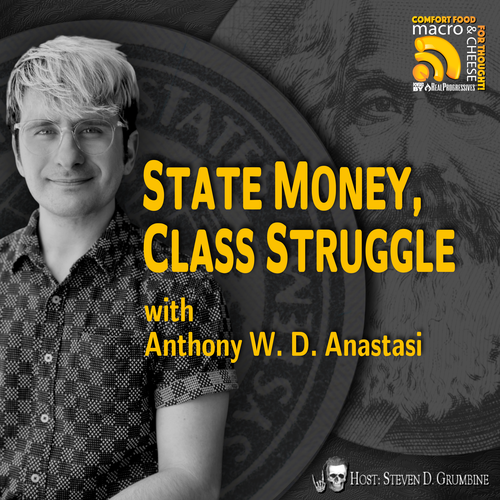
Episode 364 – State Money, Class Struggle with Anthony Anastasi
FOLLOW THE SHOW
Anthony W. D. Anastasi, an economist based in China, believes that MMT and Marxist class analysis can complement each other when money is understood as a tool of the state rather than an ideology. He and Steve take on common Marxist critiques of MMT, discuss non-reformist reform, and what China’s political economy reveals about monetary sovereignty and power.
We’ve made the case before, but it bears repeating: MMT is a politically neutral, descriptive lens explaining the operational realities of a sovereign fiat currency system where the availability of real resources, not money, are the constraint. And Marxism is an analytical framework for understanding class relations and production. The two are not inherently opposed. It’s a mistake to dismiss MMT as capitalist apologetics.
Steve’s guest is Dr. Anthony Anastasi, an economist teaching at the Sino-British College, University of Shanghai for Science and Technology. They talk about Anthony’s paper, Marxism and MMT: How Modern Monetary Theory Can Enrich the Debate Amongst Marxists.
They dismantle the all-too-common Marxist critiques of MMT, which claim that the state can’t control money’s value, and that MMT lacks a theory of value. (However, the ubiquitous “taxpayer money” framing that feeds austerity myths is not limited to Marxists.) The discussion reframes the state’s monetary capacity as a tool for class struggle rather than a capitalist backstop.
They look at the federal job guarantee with reference to Rosa Luxemburg’s concept of non-reformist reform, ie, a reform that can weaken capitalist logic and build working-class consciousness and power.
Anthony also brings an on-the-ground perspective, sharing observations from China’s political economy, including local-vs-central financing, RMB-denominated debt, capital controls, and emerging debates that resemble MMT arguments even when not labeled as such.
Dr. Anthony William Donald Anastasi is an economist and lecturer specializing in development economics and international political economy. He teaches at the Sino-British College, University of Shanghai for Science and Technology, and holds a Ph.D. from East China Normal University. His research examines how state–business relations, industrial policy, monetary sovereignty, and income distribution shape economic growth, trade patterns, and political power, with a particular focus on China and East Asia. Alongside publishing in SSCI-ranked journals, he regularly writes for the popular press on the Chinese and U.S. economies and global trade.
Twitter (x): @_AWDA_
Steve Grumbine:
All right, folks, this is Steve with Macro N Cheese. I’m always caught off guard when I find out that people that I read were already following our podcast, Macro N Cheese.
And this podcast- for those out there who aren’t familiar with us or have just started recently listening to us- we’ve been around for seven years. We’re approaching the 370th episode here of weekly podcasts. It’s pretty amazing.
I mean, you think about 52 weeks in a year, almost seven years, and we are still going strong. It’s a volunteer-led organization doing what we consider to be important work. We hope you find it important too.
So with that, my guest today is an expat. He lives in China and he wrote a paper some time ago during the pandemic that caught our attention a while ago.
But because of naming convention on Twitter or X, we couldn’t really identify because it was written in Chinese letters. And we unfortunately, as much as we try to be international, we’re not quite there yet. We don’t know how to read Chinese.
So we didn’t know that this guy who we’re going to bring on here actually was already following us. And I had been talking to him behind the scenes and didn’t even know I was talking to him. This is amazing.
This is one of those perfect storm awesome moments where our need and our desire backed up to his wheelhouse for something he wrote some time ago. And so with all that fun introduction, I’m going to introduce my guest is Dr. Anthony William Donald Anastasi.
He is an economist and lecturer specializing in development, economics and international political economy. He teaches at the Sino British College, University of Shanghai for Science and Technology and holds a PhD from East China Normal University.
His research examines how state business relations, industrial policy, monetary sovereignty and income distribution shape economic growth, trade patterns and political power, with a particular focus on China and East Asia.
Now, one of the most important things that come from this though, is that he wrote a paper and it was, I assume, part of his master’s thesis before he had gotten his PhD called Marxism and MMT: How Modern Monetary Theory Can Enrich the Debate Amongst Marxists.
And as you all know, our goal here of late, in particular, over the last several years, has been to bring class awareness, class analysis, and perspective to the MMT lens. No, they are not the same lens, by the way. We know that. We don’t require a lecture backwards.
We understand MMT is a politically neutral ideological-free zone, so to speak, even though we believe institutions are not ideologically free. But that said, MMT is in fact ideological minus the ideology, and the two feel like oil and water frequently. When we talk to people, the opportunity to bring Marxists into an understanding of Modern Monetary Theory has been challenging, to say the least.
And on that, we’ve had a difficult time bringing some MMTers into a class awareness where they’ve somehow or another managed to make stockbrokers and Wall Street just normal people, just like all of us, instead of realizing the parasitical nature of finance capitalism. So, without further ado, let me bring on my guest, Anthony. Welcome to the show, sir.
Anthony Anastasi:
Thanks, Steve. Glad to be here.
Steve Grumbine:
Absolutely. See, your paper was really fascinating.
I had read it years ago because you had sent it to me years ago, but I didn’t realize, and I should have because at the very top of the paper after the title, it gives your actual name. I feel so bad about that, but I’m so happy. It was such a neat little way of bumping into each other, so to speak.
Again, it’s like reintroducing again.
But this has been a few minutes since you wrote this paper, but you know, obviously this is an important subject, so let’s go ahead and just jump right in. I mean, we talked a little offline. What was your motivation for writing it? And then we’ll dive into the meat and potatoes.
Anthony Anastasi:
Yeah, sure. It was actually for a class during my PhD program.
It was actually a Marxist class, and I forget which one I read first, but I read a few kinds of Marxist critiques on MMT. And like, it just didn’t seem they were really arguing against it. I think they just had some sort of misunderstanding. And what you just said, like, MMT is not an ideology.
It’s more an explanation on how modern money works in a fiat currency system. And then, you know, Marxism is something that explains social relations and how production influences all of that.
And the two of them could be compatible if you look at it the right way. But then again, MMT can be compatible with any sort of ideology.
And so it just pretty much born out of some Marxist critiques on MMT I read, and I didn’t think it was quite right.
Steve Grumbine:
With that in mind, obviously, I’ve read a lot of those critiques, too. One of them was a gentleman named Doug Henwood.
And he and Randy Wray, years and years ago in New Economic Perspectives, et cetera, had gone rounds. But Doug Henwood has taken several shots at MMT over the years.
But a lot of them, James Medway has taken shots over, Grace Blakely has recently taken shots at it.
There is a host of folks out there that don’t fully understand what it is, but have determined contempt prior to investigation, that MMT simply isn’t relevant to the political sphere, or it isn’t relevant to our understanding, or it’s not compelling to bring up politically.
Because what are you going to do, retrain 352 million Americans to suddenly think differently and say, well, you want different outcomes, you gotta have different inputs, right? You gotta have different framing.
Anthony Anastasi:
Yeah.
Steve Grumbine:
And so, yeah, sorry, folks, sorry Marxists, my friends, my comrades, my fellow travelers, we do have to think of it a little differently. And I just want to throw this out there for folks that think that this is somehow or another capitalist apologia.
If you were a person that decided you really wanted to learn about Marxist thinking and theory and so forth, and you decided to stumble upon something like State and Revolution with Vladimir Lenin, you’d realize. And you could go back to Marx too, by the way, in case that wasn’t relatively available.
You can go to Engels, you can go to all of them and realize that at the end of the day, there are these transitional phases, okay? There are these things about capitalism that just aren’t going to go away. The state isn’t going to just suddenly wither away out of nowhere.
It’s over the long haul. Right?
And Lenin goes into great, great pains to explain that you’re not going to have equality right away.
You’re not going to have all these things right away. You’re not going to have a lot of these things until you have the armed dictatorship of the proletariat, okay? And so that isn’t here.
So obviously we’re in a different phase. I don’t want to larp [live action role play]. I don’t want to come up with a million ways to talk about how what is suddenly not worth knowing?
Well, it is worth knowing because it’s important to understand the material conditions that we live within today and the dialectical perspective of how we got here.
So with that, I was really, really thrilled that you took this paper on, because obviously these guys, their cup is full and it’s running over. They’re not looking for new information to put into it, unfortunately.
And I think that tipping the cup over a little bit to let some out so they can put some new in, I think is key to moving forward. What are your thoughts on the critiques of MMT from Marxist thinking? I mean, so far, what were your experiences with that?
Anthony Anastasi:
Yeah, so I think first there definitely are some Marxists- I mean there’s so many different titles for all these, like different subsets of leftists and Marxists and kind of turns me off from labels.
But Marx wrote about commodity money, right? [Yes] He wrote about gold money.
And that needs to be understood in the context of when he wrote it and not just have like a dogmatic view that this is the word of God and everything he wrote then holds true for hundreds of years afterwards. But for that paper, I kind of gathered three big reoccurring critiques.
The first one was that the state can print money, but it has no say in the value of that money. Second was that, well, MMT has no theory of value and three, that MMT would just act as a backstop to capitalism.
And so that first one, I don’t think it’s quite strong. I, I go through in the paper. But obviously one thing about the MMT lens, it’s- well, in a monetary sovereign state- it’s not so much about the actual dollar deficit or the amount of debt, it’s the productive capacity, it’s the actual resources within that economy. It’s what you can actually buy with that money.
And I mean the state could, if responsible, if they act responsibly, can protect the value of that money or at least protect the purchasing power of the currency that they issue, which I think is pretty obvious. And so that’s why that first critique doesn’t really land that much.
The second one says MMT has no theory of value, which could be true, I think I remember a few years ago, Warren Mosler, I don’t know if he ever finished it, but he said he was coming up with an MMT theory of value where the state sets this level for certain things because of it is the biggest spender within the economy, but…
Steve Grumbine:
Yes! Randy Wray actually did that.
Just so you know, Randy Wray, I know Warren has talked about it as well, but I know we had Randy on talking about MMT’s theory of value and he agreed with that assessment that MMT had not really taken a theory of value. They just had not articulated it very effectively. It doesn’t mean that they didn’t have a theory of value. And he went about putting that out there.
So you’re spot on. Keep going. I’m sorry about that.
Anthony Anastasi:
Yeah, no worries. Yeah, but this paper, I mean, I think I wrote it in like early 2020. I remember hearing about- well, at least Mosler when he talked about it.
I don’t believe I came across Randy Wray’s answer to this yet- but yeah, I mean, it doesn’t really have a theory of value like part in the paper.
How I kind of deal with this critique is like, sure, maybe it really doesn’t, but at the same time it can’t say if there’s idle production or idle resources within the economy that could be used for production, but it’s not.
And without the money creation or deficit spending, unemployed people will just stay at home or even worse, and then idle capital or idle land, so on and so forth would not be used.
So with deficit spending and with an understanding of MMT, yeah, you can bring in more value into the economy that would not originally be there without that deficit spending. And third was probably the most important critique that I’ve heard from them.
It was that MMT could act as a backstop to capitalism, which is 100% correct. However, it could be, again, like we spoke earlier, it could be used to promote any sort of worldview.
It just depends on who has the understanding of it and who’s actually using that understanding when governing.
Steve Grumbine:
It’s interesting because one of the things about Modern Monetary Theory’s theory of value stems from the fact that the dollar is a tax credit. Right? And that’s a famous Moslerism.
Anthony Anastasi:
Yeah.
Steve Grumbine:
Is that the currency is a tax credit.
And we talk about MMT being tax-driven money and that by the state’s ability to set taxes, it in effect sets the nominal value, if you will, through the role of the tax and social convention, et cetera.
But when the state itself chooses to pay more money for labor, like hypothetically, I’m a business and I submit an RFP [request for proposal] to the government or a response to an RFP to the government and I give them a rate card saying, “Okay, so you’ve been used to paying programmers $100 an hour. We’re seeking $120 an hour.”
And if the federal government being that first bit of money out the door, before the banks even sniff it, it’s going direct spending into the economy that the government has by default become the price setter. Whatever prices it chooses to pay for fuel, whatever prices it chooses to pay for these things, sets the base case, if you will, and goes from there.
So I think that there’s something to be said for that, but I also believe that Marxists- and I understand- like Marxism is really dictating, if you will, who owns the means of production. It doesn’t necessarily understand all the financial elements to this.
I think Lenin and the rest of the gang did their best to break out what international finance capitalism looks like and imperialism, the highest stage of capitalism, et cetera. It reads almost like a modern-day newspaper when you look at what’s happening to the Global South geopolitically.
But when I think about value, I think about the fact that it isn’t just some arbitrary thing. The government is the currency issuer.
It spends it into the economy through whatever spending, legal arrangements it has with its central bank and with its treasury and whatever other institutions. Each currency issuing state, like China, even the arrangements that they set forth. Let me just ask you for a minute.
Once we go to that next critique, beyond value, what is it that you think is the next piece that we need to address? Because every Marxist I see out there wants to talk about “their hard-earned tax dollars paying for things.”
And Michael Parenti and his book Against Empire is like, it would be reduced to a minor pamphlet if they got rid of all the taxpayer dollar references. It’s shorthand for sure, but it really does kind of create the base case for austerity.
What are your thoughts with the Marxist critique of taxes and funding and so forth? Did you run into that as well?
Anthony Anastasi:
Not right for this paper, but if you think about it, that sort of tradition, I don’t want to say the traditional, but like the myth we’ve been told at least since I was born, during my life, we’ve always been on a fiat currency system that, you know, “Our taxes fund the government’s spending,” and so it gives taxpayers ownership of what the state’s actually doing. And so I, I do think it’s an easier sell, it’s easier to believe in than if you flip it around, say, “Oh, well, actually there is no taxpayer money. Why? Because when you send taxes to the Treasury Department, they destroy it.” It’s not a nice fairy tale. It kind of feels a little bit more alienated.
Well, of course, at the state level or at the local level. Yeah, no, the local/state governments know their taxes actually fund their spending, but not for the currency issuer.
The currency issuer of course, creates its own currency and it has to spend that before it can even tax it. I mean, you can’t tax something that doesn’t exist. You can’t borrow something that doesn’t exist.
It has to be, you know, brought into the world before the government can even take it away. So I do think it’s kind of like a nice story because it makes you feel like you have a little bit more ownership over what’s going on.
However, that’s not quite how government finance works in today’s world.
Steve Grumbine:
Okay, so you also went through some really what I think are important points. And before we go further into these non-reformist reforms and stuff that you write about, I want to take a step back.
I mean, we’ve touched on what is MMT- and this podcast has talked about it extensively- but on the idea of that some new person who has just come to this podcast has never heard of MMT, Modern Monetary Theory or Modern Money Theory, depending on your perspective- can you just quickly give a overview of what you feel or came to believe MMT means?
Anthony Anastasi:
Yeah, sure. In the 1970s, the world fundamentally changed. Once Nixon, first temporarily pulls us off the gold standard, then permanently did.
And because of that, fiat currency was born out of that. And it’s just so happens that nothing is backing that. There’s no longer gold, no longer silver or anything like that.
It’s literally just digits in a computer or paper and metal coins.
And because of that, the government has essentially no real financial constraint anymore because they are the currency issuer and they can never run out of that. It’s like you can never run out of your own signature, so on, so forth. The government can never run out of its own currency.
And so there’s a few kind of, I guess, caveats that no, not every state has this ability to create as much money as they deem necessary. The first one is that the state that prints its own currency must actually only issue debt in that currency.
And it does complicate things if we’re looking, say to the Global South and other countries outside of the West, if certain private actors have such a large amount of foreign denominated debt, because then that does complicate some things.
But however the state issues its own currency, issues bonds or debt in that own currency, and a crucial thing that I think it’s missed a little bit when speaking of MMT is how sophisticated are certain very critical industries in the domestic economy, such as energy or agriculture- things that say, if there’s ever a dive in the FX [foreign exchange or forex] market, like the currency on the FX market loses value- will that make it impossible for them to feed their own country? Will that make it impossible for them to import the energy they need? And so those are some caveats.
The best back and forth I saw making this next point, I’m going to make is between Alan Greenspan and Paul Ryan back when he was a congressman and he was, you know, asking about, “Oh, Social Security, we’re going to go bankrupt, it’s insolvent.” And then Greenspan says, “No, there’s nothing stopping us from just printing as much currency as we deem fit.”
The problem is, what can you buy with that? Will there be enough resources in the economy?
Once we become a much more elderly society, will we still retain enough productive capacity to where our retirees, when they get their Social Security checks, can they actually go purchase things in the economy? And so that’s the real constraint is it’s the actual resources, it’s the factors of production within the economy.
And yeah, so simply put, inflation, right? In a certain way, it’s supply and demand.
You know, like you can push demand up, but you have to make sure you have the productive capacity to meet that demand.
If not, deficit spending or printing more currency will just make prices go up if you can’t usher in the goods and services that demand is trying to purchase.
Steve Grumbine:
So when we talk about supply and demand here, right?
The thing I think people fail to realize that makes MMT so powerful is that the government, if it were actually serving we the people and was actually a democracy in the way that we probably grew up as children believing we lived in a democracy, that just doesn’t manifest that same way. I think of us more as subjects than actual citizens anymore. But within that space, the idea that the government sees a need, fills a need.
In other words, during the pandemic when there were supply chain shortages, that would create an issue with that actual supply and the demand side of that. Right?
The government can mobilize real resources by submitting an RFP- request for proposal, folks- out to the world and say, “Hey, we need, I don’t know, 25,000 phlebotomists at all these different hospitals, or we need 15 engineers to do XYZ or we need bridges built, or we need whatever.” The government creates that money by fiat through the legal [legislative] process.
And whoever bids for that contract will get that money directly from the federal government. The government will keystroke those dollars into the Treasury’s account.
The Treasury will then in turn spend those dollars to the people that have the legal claim based on contracts. So there’s no taxpayer involved in that whatsoever. And in order to fix those kinds of supply chain bottlenecks, we have roadway issues, no problem.
We can build more roads if we have enough people out there, companies, whatever, that can mobilize the trucks, the experts that can do the engineering, building the bridges, building the dams down in New Orleans, for example, when the floods came through under Katrina. Those kinds of repairs could easily be handled by FEMA or whatever.
They just simply put out a bid and companies bid on it and then they get paid and those workers get paid. And that’s unless you want to go to a private bank and take out debts and, you know, loans with interest, et cetera.
That right there is how money, net financial assets, gets into the economy. What are your thoughts in terms of why that wouldn’t resonate, if you will, with Marxists? What do you think makes that miss?
Anthony Anastasi:
That’s a great question.
I do think, going back to my earlier point about like the “taxpayer money,” just that phrase definitely does give some sort of agency to the actual people paying taxes to the government. So that’s one hurdle.
The second one is maybe Marx when he was writing his Das Kapital, he was engaging with like classical economics at that time, right? He was going Ricardo and Smith and so on and so forth.
And it does seem a lot of Marxists today do have a more conservative view when it comes to public finances.
Again, I’m just kind of riffing a little bit, but maybe because of that, they do see this sort of debt and deficit spending and “unresponsible”, you know, fiscal policy as like a neoliberal tactic as you will, rather than going after the wealthy or the capitalists to actually pay, like “their fair share in taxes.”
So I do believe it’s probably because of the agency that the myth of taxpayer money gives, and also just the, the classical economics bent or like the conservatism of fiscal policy that some Marxists hold.
Steve Grumbine:
I think that’s a fair point.
I mean, a lot of us are trapped in that household analogy that makes us feel like, “Hey, if there’s not money in there, then where are you getting that money from? Oh, my God, the oppressive debt, it’s killing us and that debt is passed on to our grandchildren.”
But you would think that there would be an openness, if you will, using historical and dialectical materialist lens to couple with your MMT lens.
You would think that a historical dialectical materialist lens would lend to being open to evaluating the real material conditions, which MMT is, I believe, flawlessly accurate on when it comes to breaking down the plumbing of the way a fiat currency works.
We had Vijay Prashad on a couple weeks ago and we talked about Gramsci and we talked about cultural hegemony and different aspects of the institutions that we believe, the things we believe that were passed on to us and many of those things that were passed on by the ruling class, the ruling elite. It frames how we think of things and the ruling elite.
Going back to Clara Mattei, who is another guest that we had on several times, she wrote a book called The Capital Order and she talked about how austerity was created by economists as an overreaction to the Bolshevik revolution. And it was like the shot heard round the world and they panicked. And so austerity is the name of the game and they’ve been preaching that forever.
I mean, you go back to the neoliberal era with Jimmy Carter in the ’70s and he was busy telling you to, “Put on your sweater and tighten your belt and let’s put another log in the fire to be conserving energy and conserving this and conserving that.” He was the first one to really begin that kind of- Nixon wasn’t even like that-you know, I mean, yeah, Jimmy Carter was the first real neoliberal, if you will. That kind of set the stage for what Reagan ended up doing from a standpoint of understanding where we are today.
I feel like that neoliberal push served as a hegemonic message bulletin, I guess to all. And the Marxists have interpreted that through their own lens.
But I think the beauty of MMT is that it is so non-ideological that if you step back and you use the lens and overlay your political economy over it, you can fundamentally understand there’s nothing inherently against capital controls. There’s nothing inherently against 95% tax rate, nominal tax or whatever.
I mean there’s nothing that would prevent that short of political will and power, let’s be fair, power- agency that you use to talk about “taxpayer dollar.” I’d like to point that momentarily toward the idea of the “voter.”
Gillens and Page in 2014 showed that there’s a statistical near 0% impact of political decisions made by the ruling class. They showed a correlation of statistically near 100% of all decisions made represented the wealthy, the donors and the ruling class.
It didn’t have anything to do with the working class. So I can see why people would be maybe clutching and because there is no one, in a position of power
anyway, that is addressing these things with this framework. They’re using the lies, they’re using the bad framing, they’re using those things and pounding people with it.
My guess is that that’s sort of where it comes from, in my mind. Your thoughts, and then we’ll move on to the job guarantee.
Anthony Anastasi:
Yeah, well, definitely before the job guarantee, one thing you talked about was just how the donors, the ruling class, the ruling elite, their policy preferences get enacted. I read that paper quite a while ago how your average Joe, their political preferences don’t really get put out into policy. Mostly because the-
one of the things that touched in the paper is simply- the way we fund our politics. Not the way we fund our government or anything like that. The way we fund actually, like the exercise of our politics, our elections.
And you have all this incredible, like, I feel like we’re the only country that has elections that run for two years. Like in the UK, I forget the actual limit, but they have a time limit. We’re gonna start, like as soon as the midterms are over, right?
We’re gonna get a new sum or whoever else, and then they’re gonna go raise an incredible amount of money from very powerful individuals, which is a huge problem. If we want to live in democracy. It should be one person, one vote, right?
It shouldn’t just be whoever has the most money to donate to someone gets the most say. And then, you know, of course, the job guarantee. But one thing I guess I haven’t really heard that many MMTers kind of push for.
I mean, the job guarantee is like the natural conclusion or the logical conclusion if you pull the cord to the wall. [Yes] The MMT point of view, yeah, of course, job guarantee, but, you know, publicly funded elections.
I believe that’s how we can actually get back to one person, one vote.
Intermission:
You are listening to Macro N Cheese, a podcast by Real Progressives. We are a 501c3 nonprofit organization. All donations are tax deductible. Please consider becoming a monthly donor on Patreon, Substack, or our website, realprogressives.org. Now back to the podcast.
Steve Grumbine:
I’m very cautiously trying not to become dogmatic as we dig deeper into theory and history and tying things together.
But it is hard because there are some truisms that were ferreted out over a hundred years ago, probably even longer than that. But just on the surface, people like Rosa Luxemburg, for those that don’t know her, she wrote a great book called [Reform or Revolution]. They Should.
Anthony Anastasi:
They Should.
Steve Grumbine:
They should, absolutely. There’s a Rosa Luxembourg Foundation. There’s all kinds of… But she was one of the core voices during the early 1900s and so forth.
She wrote this one quote that I want to throw at you before we move on because you brought up the publicly funded elections and how they’re funded and so forth. And this to me sticks out because this is, in my opinion, so easily observable, you know, materially observable.
What she says is: “The character of a bourgeois government isn’t determined by the personal character of its members, but by its organic function in bourgeois society.
With the entry of a socialist into government and class domination continuing to exist, the bourgeois government doesn’t transform itself into a socialist government, but a socialist transforms himself into a bourgeois minister.”
And I think that’s key, that when we look at these people that they come in, you know, I think AOC talked about “bringing the ruckus” and five minutes later she was busy calling Pelosi Mama bear. And so for people like myself, that didn’t work. That wasn’t the type of thing that’s going to work for me.
That was the type of thing that made you feel like, okay, somebody warned me about you. Her name’s Rosa Luxembourg and she told me you were coming. I’ve been waiting here for a long time, AOC and there you are.
I don’t feel that capitalism and democracy can really work together because capitalism itself depends on a lot of precarity. It depends on a lot of people being poor, if you will, desperate to do jobs that others don’t want to do.
And it’s kind of like the rich, a little bit like, you know, the old southern culture.
You know, you got your hands that serve and you got the rest of them with the pomp and circumstance and little umbrellas and all the niceties and everything. But in reality you’re basically laying in a mud puddle so that the girl can get out of the carriage to go to the dance or whatever.
And we’re living a little bit of that today. I think you could see it in a lot of things. What are your thoughts in terms of MMT as a political tool for bringing about equality, if you will?
Anthony Anastasi:
Sure.
Rosa Luxemburg, a very towering figure in the German Social Democratic Party, she did, I guess, a friendly critique of Lenin, pushed back on this whole, if you will, like Lenin’s revolution.
It was a small group of people, right, small group of elites that went and took over the state eventually and then tried to do a top-down change of society through there with some changes along the way.
Like Lenin during his time, he decided they need to promote some sort of state capitalism, where I forget the exact term he called it and then had Rosa Luxemburg on the other side saying that, no, actually one of the most important things is the learning of the working class. It’s the experiences of the working class.
And without that experience, and she even said without that failure through politics, through trying to get into government, or when you’re in government, trying to pass policy, seeing how policy works, there will be no class consciousness without that experience of the working class, you know, involvement within politics. And then her work, the Reform or Revolution, she laid out the case for non-reformist reforms.
That these reforms are not there to necessarily protect the current social order, the current social architecture that had these classes. And there’s people permanently on the bottom, people firmly at the top.
But it was these reforms are there within the current system to awaken what can be powerful, what can be achieved to the working class. That’s my view on it.
Steve Grumbine:
No, that’s great. It brings us back to that concept of non-reformist reforms. And I think that we should start with the job guarantee, as we said.
I mean, this to me is core MMT. Even though it seems like a policy proposal, it’s really more of a…
We created a system where we’re going to put a tax on you as the instigator of commerce, the instigator, if you will, of an economy. You know, the tax is what drives the economy.
But we’re not going to tell you you’ve got to pay a tax if we’re not going to provide you with a way of fulfilling that tax. And that tax credit, if you will, which is another Warren Mosler statement, is remedied through a federal job guarantee.
Because businesses, and I’ll let you talk to this here in a minute, businesses are in the business of making money in a capitalist society. They’re not in the business of employing everybody. And if they need people, great.
If they don’t, they’ll work you to the bone until government tightens regulations to, you know, give labor a chance at breathing and not being a slave, if you will.
And so the opportunity there for people to fall out of the system, to become involuntarily unemployed and to become “parasites” on the system, as so many say, both left and right in the United States, this kind of punching-down-mindedness of people that are in that upper middle class and even some of the people at the bottom who are just embarrassed, future millionaires kind of people, you know, this brutal assault on the poor.
And I think that the job guarantee is the perfect loop to close by ensuring that everybody that wants a job can have a job at a living wage with benefits that would be paid for from the currency-issuing federal government in the US and would be ultimately administered locally so that the community itself can determine what it values and then apply those. And there’s many different forms of the job guarantee. You have jefes down in South America and you also had other trials.
I think there was some in India.
But ultimately the job guarantee is based on the way that people like Michal Kalecki and [MMT co-founder] Bill Mitchell, who would consider himself to be a student of Kalecki and Marx as well. There’s a million ways of designing a job guarantee.
Bill Mitchell famously said that, you know, “Hey, if you got a surfer, we can pay him to be a surfer and we can just ask him to pick up water samples while he’s in the water. Or a guitar player, we can ask him while he’s playing his guitar to maybe teach local classes for kids how to play guitar.”
Just a million ways to look at what a job guarantee could be. It’s not competing with private sector for-profit stuff.
It’s really filling those voids and setting a base case, the actual de facto minimum wage, by creating a wage floor through that job guarantee wage. Your thoughts?
Anthony Anastasi:
Yeah, definitely. Also essentially a job guarantee would set up like a two-tier labor market.
You can find employment in the private economy or if you cannot for some reason, then you’re guaranteed a job. And of course like what you just said, it would set a floor or pretty much do away with a minimum wage. Right?
It would set a floor for wages, but not only just wages, it would set a floor for working conditions, it would set a floor for your benefits you get for your job. It could even set a floor for the dignity of work essentially.
And yeah, I mean first of all, it needs to be “funded” by the level of government that actually does issue the currency. So you know, in the US that would have to be the federal government, but how is it administered?
Could be locally, so the local communities could figure out, okay, what do we need? Some maybe goes to the county government or so on and so forth.
Or maybe there’s a new council that’s set up specifically to take stock of things that could be done to improve the local communities and then have people employed. Or it could be not necessarily a jobs guarantee. Right, but part of the New Deal was certain national priorities.
We have hired a bunch of people to go do that. I mean right now you know what’s going on in the U.S.? Well, we have very poor infrastructure. [Very]
I don’t think I’m going to find anyone who’s going to disagree with me on that one.
Another one that seems like even a bipartisan consensus, even, you know, [inaudible] so on and so forth agrees that maybe the US should re-industrialize. Relying on imports for very crucial things might not be the best thing. And that was pretty apparent during the pandemic, right?
With these national priorities. Right? Okay. If you can’t get a job in the private sector for whatever reason, maybe it’s, you know, we’re in a recession or so on and so forth.
Well, you sign up, you get a job with the government, either at the local level or it could be something at the national level with doing the national priorities, and then you go work and then when the economy starts picking back up, you can leave that job to go get employment in the private economy or you could stay with that job if you like it so much. But I do think if there’s ever is a jobs guarantee program, the work should be meaningful, right?
It should actually do something to make the country, make the community a better place to live in. But most importantly is to not have unemployment. Right?
Because a year unemployed, two years unemployed, that will fundamentally transform for the worse, your life earnings trajectory. Not even with like earnings or wages, but your relationships, your marriage, your relationship to alcohol, to drugs, to even crime. Right?
That’s why I really don’t like the UBI crowd. Well, it’s not like I don’t like them, right? It’s just I think there’s a better option than a universal basic income.
I think that’s like a cheap way out. People find their identities are tied up with work, with what they do is what they do for other people, what they do for their community.
And I think a jobs guarantee would make a healthier economy, but would make a healthier society with healthier individuals.
Steve Grumbine:
I want to touch on that UBI for a moment. You know, the sensibilities of the UBI crowd, guys like Steve Keen, even rep UBI and I don’t agree with that. Okay? At all.
But for me, taking it from a slightly different perspective, the UBI is a Trojan horse of capital. Because you notice a lot of capitalists are pretty excited about a UBI. And a UBI doesn’t guarantee the person receiving anything.
It guarantees that they got whatever that stipend is. But there’s no guarantee that poor person has the ability to negotiate health care with that amount.
There’s no guarantee that that person has the ability to negotiate housing. There’s no point that in any way, shape or form that they have a guaranteed access to whatever it is that they need. It’s just money.
And as you saw Isabella Weber, who during this pandemic was very front and center, pointing out seller’s inflation, where the gouging, the systemic rot of capitalism was on display.
I mean, there were companies that were making over a thousand percent profit using the crisis as a crutch to lie us into higher prices and to lull us to sleep.
And then as if that’s not bad enough, a lot of documents have been leaked that showed that they knew that these things weren’t necessary and they had no intention of lowering the price again because now people were normal to that price and so they were happy with their thousand percent profit. Fancy that.
So the idea though of a capitalist capitalizing on a person’s UBI, the other thing with the job guarantee, let’s just hypothetically say I’m putting 40 hours a week into that. Those are 40 hours a week that a bad company that subsidizes its wage with the UBI can’t steal.
So now all of a sudden that company really, truly has to do something to meet or beat the job guarantee wage versus the stipend that they can siphon from because they’re winning hand over fist.
They’re probably collecting money from people at Walmart, for example, buying generic ibuprofen and shoes and whatever else right there from their paycheck at the store and simultaneously being funded by the state to have a lower than living wage provided for a multi-billion-dollar corporation, which is parasitic in nature.
Anthony Anastasi:
Yeah, no, no. One more thing to add about the UBI, what you said is 100% correct. It really boils down to the UBI does nothing to increase power, right?
Like the market power of the working class. Right? There’s very little to stop. Like say there’s a thousand dollars a month or whatever Andrew Yang said.
Of course there’s still going to be the market competition aspect of this. So businesses probably, I mean at least your local businesses, your local taco shop probably can’t raise the prices of the tacos that much.
But for these huge firms with extraordinary market power, right, there’s nothing stopping them from raising their prices now that everyone’s got a little injection of cash. Your landlord, right? Probably nothing stopping him from doing that, especially if it’s in concert with all the other local landlords.
However, job guarantee, that would effectively raise the power of the working class, the economic power of the working class, especially when negotiating wages, working conditions, benefits, so on and so forth, with their employer. Again, I just think if we look at it from a class power point of view, yeah, job guarantee is going to be way better. UBI does nothing.
But just from an economics point of view as well. I mean like from a macro-stability point of view. Right? There’s what macroeconomics call an automatic stabilizer.
Steve Grumbine:
Oh yes.
Anthony Anastasi:
When the economy slows down. Okay, well this is going to keep us going. Second, there’s also like a built-in inflation control mechanism in there.
Like if there’s one sector that’s overheating, right, the government, it would take a little bit of management, so it’s not so automatic.
But they could go in, maybe raise taxes on that sector, slow it down, people would lose jobs in the sector, but then go into a steady-waged public sector job which could, you know, a much better way of managing inflation than having a permanent 3%, 4% unemployed.
Steve Grumbine:
Absolutely 100%. I’m glad you brought that up.
I think Warren Mosler also would say that the job guarantee creates a nominal price anchor that is a way of staving off inflation for sure.
But one of the things that I think about the inflation story that gets not only Marxists, but libertarians and every other school of thought worried is this concept that inflating the money supply is the source of inflation. When in reality we see that’s not the case in a baseless, free-floating fiat regime. You’re talking about a totally different set of issues.
And it usually comes down to pricing power, the ability to price whatever it is. And you can look at something like the iPhone. You can look at a lot of these gadgets that are $2,000 for a phone and stuff like that.
It’s just preposterous. But they’ve got a monopoly on the iPhone. You can’t make the iPhone. They have proprietary everything.
But you can also look at that through fuel pricing, you know, with folks that own the means of the, let’s be fair, the refined oil, the refined petroleum products. There is an awful lot there where the games played to eliminate new entrants that would maybe bring down prices. You know, because after all, competition brings down prices. Right?
But all this stuff is literally turned to monopolies, monopoly capitalism, global corporations that have no loyalty whatsoever to a nation or anything. They have a loyalty to themselves. And their goal is not to provide the best fuel to the people at the best price. Their goal is to maximize profit.
And I’m just an MBA. I’m nobody. And they taught us that, at least in schools, that corporations are amoral.
They have a profit directive and they are to maximize profit and maximize shareholder value. So if that is the driver of everything, employment isn’t going to be on the page. Neither is sustaining the environment on and on and on.
There’s a corporation left to run its own rules as a corporation that is going to deplete the planet of needed resources and really put a lot of people out of work.
Anthony Anastasi:
Mm.
Steve Grumbine:
Let’s go to the final phase here.
Obviously you are somebody that lives in China, have lived in China for some time, and two things we just recently talked to Emma Holten, who talked about care work and so forth. And those are things going back to the job guarantee conversation that I think are really important to consider.
But you living in China, you get to see it a little bit differently.
China as its own sovereign currency, that they operate in their own unique fashion by some currency controls, manipulation and capital controls, things like that. We had Yan Ling come on and discuss those in great detail.
But as someone living there, somebody that is experiencing China, which is socialism with Chinese characteristics, as they say, what has been your experience? Because obviously they’re using, whether or not they would ever say “We’re using MMT”.
I mean, they’re not “MMTers,” but they understand the power of the state, which is, I think an entry point into MMT is understanding State Theory of Money, which you bring up in your paper with Friedrich Knapp, etc. Explain what your experience has been like living in China and how you see these economic truisms that we’ve been talking on this call, how might manifest there.
Anthony Anastasi:
Sure, the debt to GDP level of the central government here is quite low. Actually it’s something that I guess maybe many people in the US might not know is just how decentralized the public sector finances are in China.
Something about 85% of government spending is done at the local level.
The central government, they’re really like, through their spending, they’re really only responsible for national defense, diplomats, so on, so forth. The rest is carried out by the local level.
And in the past, like 20, 30 years, there has been the highest buildup of debt, like probably within history. In China, if you take up all debt just for 300% of GDP. There are debates of MMT within China.
Some people here believe, “Okay, this excessive deficit spending is something like the decadent west does, not us. We need to keep it together.”
And then there’s the people on the inside that kind of see how the sausage is being made and were like, actually no. All of our debt – well, not all of it, but close to 90% of Chinese debt is denominated in RMB [renminbi]. They have closed capital account. The banks are all state run.
They can sustain whatever sort of debt burden they want just as long as the central government has the will to carry it out. MMT is still kind of fringe, but it has made it into the domestic debates. Like where is he, the chief economist at the Bank of China, Xu Gao?
I think it’s like the fourth largest bank here. So it’s one of the big four. Like there’s four big commercial banks here. All state run though.
But without actually using the term MMT, he went after Ray Dalio.
Steve Grumbine:
Yes.
Anthony Anastasi:
How he’s been writing those just God-awful books recently, like I got this ‘500 year cycle,’ blah blah blah, whatever. And so this chief economist at the bank of China, Xu Gao, he has this amazing piece.
I think he published it like a month or two [July, 2025] ago, just taking it apart and he goes and says, “Well Dalio treats sovereign debt like a household. No. That’s not actually how it works here for any sort of sovereign government that issues their own currency, so on and so forth.”
And not within that piece but in other pieces he has been saying because you know, ever since COVID and then they on purpose took out the property market, which should have been done. Its property values got way out of hand and the sheer size or the makeup of the economy that the property sector had was just too large.
And so they took it out. But it has resulted in a few year-long slowdowns, and the big trouble is domestic demand. Consumption’s very weak in China.
It’s if not the lowest in the world, one of the lowest consumption shares of GDP. And so Xu Gao says, “Well look, we might have a lot of debt but we can just create the cash, give it to the people and have them spend.
We have *deflation* right now. There’s nothing stopping us from doing this. We produce way more than we consume.
We can, through the financial sector, create the cash, then create the demand and solve these problems.”
Yeah, it’s still contentious but the people that, at least from my point of view, some of the ones that I’ve seen that do make the sausage have similar understanding as me and you of the financial system.
Steve Grumbine:
That’s fantastic to know. I didn’t know that. I mean I do know that there are people trying to get it out there. It’s good to hear that from you. I appreciate that immensely.
Listen, we are coming up on time and I want to give you a chance to put an exclamation on what we’ve talked about today because this is my first time talking to you. Your first time talking to me. I’m glad to know that you listened to the podcast. What might you want to part with here that we haven’t heard so far?
Anthony Anastasi:
Ooh, you know, I want to go back and shout out Rosa Luxemburg. I think she is, in the leftist communities, not read enough.
I think others get the spotlight and I think a lot of people should go back and go read what she has to say. Yeah, that’s it.
Steve Grumbine:
Okay, very good, man. Well, listen, I guess to put a kind of bow on this whole thing…
We don’t know. Marxists are not like a monolith, so we don’t know everything that they. And I say they when I consider myself one. We don’t know what individuals in different sects.
I mean, you know, I hate to say it like this, but you said it’s like a little bit of “Thus saith the Marx.” Right? There is an element of religious fervor.
And I understand it, though, because when you’re surrounded by capital lies and propaganda selling you on how it’s okay to be a slave kind of thing, and don’t look over here because you’ll see something. So keep your eyes over there. I understand why people are looking for a North Star, an honest broker that has their back.
Even if they get some things wrong, they are much closer to right than not. So I completely get that kind of thing. But from my vantage point, I kind of lucked into this, is that I learned the MMT side.
I came from a right-wing perspective and I just keep moving leftward because I really do believe in the people. I really do believe that families shouldn’t be suffering because capital wants to make more profit.
And I think our government should recognize those people. And it does it because it only supports the pursuit of profit.
And you even got people like Elizabeth Warren out there saying, “She’s a capitalist to her bones,” and on and on and on, and that just tells you who she serves, even if she comes up with a few nice policy moments. At the end of the day, even the kindest capitalist is seeking capital’s survival, not the people that it predates upon’s survival.
So I think that is, for me, why I’ve moved to the left is that I’m looking for people that don’t place profit and don’t place employment based on just the whole extractive, predatory nature of it all and the precarity that people like myself, here I am older and they’re saying that they’re firing and laying off people that are 50 to 60 years old, left and center. That’s the new rage. My God, what do I do? I mean, weren’t we supposed to be promised a better life as we get older?
Well, no, because capital has allowed contractors to become the norm where they have no time off, no paid time off, no benefits, et cetera, and can be cast aside the minute that conditions say, “Ah, let’s cast them aside.” So for me, I think that there’s a good reason why Marxists are skeptical.
I think there’s a good reason why Marxists should open their eyes and open their ears and open their minds to this, because I believe that the combination of class and Modern Monetary Theory will open doors that were otherwise closed. And that’s kind of where I’m at. So I appreciate you coming on here with me, Anthony. Where can we find more of your work?
I know you’ve got some other writings out there.
Anthony Anastasi:
Yeah, you can follow me on Twitter or x @_awda_. I usually post my writings there. I do sometimes write for the popular press, some op eds, mostly in the South China Morning Post.
You can find my page there as well.
Steve Grumbine:
Very good. All right, without further ado, let me bid you adieu. And I want to thank my guest, Anthony Anastasi for joining me today.
And for those of you looking for him, he’s Dr. Anthony William Donald Anastasi. And I appreciate your time, sir. Folks, we are Real Progressives.
This podcast is part of Real Progressives, which is a 501c3 not for profit in the United States. We live and die on your contributions.
If you find value in the podcasts we produce, you find value in the other things that we do, from book clubs to going out in the world and covering topics that maybe others aren’t covering or covering it from a unique perspective. We could certainly use your donations. You can find us@realprogressives.org and there is a dropdown menu for donate.
You can go to our Substack, which is substack.com/realprogressives. You can also go to our Patreon patreon.com/realprogressives and become a monthly donor as well. This is January 2nd, my father’s heavenly birthday.
Dad, miss you. On behalf of my guests, Anthony Anastasi, myself, Steve Grumbine, the podcast Macro N Cheese, we are out of here.
End Credits:
Production, transcripts, graphics, sound engineering, extras, and show notes for Macro N Cheese are done by our volunteer team at Real Progressives, serving in solidarity with the working class since 2015. To become a donor please go to patreon.com/realprogressives, realprogressives.substack.com, or realprogressives.org.
Extras links are included in the transcript.
Related Podcast Episodes
Related Articles


Is a Flag Worth Fighting For?