
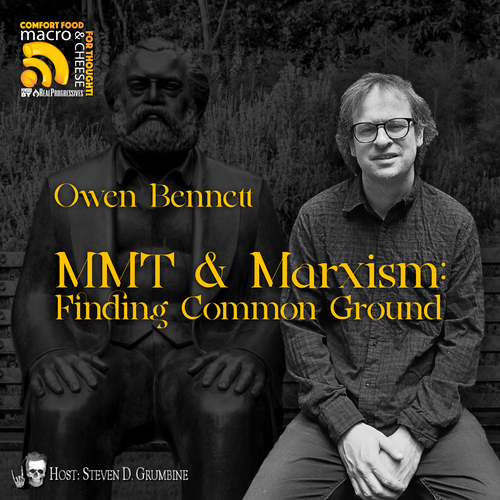
Episode 367 – MMT & Marxism: Finding Common Ground with Owen Bennett
FOLLOW THE SHOW
Australian labor historian and organizer Owen Bennett digs into the divide between MMT and the Marxist Left. He also discusses the left’s current dismissal of a full-employment policy, which is a break with historical precedent.
Can Marxists and MMTers find common ground, or are they doomed to be strategic enemies?
Steve’s guest is Australian labor historian and organizer Owen Bennett, who founded the Australian Unemployed Workers’ Union in 2015, and more recently, Unionists for a Job Guarantee in 2024. He and Steve explore how to tackle the deep divide between Modern Monetary Theory and the Marxist left. Owen argues that the left’s current dismissal of full-employment policy is a historic break from a time when communists and unionists successfully fought for – and won – some major concessions under capitalism. We should look to reestablish that kind of unity.
If the state is a tool of the oligarchs, is fighting for a policy like the Job Guarantee a distraction from revolution, or is it a necessary front in the class war? Steve and Owen discuss austerity, strategy, and whether “socialism or bust” has left the working class with nothing at all.
Owen Bennett is a unionist, university tutor, PhD graduate in labour history, activist, author, and researcher. He has published widely on the history of working class struggles against unemployment in Australia. His book on the struggle for full employment in post-war Australia is forthcoming.
Owen founded the Australian Unemployed Workers Union in 2015 and, more recently, Unionists for a Job Guarantee in 2024.
Steve Grumbine:
All right, folks, this is Steve with Macro N Cheese.
Folks, I am going to be talking about one of my favorite subjects again, Modern Monetary Theory, but we’re also talking about Marxism and crisis. And the gentleman that I’m speaking to today, we have not had on our show, though he’s told me point blank he listens to us.
So I’m feeling pretty good about that. My guest today is Owen Bennett, and Owen is a unionist, a university tutor, PhD graduate in labor history, activist, author and researcher.
Owen has published widely on the history of working-class struggles against unemployment in Australia. His book on the struggle for full employment in post-war Australia is forthcoming.
Owen founded the Australian Unemployed Workers’ Union in 2015, and more recently, Unionists for a Job Guarantee in 2024. So with that, bring on my guest, Owen Bennett. Welcome to the show, sir.
Owen Bennett:
Thanks, Steve. Good to be here.
Steve Grumbine:
Absolutely. You wrote a fantastic piece that I’m really, really glad to have stumbled onto.
It was published in a publication called Arena In October of 2025, Arena quarterly number 23. And the title of this was MMT, Marxism and Crisis.
And what a timely thing because we have been spending a lot of time trying to reach Marxists who I believe have largely rejected MMT. And I believe MMT, in many cases at least most of the folks that I talk to have given up on Marxists.
And so we’ve tried to slot ourselves in that spot because we are Marxists and we are also MMTers. And so it’s an interesting Venn diagram that we fit into. And it makes it challenging because a lot of times the folks act like it’s oil and water.
And in reality, let’s be fair, the insights of MMT, it really boils down to the most basic case of currency issuer, currency user, and how this works.
And if you have a state, and I believe Marxists, if they subscribe to Lenin’s work, can go back to State and Revolution and understand point blank that the “withering away of the state” is not something that’s gonna happen overnight. It’s something that’s gonna take a long period of time.
And I think, quite frankly, Lenin was pretty specific in the fact that the institutions and the other aspects of society weren’t gonna just vanish. He did say that there would need to be an armed proletariat, dictatorship of the proletariat. But aside from that, it was gonna take a long time.
So no matter how you slice it, for those people out there who say Marxism doesn’t require money, you know what, you got hundreds of years probably to deal with money if it ever goes away. And I have a really strong inclination that it wouldn’t go away. Because what is money, right? It’s a means of mobilizing resources.
And whether it be shells or whether it be a check mark on a stick or whatever, it all is a form of money. And MMT would describe it, it would tell you how it works. So I’m interested. What got you writing this paper, Owen?
Owen Bennett:
I think a similar experience to yourself, Steve, where you’re looking around for a coherent and effective anti-austerity movement in the working class. And it’s really hard to find within the socialist Left. And I’ve been coming up against that for a long time and just been thinking, why is that?
The more I dug into the history of it, the more I realized that actually the era we’re in right now is pretty unusual in the history of Marxist and socialist thinking.
During the post-war period where a lot of Western countries, unfortunately the United States doesn’t make this category, but a lot of OECD countries experienced a long period of full employment. In Australia, for example, our unemployment rate averaged under 2% between 1945 and 1975. Some people call that “the golden period of capitalism.”
And a lot of other Western countries in Europe had the same experience.
That was, I argue, a reflection of the left-wing socialist struggle which saw full employment as not only possible under capitalism, but really important demand for the socialist Left. And that includes the union movement, that includes communist parties. All of those groups came together on that really important demand.
And that meant that every time the capitalist class tried to raise up unemployment because that suited their class interests, there was a huge mobilization of working-class forces during that period, particularly in the ’50s and ’60s.
So the rise of the new Left in the late ’60s saw a kind of a reorientation where that demand of full employment under capitalism ceased to be an important objective of the socialist Left. It was seen as a steppingstone to socialism by the socialist left in the post-war period.
But then once the new Left came around in the late ’60s, it stopped being seen as that. It started being seen as this isn’t really possible under capitalism anymore.
If we want genuine full employment and want to maintain it, we have to just go straight to socialism. And that kind of led to a new way of thinking about full employment.
And a lot of Marxists started thinking, all these people who are talking about full employment under capitalism, they’re really misguided and they’re essentially reformists. They don’t really want to overhaul the capitalist system. And that new Left kind of way of thinking is dominant now.
And a lot of people think, “Oh, this is what left-wing thinking is. This is what left wing socialist activism is.”
But what I found in my research is that, no, what we’re experiencing now is pretty unusual when you compare it to what happened after World War II. And I think there’s a lot of lessons to be learned from that, which is what I’m trying to kind of dig into a bit.
Steve Grumbine:
So I had an opportunity to talk with Gabriel Rockhill, who wrote about the funding of Western Marxism and the removing, if you will, of class struggle from the concept of Marx and identifying that groups like the CIA and others funded these opposition movements to really write an inordinate amount of theory, calls it like the theory industrial complex, where these folks that are paid really by official, sanctioned capitalist entities find what they call “the acceptable left” and basically funded them because they were the Social Democrats, the ones that Lenin broke away from way back because they thought they could buff the edges off of capitalism and everything would be hunky dory. Now, one of the challenges, and we talked a little bit about this offline, that I don’t feel that almost anyone in the MMT movement really speaks to.
And that’s a 2014 study by Gillens and Page from Princeton University.
It showed that rank-and-file Americans, and this is just in America, obviously there’s a big world outside of America, but America is the bully in the house right now.
And ultimately regular people, working-class people, have a near negligible impact on their government, the policies that are selected, any of the things that are there. So for evidence’s sake, being someone that would consider himself a materialist, there’s no evidence whatsoever that we live in a democracy.
In fact, there’s all the evidence that we don’t live in a democracy.
So the concepts that would lead to MMT informed policies would be highly dependent on appeals to the oligarchs to be gentler and nicer to the regular folk. And that kind of positioning, it’s hard to get past.
It’s hard to look that and say, “Yeah, Biden stuck the landing,” or “Hey, that’s great, we’re doing great things, look at Donald Trump”, et cetera. We don’t in the United States live in a demonstrable democracy where the people have a say. So how do we reconcile that, given that Marxists- one of the chief complaints
that I see, and I know you addressed some of this in the writing here- but they would say that we don’t believe this is possible within a capitalist system.
And when you look at who our government in the United States, the largest empire, most deadly empire in the history of the world, it’s run by oligarchs, it’s run by trillion… I mean, Elon Musk is due to become a trillionaire here soon.
So I think that whether they’re right or wrong, I believe there’s enough evidence out there that would make them at least have a case for debate, for a debate of ideas to say, I don’t believe we can do this within a capitalist economy. Your thoughts?
Owen Bennett:
Yeah, like you suggested, I have sympathy for that understanding. You know, like it is appealing to say, “Well, why are we fiddling around the edges of capitalism when we can just go straight to a socialist society?”
You know, as a movement and as a campaign that seems to have a certain appeal to it.
But I think the broader experience of the socialist Left has been one of demoralization, because in countries like Australia, the likelihood of socialism existing in the short to medium term is very remote. And I hope I’m not being too defeatist by saying something like that.
Steve Grumbine:
It is what it is.
Owen Bennett:
As much as I want it to be something that is closer and more of a realistic proposition, I think that the material evidence around us suggests that it’s not.
I mean, you have the union movement in historic decline, the left-wing movement in historic decline, not just in Australia, but across a lot of countries. In Australia, our Communist party, they collapsed in the early ’90s along with many other communist parties.
So things weren’t looking good for socialism.
And yet you had a socialist Left that was very doctrinaire and very sectarian about socialism is the answer, without trying to fiddle out, well, what’s going to happen tomorrow?
You know, at the moment, there’s in Australia, for example, just like in many other countries, we’ve got a huge percentage of people who are unemployed, underemployed, dealing with a very punitive Social Security system, trying to make it from day to day. There’s about 3 million people in Australia who are looking for work, who are shut out by our austerity system.
The Left has to grapple with that in the short term and that’s really important. And I think there has been a demoralization which began when mass unemployment became dominant the mid-70s onwards.
People thought, “Well, socialism doesn’t look like it’s going to become a reality anytime soon.
And yet we’re being told continuously by the socialist Left that that’s the only way that we can really, you know, go back to that full employment post-war period,” that I mentioned earlier. So there was a demoralization that occurred within the Left and a kind of a collective amnesia about this full employment even being possible at all.
We’ll go into the reasons for that a bit later I think, but I think we need to remember that no, this is possible. We had 30 years at least in these OECD countries in Europe and Australia where full employment did happen. How did that happen?
I don’t think the contemporary Marxist kind of approach really grapples with that and really understand why 30 years of full employment occurred.
And I think if we have a better understanding of that then we can have much more of an optimistic movement pushing for anti-austerity politics similar to what happened briefly in America with the Green New Deal movement.
I’m not sure what your feelings are about that Steve, but I think that was a period of optimism within the Left and that was a good example of what I’m talking about.
Because then a lot of very high-profile Marxists came around and really dampened any enthusiasm and said no, this is a waste of time basically to talk about full employment under capitalism through a Green New Deal style, MMT-informed policy framework. And I think that was a great shame because we had some momentum there. But then I think we lost it.
Steve Grumbine:
I agree with you in principle because obviously their critique is my critique of them, not whether or not I believe that we can “Vote our way there” just a level set. There was a huge push in the United States for this legislation called the PRO Act.
All the Pro Act was basically tip of the hand to unions and really giving unions a shot. And there was a seldomly ever heard of person within the government called the parliamentarian that nobody in the US had ever heard of before. No joke.
It was like what are you talking about? But the parliamentarian was able to cause Joe Biden to fall face first and do nothing about it.
And so after all the effort of unionists and everybody else “within the party,” it was dead on arrival.
But their critique, I think where they fall down, the Marxist critique, is because they don’t understand modern money, they don’t understand fiat systems, they don’t understand where money comes from. They have no idea how any of it works. And you can see it in the things they write.
And I think this is one of the challenges that I want to try and undertake is to get them to understand how that works. So let’s table the Green New Deal momentarily because I was a huge proponent of it. We had Fadhel Kaboub come on and work with us quite extensively.
We did a big event in Harrisburg {Pennsylvania] on the Green New Deal where we had people come and talk about it. Fadhel came and talked about it for us, and it was really powerful. We really were excited about it.
Fadhel talked extensively about what they call a layer cake. He talked about all the different layers of the Green New Deal and how it could be funded.
And so we were very passionately working in that space as well. But honestly, the minute Joe Biden was elected, Joe Biden said, “Green New Deal, no, no way. I’m not doing a Green New Deal”.
And Nancy Pelosi, who’s the head of, at the time, House of Representatives, she came around and she says, “What’s this Green Dream something thing”? She mocked it too. And it was dead. It was done. And everybody that was a cheerleader for the Green New Deal, we were fools.
We kept going for like two years, begging for it, but everybody else shut down. They stopped talking about it.
The transition team that had Stephanie Kelton, Derek Hamilton, union leaders and others, they went in there and pitched various things. They pitched Green New Deal type stuff. They pitched a host of things and honestly didn’t see those things come to fruition either.
So my personal enthusiasm plummeted at that point because it’s like, wait, hold on. You guys went crazy pushing Joe Biden on us. I didn’t want Joe Biden. But you pushed him on us anyway. And he killed it before he even took office.
It was like, nope. How about double nope and triple nope, no Green New Deal.
And he comes up with some whack-a-mole thing called Build Back Better, which was the most watered-down Zwieback-cookie of a nothing burger you ever seen.
It’s easy to talk about how it was better than what’s going on with Trump, but then again, I could break my arm and it would be better than what’s going on with Trump right now. So I think the politics of it all, we know the logic. The logic is sound. We can do this.
We just can’t get through the official channels to make any of these things work. I mean, Stephanie was the chief economist for the Senate. She had very special access and none of it happened. That’s terrifying to me.
Do I think it’s a great idea? Absolutely. I just don’t know how you get it done. It’s not that it’s not practical, it’s not that it’s not smart, it’s just what’s the path?
And there was plenty of people that wanted it. Just couldn’t get it through internally with friendlies. Couldn’t get it through. You know what I mean? That was the hardest part.
So what do you do with that? I don’t know. Your thoughts, man?
Owen Bennett:
Yeah. I think we’re talking about a massive overhaul of capitalist society.
I think you mentioned earlier it’s not going to be something that happens quickly. It’s going to be something that takes decades, particularly.
It’s been so long since we had that period where the capitalist state was kind of, you know, in a period of reform where full employment was considered as acceptable within the Overton window of capitalist society, where we’re 50 years away from that now. So there’s going to be a long period of struggle to get there.
So I wasn’t surprised that Biden and everybody else sort of mobilized against the main principles behind the Green New Deal. I think that’s to be expected.
The failure of the Green New Deal movement to keep on going is more of a reflection not on the sort of spokespeople for capital, but on the Left itself. And that’s what my whole focus is on.
It’s like it’s easy to say, well, this is not possible because we’ve got leaders within the labor movement, we’ve got leaders within the Social Democratic parties, we’ve got leaders who we’re just never going to be able to crack. And these guys are to blame. I think that’s the easy route.
I think the hard route is to look in the mirror and say as a left-wing movement, we’re not effective.
And we can be effective because we see throughout history that these anti-austerity movements have worked, but they work because they’re persistent and they never give up. And they constantly try to educate and re-educate people about this being possible.
I think that there was strides being taken, but those strides that were taken in the Green New Deal era in early 2010, they need to be maintained for at least 10 years before we’re going to start winning, I think, because you’re talking about creating a whole new way of thinking about politics that’s not going to happen quickly.
This is why I think it’s interesting to take a few steps back from the MMT-Marxism conflict. And I know that that’s the reason why we’re talking in a way.
But look at the history of that conflict and you realize it’s not really about Marxism versus MMT. It’s about Marxism versus this idea of trying to reform capitalism so it can become a steppingstone to socialism.
And Marxists have turned against that idea as a whole. I mean there’s always going to be notable exceptions. But as a whole they turned against that idea of full employment for example.
That’s what I stick on because that’s my research focus.
Steve Grumbine:
Sure.
Owen Bennett:
That they rejected that idea of being possible under capitalism within a few years of the stagflation crisis and the oil shocks, etc. in the mid-70s. And Bill Mitchell has written a lot about this.
Steve Grumbine:
Yes.
Owen Bennett:
Someone I really respect. And his book Reclaim[ing] the State I think is really necessary reading for everybody in the left to understand the history of this.
It isn’t just an MMT-Marxism conflict, it’s a conflict within Marxism itself and Marxism in the Left where you have certain left radicals who consider themselves Marxists that say ‘no, we can create a full employment society, we can eliminate unemployment as a steppingstone to socialism within the capitalist system”. And you have other people who say “No, that’s just not possible. It’s a waste of time, frankly”.
This is what they say to be having those sorts of demands, you’re actually doing more harm than good. This is what a lot of Marxists say with the Green New Deal movement.
You’re doing more harm than good because you’re misleading a whole generation of working-class people to think that capitalism can be reformed. And that’s a massive change and it’s bigger than MMT.
And this is what I write about in my article is that you have a huge debate within Marxism that began in the ’30s and ’40s between people who thought “No, socialism or bust basically is the only route.”
And then people like Rosa Luxemburg and Michal Kalecki and very prominent Marxist thinkers who said “Well hang on a second, we can actually create full employment capitalism. There are tensions within that, but there is no reason why full employment capitalism can’t exist”.
And that is an important I think short term goal for any left-wing radical movement to try to do that just for the sake of the millions of people who are living in insecurity and poverty and unemployment and all the rest of it. That should be a really clear goal and great way to unify the left on a very coherent mission. Which is what I thought the Green New Deal was doing.
But unfortunately, those tensions that have been around for 50 years, they came back to the fore.
Steve Grumbine:
So going through here, getting past the socialism or bust, some of the attacks on MMT were just over the top and ridiculous. And you know, and I’m extremely sympathetic to not believing that we can reform capitalism.
I’m not saying that we can’t make some strides to make life better because, you know, as you probably know, my Twitter handle is Austerity is Murder. So I’m very much in the anti-austerity camp.
But the conversation that comes about, especially the individuals that you critiqued in this paper you wrote, I think almost all of them are just ridiculous. I think you broke it apart quite well. Can you take us through the various critiques that you addressed here?
I mean, I’ll let you walk through them, but I also want to get back to Reclaiming the State as we go out later.
But right now, just looking at the people in particular that I’m trying to go through here right now to find the names again, but you broke it down very well and I want to give you a chance to talk through like, well, I just cannot stand to listen to Richard Wolff talk about macroeconomics. It’s like nails down a chalkboard how bad it is. And then I think you talked about Lapavitsas. You had several of them. I’ll let you take it from there, Owen.
Owen Bennett:
Yeah, I think it is important understanding the theory that these Marxists used to basically tear down MMT and any kind of movement that tries to use radical thinking to push an anti-austerity full employment movement in the short term.
I think, yeah, to understand that theory is important because it can help us understand how Marxism has become very narrow, I think, in recent decades.
And when I say narrow, I mean that all those Marxists you mentioned, so people like [Costas] Lapavitsas and Michael Roberts and all those, you know, it’s a standard Marxist position these days, is to say that unemployment is a necessary part of contemporary capitalism. Contemporary capitalism couldn’t exist without a degree of unemployment. And just to drill down on that a little bit. So what do they mean by that?
Well, they’re talking about Marx’s work in this area, which was really groundbreaking, where he said unemployment was used as a, quote, “lever of capitalist accumulation” and that unemployment was considered for him, he presented it as a condition of existence of the capitalist mode of production. That was a really groundbreaking analysis. But there was much more complexity in that that I think is often given credit for.
I think it’s good just to understand what Marx meant by that. So he was talking about the tendency of profit rates to fall.
And I think most Marxists will understand that, that there is an inherent tendency within capitalist production toward crisis and overproduction and the tendency of profit rates to fall. So when profit rates fall, there’s always going to be unemployment. And there’s no way around that.
According to this very first principles understanding of capital.
Where things get much more complicated is when you stop looking at it as a closed system of capital accumulation, which is the standard kind of theoretical starting point for Marxist thinking, and you start opening it up to, well, hang on, what happens when the state gets involved here? It’s not just a closed system of capital accumulation on the production side. There’s also the demand side, the effective demand side.
And that’s where I think a lot of Marxists have very different opinions. And this was most clearly brought up with Rosa Luxemburg.
She was one of the early kind of innovators in this area and said that we need to start looking at the demand side more and the capacity of the state to actually lift demand through stimulus.
And if the state does lift demand through stimulus, then it’s possible theoretically that there isn’t this tendency of profit to fall as radically as it would when looking at production through a closed system, if you understand me.
Don’t want to get too theoretical here, but I think those two different schools of Marxist thinking we’ve got looking at it purely as a closed system and looking at it as an open system where the state can actually intervene with these interventionist stimulus policies. That tension was really, really strong and Kalecki built on those ideas.
And he also said that there’s no reason why Capitalist A couldn’t use its fiscal stimulus mechanisms to basically try to manage that tendency toward crisis. And there are many tensions within that and many difficulties.
But that was sort of almost after a few decades of full employment after World War II, that became kind of understood within Marxism because obviously when you have two decades of unemployment below 2%, 1.5% in the case of Australia, then people are going to start asking questions about, well, hang on, maybe capitalism isn’t inherently prone to crisis, as we were kind of told. Maybe there’s more going on here.
And that was the height of Kalecki’s popularity really, because he was one of the early Marxist thinkers who were pointing to that and saying, oh, it is possible, but there are many class issues that we need to focus on because there’s going to be a massive mobilization of ruling class and capitalist class forces against full employment because you know, it means that they have much less social power in society.
When everyone has a job and you get shit conditions and shit wages at your job, you can just go down the road to another side and you can keep doing that until you get the conditions that you think are the going rate. So obviously I’m sure your listeners know this work very well, that mass unemployment is hugely beneficial to capital.
So there was that tension that existed. But it’s still, I think, really important to see that tension within Marxist thinking. It’s always been there.
It’s been there since the beginning and it’s swayed backwards and forwards.
And at the moment we’re very much swayed toward the side of seeing capitalism as this closed system of production where profit rate has a tendency to fall, unemployment is inevitable.
It’s a waste of time to be focusing on these Green New Deal style movements that try to say, “Well, hang on, let’s in the short term try to get a position where a job guarantee exists,” and those sorts of MMT staples that we’ve discussed till we’re blue in the face.
But you know, those same debates have been happening for decades, since the mid-70s where a lot of people on the Marxist side were saying, “Keynesianism is a complete waste of time now because the capitalist state has advanced to this new stage where those Keynesian fiscal stimulus measures won’t work anymore, so the Left has to adapt.”
Steve Grumbine:
Can I jump in there real quick? I think for me, when I hear this, because I’m obviously an MMTer, but I’m also, well, Marxist.
And when I think about this, their critique, when they say, “It can’t work or it can’t this or it can’t that,” obviously it can work. That’s, that’s not true. They don’t understand the way currency works and they don’t understand the mobilizing power of the state’s currency, okay?
But I think where the MMT side has a bit of a struggle is that, and I ask, believe me, if you listen to almost every one of my MMT-oriented interviews, I asked them, so how do we make this happen?
And I think when you have a class lens to match with your MMT lens, because as Bill Mitchell will tell you straight up, “MMT is not the theory of everything.” So you have to marry your MMT lens with a political economy lens. There has to be two lenses in play.
And the lens that I had really built, Macro N Cheese, and quite honestly, the entire nonprofit that we work through, was based on the idea that we can mobilize these real resources.
I don’t think the issue for me anyway is whether or not it’s possible because I believe, I mean, this is the stuff we need to teach them. I want Marxists to understand MMT so that they’re effective and that we’re affective. Because if they win, then I win, because I want that to happen.
Right?
But the concern is that there’s still the understanding of class interests and who institutions serve and whether these institutions that MMT relies on, like the state, or more importantly, the various institutions within the state, whether those are there for you and me and Jane and Joe Six Pack, the regular working-class people, or whether they’re only there to serve the elites. And I think each time I’ve talked about it, they’ve been like, you know, “Hey, I’m an economist.
I don’t know how we make this happen,” you know, and to be fair, I mean, if anybody knew how to make it happen, it would already have happened by now, right? So we really do have a huge hill to climb.
No matter what you’re doing, whether it be, hey, we’re no closer to socialism than we were, whatever, we’re clearly not close to that. We are not organized, we are not teaching good theory, we’re not organizing the way that we should.
And we’ve got people, honestly, that are very comfortable in life that paywall their material, make it impossible for regular people to learn unless they have money.
Having wine tastings and stuff like that for $300 a person, not really exactly what you call gearing it up for working-class people to build working-class solidarity.
And it makes it really challenging because this information goes against all the hegemonic thoughts that have been pumped through the school system, pumped through the university system, pumped through the news airwaves, etc. So I think that overcoming those narratives is going to be particularly challenging. Anyway, back to your paper, if you don’t mind.
Obviously, Bill Mitchell speaks to this quite a bit. I love the fact that Bill takes this on and has taken it on repeatedly. He’s come on here many times and talked extensively about this.
But also one of the things he said in one of the prior episodes that we did was pushing for this stuff. You know, people get killed.
And he made the point that they’re willing to go farther than I think people realize to defend the way that they want things to be done. It’s a challenge, it really is, Owen. I’m not sure how to get that part right. That’s the gap for me, the biggest gap.
Intermission:
You are listening to Macro N Cheese, a podcast by Real Progressives. We are a 501c3 nonprofit organization. All donations are tax deductible. Please consider becoming a monthly donor on Patreon, Substack, or our website, realprogressives.org. Now back to the podcast.
Steve Grumbine:
But I want to go back to your paper, though, like I said, and kind of get into the each one of these approaches.
Owen Bennett:
Yeah.
And I can see what, you know, you’re wanting to understand, you know, and flesh out for your listeners these individual figures and why they’re taking this position. Why are they closed off to MMT and its key insights?
My feeling is that it’s more advantageous to take steps back and think what Radhika Desai is saying is basically the same thing that Marxists have been saying since the mid-70s, which I don’t want to go into those, you know, too much because that’s something that Bill Mitchell has spoken about, and he can do it much more eloquently than me.
But I suppose what I can bring to the table that is a bit different is I studied very, very closely the history of what happened in the mid-70s and in the ’80s and why it was, and in what way did these Marxists reorient themselves.
And I think if we can’t figure out the way these Marxists reoriented themselves in the mid-70s, then we’re not going to be able to figure out why they reoriented themselves now, if you understand me. And what are the red flags to look out for? And I think that that’s just the same kind of argument that Michael Roberts and Radhika Desai are making.
And I suppose that’s part of my broader point here, is that you can really get focused on the minutiae of the economics of it, which, you know is important. And I know a lot of people do that, and they’ve got their reading groups and they’re studying, and it’s really important work.
But arguably, I think what’s even more important is understanding the politics of it and trying to put these theories into action.
Like you and I understand that this is how the money system works, but we can talk about that till we’re blue in the face and the inflation anchor and job guarantees and all that sort of stuff.
But unless we understand the politics of it and why that hasn’t stuck, then I don’t think we’re going to advance unless we can really identify the key reasons why these ideas haven’t stuck within the Left because they’re not going to stick within the Left, they’re never going to stick anywhere else. Because this should be bread and butter for a working-class radical movement.
The fact that it has to be understood and what are the things to look out for when people are talking this way.
So I just want to mention that the key kind of distinction that I found and the, I guess the departing point from this kind of strong anti-austerity focus which the Left had in the mid-70s and then that kind of broke in the mid-70s, the key departing point was this idea that we have to be focused on production. Production is the number one focus.
Because we’re in going back to that theory I mentioned earlier, we’ve got this closed system of production and if we don’t try to have a militant attitude towards production on the factory floor, so to speak, then we’re not going to advance as a class. And that became dominant. So there’s a lot of things that came from that.
So one of the, probably the most prominent ways of fighting unemployment that came from that was that instead of using the state to create jobs, that was seen as not really a feasible strategy anymore. And it became, “Well, we need to create the jobs ourselves.
We need to engage in these workers control style movements and campaigns where we fight the sack on the factory floor.” And that became really dominant in Australia. And it was a really a huge tactical mistake. It failed really badly.
And I don’t think those lessons have been learned.
So there’s this hyper-industrial militancy that has become the focus of fighting unemployment in Australia and elsewhere and a retreat from the state as a vehicle to tackle unemployment. And people I think are just creating a theory that really justifies that position.
But I don’t think it really understands the history of it and why that decision was taken in the first place and how as a Left we can sort of learn those lessons.
Steve Grumbine:
So the job guarantee, which is core MMT and is really, I mean some would argue that it is a policy, but in the way I understand it and the way I believe it, the state imposes a tax and that tax creates the first unemployed person.
And if you think about the fact that the tax creates unemployment because a state imposes that, then the state should also impose the solution that can satisfy that tax. And I think a lot of people don’t recognize the tax for what it is.
I think that’s another huge problem is understanding the role of taxation and what its purpose is versus what they believe the purpose is. I’ve talked to many of them. One of my favorite authors and just people in general is Clara Mattei.
But I cannot get her to believe or to get on board with the fact that taxation creates demand for the currency, but is not a funding operation.
You know, a lot of these folks, I mean I read what is a phenomenal book but poorly understood on the economic side by Michael Parenti, called Against Empire and I jokingly said if you got rid of all the economic illiteracy from that book, it’d be reduced to a pamphlet.
Because the entire time he’s talking about, “It’s not the government that is sending money to these other countries for aid, it’s taking poor people’s tax money and say…” he goes way out of his way to say it. And so you figure how many people love Michael Parenti, myself included, I love Michael Parenti. I don’t love his economics.
He doesn’t understand it, but I love so much else in his writing. So how do you discern and break away from that?
Because you’re going to tell me that you can create full employment by the federal government spending money. Where is it going to come from? They don’t understand that the government is literally spending money into existence and taxing it out of existence.
And so this understanding of the way federal finance works or the way that a sovereign currency-issuing government spends, they fundamentally think that somehow or another governments go out and have to borrow their own unit of account from some weird private bank.
And this is all in their head, literally non-stop belief that the governments are beholden to a private bank, not realizing that the charters for these banks comes directly from the government itself to begin with. They don’t function outside of, they function within, independently perhaps, and with the class interests of capitalists.
But they don’t understand that. So how are you going to sell a job guarantee if they’re thinking that you’re taxing poor people or taxing people to pay for these things?
First of all, it doesn’t add up. There’s no way you could ever tax enough to be able to pay for everything that we need to do to do a Green New Deal, much less a job guarantee.
Your thoughts on that?
Owen Bennett:
Yeah, I think it shows the need for a different left-wing strategy, one that’s built on re-politicization.
And this is something that there’s been a lot of talk on about how we have depoliticized economic policy where we have these institutions that are apparently independent, that they set the interest rates and it’s not something that the politicians can actually do themselves, something that Parliament has control over.
Something that’s a constant debate in Australia, where we have the Reserve Bank, similar to your Fed, I think, and they set the interest rates.
But if you actually look at the legislation, the Parliament can dissolve the Reserve Bank Board at any time and it could set the interest rates if it wants. So there has been this problem which I think has gone alongside this retreat from full employment, where people have tended to understand.
I think the Left has unwittingly encouraged this idea that there is a lack of political agency within the state to actually make these things happen. And I just want to talk a little bit about a writer who I think really helped open up this issue.
And again, it’s about understanding the history, because once you do that, then you can say all of this stuff for what it is. And I think it adds a new sense of hope and enthusiasm within the anti-austerity movement, which I think is badly needed.
So there was a writer called Goran Therborn, who’s a Swedish sociologist, who’s a Marxist, and he wrote a really interesting book in the early ’80s called Why Some People Are More Unemployed than Others.
And it’s really fascinating because he looks at basically all the OECD countries and he tries to understand why is it that there was four countries who managed to maintain a level of full employment during the mid-80s. What made them so special? All the other countries that he surveyed, US, Australia, all the OECD countries, their unemployment rate went up a lot.
But these four countries, which included Japan, Sweden, Austria, Finland, I think, those four countries maintained fairly low levels of unemployment. And he was like, why is that?
And that this is a bit of a history that you don’t hear much about within the radical Left, because they don’t want to know about it.
They don’t want to know about these success stories where, you know, these movements have successfully fought the austerity policies of capitalist governments and managed to maintain high levels of employment.
So Therborn’s analysis was that the reason that those countries were so successful in maintaining their full employment system until the mid-80s was because there was what he called a institutionalized acceptance of full employment. And that was because there was a strong understanding and a strong expectation within the electorate that full employment was needed and possible.
What he called the politics of full employment.
And that to me is fascinating and it shows us that there is a blueprint for a successful anti-austerity movement is to make sure that we continually bang on.
And that’s what I was saying earlier about the Green New Deal is keep banging on and making it known that this is possible, that this is a political choice.
And if you do that enough, then those institutions have no real option, I believe, than to sort of adopt certain aspects of this full employment thinking.
Because if they don’t, then politically it’s not going to be feasible for the government of the day because the other mob will come in and they’ll try to win votes to get this full employment vote that people have.
And that’s what happened in many countries during the post-war period where it was just like in Australia, for example, the main government that presided over our full employment period were the Conservatives. They were in power for most of our full employment period.
And that was because the opposition at the time, the labor opposition, they’re the Social Democratic Party, they were pushing full employment and they kept banging on about this issue. Whenever unemployment went above 2%, they were saying, “This is a crisis.”
And so that’s why there was a strong expectation and a strong institutional commitment to full employment, which was really, really kind of protected by the radical Left. But then when the radical Left abandoned that position, then it was no longer protected.
And then that allowed the Social Democratic parties to say, “Well, we’re not sure about this full employment thing anymore”. And then basically the whole house of cards came tumbling down.
So I think there’s a lot to be learned from the history and that even in our modern kind of period of capitalism, post the stagflation crisis of the ’70s, there were four of these countries who kind of withstood the invading neoliberal forces for quite some time, which can’t really be explained by a lot of these dominant Marxist thinkers who say that technically that shouldn’t be possible.
Steve Grumbine:
Yeah, I appreciate that. I really do. I think that for me, I’m trying to figure out how the messaging works in the other direction.
Because when you’re trying to deal with someone, you know on their terms, to try and help win them over to your point, you got to take their argument and you’ve got to be able to meet them where they are. You can’t expect them to just jump over where you are and hope that they’ll just see it your way.
There’s some legitimate points that they’re bringing up and it may be defeatist, and that may actually be the truth. It may actually be defeatist and they’re just getting it completely wrong. But there’s a reason why they feel the way they feel.
They’re either a) completely and utterly dishonest and just ulterior motives are wrong or there’s something to what they’re saying. And I think that for MMT, I think we give up too much. You know, we just stop trying to get through to them.
I mean, I’ve seen people like Doug Henwood who it would do all sorts of good for him to learn MMT, but he steadfastly refuses. And there are others that fall into that camp as well.
But again, when I see people talking about this stuff, having put on a Marxist cape as well as an MMT cape, when I hear somebody talking about how, “They understand class, they consider class all the time.” And I see them talking to investors and things like that, I’m thinking maybe it’s not the same class we’re talking about, right?
I mean, they are living in bourgeois society. They’re living in the elite areas of London or Australia or New York City or other Mediterranean islands or whatever.
And they’re not really considering the average person that can’t even pay their electric bill, much less fly across the country for a one-day conference. There’s a lot of class-based, real major gaps, if you will, in terms of what’s interesting to various people.
You know, as a guy, I guess I would qualify as that professional managerial class, PMC, as a senior project manager in my other world. And you know, in that space I know that they offer a 401k which is a retirement plan, they offer certain benefits.
Mine aren’t great compared to the people that are not contractors. The full-time workers get much better benefits than I do.
So when I talk about something, they have a different class interest, they have a different set of interests because they are in a better position to receive benefits. So they don’t see the struggle that other people are suffering through.
So they’re elevated several layers up and they miss a whole lot of the how and the why of why these struggles fall on deaf ears. I think framing is something Bill Mitchell talks extensively about as well.
And knowing your audience I think is equally challenging.
So how would you recommend, as somebody who is trained in Marxist thinking and also, you know, an MMTer how would you go about messaging to Marxists who in their mind feel fully validated and completely right in their standing that this isn’t possible? How would you message it? I’m not saying you’re right or wrong, I’m saying how would you message it?
Because getting through to people is probably 9/10 of the battle.
Owen Bennett:
Yeah, exactly. I mean, there’s so many different audiences as well that you need to be thinking about.
Yes, there’s the sort of core of Marxist audience that you want to be appealing to. But then there’s just ordinary people, which is what you were talking about before.
And that’s a really hard one because you’ve got five decades more of ideology that you need to break through. I’ll give you an example.
Like in Australia, a lot of people who are on mortgages, they’re paying their mortgages and interest rates are quite high at the moment in Australia and there are headlines that happen all the time where the headlines are actually lamenting that unemployment is going down.
Because when unemployment goes down, people expect that their interest rates are going to go up and that means they have to pay more money on their mortgage. So there’s all these divisions that have been put into the working class on this question.
And you’ve got a section of the working class who are mortgage holders who actually want unemployment to go up because when unemployment goes up then their mortgage rates go down. There’s all these tensions that exist in the working class right now and having to break through that is really hard.
So in my work at the moment with unionists for a job guarantee, so we’re trying to appeal to unionists that the job guarantee is going to be really good for the union movement. It’s going to lead to a huge increase in bargaining power because more people have jobs. So this should be a core focus of the union movement.
That’s our fundamental position.
Unfortunately, when we talk about the job guarantee, we get a lot of opposition from unionists because they look at the job guarantee proposal as put forward by MMT and they say, “Well, this job guarantee actually has a fixed wage and we can’t agree to that as unionists because as unionists we think that we should always be able to bargain higher wages.”
So we’re just got this instant opposition from unionists because they don’t like that idea that the job guarantee wage would be fixed and that unionists see that as the right of all workers to be able to bargain higher wages within the industrial system. So there are all these sticking points that we find.
So to get around those sticking points, I think it’s important just to try to win the argument on principle that focusing on looking at for the unemployment question that, you know, it is an injustice that there are, let’s say in Australia right now is about 10% labor under-utilization rate. So there are 10% of people who are never going to be able to find full-time work. That’s an injustice.
And if you nail that point, people agree to that, then that opens up a new world of politics. So in Australia, for example, we have a very punitive system. We have one of the lowest unemployment benefits in the OECD.
People who are unemployed, we force them through a privatized system of appointments and activities, including unpaid Work for the Dole. That’s what it’s called, where people have to work for their unemployment benefit.
And there’s millions of penalties imposed every year on these unemployed people. And the average time people are unemployed is about four and a half years. So there’s very little spoken about that for obvious reasons.
Politically it’s a political nonissue.
If we made that an issue and if we said, “These unemployed workers are suffering because of this political status quo, where there’s been a paralysis on a positive unemployment policy for 50 years.”
And that argument can be put to many different people, can be put to neoliberals, but it can also be put to Marxists, because Marxists should reckon with that.
They should reckon with the fact that their inaction on unemployment policies and trying to fight for a more humane unemployment policy has led to this injustice that’s ongoing.
And it is bizarre to think about this like I think in a thousand years’ time, I hope anyway that we’re going to look back at this time and think so we had a society where we needed to have say 5 to 10% of the population who couldn’t find work. And that was deemed as socially acceptable to put 5 to 10% of the population in poverty.
And that was the only way that society could function and be sustainable. And that’s basically what we’re being told.
And I think if we put that in very clear terms to people across the political spectrum, I think they couldn’t help but agree with the injustice of that, that we’re just basically throwing all these people under the bus in the name of creating a more sustainable capitalist economy and making profit for employers. We put that very clearly and say, “Well, this is the problem and here are some solutions that have worked in the past.”
Got a great track record of government intervention and I think going into the particulars of all the minutiae of MMT positions, et cetera. I think that comes later.
I think if that initial argument that needs to be won and once that argument is won, then some of those neoliberal kinds of conventions will melt away and we’ll start seeing a more kind of dynamic and effective anti-austerity movement.
Steve Grumbine:
I like the ideas. I mean, I’ve got almost 20 years of track record of fighting for this stuff.
And, you know, I believe with all my heart, and I’ve put all of everything that I have into trying to get the word out and to educate and so forth. And I’m just a dude, man. I’m not anybody special. And I try really hard to get this message out there.
And there’s a lot of in group, out group kind of weird kind of othering that goes on that prevents these struggles from really uniting and being as effective as they could be. I believe that, you know, kind of makes it challenging. Right? You think about when Bill [Mitchell] and [Thomas] Fazi wrote the book Reclaiming the State.
That should have been must read for everybody. That should have been like the most important book anybody could get their hands a hold of.
And for the longest time, I screamed it from the heavens how important it was and is. It still is. And yet I don’t think that we’ve made the kind of dent that would give people like, hey, there is fruit at the end of this.
I think there’s just too much pressure.
People are tired, they’re exhausted, they’re propagandized, they are fighting at home, trying to maintain their own lives and trying to rally them around this stuff has proven to be incredibly challenging. Incredibly challenging.
And I think that obviously the job guarantee is not a one size fits all proposition. There are multiple job guarantees out there.
For example, Bill Mitchell used to always talk about, hey, if you’re a swimmer or a surfer, we’ll give you some vials and you can go out there and take water samples while you’re out there. Or if you’re a guitar player, you can also teach the kids musical theory as part of this. And then you’ve got these nonprofit models and so forth.
But I’ve also seen job guarantee models that don’t just go along with the basic transition job that Warren Mosler would posit. You know, I. There are many different forms of this. I know Pavlina [Tcherneva]‘s come with one. I’ve heard Fahdel Kaboub express differing ones.
Bill [Mitchell] himself, obviously, different ones. Randy Wray, different ones. Warren Mosler, different ones. Sandy Darity and Darrick Hamilton have come out with varying versions of it as well.
I’m curious, do you think that the bottom line is there can only be one version of the job guarantee? Or do you think that in the end, really what matters is that we have a buffer stock of unemployed or a buffer stock of employed?
And at the end of the day, whatever it looks like doesn’t really necessarily matter.
We just need to end this predation upon using people as a buffer against, you know, the business cycle, just letting them suffer as unemployed people, you know, it’s impossible to get back on the saddle once you’ve been out of the workforce. People don’t want to hire you, they see you as damaged goods.
Do you think that’s the real treat right there, the real trick is just simply to provide full employment? Or do you think the way that the job guarantee itself is structured is of equal importance?
Owen Bennett:
Yeah, I don’t think you can really separate the two. I think the way it’s structured is really important.
But yeah, I think it all depends on where the political consciousness is in your particular place, in your particular country. In Australia, for example, our consciousness is rock bottom. It’s bottom of the barrel stuff. So we have to adapt our campaign to that end.
And I think if we go around and start talking about the inflation anchor and sort of a MMT kind of position of a job guarantee put forward by Bill Mitchell and other people, then I think you’re going to lose people.
And I think you’re just going to perpetuate this idea that what you’re saying is just something a crank would say because I don’t know, you’ve probably come across this, Steve, where you’re talking to people who are not really okay with this and you see their eyes glaze over as soon as you start talking about the technical aspects of it. And I’m at war with that.
I think that we can do much better at trying to win the broad argument and cater our policy asks to fit in with the dominant political kind of tendencies and that’s a win.
And then we take one step, one step at a time up the ladder to think we can just do snakes and ladders style, just go on one of the big ladders all the way to the top, you know, instantly is, yeah, it’s, it’s a fantasy and it’s not going to be something that’s going to be helpful to the movement. So I’ll give you an example.
So with this group that, you know, we’re a modest group, I don’t want to make it seem like we’re really significant here, although I’d really like us to be in Australia. This group, Unionists for a Job Guarantee.
So we’re trying to do this work and we had a big meeting, you know, policy working group, where we discussed, well, what is the job guarantee policy position that we’re going to take to the union movement? And we had a lot of conversations about this and we tied ourselves up in knots at times trying to figure out, well, how are we going to be effective?
And what we decided was actually the best way to do this is look around and see what was the most recent policy that has been having some kind of political acceptance that is pretty much close to a full employment policy. And we looked around Australia and we found one. It was called Working for Victoria. So it’s a, in the state of Victoria where I live, they had a policy during COVID where using government fiscal expenditure to create jobs in the not-for-profit sector.
So very much far away from a traditional idea of a job guarantee, but it had the mechanisms of a policy that could create full employment if it was scaled up to the correct level.
So we looked at that and we broke down the numbers and said, well, if this policy was rolled out nationally, it would cost about $8 billion for us to have full employment tomorrow. And we thought that’s pretty good, that’s a good start. Because it’s a policy ask that not only that, the people who came up with the policy, they’ll like to have their ego stroked because they came up with it. So it’s a good starting point to talking to politicians and saying, “We like this thing you did. Just do it again, but much bigger.”
And that’s a good way to start walking up that ladder and start bringing in people who really should be as part of a working-class anti-austerity movement.
Perhaps they don’t know it yet, but you bring them in unknowingly, maybe at first, just because they think, “Oh yeah, this is a good policy, it’s going to create jobs.”
But once it’s expanded and expanded and you’re building momentum, then all of a sudden you’ve got something that could resemble an effective full employment movement. And I think that there are plenty of examples like that across Europe.
You know, there’s lots of really good trials going on in Europe, even in America, you know, the Anti-Inflation Act [Inflation Reduction Act of 2022] I think it was called, correct me if I’m wrong there, but you know, that had some building blocks in it that could be tweaked and expanded to a point where you’ve got a really good basis for fiscal expansion necessary for job creation and to smash some of these austerity kind of star politics. So that’s kind of where I’m focused on is try to make this stuff effective and then build upon that. Get a base and build on that.
Steve Grumbine:
Understood, man. I appreciate it. I mean, this is the good fight, right?
Anybody that has stumbled onto the MMT bug, once it gets in there it’s hard to shake it and you can’t unsee it. And so the real question comes down to how do you message it? How do you get people on board? And it really does come down to who you’re talking to.
You got to modify the message, you got to modify language. You want to speak to them in a way that they hear you. And that’s a challenge. That’s a challenge. There is no question about it. Very big challenge.
Listen, Owen, I want to thank you for spending this time with me and I appreciate, I tried really hard to take the critiques that I’ve heard and throw them at you. So my apologies if it came off rough. But I think it’s important because we gloss over these differences. We do. And we frequently just blow them off.
And once we blow them off, the people that we were trying to reach blow us off. And I think it’s important to understand where people are coming from.
And just because they think something differently than we do doesn’t mean that they’re not allies. And it doesn’t mean that we can’t find common cause and common purpose and common struggle. And I think that for us, we say we’re MMTers.
I mean, we have to find an answer to the electoral problem. We can’t just pretend we can source the vote.
And we have to find ways to overcome these structural barriers if we want to have credibility with people that see the system differently. And I think that you’re doing great work over there.
I’m really glad to see you keep ’em working with unions, because I think that we actually had functioning unions in the United States we would be a world better in terms of maybe having a militant labor movement to stand up against capital and to do the things to make the state behave for the people.
And that just doesn’t exist right now. So I guess it’s up to us to make it happen with that. Owen, where can we find more of your work, sir?
Owen Bennett:
Good question. I thought of pop articles here and there. I can supply with some links. I got some articles on Jacobin and yeah, Arena. I’ve got a couple on there.
But yeah, I’ve got a book coming out about this history of full employment in Australia. So I’m really excited about that, so.
Steve Grumbine:
When do you expect that to come out?
Owen Bennett:
It’s hard to say at this point. Yeah, I’m sort of still putting the finishing touches on it, but hopefully sometime toward the end of the year.
Steve Grumbine:
Okay, I hope to have you back on so we can talk about it. [Love to.] All right, with that, I’m going to take us out. Folks, my name’s Steve Grumbine. I am the host of Macro N Cheese.
This podcast is part of Real Progressives, which is a 501c3, not for profit organization in the United States. As you can see, we represent class struggle and Modern Monetary Theory, and we’re trying to help everybody bridge the gap between the two.
And we require your donations. We need them. And as a nonprofit, they’re tax deductible. So if you’d consider becoming a donor, there’s several ways you can do that.
Our website, realprogressives.org. There’s a place to donate. You can also go to patreon.com/real progressives to donate. And you can also go to our new Substack.
If you’re not on Substack or if you are on Substack, please follow us over there.
We’d love to have the engagement. Guys, leave a comment. Restack it. It really helps us get the word out and also give you an opportunity to maybe meet people that know or don’t know that could use your insights. So, with that, on behalf of my guest, Owen Bennett, myself Steve Grumbine, the podcast Macro N Cheese. We are out of here.
End Credits:
Production, transcripts, graphics, sound engineering, extras, and show notes for Macro N Cheese are done by our volunteer team at Real Progressives, serving in solidarity with the working class since 2015. To become a donor please go to patreon.com/realprogressives, realprogressives.substack.com, or realprogressives.org.
Extras links are included in the transcript.
Related Podcast Episodes


Related Articles


How to Make a Po’boy