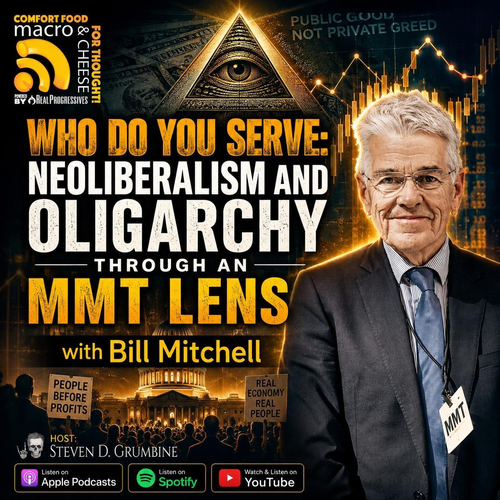
Episode 386 – Who Do You Serve: Neoliberalism & Oligarchy Through an MMT Lens with Bill Mitchell
FOLLOW THE SHOW
Today’s overlapping crises demand more than policy prescriptions. Economist Bill Mitchell discusses neoliberalism, class power, and the limits of electoral politics through the combined lens of Modern Monetary Theory and historical materialism.
Modern Monetary Theory explains how sovereign currency systems work, but it doesn’t tell us who controls the state or whose interests state power serves. Economist Bill Mitchell suggests that a dialectical understanding of capitalism is essential for answering that question.
He and Steve discuss MMT not as a policy prescription but as a lens to dissect the capitalist state, not a neutral arbiter but an instrument of class conflict. Bill traces the motion of capital from the post-WWII “Golden Age,” which was a temporary compromise forced by a strong working class. He takes us through what he calls the neoliberal counter-revolution, epitomized by the Powell Memorandum, wherein capital consciously exercised control to reverse social gains and redistribute income upward.
The government’s “fiscal crisis” is an ideological fiction (a fetish of money) that obscures the material reality: a currency-issuing government faces no inherent financial constraint, only real resource limits.
From the erosion of labor power and the rise of think tanks to militarism, financialization, climate crisis, and AI-driven social control, Bill contends that today’s crises are not policy mistakes but the logical outcomes of capitalism’s extreme contradictions. The conversation explores why understanding monetary sovereignty is only the beginning, but reformism and electoralism are insufficient. The material conditions are driving toward a necessary rupture.
William Mitchell is Professor of Economics and Director of the Centre of Full Employment and Equity (CofFEE) at the University of Newcastle, NSW Australia. He is also the Docent Professor of Global Political Economy at the University of Helsinki, Finland, and Guest International Professor at Kyoto University, Japan.
He is one of the founders of Modern Monetary Theory (MMT). His daily blog is one of the world’s leading economics blogs.
Follow Bill’s work and find his books at https://billmitchell.org/blog/
Steve Grumbine:
All right, folks, this is Steve with Macro N Cheese. And you know what? It’s been a minute since we’ve had MMT [Modern Money Theory] on the show.
And the reason why that is is because we’re talking about all the connected webbing, all the things that impact- you know, when I started first talking to MMTers, I was such a childlike person. I really was. I had rose colored glasses on.
And I think the very first time I met my guest, Bill Mitchell, you know, I was like, “Hey, you know what’s going to change the world? We’re going to, we’re going to do all this stuff.” And he kind of gently laughed at me and said, “Oh.”
He goes, “Stephen, this is going to be a bit of a project. This is going to go beyond our lifetimes, man.” And basically, you know, all that has happened since then is that the rose colored glasses dropped.
I still see many, many, many, many, many rose colored glasses folks out there.
And maybe that’s kind of like a phase of this MMT journey where you start off seeing the possibilities, but then, you know, as you get into this a little bit further, you start realizing that MMT is a lens. And if it’s a lens, it’s a lens into what is happening.
And if you really want to use MMT as a lens to understand the world in which you live, Bill Mitchell is a great person to get to know. Bill Mitchell is one of the most real guys that I have ever met.
And Bill has talked to me many, many times, patted me on the head gently, lovingly, got me through my, you know, enthusiasm, youthful enthusiasm. Well, I’m not young anymore and I realized there’s a heck of a lot more road behind me than there is in front of me.
And I’m not playing games anymore. You know, the things that we’re talking about now are for-realsies. We are talking about the actual application of the lens of MMT.
And when you understand the stuff that Bill has written, and we’ll go back to Reclaiming the State: [A Progressive Vision of Sovereignty for a Post-Neoliberal World] which I think is probably one of the most important books you will ever read. And if you haven’t read it, read it, you must read it, because it’s like telling you everything that’s going on today.
You know, and I think the big thing that we’re going to talk about, aside from just where the economy is today and really kind of why it is the way it is today, is we’re going to also strip bare that idea that “the economy is broken and they just don’t know what they’re doing. They just don’t understand.” See, that lie has filled the American mind.
Most of the people that I talk to in the MMT spaces still believe that we’re going to vote a few more progressives in and we’re going to change the world. But they don’t understand.
They do not understand the neoliberal project itself fundamentally stripped away the public commons, stripped away our agency, stripped away any semblance of democracy, cloistered power and wealth to the top .0001% and has continued to do so to this day. And folks, it’s not just the great Americans, these super exceptional Americans. It’s happening in Australia as well. It’s happening around the world.
This project that MMT reveals, if you have eyes to see and ears to hear, okay, you will begin to understand the world in which you live. MMT is the most accurate way of understanding the economy. It’s the most accurate way of understanding the way monetary systems operate.
And Bill Mitchell, who wrote this wonderful piece, which let me be fair, I say wonderful, but it’s terrifying, but it’s wonderful, called the US Economy on an Unstable Knife Edge at Present. Now, this is back on May 4th. We’re in the June timeframe here, so get your bearings straight.
But I asked Bill to come on and Bill was kind enough to join me because unlike a lot of folks, Bill does not have that Pollyanna version.
And I can stay sane with somebody that’s not speaking in Pollyanna terms, gaslighting me to believe it’s all going to be better and we’re just going to vote a few more progressives and everything’s going to be better. No more lies like that. So without further ado, let me bring on my guest, Bill Mitchell. Thank you so much for joining me today, sir.
Bill Mitchell:
Yeah, Steve, thanks very much for having me. And hello to all your listeners from Australia. Early morning Australia in beginning of winter. It’s getting cold.
Steve Grumbine:
Wow. It’s so weird how different. I guess that’s why they call it Down Under. I mean, it’s like it’s a totally different world.
We’re just getting ready to get warm over here and it’s just becoming evening. But with that in mind, Bill, before we got started on this, we talked a little bit about the fact that progressives think that the system is broken.
They fundamentally don’t understand why there’s always money for a war, but there’s never money for health care. And if we could just get our representatives to vote the right way and if we could just take over the halls of whatever, everything would be okay.
Hunky dory. I don’t think they realize how late the hour is. And really the fix, what the fix is.
Can you tell us a little bit about what the neoliberal era did and what the intentions of government is today? Not the one that everybody wants it to be. I want it to serve me. I want it to be good for my children.
I want the wars to be, you know, for just causes.
I mean, the real actual storyline here about what the neoliberal project is, was, and what its intentions are and why people have got it wrong when they think the benevolent government is going to swoop in and save them.
Bill Mitchell:
Yeah, well, I think you have to see the government as an institution and what MMT provides us with, as you use the words lens, and I introduced that term some many years ago to differentiate between a lens and an ideology or a set of values.
And what MMT does is provide you with just a clearer lens into understanding how monetary systems, in other words, economies that use currencies, which are all the economies, how those currencies actually work and what the intrinsic capacities of the currency issuer are within a monetary system, and then what the implications are of using those capacities in different ways to implement public policy. Now that’s where MMT ends. It’s a very clear framework for understanding those things, but that’s the end of it. And to make sense of the world then.
So in other words, you ask the question, “Well, why is the American government able to shunt tons of metal from their planes into and bombing and killing and maiming and all of that in Iran at the moment?” Well, at the moment they’ve stopped for a little while, but you know what I mean.
“And how can the Israeli government slaughter people in Gaza by bombing the hell out of them? How can they do that, given that on the other side they say they can’t afford to provide poverty relief in America and or provide decent housing for homeless people?”
And so people say, “Well, how come once I know MMT, how come we know that the American government could, within the available productive resources, bomb the hell out of Iran and provide good healthcare and education and housing up to the capacity of the available actual resources, you know, labor and materials?” And so a lot of progressives get caught up in that dilemma of well, how come?
But they don’t ask the actual question because just knowing that the American government has no financial constraint is a pretty trivial piece of knowledge when it all comes down to it.
And it’s amazing how the mainstream narrative trips us up even on the most trivial fact and convinces us that the American government is like us as households with a financial constraint. That’s how amazing the fiction that the mainstream economics profession succeeds in perpetuating.
But the point is that knowing that’s a fiction is really not much at all. So, you know, MMT is not that much at all.
The question you’ve got to ask to understand how come we can bomb the hell out of Iran or America can, but not provide decent housing for its population- you’ve got to go and understand the dynamics of the actual system that manipulates the institutions of government, for example.
And this is why my work has always emphasized that it’s the understanding of the ideologies and the values and within this specific context, understanding that the system that we live in, which we broadly call capitalism, is a system that is defined by class conflict.
And that class conflict is between broadly, the working class who doesn’t have any means of production and has to sell their labor to a owner of the means of production, the capitalist class, in order to survive.
And the capitalist class wants to get as much out of the worker as possible by way of labor time and therefore output, and pay them as least amount that they can get away with. And the working class want to do as little as possible for the capitalists and get paid as much as possible.
And that those two conflicting ambitions really define the system we live in. And then the dynamics that emerge from that are what defines the policy choices that our institutions make.
So for example, when the Second World War ended, and effectively the prosecution of the Second World War ended the Great Depression, that had sort of damaged economic prosperity during the 1930s.
The situation was that the balance of power was much more tilted towards the working class and capital had to really bite its tongue because trade unions were becoming stronger and governments were charged with a sort of social democratic mission to reduce inequality both at wealth and income, provide jobs for everybody that wanted them.
And that political mission gave us that so-called golden age where we did observe, you know, the growth of public goods, the growth of public education, public health care, public transport, publicly owned utilities across the world, reduced inequality, true full employment, unemployment was very low. Real wage growth for the ordinary person was strong. Productivity growth permitted that.
And we had what seemed to be, you know, it was called the golden age, but it was still within capitalism and it was just permitted because the power of the people was expressed through the political process, was sufficient to offset the desires of capital to take everything for themselves.
Now, if you trace the history of our economies and our societies over that period, what you’ll understand is that capital was restive, it was not happy, and but because of the political dynamics, it didn’t have the capacity to completely undo the social democratic reforms. Now go into the 1960s and you can see that capital was getting more organized.
And by the early ’70s, so in the late ’60s, for example, in Australia, which was, you know, there are differences across the countries, but the dynamics are representative. In the late ’60s, all the talk in the conservative media, which was mainly a print media in those days, was trade union power.
We’ve got to do something about trade union power. As I was growing up at school, it was all the talk that we’ve got to reduce trade union power. Well, who was saying that?
Well, the conservative press, funded by, which was the voice of capital, was saying that. And by the early ’70s, the industrial capital end, of financial capital hadn’t really emerged as the dominant expression of capitalism.
Industrial capital decided that they need to become much more strategic.
And in America, of course, we had the Powell Manifesto [Memorandum] in 1971 and that outlined a explicit strategy by which capital could regain power over the political process. And that strategy included things like creating think tanks.
So these big think tanks, the American Enterprise Institute and the Cato Institute and these type of organizations, these were developments. Some had been around for years, but a whole lot of new ones emerged in the early 1970s, not only in America but elsewhere.
And these became well-funded institutions that were held out as research institutes, but were basically just propaganda and marketing institutes. And they were really well funded and they were very good at doing what they do.
In other words, introducing information, misinformation, masquerading as research, independent research that was- and then with this massive marketing and press machine added to it to manipulate the debate.
The Powell Manifesto also developed pathways into the formal education system, both secondary and tertiary.
And what you saw was a dramatic increase in, for example, funded chairs within the university system and curriculum that were aimed at influencing curriculum within our both secondary schools, but also within universities. And the other thing Powell recommended was that capital take over the media.
And so what you saw in America and its derivatives was Fox News emerges and Sky News emerges around the world.
You know, these Murdoch, you know, Australia’s worst export, Rupert Murdoch, his media machine was, became a, you know, a misinformation propaganda machine that was explicitly working to advance the terms of the aspirations of capital. And so, you know, by the then we had the OPEC oil crisis in October 1973, when oil prices sort of went through, you know, double virtually overnight.
And that really gave this emerging fight back by capital.
It gave capital the cover to allege that the inflation that emerged after that was really the result of excessive trade union power, of poorly designed and implemented social democratic welfare policies and all the rest of it, blah, blah. And even the progressive voices in those days fell prey to the narrative.
And so you started to get, you know, progressives writing things like The Fiscal Crisis of the State, James O’ Connor 1973, the book where progressives were holding out what we now take as the mainstream progressive view that “Oh well, the government’s going to run out of money.
We want public hospitals and welfare policies, therefore we have to tax the rich and do something about the fiscal crisis to ensure that our progressive policies can be maintained.” Now that was just gross naivety. A) because Modern Monetary Theory indicates that there was no fiscal crisis.
There was just a takeover of government by capital. An explicit takeover. It wasn’t a random event. It was an explicit strategic takeover of the institution of government.
And what it did in the social democratic period those few decades, the government was really a mediator in the class conflict and it was sort of trying to balance itself between the competing interests.
And so it would do a bit for labor, but it would make sure that it didn’t disenfranchise capital because it couldn’t afford to put the big media machines and that of they couldn’t upset them too much.
But by the 1970s and into the 1980s, as the neoliberal articulation became widespread throughout the academy and throughout the public policy institutions and throughout the, you know, the fourth estate and the media generally. Government shifted from being a mediator in the class conflict to being an agent of capital. And capital reconfigured the state.
The state didn’t go away. The state wasn’t powerless. The emergence of global financial capital didn’t render the national states powerless.
All of the shifts that have occurred that we broadly call neoliberalism occurred through the institution of the state, through its legislative and regulative capacities.
And so really what capital understood was that if it wanted to achieve its neoliberal objectives, then it had to do it by co-opting the state in its own image. And that’s what happened.
And the progressives sat there and started to worry about identity and politics and they gave up on the macroeconomic contest and basically just lay down and surrendered, and felt warm and fuzzy by occasionally bleeping “let’s tax the rich.” And that made them feel okay because it sounded as though it was a plan.
But by then the state had been totally co-opted to pursue the interests of capital.
And so you had all the dimensions of that, the lobbying, the revolving door where ministers of government would be determining public policy one minute and then the next day they’d be being paid massive amounts as consultants or CEOs or something of some other, some company that was directly benefiting from the policies initiated the day before. The so-called revolving door. And you know, capital stitched it up.
And so when we bemoan the fact that the economy isn’t working that “oh woe is us, the economy’s failing us” you’re asking the wrong question.
Because for the cohort that co-opted government, the changes to our institution called government have been spectacularly successful, have achieved exactly what the goals of the takeover were. To redistribute national income to capital, away from the working class.
And all of the sort of smoke screens that get put up to blur the fact that there is a working class, you know, and to blur the fact that, that all these things are just happenstance, are just strategic structures to blind us from the reality that our institution government, has been taken over. And the only way to shift it to a progressive orientation is to take it back, to reclaim it.
And the only way, in my view, that that’s going to occur is to overthrow the current power system. And that means, in my view, that the only future for humanity is to move beyond capitalism. Now how that’s achieved is a good debate.
But you know, I’m now I’ve been around for a while, my career is long.
And that’s where I’ve come to that all of the issues that we want our institutional government to address, like climate change, like peace, like reducing inequality, like making sure people have got jobs and homes, none of those things will be achievable in any satisfactory progressive way without a major shift in power relations within the system.
Intermission:
You are listening to Macro N Cheese, a podcast by Real Progressives. We are a 501c3 nonprofit organization. All donations are tax deductible. Please consider becoming a monthly donor on Patreon, Substack, or our website, realprogressives.org. Now back to the podcast.
Steve Grumbine:
You know, that brings me to probably the most painful point before we get into some of the stuff from your article, and that is I’ve talked about this many times and I’ll continue to talk about it until I start to hear others bring it up constantly. And I don’t hear any of them do it because they’re, I believe they’re cowards. I’ll just say that point blank.
But there was a study in 2014 by Princeton called Gilens and Page, where they identified that the interests, the desires of the voting public had a statistical near zero impact on public policy. People walk right by that like I didn’t say it, or better yet, they treat it like I said it. And I didn’t have backup for it.
But that right there is a study done by a reputable university, very, very detailed study that showed, quite frankly, that we live in an oligarchy.
Now, I have friends that will go out there and say, “Steve, but we’re just going to go ahead and keep doing the same shit we’ve been doing over and over again, expecting different results.” They pat me on the head and they walk away. You don’t have to like me. I’d like you to, but you don’t have to like me.
Go fact check what we’re talking about, what I’m saying and what you’re saying. Because for me, the thing that interested me most in MMT was that it blended so many…
You had to understand everybody else’s stuff so you could explain what they got wrong. So the lens, you could, through interdisciplinary understanding, you could see the lens in action.
You could understand the motivations once you understand what is possible.
And for a long time, I kept banging my head against a wall thinking that Bernie Sanders was going to come and save the world and AOC was going to come save the world. And there’s a lot of MMT’ers out there that will repeat that to this day in the year of our Lord 2026, which is preposterous.
But here we are in the year of 2026. We’re watching the United States snag up [Venezuelan President Nicolas] Maduro, a democratically elected, you know, head of state, okay? And we were watching them bomb Iran.
We’ve watched them bomb Iraq. We’ve watched them start proxy wars with Ukraine. We’ve watched them do all sorts of things.
None of these things insane stuff with this Trump administration, and absolutely none of it is stuff that any one of us really voted for. The people themselves are sitting there scratching their heads, saying, “What Is this?”
I was at a gas station the other day filling up my tank, my car, it was $5 a gallon, which is huge for us. I mean, $2.99 is terrible, but $5 was ridiculous. And nobody’s getting pay raises.
And I was sitting there pumping gas and this guy comes up with a big MAGA hat on and he says, “You know something?” He goes, “I told my boss the other day that I have to get a part time job just to cut the grass because of the gas.” And I started laughing.
I said, “You know something? That’s pretty slick.” You know and we started talking about it. I broke the MMT story down to him and I told him point blank. He goes, “Well, I don’t want to get political.”
I said, “Well, we don’t have to get political.” I said, “Is there anything that’s happening right now that your family’s benefiting from?” He goes, “Hell no.” And I said, “Me either.”
And I said, “You know what? Nothing was happening good for me either under Biden either. Nothing’s been happening good period.”
Our lives are going into hell because we are dependent sadly on these disgusting capitalist pigs that run the government, this oligarchy that runs the world, really, because at the end of the day, the empire is out there busy flexing its muscles as people are crowing about the end of empire. I think it’s way too soon.
And I think that reality is that people are still not getting the point that this is not something we’re voting our way out of. At best you get a crumb here or a crumb there, but there is no voting our way out of this.
Capital is large and in charge, and we see this in every aspect of government, from the university systems, you name it. Bill, I am curious, you know, what do you think it is about Americans that make them believe that they can just vote their way out of this?
They have no concept of empire. They have no concept of power. They truly have tried to pretend that there’s no such thing as class.
They’ve tried to pretend there’s no such thing, even loosely, as capitalism. And they are literally sitting there believing that some random dude is going to save them from this horrible disaster that we’re living in.
I don’t fundamentally understand. What is it, the propaganda? Is it just fear of accepting what they have to do, what they’re looking at? I mean, we need a revolution. There’s just whether that be a…
However we get there, we need some form of real honest-to-God change. And it isn’t going to happen at the ballot box. And it’s killing me.
Bill Mitchell:
You know, the other aspect of it is that…
And it really emerged in the 1950s and prior, you know, in the 19th century, the elites were able to retain spectacular wealth while the rest of us, the peasants, were living in squalid material poverty. And, you know, in the early era of capitalism, you had the labor of those in squalid poverty enriching and reinforcing the wealth of the elites.
And what allowed that to happen was religion, this belief in sort of fate.
And in the 1950s, of course, as we became less sort of bound by Christian, mostly Christian religion, a new drug had to be introduced to keep us under control. You know, Karl Marx said, “Religion’s the opiate of the masses.”
That was his famous sort of reflection on how social stability was maintained amid squalid poverty. Well, in the 1950s, squalid poverty was no longer really possible to maintain.
Governments had to redistribute a certain amount of material prosperity to a proportion of the working class. And this is the emergence of the middle class.
And the way, while religion was the opiate of the masses in the 19th century, in the 20th century, particularly the second half of the 20th century, mass consumption became the opiate. And capital worked out that it could still gain spectacular profits.
It was forced to share a bit of the national income in a better way than previously, but it could still keep us under lock and key, keep social stability. And so that we didn’t work out that we were going to work for a capitalist and create surplus value for them and get underpaid, really.
Or the other way of thinking about it is if the system was different, we could work less and still have the same material outcomes. Or to keep us from understanding that, mass consumption became the vehicle. And so, you know, you had the…
Supported by the emergence of mass advertising that kept us under control and locked us up into credit arrangements.
And as long as we had bigger houses full up with stuff, gadgets, electronic gadgets, washing machines, TVs, big garages with cars and all the rest of it, now that’s become, you know, a chain around our necks. And, you know, I prefer not to think of people as stupid or, you know, naive.
I prefer to see them as captured in a bind that is so pervasive that they have difficulty understanding how they’re going to get out of it.
And so what I mean by that is that most of us are completely locked into credit arrangements, mortgages, that are so onerous these days, especially when interest rates increase and the cost of living increases.
That really our whole survival is linked to being able to keep our jobs and pay our bills, because the alternative is pretty grim because the financial sector has us by the neck and we lose our homes if we can’t keep paying our credits off.
And, you know, the average citizen’s in a real bind, so of course they’re going to worry about maintaining survival rather than thinking of deeper concerns about how the hell has capital taken over the US government? I can understand that households really will avoid that big question because they’re facing such difficulties just surviving.
And that’s all part of the strategic plan by capital to keep us under control.
Steve Grumbine:
That control mechanism that’s part of the institutions that control us all. I mean, like, you know, I’ve been a relative recent, you know, study of Gramsci, and I’m nowhere near…
It’s very thick and tough to understand because he wrote in jail, and the stuff he wrote was, had to be in many ways coded because he didn’t want it to get captured by the people in the jails that, you know. So it was very difficult.
But the things that came from that and some of the interpretations, understanding how institutions are representations of the ruling elite and ruling class in general, these are lessons that maybe never quite made it to Main Street. People never quite grabbed hold of and understood.
And here we are now in possibly the worst timeline with AI and the lunatics that have this weird, you know, I can’t even call it religion, this weird mythological fetish of end times with Peter Thiel and all these other crazy guys that are building the weapons of war through AI to keep us in prison, basically, to spy on us, to absolutely decimate us as human beings, I guess, how, you know, how did this stuff come to be? Because, you know, people, it just sort of seems like it just happened.
It feels like it happened, like, almost overnight.
I mean, you could look at the COVID pandemic, and we were all docile, behind closed doors, wearing masks and so forth, while they were busy plotting and planning. And we got to see a moment where they spent a lot of money, and we got to see, “Hey, they can spend this money.”
And then we forgot immediately that they could do it. But lo and behold, here we are literally killing everything in sight. The poor people, the Palestinians that have been slaughtered.
It’s just unbelievable. But this is part of the plan. You know, maybe the AIPAC supporters voted it, but nobody else wanted this. This isn’t what people wanted.
Obviously, people are living in denial, because to stare down the barrel of reality is pretty dark. It’s pretty scary.
And there’s parts of me thinking back to Cipher from the movie the Matrix, where he goes, “I know this isn’t steak, but I love it anyway. I mean, I know it’s not real, but I’m going to do it anyway.
Because the idea of living on a planet that’s been desolated by nuclear destruction, et cetera, is just not appealing to me. Plug me back into the battery, give me dreams, I’m good to go.” That is a real kind of outcome. People are afraid to see what is.
And then once you do see it, it’s like, so what do I do now?
Bill Mitchell:
Yeah, but, Steve, for the average citizen in the suburbs around the world, life’s a struggle. You know, you’ve got personal struggles within your families and you’ve got economic struggles just paying the bills.
And most people don’t really have the time or the energy to think beyond those things. They’re all pervasive. The system has made it much harder for us to…
On one hand, it’s offered all of these goodies, these possessions, you know, these glitzy gadgets and technologies and cars and all the rest of it that just shine brightly in our eyes. And on the other hand, it’s made it harder for us to get them.
And it’s created vehicles where we can get them, like credit, that’s completely enslaved us to the mission to keep working and to make sure we’re solvent and to not really think much beyond that.
And, you know, we’re so tired at nights that we sit in front of some TV program or something, a streaming program these days, you know, pop entertainment, and we go to bed waiting to get up next morning for more of the same.
So you can’t really be too critical of the average citizen who is totally disenfranchised by their political systems because their political systems held out as being, “oh, there’s this arena of contest where we’ll vote and our expression, our preferences will be revealed, and that will then manifest in shifts in policy.” That’s not the way the political system works at all. And I think that Princeton study demonstrates that categorically, that’s not what it’s about.
The neoliberal institution of government is not about hearing our voices and articulating, designing policy to reflect that. It’s nothing to do with that.
It’s to command the big state, which then allows the legislative and regulative capacity of that state to do things that please the funding of that state, which is the elites, you know, they fund the political movements you know, these big funding organizations in America, they’re called APEX or something. Are they?
Steve Grumbine:
AIPAC? Yes, it’s the Israeli Political Action Committee, yeah.
Bill Mitchell:
Oh, yeah. But there’s a whole lot of them, isn’t these?
Steve Grumbine:
Oh, yes.
Bill Mitchell:
Well, you know, and these [political action committees] PACs are representative of the lobbying interests and most of us don’t have a say in any of that.
We go to work each day, if we’re lucky these days, and we earn a salary that’s hopefully just sufficient to keep us food on the table and pay our bills and that’s our energy, you know, and it’s been a total takeover. And that’s what people, progressives, I think, abstract from.
They think that the political system is something that, “Oh, if we just lobby a bit more powerfully and get a bit of a movement going, we’ll be able to shift things.” Well, only around the edges. Nothing intrinsic is going to change. I mean, you know, we march in the street and I do.
I’m angry about Palestine and Gaza and I march on Saturdays and whatever and shout and scream and chant slogans.
But I know that that assault on humanity in that part of the world is an explicit expression of a strategy to make sure that the military, the industrial state, gets more and more government funding to build more and more weapons that deliver real income returns to the shareholders of those companies. That’s what it’s about. And that’s the most sort of malicious and nasty manifestation of capitalism. But that’s what capitalism is.
Take over the state, get government funding and procurement contracts to underwrite prosperity for the shareholders of those firms. That’s what the system is. And if we get too much in the road of it, the ordinary citizen will then be rebuked.
But as long as we shut up and take what’s given to us, then the system continues. And I think what the dynamic of that system, though, is unstable.
And I think that’s what I was talking about in that article I wrote in May, that there was a reason, for example, why trade unions formed in the late 1890s, and there were reasons why the movement to comprehensive welfare states in the early 20th century materialized after the Second World War. And that’s because you can only push the citizens of societies so far. You can only impoverish them so far.
And, you know, in the late 19th century, for example, the ideas of Karl Marx were becoming more popular among the working class because those ideas resonated with the view that here we are in squalid poverty, working our guts out, and the boss was living up on the hill, in a grand mansion, driving a fancy car and pompous in every respect.
And those institutions, trade unions, welfare states formed and the capitalists sort of allowed them to form because it was worked out that otherwise the increasing social instability, embracing ideas like Marxism, would violently overthrow the system. And in some countries, of course, Soviet system emerged in Russia, those countries did overthrow the capitalist system temporarily.
Steve Grumbine:
Temporarily.
Bill Mitchell:
And I think the current dynamic with climate change overlaying the social struggle is we’re heading towards unsustainable social instability.
And eventually, as neoliberalism hollows out the middle class and makes the class conflict much more transparent again, we will see that social instability demand and rise up again. Now, whether it rises up in the form of social democratic movements that can offset the lobbying power of capital, I’m not sure.
That only worked for a few decades in the 1950s and on, or whether it’s something much more fundamental, I’m not sure. It’s outside my area of expertise. But I think there’s a reason why those social democratic institutions emerged.
And the dynamic is there again, but it’s much more fundamental now because of the existential threat of climate change. I think that’s a total game changer.
Steve Grumbine:
What do you think the impact of AI is on this power dynamic? Now that they’re able to surveil us more, that they’re able to basically use remote weaponry, they’re able to do a host of things.
I mean, this has kind of fundamentally changed from just having a bunch of cops with billy clubs knocking union guys over the head. It’s a little different now, isn’t it?
Bill Mitchell:
Yeah, it is. And, you know, the way I think about it is that we were suppressed into sort of mediocrity and subservience- this is the citizens, by mass consumption in the 1950’s. We were told to shut up and some prosperity would be delivered to us.
And that was overlaid with the sort of macroeconomic fictions that if we ask for too much from our government, despite the fact that the military industrial state was getting mega from the government, but if we ask too much in the form of public education or public health or whatever, then the government would run out of money and they’d have to tax us more. And taxes were bad. And we said, “Yeah, taxes are bad, therefore we don’t want to ask too much.”
So the sort of neoliberal mainstream economic fiction was a vehicle to keep us from having too lofty ambitions for our governments. Now, what we’ve seen with AI is that the fiction goes one step further.
That our basic understandings of the world in front of us are now being manipulated by fake images and social media pumping out so-called knowledge that’s just total fabrication. And you know, I’m a professional researcher. I’ve had a long career of digging into information and sorting out the wheat from the chaff.
And even I struggle now. I basically don’t look at social media anymore because it’s very difficult to sort out fake from reality.
And I think that that additional control layer is incredibly powerful and who knows where it’s going to end. I mean, we’re living now in a fiction and how we break out of that or move through it, I don’t really know.
I’m struggling that with myself as a person to see, you know, I’m a skeptic, so I doubt everything now. And you’ve got a president of the most powerful military who lies to his people every single day and just makes stuff up.
And the mainstream media is barely able to, you know, we’ve got fact checks and all of that, but you know, the game’s getting lost. Trump just gets out there every day and just lies his face off and it’s being very difficult. So the average citizen just turns off.
And that’s a victory for the elites because they’ve got us to turn off our government and to just turn the other cheek and move on and worry about how we’re going to pay the next electricity bill. [My goodness] Massive success.
Steve Grumbine:
Yeah, yeah, absolutely.
Listen, Bill, as we’re getting here, closer to the end of this discussion, I want to give you an opportunity to leave everybody with kind of like a final word. I mean, ultimately, I’m not going to lie, it’s bleak. The way out is scary and people are outrageously trapped.
They’re enslaved by debt, I’m enslaved by debt. We’re all enslaved by the system now and there’s no democratic means of getting out of it. Take us out.
I mean, like, obviously there’s no real success here. I mean, we’re all living, we’re going to make it through however we make it through. But your final thoughts?
Bill Mitchell:
Well, look, you know, I’m, I’m a sort of optimistic type character by nature and in this sort of bleak environment, I, I look to family connections and friends and, you know, those sort of micro ways of behaving to get joy in the world. When the sun shines, you smile and, you know, that’s really the only way you can cope because in a macro sense it’s, we’re heading to Armageddon in my view.
The climate dynamics are terrifying. What’s happening in our oceans is terrifying.
We’ve been told in the last two days that there is a dramatic new El Nino occurring in the Pacific which will devastate farming particularly, well on both sides, and cause even worse weather variability, massive storms, et cetera, which will cause massive damage to agriculture and then the subsequent cost of living pressures intensify. You know, all of these things are terrifying.
And you know, a report came out in Australia this week which was telling us that parading the increasing number of billionaires in Australia and that on average, this small group of Australian people are increasing their wealth by 50,000 Australian dollars per minute. Now, a lot of Australians only earn $50,000 Australian per year.
And you know, if you think about it, put together all of these things, you know, we’re spending billions on military equipment now because the Americans have bullied the world into becoming more militaristic again. Yet at the same time, homelessness in Australia is rising. Now, Australia is one of the wealthiest countries in the world on average.
But you know, we’re heading back to squalor for a significant portion of our population. And so to me, we’re facing, we’re heading towards Armageddon on multiple fronts. I call it the polycrisis.
And how that’s resolved is not going to be good in any way.
Steve Grumbine:
Terrifying.
Bill Mitchell:
You know, the climate effects in Europe, the desertification of the food bowls in Southern Europe. So how is mainstream continental Europe going to feed itself in the future? Well, it’ll look elsewhere for food.
And how will it get access to that food? Well, it’s only going to come through military conflict. And so, you know, humanity is fairly myopic. Capitalism is definitely myopic.
You know, these capital people of capital who are designed shifts in our system called neoliberalism to build more for themselves, well, that can’t be sustained. You can’t drive the working class to squalid poverty again for very long. That’s going to have to give.
You can’t push the natural environment to its now breaking point forever. That’s going to give. So what’s going to be the resolution? Well, I don’t know.
It’ll probably be a few years after I die, but it’s not looking good for anybody. So for an optimist, you’ve got to just look for small micro pleasures, smile when the sun shines and do what you can to reverse the narrative.
But that’s an increasingly hopeless task, I think. I’m sorry, that’s the best I can do for you, Steve.
Steve Grumbine:
No, Bill, you nailed it, man. I mean, look, I would much rather reality than and somebody glazing me with a bunch of phony lies. So I appreciate it immensely. And…
Bill Mitchell:
You know, on the hopeful thing, do what you can for the people around you, fight against injustice, do what you can. And that’s the best you can do these days.
And you know, in my view, inform yourself as best you can and be prepared to get on the front line when the social instability gets so great that we really do have to change the system. Don’t demur from that responsibility. That’s sort of my mission in the latter half of my life.
Steve Grumbine:
I’m with you there, sir. I’m with you. I appreciate this so much. Thank you for keeping it real with me, Bill. I’m going to go ahead and close us out.
I want to thank you first of all for coming on with me. As always. It’s been, I mean, this is we, we’re coming up on our 400th episode of weekly podcasts going back almost eight years.
And you know, you were episode number one, Bill, and I thank you so much for being part of that. So with that, folks, my name is Steve Grumbine. I am the host of Macro N Cheese and the founder of the nonprofit Real Progressives.
We are a 501c3, not for profit education organization and we are trying to get the word out, we’re trying to teach people and these podcasts are a way of doing that. With that in mind, we rely on your contributions.
So if you would consider donating to us, you can go to patreon.com/realprogressives. You can go to Substack and go to Real Progressives and become a donor. You can also go to our website, realprogressives.org and become a monthly donor or a one time donor.
And with that, on behalf of my guest, Bill Mitchell, myself Steve Grumbine, and the podcast Macro N Cheese, we are out of here.
End Credits:
Production, transcripts, graphics, sound engineering, extras, and show notes for Macro N Cheese are done by our volunteer team at Real Progressives, serving in solidarity with the working class since 2015. To become a donor please go to patreon.com/realprogressives, realprogressives.substack.com, or realprogressives.org.
Extras links are included in the transcript.
One response to “Episode 386 – Who Do You Serve: Neoliberalism & Oligarchy Through an MMT Lens with Bill Mitchell”
-

This was a fantastic episode that showed Real Progressives at our most central position, combining Modern Monetary Theory and class analysis, and featured the RP OG and first MNC guest ever Bill Mitchell.
I’ve learned so much from Bill but what I disagree with him on here is his belief that in the 70’s the state (I suppose in most of the western world) was “taken over” by capital. Captured. Transformed in that moment from what was once a democratic state ruled by the people to an oligarchy ruled by capitalist interests. That prior to that, the state existed as some intermediate and neutral arbitrer between capital and labor.
But in my education here at RP, and particularly in our reading of Lenin and others, it’s become so clear to me that the state is always and necessarily a representation of ruling class interests, whether that is the bourgeoisie or the proletariat in power. New Deal reforms were concessions made by the capitalist ruling class to maintain capitalism. It’s not as if capitalists were not in control of our government FROM THE VERY BEGINNING.
Go back to 1776… a bunch of rich, white, landowning (many slave-owning) men made the choice to conduct a bourgeois revolution against their King George III, just like the French would conduct a bourgeois revolution against their King Louis XVI. And in 1787, the same rich white men would write a document based largely on PROPERTY RIGHTS, and despite their claim “all men are created equal,” they codified slavery INTO the U.S. Constitution. Because the state is ALWAYS and necessarily a representation of ruling class interests.
I agree with Bill that a radical change DID start around the time period he discusses at length here, with regard to stuff like the Powell Memo and the Mont Pelerin Society, but I think this shows how capitalism adapted its tactics and pressed its advantages far more than transformed government into something entirely different than it was ever before.
All in all though, this was great Macro N Cheese that should make for great discussion on this Tuesday’s Chill

Related Podcast Episodes
Related Articles
The Truth About “Printing Money”
The Strategic Activist


Leave a Comment
You must be logged in to post a comment.