
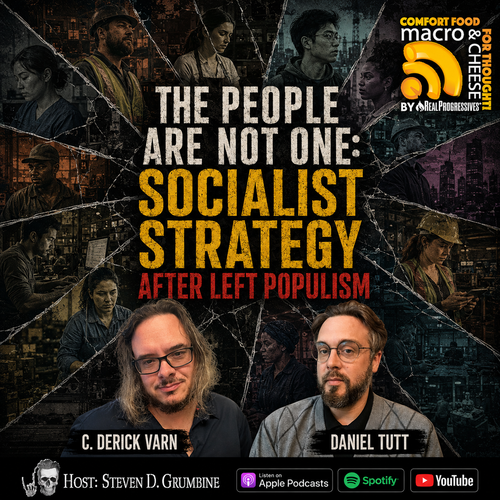
Episode 392 – The People Are Not One: Socialist Strategy After Left Populism with Daniel Tutt & C. Derick Varn
FOLLOW THE SHOW
From Occupy to Bernie, the left has spent fifteen years rallying “the people” against “the elite.” Daniel Tutt and C. Derick Varn say that framing was the problem, not the solution, and explain what organizing around class really means.
Daniel Tutt and returning guest C. Derick Varn join Steve to discuss their new book, The People Are Not One: Socialist Strategy After Left Populism, whose title states its thesis outright. When the left speaks of a unified people confronting a corrupt elite, it conceals the real stratifications inside the working class and borrows a Manichean framework that functions identically on the right. Their argument: since 2008, from Occupy through Syriza, Podemos, Corbyn, and Sanders, left populism has served to extinguish the class antagonism at the center of socialism, operating as a new Popular Front in which liberalism holds the upper hand.
The conversation lands directly on this show’s own history. Varn is blunt about his long-running argument with MMT advocates: he never disputed the nature of the currency, he disputed the analysis of power. They are not going to let you have a Job Guarantee, because it removes their ability to discipline workers. Steve agrees, describing his own path out of economism and the trap of thinking a basket of policies and a few more progressives in office adds up to a threat to capital.
On class consciousness, Varn is careful with a term he calls one of the most abused in socialist history. The reason to organize around the working class is not its victimhood. It is that the working class already possesses, collectively, the skills to reproduce society. The differences within the working class are resolvable. The difference between the working class and those who live off its labor is not.
They close on electoralism. Varn’s formulation: electoralism is a tactic, not a principle. Democracy is the principle. Tutt points to Lenin’s actual position, that ballots are justified only alongside extra-parliamentary means and on terms of strict class independence. The Popular Front let liberalism lead. The United Front did not.
If you’ve followed this show from Ep 218 – Beware! the Counter-Revolution with C. Derick Varn, through Ep 318 – The Death of the Left? with Simon Winlow & Steve Hall, Ep 371 – You Can’t Vote Away Colonialism with Fadhel Kaboub, and Ep 388 – From Theory to Praxis: Lenin’s Revolutionary Formula with Breht O’Shea, this episode is the strategic argument those conversations kept circling.
Daniel Tutt is the author of Psychoanalysis and the Politics of the Family and How to Read Like a Parasite. His writing has been featured in Jacobin, Current Affairs, Philosophy Now and Aeon Magazine. He is the host of the Emancipations podcast and study group collective. Find him on Twitter @TuttReal or his Substack: https://danieltutt.substack.com/about
C. Derick Varn is an author, poet, and educator, and host of the podcast Varn Vlog, where he publishes podcasts and series on the great thinkers, and interviews authors and academics. He is the author of Apocalyptics and Liberation and All That Bright Etc. He has been a union rep for the past six years. Find him on Twitter @TheRealVarnVlog or his podcast https://varnvlog.buzzsprout.com/
Steve Grumbine:
All right, folks, this is Steve with Macro N Cheese.
Today’s guests plural, that’s guests plural, are a returning guest, C. Derick Varn, AKA Derick Varn. You know Varn, he’s been on here multiple times. And we have a newcomer to the program, Daniel Tutt.
They are co-authors of a book that I got to tell you, I was absolutely floored by. It’s 80 pages long, so there’s no excuse not to read. It’s amazing.
And this book is called The People Are Not One: Socialist Strategy After Left Populism. Okay, now let me just introduce my guest properly.
Daniel Tutt is the author of Psychoanalysis and the Politics of the Family and How to Read Like a Parasite. His writing has been featured in Jacobin, Current Affairs, Philosophy Now and Aeon Magazine.
He is the host of the Emancipations Podcast and Study Group Collective.
And C. Derick Varn is an author, poet, educator and host of the podcast Varn Vlog where he publishes podcasts and series on great thinkers and interviews authors and academics. He is the author of Apocalyptics and Liberation and All The Bright Etcetera.
He has been a union rep for the past six years and of course the author of the book that we are going to be discussing today as well. With that, gentlemen, welcome to the show.
Daniel Tutt:
Hello. Great to be here.
Steve Grumbine:
So you know, Derick sent me a copy of this early on and I got to be honest with you, I started to open it with trepidation because Derick had posted stuff about how he had kind of done a, you know, kind of a critique of himself. What do you call it, self-critical kind of analysis. Something jumped into, say, there you go.
He jumped in there to see what DSA [Democratic Socialists of America] was all about and he found out some things that, you know, he, you can feel free to talk about, but they weren’t pleasant, they weren’t great and they didn’t provide a lot of hope.
And so when I read this book, I was pleasantly surprised that I did not get the standard Pollyanna, DSA-type of apologia that I was expecting after he had said he’d done that. And that made me read even harder. And the more I read the more I understood this is really important information.
This is kind of like that missing gap in between, you know, “everybody wants to elect the next whatever” and “hey, we need a socialist revolution.”
And all the in between stuff are where we tend to just skip. We tend to ignore. And it wasn’t just that, though.
I think the important things that I gathered from this were things that, like, I had intuited or I had read or I had picked up through other things that you guys put words to. And the revelations I felt like were really, really powerful.
And so let me just jump right in and say, you name this book something that just caught me off guard. It was. It felt like Build Back Better at first, the way it was framed. The People are Not One. And I didn’t understand that.
I was like, wait a minute, I know exactly what he means there, but why don’t you go ahead?
First of all, you guys explain where the title came from, why you named it that, and I guess I’ll just put out there that the title rejects the assumption that the people already constitute a unified political project, right? I guess the question is what social and class contradictions are concealed when the left speaks of a single people confronting a corrupt elite?
Derick Varn:
I’ll speak first, then I’ll hand it over to Daniel, because we went back and forth in the title for quite a bit, and I think we kind of mutually came up with this one after a couple other titles were not as obvious. I think one of the ones we initially floated was the Empty Soapbox, but it’s an old reference and there was already a podcast named after it.
So we went away from that. And then I think talking to Daniel and I was just like, “Well, why don’t we just state the thesis of the book just explicitly?” And I.
And I was like, “Well, The People Are Not One. Oh, that has a good ring to it.” So we put it on there. The subtitle I’ll let Daniel speak about, actually, but that took a little bit more wrangling.
Daniel Tutt:
Yeah, wonderful. I mean, your endorsement of the book is extremely inspiring and I’m very happy that you were moved by it.
I mean, you know, the core thesis here could be summarized as saying that, you know, since 2008, primarily, but there’s like a big historical thing we can talk about as well.
We’ve seen the resurgence of socialist politics, left wing populism, largely since [Bernie] Sanders, but of course, before Sanders, in 2016, we had the Movement of the Squares, Occupy Wall Street, Syriza Podemos and Corbyn and so on. That left populism becomes a way to extinguish the class antagonism at the center of socialism.
So it becomes a new form of, like the Popular Front, which we had when we were fighting Hitler and Mussolini back in the ’30s, where, in essence, liberalism has the upper hand in the coalition of the left. And that requires a theoretical analysis of class and a return to a Marxist analysis of class in order to make that more evident.
And that also requires a bit of a polemic from the position of the working class and its interest. That becomes the fulcrum of, I think, what’s most perhaps novel about the book and what maybe even what is most forceful in our argument.
And the subtitle, of course, is Socialist Strategy. So we’re arguing that the core of our strategy on the left needs to re-engage with what Marx and Engels put forward at the level of strategy.
So we read communism as a form of political strategy, right? That’s not to say we don’t appreciate, you know, the economic analysis and Marx’s critique of the value form and the labor theory of value.
Of course we do, and that’s essential. But a big part of the book is to actually extract what did Marx and Engels say as strategists for socialism in their time?
And we see so much indispensable insight there.
Steve Grumbine:
One of the things that jumped out at me because this podcast has largely focused on macroeconomics over the last decade. And macroeconomics, I think, is really important because it’s part of the material reality that we live in. You know, have a scientific perspective.
Accounting is pretty much science. And so we’ve always found it to be a value. But we kept butting our heads up into kind of like this void of ideological emptiness that just valued.
Kind of like, we’re all together. We’re over here in this little group. We’re clustered. We’re, you know, we’re angry and we’re.
We got great signs and we’re shaking our fists in the air. And it was all I had at the time, right? I didn’t. I had not read Engels, I had not read Marx. I had not read a lot of these things.
And so I would typically fall back to economism in a lot of ways, which I think is a real big trap, especially for us, that focus on Modern Monetary Theory, to think, “Hey, we’ll just get a few more progressives elected and we’ll have a basket of policies, and life is going to be super special.” It was devoid of the class conflict.
It was devoid of calling capitalism out specifically and focused instead on, you know, “No Kings” and other nonsense that just was vapid and vacuous.
And after a while, after reading some of those things, it became much clearer to me how important having that distinction of class struggle versus just basket of policies, you know, left populism, etcetera, that is the Bernie Sanders movement, that is kind of that AOC. And I struggle with thinking of them as even moderate socialists. I don’t see them really in any way, shape or form threatening capital at any level.
So to me, I think it’s, you know, sort of vaporware. But the way you guys wrote this, you really attacked populism and populist language, basically oversimplifying.
And I know this might be controversial, but kind of piggybacking off of what Gabriel Rockhill would say is kind of that fake Marxism that’s kind of devoid of class struggle in the Western Marxist kind of tradition here. Can you talk a little bit about why left populism is problematic for actually creating a sustainable leftward movement?
Derick Varn:
Yeah, I mean, left populism is a different thing after the 1970s than before it. And I think that’s kind of important.
One of the things that we look a lot at is the actual sociological state of the working class, which is actually kind of ignored by leftists, but picked up a lot by liberals. And some things that like Jacobin magazine does, and this is really.
Daniel spent time looking at that, and I spent a lot of time looking at the changes of organizational models in the 1950s and ’60s and how they weren’t just about ideology.
Like, you get this narrative from a lot of left populist that unions became unpopular because neoliberals ran a political campaign that made them unpopular. And that’s not really true. Unions started becoming unpopular as union management was more integrated in with management altogether.
That actually starts significantly before neoliberalism or even before the, the profitability crisis, of which neoliberalism both engendered and solved.
So when you try to parse it out, you see that deindustrialization makes large scale industrial union models a lot harder.
Franchisisation, which really expands during the neoliberal period of capital, makes organizing large shops, even in the service sectors, really difficult. And that Marxists had realized this pretty early on and that what that led to is a couple of different things.
I mean, we talk about Stuart Hall realizing that this populist logic actually came in through the right first, as a way to recuperate legitimate grievances of the class and defang them.
Christopher Lasch, who we critique in the book actually also noticed this around the same time, but in the same time and in the ’70s and ’80s you start seeing like a lot of people coming out of the Eurocommunist tradition, specifically [Chantal] Mouffe and [Ernesto] Laclau to a lesser degree, you see it in [Michael] Hardt and [Antonio] Negri, although they were not populist in a cleanest sense, talking about the need for an abandonment of the working class for either the lumpen or the lumpenized.
And we can talk about that later, which did come out of something real too, which is the lumpenization of a lot of the blue collar working class in the first place.
And then the other thing that we saw was the focus on empty signifiers from particularly Ernesto Laclau, which he really developed in Emancipations in 1996 and then On Populist Reason in 2005, which talked about the need for representation, but that mass politics was really not congealable according to interest and that you needed an empty signifier to relate these unrelated demands. And so you would use a person or a slogan or whatever as like a form of chain of equivalence and build out from there.
And I’ll really turn this over to Daniel now, but this really kind of had a profound effect because this logic has shown up in things that don’t seem like they’re the same thing, but actually kind of are.
Because one of the reasons the empty signifier logic is so pernicious is that it pretends that you can just use rhetoric to paste over class interest distinctions. And their model for this, I mean Laclau is actually explicit, is [Juan] Peron in Argentina. And I think that should give people a little bit of pause.
But I’ll turn it over to Daniel to let him really develop this.
Daniel Tutt:
Yeah, I mean, part of the definition of populism, both on the right and the left, is a conception of social conflict through a Manichean division, which tends to be functioning on elite theory.
So, often, and this is interesting, right, because if you think about what the diagnosis is for solving social ills or social injustice, it’s usually an intra-elite solution, whether it’s on the left or the right, like we need to find the good elites. But that’s a kind of liberal, technocratic vision if you think about it.
So the paradox of left populism is that liberal technocratic hegemony can persist with a framework of left populism.
And this introduces the problem of the PMC, the professional managerial class, as arbiters of the capitalist class at the level of the superstructure or of culture. And we get into a whole interesting debate about that which we can look at.
But suffice it to say I think that you made a very interesting connection to like left populism and even some MMT theory, which the problem is is that it’s not actually going down into the civil society level, the kind of base level, and building up from there.
Instead it’s sort of uncritically relying on the existing division of labor, particularly the existing division between intellectual and manual labor, which we see as a contradiction. You know, we have a whole section on post-Marxism because it’s not that all Marxists have this figured out.
In fact, one of the hallmarks of post-Marxism, from even like Herbert Marcuse to Hardt and Negri to Leclau and Mouffe, is that they effectively abandoned the proposition that the working class remains the revolutionary agent and they then fall into a kind of left populist position.
And with Marcuse, even before he dies in the late ’70s, basically says that only elite technicians, scientists and academicians can be the stewards of transforming society.
Now that’s very interesting from Marxist point of view because that is equivalent to exactly the type of socialism that Marx and Engels criticized in The Communist Manifesto, namely Christian socialism and utopian socialism like [Charles] Fourier and [Henri de] Saint-Simon, right? Basically it’s elitist socialism.
So we read the Marxist tradition from that point of view and we recognize that actually it requires the development of institutions at the civil society level in order to construct a truly socialistic and kind of Marxist-oriented politics. So the task ahead is actually like strategically a huge task.
And we recognize that it’s a big, it’s a big hill to climb, you know, but I think the left populism tries to make a workaround, you know, and that’s where the problem is.
Steve Grumbine:
Some of the framing that I got from this and just I hear myself saying them and I’m embarrassed at times now in retrospect. But you are where you are, right? And none of us are free of the, you know, long tentacles of hegemony and the various narratives that come through.
I think we all are. We are not immune to its impacts and not immune to accidentally bringing them into our own frame.
And it takes a concerted effort to remain principled and not allow things that are happening to impact you and change your view uncritically. And you know, like the billionaire class, I frequently talk about the oligarchy. I mean, I’m frequently referring to things like that.
And I say to myself, I understand the institution of capitalism is not about good people, bad people, great men, small men.
It is about a system that in and of itself produces these externalities that, you know, some people, but few benefit from, most get some side benefit from, or they would have already maybe stood up against it. And then the vast majority are crushed by it. And, you know, it’s not really necessarily just the elites. Yes, the elites have a class interest, right?
They have their own interests that they are fighting for. So I guess thinking about it from a class struggle perspective, there is class warfare there.
There is a class, you know, fight going on, a battle, whether it be all one way at this point in time, and really very little fight back. That’s real. But those terms don’t really keep the focus on the system. They focus it on Donald Trump, bad.
Donald Trump, tiny hands, bad, you know, Hillary bad. Bad people all over the place full of bad supervillains, as opposed to having a systematized view of the problems that we’re up against.
Can you possibly explain, you know, this feels like this red-brown alliance moment here where the right is taking pieces of this populist rhetoric and appealing to workers through scapegoating and other things. But how does this kind of focus on, like the establishment or the oligarchy and stuff?
How does that lead to right wing kind of movements and right wing populism?
Daniel Tutt:
I mean, I think one of the things we should call out here is the attempt that we see on both the right and the left to introduce this concept of something like the Epstein class to describe the capitalist class. And I think that’s a good example of a kind of incoherent fusion of right and left populism.
And also it indicates why in our subtitle of our book, we use the word “after” populism. Because that’s ambitious. The use of that word is an invitation to the left to transcend these kinds of frameworks.
Right, because you can see it’s a construct that is saying that politics can really only be moralistic. And I think from a class struggle lens, politics is not moralistic. Like, have you ever seen the show Succession? Right on HBO?
I always loved how it’s like a Rupert Murdoch oligarch who runs a kind of equivalent of Fox News. But when they speak privately about politics, they are like hardcore Marxist materialists talking about class struggle.
But then they run a service which is just pure culture war slop. And so populism can’t get out of the culture war slop that’s its biggest problem.
Now, we recognize that on the left, to be super focused on class organizing goes against a lot of the historical reflexes and patterns of habituation that occurred during the New Left. And that actually makes the New Left at times will make Marxism into like this vulgar class reductionist thing.
But we try to sincerely synthesize the lessons of the New Left with Marxism without falling into a kind of vulgar class reductionism. And that itself takes patience, that takes precision, that takes good analysis.
But it also invites us, I think, to create ways of talking about politics and even social antagonism from a class lens that’s actually more broadly construed.
So, for example, we’re interested in things like social reproduction, the breakdown of the family, the distinction between not just proletariat, but also the lumpen proletariat, right? And to talk about all of those things from a kind of consistent materialist lens can include anti-racial struggles, anti-imperialist struggles, right?
Because there is a tendency, I think, to be too narrow on the class question.
And Derick and I really, I think, and I’ll kick it to him, we want to open up. We have a kind of big tent Marxism in a certain way. Maybe Derick, you could build on that vision as well.
Derick Varn:
Yeah.
I consider myself a non-sectarian Marxist in that I think the history of the sects has been a limit to the development of Marxism, both as a political program and as a research and theoretical program. But what I don’t want from that is just generic left unity, right? Because, like, why should we unify with all the existing Left?
We don’t even know what that means. Not really.
The other thing I’d say is the push against class reductionism is not because we, you know, it’s not because we don’t believe in the class. It’s actually because we think it’s fundamentally dishonest about the nature of the class.
And that even, and I would accuse a lot of writers for like Jacobin magazine of doing this. They reduce class to an identity category that they just valorize because it seems more important.
In fact, this is an error that I accused Mark Fisher of back when he was still alive, when he wrote the Vampire Castle for Northstar magazine, which was. I was on the editorial board and he was defending Russell Brand and class origins.
And I have come to think that class origins is more important than I used to because it does inform a lot of our sociological realities.
But that’s still not a great way to understand class because it renders it just an identity, just like the other identities that we talk about in the melange of left politics. And it also enables people to have delusions about what the working class currently is.
So you can believe in like in blue collar/hard hat people, which are really something that only makes up about 8% of the workforce.
So the question that you have then is how do you respond to these problems and these images of the working class when even a lot of the people who talk about the working class, Bernie Sanders, the DSA, etc, do not actually have particularly good analysis of what is going on. And they basically view socialism as a set of policies done for the working class, not as something the working class takes charge of itself.
And this was been, you know, in my many, many debates with MMT’ers, I never argued that they were wrong about the nature of currency. I always argued that they were completely deluded about the nature of power in a capitalist society.
That no, Virginia, they’re not going to let you have a Universal Jobs Guarantee because that removes their ability to discipline the workers. No amount of saying we don’t need to tax you is going to change that power dynamic. And so I say this to make it relevant to your audience.
But it’s a general problem because a lot of people think you can one neat trick this and what we’re saying is not everything in those one neat tricks are wrong.
But if you remove the underlying social antagonisms and why they exist.
And also, and this is where it gets really hard I think for a lot of people, remove the antagonisms within the broader working class and how other classes are being forced into it, but bringing their values and habitas, which is a big way of saying it’s not exactly this, but their cultural formations and their habits into that class. That’s one of our big critiques of the so-called PMC.
It’s also what we talk a lot about with making lumpen a verb and not a static class category, because we see lumpenization happening in all classes, but particularly the blue collar working class in really pernicious ways that we can back up statistically.
And it’s really given to being abused by right-wing grievance mongering because and this is something Christopher Lasch said in his good period before we started critiquing him, is that, for whatever reason after the New Left, the left would often ignore problems that really hampered the social reproduction of the working class, while the right would admit that they were problems but then lie about them. And we see this pattern now persisting from the 1970s to today and intensifying and getting worse and worse.
And the other thing we see is a group of people who come from what used to be a petit bourgeois background, even though they have never probably been, properly speaking, petit bourgeois. And by that we mean. I’m going to define this for your audience.
A small business owner who employs, you know, almost no one, but is not subject to the wage fund, right? That’s what doctors, lawyers, even teachers in the 19th century used to be teachers and nurses were the first to… nurses have kind of never been this.
But teachers were the first to be proletarianized in the early 20th century. But we’ve seen this with all these other professions and that is the basis of things like the DSA and even a lot of the more radical socialist sects.
Because those people have a lot of education and a lot of time and usually actually don’t have that many family commitments. But they bring those petit bourgeois values in with them. And it’s not because of a personal failing. And that’s what I really want people to hear.
This is not just moralization.
It’s because the entire apparatus around those groups, the university system, the professional organizations, even professional unions, have basically assumed that people are selling their knowledge base as a form of capital, you know, human capital on the market as a petit bourgeois seller. And that’s not true.
And you also pair that with the gigafication of blue collar and service work, which also distorts this relationship by making clearly employee relations look like petit bourgeois relations.
And you have all these bad habits that look like they might be about socialism, but when you really think about what they are, they’re actually trying, this group of people, trying to desperately stop themselves from being further forced into the blue collar working class of the proletariat. If you think about this, you see this in everywhere. Like why is in socialist education policy there’s such a big focus on fucking college?
You know, when you think about what a college really is, right? It’s yeah, it gives its mission of social justice and moral clarity and blah blah, blah, blah blah blah.
But it’s the major sorter of intra-class opportunity that exists. It stratifies the classes.
It also, in its most elite form, which is the forms that are likely to survive austerity, which we are currently going into, are rentiers that suck out. Like the biggest landlords in New York City are NYU and Columbia, right?
The biggest hospitals that are doing these neoliberal-fication of nursing workforce, public private partnerships that even pit workers against each other, like nursing contract bidding. Well, that’s coming out of University of North Carolina.
So this obsession with saving the universities seems to be because it’s seen as a way to stop proletarianization without people being totally conscious of it.
And it’s because these are also the forms of institution that people perceive, although wrongly as existing outside of the capitalist market framework. So they over-focus on these.
And I don’t have like a problem with universal higher education in and of itself, but it doesn’t ameliorate class distinctions. And we know this from Europe where you do have a more meritocratic free college system.
But you know who primarily benefits from that free college system? It’s already the rich. Yes, it is more meritocratic than what we do, which is pure money and legacy emissions and all kinds of that.
But you actually look at this and like, well, this does nothing for class alleviation in Europe where they have free college. Why are we pushing this like as the primary? Why don’t we have other socialist demands for education?
And if you look at what like the current DSA project, it just says universal pre-K up to universities, which by the way doesn’t exist in every state. But where it does exist, it’s free.
That already is a demand that’s being met by the capitalist society in some states and a fair bit of states in the United States and in most countries in the developed world. So why are you making that a socialist demand? Why aren’t you talking about what a socialist education would look like beyond free college, right?
Well think about who these people are.
And even though a lot of them are really working class and that they’re subject to the wage fund, their project seems to be about preventing their own deterioration into the lower rungs of the working class. And yes, they’re going to universalize that and I guess that’s kind of positive.
But it really does make socialism kind of the plaything of white collar-fail sons and daughters.
Steve Grumbine:
Daniel what are your thoughts, sir?
Daniel Tutt:
It’s an interesting and very complex problem.
I mean, in a certain way, the ideas of the left, high theory ideas, that still guide our practice were generated out of a social surplus from the Fordist welfare state that kind of culminated in the 1970s.
And I think, you know, as you guys talk about on your program, the neoliberal period really weaponized things like the Federal Reserve and transitioned the capitalist system into a much more finance oriented system that has in many cases liquidated that social surplus so we no longer have a rising middle class.
And therefore a lot of the premise of so much of left wing thought and theory that came out of the New Left period speaks to a different political economic reality than our own.
And so that’s why we wanted to turn to theory and actually look at some of the shortcomings even of Marxist theorists in the book, we sort of try to systematically go through them.
And in some cases we say, you know, people like Ernesto Laclau and Chantel Mouffe, who wrote Hegemony and Socialist Strategy in 1985, which became hugely influential and very much absorbed as a practice, as a strategy for the left, that this actually fed into this same kind of left wing elite problem that we’re talking about here. And yeah, there was sort of two features of Laclau’s system.
One is the left wing Bonapartist feature, and the second was the academy, the university. And with austerity, you know, the political potential of the neoliberal university has significantly declined.
And now we’re in a situation in which most dynamic, thoughtful stuff that’s happening, it’s actually happening on YouTube and in para-academic places and spaces.
So we’ve seen both the right wing try to destroy the neoliberal university, which of course is tragic, and we should defend the existence of the university, while at the same time we’ve seen a hyper-leftism envelop the university and sort of evacuate critical thought.
So it’s actually quite difficult even at elite levels to have like a truly critical and productive conversation about socialism in the left from within the space of the elite university.
So we talk about how we can actually construct that through existing podcast networks para-academic groups, and maybe they become sites for future socialist activity. Because right now a lot of the stuff we’re doing in the podcasting world, I think, is actually some of the more cutting edge stuff, frankly.
And also, you know, we talk a lot about the culture of the left and the internal culture of the left and how to improve it, right? How to, how do we engage with the right, how do we mitigate cancel culture? How do we address class issues internal to the left?
How do we take on the problem of ABC theory, anything-but-class theory, which is very prominent, we should be honest. And there is a way in which corporate identity politics can fuse with far left identity politics, and that needs to be called out as well.
But the sort of epistemology of that identity politics is also pretty aggressive. So to call it out is an invitation to get into a fight. So we try to ground our analysis in a comradely way.
A lot of things that happen in the left populist world, of course, leads people to be neither right nor left or post-left. We very much disagree with that. We want to remain steadfast leftists, right, so those are some points I would share.
Steve Grumbine:
You know, one of the things that jumps out at me and obviously the book is The People Are Not One.
And that kind of points to all the different interests that are baked into what would make up the working class as a result of all these various forms of stratification, etcetera. I want to know, I guess, what role do you think socialist consciousness would play in transforming workers into a revolutionary political force?
Derick Varn:
I mean, what do you mean by socialist consciousness? It’s one of the most abused terms in socialist history.
Steve Grumbine:
Well, so for example, what you just said, let me. Class consciousness, how about that? I mean, what role does class consciousness play in transforming workers into a revolutionary political force?
Derick Varn:
So the consciousness issue is an issue that I will probably hand to Daniel after making a few caveats. Class consciousness historically for Marx and his Hegelian framework is a way to turn what is an aggregate into a…
This is the terms that Marx would not have used, but maybe modern people understand it-
An agentic collective, that’s a big way of saying that it can act as if it has agency collectively as opposed to just being subject to what happens to it on a sociological level, which happens in aggregate, which means it’s happening to individuals and become something that is mathematically predictable.
The way that we frame that in a Hegelian framework is the move from the class in itself, which is just your raw experience of your class position, your class origins, your struggles in your daily life, and the class for itself. And the reason why this is important isn’t just some abstract Hegelian mumbo jumbo.
It’s also because the class for itself sees its interest in the long term, not just short term, where short term interest in the working class can actually be quite internally opposed.
And this is one thing I don’t like about like a lot of Jacobin rhetoric is they kind of pretend that this first thing isn’t true, that workers aren’t alienated from each other and not just by the obvious things like race and gender that the left focus on, but also by non-obvious things like sector.
And it’s not just blue collar versus white collar like shippers versus producers, manufacturing versus logistics or regional industries being different or this, that and the other. This actually tends to produce a lot of people’s real politics, probably a lot more than any abstract notion of consciousness.
The reason why you need class consciousness to go into the kind of broader scale is then what you see with class consciousness is the reason why we focus on the working class isn’t their victimhood… it isn’t because they’re morally victimized. They are. That’s part of socialist theory. But there are lots of groups that are morally victimized.
The reason why we focus on this particular group is because if it is aware of itself, it already has the skills collectively to reproduce society. Workers know how they do their work. They are not in charge of their work. They’re alienated from their work. They’re removed from the structures and power resources of the work.
But they know how to do their work. And they could reproduce the world that we currently live in if they so choose.
The reason why you have to build the consciousness, which I do think would lead to socialism almost necessarily, but it is not something innate and will just emerge organically by itself, is because there are immediate interest conflicts within the working class among itself. And it takes getting over those and seeing the broader issues that unite them to bring about some kind of collective good.
Because workers are already socialized to survive collectively. They already do. Like when people say, “Oh, I want to live only on my own labor.” No one in the world lives on only on their own labor.
That does not happen. You don’t do it. So you have to go and kind of deal with it.
The issue that I have with class, with consciousness, and you might hear it in my skepticism and why I’m very careful using these words, is that a lot of people use class consciousness in this idea that there’s an abstract for itself that somehow intellectuals already know and can bring in force to the working class. And we talk a lot about the merger thesis in our books and like the role of intellectual socialist and blah, blah, blah, blah, blah.
But the reason why this is so important is… it is a mistake to think that you can just tell the working class to have socialist consciousness and they’re just going to have it in the way that you want them to. And this is why the sects get stuck. This is why left populists gets stuck.
This is why so many things get stuck and are unable to move, is because there are differences. We believe that the differences within the working class are resolvable.
We actually do not think the differences between the classes are resolvable, because there’s no reason that in the long term the logistics worker and the service worker and the factory worker actually are permanently pulled apart because one does not always subsist at the expense of the other. But the capitalist and the rentiers always necessarily exist off the work of someone else, period. That is how they make money.
That is how they value-ize profits. There is no way for that not to be true.
So when you try to include sections of them in your coalition with the working class, you’re always going to have a consciousness problem that’s going to merge in a way that leads to either demagoguery, focus on personality, focus on political figures, whether good or bad, Bernie or Trump, whatever, or on cultural issues because they can seem to erase the impossibility of, reconcile the differences between classes that live off the, you know, the exploitation of other classes for a little while. Whereas within the working class itself, there is really a way where all of these people could actually benefit as individuals and collectively.
And that’s where socialist consciousness really comes in. But if you try to impose it by just having the right ideology, it doesn’t tend to go that well. And I’ll turn it over to Daniel.
Intermission:
You are listening to Macro N Cheese, a podcast by Real Progressives. We are a 501c3 nonprofit organization. All donations are tax deductible. Please consider becoming a monthly donor on Patreon, Substack, or our website, realprogressives.org. Now back to the podcast.
Daniel Tutt:
Yeah, I mean, it’s very interesting that the right wing tries to say that the neoliberal progressives are equivalent to communists. And then it’s even more strange that some communists will sort of agree with that assessment and say, “Yeah, what’s the problem?”
So there’s a lot of work to be done internal to the socialist intellectual movement. And historically there is seen a kind of line of demarcation between the intellectuals and the workers.
Although in our own time one of the things we’ve seen is that out of the social surplus from the post war boom, many generations of working class families were able to have a degree of class mobility.
In the section of our book where we look at contemporary millennial generation ethnographies of the working class, we get the reality that actually that social mobility has really come to a screeching halt. And so that develops a type of, you know, what [Karl] Kautsky would call a class instinct. So the class instinct is formless.
Class instinct is effectively apolitical or kind of general baseline consciousness of class antagonism can, you know, be coopted by the university system or some ultra liberal idea. The idea of the merger thesis would be to shift at a second order level, right?
Because I think in the Marxist tradition we generally have the view that the worker’s relationship to their own exploitation does not necessitate some seminar to describe that to them. It’s felt, it’s known, there’s an empirical level to it, right?
But the higher order mediation that needs to take place would be one that is happening at an organizational level and a collective level that is capable of uniting the maturity of the class struggle with the maturity of the working class’s resolve and capacity to act as a collective.
Once you’re able to inculcate that collective agency and you then build a certain institutional fabric of trust with the working class, which we should add liberalism, by its very design, I think historically we could say, is not interested in that because it doesn’t acknowledge these distinctions of class. And neither does left populism. You get a weird mishmash.
So socialist consciousness would have to be based upon the power both of civil society groups that represent the class as well as political parties that do so. And those are two things that we really are at baby steps to construct.
And that’s why we say, you know, our best analogy historically is really pre-1848 when the workers movement was effectively in an incubatory stage.
And that’s a very interesting fact because obviously we have the thesis of Hyperpolitics, of Anton Jager and many other theorists have suggested something similar, which is that we live in an age where politics is everywhere, right? And so there was a group with DSA called Geese Magazine, which are kind of zoomer left populist Marxists.
And they criticized us as basically being a little quietistic because we want to go back to square one and actually build, right? Build institutions that can actually do second order mediations with the class, right?
And actually move from this kind of abstract, instinctual idea that workers have that they’re being exploited to something that’s actually flexing their muscles. And they’re, you can read our debates. It’s actually a very interesting debate. It’s worth reading. And we have respect for them.
It’s not like, you know, there’s bad blood. But I mean, those are some points I would say about class consciousness, you know.
There’s a lot of inspiration we get from [György] Lukacs, you know, the great Marxist author of History and Class Consciousness, which I think is probably the finest text that outlines how this is to work. You know, this unity between the working class and socialist consciousness.
Steve Grumbine:
You know, I want to try to bundle, because there’s so much to talk about. I mean, I want to go into institutions, I want to go into so much.
But one of the things that I’m hearing, and maybe you just actually answered it without me asking it. And that is kind of, you know, when push comes to shove, I have subscribed to vanguardism at some level, right?
And I don’t believe that we have anything that even remotely represents that at this point.
And I think you’re kind of pointing back to the idea that we have to do this with workers, but the stuff that we have in place today isn’t really fit for purpose.
And so you’re suggesting going back in time while it was still being formulated and really kind of review that in light of current circumstances, I would say current material conditions. Am I close there? Am I in the stratosphere of what you’re saying?
Derick Varn:
Yeah, I mean, one thing that we need to be very clear on is vanguardism is a result of the merger thesis. And…
Steve Grumbine:
That’s what I. That’s exactly what I thought. Okay, thank you.
Derick Varn:
The, the issue, the way Marx states it, and this gets reinforced in Lenin’s State and Revolution, is that you do have people who have a knowledge of socialism. They’re from all kinds of classes. Marx does not have just disdain for the utopian socialist.
Like he actually does see them as a necessary step in a chain.
But the problem with the utopian socialists is they didn’t, you know, from Marxist perspective, a scientific point of view that merged their issues with class issues. And also they thus sounded like moralizing preachers to the class trying to enforce something upon them.
The way I kind of think about good versus bad vanguardism and what I say, bad vanguardism is sectarian vanguardism, which usually cannot grow. If you look at like the history of most socialists sects, they put ideology first and they have about a 5,000 person limit.
And the, the 5,000 person limit is actually weird. I actually can’t explain why it’s like kind of clean like that, but it’s consistent.
And it’s not that we don’t think ideology is important, it’s just that I don’t think any socialist group has the answers or we would have already succeeded.
And at this point, I don’t want to get into theoretical concepts that Daniel, I didn’t totally develop out in this pamphlet, but we actually think things have gotten so decadent. And I don’t mean that in a moral sense.
I mean that in like these forms have existed so long, they are beginning to collapse from their own weight and their internal contradictions are irresolvable. However, there is nothing emerging immediately to replace it yet.
But you know, remember the decadent metaphor is that something can grow out of this death, right? But, you know, all kinds of things can grow out of this death.
So we have to look at it and go, okay, well through most of the 19th century and early 20th century socialists thought they were inevitably going to win. They didn’t. So how do we look at that and say, let’s get this thing started back, let’s really get going.
And I think you do have to look at the conditions of the early socialist movement. And I would actually say some of that is the left’s fault.
Whatever we mean by the left, and I’m not blaming everyone equally, but like the New Left, Western Marxism, even Soviet Marxism because of the Sino-Soviet split, all got in the cul-de-sacs, they couldn’t get out.
And I think, but I’ll let Daniel speak for himself here, although I think we have very similar opinions, that this means that the ideological project is something that we have to construct with the basic principles of what communism is, which is we’re building towards a classless society. And classless has some specific meanings.
And I actually think the person who states that what that is the best is also Lenin in State and Revolution. So for example, police abolition is part of socialism, but that doesn’t mean what liberals and a lot of frankly leftists mean by it.
It doesn’t mean that you don’t have a social security force. It means that you don’t have a standing police and a standing army, that you have like universal militias handling that.
That was the traditional answer. Everyone has responsibility and everyone has a stake in it going well.
And it is not just like, “Oh, we have a corrupt institution, let’s replace it with nothing or social workers or whatever.” Now I also think if you had socialism, like most claim, kind of takes care of itself, but not all of it.
So these are things that socialists had real answers for that for whatever reason in the 20th century, we’ve forgotten or like with family abolition. Family abolition meant something very different in the 19th century than it does in the 21st.
In the 21st it’s like whatever Sophie Lewis is talking about, it sounds like total dependency on the state to raise kids, blah blah, blah, blah.
Family abolition in the 19th century was the right to like no-fault divorce, to the decriminalization of infidelity, to set up like more social outlets to raise kids, universal schooling, no more four-star arranged marriages, et cetera, et cetera, et cetera. And that’s a very different thing than universal workhouses. I mean universal, like mother houses or whatever.
And we don’t think that everything was perfect in the 19th century.
In fact, we actually think we need to innovate beyond that because our social conditions very different, but what is the same is that the welfare state will be allowed to exist in some really sick, perverse means that actually even keeps people poor so that you have enough surplus population to discipline capital.
This was a point made by Matt McNair [Mike Macnair – Revolutionary Strategy] who’s an inspiration to our book when we talk to him, but that it’ll be more and more anemic and shittier and more and more austerity and will keep people at a lower and lower subsistence level while also trying to remove their access to jobs.
And the reason for that’s actually deeply cynical because if you have, you know, as MMT’ers know, if you have a universal work guarantee, or a very low work population, those workers have a lot of market power. So these are the kinds of things that we want to look at and work through.
And that means that the vanguard can’t just repeat slogans that, you know, came out of the 19th century and were used in the 20th, as if we know how it’s going to work, because unfortunately, whether we like it or not and whether that, you know, and the Western imperialists definitely had a whole lot to do with it, but we kind of always should have known that they were going to try. The Soviet Union doesn’t exist, and China had to pick a different path in the 1980s, and China has been reintroducing socialist reforms.
I have a lot of good things to say about the Chinese experience, and I’m not here to criticize them, but the extent of liberalization under Deng [Xiaoping] is actually often understated. And I’ve gotten this not from Western scholars, but from Chinese ones like Dongping Han and Mobo Gao.
So these are things that I think a lot about, and I’ll turn it over to Daniel because I think he’ll want to have to say about this and probably wrap this up.
Daniel Tutt:
I mean, I think that the vanguard theory after the rise of the neoliberal restructuring of the parliamentary system in Europe and the congressional system in the United States, which you could make an argument the congressional system in the United States has created legal barriers to a serious Workers Party, especially since the liquidation of the [American socialist Eugene]Debs-ian Party at World War I. But really in, you know, 1980, we saw the enfranchisement of communist and socialist parties in Europe steadily removed from parliament.
So Lenin’s commitment to the Kautskyist revolutionary social democracy strategy from which the vanguard theory emanates in the context of our present, in which truly socialist parties are legally prohibited from playing in electoral arena, creates a weird situation. You know, we should be honest about that, where we appear to the working class as far more like far left ultras than we really are.
So this is something we need to take on at the level of civil society. That kind of goes to your point about institutions.
And that would be where I think we would want to prioritize things at the level of culture and education. That’s not to say that we can’t do anything in the electoral arena. I think we should use the orientation of strong and firm principles in that arena.
And I would say non-cooperation with the Democratic Party, which of course, you know, groups like DSA are unwilling to do.
But so, so we have a somewhat confused situation of the vanguard precisely because truly socialist and communist parties have legally faced these barriers, right? So there’s a lot of work we need to think through about how to transcend those things.
Because ultimately if the working class is the revolutionary agent, it’s not just a matter of their self interests. It’s actually that a classless society would come from the by now multi-generational proletarianization that they have had to live through, right?
And that’s the materialist reality that we’re facing in this society in America, which is we have a new working class which is ready, I think, primed for the kind of socialistic politics, but they lack a vehicle to implement it. And that is something we want to rectify.
Steve Grumbine:
So let me throw this out there real quick because I want to get this in because we are coming up on time here. But when I think about vanguardism, I’m not necessarily thinking electorally because there’s been some pretty empirical studies done.
One of my favorites that I bring out of the, you know, woodshed every day is the Gilens and Page study from Princeton in 2014. And you know, I don’t believe in electoral politics. I don’t think we have a system.
I think we have a, an unplugged extension cord that we have plugged into itself and we swear we have agency through. I don’t believe there’s any real value in it. And I believe that it’s a way of stifling actual revolutionary spirit.
It’s literally shrinking the 360 degrees. We could be looking down to a 1 degree of what is possible. And I believe that we kind of have to build outside of that arena.
I’m thinking as a project manager and as a worker when I say building parallel institutions and dual power. And when I think about what that might look like, you know, I think about, you know, a network of hostels. I think of a network of mutual aid.
I think of building capacity to withstand the pressures of the austerity Derick brought up and just some of the other things we brought up. When I think of vanguardism, I don’t necessarily think in terms of electoralism because let’s be fair, Lenin was talking in a parliamentary sense.
We don’t live in a parliamentary system. In fact, we live in a system that is a bourgeois democracy where the people have a statistical near zero impact on any policy regardless.
There is no vehicle to get money out of politics. I laugh when people say that because by what means do you get money out of politics, my friend?
And then each step through this process, I see it as a complete dead end. But I know that we keep getting driven back, especially by the DSAs.
I see folks like Eric Blanc writing these, you know, soliloquies about, if not AOC, then who? And. And on and on and on.
And it’s just depressing and heartbreaking and gross to me, actually, because I see people rally to that thinking that they’re going to get. So it’s almost like a cruel joke. You could see Charlie Brown trying to kick the football as Lucy yanks it away every time.
Can we just kind of end, like on a situational, you know, what do we do with electoralism? How do we view electoralism in the space?
And to be perfectly honest, I don’t think that Lenin or any of the, you know, priors would have said, “Yeah, it’s good stuff man. hang out with the capitalist classes, these capitalist parties, and do capitalist things.”
I don’t think that’s what he meant when we talk about, you know, kind of his approach to things. You guys’ thoughts? I’ll let you guys carry us out on those comments there.
Derick Varn:
Well, there’s a couple of thoughts and then I’ll turn over to Daniel. But the first one that I think about is electoralism is a tactic. It’s not a principle. It’s not the same as democracy. That’s a principle.
Electoralism is just a tactic. It’s a tactic where most the institutions that you engage in are structurally controlled, not even by the representatives.
I mean, what do most representatives spend most of their time doing? Begging for money? Actually, strategically, that’s what they do.
And yes, there are small fixes for that that make it less obvious than it is in the United States.
But we can see from the results in Europe that has a lot of these things, these progressive wants, has a parliamentary system, blah, blah, blah, and they’ve calculated their oppression of like socialists, to be really precise.
So it’s not enough, for example, to drive socialists into clandestine organizations or workers and unions in clandestine organizations, which happened in the 19th century, which actually some of these organizations were able to build dual power under clandestine conditions like they weren’t legal.
That’s even true for the SPD at different points of its history, the Socialist Party of Germany and it was definitely true for the communists of different periods in history. But they’re not so much made illegal in forcible clandestine as they’re shut out.
And the other thing that I think you’re right about is that, and this is my issue with populists in general, it’s like, okay, you get all these good policies, but we can see from the UK that even if you have good, you know, a good national healthcare service, whatever, if workers don’t control it, it’ll rat fuck you. You know, the capitalists can sabotage it and make it so shitty that it becomes incredibly unpopular.
Now that hasn’t happened with the NHS exactly, although it is getting quite bad there. But it’s happened with a lot of other social programs. And say what you will, but working class people don’t tend to screw themselves.
So I think those things go together. And this is why I would agree with you.
I mean my issue with vanguardism is like it tends to come after the 1950s with a pre-established ideology that tries to enforce on people, but the electoral part of it, it’s not that important. And I think we see this in real time now with [Zohran] Mamdani, there’s a lot of, you know, you mentioned Eric Blanc.
I can also mention David Sirota who’s always talking about how Mamdani is doing this thing that’s completely unique, right? Like rent freezes. Well, it’s actually a rent control freeze. It’s been used twice by Bill de Blasio.
And the only thing unique that Mamdani did is actually expand it to two years, not one. It only applies to 40% of rent stabilized apartments, not rent control apartments or market apartments.
And if there’s a grievance, you’re going to have to actually fill out paperwork and do means testing to prove that your landlord’s not in compliance. So great, I guess. But that’s not unique or original or new. It’s not necessarily bad.
We didn’t necessarily oppose it, but we can already see how the Democrats get all up in that.
And it really becomes really obvious in Mamdani’s housing policy, which is probably based, you know, it’s not probably, it is definitely based on Obama and de Blasio policies which expand housing by building a lot of up market housing in down market neighborhoods. So it’s just gentrifying the area.
And while they call them affordable housing, they’re affordable housing at market rate and they might be rent stabilized, but they’re still going to be like $3,000, you know, one bedroom apartments for the most part. So is that really helping the poor or the developing homeless problem in New York? Not really.
And then you heard all these things about miracles Mamdani did with the budget in New York. Well, what did he actually do? He passed the pied-a-terre tax, which only helped the budget shortfall by about 2 to 5%.
It doesn’t have that much effect. He got a loan from the Democrats.
And when he did this, you can already see his rhetoric around socialism changing so much that when we were touring the book last week and this was in the end of July, so you know, this will come out a little later, he was literally pivoting away from socialism and towards Obama in ways that got progressives to say, no one’s ever done this before. Just saying, you know, if you call a socialist, it’s an insult, but it doesn’t mean anything. And look, we’re more like Barack Obama.
I’m like, that’s all I’ve heard for the past 30 years.
This is the same distancing and pretending that socialism is an immature philosophy from a guy who was able to become mayor of New York on a socialist ballot line, explicitly, not implicitly, like AOC. And so then watching all these people go, oh, if we can get AOC and there’s all kinds of faction the DSA is doing this.
You might find interesting is this is getting so intense that it’s actually threatening to split the DSA apart.
So like the battles over this are getting that intense because there are people who realize that, okay, let’s say you do get an AOC president, will she’ll be able to have 100 DSA cabinet? No damn way.
Even with massive increases in the House of Representatives at current levels with current candidates, there’s absolutely no way the DSA would have enough of control for those people to get through even Congress. But they don’t go through Congress. They go through the Senate where the DSA has virtually no representation.
Maybe, you know, Bernie, and maybe, I don’t know, maybe one other person, but that’s it. So who’s going to confirm a DSA cabinet? Nobody. There’ll be normal progressives backed by the same people that you saw with Obama.
And it’ll probably go the same way.
The other irony, and then I’ll quickly turn this over to Daniel, is at a municipal level, we all know that municipal government does not have currency sovereignty and can’t that wouldn’t make any sense. And so austerity is going to be a real issue. The irony is progressives and even left populists are more popular in austerity time periods.
But that’s also when people expect people to put up or shut up.
And that’s when they have the least ability to do it without massive increases of taxation, without federal backup because the Feds have currency sovereignty. And this is happening at a time point where the progressives have like no pull on the federal government.
So what is likely to happen is what we saw with like Brandon Johnson, who not DSA endorsed but was was a fellow traveler did in Chicago where they hit budget lines and become incredibly unpopular because eventually people hold you to account for more than rhetoric.
And I the the interesting thing that we started seeing with Mamdani, who had stayed primarily on a, you know, affordability platform with a little bit of stuff about Israel, but mostly focus on affordability platform stuff, is as soon as he got done with his budget and these policies are kind of slow rolling out, you start seeing him pivoting to try to like outmaneuver Tish, who he could fire but won’t and whatnot. Tish is the police commissioner. [Raving Zionist.] Right?
By saying he’s going to arrest Netanyahu, which he has no power to do, I mean like, and then immediately, immediately backtracking off of it in a way that got him a lot of attention. Well, as much as I am an anti-Zionist, that’s a stunt. It doesn’t affect the struggle, it doesn’t affect the genocide at all. It’s just optics.
And it’s optics coming at a time when you’re already seeing his ability to deliver new policies get limited within six months.
If these people weren’t facing a highly unpopular and highly gerontocratic DNC that is also like running out of money, I actually don’t think that they would be as successful. But one thing we can say is the speed and alacrity which they are pivoting away from explicit socialism is actually kind of staggering.
And that they are lining up with Barack Obama is also a little bit staggering. So, what you realize is this is just going to become an inter-elite debate within who gets to be the next DNC in the Democratic Party.
It’s unlikely to have the same kind of wild reaching change that these people are promising. And on that note, I’ll hand it over to Daniel.
Daniel Tutt:
I would recommend.
On this question of Leninism, vanguard and electoralism, there’s a great study by August Nimtz, who’s a Marxist scholar who incidentally just published a very interesting critique of black Marxism. I’m going to be interviewing him on my show Emancipations. But he wrote a book on Lenin’s relationship to elections and to ballots.
Very useful book… because the only way that Lenin would justify it is if you have a concurrent set of strategies that would also entail extra parliamentary means, relationship to labor unions, insurrection, and so on, right?
So in other words, only insofar as electoralism can be a way to further class objectives, and you do it on terms of principles of class independence.
This kind of goes back to the difference between the Popular Front and the United Front in the 20th century, where the Popular Front allowed liberalism to lead the coalition ideologically and put socialism in the back seat, whereas the United Front strategy did not. And, you know, you could work with a liberal coalition. You could, but on the condition you had class independence. So that’s what I would point to.
And I think even despite legal barriers in the American system, that doesn’t preclude us in the future to think about strategic use of the system at the electoral and ballot level. The problem is, is that the organization’s leadership does not have any commitment to remaining consistent at that level in terms of principles, right?
So that’s what I would say. I mean, it’s very interesting what we’re saying about Mamdani.
I think that, you know, what he shows is that actually socialist consciousness is already very popular, in fact, and that both the centrist and the right have no longer been capable of running kind of neo-McCarthyite. I don’t think that they have any efficacy. This Red Scare stuff we’re seeing.
I think that actually Trump has destroyed the contours of the public sphere and made such a mockery of it that when he tries to run a new Red Scare, nobody actually has any buy-in to it. Nobody believes it. So that’s an advantage for us. The problem is not so much with Trump, it’s much more with the centrist liberals, will have more of a hatred of socialism than they do in a certain way. So that has to be retained. And that’s part of a problem of youth.
Young people don’t know. Young people don’t know what the Democrats are capable of.
I would slightly disagree with Derick insofar as this notion that the Democrats are bankrupt.
Of course, you know, after Citizens United, that “bankruptcy” can be alleviated in a heartbeat through their connection to Silicon Valley oligarchs. In a heartbeat.
And so they actually have an interest in portraying the DSA as more powerful than it is, only insofar as they will destroy the DSA in the next move. But that’s who we’re working with. And we have to remember that.
Derick Varn:
Well, I mean, if they want to pivot to Silicon Valley oligarchs, they need to pull them away from Trump again. But we already know, because the Silicon Valley oligarchs have changed sides so many times that that wouldn’t be that hard to do.
Steve Grumbine:
Don’t they have Ro Khanna?
Derick Varn:
Yeah. I mean, well, what is interesting is, like, they are, factually, bankrupt. The DNC is millions of dollars in debt. But I agree with Daniel.
They seem to be biding their time on appeals to power, or that power is just waiting to see who’s going to win this next battle within the Democratic Party. Just like we saw all these oligarchs shift from Republicans to Democrat during the Obama and again during half of the Biden administration. I…
There’s no reason to think that these people won’t shift sides again, and there’s no reason to even think that they wouldn’t support AOC. And that is where things get really pernicious, right?
Like, if you think about corporate support, particularly today, this is actually a point that Daniel’s made elsewhere. So
it’s not my point, but, like, the divide amongst the progressives and the populace between, like, Elizabeth Warren being the progressives and, and Bernie Sanders being the populist, that doesn’t exist with AOC in the same way. There is no such divide.
Daniel Tutt:
Yeah. I just want to build on that very quickly.
And I know we’re wrapping up, but it’s interesting because we were on tour and we had a zoomer in the audience and they didn’t know what the 1619 project was. [Yep] Right? Because, you know, they may be coming of age after the George Floyd uprising, but 2020, in a way, was kind of like a clean slate.
And a lot of people don’t know things like the class struggle that emerged between Warren and Sanders voters and how that created, like, a little microcosm of a petty bourgeois class conflict, which I think looking back on, it was very, very much like a symbolic, affective, and emotional problem, which, I mean, it certainly was interesting, but I think it was very detached from, like, material stakes of class in a certain way, but zoomers don’t even have that, right?… because the system hasn’t implicated them. I mean, they’re also much smaller generation than we are.
But, you know, from a Marxist class lens, like generation as a category, it’s just not as helpful as class is in terms of analyzing social media divisions, right? But that’s kind of how people are fed politics through this generational lens.
And I think one of our objective is to sort of say, “Well, I think a lot of education about class literacy is needed.” You know, we have a pretty good bibliography if people want to go to the book. I would recommend checking out a lot of the stuff that we cite.
We really bring out a lot there.
Steve Grumbine:
I think that’s really great and powerful too. I like the fact that you give breadcrumb trails to where you got your information from.
I would like to say one thing, and then I want to close this out.
You know, one of the things that I noticed about the generational issues, and I was just talking about this the other day, that there are programs, if you will, there are beliefs, there are institutional arrangements that each generation is used to, and that’s the world that they mentally think is the real world. That is the world. Like, my parents couldn’t understand, you know, why we struggled without pensions and stuff like that.
When my parents each got quite a bit of money when they retired each one of them, it wasn’t really savings. It was just something they got from working there forever.
And then it shifted from pensions to 401ks, where, hey, you know, we’ll match a dollar for whatever up to a certain point point. And then it became, hey, you’re kind of on your own.
And so a lot of the things that generation A takes for granted or took for granted are not available to generation B and generation C. And as each one of those generations dies off, the next. Like, for example, I grew up believing that everyone could buy a house.
And, you know, my parents bought their house in, you know, the early ’70s for, like, I don’t know, $15,000. Today you can’t buy a house for under $300,000, let’s say. You know what I mean?
Like, so there are some generational things that they hold, you know, “Oh, I saved. The reason why I got a house is because I saved 300 bucks and was able to buy it.”
Well, 300 bucks barely buys you electricity for the month nowadays, much less a house. So I do think that there is something to the material conditions that each generation was born and raised on.
The schooling that they got as a small child, that cemented kind of their view of the world and civics, the lessons they learn.
You know, think about the folks that were dealing with the nuclear war, and there’s just so many things that are unique to their generation that I do believe it colors their view of what makes up class. I don’t know if I’m right or wrong or not, but that’s something that I was.
Daniel Tutt:
I wouldn’t want to take away. I wouldn’t want to take away from that. You’re completely right.
And I think that the thing is, though, is that we’re talking about class consciousness, class politics.
It’s very rare, I think, in standard, kind of normal bourgeois politics, because bourgeois politics is sort of designed to keep class politics out of the picture.
Steve Grumbine:
Yes.
Daniel Tutt:
Sometimes it creeps in and that those are the moments that we want to seize on because we feel that that’s the way forward. That actually that’s where building this agency question can actually take place.
And that’s why you need independent organizational priorities in order to maintain those principles.
And when you do, one upside of that is you keep the liberals a lot more honest, and they will appear a lot more conservative than they currently appear. And that’s actually a good thing. That’s actually…
Steve Grumbine:
I agree. Let them show their face. I agree 100%.
Daniel Tutt:
Exactly. Exactly.
Steve Grumbine:
All right.
Well, gentlemen, this has been an amazing talk. It’s always great to talk to Derick, but, Daniel, I’m so glad to have finally gotten to talk to you.
I hope I can have you back on, like, as an individual sometime in the future, because we’re always trying to build out our relationships, our knowledge base, and bringing forward stories that we feel are pertinent to building capacity within the working class. So thank you for agreeing to do this, both of you. It has been an absolute pleasure.
I will let each one of you tell us where we can find more of your work before we close out.
Derick Varn:
You can find me at Varn Vlog and just search my name on Google.
Daniel Tutt:
Yeah, you can find me on Emancipations with Daniel Tutt at YouTube. And I have Daniel’s Journals, my Substack, where I just kind of post.
I post my podcast there as well as essays and different things that I write, blogs, stuff like that. Yeah, those are the two. And I also teach like some offering a seminar on a Marxist philosopher by the name of Lukacs at a para-academic institution called the New Center. I teach it colleges and universities, but I also
teach online as well. So that’s what I said.
Steve Grumbine:
Yeah, well, we definitely want to tap into some of that as we go forward because we’re a bunch of newbies, man, trying to figure this stuff out.
I mean, we walked down the MMT road and we found socialism and we crossed over the border and we haven’t really been able to look back and really appreciate you guys adding to that knowledge base.
And with that, I would like to offer up that on Tuesday nights after we release these episodes, we have something called Macro N Chill where we do a webinar. And we talked to you a little bit offline about this, but we would love to have you guys there.
Obviously, I know that schedules are difficult, but if you can make it, we’ll make sure you get the information and you’re always welcome to come and talk to the people. It’ll be fantastic. With that, my name’s Steve Grumbine.
I am the host of this podcast, Macro N Cheese, and the founder of the nonprofit Real Progressives, poorly named, but it is what it is. With that in mind, we rely on your donations and contributions.
You can go to our website, realprogressives.org, you can go to patreon.com/realprogressives or you can go to our Substack Real Progressives and become a monthly donor, a one time donor. Either way, attend our stuff. Everything we do is free. Nothing is behind a paywall.
We believe the information is far too valuable to, you know, put it behind a paywall.
So with all that said, I want to thank my guest, Daniel Tutt and Derick Varn on behalf of the podcast Macro N Cheese and the nonprofit Real Progressives. We are out of here.
End Credits:
Production, transcripts, graphics, sound engineering, extras, and show notes for Macro N Cheese are done by our volunteer team at Real Progressives, serving in solidarity with the working class since 2015. To become a donor please go to patreon.com/realprogressives, realprogressives.substack.com, or realprogressives.org.
Extras links are included in the transcript.
Related Podcast Episodes



Related Articles
The Truth About “Printing Money”

Why Didn’t the Chicken Cross the Road?

The Strategic Activist


Leave a Comment
You must be logged in to post a comment.