
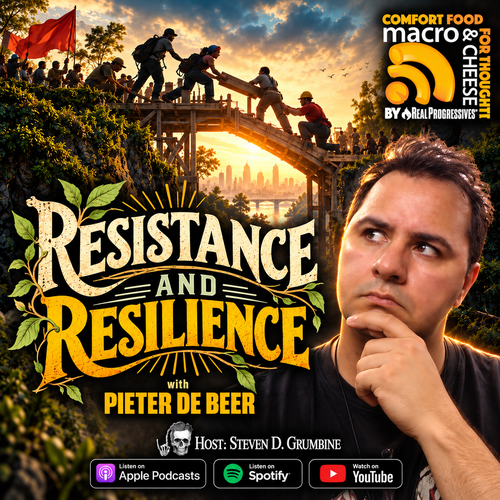
Episode 399 – Resistance and Resilience with Pieter de Beer
FOLLOW THE SHOW
If electoral politics isn’t the plan, what does building an alternative actually look like? An anarchist and a Marxist-Leninist get together to exchange ideas.
** Come to Macro ‘n Chill, our community-building online gathering & discussion group. Tuesday, October 6, at 8pm ET / 5pm PT. Register here: https://us06web.zoom.us/meeting/register/6VRb9hKDRB2_oCLzzEVquQ
If we reject electoral politics as a path to fundamental change, the inevitable question becomes: “So what’s the plan?” In this episode, Steve, a Leninist, is joined by Pieter de Beer, an anarchist, community organizer, and author of the Anarcasper Substack, to talk about dual power and building parallel, horizontal systems to aid working people in taking action.
Despite approaching the question from different traditions, Steve and Pieter find considerable common ground in the need for dual power, mutual aid, community resilience, and collective self-provisioning.
Pieter argues that cooperatives, tenant unions, mutual aid networks, community land trusts, and other alternatives already exist. The problem is that they remain isolated islands. The task is to connect them, coordinating resources and building the trust that an atomized capitalist society systematically erodes. Rather than waiting for political institutions to deliver change, communities can begin constructing networks capable of providing food, housing, healthcare, tools, and other necessities, strengthening their ability to struggle.
Steve and Pieter also discuss:
- why strikes collapse when workers have no material backstop
- “permeable selfhood” and participation as its own reward
- tool libraries and mutual credit
- how “awakening” without community can curdle into conspiracism
For Pieter, the starting point is clear: show up, help people, build trust, connect organizations, and turn isolated acts of solidarity into durable social power.
Pieter de Beer, known online as Anarcasper, is a community organizer in the Middle East. He is currently part of several mutual aid and direct-action anarchist affinity groups, and has been doing mutual aid for 28 years, across a multitude of countries.
Find Pieter at https://substack.com/@anarcasper
[00:00:42] Steve Grumbine: Alright folks, this is Steve with Macro N Cheese. I am going to answer a question that has caused everyone major pain. I’m going to call it labor pains of sorts because it’s so painful to birth an idea. It is almost impossible for people when they are, I believe the term I would like to use is culturally hegemonically kind of informed.
They believe the things that they’ve been told because the state has said so, because the television has said so, because their education in elementary school, middle school, high school, college has told them so. They go to work every day. They get the same messaging reinforced because that is the way messaging works in a hegemonic state, right? Capitalism, which we live in,
has created some things that are just truisms we just accept them and we don’t think twice. Elections we just assume we naturally are going to get what we want because we voted and therefore we put an “I voted ” sticker on our forehead and we just think hey it’s going to happen and when it doesn’t happen we’re all moribund we’re all sad we’re “what happened?” “they sold out…” whatever, and i’m here to tell you. every time I break this down, every time I show someone the Gilens and Page study, which everybody’s starting a drinking game over, and rightfully so, because I say it as much as I possibly can, okay?
With that, though, the rejoinder, the constant question I get back is, “So, Steve, what’s your plan, man? So, what’s your plan?” And I’m like, gosh, if you’d paid attention to me, I mean, you want to critique me for my plan, well, you should be following me to find out what my plan is. People, you know, they want to have a transaction.
They want to, “what’s your plan?” Well, I’ve been talking about it. I’ve been saying, we’ve got to create dual power. We’ve got to create what I call parallel systems. Others call horizontal systems. Same difference. At the end of the day, we need to build resiliency in people. And I take this back to my time in the unions.
I used to be in the local CWA 2222 with Verizon and Bell Atlantic back in the day. And the union would sit there and tell us, “Hey, you guys, we’re going to go on strike. We’re going to take a strike vote. We’re going to go on strike.” And people were befuddled, befuddled. Within a week of the strike going off, why people were crossing the picket line.
They just couldn’t fathom how somebody that needs to eat, needs to pay their mortgage, needs to be able to ensure their children are taken care of, why in the world would they cross the picket line? And the fact of the matter is, is that a $200 stipend each week or whatever isn’t paying the bills. And people, unless they have massive amounts of money saved up, they don’t have the ability to do that either.
And that right there is reproducing that it’s all on you. It’s all your fault. You’re the king of your future. You’re the reason you fail. You’re the reason you succeed. And so all this great man theory, this individualism, the capitalism and neoliberalism and all these isms breed into us. We reproduce that. We believe that’s just the way it is.
And so our life is just completely and utterly shaped by these thoughts. And so I have been saying, look, we don’t live in a democracy. Capitalism cannot be voted away. The very things you detest are inherent to the system. And then I get the constant, “well, what’s your plan, Steve? What do you want, a violent revolution? What do you want?
You know, you’re just not going to vote?” You know, some ridiculous tropism because they can’t imagine doing anything other than being a good obedient person and they follow what they think is the good common sense of the day and unfortunately it’s just not so. And so today I brought on a friend, an organizer, a community organizer, someone who looks to build resiliency in communities.
Someone who does not necessarily share my political or my entire theoretical framework, but shares probably a lot more of my framework than most people that think they’re going to vote their way to freedom think, okay? So Pieter de Beer, who runs the great anarchist Substack, Anarcasper, is joining me today. And I want to say this before I bring him on.
Pieter takes great joy in watching guys like me who will take the claim of being Marxist-Leninists and follow an anarchist. And the reason is because we share a critique of capitalism. We share a critique of the state. We share a critique of the necessities of getting people to be resilient, to resist the state. And by resist the state, I’m not talking crazy stuff here.
I’m talking about you watched a genocide occurring in Gaza for years and had nothing you could do about it. We saw so many people valiantly trying to resist going to the campuses and doing what they could. And what happened? The state cracked down on them, destroyed them, tried to go after people, literally took away their tenure, took away their scholarships, kicked them out of school, you name it.
So we need to be very, very clear in what I’m talking about. We are talking about the very things that every one of us in the coffee shop talk about and every one of us that talk to our families talk about. We want people, us, to have a say in what goes on in our world. And under capitalism, under the system that we have, as long as we follow the rules that they’ve given us, we have no real say.
It is a false promise. So I’ve been asked, what’s your plan, Steve? And I’m going to talk about dual power and building horizontal/parallel systems today with my guest Pieter de Beer. Pieter, welcome to the show and thank you for listening to that.
[00:06:55] Pieter de Beer: Hey, Steve. It was wonderful to listen to. It’s a very lucid understanding of the problems we face today.
[00:07:05] Steve Grumbine: So, you know, let’s get the elephant out of the room here. You’re an anarchist. I’m a Marxist-Leninist. I’m an MMT-er. There’s a lot of things here, a lot of identities. You know, I hate to call them identities, but there are a lot of ways in which we see ourselves. But one of the things that really drew me to you is the fact that you are lucid, as you said, about the state and you are very lucid about the ideas and the necessities of building resiliency within society so that they do have the ability, the strength, the education, etc.
to resist what is ultimately tyranny. I hate that word because it sounds so dramatic, but isn’t it real, though? I mean, I fundamentally see people that just can’t fathom that their vote didn’t get them what they thought they would get. And I’m interested, what is your critique of the state? How do you see the current world order?
And what do you think of the system at which it rides on?
[00:08:08] Pieter de Beer: Okay, so that’s an interesting starting point. Obviously, I am an anarchist. I’ve been an anarchist since I first read The Ecology of Freedom by Murray Bookchin when I was 12. And I’ve spent the majority of my life not just reading theory, but living the praxis, getting involved in community, doing mutual aid work, essentially getting stuck in. And the result of many years of working within communities is that I see the state, and capitalism by extension, slightly differently to how it is commonly portrayed.
I view the state not as an entity. When I talk about the state, I’m not talking about the government. I’m talking about an underlying pattern of social relations that is geared towards control.
So, the shorthand for that is to say that for me, the state is a pattern of control. And as part of that, I then view capitalism as a particular configuration of the state. This leads to the conclusion that when we’re fighting capitalism, when we’re resisting capitalism, when we’re struggling against capitalist oppression, we are necessarily resisting the state.
We are resisting that underlying pattern of control. But because it’s not an entity, I’m not simply opposed to the government. I’m not simply opposed to corporations. I’m opposed to this idea of the need to control society. A good friend of mine put it in the best way ever, and he’s repeated it so many times throughout his life, that if you don’t trust people to manage their own lives, are you suggesting that we have people elected to govern our lives?
That we give over our labor and our money to people who will make decisions about our lives? Because they’re people too. And so you’ve got this recurring loop of control that underpins everything. That’s just an aside so that when I talk about the state, when I talk about capitalism, I’m not talking about the government. I’m not just talking about corporations.
Obviously, I view the government and corporations as subordinate to the same logic of control and very much crystallizations and manifestations of this logic of control. But it does mean that what we’re actually fighting is something a little bit more abstract than the concrete actions of a corporation or a police force or a military. We’re fighting against the way that people relate to each other.
[00:11:24] Steve Grumbine: Very, very cool.
[00:11:26] Pieter de Beer: Yeah, that’s essentially what my point comes down to when I say that I define the state differently. I oppose the state because I oppose the way, it’s like you said in your introduction, people are essentially, they want freedom, but how they get that freedom is by being good, law-abiding capitalist workers. And that can’t get you the freedom that you want because what you’re doing is you’re reproducing the social relations of capitalism.
[00:11:58] Steve Grumbine: Yes. So let’s go to the next part of this because I think that the real meat on the bone here is currently, right, wrong, or indifferent, people are expecting certain outcomes. They’re expecting, you know, by going along that they will get everything in the world that they want. That things will be hunky dory if they just phone bank enough, if they just door knock enough, if they just vote hard enough, they will suddenly get these things.
And I think history has shown us that when major changes happen, even within the state as it is put together today, the apparatus, the ideas, et cetera, that make that power relation up, it only gives when the people make life unbearable to not change. You know, I’ve often talked about the great overreaction when the Bolsheviks won their revolution in Russia in 1917. I oftentimes talk about how the capital order was like, “Oh, my God, what do we do?”
And you could see that in the behavior of FDR, who his purpose was not to make the people better, was to maintain the capital order, to maintain society as it was. He made concessions because without making those concessions, the very real possibility of, you know, anarchists and communists coming together and bringing about a new order was right there.
They had seen a blueprint across the pond. They had seen working class people, rightly or wrongly, however you frame it, do something different. Do something other than what was told to them was possible. And that very awakening, I think, created a fear. And you look at the civil rights movement, I would say that a lot of things that came from that were very, very positive.
But I would also say a lot of them were placebos. It’s like, hey, now you get to be a good capitalist too. Now we’re going to give you an opportunity to create a PMC, [professional managerial class] a bourgeois of your own reflection, your own identity, you know, and it didn’t fundamentally change power dynamics. It just gave a different face to the exact same system.
But people rising up, organizing, creating, making demands, that’s not adequate, but that is as close to watching this system capitulate in any way to the needs of the people. It never starts at the ballot box. It never starts from a political campaign. Even with the rise of Bernie Sanders we haven’t seen any change to the left at all, any change to make people’s lives better. We have seen a massive rightward shift, not just in the United States but in the world as a whole.
What are your thoughts in terms of how that relationship can be undermined by building resilience?
[00:15:16] Pieter de Beer: So when I first started writing about this about three years ago, I went through a short phase of not being able to get involved with my mutual aid groups, with some of the direct action groups that I was involved with for reasons that I can’t really get into. But, I had a space of about six months where I was locked out of my ability to organize community.
And so I wanted to write about it. And for those who already follow some of my writing, I am informed by but don’t wholeheartedly agree with the work of Jonathan Nitzan and Shimshon Bichler, who wrote Capital as Power, in which they analyze empirically capitalism not as the ownership of the means of production and not the neoclassical utilitarianism, but instead viewing capital as finance so that they reach the conclusion that capital is power.
And when they say power, they mean the ability to have a sense of confidence in the obedience of the labor force, of consumers, of suppliers, of the entire market and state that goes with it. And so in my downtime, I had a bit of time to think about all of this and how it related to me. And I realized then that if what you want to do is you want to undermine capitalism and the capitalist relations, then you have to look at what it is that is actually being capitalized.
The way that it actually works, like this is something not a lot of people look into because finance is boring and unless you’re making money out of it, no one pays attention to it. But the way that corporations finance and evaluate their value, in other words, calculate their power, is what used to be called the DCF. It’s discounted cash flow.
These days, I think it’s called DCAM. [data management capability assessment model] But regardless, it’s basically a method by which you take a given period of time. It’s usually around three to five years.
You do a forecast of how much revenue you’re going to bring in within those five years and you have a discount rate that’s usually quite similar to the interest rate and you discount the total revenue over that five-year period back to the present value adjusted for risk factors and divide that by the number of shares in your company and you then have a valuation for how reliable your ability over the next five years is to ensure that workers are going to enact your will, that the consumers are going to continue buying.
And there’s variables that fit into this. The consumer is also looking at your competitors. So one of the risk factors that you calculate in when you’re calculating your own value is you look at how consolidated is the market. You will look at government regulations of your industry, you will look at wage relations, and all of that gets calculated in.
So, if we as a community decide that we are going to decapitalize our communities by self-provisioning, this does something to the capitalist state. In essence, if I provide food for everyone in a community, and I provide housing for everyone. And by I, I’m referring to the community. If the community is self-provisioning food and electricity and housing and clothing, then there’s no incentive to go and join a corporation.
Because the only thing the corporation is giving you is the means by which to reproduce your own life. So this idea started percolating back then that what we need is to decapitalize. And the only way that we can decapitalize is by building resilient communities. Now, this isn’t something that has to be started from scratch. If you look just in the US, okay, just in the US, there are at present, I think, 1,300 or 1,400 worker cooperatives that are registered and functioning with active membership and that perform their functions.
There are hundreds, if not thousands, of mutual aid groups. There are tenant unions. There are all of these collectives that are doing things in a way that is alternative to what capitalism is offering them. But there’s a problem, right? The reason that all of these systems are not resulting in any kind of change is that they’re disconnected.
We seem to have, as a society, become fantastic at building islands, but not that good at building the boats and the bridges that connect them.
And this is where I have been theorizing for the last three years- is what is it about these organizations that sets them up so that they work in isolation only. And a lot of it is actually, it turns out, just a lack of doing so. There’s nothing systemic preventing two worker cooperatives from connecting with each other and asking each other, “Look, I have these excess resources.
Do you need any? And we’re short of these things. Do you have them for us?” There’s nothing preventing these organizations from interconnecting other than just doing it. And this leads us to the real problem. And the real problem, as it turns out, in my opinion, obviously I’m not going to make broad claims about what’s really going on in the world.
But in my opinion, the problem is trust. You know, when you’re talking about people campaigning, people participating in the electoral system, people going back to the job that they hate because they need to make ends meet, the only reason that they do this is because they don’t trust their next-door neighbor to have their back. They don’t trust that their little worker cooperative can work with another worker cooperative and a mutual aid group and so what you end up with is islands.
All of these disparate islands that are not properly connected. And so that’s what I think is the actual underlying problem of how we have structured our society and more specifically our resistance to capitalism is disconnection.
[00:23:06] Steve Grumbine: You know it’s funny you say that I’m gonna take an abstraction I live in the abstract. The idea of something as simple as social media you know instead of people saying, “Ah this is things that I’m interested in that they’ve taken the time to build this thing let me help put some air under it and share it and get it out there so that others can hear this as well”, it’s like bystander syndrome it’s like hey I you know “well, will they share my thing?”
There’s like a weird kind of non-trust. You expect camaraderie, you expect mutualism, you expect a cooperative of sorts, but that is a… it’s a hope. That’s not a reality. And when you see this at a local level, the idea of somebody who has things saying, “Well, hey, wait a minute, you know, if I share, what’s to say someone’s going to share back with me?”
A friend of mine, a friend of the program, Brett Scott, did a episode with us a while back called Mutual Credit and talked about how, you know, maybe in a community everybody’s not going to need a bicycle that day, but everybody will need a bicycle at some point during the month. So why not have a few of them for the community to share as opposed to everybody needing to have a bicycle?
And it was just an example, right? Like it could be tools. It could be, hey, everybody’s not cutting down a tree today, but everybody’s going to need to cut a tree down. So let’s have a shared chainsaw that the community can share. Anyway, just it was coming to mind as you were speaking there.
[00:24:53] Pieter de Beer: I mean, the mutual credit thing is very interesting. Do you know, this is a bit of an arbitrary example, but do you know how much use the average drill gets per year? [No idea]. Okay, so it’s eight minutes. There was, I can’t remember the name of the study, but I read it about three or four years ago.
Some guys went around and they basically polled homeowners and companies and all sorts and from about 5,000 respondents in an area and then they replicated this in another region and they found that the average was eight minutes. And we can apply this to just about everything. This is where the idea of tool libraries come in handy, right?
The idea that we don’t need to be producing eight billion drills in order to ensure that everyone has access to a drill when they need it. We just need like 5 or 6 per community and then we need to communicate with each other about when we need them. We need to be able to schedule things and we need to coordinate.
And this is the vast amount of the theory that I’ve been building in the last three years is this idea that coordination is where we as normal average human beings day-to-day, coordination is where we get our power.
[00:26:22] Steve Grumbine: You know running a nonprofit okay, is interesting because let’s say you have and I’m gonna just play with round numbers here let’s say you have a hundred people in the organization that are going to be pulling in the same direction. History shows me that there’s probably five people doing the lion’s share of the work [sure] and the other 95% are casuals.
They fancy themselves doing it their own way, but in order to keep the lights on, in order to keep the gears turning, there’s five people that probably are killing themselves to make everything else happen. And I think that that concept, that framework, creates a lot of bitterness, creates a lot of distrust, and creates a lot of, you know, animus actually, right?
To make it funny, there’s this movie clip from an old movie called Old School. Very, very funny, silly, old school movie. And there’s this guy, Hank the Tank. Will Ferrell plays him. And he’s drunk and he’s at this big, you know, party. And he’s like, “Come on, everybody, we’re going streaking through the quad.” And he starts running and looks back behind him and realizes nobody’s with him
and his wife drives up behind him. And’s like, “What are you doing?” He goes, “We’re all streaking through the quad.” She goes, “Who’s we all?” There’s nobody behind them. He’s like, get in the car. Anyway, the point is that I think a lot of times people just assume, hey, we’re all on the same page. We all agree.
We all believe. And then that shared sense of responsibility is lost. People don’t do the work. People don’t show up. People don’t let you know they’re not going to come around. People do these things. And I have not found the antidote to that yet. It’s always, ” Well, you gotta make it enticing., you gotta do this…” Well, what about everybody’s shared mutual interest? Isn’t that enticement enough? It’s like clearly not.
So what is your thoughts on that? Because you’re dealing with a society of billions of people, millions of people in local communities and so forth. And the idea that the lion’s share of not only the coordination, but this, that, and the other tends to naturally devolve into small spheres of unintended, unelected power. Power dynamics, because I know that the framing of from each their ability to each their own need or something to that effect, I butchered that quote, but you get the point.
How in the world do we make heads or tails of that in this kind of self-provisioning community-mindedness, when in fact the bulk of the work tends to fall to a very, very small number of people?
[00:29:19] Pieter de Beer: Okay, so there are three points to this that might not seem wholly related, but I’m hoping that you’ll see the connection between them. [Sure] First of all, in China there is no such thing as social loafing, which is the phenomenon that you’ve been describing. And we’ve all experienced social loafing when you’re doing a group project and one person isn’t pulling their weight and everybody else then has to pick up the slack.
We’ve experienced it and yes, it’s absolutely frustrating and it creates this feeling of resentment. But it turns out that this is not a thing that they’ve had to deal with in China. And that suggests that it’s a cultural problem. That there’s something about Western, atomized individualism that leads people to this conclusion that they a) don’t have to participate that other people can pick up the slack for them and b) that if someone doesn’t perform we need to do more from our individual selves we have to give more because the task still needs to be done and it comes down to the social, the collective understanding of the individual and the atomized understanding of the individual. Which brings me to the second point. And that is that my friend, who I was mentioning earlier, has this philosophy of “I don’t care if you’re not participating, if you’re being lazy, if you are social loathing, I don’t care.
And the reason I don’t care is because I’m not doing the work that I’m doing in spite of you. I’m doing it for you. I understand that maybe you’re lazy today because you had a rough night last night.
Maybe you’re lazy today because your heart just isn’t in it. Maybe you’re lazy because you don’t enjoy the task. But there are other things that you do do that will benefit me in the long run. And so It all kind of evens out if we look at the bigger picture, but this can’t really work when we have an individualist mindset that looks at what do I get back from this, and I don’t really care about the rest of society and how they’re functioning.”
And then the last part is going to be about how I have experienced the entire mutual aid milieu over the last 28 years when people are working together towards helping each other when they are cooperating towards helping each other and the end goal is the benefit of the community, of the group and not the end goal of achieving some grade or finishing a project for the boss so that he can look good to his superiors or working together on a project that will ultimately be superseded by the government retracting funding or whatever the case may be.
The moment that the end goal is itself the embetterment of the community, suddenly social loafing sort of withers away. It becomes this non-issue where the moment that someone isn’t participating, instead of taking them to task, or instead of just ignoring the problem and doing more work, people go up to each other and try to find out, is everything okay?
Are you okay? Is something going on with you that you need additional help with? And nine times out of ten, that’s actually been what’s going on. Someone has lost a loved one overnight, or they are distracted by a rent payment that is running late or they didn’t get enough food that morning. There’s usually these problems that people face and are not comfortable telling everyone about because they feel like it’s some kind of failing of their own.
But once you’re in community, that sort of, it sort of goes away. I’m not saying that people don’t have laziness. I’m saying it becomes less of an issue. Does that answer your question?
[00:33:49] Steve Grumbine: Absolutely man, you know again it’s very hard because we are atomized. We do live in a neoliberal world the material reality of our existence today which is the genesis for all the needed conversations that we’re having is a critique of the world that we live in and the system that governs us the system that sort of dominates and reproduces these very very individualist, your success, your failures are all on you.
It’s reproduced even in these kinds of scenarios which don’t take into consideration that, hey, yeah, you know, you’re really good at working with technology or yeah, you’re really good at thinking through problems or whatever. But, you know, you had some advantages perhaps within this current system that gave you skills and stuff that can be used for the betterment for the mission.
And you know everybody doesn’t necessarily have those same skills and so forth so I’m going to say something more opinion than fact but like don’t withhold your services just because somebody else isn’t doing their job. You know like the object here is to do the job because that’s how we will build the resiliency that will enable the community to fight back and to even see the possibilities.
Am I close to right there?
[00:35:14] Pieter de Beer: You’re absolutely spot on. Absolutely. My wife has on many occasions asked me why I continue to go to… We have this one neighbor who is just… They’re just the worst. They complain about absolutely everything. They are struggling for the last four or five months. They haven’t been able to get a job. And here in [from] the Middle East…
If you’re here from another country, you have to be on an employer’s visa or you can pay out of pocket for what used to be called a flexi visa, which means you can stay in the country, but you have to keep paying. And it’s not the cheapest thing, especially if you don’t have work. So they haven’t had a job for like four months now and they’re miserable people.
The husband and wife, they’re extremely difficult. And nothing you ever do for them is good enough. Nothing. Like the food you bring them, this is not the kind of rice they like to eat. You bring them some fresh clothing, there’s a hole here on the side. Constant complaints. And my wife has asked me several times now why I insist on going back and helping them again and again when they’re so ungrateful.
My response to them is simple. I don’t help them because of who they are. I help them because of who I am. And not doing that would mean I’m not being true to who I am, true to what I believe and what I feel. So I’m with you 100% on that.
[00:36:58] Intermission: You are listening to Macro N Cheese, a podcast by Real Progressives. We are a 501c3 nonprofit organization. All donations are tax deductible. Please consider becoming a monthly donor on Patreon, Substack, or our website, realprogressives.org. Now back to the podcast.
[00:37:20] Steve Grumbine: This is where it gets dicey, right? Because the identitarian individual, a lot of this is overly individualized. And I think that this has always been a challenge in working. together. Because first of all, we start from an atomized state within this neoliberal world. And I think all of us at this point have existed the majority of our lives, if not all of our lives, in a neoliberal state, in a state of neocolonialism, neoliberalism, etc.
And, you know, obviously coming from a different perspective, as a Marxist-Leninist, I have a critique of that. But what I would like to focus more heavily on right now is the various types of community building resiliency that we can do. And what I would lay out there as part of the parallel systems, as part of a here’s what we can do now.
You’re not going to think about any of this stuff. All this stuff is going to feel like pie in the sky until you recognize you can’t vote your way out. You’re going to always continue to go back to the well. But within this, I’m thinking to myself, obviously, we know about mutual aid. I want to talk about that.
I had this weird idea. And I don’t know, it doesn’t sound so weird. It just sounds like I used a different term than what you were using. And that is, I used to say a network of hostels. If you think of hostels throughout Europe and so forth, in South America, hostels are kind of how people get around.
But imagine if people had the ability to know that there would always be a roof over their heads, regardless of what the capitalist state does to them, regardless what occurs, that there would be a means of providing housing. And I just called that a network of hostels, right? We can… do these things, I mean it comes down to like media. I’ve got this one guy that’s constantly coming at me saying “We need to create a public commons media” and it’s like “Yeah, how do you do that? I mean the infrastructure and all that stuff if you’re looking at official channels they’re never going to allow that because that right there in and of itself takes a part of their power away that is a part of the power dynamic is the ability to control the message. So how do you build a commons? I think that that might be a challenge unless it’s in a future state, a future state as in like a phase, not a state as in another re-creation.
But within that space, you know, there’s a lot of neat ideas, but they can’t be done as a public commons. They have to be done more localized, at least to start. Like, help me understand the different flavors of community resilience building. Let’s talk about mutual aid, but let’s go beyond mutual aid. What is the framework of breaking free look like?
What would that look like in terms of medical, in terms of food, in terms of all these different means of producing resiliency?
[00:40:26] Pieter de Beer: So, let’s start with your network of hostels, right? This is actually, it’s a big misconception that I’ve come across again and again and again. We don’t really need to start from scratch. A lot of what we need in order to build resilient communities and to build this prefigurative society that eventually gives us the means for dual power, a lot of that already exists.
In the US, you have… the legal frameworks for what’s known as community land trusts. Have you heard of these before? [I have.] Okay. So once you’ve got a community land trust, once a community has established that they’ve got a trust from which they can purchase land that then belongs to the community, they can then build, according to regulations, still kowtowing to the state, but…
with this alternative route and off-ramp starting, they can build a little bit of housing that they can allocate towards a network of hostels. Another community has a similar land trust and builds another set of hostels that they can contribute towards the network. And you replicate this again and again and again across communities. And this same principle gets applied
to every area. You can do this with food in the form of consumer cooperatives and producer cooperatives. You can do it with textiles. You can do it with healthcare. There are so many healthcare cooperatives in the United States. The trick here is not that we need to start from scratch. The trick is connecting everything. The trick is coordinating everything.
And this is the real challenge because, man, everybody, when you start talking, and I know this because it’s what I write about predominantly, when you start talking to people about coordination, their idea of coordination is always someone sitting at the top delegating tasks to everyone else. That’s the general idea of what coordination is. But that’s not at all what coordination is.
Coordination is… one of the broadest fields of study that we’ve ever had as a society. It goes from biology to sociology to economics to technology systems to data infrastructure. Everything requires coordination. And it’s there that we need to really be having the discussion about what we do next.
[00:43:21] Steve Grumbine: I want to throw this out there. You know, I’m a project manager by trade. Another thing, folks that play the drinking game, here’s an opportunity to drink. I, as a project manager, one of the things that I started with was this kind of like big requirements up front, kind of like hierarchical in a left to right fashion on the timeline and so forth.
However, I did become certified in something called Agile or Scrum. And Scrum is a somewhat of a leader-less environment where you could say you have a stack rank thing of necessities that need to be accomplished. And the team goes ahead and prioritizes them. There is a Scrum master, but the Scrum master is merely a cheerleader to help keep the team moving forward.
It’s not really someone with power to discipline and things like that. The team, the development team, as they call it in software, works together to achieve these things that the team has determined are in priority order. So there’s a natural flow of getting things done collectively and not with that massive hierarchy over top of it. I find, unfortunately, a lot of people are disinterested in that as well, which is très bizarre to me.
But the reality is, is that of all the kinds of systems that we can forklift and take out of other places and reproduce in different ways that provide us with a runway. I even look at things like recovery for alcoholism and things like that. There are flows that start with certain steps that collectively produce a certain outcome.
And within that framework, I think people, without having, you know, respect to income or respect to education or respect to any kind of differences, it enables all to succeed, to pull together and to build that kind of community bond that, “Hey, am I my brother’s keeper?” Yes, you are. Yes, we all are. And I think it’s a really, really powerful, and the bottom line is people are constantly backsliding there.
It’s not like I’m going to stop being sober just because somebody else went back out and did something stupid, right? We learn that doing the next right thing, right? Whatever that next right thing might be, I think is really, really powerful. And it’s weird because you and I, I think, share in this that at one level, we cannot atomize this again.
We can’t put this all on the individual to say, “Hey, this is all about you, you, you.” But there is a you component to participating and contributing your talents and resources to whatever mission you’re on. How do you balance the difference between individualism and collectivism? There’s trust. I think that was well established. And then there is the interconnection of those things.
Really, truly. I mean, I was reading an old article in The Guardian the other day about the mental illness and the isolation that neoliberalism has beset upon us, which makes us feel like everything’s our own fault and so forth. But there is an element there, I think, that needs to be ferreted out, but we don’t want to reproduce individualism in the sense that, you know, I’m about me, Imma get mine kind of thing.
How do you do that? I mean, like, it’s not. It may be natural in China, but it clearly was not socialized that way into us here in the West. How do you overcome the hegemony of thought there?
[00:47:08] Pieter de Beer: Okay, so obviously I’m in the Middle East and a lot of the people that I work with are Asian. And so I’ve got a kind of weird relationship to all of this. One of the girls that… And I say girl, she was 14 at the time. Very involved in cooking for one of the mutual aid groups. She introduced us to this idea that I have since come to call permeable selfhood.
Now, this kind of bridges the gap between the connective and the individual. In that, it says… There is not really such a thing as an individual. You are not a self into and of yourself that is in isolation. Most of your decisions are made by your gut bacteria. Your education is the result of thousands of years of human learning sort of intertwining into what you believe today.
The systems around you are what keep you supported and able to reproduce your own survival. So there is no such thing as the self. But obviously we need to be able to close ourselves off from those things around us that can cause us trauma. It would be monstrous to take the victim of sexual abuse and tell them that they don’t exist as an individual and they must integrate into the collective.
They’ve already had an attack on their individual self. And so the middle ground is this idea that we should be able to open ourselves up and close ourselves off when dealing with the understanding of what and who we are within the collective. The way that we apply this in the mutual aid groups is unspoken, so it’s kind of difficult to articulate clearly.
When one person contributes, there is no reward for that other than the participation in the whole. When one person doesn’t contribute, there is no discipline for that. Instead, there is participation in the whole. And this idea that you are able to engage or disengage without the fear of discipline and without the incentive structure that doesn’t necessarily match your expectations means that I would say 99% of everyone that’s ever participated in our mutual aid groups always feels like they are part of the group.
They are given tasks that match their skill set, but that also challenge them. Because we never have two days that are the same in mutual aid work. And so there’s this constant idea of I am contributing, but it’s not for my own aggrandizement. I’m not participating so that I can earn something back. I’m participating because participation is its own reward.
[00:50:46] Steve Grumbine: Wow, I love that. You know what? I want to piggyback on that real quickly, right? [Yeah] We’ve been doing what we do here for a long time. We started this place back in 2015. And there’s very little financial reward, so to speak. It doesn’t really produce that. We barely have enough money coming in to keep the lights on.
But with that said, every time somebody sends me a message that, “Hey, I’m really thankful for that podcast. Thank you, Steve, for doing that.” And it’s like, “Hey, we got a whole team that produced this thing.” I think to myself, I feel great, but I feel responsible too. I don’t know if that is the right feeling, but it is what I feel.
I feel a tremendous amount of responsibility, even though my own personal life may be difficult. I may be struggling in different ways. I may risk myself in certain ways. This is an odd time of the day for me to be doing the recording. And for those who don’t know, I mean, obviously when we’re recording with international guests.
I make myself available according to their schedule. And we’re up early. I mean, this is kind of the normal time for me to work. But the idea of shifting that because I feel like this conversation was too important not to do. I mean, there’s no reward at the end of this. There’s not somebody that’s necessarily going to pat me on the back.
But at the same time, knowing that the information that we’re providing is helping people understand the world better and perhaps help build to a place where they begin to see the need to do the things that we’re talking about, to begin to understand the material that we’re putting out there. I feel like education is really important to helping people overcome some of the bystander syndrome, the imposter syndrome, the nothing’s going to really come from this syndrome.
And to me, in and of itself, I do feel that burden. It’s a burden, but I wouldn’t stop because I feel like it’s important. Is that kind of the intrinsic reward that you’re speaking of in the sense that, you know, okay, so maybe we don’t have enough people that listen. Maybe most of the people that listen don’t bother to share it on social media, which breaks my heart, whatever. There is a feeling of, I know this is necessary.
I know I wouldn’t feel right if I didn’t get this information out. And so I do it for that purpose, if nothing else. Is that what we’re talking about, or am I missing this?
[00:53:26] Pieter de Beer: You are absolutely spot on. I have long believed that I just need to help one person. One person. That’s all it takes. If I’m not helping anybody, then I’m probably not doing it. But as long as there’s one person that is improved, that is relieved, that is assisted in some way by what I’m doing, I’m going to keep doing what I’m doing.
[00:53:58] Steve Grumbine: That’s it. You know, there’s that saying, “We don’t fight fascists because we’ll win. We fight fascists because they’re fascists.”
It’s kind of, you know, there’s an element here of, hey, you know, it’s not like I’m doing this podcast because I believe that I’m going to get 350 billion people or however many billion people to listen. It’s because if we get anybody to listen and they’re changed and moved by this and something we unwedge a block that enables change to occur, I would call that successful.
I mean, it’s sometimes difficult to do that because in my mind, I want to reproduce people that have this awakening. I call it an awakening. You and I, I mean, I know just by reading your work, Pieter, that, you know, you’re a well-read man. We may not have come to every conclusion the same, but I know that you have endeavored to learn.
And learning is really important. I really do believe. But out of learning. I believe there is what I call awakenings, right? It’s like, okay, I’ve got all this head knowledge, great, but I’m just living my life anyway. I’m just doing a thing. It’s when that knowledge goes from being knowledge into praxis. It goes into an awakening, as I call it, where I’ve connected that this is not just some fiction novel I’ve read.
I’m bringing this to life. I’m taking the material conditions of my day. and I’m doing something with them. What are your thoughts on the difference between education and awakenings?
[00:55:39] Pieter de Beer: So I think that education, obviously, the idea of expanding what you know, it’s vital to anything that we do. But there’s a difference between education being handed down to you from above and education that awakens things within you. I don’t know if you’re aware of this must have been now about 20 years ago… 15 years ago something like that there was uh something called the Zeitgeist Movement [yes] Peter Joseph and the Zeitgeist Movement [yeah] it’s a prime example of what happens when you give people an awakening but there’s nothing for them to turn to. There’s nothing for them to do.
There’s no community for them to get involved with to build resistance to neoliberal capitalism. And, like, the Zeitgeist Movement is still going to this day. I checked up on them a few months ago, and what it has become is a very niche group of anti-Semitic conspiracy theorists that have just gone completely off the rail [yep] and this is unfortunately what happens when you tell people that they’re in trouble, right? You tell someone you are in a boat there’s a hole in the boat, the boat is sinking and they’re going “I don’t know how to swim” and instead of teaching them how to swim, instead of fashioning life rafts together, instead of figuring out ways to keep everybody afloat as you make your way to shore, you abandon them.
You jump off the boat, you’re able to swim, but you leave them to drown. And what they’ll do eventually is everyone else in the boat with them that can’t swim is going to get dragged under and they’re all going to drown together.
And this is why I love education. I love awakenings. But I feel like there’s been a lot of cultural awakening without the material backing that it requires. And what it requires is that people actually put down the phone, switch off the laptop, switch off the TV, go out and meet your neighbors. Ask around until you find out which one of them needs and help them see to their needs.
And when you do that, and you do it again and you do it again, by the third or fourth time, you’ve started building trust. That person trusts you enough that they are going to come to your house and say, “Do you need anything?” And the next door neighbor that nobody had any idea was having a problem, they’re going to come out and say, “I need some help with something.
I see you people helping each other and I need help.” And they will get help. And in this way, you build trust. And the same thing applies to organizations and affinity groups and cooperatives that need to learn to communicate together and coordinate together. They need to build trust. And the way that you build trust is by showing up, getting involved, and showing up.
That’s it. I mean, people want the secret to revolution. That’s the secret, is show up and get stuck in.
[00:59:19] Steve Grumbine: Buddy, let me tell you something, man. This is like, I have so much to say, because you’re my guest, I’m going to say less, but I want you to know how music to my ears that last statement was. We had Breht O’Shea, who is a Marxist-Leninist, not an anarchist, literally say exactly what you just said, okay? I want you to be aware.
He said exactly what you just said. So we’ve got an anarchist. We’ve got a Marxist Leninist saying the exact same thing. And we are our organization is not a localized organization. We have people in California. We have people in Connecticut. We have people in Kalamazoo. We have people in Florida. We have people all over the country. And we meet as a
collective virtually, because that’s how we can meet. And within that space, it’s the same thing. It’s like, can you check in? Can you show up? Can you find out if somebody needs help? Can you just ask, even if you, you know, and this is the framework, right? When I think about, you know, I know some people have problems with it.
I obviously don’t. And that is Alcoholics Anonymous. One of the keys to that is to carry the message. to those still suffering inside and outside of the rooms, and to work together and build the trust and create sponsors to help people to work together. I have a friend who lives about 40 minutes away from me that whenever I need help, he’s right there.
We’ve built a trust. He’s somebody I met when I sold a tractor online one time, and we’ve been fast friends ever since. I have a neighbor who helped me build something in my home and now he has he just was told he has about a year to live and he has ALS, you know watching people rally to make his life better and to help with that and me being a small part of that as his neighbor being able to help as well, I mean it really does come down to actually doing, right, take that knowledge and go from knowledge to praxis.
And Vijay Prashad, who is another Marxist Leninist, he talked about this at length as well. Ali Kadri, who is a Middle Eastern Marxist scholar, said the same thing as well. This is the recurring theme and getting people to realize that, yeah, it’s great to have a great message. Yeah, it’s great to have proper propaganda, agitprop, all that good stuff.
Messaging is key, on and on and on. But it matters more that you show up, that you show up. That’s it. And you make sure other people know that you’re there so that they begin to build that trust. That’s how you build community. If you don’t do that, now locally, you can do it easier because you can see each other.
But in a virtual space, if you don’t show up, you’re not building community and you’re just building a bunch more education that doesn’t lead to praxis. Your final thoughts on this.
[01:02:28] Pieter de Beer: I think that for too long, there has been this schism between anarchists and Marxists and Leninists and Stalinists. The Stalinists, I still have my issues with. But I don’t think that we are working at cross-purposes. I think there are some ideological differences [sure] that might pop up later down the line, but we’re not there. We’re not there.
We’re living in a society that has become so atomized, so disenfranchised, so alienated, not just from the means of production, but from each other, that we have to get back to the basics of showing up. And when you show up and you do it consistently and you build trust and you start to build this idea of resilient community and you start
talking together and you’re figuring out ways for the community to begin self-provisioning, which then allows you to undermine capitalism and undermine the state, you’re also simultaneously building the means by which revolutionaries are sustained. People that want to go and fight capitalism on the front lines, they’re not going to do it if they don’t have a community that can support them as they do it.
And so the whole idea here is you’re not just building community because community is great. You’re also building community so that those who are adept at fighting back in the physical sense are able to do so. You’re doing it so that those who have been not just the most harmed by the system are included in the community, but everybody can be included in the community.
That those who used to be on the far right and have become disillusioned because Trump started another war, I don’t care about the politics that you come from. I want to give everybody a sense of community because I can tell you this much, right? The neo-Nazis, and the fascists and the conservatives and the liberals, the one thing that draws them all together into their little echo chamber groups is sense of community.
They feel like they belong to something bigger than themselves. And this has been shown time and time and time again, but I too often see people on the left arguing about theory when they’re not applying any of the theory in their lives. And if they did, if they got involved, if they showed up for their online community, their physical community, if they show up, they start to see that the niche ideologies that they’ve been arguing about online don’t really exist in the same way in the real world.
In the real world, we are all in this together. And we might argue eventually about, do we need a vanguard to protect the revolution? Or do we need to build prefigurative communities so resilient that the state withers away before there’s a seizure? That can come down the line. First, we need to actually band together and build our prefigurative community.
[01:06:12] Steve Grumbine: Man. I really like this. I mean, obviously me and you, I want everybody to know there are folks out there that you just want to know. Pieter is one of those people. I have appreciated his very, very thoughtful approach to things. We do not agree on everything, in it. I hope you hear that, you know, unlike Twitter, it is possible to talk to people you don’t agree with on every possible thing and build together and come together and…
And it’d be okay. You don’t have to cancel him or me or whatever. You have to pay attention to where we are right now. And we’re an atomized society that doesn’t have anything other than these political parties that lead us back to capitalism, that lead us back to all the predation that we decry. “How come we don’t have health care?
How come we don’t have that?” It’s not hard to understand how come you don’t have it. You’re not voting it in, unfortunately. And I wish I was wrong. I don’t say this sarcastically or cynically even. I see this system-wise. Systematically, you don’t have that power. You just don’t. And it’s empirical. And I’ve come to believe that people are not going to even consider the things we’re talking about as long as they continue to look at what I call kayfabe, the fake system belief that you’re going to somehow or another change it at the ballot box.
It’s all the other things that we have to do to bring that change about. And this program speaks frequently about Modern Monetary Theory. And for you socialists out there who don’t find it engaging or interesting, it’s about the material conditions, the material reality of today.
And so understanding the way that the state funds itself, understanding the way that these wars are paid for, understanding the way that they funnel massive funds directly into the oligarchs such as Elon Musk and others, once you understand how that works and you understand the state as it is, self-funding, that it does these things in spite of our will, in spite of our wishes.
And it spends all of its time and money trying to pre-configure our brains so that we accept this, starting in elementary school with a pledge of allegiance and everything else that they teach us to create a citizen that stays in between the lines, that doesn’t fight for their own good, and they just take it on the chin that they’re a failure.
I want you all to hear this because ultimately, what’s my plan? Well, my plan is to educate, yes. But on the flip side, to be a part of building that mesh, to be a part of building that network, that interconnectivity of struggles. And that’s why we bring in people that aren’t just MMTers or just Marxist-Leninists, because in the end, all these things, we’ll fight about those in a couple hundred years.
If we have a couple hundred years, if climate crisis, it doesn’t destroy us in the process. But we need each other today, and we need to strip away the duopoly-minded thinking. and start beginning to think as people, as a working class, to have an identity that doesn’t involve being a cog of this capitalist system. So, Pieter, with that, I want to thank you so much for joining me today.
Tell everybody where we can find your Substack and your work.
[01:09:42] Pieter de Beer: Thanks. Yeah, you can find me at anarcasper.substack.com. That’s anarcasper is with an E, not an A at the end. That’s it. I don’t really exist anywhere else online. Pulled out of Twitter and BlueSky and all the other places pretty early on.
[01:10:03] Steve Grumbine: Substack is a pretty amazing place. I mean, I try and talk people into coming over there because it’s one of the few places where there’s long form interaction with people. And it’s not just hot takes. It is thoughtful, thought provoking. I’m sure there’s some dumb, bad takes out there. But I mean, I’ve experienced quite a few. I try and throw a few pieces of chum into the water and see where it goes.
But in reality, it is a great place. And you do write long form stuff. And I find it to be very valuable because what I like about your writing, let me just say this at the end here, you acknowledge the difference and you understand that you have people like myself who would call themselves a Marxist-Leninist following you.
And I appreciate the follow back and I appreciate the exchanges and the conversations and, you know, with Erald [Kolasi] and others. I mean, there’s a little bit of a community there as well. I’m always looking forward to seeing what you’ve said next. I really appreciate it. Anyway, I’m going to take us out. I just really thank you for doing this.
Folks, my name is Steve Grumbine. I am the host of this podcast, Macro N Cheese, and the founder of the nonprofit Real Progressives, unfortunately titled, as you can tell. But with that, we are a 501c3 not-for-profit, and that means that we live and die on your donations. Those donations, for those of you who choose to donate are tax deductible.
So there’s a win there in this system that we have to operate within. Please consider becoming a monthly donor. You can go to our Substack, become a donor there. You can go to our website, realprogressives.org and become a monthly donor. Or you can go to patreon.com/realprogressives and become a one-time or a monthly donor.
We need your support. So please consider if you find the information that we put out valuable. We do a Tuesday night thing called Macro N Chill, which is a webinar where sometimes our guests may join us. And I know it’s late for you, but you’re welcome to join us, Pieter, when we have yours. But it’s 8 PM ET and 5 PM PT.
We listen to these interviews and discussions. And we break them up in 15-minute clips that has a read-along with the transcript so you can see and hear at the same time. And then listen to us as a community discussing these things. It’s really important. And for those of you out there who already know all this stuff and are already set, don’t think that you have to come to be educated.
Come to share your knowledge. That’s why we ask you to come. You know, you MMTers out there that understand ledgers and stuff like that, people need to hear your voice. Don’t be afraid to come. And that goes for everybody. We’d love to have you. And that’s on Tuesday nights, 5 PM PT, 8 PM ET. And with that, on behalf of my guest, Pieter de Beer, myself, Steve Grumbine, the podcast Macro N Cheese, we are out of here.
[01:13:12] End Credits: Production, transcripts, graphics, sound engineering, extras, and show notes for Macro N Cheese are done by our volunteer team at Real Progressives, serving in solidarity with the working class since 2015. To become a donor please go to patreon.com/realprogressives, realprogressives.substack.com, or realprogressives.org.
Extras links are included in the transcript.
Related Podcast Episodes
Related Articles

Why Didn’t the Chicken Cross the Road?
The Unseen Labor of Liberation



Leave a Comment
You must be logged in to post a comment.