
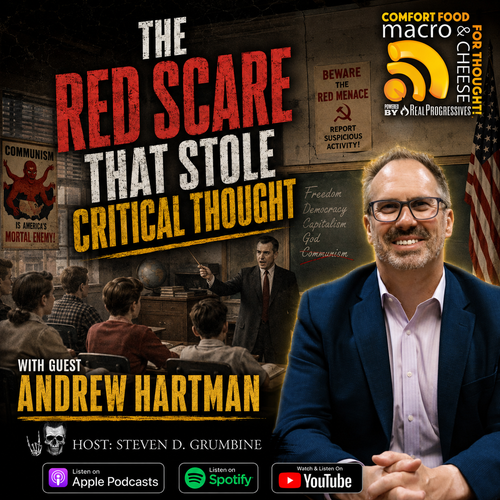
Episode 395 – The Red Scare That Stole Critical Thought with Andrew Hartman
FOLLOW THE SHOW
Should schools teach our kids to question and transform society, or train them to accept capitalism as the natural order? Historian Andrew Hartman joins Steve to explore how Cold War anti-communism turned American classrooms into an ideological battleground.
** Look forward to an exciting ‘Chill’ this week! Join our online gathering to discuss this podcast & build community. Tuesday, September 8th at 8pm ET/5 pm PT. Use this link to register: https://us06web.zoom.us/meeting/register/nFGkw4EfRUCv9EHxqCFFqg
They say the greatest trick the devil ever pulled was convincing the world he doesn’t exist. Capitalism pulled off something even trickier: convincing us it’s just the way things work.
Historian Andrew Hartman joins Steve to examine how American public education became a battleground in the struggle over class, ideology, and political consciousness. Drawing on his book Education and the Cold War: The Battle for the American School, Andrew traces how the radical possibilities of the 1930s, including militant teacher organizing and encouraging students to question capitalist individualism, were systematically narrowed by the Red Scare. Schools increasingly shifted toward preparing students to adapt to the existing order.
Steve and Andrew explore the crucial role of liberal anti-communism, the Cold War equating of capitalism with democracy and freedom, and an educational culture that treats capitalism as ordinary reality while Marxism and socialism must continually justify their existence. The result is a powerful look at cultural hegemony: how the boundaries of what Americans consider reasonable, possible, or even thinkable were constructed, and why so much of that Cold War ideological architecture remains with us today.
Andrew Hartman is a distinguished professor of history at Illinois State University and the author of several books, including Education and the Cold War: The Battle for the American School; A War for the Soul of America: A History of the Culture Wars; and Karl Marx in America, out in 2025 with the University of Chicago Press.
Steven Grumbine:
All right, folks, this is Steve with Macro N Cheese. You know, I talk a lot about hegemony on this program, cultural hegemony in particular in the reproduction of ruling class ideology and thinking.
And there’s probably nothing that screams cultural hegemony more than the Red Scare and the work that was done during the Cold War to brainwash us into despising Russia, to despising communism. And you can go back to the Ten Days That Shook the World, and you can look at the Bolshevik Revolution and think back to there.
And you can think back to World War II after, you know, the Soviet Union was able to crush Nazi Germany. You can think back even further.
I mean, the creation of the World Bank, the creation of the World Trade Organization, the creation of the IMF [International Monetary Fund], the Peace Corps, you name it.
There’s so many things that were done with the advent of trying to stave off any kind of socialist, communist organizing or uprising or any kind of feeling of love or interest in these things. And the US has been systematically attacking the concept of socialism, the concept of communism, the concept of Marxism for over a hundred years, okay?
And so my guest today, Andrew Hartman, he’s a distinguished professor of history at Illinois State University and the author of several books, including Education and the Cold War: The Battle for the American School. And that right there is a little bit of an older book. His most recent book was Karl Marx in America.
But we’re going to be talking about this Cold War battle over American education because it’s emblematic, if you will, of everything that we’ve been talking about. You didn’t come to these ideas on your own. These ideas weren’t something that were just, “Oh, it’s natural to despise socialism. It’s natural to despise
communism.” And, you know, the Cold War battle of American education was not simply a struggle between competing philosophies.
It was part of a broader struggle over the reproduction of capitalist social relations and the boundaries of permissible political consciousness. And I think it’s important to say that capitalism and capitalists are not the only thing here, right?
I think it’s important because when you look, Andrew’s book here which is phenomenal, demonstrates that teachers resisted, students resisted, progressives fought conservatives, liberals fought communists, communists organized, black activists challenged racial hierarchies.
Ultimately, there were so many things that were going on during this time that I think it’s really important for us to center them and situate them into the way we consider how we got to the knowledge we think we have today. So with that, let me bring on my guest, Andrew Hartman. Welcome to the show, sir.
Andrew Hartman:
Thank you, Steve. I’m excited to be here.
Steven Grumbine:
Well, this book, I know it’s not your most recent one, but I think that for a lot of people, this is really important stuff. It’s happening big time. I mean, currently out in the social media sphere and really coming straight out of the executive branch.
You’re hearing lots of crazy nonsense about communism and socialism and just all kinds of unhinged positions.
And I don’t really want to get caught up in the immediacy of the situation because I think that it’s like talking about, you know, something that happened one day, but in reality, the iceberg of history, all the stuff below the surface, has been going on for quite some time. And your book lays this out really, really well.
And I know it’s been a hot minute, but can you explain what your thoughts were as you created this book and what the point and purpose of this book was?
Andrew Hartman:
Sure, yeah. No, it’s fun to revisit this because it was an important time in my own intellectual development.
So prior to going to graduate school to earn a PhD in history, and this book was based upon my PhD dissertation, I taught high school for a couple of years, high school history and social studies.
And I was this kind of young firebrand radical teacher who thought that I was going to change the world, or at least the consciousness of my students in the way that I taught and the way that I kind of organized in the school.
And I was dismayed as a idealistic young radical at how difficult that was, at how the school administration and my fellow teachers and some parents were so incredibly resistant to what I thought was just common sense. You know, I was teaching as a radical and a socialist. I had by that point been sort of like Howard Zinn-ified and Noam Chomsky-ified.
And I, you know, I just, I thought that, like, teaching the students a different perspective on the nation’s history, teaching them the long storied tradition of civil disobedience would be a civic duty. The resistance that I caught for doing that took me by surprise, I have to admit. And so when I entered grad school,
one of my burning questions was like, how did we get here?
How did we get to the point where a teacher like me couldn’t just go into a basic working class public school in this nation and, you know, teach students ideas that were a bit different, a bit outside the mainstream? That kind of led me to the topic. And so I had this question. What are some of the historical origins of ideological conformity in the schools?
What are some of the origins of a deep seated anti-communism, anti-socialism, anti-Marxism, anti-anything that challenged capitalist hegemony? And in particular, what are the origins also of American exceptionalism with regards to the rest of the world and the nation’s foreign policy?
Those are kind of the burning questions I had going into grad school.
And so I chose my topic looking at the schools in the cold war, but more particularly development of ideology and politics around education from early 20th century Progressive Era on through to the 1960s. And what kinds of transformations happened and why.
Steven Grumbine:
So what exactly was being fought over? And why did education become so politically important? I think I know the answer.
I mean, bottom line is they need us to feel and believe a certain thing. They need to quote your Chomsky, they need to “manufacture consent.” Help me understand what they were battling over.
Andrew Hartman:
So it’s a complex story, but there’s a couple of important historical developments.
First of all, so as the education system was really emerging as a modern institution in the United States in the early 20th century, in what historians refer to as the Progressive Era, it took on a crucial role in terms of thinking about how to transition young people into the adult world.
And the most important factor there, especially as a growing number of working class immigrants were entering into the school in the 20th century, the most important factor is how do we create capitalist subjects? How do we create workers, compliant workers?
That is like question number one, that was hugely important in the emergence of the modern education system in the United States and elsewhere, but particularly the United States. But alongside that, during the Progressive Era, there were a lot of, like, radical ideas.
Some of these went by the term of progressive education, which was kind of like a twin of pragmatic philosophy.
This is the philosophy of William James and others, but most notably John Dewey, who not only was a philosopher, but an educational theorist, and his version of pragmatism or progressive education, had the potential to be a radical challenge to this idea that schools were just meant to reproduce the social order. And so this, his ideas come out of like the 1910s and ’20s.
But by the time you get to the 1930s, there’s like radical uprisings kind of all over the country, all over the world, but all over the country. Most notably in the labor movement that organized under the Congress of Industrial Organizations (CIO).
But also the 1930s is the heyday of the Communist Party in the United States, which had close connections to the CIO, the labor movement. There really was a labor uprising. You know, like 1934, for example, is the year of the strike.
The late, great historian Mike Davis refers to this as like the apex of class struggle in the United States.
So in that larger context of class struggle and labor uprising and working class radicalism and communist and socialist organizing, things were happening in the schools as well. In the areas of educational philosophy, this sort of pragmatic idea that you could use the schools to transform society became much more radical.
And you had people like the educational philosopher George Counts at Teachers College in Columbia University making the case that the school should really be the sort of, like, centerpiece of rebuilding the social order.
And when he wanted to rebuild the social order, he wanted to move away from capitalism and towards socialism, or at least some version of social democracy or democratic socialism, definitely, like move it away from the dog eat dog capitalism that had brought on the Great Depression. So that’s in the educational sort of like thought realm.
And then also in the 1930s, alongside the labor organizing that was happening in the CIO, you had some radical teacher unionism happening in places like New York City, involving lots of members of the Communist Party.
And some of these teachers unions were quite organized, quite militant, and were taking control of schools in places like Harlem and other cities, especially in cities like Chicago.
So mostly urban areas, but they were taking control of the schools, and in doing so, they were giving teachers more power, not only over the workplace, but over the curriculum.
And so these were some, like, radical things happening that had a lot of potential to transform the nation, I would argue, transform at least the sort of consciousness of lots of working people, young people who are being shoveled into these schools. That was the main thing that was threatening.
Steven Grumbine:
So it’s interesting you say that because, you know, as I’m thinking to myself, there’s always this stated goal and then there’s the real goal.
And, you know, I remember going through grad school even, and I got an MBA, which is hilarious when you think about it, because it’s basically teaching you to be a good capitalist. And there was so much that I had to pay for and so much that I’ve had to unlearn from going to grad school.
But one of the things that jumped out, that was continuously repeated was that school is meant to be a place to teach us to have critical thinking.
Not to tell you what to think, but to teach you how to understand things, to teach you how to figure things out, to be critical, to evaluate and to, you know, kind of consider the possibilities.
And this isn’t really a one-for-one, but when I think of something like the Overton window or I think about the duopoly in this country, and I think about what they call the battle between the reds versus the blues. And you look at this very, very narrow sliver which makes up 1% of the 360 degrees that you would be looking at.
They’ve narrowed what we can talk about, what we can think, what we can do, how we should act, how who we should be friends with, who we should hate, who we should like. They’ve narrowed it down to this acceptable 1%. It’s a very, very tiny window of possibilities.
I gotta ask, what happened to the vision of critical thinking, of teaching kids critical thinking as opposed to indoctrinating, as it were?
Andrew Hartman:
Yeah. So I teach future teachers at Illinois State University. It’s one of the things I do. And I teach them not only history, but methods.
And they all come to me, and I’ll get to the historical part of this, but I think this is an important point. They all come to me with this idea that, of course, their job is to teach their students critical thinking.
Not teach them what to think, but teach them sort of how to think critically. But as I always make the case to them, yes, that’s great. That’s all fine and dandy.
But the problem is most people growing up in the United States, it’s impossible for them to think critically. Because, as you, I think, stated quite clearly, the Overton window, or in other words, the known knowns, are such…
It’s such a narrow perspective on the world that thinking critically without giving students alternative modes of thinking, alternative modes of living, is impossible. It’s quite simply impossible. And so teaching critical thinking has to be married to teaching alternative perspectives.
And that’s when I make the case for, you know, like Marxism or socialism or communism being one such alternative, not the only alternative.
But, if students aren’t made aware of these alternative modes of thinking about the world, then how can they possibly apply a critical lens to society? And so I think during the 1930s, there was this mushrooming or flowering of critical perspectives on US society. There was a lot of potential there.
Lots of sort of little intellectual uprisings that had the potential to transform the schools. And a lot of educational theorists, from liberal to pragmatist to Marxist, that was their goal.
And part of the organizing of communists and militant unionists and teachers unions was not just to create better working conditions, but to create the possibility for such learning. But all of that was shut down by various historical forces, which I assume we’re going to get into.
Steven Grumbine:
I think we will get into it because this is really where it kicks in.
I’ve talked to a lot of people, and particularly one of the people that does a lot of historical work is an economist and friend named Clara Mattei who runs the FREE, [Forum for Real Economic Emancipation] which is a radical economy out of Oklahoma, out of Tulsa, Oklahoma. And one of the things she brought up was, is that economists, for example, invented austerity as a result of kind of capitalism losing its edge.
After the Bolshevik Revolution and the terror, you know, to quote it, Ten Days That Shook the World, there was a lot of backlash from that. A lot of things came from the fear of, “Oh my God, could that possibly happen here?”
And we had FDR do the great compromise and capitulation to literally preserve the ruling elite and the capital order, as it were. We also had Keynes doing similar things in his own form of elitist kind of educating.
But as we flash forward, we know that there has been incredible amounts of anti-communism rhetoric from that point forward. And I guess the question is, how important do you think it was?
And maybe this is framed incorrectly, but I’m going to try my best to put it together here. The anti-communism that the teachers could teach, basically, that they were forced to teach, that they were put to teach. What was the point of that?
What was- I mean, obviously capitalism does not want us to have an alternative.
But the ruling elite, the capitalist class, as it were, or as Clara Mattei calls it, the capital order, isn’t one monolithic group. There are many interests in that group, and at times they correspond with what society may want. But most of the time there are warring factions.
And you can see that with a lot of the geopolitical stuff that we see in modern history today. What are your thoughts on that? Why do you think it was so important to narrow that out of the, you know, education space?
Andrew Hartman:
Yeah. So the anti-communist, or what I would say is the second Red Scare.
This is what sometimes is more colloquially referred to as McCarthyism, the kind of ten years following World War II, although I’d argue part of this started during World War II. Probably one of the most important sort of ideological enclosures in U.S. history.
I’ve talked a lot already on this very podcast with you about the possibilities of the 1930s. The Red Scare and anti-Communism did so much of the dirty work of closing down those possibilities.
And you could look at almost any level of American political and intellectual and educational culture and see examples of this happening. In terms of education, in terms of how the schools were organized, and in terms of how curriculum was theorized and put into practice, there was never really much in terms of Marxism, a Marxist curricula that was put forward in the schools.
Tidbits here and there, but for the most part, the most radical that we could have hoped for was kind of like the left edge of pragmatism. And this is like the George Counts, John Dewey, dare the schools build a new social order.
And a huge component of that was like a de-emphasis of American exceptionalism, a de-emphasis of thinking that the United States was always right via might.
And also this sort of like left end of pragmatism or the left edge of progressive education, which was quite popular in the 1930s, was much more socialistic than it was capitalistic.
So, for example, Dewey made this case, but others made it even more militantly, that children, before they are propagandized into a capitalist order, are naturally sort of like have elements of helplessness that makes them much more reliant on other people, much more reliant on society.
And if you could organize a curriculum to accentuate and sort of universalize that impulse, you would sort of breed out of Americans this sort of unhealthy ideology of false individualism. These types of ideas, I think, were quite innovative.
And although us Marxists might have thought that maybe they weren’t quite radical enough, they were quite innovative and I think would have produced a much more interesting school curriculum that would have allowed for the type of critical thought that we’re talking about. But during the early phase of the Cold War, that type of progressive education was rooted out by the Red Scare. It started early.
There was this textbook that was quite popular, a social studies textbook that was quite popular across the nation by Harold Rugg, who’s one of these progressive educators, which was kind of the left end of progressive education in terms of teaching US history and government to literally millions of students across the country. It had sold millions of copies.
Conservative business groups led by William Buckley Jr‘s father, they basically started a sort of propaganda campaign against this textbook. And this happened during World War II. So even before the Red Scare, that I would call as like an early anticipation of the Red Scare in the schools.
And by the time you get to 1945, at the end of the Second World War, these books are out of print. They’re not being used anymore just for simply having a sort of like, left progressive interpretation of, for example, the founding of the nation.
They were heavily reliant on Charles Beard’s interpretation of the formation of the Constitution, in which he argued that the main reason why the founders wanted to create a stronger federal government was to protect their class interests. Harold Rugg’s textbook made that case. And that was, you know, deeply problematic in the eyes of the capitalist class.
So it’s like that type of attack then just gets heightened during the early Cold War when you had…
When the Soviet Union becomes thought of as the ultimate threat in the nation, and then you had progressive educators, even much less radical progressive educators across the country being attacked, often fired. John Dewey’s name. You would have thought that people were summoning the ghosts of Karl Marx when they referenced John Dewey.
And so this was like the ideological work being done to limit the options in the world of education.
Steven Grumbine:
That’s well stated. I mean, I can almost envision what life was like. I mean, I can’t because obviously I wasn’t around then.
But I have a vision in my head of what that might have felt like or what it might have been like at that time. You know, one of the things that I find fascinating, and you can choose to agree or disagree with me, I, I’m…
This is not a big point here, but, you know, I find it fascinating to watch what we call the liberal political sphere spend more time attacking socialists, more time attacking even people that are slightly left of center, slightly left of Hillary’s pragmatism. They just spend all their time, you know, doing a Karate Kid sweep the legs of anything that looks remotely progressive.
And in your book, you went to great effort to bring attention to liberal anti-communism. And I think that’s a really important point because, you know, our lying eyes see it today to this minute. We’re watching it happen today.
And I think to myself, did liberals ultimately play as important a role as conservatives in removing Marxism and more radical critiques of capitalism from legitimate educational discourse? I mean, they feel like they’re doing it even now.
I have this sad, horrible vision of this guy who was leaving the Democratic National Convention this past time, and there was people protesting US funding of Israel’s, you know, actions and genocide, quite frankly, in Gaza. And they were laughing at them. They were throwing their head back and laughing.
And you see even now a kind of coordinated attack on and you know, I’m not a DSA [Democratic Socialists of America] guy, but you see a coordinated attack on DSA for anybody that speaks out against Gaza, etcetera. Can you kind of tell me the liberal role in creating this anti-Marxist paradigm?
Andrew Hartman:
Yes, for sure.
I know whenever I step foot on social media and see so-called liberals attacking the Hasan Pikers of the world, I have a lot of historical context for this.
So yeah, I would argue especially in the early Cold War, liberals might have played an even more important role in anti-communism than conservatives, at least in the sort of 1940s and early 1950s. And there’s been a lot written about this.
So like the liberalism that is so that you just described that we are living with contemporaneously, I would argue is like a zombified Cold War liberalism that was developed and established in the 1940s. So in the 1930s liberalism was much more capacious.
And liberals oftentimes, especially during the time of the Popular Front, were, they might have held their noses, but they were willing to work with the left, even sometimes communists.
And I don’t think, even though I agree with your description of the New Deal as the Great Compromise, I don’t think we even get in the United States a modified version of social democracy in the form of the New Deal without this Popular Front, without like communist or left wing organizing on the one hand and liberals being at times somewhat tolerant of it just out of necessity. But what the early Cold War did was completely narrow that and lots of people have written about this.
There’s a great recent book [Liberalism Against Itself] by Sam[uel] Moyn about the sort of like liberals killing themselves. Whatever sort of radical imagination liberals had, they completely closed off in the early Cold War out of their vehement anti-Communism.
To me, you can see this in the intellectual sphere, you can see it in the schools, but you can also even see it in the presidency.
So Harry S. Truman, you know, when we remember the Red Scare, we like to think, oh, this was just the work of these paranoid right wingers like Joseph McCarthy or even the director of the FBI, J. Edgar Hoover, who was indeed a paranoid right winger.
But Harry Truman in 1947, just at the time when he was announcing the Truman Doctrine in terms of foreign policy, in which he declared that the US was not going to allow for the expansion of what he called totalitarianism. And so he’s announcing that the US is going to fund an arm, the Greek nationalists, against the Greek Communists in that particular instance.
But really he’s sort of announcing a global Cold War in the very same moment he issues an Executive Order 9835 which is determined to weed communists out of the federal government. So it’s 1947 by this point the US Communist Party was a shell of its former self.
There just aren’t that many communists around anymore and certainly not working in the federal government.
And so what this did is lots of people lost their jobs in the federal government and then lots of states across the country created their own similar such anti-subversive laws and weeded out lots of kind of left leaning individuals in state government, in the schools. Lots and lots of teachers lost their job. There were like loyalty oath boards created.
Basically it created a situation where people could rat out their co-workers if they didn’t want them around for say, reading some really deeply subversive magazine like The Nation, or oftentimes for being gay or homosexual.
And so there was this sort of pervasive period of deep reactionary anti-communism, I would say anti-leftism of all sorts that was really instigated at the hands of Harry Truman, who’s known in many ways to be one of our most liberal presidents in terms of his domestic policies, otherwise.
Steven Grumbine:
You know, I think that’s really well stated. I freak out when I think about speaking boldly.
I mean, like I, you know, I have a family, I have a career, I’m putting tape out there, you know, every time we do a podcast.
And you think about the crazies that are out there and you know, I can’t really blame them so much as they are being inundated with insanity, officially sanctioned insanity.
And I hate to bring this up at this moment, but I just want to say that we have a Gilens and Page study from 2014 that shows we don’t live in a democracy and people feel like they’re cheering on their high school football team at these elections.
But there’s proof positive that there’s a statistical near zero impact of personal desire, affinity groups, social action groups, anything that shows we have zero impact on government.
And as I think about that, I think about that study, I know that some try to blow it off because just one study, I mean they looked at 30 years, they looked at a lot of time and we could see today how, you know, I believe Biden allowed the parliamentarian to block the PRO Act.
We’re talking about a ruling class that has been told by whether it be the liberal or the conservative or the radical, crazy, whatever, “Hey, nothing will fundamentally change.” And I assure you, things are fundamentally changing for a lot of people. I mean, cost of living, you name it. And so they’re questioning.
They’re like, “Why are things so screwed up? You know, this isn’t the great US. What’s going on?”
And, you know, as I think about this, one of the things that I really came to believe when I was going through some of my own research to lead up to this was that a lot of the ways that we’re educated are about creating norms, creating adaptive strategies to make people conform to whatever the norm, whoever it is wants us to be. And as I think about that, and I think about what the function is here, right?
You know, the rise of “life adjustment education” versus “transformation toward adaptation.” What are your thoughts on that? It feels like there is a. It’s an intentional.
I mean, I don’t know that there’s a playbook written out there, but I probably is, you know, telling people that this is how we’re going to do things. What are your thoughts on that from adaptation and, you know, etcetera?
Andrew Hartman:
Yeah, I’m not sure there’s a playbook necessarily that would ascribe a little too much sort of rational intention to our elites, who I think are wildly all over the place.
But the problem is capital itself is so powerful and we’re all just sort of like following capital, and we’re also following the sort of like ways in which capital rationalizes itself, like around the nation state.
And so what you saw happen in the early Cold War is it’s not that progressive education lost out, but there were different types of progressive education going back to its origins in the early 20th century.
And one of those types of progressive education was all about sort of adaptation and assimilation, getting especially working-class immigrants from basically what the Protestant elite at the time thought of as these sort of savage backgrounds like Italian or Serbian or something like that, getting them to assimilate and adjust to society as it was. This is a whole sort of one element of a conservative element of progressive education.
And the whole progressive era was sort of like a big debate between the more accommodationist and the more liberationist sides of the progressive movement. And you see this in terms of education as well. That aspect wins out in the early Cold War.
And there’s this thing called the Life Adjustment Movement, which mostly even historians have forgot about. It didn’t last that long. And maybe as a movement it’s not that important.
But in terms of the ideological work that it did, and in terms of how US schools basically, curriculum wise, model themselves after that from then on, I think it’s very powerful and what you see happening is rather than have students think about the ways in which US society might not be working very well, rather than have them think about the ways in which we might change or reform or revolutionize society, you work from the assumption that this is the best society in the world, that democracy is functioning the way it was intended to be. And so you rather try to adjust children to the way the world is. And to me, that’s not progressive. I don’t know. That’s just reactionary.
That’s a sort of reactionary status quo defense of capitalism. And that was particularly imperative to lots of elites in the Cold War as we’re sort of struggling against the Soviet Union and global communism.
The most important thing to many people was less about military preparedness, although that was important, and you can see that in the schools as well. But it was more so about ideological preparedness.
We had to sort of ready the troops to defend “the American way of life” which was oftentimes sort of made equivalent to democracy.
And, you know, in doing this research, writing this book, and I still think about this when I talk with my students today, I’m reminded of something Noam Chomsky wrote many, many years ago when he was asked about education and government and civics. And he said, “The more a government teacher teaches about the actual formula of American government, the less democratic that education is.”
The whole point of a democratic education is to teach students how to question the very system. And we’re so, I think, paralyzed and incapable of doing that.
You have, like, what I consider a very modest reform proposed by some of these recent DSA nominated candidates, Abolish the Senate. I’ve been saying that for 30 years, and to me, that’s a pretty modest reform.
The Senate is, by the book, inherently anti-democratic. That should just be a starting point.
But they are, you know, the media, both “liberal and conservative media” sort of latch upon this as, “Oh, these people are just beyond the pale with the radicalism. They want to abolish the Senate. Oh, my God.”
Intermission:
You are listening to Macro N Cheese, a podcast by Real Progressives. We are a 501c3 nonprofit organization. All donations are tax deductible. Please consider becoming a monthly donor on Patreon, Substack, or our website, realprogressives.org. Now back to the podcast.
Steven Grumbine:
You know, I want to throw something at you because I started and I never got finished because I ran out of energy.
And I’m sure somebody else out there will do it. I hope somebody out there will do it.
And that is just all the different ways in which this society is sold a bill of goods, that we are living in a democracy, while simultaneously every single anti democratic, stopgap barrier, you know, vapor barrier, whatever you want to call it, man, the amount of effort from, I mean, the Democratic National Party, when Bernie ran the first time, was taken to court.
The DNC was taken to court in Florida and they were challenged for rigging the primary, for not giving the funds that Bernie Sanders had, whatever, you know, to the right people, and on and on and on. And the Democratic National Party fought in federal court saying, hey, look, we’re a private corporation.
We have no responsibility whatsoever to run a primary, much less honor the results of a primary. We have no responsibility whatsoever to make sure money’s donated to candidate A or B get to them, we can use them for party purposes.
We can do anything we like. And you know, if we choose to name somebody, it’s our choice. We can do it. Super delegates, eat it, deal with it.
Too bad we don’t care what the people want. We’re going to tell you what you want. And when that came out, that was a real eye opener for me, that and the Gilens and Page study.
I put those together and I haven’t really let go of them. And I figure, you know, as a good materialist, I have to know how we got where we are.
And these are things that if you ignore them, if you cosplay and pretend they don’t exist, then you’re never going to really understand what you’re up against. And I think that kind of takes me to one of the things that I feel is even more important perhaps at times.
And that is you go back to the roots of where these things are happening. I mean, we obviously, we had the end of Bretton Woods in ’71, something like that.
We had the rise of the John Birch Society, we had all these different right wing groups in the ’60s and ’70s working this long strategy of getting the courts and literally robbing us of any kind of agency within the system. And then you had Bill Clinton’s triangulation with the Third Way and everything else. And it’s been a shit show.
I don’t know that we ever lived in a democracy, but the veneer that we thought we had was literally wiped away, in my opinion, when Bill Clinton did the whole dipsy doo through the Third Way.
With that in mind, understanding, like Sputnik as a kind of fracture point or rupture point, if you will, in terms of society’s understanding of what was going on. Like, we’re at a point now where Russia is already the bad guy, even though Russia is the one that literally wiped out the Nazis in World War II.
Russia’s the Nazi, Uncle Joe’s the bad guy. We’re doing everything we can to spread anti-communist propaganda, and now all of a sudden we’ve got this Sputnik thing.
I think that this right here is a really core point that you bring up in your book. Can you talk about Sputnik in terms of how that framed popular opinion and how that framed the things we think we know that maybe just ain’t so?
Andrew Hartman:
Sure. So Sputnik, you know, was launched successfully in ’57 and another one in ’58.
So this had happened after over a decade of, like, systematic attacks on the public schools by conservatives and liberals for being a whole variety of things, but namely, like too silly, too progressive, right? So not only was there this attack on left wing ideas, but also there was an attack on the schools as being just sort of superficial.
To some degree that attack had some legitimacy.
And so, like, after a decade of attacks on the schools, rhetorical attacks by conservatives, by liberals, when the Soviets launched Sputnik, interestingly enough, society itself, especially elite society, blamed the schools for this. “Oh, the US schools aren’t preparing our children to be brilliant scientists and brilliant mathematicians.”
And this meant that the nation lost to the Soviets in terms of launching the first satellite into space. And so, like, for example, Life Magazine, which was the most subscribed to magazine at the time, ran this story.
And they went through the sort of daily life of these two high school students. One was a young man in Chicago and the other was in Moscow.
And the student in Moscow spent just hours and hours of his days working hard at math and science. And the student in Chicago was much more interested in, I guess, being popular and in physical education and sports.
And so this was like this shock piece to American society. And from there we get the National Defense Education Act.
And this was in a period if you wanted to get funding for anything domestically, you had to attach it to national defense. You saw that with the creation of the highway system as well. And so out of this, we get the most federal funding to US schools up until that point.
And most of it went towards either math and science or language studies, or, I’m sorry, area studies. So trying to teach people about different parts of the world that were strategically important in the Cold War.
So you get lots of people learning Russian in that scenario.
I mean, to me, this speaks to not only the sort of like inflection point of the Cold War, but the ways in which schools had come to be like the mechanism in US society in which people imagine that you could have progress, reform and democracy as well. And I mean, I agree with your assessment about the lack of democracy.
And I think lots of people have long suspected as much, especially in terms of like political power relative to capital.
And so lots of people, theorists, radical theorists, conservative theorists, and everywhere in between, have turned to the schools as the potential mechanism that might empower people in various ways. And I think that’s like a symptom of the lack of power we as citizens have in this nominal democracy.
Steven Grumbine:
It’s funny you say that because you know, one of the things that jumps out at me, and perhaps you will take a different opinion on this, but I think we all, at some point in time, without proper education, buy in a little bit to the Great Man Theory, especially in the US where we lionize and create heroes out of zeros. Just, it’s amazing, kind of like how we attribute, you know, bad guy, he’s bad, it’s all him.
If we get rid of Donnie Tiny Hands, we’re going to end all the problems we have. And you know, I’m sure, you know, his representation, his visage is bad.
But you know, I think back to the Dakota Access Pipeline under Obama and him sending in the military in there to take on the indigenous people. I mean, like again, Joe Biden saying China is our greatest threat while simultaneously funding a slaughter in Gaza. On and on and on and on and on.
This is not like a great man anything.
In fact, I think this is an important point about capitalism, that capitalism as a, as an -ism kind of morphs and evolves and reproduces these really, really bad negative outcomes and societal outcomes prioritizing all the wrong things. And as you think about the hegemonic nature of how we’re taught this stuff and you realize that the system, it’s not just bad.
Like if you put a really nice guy on top, capitalism is still capitalism. You put a mediocre person in there, capitalism is still capitalism.
Yes, one may have better bedside manners, yes, somebody else may give you an extra 15 minutes on your pee break, etcetera, etcetera. But we are not talking about any kind of real meaningful transformational stuff here.
We are talking about like all the laws of this country that each of these so-called socialists that would be bought into government might be called to enforce and to work within are reproducing capitalism. They are not able to vote their way out of this system. This system is not what’s on the agenda. The agenda is nickel and dime things here and there.
It’s intentionally occluded. The actual power dynamic isn’t the individual, it is the system. The system reproduces this stuff.
And there is a class of people that support that because it supports their class interests. I’m interested based on, you know, how much of our energy and how much of our education focuses on the Great Man Theory.
I mean, let’s take it even to sports. You have a quarterback on a team with 11 offensive players and another 11 defensive players, plus backups and special teams.
And they quote how many games the quarterback won. “Well, he hasn’t won the big game yet.” Well, dude, he’s got 22 for sure players on his team, including himself.
I mean, you know, if he doesn’t have 21 other players that can do the job, he could be the greatest quarterback. It doesn’t matter. The system reproduces what it reproduces.
What are your thoughts on the way that we’ve been indoctrinated into hero worship and the Great Man Theory of, you know, history and so forth?
Andrew Hartman:
Yeah, as a Marxist myself and as a historical materialist, I agree with that assessment you just gave. I think social forces, context, institutions matter more than individuals. Although I think there’s wiggle room. There might be some wiggle room.
I don’t know. You look at the two Democratic and Republican parties right now and you just say it’s capitalist Party A and capitalist Party B.
But they do represent different interests of capital. So there’s some degree of it mattering. But it’s not based on individual personality, that’s for sure.
And I think that the way schools operate, the way history is taught and has always been taught in this nation accentuates this sort of Great Man Theory of history or the Bad King John theory of history. A really great book that I would recommend to your listeners. It’s a bit old now, but I think it still really packs a punch.
I assign it to my students who are training to be high school history teachers, is James Loewen Lies My Teacher Told Me:[Everything Your American History Textbook Got Wrong].
So what he does in this book is he analyzes about the 15 or so most used textbooks in American high schools and kind of synthesizes a critique of those textbooks.
And one thing he does make the case very convincingly of is that almost all the textbooks sort of just like matter of factly assume that there are great individuals in history that move history, but also as such, a lot about individuals is left out, that sort of, like, allows students to just ignore or not understand larger social forces.
And he has this chapter on two American individuals in particular, sort of side by side. One is Woodrow Wilson and the other is Helen Keller.
And he makes this really interesting point that Woodrow Wilson is often heroified as maybe a tragic figure, but also as the figure who gave us these sort of like, modern international institutions. His 14 points, his innovation of the League of Nations.
Yes, he couldn’t convince the American Congress at the time to push these things through, but he innovated a sort of international system that would eventually come to fruition after World War II. And he was the great sort of liberal international thinker and politician who was crucial to creating a better order in the 20th century.
That’s how the textbooks sort of paint him ignoring a whole bunch of things about Woodrow Wilson, including the fact that he was a segregationist, a white supremacist, showed the deeply… the celebration of the Ku Klux Klan film in 1915, and I’m trying to blank on the title [“Birth of A Nation”] right now in the White House.
He race segregated D.C. He was a trained historian at Princeton who wrote this deeply racist interpretation of Reconstruction. And you might say, okay, well, that… that was… He’s just a man of his times.
But that has no sort of relation to his great liberal internationalism, except for the fact that self determination, one of these key points of his 14 points, was only applicable to European nations.
It wasn’t applicable, for example, to Vietnam, who, under the sort of leadership of a young Ho Chi Minh, was applying for self determination in Vietnam at the time. And then the other figure that Loewen details in this book is Helen Keller.
And the way in which textbooks and frankly, schools from a very young age teach young Americans about Helen Keller is that she, more than anyone else, overcame difficulty because of her disabilities. And she was still able to overcome these, like, major inhibitions because of her disabilities. So we should all just try a little harder.
We should have a little more grit. Like, your problems can’t possibly sort of stack up to her problems. [Bootstraps!]
Yes, and the textbooks totally ignore the fact that in part because of her disability, she became one of the great leading socialists of her era and suffragists of her era, and was a super radical militant. That’s just left out. And so the larger sort of political and social context is ignored.
And rather, it’s kind of like the way in which Frederick Douglass’s autobiography is taught, not rather as what he intended it as, and that is a harsh critique of slavery. But rather as, look, even this enslaved person could achieve greatness. Why can’t you? Right? This sort of, this heroic individual. [Ayn Rand, hunh?] Yes, yes, right?
And so, like, I think that is an ideology that’s so pervasive in the United States, and the schools help propagate it. And that is just this notion that we’re all islands unto ourselves.
And so, like our decorum, our behavior, what we do as individuals is what’s going to determine our life, not the larger social forces that are, for example, denying us healthcare.
Steven Grumbine:
Man, Preach. One of the things that you just brought up leads me to another question that I think ties some of this together.
In fact, you go to the trouble of connecting race, desegregation, and Cold War politics, which you just talked about, but really. And it goes back to exceptionalism, the whole concept of the leader of the free world.
Okay, help me better understand kind of how that shaped the struggle for desegregation, for and against.
Andrew Hartman:
Yeah. So, of course, there’s a large and powerful civil rights movement that emerges after World War II and really sort of reaches its apex in the 1960s.
And, you know, luckily, that civil rights movement, the heroic movement led by Martin Luther King Jr. is to some degree taught in schools and in history books now. But again, it’s one of these stories of achievement that for the most part ignores larger social forces that helped make possible the achievement.
And it was an achievement. And I think if we’re gonna heroify any one group, then the civil rights movement of the 1950s and ’60s, we should put on a pedestal.
I think that’s okay to do, but we have to sort of historicize the larger social forces. And so there were these competing arguments made about civil rights.
Southern segregationists made the case convincingly to a lot of people that the civil rights movement was a product of communism.
And so they were using the sort of specter of communism, anti-communism as a way to repress and tamp down on the popularity of the civil rights movement. But on the other hand, liberals in the North who were, I wouldn’t call them like dyed in the wool civil rights activists, in fact, far from it.
I think they would have preferred to ignore the issue altogether.
But their main issue, and that is American control, American hegemony of the world order in relation to the Soviet Union in particular, that was their main issue, right?
And they began to recognize slowly but surely that having a huge chunk of the United States that was governed by these rather archaic racial caste laws, this racial caste system we know as Jim Crow, was hurting their chances of “leading and growing the free world.”
This was most evident, for example, when sort of dignitaries or diplomats from the newly decolonized African or Asian countries would come to D.C. which was a part of the Jim Crow south, and when they were going out to a local cafe or diner to get a bite to eat between meetings with American politicians, they were refused service. That’s a bad PR problem. And so famously, Mary Dudziak has written about this in her book Cold War Civil Rights.
The context of the Cold War helped pave the way for the civil rights movement.
And you can see this, for example, in The Supreme Court’s 1954 Brown v. The Board of Education decision, there was an amicus curiae–friend of the court–brief written by both the Justice Department and the State Department that made the case that if the US was going to be able to convince the large number of non white nations of the world to sort of join the free world, as they put it, or join with the forces of capitalism and not the forces of communism, they were going to have to rid the nation of this archaic racial caste system.
Steven Grumbine:
Well, let me kind of tie this up here. I’ve got two more questions. This one right here, I think will lead us into the concluding question that I have.
And you know, this one actually hurts a little bit to say out loud because, I mean, I think I, I started off as a radical right wing kid coming out of a conservative household that revered Ronald Reagan, listened to Rush Limbaugh, G. Gordon Liddy, Pat Buchanan, supported, you know, every right wing president you can think of up until even I don’t, I can’t even begin to tell you how many times, right? It just a life transformation occurred. You know, it’s well documented on this channel.
I’m not going to bore anybody with those details right now, but the reality is that, you know, I always thought you were being the adult in the room when you say, I’m not going to get into your ideology. I see good and bad in everything. And, you know, eradicating kind of the lines of demarcation or the, the real battlefield, right?
Like kind of muddying it up with this weird pragmatism of I see the value in both. I’m neither, I’m not extremist or whatever.
And so this kind of played into this idea that capitalism isn’t an ideology at all and that it kind of disappeared from society, as a matter of fact, and that students are frequently taught, and I was taught and believed that communism was an ideology that needed to be wiped out the capitalism was just the way it was. There’s like, this is the way it is, and that’s ideology, man. You talk, you’re just an ideologue. You’re just a, a fanatic or a whatever, right?
And so it feels like this is one of the sad kind of Cold War victories was this whole idea of capitalism being synonymous with freedom, democracy, and normal economic life, that it’s just the way it is, man. It’s the hegemonic view. It’s common sense. Can you elaborate on that?
Andrew Hartman:
Sure. But before I do, so let me congratulate you, Steve, on pulling yourself up by your bootstraps to become a Marxist.
Steven Grumbine:
Hey, buddy, I’m not just a Marxist, man. I’m a Marxist Leninist on top of it all, man. And which is hilarious, because I remember how many of these things that I hated.
I mean, literally, like, if you think of the two minutes of hate, or. I know Orwell was hating on commies at the time, but Orwell was just straight up, you know, in two minutes of hate in 1984, that was me.
I didn’t require the party leader staring at me. I was putting my hands up, screaming at the screen, “down with Goldstein,” whatever, you know?
Andrew Hartman:
Yeah.
Steven Grumbine:
And so I know. I mean, I’d be up late at night watching the TV and screaming as the election results came in, thinking, gosh, I’m winning. Winning in life. This is..
Whatever…
Andrew Hartman:
You made the reverse Eugene Genovese trek. And that is. He went from Marxist Leninist to reactionary conservative Catholic. And my.
My friend and teacher, Leo Ribuffo, who studied with Genovese, told me the key to understanding him is he always hated liberals.
Steven Grumbine:
Okay, you know what? To be fair, I still don’t love liberals. Yeah, don’t really love liberals. So there’s one common thread, right? Anyway, what are your thoughts on this guy?
I appreciate.
Just so you know, for folks not named Andrew Hartman, I want to make sure that you all know that there is a podcast episode of me telling you how I came to this place. And I hate to put up my own stuff there because I don’t do very many solo ones, but that one means something to me. So go, go back through the Rolodex.
We’ve got almost 400 episodes, man. So it’s in the last hundred. I can assure you that. So go check it out. All right. Go ahead, Andrew. I’m sorry.
Andrew Hartman:
Yeah. So what you describe in terms of this idea that, oh, I’m not ideological, you’re ideological.
That became a key component of Cold War liberalism and I think became almost hegemonic over elite society in the United States in the early Cold War.
There were several books written by some of our most influential intellectuals, liberal intellectuals at the time, from Arthur Schlesinger Junior’s The Vital Center to Daniel Bell’s book The End of Ideology. Schlesinger argued that the great thing about America is we’re not ideological, we’re just practical people.
And the problem with society is we have these people on the left, communists or leftists, and we have these people on the right, the sort of reactionary right, who are ideological and they are beholden to rigid ways of thinking that are almost dogmatic, almost religious. But we, in this vital center, as he described it, we’re just practical people trying to figure out problems and solve problems.
We’re not beholden to ideology. Slavoj Zizek once argued that the sort of, like, quintessential ideological statement is to make the claim that you’re not ideological.
And I tend to agree with that like, if Cold War liberalism isn’t an ideology, then ideology doesn’t exist. I also tend to think that we’re all ideological. There’s not
like some of us who are more or less ideological, we might be more prone to listen to people with other ideologies and maybe think through issues presented to us by people with different ideologies, but that doesn’t make us more or less ideological.
But I think it’s definitely the sort of holdover of this mid 20th century Cold War liberal moment that is hegemonic and that is lots and lots of people in power think we’re the practical ones, we’re the realistic ones. Everyone else, they’re the crazy ones. They’re the crazy ones, making the case that we should abolish the Senate.
I mean, if that’s not ideological, I don’t know what is, right?
Whereas protecting this archaic, elitist, anti-democratic institution of a hundred, mostly men, almost all of whom are millionaires, some of whom might be approaching the billionaire status, that’s not ideological. What is that, practical? Yeah. So this is a holdover, and I think the school curriculum could do a lot to sort of overcome this problem I see.
If we presented ways of thinking, ways of living, approaches to life, models of philosophy that were outside the mainstream, and said there are legitimate reasons why people would want to follow this particular philosophy. Let’s break it down.
Now that’s going to provide the critical thought that’s going to allow us to sort of break the log jam, not sort of staying stuck in this status quo.
Steven Grumbine:
Isn’t it funny? And I say that not in a very humorous way, that communism must explain itself, but capitalism doesn’t.
The idea that all these philosophers and doctrines and so forth. Capitalism’s just economics, man. There’s nothing ideological there. It’s just plumbing, baby. It’s just the way it is.
Andrew Hartman:
Yep. Yep. That is like one of my lifelong frustrations with living and teaching in the United States. Yep.
Steven Grumbine:
And this has been amazing.
I guess the last question I have for you, which is kind of like our way of going out of here, is that obviously we’re dealing with reproducing kind of educational results. And in this case, we’re talking about reproduction of Cold War thinking.
And given the way education has happened after the Cold War, how much of that ideological architecture actually disappeared? I mean, are we still educating students inside categories created by the Cold War?
Andrew Hartman:
Yeah, I think we’re still there. I mean, there…no, we’re still there. I can’t see any way in which we’ve broken free of it. Now there’s more.
You know, the 1950s part of what I describe in the book and what we’ve talked about a little bit in terms of these sort of debates about education kind of had a culture war feel to them to some extent.
You know, when right wingers were complaining to school boards in the 1950s about progressive educators at the same time as they were complaining about fluoride in the water system.
That had a kind of culture war feel to it in the same way that more recent complaints about, like, vaccines and masks at schools has a kind of culture war feel to it.
And so there’s always been that in debates about US education, but in terms of, like, the basic core ideology that shapes the institution of the public schools, we’re still in a Cold War space.
Steven Grumbine:
That’s exactly what I think. I don’t have the backup for it, but I appreciate the writing that you did, and I know this was old. May I suggest.
May I offer up that you might consider revisiting this in the modern. Because things are happening so rapidly. I think people need to hear this.
That’s why I wanted to cover this with you, because I’ll be honest with you, of all the things I am sick of, is feeling like the oddball for trying to explain that our best interests are served by not oppressing each other and stepping on each other and giving into the worst impulses that we have.
And all of those things are inherent to what capitalism rewards: seeking profit, dog-eat-dog competition at all cost, even if it’s not fair competition. Compete by any means necessary. Win. That is the only thing that matters is winning.
And, you know, there’s this one bet365 commercial, and it really grosses me out because I admit that I listen to sportsball every so often on the radio, and there’s this bet365 commercial that comes on every time. And it is done intentionally… the way they do. It goes like this. This guy goes, “You know, we were at the company softball game today, and we lost.
But Dale said, ‘Hey, guys, winning isn’t everything’. And he goes, Dale’s a loser. I play to win.” You know, and it sounds so harmless and kind of funny the way he does it.
But this goes back to even when Roseanne Barr came back after all those years being off, and they were before she got fired again.
She sat there in the very first episode when they came back and she was fighting with her sister, and she said, you know, you voted for Jill Stein or whatever. And she’s like, well, you know. Yeah.
And she’s like, “Well, you know, the only problem with socialism is eventually you run out of other people’s money.” 15 Million people watched that episode right there.
[Yeah] 15 million people heard Roseanne, who at that time was popular, say, you know, “The only problem with socialism is eventually you run out of other people’s money.” Now, here’s the thing. I told you when we were talking offline that I am a Modern Monetary Theory activist as well as a Marxist Leninist.
And when I think of MMT, MMT says that money is a creature of the state, that when the state spends, it spends money into existence, and when it taxes it, taxes it out of existence. They don’t re-spend your tax dollars. It’s a fiat system.
And it was really, really taken off of any pretense of commodity money back at the Bretton Woods Accord. And you can go back even further.
But the bottom line, though, is, even with the Federal Reserve and all the other stuff, the government spends money into existence. It does not spend tax dollars.
So the very fundamental fight over taxes, funding, spending, you have the liberal version, which is, “Hey, we gotta raise taxes on the rich to pay for things.” And then we’ve got the conservative one, “Hey, we got to cut taxes on it because you shouldn’t be penalizing excellence and superiority and why and why
and why am I paying for your trans surgery” or whatever crazy thing they come up with, right? But the reality is they both got it wrong.
The reason you would tax is to maintain the currency for it to have value by doing that, by maintaining the hegemonic state of it, if you will, the monopoly, the tax, you settle your debts with US dollars. And the government, you know, has very explicit Article 1, Section 8, [of the US Constitution] says the federal government can do it.
Article 1 section, actually, Congress in Article 1, Section 8, and then Article 1, Section 10 says, oh, and by the way, the states can’t do it. That’d be counterfeiting.
So you’ve got a federal government, a central federal government that is your currency creator, currency issuer, by statute, by law, whatever you want to call it, the unit of account coming from the government. And when you think about that, all that, the only problem is you run out of other people’s money. That goes away pretty quick.
And then you think about where Elon Musk is getting all his money right now. Well, damn it if it isn’t federal financing, federal grants, federal spending, right into his bank account, basically.
And so the more you think about it, the more you understand that the lies that they’ve used to control us, to keep us compliant and just reproducing capitalist outcomes is literally the very thing that kills us.
Because if you believe that we’re restrained by tax dollars, which you should know just by the sheer ability to keep bombing Iraq, Iran, Syria, going to Venezuela, on and on and on, all the funding of Israel, all the proxy war with Ukraine, on and on and on and on and on, and your taxes haven’t gone up. The government creates money at will.
And the whole idea of the national debt, which is prevalent right now, is another one of these things that goes right into this reproduction of capitalist belief that it’s your hard work and that it’s your hard earned tax dollars, when in reality it’s the priorities of the ruling class spending money into existence on things they want and literally telling us all, oh, yeah, by the way, be able to fund schools, kids schools, kids education, any kind of social support for families. Yeah, that’s socialism and that’s tax money. And we’re not going to raise taxes for that. So this whole lie reproduces itself at every single level.
And once I got through that part, I think that recognition, that moment right there where I realized that the government was the currency issuer and that it wasn’t just private banks, once I divorced myself of that, I realized that my entire ideological bend on being a conservative fell apart. And then I started realizing how many people were being put in jail and so forth for these very things.
You know, when we cut spending, what happens we increase crime, what happens then? All the people with money say, oh, we don’t want those bad people around us. And all of a sudden they gentrify things.
They put people in jail for minor offenses, you know, drug, blah, blah, blah. So it just really continues to reproduce all the negative externalities. But it’s not ideological in the sense that that’s how the system works.
What’s ideological is the reproduction of the capitalist interest over top of that system and the lies that are told in defense of that system to keep us deaf, dumb, blind, poor, whatever. And with that, I will give you the last word here to take us out, sir.
Andrew Hartman:
I don’t know how I could top that. That was an excellent rant. But I will say this.
I agree with you that, well, you know, this like, endemic to American ideology is this winner-take-all sort of concept that we apply not just to sports, but also to our economics, to everything.
But for much of US history, it was kind of recognized that this was something we should maybe hide at times because it’s not very nice if Donald Trump gives us anything. He’s taken what I would consider this American id. Not to get too Freudian on you, but taken this id and put it out front and center.
He wears it proudly and I don’t know, maybe optimistically this will leave more and more people to recognize that this is a really inhumane way to think and live. So maybe better times are ahead of us.
Steven Grumbine:
Well, I got my fingers crossed for that. But I come from an old school thought that the only way out is out.
And I don’t think that anybody’s going to let power go just because I say, hey [oh no] you think? How about it?
Andrew Hartman:
No, no, it’ll be a struggle. I just hope more people join the struggle.
Steven Grumbine:
Dude, we are like, yes, the 1% in the wrong direction. So, absolutely. All right, well listen, tell everybody where we can find more of your work and obviously let them know about your other books.
Andrew Hartman:
Yeah, so, Andrew Hartman, you can find me on Twitter/X whatever the Elon’s calling it these days.
And in addition to Education and the Cold War, which we talked about today, I have two books, A War For the Soul of America, which is a history of the culture wars, and my latest, which I’m pretty proud of, Karl Marx in America.
Steven Grumbine:
We’ll have you back on to talk about that if you’ll grant us the audience. I’d really love to talk about that as well.
Andrew Hartman:
That’d be great.
Steven Grumbine:
Absolutely. All right, so I’m going to take us out. Folks, my name is Steve Grumbine.
I am the host of of Macro N Cheese and the founder of the nonprofit Real Progressives. We are a 501c3, not for profit. Folks, if you don’t think this was bang on, man, woo. I thought this was great.
But if you enjoy the content, if you enjoy what we’re trying to do here, then please consider becoming a monthly donor. There is no millionaire waiting in the wings just dumping money on us, man. We literally live and die by small donors.
Many people that have been with us for 10 years, I mean, just really appreciate the support, but we need more. Please consider becoming a monthly donor. You can go to our website real progressives.org become a monthly donor there.
Or you can go to Substack where our Real Progressives page is as well and become a monthly donor. Or you can go to patreon.com/real progressives and become a monthly donor or a one time donor.
All donations come to help us put this content out and to do even bigger and better things. We’ve been around for a long time, folks. We’re not going anywhere. But without your help, we can’t grow the way we’d like to.
So please consider becoming a monthly donor. On behalf of my guest, Andrew Hartman, myself Steve Grumbine, the podcast Macro N Cheese we are out of here.
End Credits:
Production, transcripts, graphics, sound engineering, extras, and show notes for Macro N Cheese are done by our volunteer team at Real Progressives, serving in solidarity with the working class since 2015. To become a donor please go to patreon.com/realprogressives, realprogressives.substack.com, or realprogressives.org.
Extras links are included in the transcript.
Related Podcast Episodes

Related Articles

On Comradeship and Revolutionary Solidarity

Sex Work & Vice City

Where There’s Smoke, There’s Fire

Leave a Comment
You must be logged in to post a comment.