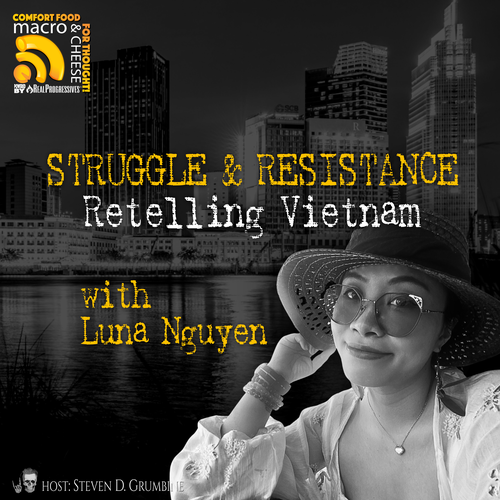
Episode 380 – Struggle & Resistance: Retelling Vietnam with Luna Nguyen
FOLLOW THE SHOW
Luna Nguyen, also known as Vietnamese Marxist-Leninist YouTuber Luna Oi, joins Steve to retell Vietnam’s anti-imperialist struggle through a historical materialist lens, exposing US betrayal and sharing her family’s personal trauma from the “Resistance War Against Imperialist USA.”
You may know Luna Nguyen as Luna Oi!, the YouTuber and member of the Non-Compete content collective who creates videos about culture, history, and politics in Vietnam, as well as panels and interviews with indigenous activists and comrades in the Global South.
Steve asked her to come onto the podcast because, as a Vietnamese Marxist-Leninist, she can take us beyond US propaganda and into the lived history of Vietnamese resistance. The conversation goes into Ho Chi Minh’s revolutionary development, the application of Marxism-Leninism to Vietnam’s reality, French colonialism and Japanese fascism, the 1945 famine and August Revolution, US betrayal after WWII, the fabricated Gulf of Tonkin incident, the nature of the “Resistance War Against Imperialist USA,” and the post-war embargo and debt extortion.
Luna shares deeply personal family history – her grandfather’s death in the Tet Offensive and her mother’s childhood survival of a US bombing – grounding the analysis in living memory. She also connects Ho Chi Minh Thought to dialectical and historical materialism, making the case that revolutionary movements must emerge from concrete material conditions.
Born and raised in Vietnam, Luna Nguyen is a writer and creator on a mission to share her country’s perspective with the world. She’s currently tackling the ambitious project of translating Vietnam’s official Marxist-Leninist philosophy curriculum into English. In addition to her translation work, she also produces YouTube documentaries that dive into the intersection of Vietnamese culture and politics.
Check out her channel https://www.youtube.com/LunaOi/
Free E-books available at https://www.banyanhouse.org/shop/
Steve Grumbine:
All right, folks, this is Steve with Macro N Cheese, and we are taking a trip around the globe through history, and we are shining a light on the beautiful country known as Vietnam. And most people in the United States in particular, have a convoluted understanding of not only history, but what makes up the nation of Vietnam.
And for me, it has become absolutely critical to shatter myths of American exceptionalism, shatter myths about the bad people around the world and all these countries that we just assume were bad because the United States went to war with them. We are going to smash apple pie.
We’re going to smash all the pork pie hats and the red, white, and blue kind of tropism that shields us from understanding what Vietnam is, what it was, figures such as Ho Chi Minh who were incredibly important figures to Vietnam.
And to do this, I couldn’t find anyone better, no one more perfect for this discussion today than my guest, Luna Nguyen, who is a translator and content creator who speaks from a Vietnamese Marxist-Leninist perspective, which we value very much here. So with that, Luna, welcome to the show.
Luna Nguyen:
Hi. Yes, hello, everyone. I’m Luna.
I’m a Vietnamese content creator and a translator, and I am very excited to be here today, and I can’t wait to talk to you all.
Steve Grumbine:
Thank you so much. I really am excited about this because I had Carl Zha, come on, from the Silk and Steel podcast, who is really excellent.
He’s been on a number of times, and he always points to having you join us. He says you are the expert on Vietnam.
And having read and discussed and learned, I debate about how much of what I learned was actually real versus CIA propaganda and talking points from the State Department and things like that. As we watch the US Propaganda machine, which really serves to demonize anyone that stands in the way of their extraction process for empire and, you know, understanding that Vietnam was under French colonial rule at the time of Vietnam and understanding some of the things that happened during that time period, I would assure you most people have a very, very poor understanding not only of that, but the history in general of Vietnam. And so what I want to do is I want to go back to the beginning, because I fell in love with Ho Chi Minh.
I loved his excitement, his exuberance, his willingness to learn. And one of the things that made me feel so tied to him was the pain he felt. He really looked up to the United States.
He really valued the United States. And to watch the United States betray him and betray his vision of what he thought the United States was, it kind of…
In some ways, I totally can relate to that.
As a citizen of the United States and as someone who had bought into the propaganda myself to watch us committing genocides and to hear the nonstop “everybody’s bad but us” mindset. It just made me really find kinship with Ho Chi Minh and his belief system.
And so with that, can you tell us a little bit about Ho Chi Minh, who he was as a person and kind of his history there starting out before he became Uncle Ho, you know?
Luna Nguyen:
Yes, yes, okay, Ho Chi Minh. Long story short, Ho Chi Minh was born in 1890 in the Central [part] of Vietnam. And he grew up receiving the Confucius kind of education from his family, because his father used to be the Mandarin who worked for the king. But after, yes, he was like kind of, not really too high, but kind of middle, middle level kind of Mandarin who used to work for the King of Vietnam.
But due to a lot of reasons that we actually, we don’t know exactly what the reason, but his father resigned, stopped work for the king. He stopped working for the king and then he came back home and become just a teacher, teach kids in the village.
And actually they grew up really poor life in the village. And so he received the feudalist kind education from the Confucianism and feudalism time of Vietnam.
And at the same time, it was a time when the colonial government of France were also occupying Vietnam too. So he knew very clearly what the colonial government of France did to Vietnam and how useless [was] the king at that time.
Another thing that many wouldn’t know about him was that he had four other sisters. So the whole family had like five members. Ho Chi Minh was like the second to the last one. And actually it was a very sad story of him.
When his brother was like a few months old, his mother died because they were so poor and did not have enough food to eat.
The mother died and he, Ho Chi Minh, had to carry his infant younger brother, walk around the village to ask for milk to try to feed his younger brother. It was really sad story. And of course there was not enough people who can, who could spare some milk for that kid.
So after a few months, his youngest brother died on his arms. So it was like a pain. I think that it lasted, you know him, even to the day he died.
Because like he was the only one that had to witness the death of his mother and his own youngest brother in his arm. So when he was 15 years old, he was accepted to study in the Hue High School.
And at that time it was like the best high school in Vietnam that received the colonial education from the French government. And right from that time, he’s already started organizing, protesting, and teaching people about the truth of the colonial French government.
And because of that, he was kicked out of school. Two years later, I think, when he was 17 or 18, he was kicked out of school.
And since then he kept like fighting and protesting and teaching people and also learning too. So around when he was around 19 and 20 year old, he started questioning the system that is ruling over Vietnam at that time.
Like why the king was so useless and why the French colonial government had the power to go here and there to teach our people about freedom and democracy, while he didn’t see any of that in Vietnam and how the way the colonialists, the French colonialists treated our Vietnamese people. And then he started reading all the documents, all the declaration from the French colonial government.
And that was why he decided to get out of Vietnam to see the world.
Because, oh, another side note, the reason, one of the main reason why Ho Chi Minh decided to get out of Vietnam, to go out of Vietnam, to find a way to save our people. Because like for hundreds of years, Vietnamese people try so hard to have a revolution to save our own people. We tried a lot of things.
Ho Chi Minh at that time, he had a lot of contact with those Vietnamese revolutionaries, not Marxists, but revolutionaries who tried a lot of ways to save Vietnam. For example, there’s a guy him named Phan Bội Châu, he looked up to Japan at that time. And yes, they had letters, talked together.
And that Phan Bội Châu guy, he failed.
And the other guy who wanted to support the king, but the good king about it at that time was a bad king and he supported a different king that he thought it would be a good way for Vietnam, but they also failed. So a lot of revolutions and they all failed.
So Ho Chi Minh at that time, he thought about, like, why not go into the West to do that, to try to fight away? Because all of the things that we try, they all failed.
So he did it when he was only 20 year old, he decided to get out of Vietnam to get a job on a cruise ship, like being just a chef on a ship. And you know how hard it was, that job. And he learned language there and he learned how to be a baker, you know.
And that was why he started his journey out of Vietnam all the way until 1940.
And in that trip he went to a lot of countries such as, yes, the USA I think in 1912 he went to Boston and he also went to the USA and he saw the Statue of Liberty. And he used to work in a bakery in a hotel near that Liberty Statue. And he did write a note and he left a note near that Statue of Liberty.
And he said that he saw the black people, how black people got treated in the USA at that time.
Even though you were talking so much about freedom for everyone, you know, the founding fathers or about that, but all of those watch only for white men. Meanwhile black people and women still under oppression and racism and sexism. So he understood the nature of the USA right from that time.
And then after that he went to Brazil and he saw those colonialists treated Brazilian and a lot of other countries in Africa too. And. And then he stopped at France, we called it at that time. We called France our mother country because they colonized the heck out of us [right.] Yes.
And he saw it too. He was…
It was eye opening for him because in Vietnam he saw with his own eyes how horribly those colonialists of French colonialists treated Vietnamese born.
How in our colonial education at that time, they taught us that Vietnamese are the second class citizen and we deserve to be the servant and the slave for those French masters. But then he came to France. He also saw poor people got treated so badly from those rich people.
And he started seeing the true nature of colonialism and imperialism. It is the same everywhere for poor people and it’s even worse for non-white people in colonies.
And at that time he found out about the Second Comintern and he joined the socialist movement, the Second Comintern in France. And he became a very active member of that international. And he wrote a lot. He ran a newspaper too.
At first he tried to write and send all of his articles to a lot of newspapers in France. But none of them was approved, of course, because his article was too “woke,” quote unquote for those newspaper at that time. So they all rejected him.
And that was why he and three other friends. So those four people, they started their own newspaper, the Human Night or something like that in France.
I don’t know exactly how to say it, but yes, he’s…
He and his friends started his own news world, just like now we started our own YouTube channel because none of the corporate media want to publish our writing, you know. Yeah, and another thing, this is very important. Why Ho Chi Minh left the 2nd International to join the Third International.
At that time when he was joining the 2nd International, he saw those French socialists talk a lot about how the workers in France and in other colonial countries need to unite together and to fight against the capitalist side. Yeah, it is all true and correct. But then Ho Chi Minh asked them about, “What about the colonies?”
We are also fighting for our freedom, just exactly like you. I think we should include those people into your discussion. But the people from the Second International rejected him.
They didn’t want to because they thought at that time that it was irrelevant to discuss the people from the colonies because somehow to them, it was not as important as their fight in France. Ho Chi Minh was really mad at that time and he had a lot of argument.
And actually he met Rosa Luxemburg in one of the meeting of the Second Commintern in France. And actually Rosa was the one like, very kind to him and she actually taught him and listened and agreed with him.
But the people from the Second International ignored his concern about the people from the colonies. At the same time, he’s. A few years later, he saw the question of the colonies from Lenin. Right?
He wrote that. The moment that he read that, he was like, “holy shit” moment. I think this is exactly what we’ve been looking for.
Some people that actually see this issue, this problem and show us the way, that was why he decided to leave the Second Comintern and join the Third International like that. Oh, by the way, a side note, when I talk about Ho Chi Minh’s father was a Mandarin. Okay.
Just so you know, just in case you don’t know what Mandarin means, Mandarin means that a Confucius scholar who passed the exam, the Confucius exam, and joined the King and work for the king, it’s just like a government officer at that time. Yeah. So that’s the word Mandarin means.
Steve Grumbine:
Thank you for that. I really appreciate that. You know what I remember from my talks and the things that I read, he was very studious.
I mean, he was incredibly bright and he yearned to free his people. I mean, it was the deepest passion that he had. Everything was based on that.
And you can kind of see even today as the real Left, the Left that doesn’t appease capital really fights and the people are like, that’s just not relevant. Of course we gotta do capitalism. We’ve. What do you mean that you’re pie in the sky? You’re one of “those people” over there, man, you, you, you’re.
You’re an ultra, you’re a nihilist, you’re a this, you’re a that. And Ho Chi Minh was right all along. And it was the people that were ignoring that struggle that were really wrong from jump.
And we can see it clearly now. I mean, if you have eyes to see, you see it.
Help me better understand now that we’ve experienced how he kind of came into the socialist world and how he was very, very disappointed in the, the Second International. But then how he came into his own through his readings of Lenin and going back to Vietnam. Take us through that.
Luna Nguyen:
Yes, yes. So around 1920-ish, he joined the Third Comintern. And he started his connection with a lot of Marxist-Leninists all around the world.
And that was when his and his friends started forming some kind of Indochina Communist Party.
And before he came back to Vietnam even, we already sent people, you know, our comrades back to Vietnam and with all the books and the documents about Marxism-Leninism. And he already started teaching about Marxism-Leninism in Vietnam from 1920s. And it was so successful.
And a lot of Vietnamese people started adopting that ideology right from that time. It was so effective that right around 1927, 1929, we had our very first Red Union in the Basan shipyard in Ho Chi Minh City.
Yes, it’s very successful at that end. Right from that moment when we had the first Red Union, it spread like, you know, like rain spread it all over the Vietnam.
Because like, workers start seeing that. Start seeing the way to go. Because for hundreds of years we try so hard, we never stop fighting, but we could never find a way.
Right from that time when we were taught about Marxism-Leninism, Communism and socialism, we knew that it must be the way.
So from 1927, we had a lot of workers union form all around Vietnam, especially in the factories owned by French colonialists and the red unions at that time, not only just educating people about Marxism-Leninism, they also teach people about the workers right. About the power of the workers, the historic mission of the workers, and how to protect each other from the mistreatment of those French owners.
During that time, we had a lot of protests and worker strikes all over the south of Vietnam especially. So it was pretty successful movement at that time. And in the year 1930, we formed our very first Indochina Communist Party.
And over the year, we merged with two other groups organization. And that was the formation, the very, very first formation of the Communist Party of Vietnam. At first it was the Communist Party of Indochina.
Because at that time, Indochina countries, Vietnam, Laos and Cambodia were merged together under the French colonialism. And we were ruled over by the French colonial government. That was why we had the Indochina Communist party.
And until 1945, we had the successful revolution, the August Revolution. And the Indochina Communist Party was changed to the Communist Party of Vietnam.
Steve Grumbine:
Oh, wow. Okay.
Luna Nguyen:
Even though the Indochina Communist Party was formed in Vietnam right from 1930. But Ho Chi Minh was not in Vietnam, yet, at that time. He was travel all over the place. And most of the time in the ’30s, he spent his time in China.
Talking with a lot of the communist force in China. Working with Mao Zedong and a lot of other Chinese comrades. And we did receive a lot of help from China.
And at that time, Ho Chi Minh saw with his own eyes how the Chinese Trotskyists were trying so hard to sabotage the movement of the Chinese Communists. And that was why he wrote three letters back to the communists in Vietnam. Warning our comrades about the Trotskyists and how. What.
How they are doing in China. And warned them, you know, about that.
Steve Grumbine:
I appreciate that. All right, so Luna. Now, Ho Chi Minh, when did he become Uncle Ho? When did he start to take on a real leadership role within the country?
Luna Nguyen:
Okay, so in 1939, Ho Chi Minh was still in China. And he was arrested by the Chiang Kai-Shek army. And the Chiang Kai-Shek government. Under the control of the British, you know, colonial government, right?
They together arrested him and put him in jail for 14 months. And after he got out of the jail, he came back to Vietnam in around 1940.
But here’s the thing. This is the important part. At that time, Ho Chi Minh could not go back to Vietnam in any open way.
He could not let anybody know that he was trying to get back to Vietnam. Because the French colonial government was hunting him down along with the King of Vietnam at that time.
Because the King was still under the control of that French colonial government. And he tried to walk his whole way back from China to the north of Vietnam. To all kind of jungles and mountains like that. He failed.
He failed three times, actually. Because when he. Because at that time, he just walked the normal walkway of Vietnamese people.
And then he saw those secret spies and police and the cops trying to catch him. So he had to go back. He couldn’t find a way to do that for the last time. The fourth time, he and four other comrades. So there was five people.
He had to walk through the jungle. But could not use any already known road at all. They had to find their own way, their own road to walk for hundreds of kilometers.
From the jungle of China to the jungle of Vietnam. And he did it successfully. So in 1940, he walked back to Vietnam. In the North Mountain, north of Vietnam. And he started the whole, you know, army.
And he called for the army. He called for the revolution he prepared. He took him five years. It took him five years to prepare the army, teach the people.
And, long story short, in 1945, he called for a revolution. It started in Haiphong and then in Hanoi. Haiphong is a city in the north of Vietnam. The port city in Vietnam.
And then it was in Hanoi, the capital city of Vietnam at that time. And he, at that time was another story. Very complicated, too. At that time, 1940, from 1940 to 1945, the whole five years of Ho Chi Minh was hiding in the jungle. Trying to run the revolution. Vietnam was under, not only the occupation of the French colonialist government.
But also the fascist Japanese also came to Vietnam. And at that time, in theory, on paper. Because the fascist Japanese army lost the war against, you know, the alliance.
So French army was supposed to demilitarize and de-weaponize those fascist Japan. But in fact, in Vietnam and Indochina, those French colonial army worked and shaked hands with the fascist Japanese.
To occupy and to steal from Vietnam. To suppress and oppress Vietnamese people even more. That was why, in the matter of only five years, from 1940 to 1945, we had a famine that around 10%, at least, at least 10% of Vietnamese people died of starvation. Vietnamese population at that time was around 20 million.
And over 2 million people died of that starvation. Because the French army and the fascist Japanese army took everything they could back to their home countries to feed their home people.
And they left us starved. And Ho Chi Minh had to lead that revolution right in the darkest time of the history. And how could we do it?
How Ho Chi Minh and the Vietnamese Communists won the support of the Vietnamese people? The truth is, the fact is, at that time over 90% of Vietnamese people know how to read and write.
Of course, nobody knew anything about Marxism-Leninism or communism. Nobody cares. We’re like, we are dying. We are starving to death. But the way that Ho Chi Minh and the Vietnamese Communists gained the support of those Vietnamese was that we stole the rice from the rice storage owned by the French colonialists. Who are the fascist Japanese. We just stole the rice.
We attacked those rice storages. We got the rice, and we redistributed that rice to hungry Vietnamese people. That was how we took it back. Now we stole it. But like, it’s…
It was us from the start, okay? We stole it back from those horrible people.
And that was the main reason why the Communist Army of Vietnam got millions and millions of support from Vietnamese people, even though we didn’t even know what Marxism was. It was because we know what they needed and we understand how we can help them. And we did it.
And the communist force in Vietnam was the only force that could help and could feed our people.
That was why, even though we were in the middle of famine, of starvation, under French colonialism and Japanese fascism, Ho Chi Minh managed to have a successful revolution in the August 1945. Another important fact is this. At that time, the USA did have some important support for Ho Chi Minh.
At that time, the U.S. president sent OSS [Office of Strategic Services], the original organization that later become the CIA. The OSS sent agents to support our Vietnamese Communist force.
And they trained us, they sent us weapons, and they trained us in military tactics and all sort of thing. So that was it. And that was why, you know, when you told me before about you read all of the information about how Ho Chi Minh, the USA could have had relationship. It was because of this time that we had kind of important support from the OSS.
But right after that, immediately after we won against the revolution, the USA turned their backs on us and betrayed us.
Steve Grumbine:
It breaks my heart to think because, you know, so much of our identity as individuals is shaped by the narratives of the ruling elite of our countries and the cultural hegemony that fills what we believe, what we think, how we view things, et cetera.
And as the shackles of those lies peel away very slowly, it’s a huge process, I think, for people to break from what they’ve always thought they’ve known, it has deeper impact than just good talking points. It’s foundational to what we view as reality and how we relate to information and people and subjects and so forth.
And so I can only imagine how excited, on one hand, a revolutionary was feeling to receive help, training, support, only to have that carpet yanked out from under them.
Probably feels a lot like it does in the US when you have someone like a Bernie Sanders or an AOC come out there and say all these great things to people and then find out that they’re defending Mama Bear and they’re stopping a meaningful progress for the people, and you realize they betrayed you. How did Ho Chi Minh deal with the betrayal? How did that coalesce in his life?
Luna Nguyen:
What to say? He did not really talk about that too much. Because at that time, I guess he only wanted to focus on how to fight against the war at first.
Right from 1945, after we won against French colonist government and kicked out of fascist Japanese army out, the French came back, man. The French came back. Right a month after we had successful revolution, the French came back.
And we spent another nine years fighting against the French army. All until 1954. Now, yes, that is a very important part.
So see, we had to fight against the French army for the second time for another nine years from 1945 to 1954. So Ho Chi Minh was actually very busy at that time. At the same time, in 1952, the USA hand picked another guy from Vietnam.
His name was Ngo Dinh Diem. Ngo Dinh Diem used to work under the King of Vietnam.
At that time, his position was kind of equal to, I say, the Prime Minister of, you know, the Kingdom of Vietnam by that time. He hated the King too. That guy hated the King because he hated the French. And he thought the King was too weak to the French.
And that guy believed that the USA could be the good ally to help him to fight against the French army. That was why he went to the USA. He was a Catholic, by the way. He went to the USA and through his Catholic connection, he had somehow he had a connection with a bishop. And the bishop introduced him to the US president.
And that was how he got his way up and how he was handpicked by the US government to be the President of Vietnam. Because at that time, they decided that they did not like Ho Chi Minh. And they did not want to support a communist leader like Ho Chi Minh.
So right from 1952, Ho Chi Minh saw that the US started something against Vietnam and not support him anymore. He knew it, but he did not make it a big deal at all. He like really quietly prepared to fight against the USA too.
He knew, he saw that the face of imperialism and he was not surprised. And until 1954, when we won against the French army again. The USA at that time forced Vietnam to sit in the Geneva Convention.
Forced Vietnam to agree to the idea that Vietnam will be split into half. They take the 17th parallel as the border to mark the North and the South of Vietnam. Vietnam was forever one country.
But at that time, 1954, in the Geneva Convention, we were forced to split into half. The North and the South. The South was under the control of the fascist puppet government, backed by the USA.
And the leader was that Ngo Dinh Diem, the guy that used to work for the King, I just told you before. And the North was led by Ho Chi Minh. The excuse for that Geneva Convention to split Vietnam into half was this:
The USA promised that after two years mean that until 1956, the whole of Vietnam, the North and the South will have a fair election where the people of Vietnam could vote for our own leader. And the power of Ngo Dinh Diem over the South Vietnam only temporary. That was why Vietnam agreed with that Geneva Convention agreement, right?
But the truth is, two years later, in 1956, there was never an election. Because the USA at that time, they knew that if there were an election, at least 80%, 8-0% of Vietnamese will vote for Ho Chi Minh.
There would be not a single chance for that fascist dictatorship that was backed by USA at all. If you don’t believe my word, go look for the memoirs of your US president at that time, in 1956, he wrote in his memoirs that there was no election.
Because if there were one, Ho Chi Minh will win. There’s no chance for that dictatorship. So yes, and right from 1954 to 1959, the fascist dictator of Vietnam, backed by the USA at all.
He implemented a lot of fascistic program where he literally, he dragged the guillotine left in Vietnam by those French colonialists.
He dragged that guillotine over the South of Vietnam and executed every single one that he suspected to be a communist without a trial. And the number of the people that got executed without trial was from at least 2,000 to 25,000 people.
There was no official number because of course they did not keep, they intentionally did not keep track of that.
And all the information we got from those witness and the family members of those victims that were executed by that guillotine. It was really horrible for Vietnamese people at that time, all the way until that same dictator was assassinated by his own people, okay?
The North didn’t even do anything. His own people assassinated him, the dictator, in 1963, ’64, right? The same time with your JFK incident.
And at that time, like after that assassination, the government, the fascist government of the south of Vietnam was really in chaos. Because you know that they have fascist and all they care about is power and money.
So they would do everything they could to really get the money and get the power into their hand.
So anyway, that was why I am very angry to this day, seeing those Vietnamese anti-communists talking about how happy or how rich the South of Vietnam was under the occupation of USA. Because that was totally a lie.
Biggest lie. At that time, in the 1950s, 1960s and early 1970s, only a very small, small faction of people living in Saigon who had, you know, direct connection with the fascist regime had something good from it because, like, you know, they work with the US Armies, they work for the fascist government. So they receive, like, money and food and sausages. They keep talking about sausages and the cheese they received from the USA.
Meanwhile, of course, in North of Vietnam, in the North of Vietnam, we were so poor, we were like actively fighting a war without having any support from as many countries. So it’s a stark difference between that and those fascist Vietnamese.
Even to this day, they keep acting like the south of Vietnam was so rich and so much better under the US occupation.
No, it was only very, very, very small faction of people living in the biggest city in the south of Vietnam that had that treatment for the vast majority of Vietnamese people in the south, especially in the jungle and in the rural area, we were treated horribly.
And if you go, you check the map, the bombing map, and the Agent Orange map, dropped in Vietnam by the USA, you will see more than half of the total of the bombs and the Agent Orange, they drop it on the South, okay? It, like, is really a contradiction to what they say. Okay?
If the South, the people from the South of Vietnam love America so much, why American army drop so much bombs and Agent Orange in the South of Vietnam like that?
The truth is because millions of Vietnamese in the south were suffering so much from the fascist regime and the US army that they signed with the communist force from the North. And actually the National Liberation Front of Vietnam at that time, the vast majority of people in that front were from the South.
They were Southerners. And that was like, very, that was a very important piece of information that I want everybody, especially people from the US to know that.
That the vast majority of Vietnamese in the South supported the communist government of the North and they wanted the reunification. There’s only a very small faction of Vietnamese fascists living in the city who supported them.
Intermission:
You are listening to Macro N Cheese, a podcast by Real Progressives. We are a 501c3 nonprofit organization. All donations are tax deductible. Please consider becoming a monthly donor on Patreon, Substack, or our website, realprogressives.org. Now back to the podcast.
Steve Grumbine:
It seems so much like Cuba. You know, you see this gusano that come around and they’re like, “Oh, down with Fidel. Down with Che. Down with this.”
And unfortunately, every American that you know listens to this stuff is like, “Yeah, we’ve got to liberate Cuba. Yeah, we got to liberate Libya. Yeah. We got to liberate Syria. Yeah. We got to liberate Iran. We got to liberate, liberate, liberate, liberate.”
And it’s so ridiculous.
Luna Nguyen:
Yes.
Steve Grumbine:
And. But, you know, it is a powerful message. People think that they are liberating people.
Luna Nguyen:
Yes.
Steve Grumbine:
From oppression. They don’t realize. I mean, I don’t know whether they’re just stupid, propagandized. I want to go for propagandized.
But I also think about this, and I want to throw this at you. It’s a visual that I had when I was thinking about how I would describe colonialism and how I would kind of think about our conversation today.
And it’s like Americans sitting on a couch with a very long straw going into a table. And the table, they can’t see through the table. The table is solid. It’s black. They can’t see anything in the table, but the straw goes through it.
And underneath of the table is the people around the world that they’re sucking the life out of. They can’t see it, but underneath they’re struggling and they’re trying to get out. And everybody’s like, why are you struggling?
You just hate us for our freedoms. But in reality, they’re sucking the life out of them, the life force out of them.
And when they fight back, when they say, “No, we’re not doing this anymore,” all of a sudden, now they’re the bad guys. And it really. I want our listeners to understand colonialism. I want them to understand propaganda.
I want them to understand the things that they think are so, that just ain’t so, are really, really destroying their ability to have class consciousness, class solidarity.
And it’s important to try to educate and learn and break free from that conditioning, because otherwise you’ll look at the poorest people among you, and when they try to get a piece of bread or they steal. Steal. I love that. Steal the rice from the colonizer.
Luna Nguyen:
Yes.
Steve Grumbine:
Okay. Is that really theft?
I mean, when I think of Howard Zinn talking about the United States even, during the Mexican American War, they had stores filled with food and people were starving. And because they didn’t have money to pay for it, they just were like, you know what? You’re not getting it. It’s sitting there locked up.
You’re going to die from starvation, but who cares? It’s about making money. It’s about power. It’s about control. And I want people to understand.
The story we’re talking about here is a story of resistance against that very predation. And I hope people will take what you’re saying as we continue and really process that information.
Really maybe consider what the cost of having cheap food and cheap products and services, what the cost is to other people. Would they allow someone else to kill their child so that they could have cheaper imports? I don’t think so.
But they don’t mind it when it’s done elsewhere because they don’t know or they conveniently forget about it. I just wanted to bring that up. Luna, keep going. You’ve been amazing.
Luna Nguyen:
Thank you. So, you know, because you just talk about how colonialism and imperialism, they really. The true source of wealth is our life from other countries.
That is why you need to really, you know, start, you know, learning about Marxism-Leninism and start having your class consciousness to understand the true nature of capitalism, colonialism, and imperialism. And to know that where your comfort come from, that is very important.
And also another thing is that a lot of people, a lot of people, especially from the US ask me about, they don’t know how to get to people, how to reach out to people, and how to make people change their look on communism because they spend so much of their lives receiving anti-communist propaganda and misinformation. So it’s really hard to break through that kind of thick veil of misinformation. And what I told them is this.
I mean, I am not a US citizen, I am not living there. So I don’t know the exact answer.
All I could tell them is this: Based on the fact that Ho Chi Minh, in 1945, he gained the support from millions and millions of Vietnamese at that time, in the time that 90% of Vietnamese people were illiterate, we didn’t know what Communism meant at all. We gained the support by helping the people, by understand their struggles and offer a way out of it. That is very important.
The people in the US right now also suffer.
Now you, if you are a Marxist-Leninist, if you are socialist and a communist, the first thing you need to do is to go out, talk to people, see people, and see what your people are in need of, what do they need, what are they struggling for? And from that need you go and you understand that.
And then you have to understand yourself about, okay, how you can offer the help, how you can get together and offer the help and come up with ideas. And once you are out there, you organize and you actually help the people, they will start trusting you.
And then you can, you know, the door is open for you for further organizing and do all of that. But Vietnam, everything started from a one single red union in one shipyard in the Basan in Vietnam, with like a dozen workers that joined.
And it took Vietnam only 25 years to start the revolution and won against the revolution. So it is very important to go out, organize and meet, help the people to meet their demands and help with their struggle.
Steve Grumbine:
That’s amazing. Can you take… This is the next piece. Obviously, at some point in time the United States engages in the war, they begin attacking.
Can you take us to the start of the Vietnam War?
Luna Nguyen:
Yes. Okay. The start of the Vietnam War, it was a little bit overlap with the war against the colonial France. Okay.
So in Vietnam, first of all, we do not call it the Vietnam War. We call it the “Resistance War Against Imperialist USA.”
Steve Grumbine:
Yes. Thank you.
I’m sorry, I don’t want to interrupt, because I want you to go on, but I just want to say for the record, it’s kind of like if you don’t go to China and ask for Chinese food, right? I mean, you have to understand the perspective of the people that are fighting this war. And the USA is a bazillion miles away.
There was no valid reason for them to be there.
Luna Nguyen:
Yes.
Steve Grumbine:
And yet at the same time, those men and women are working class people that were forced by ruling elite in the United States to go fight over there. And wouldn’t it be nice if they all laid their weapons down and said, “I’m not going.” But that’s not reality.
And you have to understand the power dynamics at play here. But I want to be clear that the United States reason for being there was bullshit.
Luna Nguyen:
Yes.
Steve Grumbine:
And the people that were there, they have every right and reason to resist. And with that, I want to turn it back over to you. I won’t interrupt you. I just. I needed people that don’t think that way to think that way.
So go ahead.
Luna Nguyen:
Yep. The “Resistance War Against Imperialist USA.” of Vietnam. Okay.
I know that in a lot of your, you know, talking points in the books and whatever official information you give out, the Vietnam war started in 1965, right after the [1964 Gulf of] Tonkin incident.
But no, in fact, in Vietnam, we consider that the moment the USA backed a fascist dictator in the south of Vietnam in 1954 was the moment that our resistance war against the imperialist USA started. So in a Vietnamese perspective, the war against the USA started right from 1954.
And in the matter from 1954 to 1964, it was a time when the USA was still very naive about the power and the strength of Vietnamese people, especially Vietnamese communists at the time they thought that they could win, you know, all of Vietnam the same as they won against the North and the South of Korea through the ruling of the fascist dictator in the South of Vietnam, Ngo Dinh Diem. And at that time they received a lot of money.
I’m talking about hundreds of millions of dollars of support in money and weapon and food and all kinds of stuff. Finally, I say to the US backed fascist regime in the South of Vietnam.
They really did everything they could to really root out communism from the people of the South Vietnam. At that time, I remember, you know, before I tell you about from 1954 to 1959 they introduced a new law.
At that time we call like the 1059 law that they dragged out the guillotine and executed everyone is suspected to be communists. That law did not succeed at all because they couldn’t root out as many communists as they wanted.
So they came up with another law was another policy was that they will like. How do I explain it to you? Like they grab people out of their home and their villages and they throw them in- they call it a hamlet. Strategic hamlet.
That’s exact word.
Yeah, the strategic hamlet policy when they literally drop in notion farmers out of their house, out of their villages, to those hamlets with their plan was that those people will be sealed off in those strategic communities from communism. So communist people could not reach out to them to spread communism.
Because at that time the fascist regime in the South really scared of the popularity of communism in Vietnam at that time. They did everything they could. But of course it failed. It failed horribly. 1954, you know after the assassination of that fascist dictator.
By the way, side note, the CIA knew about this assassination plan but they did not want to do anything because the CIA kind of quietly agree with that. Because they saw that the fascist dictator was not successful in winning the support from the people. So they also wanted to replace with a new guy.
And they saw that assassination plan and didn’t do anything. So literally they let it happen.
By the way, in 1954, 1955, when the USA saw that their original plan did not work doing it or through the fascist regime. So in 1965 they had to find a reason to escalate the war. They had to look for an excuse for that.
And they came up with the Tonkin incident that actually in 2005 there was a declassified document from the government USA. In that document it clearly stated that the Tonkin incident was fabricated. There was nothing happened.
And they just made it up as an excuse to start the war. So on the paper the Vietnam war started in 1965.
And in the matter from 1965 to 1968 and ’69, it was really dark time for the communist forces of Vietnam. But you know, the US had the Phoenix program where they literally kidnapped and tortured all the people that they suspected to be communists.
And they had the special warfare they, when they use like the Vietnamese, literally their slogan was to use Vietnamese to kill Vietnamese and kill anything that moves. That was during the hard time. That was really hard time for Vietnam. And 1968 and ’69 was a Tet Offensive. And that could be…
That is the biggest loss of the Vietnamese Communist at the time. We, we won in the end. We won in the end, but it was a big loss to both sides, especially to the communist force of Vietnam.
My own grandpa died in that time. He died in 1969 in the Tet Offensive in the South of Vietnam. When my dad was like 10, 11 years old.
I never seen my grandpa’s face because we were so poor and we never had any money to have a picture of him. So, [oh my] I grew up knowing like, you know, people, the villagers, our neighbors, just look at my dad and oh, you look so much like your father.
And that’s all we know because there’s no picture of him. So, yes, 1969 was a big mark on the Vietnam War because both sides won and lost something. It’s very important.
I mean, a lot of people in the US say that Tet Offensive was succeed of the victory of the USA, but strategically speaking, it was a big loss for both sides and also a big win for both sides.
Okay, 1969 was the Tet Offensive. So 1970, oh, this is important.
1970 and 1971, the USA saw that they were losing so much in the South of Vietnam, in the battles in the South of Vietnam. And they couldn’t take that. They couldn’t take that loss. They had to find a way to change it.
So at that time, late 1970 to 1971, the USA started bombing the North. That was…
We had like special day for it because like, we know that that was the day that the US sent so many airplanes, aircrafts, B52, to bomb the north of Vietnam. And my mother, when she was 9 year old, she was bombed by the USA.
She told me that she was walking home from her primary school, walking on the dirt road to the back to the village. Suddenly she heard a loud noise, like a huge massive fan in the sky, really close to her.
And then there was nothing, like she said, like, this is quiet. She couldn’t see anything. She couldn’t hear anything for very long time, she felt.
And when she woke up, she was covered in dirt and mud from the rice field. And she found out that the bomb just got dropped right near where she walked. And actually a few of her friends died because of the bomb.
She was lucky to stay far enough from the bomb that she was just covered in mud and dirt. And she woke up and I know that she was in total shock. She didn’t know.
She didn’t understand what the, you know, what the heck was going on at that time. She just like kept walking home. She told me, like, she just kept walking home, couldn’t think anything. She just.
All she thought at time was, I need to get back home. Need to get back home for safety.
And she told me that on the way home, she saw a lot of houses that got destroyed or the doors got totally, you know, smashed, the roof got fall off because of that bomb, the explosion of the bomb. And that was her trauma that lasted to this day. She told me that to this day she still have panic attack whenever she hears the sound of an airplane.
So that is like a very real. It is very real consequence from the war that it’s to Vietnamese people. It’s not just something on, you know, in the history book or in some movie.
It’s happened to people around us, to my mother and to my own grandpa who sacrificed himself in the war. So of all that effort, bombing the South and the North and using the Agent Orange, the USA still lasts. We kept fighting, man.
We kept fighting and fighting. And one of the. My most favorite quote of Ho Chi Minh at that time was this:
“Yes, the USA will keep killing us, but eventually the USA will be tired of killing us, while the Vietnamese will never stop fighting and dying for our own home country.” That’s what, you know, I’m paraphrasing it, but that’s, you know, Ho Chi Minh said like, eventually the USA will be tired of killing us.
While we are not tired of dying for our own nation. 1952, when we, okay, after, back up a little bit, after the Tet Offensive, the US side got a big loss.
And after the failure in the[Rolling] Thunder, we call it like the linebacker program in the USA, 1970 and ’71, bombing the North, they still failed. We forced them to cede in the Paris Agreement, okay?
And it took us like, it took us years, at least three years from 1970, 1971, 1972, to really force the USA, Henry Kissinger to sit at the table with us and right in the moment of December of 1972, when Vietnam was so close at winning already and the USA facing heavy loss right before the Christmas of 1972, Henry Kissinger and the US President at the time, Lyndon B. Johnson, [actually, Richard Nixon] if I’m not wrong, they did a horrible decision.
The whole point of that decision was so that the USA can have some better condition at the Paris Agreement, they decided to bomb Vietnam “back to the Stone Age.” That is the famous line of Robert McNamara [actually Gen. Curtis LeMay] at that time, bomb Vietnam “back to the Stone Age.” It was December 1972, right in the Christmas time.
And in 12 days, in 12 days of that time, the Hanoi of Vietnam were heavily bombed. You can go google right now. Hanoi bombing, 1972. The whole city, the capital city of Vietnam were bombed, were flattened.
And they bombed schools, they bombed factories, they bombed hospitals. The thing that you see happening right now in Iran and actually Donald Trump used the exact same quote.
It was so disgusting, especially to Vietnamese people, because we were the victim of that exact quote. So disgusting. And at that time, in that 12 days of fighting so hard against the carpet bombing of the USA, we were winning. We were winning too.
At that time, in the matter of only 12 days we shot down dozens of US airplanes. At that time we calculated that if we shoot this many airplanes of USA,
the US will not be able to keep on doing this anymore.
And it’s the truth that we shot down around 17% of their airplane. It means that in every 100 of airplanes they send to the north of Vietnam, at that time, we shot down 17, 1-7 of that airplane.
And that number was too high for the USA to take. And the vast majority of that number is B52 [bombers]. Because we focus on the B52 so heavily. It was called like the Flying Fortress.
And they believed that it was undefeatable. But actually Vietnam Army was so good at it that during that war we had came up with the little notebook to teach people how to shoot down B52.
We were so good at it. And Vietnam to this day is still the only battlefield in the world that could shoot down multiple B52s of the USA.
That was the so big loss for the USA, cost them so much money that the USA could not drag the war for any longer. That was why Henry Kissinger in 1972 had to agree on the Paris Agreement to withdraw all the US armies and officials out of the land of Vietnam.
And after they withdraw all the… that was when, you know, the famous picture of the Saigon people leaving on the helicopter on the ship like that. That was that also too.
And slowly it took them. The fascist regime, right? Fascist regime only lasted for another three years to totally collapse because of the communist force.
But yeah, that was it. Oh, another. Another fun, but not fun fact. 1975, We had the final attack to Saigon, at that time to liberate the whole nation of
Vietnam and reunite the North and the South. In 1975, when we won the war, Vietnam was immediately put under the US sanction. So could you believe it? We won the war, USA lost.
Right after that loss, the USA was so sour about it, they put us under comprehensive embargoes for 20 years, for another 20 years. And at the same time, the US government forced the communist government of Vietnam to pay back the debt of that fascist regime. It was $145 million dollars.
And in 1954, one of the main conditions that the USA forced Vietnam to agree so we can get out so the embargoes can be lifted. One of the main conditions was that we had to pay that $145 million back.
That was the money that they aided the fascist regime of the South Vietnam to oppress our country. But after they lost and we won and we took over, we had to pay for their debt. And we couldn’t say no. We could not say no at all.
Because that was one of the main conditions that USA forced us to agree so they can lift the embargoes on us and Vietnam, that time, we were under extreme poverty and millions of our people were facing starvation and famine. We had to agree to that condition.
And it took Vietnam all the way until 2019 to pay back that $145 million. It was a very recent history of Vietnam, which is seven freaking years ago, so [Wow…] it’s very vivid memories of Vietnamese. That was why I laughed so hard.
Whenever, you know, the Americans talk about, oh, but Vietnam now, love America, love the US saying this and that like, no, dude, we are nice to you. It doesn’t mean that we forget about all of the things that you did to us. We forgive, but we never forget.
And do not take our hospitality and our friendship for that, like, love for you, so yeah.
Steve Grumbine:
I wanted to just give you a minute before we close out, because we are coming up on time. Would you mind just give a short understanding of the philosophy of Ho Chi Minh? I mean, his version of communism. It’s quite specific.
And he had his own flavor. And we don’t have time to go through the whole thing.
And I’d love to have you come back on, so we can do a deep dive in that, because that is really, I think, really important. It’s important to me, and I think most of our listeners would find it fascinating.
But if you could just give a short summary of kind of what it meant to be… his philosophy.
Luna Nguyen:
Yes. So his philosophy is very, very, very unique to Vietnam. Okay. What we understand of Marxism-Leninism is this.
First of all, the original ideology is Marxism, all right? It’s very like an umbrella kind of ideology that would fit for the whole worker movement of the whole world.
And then Lenin was the one that developed it more. And he mostly developed based on the practical conditions in Russia under the Tsar and how he had the revolution, the October Revolution in Russia.
So Marxism-Leninism is a more advanced, developed ideology at that time that we all know that it was developed for Russia and from Russia, right, the USSR [Union of Soviet Socialist Republics, the Soviet Union].
And that was why Ho Chi Minh, when Ho Chi Minh adopted that ideology of Marxism-Leninism, what he believed, and also what other Vietnamese Communists believe is this.
Every group of people, every nation, every people, every country would have to come up with their own version of Marxism-Leninism, means that Marxism-Leninism is not a universal thing that I can apply everywhere, no. You have to modify it. You have to apply it to your own material conditions in your country. And after that, you can have their own set of design.
So Ho Chi Minh Thought is the version of Marxism-Leninism that is match to the specific conditions of Vietnam, the same as Mao Zedong thought as a version of Marxism-Leninism that fit China. And even like Jucheism is a version of that analogy, but in North Korea.
So if the USA want to have Communism and Marxism-Leninism, you also need to develop your own application, your own version of that analogy that fit your own material conditions. So that is why we do not think Marxism-Leninism is a static ideology.
Steve Grumbine:
Yes.
Luna Nguyen:
On the contrary, you need to apply, you need to change it and modify it. Just learn the basic, the core ideology, the core theories of that, and then you apply that into your own condition.
That was why I decided to translate the curriculum of Marxim-Leninism from Vietnamese to English, because that is the foundation, that is the basic of understanding of that ideology that everybody should know and must learn about. And that is the very foundational education that every single student of Vietnam must learn.
And we must pass the exam if you want to graduate from the university. So it’s very basic and it’s very foundational.
And I hope that with that work of me translating that I would somehow help our comrades in the US, you know, how to find their own way for the liberation.
Steve Grumbine:
I love you for this, Luna. This I. I…
And for my first time actually getting to speak to you, I’ve listened to you many times, and I did buy the books early on when you started releasing them, so I cannot tell you what an honor it is to have spent this time with you. And before we started the podcast, we did get to talk offline with yourself and E.J.
And I look forward to having you back on and doing some other things.
Because we are students, even though we’re, I guess, teachers at some level, by putting this stuff out there and creating content, we feel tremendous responsibility to be accurate. And when we are wrong, we want to promptly admit it. We want to change. We want to pivot when we’re wrong.
And so having people like yourself who are not only passionate, but loving and caring and patient, which some of us in the United States lack, we lack that patience. We lack the humility.
I can speak for myself where it’s sometimes easy to forget where you came from, and it’s even harder to change once you’ve become something, Once you’ve matured into whatever you’ve become at that age, it’s very hard to pivot. And my hats are off to anyone who embraces change and looks to come into agreement with facts. And your work is instrumental in doing that.
So, Luna, thank you so much, not only for your work, but. But for being a guest on this podcast today.
Luna Nguyen:
Thank you. Thank you so much for having me.
I always, you know, want to at least offer some support and some help, whatever I can, you know, from each according to your ability to each according to your need, and hopefully that you can spend some time in the audience. You can spend some time reading my book. The free book is always available, so don’t worry about that.
Just read it and try to understand what communism actually means, what Marxism-Leninism actually means. And hopefully in that path of fighting [for] truth, you also fighting [for] your salvation.
Steve Grumbine:
I appreciate that. Luna, where can we find more of your work other than the book? I mean, you’ve got your own channel. YouTube channel.
I know that we were joking about that offline, but where can we find your work?
Luna Nguyen:
Yeah, yeah, you can find me at lunaoi.YouTube.com/lunaoi. My channel is Luna, by the way. Where else? Where can you find me? Hey EJ. Where people. Where else people can find me? Yeah, Banyan House.org/shop is where you can find our free ebook.
Thank you so much.
Steve Grumbine:
Fantastic. Absolutely. All right. With that, Luna, I want to thank you and E.J., thank him. But you are amazing. I’m so appreciative of this.
And so folks, on behalf of my guests Luna Oi, Luna Nguyen and myself here, I just want to thank you all for coming. Real Progressives is a 501c3 not-for-profit.
Our work is fully volunteer driven and our work is funded purely by donations from people that believe in what we’re doing. And we don’t have any big millionaires or even people that are super well-to-do throwing money in the kitty.
It’s all driven by people who believe in the mission. And if you have an interest in continuing our work, please consider becoming a donor. You can go to realprogressives.org and go to donate there.
You can go to patreon.com/realprogressives and become a donor. And you can also go to our Substack/RealProgressives and become a monthly donor as well.
And folks, just so you understand, we literally live and die on your contributions. There is no one saving us, so please consider it.
Without further ado, on behalf of my guest Luna Nguyen and myself, Steve Grumbine for the the podcast Macro N Cheese, we are out of here.
End Credits:
Production, transcripts, graphics, sound engineering, extras, and show notes for Macro N Cheese are done by our volunteer team at Real Progressives, serving in solidarity with the working class since 2015. To become a donor please go to patreon.com/realprogressives, realprogressives.substack.com, or realprogressives.org.
Extras links are included in the transcript.
Related Podcast Episodes
Related Articles
On Comradeship and Revolutionary Solidarity
The High Intellectual Barrier to Socialist Consciousness

Lightsabers, Camera, Action

Leave a Comment
You must be logged in to post a comment.