
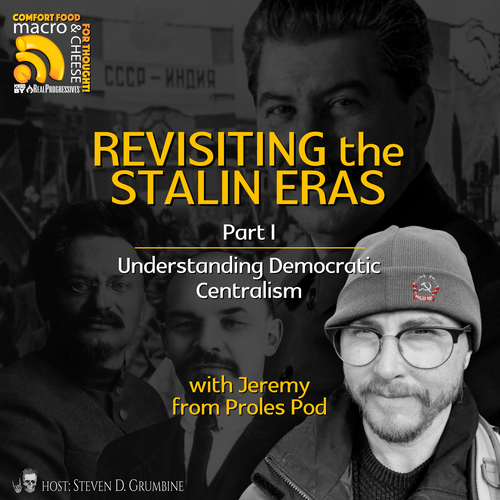
Episode 377 – Revisiting the Stalin Eras Part 1 with Jeremy of Proles Pod
FOLLOW THE SHOW
The first in a two-part series looking at Joseph Stalin and the Soviet Project, without seeking to condemn or sanctify.
** Come to Macro ‘n Chill, our online community gathering, where we listen to and discuss the current episode. This week, Jeremy of Proles Pod will be joining us. If you have questions for him, bring them! Tuesday, April 28th, at 8pm ET/5pm PT. Register here: https://us06web.zoom.us/meeting/register/G7ijDSVmTcKeDc82AAs0XQ
Last year, Proles Pod completed a multi-part series on The Stalin Eras. Now Jeremy, one of the co-hosts, joins Steve for a conversation about it, resulting in a two-part dialectical excavation of Joseph Stalin and the Soviet Project. The purpose of this exploration is neither to sanctify nor condemn, but to strip away bourgeois mythologies and ground the discussion in material conditions and collective processes.
In Part One, Jeremy and Steve look at democratic centralism, where rigorous debate is followed by unified action, then contrast it with the false choice offered by US electoral politics. They draw on Rosa Luxemburg, Julius Nyerere, and materialist analysis of US history (slavery, settler colonialism, Jim Crow as inspiration for Nazi laws), and agree that both Democrats and Republicans serve the same capitalist-oligarchic permanent state.
Proles Pod is an explicitly anti-capitalist, anti-imperialist podcast run by four ADHD-addled individuals. Although the foundation of Proles was built on the topic of history, more recently they have branched out into theory, politics, and culture. You can find them anywhere fine podcasts are distributed.
Join their Patreon https://www.patreon.com/c/ProlesPod/posts
Check out a teaser for The Stalin Eras https://www.instagram.com/reels/DP81SiTjQry/
Steve Grumbine:
All right, folks, this is Steve with Macro N Cheese. I have talked about Mao in the past. We had Carl Zha come on.
And we did a three-part series on the legendary and infamous Mao. And we have talked to others like Esha Krishnaswamy about Stalin. And we’ve talked to others about Historical and Dialectical Materialism.
And of course, as always, we’ve talked to even Carlos Hernandez, Carlos Garcia Hernandez, about the idea of fiat socialism. We’re going to talk about a very, very controversial figure. And I want to be clear before we get too far into this. I’m not here to champion nor slam.
I’m here to learn.
So before some very sweet, kind person that doesn’t understand has some opinion, I want to make sure that you all understand the intent of this interview. And that is to learn.
And to do that, I reached out to somebody who spent hundreds of hours digging into original texts, lots and lots of sources, and pulled together what may be the finest series of podcasts, quite frankly, on the Stalin eras. And his name is Jeremy, and Jeremy is a co-host of the Marxist Leninist podcast Proles Pod. We were on there.
Virginia Cotts and I were on that podcast together. And if you haven’t checked out Proles Pod, you should definitely do that. Without further ado, Jeremy, welcome to the show, sir.
Jeremy:
Thank you. Thanks for having me on. I appreciate it. Yeah, we had a great time having you and Virginia on.
We still need to have Virginia on because she’s like the [momrade], momrade. Yeah, we, I think we called her the Forrest Gump of socialism, where she just has this like every important event of US organizing history, basically, pretty crazy.
Steve Grumbine:
Can you imagine her in little shorts, like the old basketball shorts, playing ping pong?
Jeremy:
Exactly. There you go.
Steve Grumbine:
Or running with a big, long beard. Goodness gracious, absolutely.
All right, to be fair, I spoke with Virginia prior to doing this so that I could get my thoughts in order because let’s be fair, there is not a soul out there that hasn’t heard of Joseph Stalin. You didn’t start with, “Oh, my God, he’s a mass murderer, he’s a dictator. What do you want, totalitarianism?” And they throw 1984 or worse, they throw [George Orwell’s memoir] Homage to Catalonia at you or they throw some other thing.
Jeremy:
Steve Grumbine:
Yeah. Oh, yeah. And that’s. Wait a- Hold on. With all due respect, even let’s say, hypothetically, I sat down or kneeled down before a golem of Joseph Stalin.
Sat there and worshiped at the feet of Joseph Stalin.
Jeremy:
Sure.
Steve Grumbine:
I could not resurrect or recreate Joseph Stalin or the era that he was in. Nothing about that era is going to be similar in the same way as it is today. There’s nothing about it. We need to learn from the past, though.
And I, me personally, and this podcast, we are all about learning things. We’re not here to act like know-it-alls. We’re here to learn.
So obviously, you guys have done the homework, and I’m fully expecting to get tarred and feathered by some egghead out there that has, “Actually, Steve…” I can hear it now, okay. So do me a favor, help me stay out of the egghead gutters.
Jeremy:
Sure.
Steve Grumbine:
And let’s get a good, solid, non-hyperbolic assessment of the Stalin eras. Does that sound good?
Jeremy:
Yeah.
I don’t know if you can keep out of the egghead gutter or the trenches of combat with what we call the tiresome Left, but when we envision the Stalin eras, we actually decided to do that before we kind of made a comeback with Proles Pod in 2024 now.
We were talking about it in 2023, and we were like, okay, let’s see if we can get, like, a single episode together that gives a broad, like, history of the man and the context in which he found himself and so on and so forth, which was a ludicrous attempt.
And then we ended up going, okay, well, we’re not going to be able to get it done in time for the fifth anniversary of the Revolutionary Left Radio Stalin episode that we did in 2018. So let’s push that off and we’ll see if we can come back to it. And then we were like, okay, what if we did, like, two episodes?
And then it was like, well, no, we kind of need to break it down, I think, into three. And then it was like, what if we did four? I think we ended up with a total of, gosh, 1, 2, 3, 4, 5. I don’t know, 8. Eight episodes.
The first just sort of being like, why are we doing this? What is the point of this?
Which I think I’ll attempt to summarize here, but more or less, we wanted to give people a sense of who Stalin was as a human being. Not as the leader of the Soviet Union, not as the guy who robbed banks to fund the revolution, but who was this man as a human being, broadly?
Like, what were the aspects of his character that we might identify within ourselves? Like somebody who is a bit of a workaholic, somebody who tends to maybe be a bit too harsh in their criticisms of their friends. Do you understand?
Like, it’s not just that we wanted to understand Stalin as a leader, although that was certainly a major part of this, but who was Stalin as a human being? Because as materialists, as people who believe in dialectical historicalism and dialectical materialism, we do not believe in great man theory.
There is no single person who drives the engines of change through history. Even in the like micro-view, even within the small scale of a single country in a single few years.
We’re talking about millions of people, hundreds of millions of people who all came together and worked in a particular fashion to create the history that we see. Yeah. So humanize Stalin was one of the things that we wanted to do to like, get rid of this sort of “great man of history” nonsense.
Both in the sense that he was either an evil villain or he was like the great shepherd who guided the country into a glorious future. He was neither of those things. He was one man who indeed had a lot of power for several years, but he was just one man.
You know, the Central Committee sort of changed in size, but the Central Committee had a number of people who were very smart who all discussed together what would and would not happen in a given situation. And then there was the Supreme Soviet and they decided major policy shifts on the strategy scale.
And then there were the individual Soviets, the military Soviets. I don’t know whether I need to be explaining what Soviets are.
Steve Grumbine:
Yes, you do. You should just. I mean, for no other purpose than thoroughness and to ensure that absolutely not a soul walks away trying, [not understanding the structure].
That’s right, yeah.
Jeremy:
So for people who don’t understand, Soviets predate the Soviet Union. They even predate the RSFSR, the Russian Socialist Federation of [Russian Soviet Federated Socialist Republic]… Anyway, the RSFSR. My God, the Soviets were workers councils.
They were something like a union structure where the people who worked in a particular factory or the people who were in a particular division within a military organization or whatever, a group of sailors, or there were village Soviets.
Basically, it was a way to organize frontline workers so that they could have their needs met in a way that forced the capitalists or the generals or the, whatever, the landlords to listen. It functioned much like a union did.
But rather than like, there is a union that oversees, you know, hundreds of different businesses and everybody pays their dues. And then the union, like, I mean, it does kind of function like this.
You voted on whether you were going to strike, what your demands were going to be. It’s just that the Soviets, the workers councils, were explicitly socialist.
They were explicitly fighting for workers’ rights, but with the understanding that this was just a stopgap measure to improve the lives of workers until such time as the revolution came. And when the revolution came, they became the primary, like, seat of power.
I know that people will make these jokes about how Lenin did not give all power to the Soviets like he said he was going to, but they had a massive amount of power. When the Soviet Union, sorry, when the RSFSR was established, a Supreme Soviet was established over the top of all of the Soviets.
And the Supreme Soviet decided big picture strategy stuff. But when they wanted to know how to implement it, that went down to the regional and the local level. It was not decided from on high.
“You’re going to do this and you’re going to do that and this Soviet’s going to do this thing and this Soviet’s going to do another thing.” It was up to the regional level Soviets to decide what was going to happen on the ground.
And then there was a constant back and forth communication of, okay, so the Supreme Soviet is like, “We’re going to get an increase of 15% in mechanization in our factories.” And then it would go down to the regional level and go, “Okay, this factory is primed for that. This one is prime for that.
We think we can increase output by this amount.” And then it would go down to the factory level. And the factory would go, “No, there’s no way we can do that.
You know, you’re wanting a 10% increase in efficiency. We can maybe do 8.”
And then it would go back up to the regional level and they’d go, “Okay, well, we need to now adjust our numbers for how much mechanization we’re actually going to get out of this.” Like, it’s just the conversation was constant back and forth.
And I think another thing that people forget is that the RSFSR was established in 1917 and the Soviet Union in 1924. The technology did not exist for any one person even in the 1930s, there was no way that a single person could possibly tell everybody what to do and then for that to happen.
It had to be written down in a letter or communicated via radio by the 1930s to send information out to the countryside. And then there were dozens, hundreds, thousands of people who were on the ground who were then responding to those orders.
But they had very different interpretations of what those orders meant.
And so there was no way for one person to just command from on high, to monitor what was going on the ground, and to direct it in such a way that they could be an effective dictator. That is another point that I think I would like to make clear within this.
Steve Grumbine:
Can I jump in real quick? So…
Jeremy:
Yeah, go for it.
Steve Grumbine:
Hypothetically, right? The Internet didn’t exist then, right? I mean, we didn’t have [Microsoft] Teams, we didn’t have [Facebook] Messenger.
Jeremy:
Yeah.
Steve Grumbine:
We didn’t have Zoom. We didn’t have podcasts.
Jeremy:
We didn’t have [the same sense] security cameras. We didn’t have microphones that could be placed in offices to listen to what people are saying. You know what I mean?
Like, it’s just the level of technology was such that… it literally was pen and paper, and at best, radio signals, telegraph would have been a way to communicate with the front lines or the, the folks in charge of decision-making on the ground. It just was not.
And then you could not know what they were doing with the information you gave them. So to imagine that somebody was just guiding the entire project of the Soviet Union from on high is silly. It’s a very silly idea, I guess, to me.
Steve Grumbine:
Yes. No, I agree. As funky and as crazy and as stupid as my question was.
[No, I getcha] I think that there are people out there who will superimpose AI and every other nanobot that’s out there into their mind as they think about, “Well, that maybe it didn’t happen then, but if you try to do anything now…”
Jeremy:
Yeah.
Steve Grumbine:
So I just want to make sure we nip that baby quickly.
Jeremy:
Sure, yeah. Now, I will say that there was a dictator of the RSFSR and of the Soviet Union. There was one, and it was [V.I.} Lenin.
He was not elected to office, and quite often he would, I mean, obviously, with the advice of the people around him, but he would quite often go, this is the plan. This is what we’re going to do. And then changes were made around him to accommodate whatever plans that he had sort of put forward as, “This is, I think, the direction we need to go.”
And it’s because people trusted him, people believed in him, people thought he was like “the guy” because he had made many theoretical advancements that allowed the Bolshevik revolution to take place. You know, I think one of the things you wanted to talk about was like, dictatorship of the proletariat and democratic centralism.
And these were, to be clear, Marx is the one who came up with dictatorship of the proletariat. But democratic centralism was an innovation of Lenin.
And it is, I believe, the thing that allowed the Soviets to come together and to achieve the Bolshevik Revolution to establish a socialist state. I do not think it would be possible without democratic centralism.
Steve Grumbine:
Can I ask a question on that material?
Because, you know, within the space, the terms and conditions that led to the Bolshevik Revolution also are in no way, shape or form the current world that we live in.
Jeremy:
Correct.
Steve Grumbine:
Before some egghead. We’ll keep the eggheads. That’s the nicest word I can use, before some egghead comes wagging a finger at me. In no way, shape or form, am I, have I, will I recommend that we have the ability to do what happened during that very unique time after World War I.
Jeremy:
Yes.
Steve Grumbine:
Under a tsarist world that we in no way, shape or form.
Jeremy:
Correct.
Steve Grumbine:
Am I saying this is happening, Please. Because again, there will be this egghead with glasses and smiles and, “Well, actually…” [yeah]. And I just almost made me not do this interview because of those eggheads.
Jeremy:
No, no, no. Yeah. So agree. Like, you can’t transpose the conditions of feudal Russia onto the modern United States. However, many of the problems…
I don’t know whether many of your listeners or most of your listeners have involved themselves in organizing in real life with other leftists, but the absolute inability to subjugate your own personal desires in order to achieve a larger goal is anathema in the West. And I think the answer is democratic centralism. You need to have principles which basically allow you to see: What I want is socialism.
What I want is freedom from exploitation under capitalism. I want socialism. And in order to achieve that, I have to work with other people. I cannot achieve socialism by myself.
And if I’m going to get there, then a group of us need to come together and make that happen. But how do you keep that group from splintering? How do you keep that group from being mired in constant arguments about process?
How do you keep them from, like, basically just tearing themselves to pieces? Because this person thinks this thing and this person thinks that thing. The answer to me is democratic centralism.
You need to have a healthy debate because you can’t arrive at the synthesis. You can’t arrive at the, like, theoretical framework of the future, if you do not socially discuss it.
You cannot, in your own mind go, “Here’s what we’re going to do. Let’s do it.”
You have to talk to other people and bounce that idea off of them and have them express their doubts about it and have them tell you why that’s a stupid idea.
And then you have to tear that to pieces and then put it back together in such a way that everybody or most of everybody is like, “This is a good idea.” Together we have socially determined what the best course of action is.
And even if it doesn’t look anything like what your idea was initially, you’ve got to fucking suck it up and deal with it.
You have to shut down your internal, like, whatever, your egghead, the egghead in your head, the cop in your brain that makes you want to, like, whatever. “Have my selfish desires met, my social needs met, because I want everybody to tell me, I’m a smart and good boy.”
You need to put that aside and go, okay, the group has decided. “This is the path we’re going to take.” Now, once that path has been decided, everyone shuts the fuck up and gets in line.
Everybody gets together and goes, “This is the path we’re going to take, because this is what the majority agreed upon.”
If it doesn’t work, if it fails, then you stop and you re-evaluate and you come up with a new plan and you put that forth. And when that one gets put forth, you shut up, you suck it up, and you deal with it and you go forward with that plan. And if that fails, you stop.
I mean, like, that’s the process. You do not let the plan go forward and then criticize the plan constantly while it’s happening. You do not tear down your own party.
You do not talk shit about the person who came up with the idea that you didn’t like. You just get behind it.
Because while there needs to be a healthy debate beforehand, once the measure has been decided upon, you have to stick together.
Because if you don’t, then the capitalists will use the divisions that you have that you basically feel like are so important that it’s worth destroying your own party for, the capitalists will use that and drive a wedge between you and your comrades, and they will rip your movement to pieces.
That has been the problem of the Left since the seventies at the least. We cannot seem to hold the line.
We cannot seem to come together and fight for something without again, sort of being like, “My individual needs are not being met; therefore this movement is fucked.”
Steve Grumbine:
Let me jump in there because I can already hear the egghead.
[Yeah] They’re saying, “Hey, well, then you should be jumping in bed with the vote blue, no matter who. You should be going along with, let’s say Biden’s slaughter of the people of Gaza.”
Jeremy:
Sure.
Steve Grumbine:
But none of that happened. There was no all the Soviets debating and coming up with a strategy for the question or the situation or if there is a situation.
None of that happened. It was done by oligarchy for oligarchy, by oligarchy. And then some horrible person will tell you, “Oh, no, you’re being a splitter.
You need to suck it up and deal with the genocide. That’s what the party decided. The party said to do this.” That’s not what this democratic centralism is.
Jeremy:
Right.
Steve Grumbine:
And I want to be clear on that.
Jeremy:
Yeah. Because what you need to have before the debate even begins is a set of principles that you are sticking to.
The principles need to be decided before you decide a course of action. You need to say, “This is our goal. Our goal is socialism, okay? We are anti-imperialist, we are pro-worker, we are anti-bigotry.
We are these things, okay? Now, given those principles, what should we do?”
Because the problem with the moment that we live in now is that as opposed to 1917 Russia, or as opposed to 1949 China, or as opposed to Germany in the 1950s, or, you know, all of these places where socialist states were established, as opposed to those places, the number of socialists in the United States is tiny. It is a minuscule percentage of the population. And so our goal at the moment should not be, unfortunately, how can we do revolution?
Because we’ll just get killed. What we need to be figuring out now is how to appeal to workers and how to onboard them into parties that are not capitalist parties.
How can we organize the working class to get to the point where we might, at some point in the future be able to achieve a revolution.
That is the main struggle that socialists are facing right now is there are, I would guess, maximum, a hundred thousand people, maybe 200,000 people in this country that call themselves socialists. And even of those, I would say less than 10%, are like, actually dedicated to the cause of revolution.
Many of them are what we would call social democrats, people who want capitalism to remain in some form.
But for there to be reforms that benefit the working class, which is a noble goal, you’re just not going to be able to achieve it via the system that has been established within the United States. There’s no way to vote enough people into office to make the fundamental changes that you want.
So even if all you want is like a robust public transportation system and free health care and free daycare and like all of these things on a nationwide basis, you’re still going to need a revolution to make that happen.
Steve Grumbine:
You know, it’s funny you say that, because just exactly like that, I don’t consider in any way, shape, or form it to be nihilism.
To acknowledge the very system of acceptable pathways to change that the oligarchy has provided us since the wealthy, white landowners started this country, the Brits and the other colonizers [yes] set up this system, okay? Folks don’t want to give me an ounce of time. And this isn’t about me.
I want to be clear. I was. [Yeah] I want to chastise anyone that thinks that this is about me. I am the person talking.
So I guess at some level, my thoughts are about me, but this is not about me.
Because at the end of the day, I could want a million things and none of them will come to be if there isn’t a system to allow it or there isn’t mass movement to agree with me. [Right.] At the end of the day, you know, there is so much more than my opinion involved here.
And I think that an honest person, someone listening that is maybe done a little bit of Howard Zinn reading, maybe has also done a little theory reading, maybe has really kept their eyes open to the material reality of the electoral system and not just, you know, it’s like, it doesn’t do any good when you’re in a car and you have no wheels, right? To sit there and say, “No, no, no, I will not stop turning the key on this car. You’re a nihilist for saying the car isn’t going anywhere.”
Jeremy:
Right.
Steve Grumbine:
And it’s like, “Yo, dude, you’re missing the core of transportation”.
Jeremy:
Yes.
Steve Grumbine:
Wheels. [Yes] You have no wheels. And. “But no, no, Steve, you don’t understand.” [Yeah] no, actually, I freaking do understand. Yeah, you’re wrong. I absolutely do. Go ahead.
Jeremy:
Yeah, I mean, ironically, my undergraduate thesis was about the roots of white supremacy and imperialism, basically at the core of the United States from its foundation. And I used sort of the most extreme examples of these, and then was like, okay, so, like, most extreme.
By that, I mean, like, I used Nazism to represent white supremacy, and I used the imperial dismantling of India by the British Empire as the example of imperialism. And then I was like, okay, are there similarities between this and the United States? And of course there were. It’s just like on and on and on and on.
I think a lot more people now know this than I did when I was growing up or even into adulthood. But the Nazis loved the United States.
Hitler was a great admirer of the United States because he explicitly said that the reservation system was the only serious attempt that had ever been made to establish a white ethnostate.
When the Nuremberg Codes [Laws] were being written, basically the laws that would restrict behavior and subjugate particular ethnicities in Germany, the “scientists,” the political like, entities basically which developed the Nuremberg Codes, looked to the black codes in the United States for inspiration.
Intermission:
You are listening to Macro N Cheese, a podcast by Real Progressives. We are a 501c3 nonprofit organization. All donations are tax deductible. Please consider becoming a monthly donor on Patreon, Substack, or our website, realprogressives.org. Now back to the podcast.
Jeremy:
But they weren’t like, oh, let’s go harder than this.
They were actually like, the black codes go too far in many cases because they were worried that the average German people would not accept if they just took the black codes and applied them to, say, travelers or to socialists or to Jewish people or other ethnic minorities. If they just took the black codes and applied them, then the German people would be like, “Ahoa, whoa, whoa, whoa, whoa, what are you doing here? This is too much.”
So they were like, “We have to tone this down.”
I don’t know how people imagined that a system that was founded on the colonization of and destruction of existing peoples, that was founded upon slavery, that was founded upon exploitation of workers, could possibly be remade into anything else. The Founding Fathers did not love democracy. We need to make sure that’s like clear and upfront.
There was no part of the Founding Fathers that really, I mean, some of them wanted more democracy than others, but they had a great fear that the working people might get too much power if they allowed too much democracy, which is why the Senate exists. The Senate is an anti-democratic institution. It basically allows money and land to vote. That is the purpose of the Senate.
It is there to prevent too much democracy from the House of Representatives. The Supreme Court is an anti-democratic institution. It is an institution that is put into place. These are lifetime appointments by presidents, right?
And so you’re like, “Oh, well, presidents are democratically elected.” Not initially and really not really because of the electoral college. So no, I will refuse to say that that’s a democratic process.
And especially, as you can see, anytime anything good is attempted in this country, even if it’s just the like barest of electoral reform, the barest of like crumbs from the table for the working class, the Senate and the Supreme Court are there to stop it. They do it all the time.
Steve Grumbine:
Don’t forget the parliamentarian.
Jeremy:
Yes, the…I mean, I was a great beneficiary of the SAVE program, which was established under Biden, and as soon as Trump got elected… Was it under Biden, Was it under Obama? I can’t now remember.
Anyway, as soon as Trump got elected, he had his people, like start to fight it in the courts, right? And nothing stopped them from what they were doing. I’m sure, I don’t know if any of you or probably many of your listeners watch John Oliver, he did a very sort of lengthy sort of description of how the Trump
administration and the conservatives stacked the lower courts with a bunch of reactionary judges who would be amenable to these really ridiculous lawsuits that would pass them on and pass them on and pass them on so that they would get to the Supreme Court so that this very conservative Supreme Court would be able to overturn again, anything good that ever tries to happen in this country, it gets overturned by the Supreme Court, declared unconstitutional.
You know, now my payments, which were in the realm of like $100 and I think it was $140 per month, are now going to jump to $400 per month.
Steve Grumbine:
Let me put a bow on this for those people, the egghead community that will say, “Actually it was Biden.” It was Joseph Biden.
The Biden administration created the Save Student Loan repayment plan, launched in August of ’23 and blocked by federal courts as of March 26. So just five minutes ago.
Jeremy:
So, yeah, but they started fighting it basically immediately as soon as it was put into place. [Immediately, yes] It went to the courts and then it got passed up to the, the appellate court and then it got passed up to the Supreme Court.
And they, yes, just decided.
So now my payment more than triples or about triples because even this minuscule, measly gift that was given to us by the bourgeoisie is being ripped away because there is no democracy in the United States, right?
I mean, I don’t know whether many people are aware of this or not, but there have been studies to suggest that if the Electoral College was abolished, it would be nigh on impossible for a Republican to win the presidency ever again. But the Democrats don’t want that. Otherwise, they would be fighting for it. They need the Republicans.
They are desperate for the Republicans because their only serious argument for why you should vote for them at this point, outside of like a handful of what I will generously refer to as “progressives,” outside of a handful of candidates, most of the establishment Democrats want basically the same things the Republicans do, just in a slightly gentler fashion. They want to be less weird about it. They want to be less cruel about it. They don’t want to say explicitly, “We’re going to go steal Venezuela’s oil.”
They want to say, “Maduro was a dictator and the people of Venezuela deserve better.”
But what that means is the overthrow of the socialist government and the replacement of extractive industries in Venezuela. That’s what they mean. They just don’t say it.
But again, regardless, the Democrats’ only real serious point that they can get across that makes you want to vote for them is that at least they’re not Republicans. That’s all they have. They are not trying to bring about socialism. They are not trying to give the working class a better life.
They are wanting the same things that the Republicans do, just in a slightly more gentle way.
Steve Grumbine:
Can I ask something right there before we go further? So you can correct me and I’m happy to be wrong here, okay? [Sure.] My understanding of this managed, what I call Kayfabe, which is taken right out of the WWE [World Wrestling Entertainment] . It’s that
Jeremy:
Right.
Steve Grumbine:
That detente between the people that watch wrestling and the community of wrestlers.
Jeremy:
Yes.
Steve Grumbine:
That they kind of shove reality to the side momentarily and go into this fake world where they kind of agree with each other that, “Hey, yeah, it’s fake. But we’re not going to say that during this,” right?
Jeremy:
Yeah.
Steve Grumbine:
I look at the entire government theater as Kayfabe.
Jeremy:
Yeah.
Steve Grumbine:
And I look at it 100% as there’s two factions or many factions of oligarchy. And it’s really- you’re fighting over the oligarch Olympics as to which oligarch fantasy land is going to come real.
Jeremy:
Yeah.
Steve Grumbine:
And we then in turn take that on like we are cheering on a wrestler.
Jeremy:
Yeah.
Steve Grumbine:
At the, you know, steel cage match. But in reality, these guys are going out breaking bread together. They’re.. this is just
Jeremy:
…their friends.
Steve Grumbine:
We’re going to get the same exact thing either way. But we just have to figure out which message is resonating with the people right now. “The anti-Democrat. Okay, we’ll get Republican. We got the anti-Republican.”
Okay, we’ll get Democrat. But there’s no fundamental change. As Joe Biden once said, “Nothing will fundamentally change.” And he meant it.
Jeremy:
Yeah.
Steve Grumbine:
Because in reality, they serve the same master. And I don’t mean this hyperbolically. [Yeah.] I don’t mean this in any kind of like, conspiracy way. This is just the reality.
Jeremy:
Right.
Steve Grumbine:
We used to call it the deep state, but I think the better term for that is the permanent state.
And I think about the people that serve oligarchy and then they put these puppets up there that they’ve groomed us to love through their Daytime Emmy awards for their, you know, soap operas. And we follow along with popcorn and we’re super excited.
We put an “I Voted” sticker on our forehead and we really have conditioned herself to believe that we did that. But, but I say to you this way. Biden was the one that funded the genocide in Gaza. [Right]
And he would bypass Congress even, to ensure that the genocide in Gaza was funded. Then he as well set the stage for the draft that Trump now just put into practice. [Yeah] The military draft.
So each of these things, the security state brought in by Obama, made vampire through Trump, you know, each of these things, if you look, you understand, if you don’t do that, if you don’t look at it this way, if you don’t really have open eyes, you’re failing yourself. I’d say you’re failing your family.
Jeremy:
Right.
Steve Grumbine:
Which is an understatement, but you’re failing yourself.
Jeremy:
Right.
Steve Grumbine:
You know what I mean?
Like, even if you don’t have a family, you’re failing yourself not to consider what I’m saying, what we’re saying, to use your own material condition, look at your, with your own eyes at what is happening.
This is not a hyperbolic, this is not nihilism for this one particular egghead that has decided to take a dump on everything we’re doing and calling it “nihilism.” The reality is, it’s not nihilism. I believe in the people.
Jeremy:
Yeah.
Steve Grumbine:
I believe in us. We, the people. The thing that you say the government does. I believe in us!
Jeremy:
Yeah.
Steve Grumbine:
But we are not trained. We do not have access or agency to this. And sitting there pretending you’re driving away in a car without wheels is just a lie. And I can’t abide it.
And if that makes me a nihilist, then I guess I am. Anyway, I didn’t mean to interrupt you, but I needed to make that statement.
Jeremy:
No, that’s fine. Yeah, I mean, I like it. Just makes me think of the Julius Nyerere quote.
He was the first president of Tanzania and he said, “The United States is also a one-party state, but with typical American extravagance, they have two.” And it’s. Yeah, it’s like that. And it’s really more like it’s one party with a left wing and a right wing.
The right wing party obviously being the Republicans and the left wing of the party being the Democrats. But their ultimate desires, what they want out of an economic system is exactly the same.
They just don’t necessarily, 100% agree on exactly how to get there. They want laissez-faire capitalism regardless of what the Democrats tell you or what the Republicans tell you.
If you look at the actual actions that are taken. And when I say laissez-faire capitalism, yes, of course that’s also kind of a fake thing.
There’s nowhere in the world that laissez-faire capitalism really happens. There is this weird mixture of big business being propped up by the government, which is not laissez-faire capitalism.
But they desperately want a global laissez-faire system where there are very few restrictions on what another country can do in another country.
So the United States can go to Haiti and like, American businesses can buy up property and they can establish extractive industries that pull money out of Haiti and send it back to the United States.
They do not want restrictions on what a foreign government can do or a foreign business can do within the bounds of what anti-imperialists will refer to as the imperial periphery. They want laissez-faire capitalism there. They want the government to do them favors back home.
So it’s like this weird mixture, but again, both the Democrats and the Republicans want that.
And again, like, I think we have to go back to the roots of the United States for an explanation for why this is because it’s a country founded upon wealth. It is a country founded upon capitalists making money by stealing shit from other people.
If it were not for the fact that the British military secured the borders of the colonies, then these people could not make money in the United States or the colonies at that time.
And one of the major reasons for the outbreak of the American Revolution is that the British government did not want to expend any more resources on expanding into the West. They were like, “We need to keep colonists from getting any further than this particular line.” And the colonists were like, “Fuck you. We’re out of here.
We’re going to take this country for ourselves.”
And if you look at the progression of colonization to the West, once the United States hit the coast, that was immediately when they went on to start invading other countries. Cuba, I believe, happened in 1895. Then it was the Philippines in 1915. And on and on and on. We have invaded the Dominican Republic more than once.
And when we did it, it was to very graciously rewrite their constitution so that it was more friendly to us. We did the same thing in Haiti.
We went to Guatemala, we went to El Salvador, we went to Nicaragua, we went to Colombia, we were In Panama, we went to… I mean, like it… just as soon
as the United States hit the West coast, as soon as it could not steal any more land from indigenous people, it started stealing land from other people. That is the root of the United States, and it is the explanation for every single decision regarding US foreign policy since its inception.
Everything has been about stealing shit from other people. And you cannot reform that.
And it does not matter who the President is, whether it’s a Democrat or a Republican, the United States and its business interests will continue to rip money and resources away from other countries and bring it back here. And people will say, “Oh, gosh, but like Americans live such great lives compared to other people in the rest of the world.”
Yes, of course, working-class people benefit from this. The rats are always fattest near the wharf. We will always benefit from imperialism.
That does not mean that this is the way it has to be, nor does that make it a good thing. Like the fact that we get to live okay compared to the rest of the world, because we are stealing from the rest of the world, is an awful thing.
We can take the wealth from our own bourgeoisie and make our lives better. We do not need to take it from other people. And in order to make that happen, we have to destroy capitalism.
And in order to destroy capitalism, we can’t vote our way into that.
Steve Grumbine:
Let me jump on, because I know the MMT crowd is going to be screaming at me, “Steve, you didn’t say something.” Right?
Jeremy:
Sure.
Steve Grumbine:
See, here’s the thing. The government itself is the creator not only of the currency that it spends, but it’s also the creator of the rules that it creates.
If it created those rules on behalf of the working class, we wouldn’t be having these conversations.
[Yes] We would be having a totally different set of conversations because then the people themselves would decide whether they want to be predated upon whether private property should even exist in terms of the means of production, et cetera. And reality is, none of that exists.
Jeremy:
Right.
Steve Grumbine:
So even though I am an MMTer even though I can tell you exactly that the government doesn’t care about getting its money back so much as it cares about access and, and stealing those real resources from around the world.
Jeremy:
Yes.
Steve Grumbine:
Okay. That is what it matters.
And MMT as a school of thought is 1 million percent about de-emphasizing the monetary element of it and emphasizing the real resource element of it.
And see people get it all backwards because they think, “Oh, the government’s going broke, oh, they’re printing money, they’re blah, blah, blah,” in reality, if they really wanted to fight. And I say this lovingly to the socialists out there that don’t get this.
We need to understand that the money is backed by the coercive nature of the tax and it’s backed by a gun. [Yeah.] Okay? Those two things. And that it has the veil of legitimacy through the “rule of law.” Because money is a creature of law.
And that law is defended by the gun and it’s defended by the tax. Not that the tax funds it, but the tax is what maintains the monopoly. Because you don’t pay taxes and chicken necks or sexual favors.
Jeremy:
Sure.
Steve Grumbine:
You pay it in the government’s unit of account. So for those people that are MMTers that you know that, “Oh, no, Steve, you’re being a nihilist. What about MMT? You’re not telling MMT?” No, I know MMT inside, outside, backwards, forwards. In fact, I would say as a layperson, I know a lot more than most.
But in terms of understanding Empire and in terms of understanding the capital order, in terms of understanding the system of capitalism, which sadly, friends of mine deny even exists, which I still can’t fathom. Okay? But within that space, we’re given a toy steering wheel.
Jeremy:
Yeah.
Steve Grumbine:
We’re put into the passenger seat and we’re told, “This is democracy,” that we have this power.
Jeremy:
Yes.
Steve Grumbine:
And it’s an illusion, it’s false. And noticing it. Noticing it, I’m called “a nihilist.”
Jeremy:
Yeah.
Steve Grumbine:
Which is unfathomable disrespect. It’s repulsive disrespect. And it’s nihilism in and of itself because it allows us to die without a chance of fighting back.
Anyway, I’m sorry, I needed to put that in there.
Jeremy:
Yeah. Let me, let me tie a bunch of different threads together here.
So in the United States, and really in the West in general, places where there’s a parliamentary democracy, the perception is that democracy is getting to vote for who your masters are every two years, every four years, every six years, every year. But like, if you look at the number of people who actually vote in the United States, it’s like half, maybe, of all of the…In fact. Really?
No, because you don’t count felons and you don’t count children and you don’t count, like, immigrants.
Steve Grumbine:
It’s like a third.
Jeremy:
Yeah. It’s a very, very tiny percentage of Americans vote. And that’s only in years where there’s a presidential election.
If you go to the two-year cycle, it’s maybe half of that. And then if you go down to the one-year cycle where many like local and regional, county level, what’s the word? Propositions and whatnot happen.
It’s a tiny, tiny, tiny fraction of people who are deciding things and therefore they are very easily manipulated by TV ads and radio ads and YouTube ads and newspaper articles and online blogs and podcasts. It’s very, very easy to manipulate the people of the United States to vote in one way or another for things that are against their own self-interest.
It’s very easy to do. And I just mentioned like newspapers and blogs and podcasts and you’re like, well, what, aren’t you a podcaster? Can’t you manipulate the…
No, because we have like a few thousand people who routinely listen to our stuff. You know, it maxes out about 10 or 15,000, depending on the episode.
I’m not going to be changing hearts and minds as compared to like Clear Channel [iHeartMedia, Inc.] or what’s Rupert Murdoch, CNN?
Steve Grumbine:
MSNBC? Fox?
Jeremy:
Like Fox? I mean, yeah, like, yeah, I can’t remember.
I mean, I know he owns Fox News, but he has like a media conglomeration that is billions upon billions upon billions of dollars that get dumped into the market to guide votes.
And that’s aside from like easily manipulated people who are not very well educated, who get algorithmically fed things on social media that change their point of view.
I mean, the best example in recent memory for me has to be the trans athlete issue, because trans people make up such a tiny portion of the country, and of that tiny percentage, an even tinier percentage of people are athletes. And then even a tinier percentage of those people are trans-women athletes.
And then an even tinier percentage of those people are trans-women athletes who can compete at a level that is going to make them superior to cis women athletes.
It’s such a non-issue, but it became a driving force in the last election to such a degree that people voted for Donald Trump and people voted for Republicans specifically because they thought they were going to save their girls from having to get beaten in an athletic competition by a trans woman. And not to like, it’s such a non-issue. I don’t understand. I mean, I do understand because it’s very divisive.
It’s very easy to like, manipulate people’s emotions when you say things like, “Your girls aren’t going to be able to win competitions, all their trophies are going to go to trans women.” That’ll hurt people’s feelings to such a degree that they’re gonna like lose it. And I went over to my daughter’s friend’s house to have some beers.
Her dad is like a hardcore Republican and he starts saying this shit to me. And I was like, in order to argue with these people, you can’t use the talking points that you hear on MSNBC. You can’t say things like I just said.
You can’t use logic on them in the sense that you can’t flip that switch in their brain by saying something to them that they’re like corporate news bosses have already given them counterpoints to. So I was like, why do we even divide sports by gender in the first place? Like, why don’t we just have divisions based on skill level?
And he was like, “Oh yeah.”
I was like, yeah, you know, most women are definitely not going to make it into the top tiers because, you know, generally men compete at a higher level, but some cis women will and some trans women will, why don’t we do that?
And he was like, “Yeah, actually, now that I think about it, he’s like, I do like motorsports stuff and there’s some girls out there who can run circles around me.” And I’m like, yeah, exactly. Why do we separate those sports? Let them all compete based on their skill level.
And it disconnected him from this stupid ass argument. But that’s me one on one with one person. I can’t do that to millions of people.
I can’t talk to billions of people in the world and tell them this information and get this across to them when they are constantly being bombarded by a counter narrative that is supported by a billion-dollar industry. And for that reason, we can’t fight on a level playing field.
There is no way for me to convince people on a grand scale to vote for their best interests. Which is why you will never be able to vote enough socialists into office to make that happen.
Steve Grumbine:
You know, whether you love her or hate her.
Rosa Luxemburg said, “A socialist entering into the government doesn’t change the government into a socialist government, but the socialist becomes a minister of capital.” I think this is really important for people to understand. They act like I said it, like somehow or another I just don’t know what I’m talking about.
Or I’m a coward or I’m a tankie, or I’m a this or that. But that’s reality.
Jeremy:
Yeah. Yeah. Well, let’s shift the conversation over to socialism. So you’ve got these media empires, none of whom, not even MSNBC, want socialism, right?
They will pay lip service to it and they will defend certain progressive candidates, but they do not want the United States to become a Soviet Socialist Republic, right? Or anything like that.
Which is why it is very important for them to make you think that socialist countries are bad, that socialist countries are oppressive, that socialist countries are undemocratic, right? So Stalin being vilified is part of that.
Steve Grumbine:
Got nothing to add to that. That’s beautiful. This will be a two-part series. [Sure] I really appreciate your time, Jeremy. [For sure.]
Thank you for all the guests that have come through the door. We welcome your pushback as long as it’s done respectfully and in good faith. That concludes part one of our two-part episode with Jeremy of Proles Pod.
And you know, as a closing remark for this week, I just want to say we’re not looking to lionize, we’re not looking to demonize. We’re just looking to factualize and contextualize. Look, for the next week, we will cover it in more depth.
Every Tuesday night we have something called Macro n Chill, which is a discussion. We do a webinar where we break these conversations down into 15 minute segments. We have 30, 40, 50 people, sometimes on a good night show up.
And it’s a webinar. We talk, we discuss. And it is really nice to have an intimate setting where people can ask the questions.
We don’t publish it, we don’t print it, we don’t reproduce it. It’s intentionally not recorded for distribution because we want people to feel like they can ask questions.
And so, Jeremy, if you’re interested and there’s no pressure at all, we do it with or without the guest.
Jeremy:
Sure.
Steve Grumbine:
When we do these, we would love to have you show up on Tuesday night to kind of be there to answer any questions that may or may not come up. It would be an honor.
Jeremy:
Yeah. Is that like this coming Tuesday?
Steve Grumbine:
No, we’ll let you know. We’re always recording a little ahead.
Jeremy:
Yeah.
Steve Grumbine:
So, yeah, anyway, I’m going to go ahead and take us out here real quick, folks. My name is Steve Grumbine. I am the host of Macro N Cheese and the founder of the nonprofit Real Progressives. We are a 501c3, not for profit.
And that means your donations, guess what? They’re tax deductible.
And if you think the big guys are donating money to us, trust me, the subject matter we put on probably isn’t attracting the wealthy to donate. So if you’re considering something to support, we would like very much that you consider donating to us.
Because we’re a nonprofit, we have volunteers and most of the work we do is volunteer driven. And our guests like my good friend here, Jeremy, come on because they believe in the mission and I want to thank them and I want to thank you for listening. But we need your donations, folks, if you’d consider becoming a donor. We have a Patreon.
I think it’s Patreon/realprogressives, something like that. We also are on Substack. Please, you can become a donor there, but please come over there. And the conversation’s much better than on Twitter.
We’re also on Twitter, by the way, but you can also go to our website, realprogressives.org and become a monthly donor. There’s a lot of ways you can donate and time is one of them. But money is definitely needed and we’re very grateful for any amount whatsoever.
And on behalf of the organization, myself, Steve Grumbine and my guest Jeremy from Proles Pod, please do check out their work. We are out of here.
End Credits:
Production, transcripts, graphics, sound engineering, extras, and show notes for Macro N Cheese are done by our volunteer team at Real Progressives, serving in solidarity with the working class since 2015. To become a donor please go to patreon.com/realprogressives, realprogressives.substack.com, or realprogressives.org.
Extras links are included in the transcript.
Related Podcast Episodes


Related Articles

On Comradeship and Revolutionary Solidarity
The High Intellectual Barrier to Socialist Consciousness

Lightsabers, Camera, Action


Leave a Comment
You must be logged in to post a comment.