
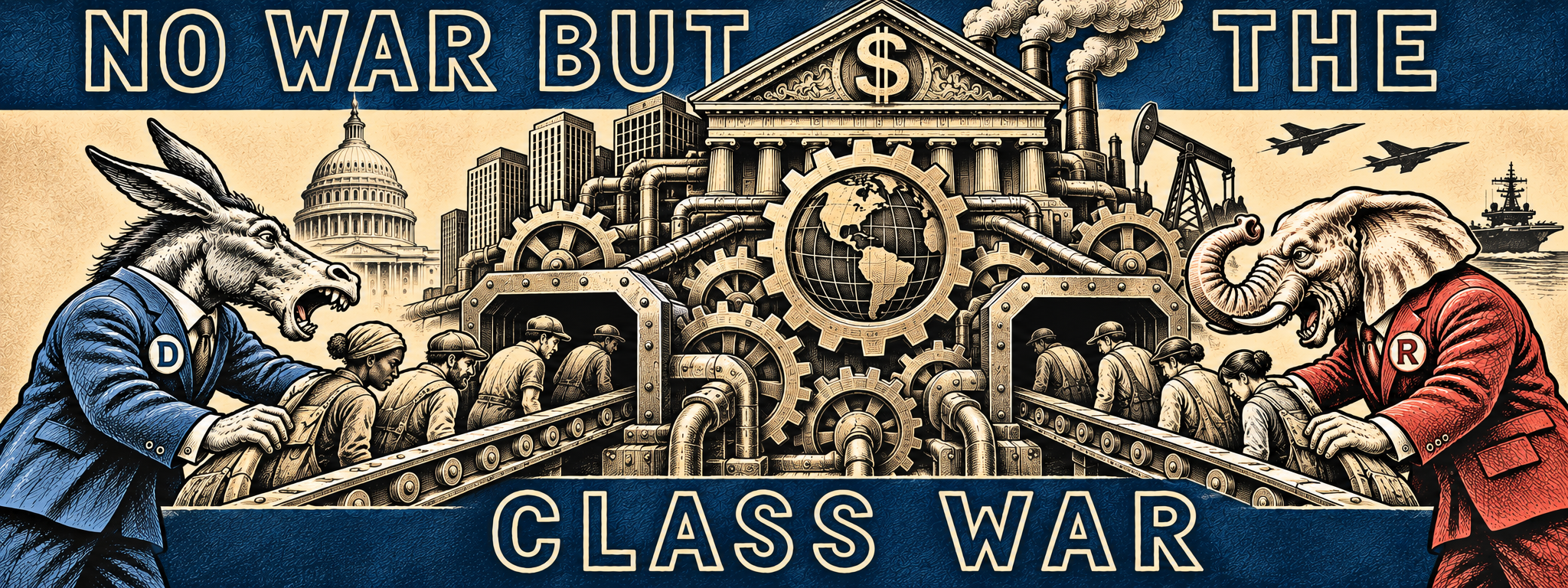
There is no denying that the Trump era has been a nightmare. The cruelty, the open authoritarianism, the attacks on working people, and the sheer arrogance of a ruling class that no longer bothers to hide its contempt for ordinary people have been exhausting. So when a blue wave sweeps through Congress, governors’ mansions, and state legislatures and knocks some of that unchecked power back, of course people feel relief. After years of watching the political system descend into something grotesque, even the smallest sign that the brakes might work feels like a victory.
But relief is not liberation. Checking some of the most visible expressions of authoritarianism is not the same thing as dismantling the system that produces them. And Donald Trump is still in the White House.
Capital is still large and in charge. Wall Street still dictates the terms of our economic existence. The military-industrial complex still feeds on endless war. Corporations still control our workplaces, our housing, our healthcare, and our access to the basic necessities of life. The capitalist class still dominates the political process, and both major parties remain committed to protecting the institutions that make its wealth and power possible.
Fascism is not simply Donald Trump, a collection of deranged Republicans, or a particularly offensive political personality. Georgi Dimitrov defined it as the open, terrorist dictatorship of the most reactionary, most chauvinist, and most imperialist elements of finance capital. It is not a personality but a form of class rule: the one sections of the ruling class reach for when the ordinary methods of bourgeois democracy no longer protect their interests. The United States today is a bourgeois democracy with a fascist movement growing inside it, and the machinery that movement would need is already built. Fascism does not always arrive wearing a uniform or carrying a swastika. Its tools are assembled through surveillance, policing, militarism, political repression, and the systematic destruction of organized opposition, much of it under administrations of both parties. If the decisive sections of capital conclude that open dictatorship is necessary, that machinery will be waiting.
Why, then, do the parties differ at all? Because capital is not a single mind. Its fractions (finance, tech, fossil fuels, defense contractors, real estate, domestic business) have different interests and lean on different political instruments. The Democrats are the preferred instrument of some fractions, the Republicans of others. The differences are real, and they can matter in people’s lives. But they are disputes within the ruling class over how to rule, not over whether it should.
Democrats are not some benevolent alternative to the dictatorship of capital. They are one of its principal governing institutions. They defend private ownership of the commanding heights of the economy, protect financial interests, and support an American imperial project responsible for enormous suffering around the world. They speak a different language and offer a more polished presentation of power, but their commitment to existing property relations remains intact.
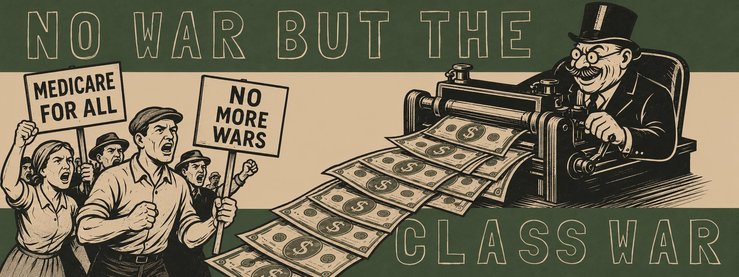
Their favorite question gives them away: “How will you pay for it?” The federal government issues the dollar. It cannot run out of the currency it creates; its real limits are labor, materials, productive capacity, and inflation. A Congress that finds hundreds of billions every year for the Pentagon can fund housing, healthcare, and full employment. When Democrats plead poverty on public needs while voting for record military budgets, the constraint is not fiscal. It is a choice about whose interests the nation’s real resources will serve.
Consider what happened under Joe Biden. University students protesting the slaughter of Palestinians were met with police repression, arrests, suspensions, and institutional crackdowns, and the president’s answer was that “order must prevail.” His administration kept arming Israel as Gaza was devastated. It named China America’s “pacing challenge” and most consequential geopolitical rival, reinforcing the bipartisan consensus that American global dominance must be defended against any country capable of challenging it. The machinery of deportation, detention, border militarization, and domestic surveillance kept running.
We cannot seriously condemn Trump’s authoritarianism while excusing the coercive machinery maintained or expanded by Democratic administrations. We cannot call ourselves anti-imperialists while treating American military domination as acceptable whenever the bombs are delivered by politicians in blue ties. Repression does not become democratic because the people ordering it speak the language of inclusion, diversity, and human rights.
And what about ICE? How many times have we heard promises of reform, accountability, and humane enforcement while the infrastructure of detention and deportation stays standing? What about the expanding surveillance state: Flock license-plate cameras, facial recognition, predictive policing, and the growing ability of the state and private corporations to monitor ordinary people? What about artificial intelligence and the very real prospect of mass job displacement, with productivity gains flowing to shareholders while workers fight over shrinking opportunities and deteriorating conditions? A government that issues its own currency could guarantee a job to everyone who wants one. That it refuses to tells you who the technology is for.
These are not isolated problems. They reflect an economic and political order in which technology serves ownership and profit, state violence protects property, and imperialism secures markets, resources, and geopolitical dominance. Working people absorb the costs. Those who own the system collect the rewards.
Which brings us to an uncomfortable subject: the electoral socialist movement that has made its home inside the Democratic Party.
Calling yourself a socialist does not make your political strategy socialist. Wearing the language of class struggle while staying tethered to the Democratic Party is not a serious challenge to ruling-class power. If your entire political horizon is winning elections, negotiating reforms, securing committee assignments, and administering existing institutions, then the fundamental question goes unanswered: how exactly does any of this end the rule of capital?
That movement contains people who sincerely oppose capitalism, but sincerity does not resolve the contradictions of its dominant electoral strategy. When socialist politics depends on Democratic ballot lines, legislative careers, and the institutions of bourgeois democracy, it risks becoming one more mechanism for absorbing dissent and steering working-class anger back into the system. Class collaboration does not become revolutionary because it comes with socialist slogans.
The point is not that socialists may never stand for office. Lenin treated participation in bourgeois elections as a question of tactics, not principle. Under some conditions it can serve as a platform for exposing the system and reaching workers; under others, as with the Bolsheviks’ boycott of the first Duma, staying out is the right call. What he never accepted was subordination to bourgeois parties. Electoral work can be one tactic among many. It becomes a trap when it replaces the strategy.
The same test applies to imperialism. A socialist movement that cannot consistently oppose American militarism, sanctions, economic coercion, and the subordination of the Global South has failed the most basic test of internationalism. Anti-imperialism is not optional, something to drop when it threatens electoral ambitions or relationships with powerful institutions.
The capitalist class is not trembling because a few more progressive politicians have won seats. Ownership of the means of production has not changed. Finance remains in private hands. The Pentagon remains the Pentagon. And the working class has not gained independent control over the institutions that determine its future.
This is why the endless celebration of electoral victories is so dangerous. It treats a change in political management as a change in class power. It invites us to believe that the system has corrected itself, that democracy has prevailed, and that we can return to our regularly scheduled lives.
Go back to brunch. Stop worrying. The adults are back in charge.
Absolutely not.
The people of Gaza do not get to go back to brunch. The families devastated by American sanctions do not get to go back to brunch. Workers living paycheck to paycheck, families facing eviction, people drowning in medical debt, immigrants living under the threat of deportation, and communities under militarized policing do not get to pretend that everything is fine because the electoral map changed colors.
None of this means that defeating openly authoritarian politicians is meaningless. Conditions under different governments can differ in ways people feel. A reduction in repression matters. An opening for organizing matters. Any relief from state violence matters to the people experiencing it. We should never be so consumed by theory that we dismiss real improvements in people’s lives. But those improvements are not the defeat of imperialism, the end of class domination, or proof that bourgeois democracy can deliver emancipation if we just elect the right administrators.
The central question has never been whether Democrats are preferable to Republicans in some immediate circumstance. It is who owns, who rules, who produces, who profits, and who has the organized power to determine the future of society.
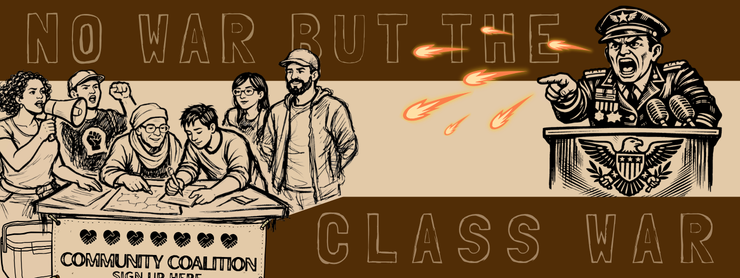
That is why working-class organization is indispensable. We need political education, labor organizing, and community institutions that develop class consciousness. Above all, we need an independent party of the working class: disciplined, rooted in workplaces and neighborhoods, able to build power outside the electoral machinery of the capitalist parties and to lead when the crisis comes. And we need people who understand that the crises surrounding us are rooted in material relations of ownership and power, not merely in bad leadership.
Most of all, we need to stop mistaking resistance to Republicans for resistance to the ruling class.
If your politics become radical only when Republicans are in power, your opposition is partisan, not revolutionary. If you condemned surveillance, police repression, deportations, and imperialist violence under Trump but rationalized them under Biden, you were not opposing those institutions. You were helping decide which faction gets permission to operate them.
And if you spend the next two years defending Democratic politicians from criticism for fear of helping Republicans, you will once again become an obstacle to independent working-class power. You will be asking the oppressed to postpone their demands, silence their criticisms, and subordinate their struggles to the electoral survival of a party that has no intention of surrendering class power.
We have seen this cycle before: the outrage, the mobilization, the election, the celebration, the demobilization, and eventually the disappointment. Then comes the next authoritarian figure, often more dangerous than the last, rising from contradictions that no capitalist administration can resolve.
The crises deepen. Electoral politics manages the outrage. The ruling class survives the transition.
So yes, breathe. Then get back to work.
Do not surrender your political independence to a new crop of capitalist administrators. Do not abandon the people suffering under American imperialism because the violence has become less visible or the rhetoric more palatable. And above all, do not trust political movements that demand your silence in exchange for their electoral success.
Our task is to build the consciousness, organization, solidarity, and independent working-class power needed to challenge the foundations of capital’s rule, not to spend another political cycle defending those who administer it.
The blue wave may have changed the political weather. It did not change the climate.





Leave a Comment
You must be logged in to post a comment.