
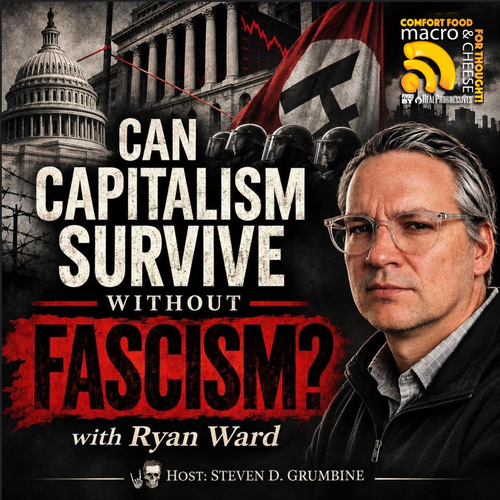
Episode 406 – Can Capitalism Survive Without Fascism? with Ryan Ward
FOLLOW THE SHOW
Ryan Ward says reading George Jackson, Angela Davis & others led him to see Fascism is not a historical accident of Italy and Germany. He and Steve discuss what electoralism can and cannot do.
This episode might make you reconsider fascism. Come listen to it with us and discuss. Macro ‘n Chill meets Tuesday, November 24 at 8pm ET / 5pm PT. Use this Zoom link to register
Is fascism something capitalism does only when it panics, or is it a permanent feature of the liberal state that most of us were taught not to see? Steve takes up that tension with Ryan Ward, whose Substack essay on a topology of fascism asks us to rethink the idea of fascism as capitalism in crisis, and nothing more.
Ryan is an associate professor of psychology at the University of Otago in New Zealand, where he researches the neural basis of learning and the sociopolitical context of human drug use. He writes about politics, Marxism and music at Free Market Moralism. He explains how reading George Jackson’s Blood in My Eye, along with Angela Davis, Fred Hampton and Aime Cesaire, led him to strip fascism from its Italian and Germany historical frame. These writers told white audiences that what they called fascism had been the lived experience of Black and Indigenous people for generations. Ryan roots the common core in the wage relation. Dispossession and enclosure strip people of any means of living except selling their labor, and the liberal state then exists to stabilize that arrangement so accumulation can continue. Imperialism, he adds, supplies the material base for social democracy at home. Steve presses on why this puzzles so many liberals, including anti-fascist economists who still cannot see the Democratic Party as part of the problem.
From there the two take apart the idea that fascism can be voted away. Steve points to the Biden era’s scapegoating rhetoric and the crackdown on campus protest against genocide. Ryan points to New Zealand, a week from an election, where the two main parties offered near identical austerity plans. Steve brings the MMT lens: equating government spending with household budgeting is a myth – a class weapon. Austerity moves wealth upward. He also corrects a common point, that bond sales and interest payments are policy choices by a currency issuer, and that rate hikes pour new money into those who already hold wealth. Ryan stresses that fascism is a constellation of measures preserving accumulation, related to capitalism but not identical with it.
On what to do, Ryan offers a two pronged answer. Use electoral politics as a bullhorn to expose the system’s limits, as Lenin would. Steve adds his own reading of Left-Wing Communism and democratic centralism. He talks of building mutual aid and community capacity, in the spirit of the Black Panther Party, so people can withstand the backlash when the system hits back.
The takeaway: fighting fascism without fighting capitalism is a contradiction, because the need for repression lasts as long as the wage relation does.
Ryan Ward is an Associate Professor in the Department of Psychology at the University of Otago in New Zealand. His research focuses on the neural basis of learning and the motivational and sociopolitical context of human drug use. He writes about politics, Marxism, and sometimes music on Substack.
Find Ryan on Substack at weareunderused, where his newsletter is Free Market Moralism.
[00:00:42] Steve Grumbine: All right, folks, this is Steve with Macro N Cheese. I am going to discuss fascism today. This is a subject we’ve got Isabella Weber with her new book, Anti-Fascist Economics, and a lot of other folks out there that have been talking about fascism ad nauseum because of the Trump administration. And honestly, around the world, we’ve seen guys like [former Brazilian President Jair] Bolsonaro um who just recently got his wings clipped um to [newly elected Brazilian President Luiz Inácio Lula da Silva] Lula and you know hopefully we can get a better understanding about what fascism really is because after a while it’s kind of like you hear this word, it’s this big word it’s a scary word and it’s the boogeyman and it is bad it is awful but its meaning is so much deeper than what we get to experience in the normal discourse of a day.
You know, I had a very childlike understanding of what fascism was. I don’t want to boil it down to everything I don’t like as bad as must be fascism.
But it was kind of like this authoritarian, this and that and the other. I kind of had this very Mussolini-like version of what fascism was. And so that was the beginning and the ending. I don’t want to sell myself short. I did ponder it. I did think. I’m not a Trotskyist, but I read Trotsky’s pamphlet on fascism.
And I felt like if you could get rid of the 90% of it, which was just bashing Stalin, if you could get that one pager out of it, it kind of left you believing that fascism was simply capitalism in crisis, a tactic by the ruling order to bring capitalism back into the daddy chair. And as I’ve learned more, I’ve realized that that’s a part of fascism, but it is not just fascism.
It is a piece of a larger ecosystem or, as we’ll be discussing today with my guest Ryan Ward, a topology of fascism, the unchanging core of settler colonialism and liberal democracy. And for those of you who don’t know who Ryan is, we’ve got a little teeny bubble out there in the Substack world. Erald Kolasi, Anarcaspar, a.k.a. Pieter de Beer, Lukas Unger, and some other people out there that we talk to and follow and listen to. And Ryan Ward is one of those individuals. And so you get to know him a little bit. He is an associate professor in the Department of Psychology at the University of Otago in New Zealand. His research focuses on the neural basis of learning and the motivational and sociopolitical context of human drug use.
He writes about politics, Marxism, and sometimes music on Substack. And for those of you who don’t follow him already, please do. You can get it at Substack.com/weareunderused. And his newsletter is called Free Market Moralism. So with that, I bring on my guest, Ryan Ward. Welcome to the show.
[00:03:56] Ryan Ward: Yeah, thanks for having me.
[00:03:58] Steve Grumbine: Absolutely. Look, I want to get to the high point. Rarely do I see anarchists, Marxist-Leninists, and others that would just consider themselves maybe DSA-ers or whatever, kind of flock to an article and say, “yeah,” in many phases. And in fact, our guy Pieter de Beer kind of got me cold dead to rights, I had responded without reading it.
And I basically threw out the Trotsky line that it [fascism] was a tactic. And he kindly kind of put my head back to the paper and said, “you might want to read it, man.” Like it was that obvious that I had not read it. And I was like, daggonit, busted. And so I read it. I was like, wow, this is really freaking good.
And it really stretched me to think about fascism in the way that you laid it out. And I really do like how you kind of tackle that Isabella Weber and Astra Taylor [with Naomi Klein, End Times Fascism] and others had written books that kind of point to this fascism, anti-fascist economics, etc. And, you know, I’ve always looked at those things and I’ve always marveled at how they can look at like a Democratic Party and not consider them fascist.
And how they kind of give the big “olé” to the Democratic Party as a it’s almost like a huge blind spot in this constant romanticizing of, you know, bringing back democracy, saving our democracy. And and I’ve been pretty critical of them. I mean, I appreciate their economics, especially Isabella. She is absolutely incredible when it came to understanding sellers inflation and understanding so much went on during the pandemic.
I give her all the flowers in the world for that. Where I stopped short, though, is her kind of near pathological willingness to be part of the Democratic Party or to kind of bless that as if it’s not fascism in its own right. And that brought me to you, man, that this whole kind of thing, made me say, “Well, you know what?
I really want to know more about this.” It is way too, it’s spoken about way too much. It’s way in the public eye right now. It’s been for a long time. So your paper here, your writing on this was truly revolutionary to me. And I guess, why don’t we get started with a very brief kind of overview on what a topology of fascism really means?
[00:06:29] Ryan Ward: Oh, well, I mean, I appreciate that. I try to, you know, write stuff that’s useful to people. And it’s always really encouraging to me when people find the stuff interesting. And I have to also shout out to Anarcaspar/Peter, who I wrote last month, a briefer article that kind of started exploring some of these ideas. And he actually pushed me, as he always does in such a, like, polite yet very probing way to like explore a few more things with it.
And so he’s actually kind of the inspiration for taking this into like a sort of more detailed and analytical direction, which is what I tried to do with this article. So, what I was trying to do is think about this idea of fascism and trying to really strip it from…
That sort of historical idea concerned mostly with Italy and Germany and analyzing the socio-political and economic context with those regimes and try to understand whether there was something that we could understand about fascism that was applicable across a lot of different historical and political contexts.
So what really sort of supercharged the effort for me was reading [Black Panther] George Jackson’s Blood in My Eye last month and a lot of other authors from like the black radical tradition. Angela Davis at the time was writing in the ’70s. Fred Hampton had a few things to say about it. Cedric Robinson, this guy, Aimé Cesar, I’m probably mispronouncing his name, but all of these people who were black or African-American are writing about fascism in the ’60s and ’70s and basically trying to tell white people that, “You know what, this has been happening to us for generations.
What you’re describing is not new. And so that really started making me think about what are the commonalities between the experiences of black people and others who have been, you know, indigenous people who have sort of suffered settler colonialism and other things, and whether there’s a way to bring all of those experiences together in an understanding of fascism that would sort of cut across this historical kind of, you know, Germany, Italy kind of idea.
And I think, yeah, I guess just one more thing to sort of fill out what I was thinking about. I think it’s useful to do that because, like you mentioned in the intro, everybody’s talking about fascism these days, and it’s almost become kind of like a catch-all term for something political that I don’t like, right?
And so I wanted to sort of take the word back to redefine it in a way that was expansive enough to include what is going on, you know, with the Trump era or whatever, you know, in Latin America, other places right now. But also that’s not so general that it loses all meaning. So that’s, yeah, kind of what I was trying to do with that little piece.
[00:10:04] Steve Grumbine: So with that in mind, you know, I. Part of me wants to jump straight to George Jackson, OK, because I have not read that book. But before I go there, I want to ask, I guess, the whole bunch of other questions. But I really kind of want to keep this dialed in, because this could go on for hours and hours, which I would love to do at another time.
But that’s just not going to be our framework for today, unfortunately. But, you know, if you think about Isabella Weber, who you point out and Astra Taylor, who you point out at the start of your piece. If you think about this weird romanticism about liberal democracy, you know, is fascism really the opposite of liberal democracy? I mean, you’re changing the conventional understanding of fascism for sure.
But when I think about what these people long for, and it kind of goes to the historical nature of what you just brought forward, that, you know, people that are not of the dominant you know race and when I say dominant I don’t mean that they’re dominant. I mean that that is the ruling elite right now. That is the white settler colonialism / um slavery uh the the list of power dynamics goes on and on and on and on and on.
You can look at the Global South even today with the US and Europe dominating that area as BRICS is even being somewhat shattered a little bit right now. A little bit of a wedge has gone in even there.
Is liberal democracy what I would call bourgeois democracy? Is this really any different? Is this not what fascism is anyway?
[00:11:50] Ryan Ward: Well, I mean, you’re hitting at the point that these authors from the black radical tradition just keep hammering home again and again, which is basically considering liberal democracy as this kind of, you know, idealized form of government with freedom, equality for all and all these opportunities. Well, it discounts what it took to get it there, which is essentially, you know, in the US, genocide of the indigenous population, right?
So from their perspective, it’s been an absolute disaster, right? It’s it’s been this horrible thing. And then what’s really interesting is George Jackson and Angela Davis, who are having this dialogue at one point in his book, and she’s writing letters from prison. He’s in prison as well. You know, they’re African-Americans who have been in prison for their sort of revolutionary activity while he was imprisoned at age 17 for supposedly stealing $70 and was given life in prison for that.
But anyway, what they’re basically saying is, there’s certain demographics within liberal democracy that are already experiencing what white people define as fascism, right? When it was experienced by Italians and Germans, and they have always been experiencing that because they feel a particular role within liberal democracy or with that type of society or they pose a particular threat, right? So the idea that liberal democracy is this thing that once you know corporations get too much power or the oligarchs start to take over then it descends into fascism just sort of ignores the fact that for certain groups of people it’s always been that way for them and so, yeah, I think then there’s obviously an element of racism, an element of privilege there.
A lot of us just don’t really think about that happening a lot. You know, you can see it whenever any group sort of gets a little bit, you know, out of the ruling power’s control and starts to have a little bit of revolutionary spirit like they’re just crushed like and that’s during the good times, right?
So, there’s always this undercurrent of fascism and whether or not you recognize it depends on sort of your perspective, like who you are within liberal democracy.
[00:14:24] Steve Grumbine: So with that in mind, I mean, obviously, you know, we the United States and I don’t want to completely make this about the United States because I think we can look at the Global North. I think we can look at a lot of places. I think that, you know, some of the really good scholarly work I’ve read out there is some of the problems with our understanding of these things is like the Euro centralizing, or Eurocentricity that we try to put on Asia, you know, washing Asia and trying to make it a monolith and washing Africa and trying to make it a monolith and all these other countries as backwards.
And you know, unable to take care of themselves. So they’re immediately placed on a hierarchy of sorts. And like you look at what happened in Gaza, for example, there’s a large swath of the population, sadly, that thinks they deserve it, that thinks that there’s no reason for them to live. And this is all baked into this kind of class hierarchy, and it is racialized at some level as well.
But I think what’s happening now is that we’re seeing the encroachment on white America and white people in general. Like suddenly the jaws of fascism aren’t just hitting, yes, it’s disproportionate for sure, but it’s starting to creep into white collar America, you know, middle level educated people, people that had gone to school and thought they were above market downturns or thought that they were capable of surviving, whereas these other groups were, oh, we’ll pity them.
Maybe we’ll throw some welfare at them and just don’t move in my neighborhood, right? Like a weird kind of relationship that exists. Help me really, I guess, understand how capitalism requires that kind of permanent underclass. This is not something that liberal democracy is suddenly getting rid of. I mean, liberal democracy still is about capital accumulation, still about an elite ownership class, still about these distinctions in class domination.
Help me understand that, because I don’t think that people, I know a lot of our listeners in particular, don’t think this way. So what are your thoughts on that?
[00:16:51] Ryan Ward: I mean, as I was searching for kind of this underlying core, to fascism, like you said, you get to this idea of like, okay, well, it has something to do with capitalism, right? A lot of people have kind of come up with a shorthand definition of fascism is what capitalism does when it’s in crisis, right? So there’s some historical precedent for that in both Italy and Germany.
There was like a lot of social and economic upheavals. The working class or the proletariat was really sort of on a roll, right? They were rebelling in Italy, they were occupying factories, there was like this real worry from people that like, this was the end for capitalism. And so there’s some, I think, truth to that, that in times of crisis, fascism kind of battens down the hatches and is there to kind of preserve capitalism for another few generations or something like that.
But I think when I was trying to think about what the core might be that could extend from liberal democracy to settler colonialism and like, you know, all the way back. Because what I was really interested in doing was looking at a purely materialist definition of fascism, which connected those to the experiences of people who were victims of settler colonialism and the everyday experience of liberal democracy.
So you ask, “What it is about capitalism that requires this kind of perpetual underclass and what’s the logic there?” And well, the way that I view it is the most kind of central aspect of capitalism is the wage relation, which is essentially that under capitalism, most people are forced to sell their labor for a wage. You get there through a couple of things, right?
First, you have to take away the means for anybody to produce and reproduce their living without having to work for a wage, right? And so this is where you come in with settler colonialism and you dispossess the indigenous people of their land. You take away, you know, any sort of economics that they had before you arrived, which allowed them to sustain themselves.
So you get rid of any kind of common resources, right? We saw how that happened in England with the enclosure movements and all of that stuff. It’s all a way of foreclosing any opportunity that people have to support themselves aside from working for a wage. And once you do that, and you have a sufficient number of people that have no way of supporting themselves except working for others, then the capitalists have a lot of control, right?
Because then they can drive the wages down, they can require longer hours, they can do all of these things which allow them to work people and to extract much more value from the work of the people then they give them back in a wage, right? That’s essentially Marx’s formulation of what the wage relation does is it allows the capitalist to extract more value than they pay the worker back in wages.
And then that extra value is then used to invest in the business, purchase more equipment, all of that stuff. So you have… that to me is the underlying thing about capitalism that leads to all of this kind of settler colonialism. And then, so about liberal democracy, essentially, once you have set up that relationship where everybody has to work, the majority of people have to work for wages, then the system of the state of liberal democracy is set up to maintain those relationships, right?
And because within capitalism, you have this continual class struggle. There are time periods where the working class or proletariat is fighting with the ruling class for increased wages and all of that stuff, right? This is what our politics are about. But liberal democracy exists to maintain and to stabilize that wage relation so that that accumulation of capital can continue in a way that…
Make sure that things don’t rock the boat too much. So I hope that answered kind of what you were asking there.
[00:21:34] Steve Grumbine: It does. I want to throw in there, you know, like us littles that are not of the capital order. You know, some people go to a trade school. Some people have no opportunity whatsoever to go to school. And then others end up going to get college degrees that they end up stuck with huge student debt. That keeps them squarely in the place that they were before while simultaneously having degrees and credited knowledge that should put them into a meritorious level within the capital order, so to speak.
But it really does. It keeps folks trapped. There’s like a ceiling still. There’s still a striving. There’s still a kind of a, what’s the word I’m looking for? There’s still an instability in life. There’s still a precarity baked into it. And I believe that so much of this fascist order is meant to ensure the fragility, the absolute precarity to prevent people from being comfortable, to prevent solidarity, to prevent people acting in their own interests or shared class interest, I should say, more of their individual interest, where they’re trying to survive this deluge of austerity.
We have ICE coming through the streets, kicking doors in to make the points. They’re not intended to be kind and sweet and gentle, looking for people. They’re there to create fear. And that fear drives certain behaviors. You know what I mean? I think to myself, we’ve seen fascism out of power and it comes off looking like it could be revolutionary. You can look back to the traditional night of the long knives with Hitler. He’s a revolutionary coming to fix things. You can look Donald Trump, he came in he was going to make America great again it was going to be another revolutionary period where there… But it was always about bringing fascism front and center to scapegoat, create scapegoats, which is necessary.
There’s some certain traits of fascism that sort of just feel like they perpetuate themselves. And scapegoating, we’ve got the immigration scapegoats now, et cetera. But it’s always kind of… you know, a lurking thing. It’s either showing itself as revolutionary, bring back some historic period of time that maybe never really existed or romanticized with absolutely playing on the sensibilities of people.
And then simultaneously, when it comes in power, after it’s securely established, I mean, this is kind of where we are right now, I think, at some level. What are your thoughts when it comes to whether or not this can be voted away? I mean, I think that there is a very naive, dare I say dangerous, and I call it cruel lie of making people believe they’re going to vote away fascism, that fascism is going to vanish at the ballot box.
Does that pass the smell test? I mean, people are running around literally believing, “Oh my God, we’ve got to source the vote. We’ve got to get it out there. We’ve got to do this thing.” And honest to God, I remember and I’ve probably said this more times than I need to, but I don’t think people hold on to these things, right?
But I remember Joe Biden at the State of the Union address calling people illegals and talking about China as the great enemy and a million other things, that I thought that I was listening to a Trump acolyte saying these things. And really what it came down to was they were both pitching the same exact fascist rhetoric, nationalist rhetoric, scapegoating rhetoric and there was some groups, “Oh as long as it’s my team, as long as it comes in the shade of blue, I’m happy as long as it’s not in that red shade. You know as long as it’s blue I can work with that. That’s the lesser evil.” And there’s kind of a an approach that normalizes these things and you’re like “don’t complain about it. What do you want, Trump?” And I think the perversion of that is so, it’s epidemic.
There is an epidemic of perversion where it goes back to this kind of fail-safe and it ignores everything else right there in front of it.
I mean, I think about the students that were protesting across the country during the Biden and Harris administration as they were trying to make universities stop funding genocide, stop doing business with genociders, you know, trying to make their voices heard. And all that was done was jackbooted police and militarized vehicles with riot gear and military gear coming to crack down on students, costing them their scholarships, kicking them out of school, putting a stain on them.
I mean, the list, and this wasn’t under Trump. This was under Biden. And to say that, it’s like, “yeah, yeah, yeah, but what about Trump? Do you want Trump?” And it’s like, “no, I fucking don’t want any of them.” You know what I mean? Like, why do we keep reproducing this? It’s okay now. We can go back to brunch.
Everything’s okay. This is kind of baked into the bread, isn’t it? I mean, like, this is a special sauce that just gets rolled out every two to four to six years every time there’s an election season.
[00:27:01] Ryan Ward: Yeah, I mean, there’s a meme that always comes around online when it comes time to vote, which is like, “If voting actually mattered, then it would be illegal” right? And I think there’s a lot of truth to that. So the great sort of illusion, I think, of liberal democracy is that it provides a freedom of choice that just…
isn’t there under capitalism, right? So if you view, like I do, like the liberal democratic state as this way of maintaining and stabilizing the accumulation of capital, then it doesn’t matter who’s in power. That legislative agenda, all of those policies and stuff are going to, in the end, be for the benefit of the capitalists. And, you know, people pretend that the Democrats and the Republicans are so different.
And in some ways they are. I mean, in some ways that matter. Now, I don’t want to take this too far, but I also don’t want to discount the fact that, you know. [Sure.] There’s a lot of social justice and just basic humanity that appears to be acknowledged by Democrats that the Republicans are just kind of discarding wholesale, right?
I’m from Idaho originally, you know, has one of the worst abortion laws in the country right now. So there’s all of those types of things that differ between Democrats and Republicans. But when you look at sort of the brass tacks of their attitudes towards the ruling class, corporations, capitalists, imperialism, right? Because we can’t forget about imperialism, all of that stuff.
What imperialism does is it essentially provides the monetary base for social democracy, which is like a redistribution of resources into like a welfare state, right? So the good lives that a lot of people enjoyed in the post-war era were provided by this sort of plundering of the imperial periphery. So that’s another thing that I think we have to always keep balanced in our minds when we think about fascism is what are things like at home, like if you live in the US or here, I live in New Zealand, what are things like in your home country?
And if they’re relatively good, at least for you as a white person, what does it take to make that happen? And it’s that you are literally plundering the imperial periphery, right?
And so this fundamental logic of liberal democracy which is that there has to be this disposable pool of wage labor and there has to be not too many explicit threats to the accumulation of capital either at home or abroad means that the voting doesn’t actually matter to change that, right? And you have, you know I mean, the democrats are considered by some, left wing in the US.
Here in New Zealand, they would be on the very, very far right. It’s all relative and it doesn’t actually matter because the system exists to stabilize capitalism and capital accumulation. And so voting, I don’t want to say it doesn’t matter, but it’s not a long-term strategy. You’ve got to do other stuff if we’re going to beat this eventually.
And it’s going to take a while. One of the things that’s so good about liberal democracy is distracting you with this kind of electoral cycle mindset, right? Once a president gets elected, then the other side, oh, we’ve got two years, then it’s the midterms, right? And then, oh, two more years and it’s a presidential election. And you’re always…
thinking in terms of electoral cycles and never thinking about building anything long term that can sort of withstand or last longer than an electoral cycle. So, yeah, I agree with you. Voting is not a long-term strategy. Whether or not you want to participate in it at all is up to you. I can certainly sympathize with people who say they don’t want to vote.
And I can also understand people who feel like they should vote, but at the same time, don’t think that’s going to change much. I don’t have a lot of sympathy for people who think you can vote away fascism. So yeah, I agree with you there.
[00:31:45] Steve Grumbine: Yeah. I mean, so when you think about it, we’re dealing with an existential climate crisis right now. That is not because you and I didn’t recycle our grocery bags. I just want to be crystal clear. That is not about you and I not recycling our grocery bags. As probably not because you and I went to the pub and had a cheeseburger, even though I am fully against the farming and agricultural practices of big ag and the footprint that comes from that.
We are dealing with capitalism on a scale that is just insane. Looking at what is going on, our guy Erald Kolasi wrote really, really good stuff about the footprint of AI, for example, in the data centers. And it’s not just one little thing or another. So, you know, you think about the ecology of the world and our ability to survive, and it is directly in contradiction with the capital accumulation process and the entire system of domination that is there.
And people roll their eyes like, “Oh, it’s the end of history. Capitalism is eternal. What are you talking about?” Right? And the problem is, is that when you start seeing these things, I mean, like, I don’t want to pull us too far back to Gaza, but when you think about the sheer destruction and the climate-destroying bombs and all the rest of the loss of life and the…
The squalor that was imposed upon, I mean, this is a microcosm of what’s been done around the world to all those groups that are on the periphery. As long as I got my toilet paper at a good price, as long as my computer came in at a good price, as long as gas is at a good price, well, don’t bother me with the details of how we got that.
I don’t really want to, that’s too much information. I don’t really care what’s happening over there, I just happen to care what goes on my dinner table at night and how I get to my job and whether my house is secure. And these are all things when you are worn out as a worker and you’re scared you’re going to lose your job and you’re scared you’re going to lose your home and you’re scared you can’t take care of your kids and stuff like that, you start turning a blind eye to things or you conveniently don’t see them.
It’s like staring you right in the face, but you don’t see it because to see it would mean you’d have to do something differently. And, you know, I oftentimes think about, you know, this is part of what has pushed me so far to the left over the years, is that no matter what happens, at the end of the day, Bernie Sanders is going to capitulate and tell you to “back his good friend, capitalist and international scumbag, genocidal maniac XYZ.”
Right? In the end, “it’s going to be that kind of thing, right? You know, I’m I’m Bernie and everybody loves me.” And I used to love St. Bern, right? I mean, I felt the Bern big. And that’s what a lot of the work we did here was. But then you’ve got the “Oh, but Steve, you’ve got to be pragmatic, don’t you?
You’ve got to be pragmatic.” Pragmatic means, hey, who cares if we break a few eggs over there as long as we’re doing OK here, right? And as long as people are doing OK here.
[00:35:03] Intermission: You are listening to Macro N Cheese, a podcast by Real Progressives. We are a 501c3 nonprofit organization. All donations are tax deductible. Please consider becoming a monthly donor on Patreon, Substack, or our website, realprogressives.org. Now back to the podcast.
[00:35:26] Steve Grumbine: So when I was thinking about kind of what, in your mind, the government’s monetary capacity, because, you know, we are an MMT organization as well, which is an odd thing because a lot of Marxists don’t focus on understanding the banking system. They peel out some old 1850s stuff that says, hey, we’re going to be in a cashless society someday.
Well, the material conditions as a good materialist tell you that you better learn how the economic system works, because that’s where the power lies. Power isn’t in the political. The power is in the monetary. The power is in the economic. And if you think about it like that, right, MMT shows us, and this may be, I don’t know how far down the MMT trail you have gone, but I’m going to get on my box for a minute here.
You know, MMT shows that the state, and by state, I don’t just mean the imperial core. You can see places like Japan. You can see Australia. You can see even Africa has the capability to do amazing things with their own currency if the government was serving the people, if it was a dictatorship of the proletariat. But because of this international system, because of capitalism and the drivers that create these externalities, these outcomes, it’s the system.
And so much of the fascist rhetoric comes back to “good man, bad man”, “good man theory, bad man theory”, et cetera, et cetera, et cetera. And we have been talking a lot about that because everything when it comes to Donald Trump, everything when it comes to the fascist nature of our society right now is boiled down to if we just get rid of that bad man right there, the good guy will make it all better.
We just got to get better representation, don’t you know? And they don’t actually touch the system that generates all these problems. But MMT flips a big spotlight on the monetary system and shows that money is a creature of the currency issuing state. That if you don’t understand how the monetary system works, you’re going to be out there trying to put band-aids on heart attacks.
You’re not really fighting the proper battle when it comes to the economic system itself, and you don’t really understand what you’re seeing. Because you don’t really – you’re thinking that the governments are beholden to private banks and they kind of borrow money and stuff like that, but that’s not the way it works at all. And so as a result of that, they were able to hide behind a monetary lie that allows them to enable fascism at a level that I think is – if people really understood the way the monetary system worked and they saw the lies that these elite use to distract us-
their media apparatuses distract us with and then the sycophants of the parties, I mean there’s some of these good old “vote blue no matter who”, “vote blue sycophants” as I call them that carry the water for well “I don’t really want to talk about MMT, I don’t really think it’s politically viable” and it’s like well so you’re telling people idiot shit you’re you’re, Emma Vigeland prime, like, persona non grata number one with this stuff. She actually goes out there and says, “Oh, I just don’t think it’s politically viable to talk about MMT. I think it’s childish. I think it’s stupid. I don’t like it.” And it’s so pathetic because in reality, if she wasn’t a bourgeois purveyor of state propaganda, if she was actually trying to make change instead of playing games and footsies within the party that she suckles to. You know, she would understand the need to talk about Modern Monetary Theory.
She would understand why it is relevant instead of walking into the room full of, you know, ego and self. It’s not important. Who are you to say it’s not important? You know what I mean? Anyway, if you think about it, this is the primary tool because what is everybody struggling with? They can’t pay their medical bills. They can’t fill their tank up.
If you understood how the state could do X, Y, Z. You know what I mean? So much of the lies would just fall away and you’d be like, “Oh, my God, the emperor has no clothes. I see. I see the system for what it is.” But I’m not here to greenwash and come up with some positivist view of, “yeah, you know, we just vote for the right people and they know MMT.
And suddenly, voila, we got a Green New Deal.” I don’t buy that for a minute because the very stuff you and I have been talking about in this discussion, that capitalism and the people that really hold the power, until you threaten that, until you change that, and you’re not going to change that at the ballot box, unfortunately.
Fascism is going to be alive and well through austerity measures and through IMF [International Monetary Fund] structural adjustments abroad and through a host of other things that are used to distract you, to make you think that the government needs to send the military in there to fix that backwards country that has nuclear weapons or whatever concocted story they have. “Weapons of mass destruction”, right?
They have purposes in everything they do. They need fuel. No problem. We’ll get you cheap fuel. We’ll just blow them the smithereens and back. So I think that understanding MMT is critical for understanding the economic warfare and the system that they’re doing so that you can see through the lies and actually take material reality and understand what is happening before you.
So I said all that. I’m on my soapbox. I’m going to step down from my soapbox for a minute. [Yeah. I think] What are your thoughts on that?
[00:40:55] Ryan Ward: So it’s strange to me that MMT is actually called a theory because it is just the way that states, the fiscal or the monetary policy works, right? They are currency issuing entities and they do not spend money that they get from taxing the populace, right? And it’s funny because, we’re a week away from an election here in New Zealand.
I don’t know if anybody’s been following that. We’re a small country, but we have elections every three years. And we have a finance minister whose background is as a lobbyist for corporations. She has a degree in some kind of, I don’t know, literature? I don’t even know what her degree is in. She doesn’t have a degree in economics or anything to do with finance.
[00:41:47] Steve Grumbine: That may be a plus column thing, by the way…
[00:41:51] Ryan Ward: Well, yeah, I mean, it’s true. If it was neoclassical economics, but the talk around finances is just maddening to me because it’s all this, like the government is like a household. You’ve got to pay down your debt. We’ve got to get to a debt, you know, a surplus.
We can’t borrow… all of this stuff. You know, you can’t turn on the money hose, like all of that kind of bull crap, right? And I feel like, there’s a few people who write about economics here in New Zealand who have been on this horse for a long time like, “hey, this is not the way that money works in the state.”
And I feel like what you said, if people could actually understand that, then so much of the political rhetoric that is used to sort of keep people chained down to this idea of austerity as the only way, it would just be revealed for the lies that it is, right? And yes, I can’t even watch the election stuff because it just makes me so crazy about these people, these finance ministers, right?
We have the finance minister right now. The government is the main governing people are national who are kind of like the Republican-light party. And then the people who want to come back in are Labour, who historically came on the backs of this like near socialist revolution here in New Zealand in the ’30s, but have since gone over to the neoliberal side.
And I don’t know if you or your listeners know this, but New Zealand was actually the first state to go as far with neoliberalism as anyone had. Like we went further with it than even the US or the UK in the early ’80s and in the ’90s. But so the Labour Party minister of finance wannabe and the current minister of finance had this debate and they were both talking about who could be the more responsible, you know, manager and all of this stuff.
And they’re just talking about the exact same thing. Like you say that there’s no difference in the parties. like both of their fiscal plans were almost identical, right? The same amount of cuts, the same amount of austerity, and it’s just absolutely maddening. Like, I totally agree with you if more people understood the way that the state issued its own currency and how all of that stuff worked.
Because one of the things- and I just want to make clear for people who might go back to read that Substack piece- I am not saying that fascism and capitalism are the same thing. What I’m saying is that fascism is this suite or constellation of measures that are taken to preserve and maintain capital accumulation, which is related to, but not quite the same thing as capitalism.
So I think Erald and Anarcasper both commented on the piece. Are you saying that it’s the same thing as capitalism? And I’m not saying that. I’m saying all of these things, legislation, austerity, police brutality, imperialism, all of that stuff are different ways of preserving the status quo of capital accumulation. And when it comes to MMT, that is one of the whole “government-is-like-a-household” myth, is one of the key ideological tools that is used to keep people in this mindset so that austerity, which has always been a tool of class war, can be used to funnel wealth and assets from the working class to the ruling class, right? It’s just another lever that the government uses to do that. And if people realize that, nope, the government actually doesn’t have to pay down its debts, it can borrow at much cheaper rates than anyone else in the country.
You can run a debt that’s many more times greater than what most countries run and still have a good credit rating. All of that stuff would just put the lie to this scaremongering that so many governments use to talk about the way that why they can’t afford to do anything like invest in their country. I mean, people in the US don’t even talk about debt anymore, do they?
I mean, I don’t know in the federal government. It’s blown out to like epic proportions at this stage, right?
[00:46:41] Steve Grumbine: It’s ridiculous, man. What they’ve done, and I want to correct you on something ever so slightly. Yeah, please. The idea of interest rates, right? Debt, like in the US, in currency issuing countries, right? These countries spend money into existence. They sell bonds as a policy choice. That’s where the “debt” comes from. And so as a result of selling bonds as a policy choice, the interest on those bonds is new money as well.
So if you think about it, we can shut down spending. Hey, we’ve got to cut spending on the people. We’ve got to cut these programs, blah, blah, blah. And inflation’s up, so we’ve got to raise interest rates. Well, what they’re doing is they are spending brand spanking new money, keystroking it right into the wallets of people who already have money, all in the name of pretending like they’re fighting inflation with interest rate hikes, which is a lie.
And simultaneously, the government doesn’t care. It sets the interest rate. It doesn’t borrow it. It defends a positive interest rate by selling bonds to purge reserves within the inner banking system and I don’t want to get all wonky… the point of that is merely to say that even the concept… Post-Keynesians will oftentimes talk about well it’s it’s cheaper. I think Erald even says this and it’s like, Erald, it’s not really the thing man. The idea that the government interest rates are are at a point where we can borrow money cheaper. Well, if we had 15% interest rate, who cares you’re spending money directly to people who own bonds, that’s it. You know what I mean?
Like it really is a policy choice. They could stop selling bonds tomorrow. And then what would people be saying? Well, where did the government get the money from? It spent it into existence. It does the bond sale after it spends. It’s purely an anachronism from the gold standard era where they were attempting to pull money out of circulation to allow them to spend new money on other things, and they’d give you interest.
Think about this. During World War II, we sold war bonds. Why did we sell war bonds? Because we needed the money? No, we sold war bonds because the productive capacity of the United States was completely and utterly dedicated to the war machine. If people were having consumer goods that they wanted to buy, they would be driving the price of regular things all the way through the roof.
And because there just wasn’t the production to support those things. So they took money temporarily out of play by buying bonds and said, okay, for three years, your money will earn interest. If you pull it out, you’ll lose money. So you better hold on to your money in the thing [bonds]. And these things are still fungible, man. They’re not even… Anyway, point being is the government doesn’t really borrow money in that way.
It sells bonds. And if you think about it, if you and I bought a bond tomorrow, the government would be in debt to us, right? It’s like a savings account you get at the bank. So if you get a bank and you get 5% savings or you buy a CD or something like that, whatever, I mean, you earn a nominal interest rate on that thing, and then when the term is up, here’s your money.
You roll it back into more bonds, maybe, I don’t know, or maybe a cash out, whatever, okay. But it’s not relevant. We could stop selling bonds tomorrow. So that brings me to the final thing. And I want to say this because my favorite comeback that people throw at me every time I say, you know, look, we’re not voting our way out of this.
That’s not me saying don’t vote. That’s not me saying go rush to vote. That’s me saying the substantive change that you care about so much, you worry about the tsunamis coming for the coastlines. You worry about the drought and the famine. You worry about the changing climate into an apocalypse. Well, guess what? That stuff isn’t being solved at the ballot box.
It’s not, right? So when you think about that, they’re like, “well, what’s your plan, Steve? What’s your plan” right? And it’s like, dude. I’m just here to point out right now the fact that we’ve got to understand capitalism. First, you still don’t understand capitalism. You’re still trying to convince me capitalism doesn’t exist, which is insane. But that said, what does genuine anti-fascist struggle look like, beyond the ballot box, right? Because this is the stuff that I think people need to see. You rightly pointed out that we get trapped in these very temporary, ephemeral election cycles. Everything is rooted around voting for the most, less horrible person and so forth. And that’s the beginning and the ending of what people fantasize about taking down fascism.
But what does a true, honest to God, genuine anti-fascist struggle look like beyond the electoral space?
[00:51:26] Ryan Ward: Yeah, it’s a really good question. And I get the same thing because I do think it’s easier to write about the problems with capitalism than to envision sort of a post-capitalist future or a strategy. And I mean, that’s because of like you talk about, you know, Gramsci’s idea of cultural hegemony or the ideological control that capitalism has exerted over sort of all of our lives, you know, capitalist realism, Mark Fisher and all of that stuff.
And even my handle, Free Market Moralism, is this idea, it started out as an idea of exploring how Christian moralism has infused its way into our daily lives via capitalism, you know, and all of that kind of thing. But and so, yeah, we do have to come up with ways of actually fighting this. And one of the things that I’ve appreciated my time on Substack for is being exposed to so many good writers and thinkers in this space, because when I, you know, first started reading my Marx and thinking what I thought was revolutionary thoughts, I was like, OK, so how are we going to like take an armed struggle to the government and overthrow the state, right? Like that’s the only way that we can beat this. We’re not voting it away. The only thing we can do is like start stockpiling weapons or whatever. And I realized that that was very naive thinking. And I think, I mean, there probably will be a place for that at some point, but we’re nowhere near that space.
So the way that I like to think about it these days is kind of like a two pronged attack, right? First, we have to use politics as they are currently constituted because the majority of people still believe in that system, right? And here’s where I’m sort of invoking Lenin a little bit. Like when he was asked whether or not we completely reject parliamentary politics, he said that’s a crazy idea because they have so much of a hold on the way most people are thinking.
But that doesn’t mean like I’ve seen some people on Substack say that if Lenin was alive today, he’d be a member of the DSA, which I think is laughable, because what he said was that we use politics and we use that political platform to highlight and to point out the failures of the political platform to solve the inability of that strategy to solve the problem of capitalism, right?
So you use politics and you use party politics basically as a bullhorn to get people to understand that this system is not going away by via the ballot box. So that’s one strategy. You can’t get sucked into this reformist idea that, like you said, if you vote the right person into power, then everything’s going to be fine. But you can actually use that political platform to really hammer home the point that the entire system is compromised, right?
So that’s one strategy. And I think that’s a way that we can use politics to boost class consciousness and use it effectively. The other strategy that I’ve been really grateful to people like Anarcaspar for pointing out to me, is this idea of building alternative capacity. [Yes] And one of the things that George Jackson says in his book at the end of his discussion of fascism is, the book is amazing-
Blood in My Eye. Everybody should read it. It’s kind of confronting for the first half because it’s a lot of letters from his brother who was killed by police because he was, you know, this revolutionary, carried out a lot of militant, violent actions. George Jackson’s very militant himself. But after his discussion of fascism and all of this stuff, he basically invokes the Black Panther Party’s program of building community capacity to take the place of the vacuum that is left by the capitalist system, right?
So the other strategy of the two prong system for me is building networks of mutual aid and community capacity to essentially render capitalism unnecessary. You can take care of yourselves. You can take care of your community. You can produce and reproduce your material existence and your lives outside of the capitalist system so that when the time comes to take the battle to the state, either politically or militarily, you have the capacity to withstand that kind of a revolutionary offensive without being starved out by the government or things like that.
So using politics to highlight the failures of the system and building alternative capacity outside of the capitalist system. That’s my short answer.
[00:56:46] Steve Grumbine: I want to add something here because you invoked Lenin, and I love Lenin, and his writing is particularly incisive. And I struggled mightily because there is a book called Left-Wing Communism, an Infantile Disorder, and DSA uses it as a cudgel against people who dare speak out against bourgeois democracy. And it’s because it says an infantile disorder, not the words inside the book.
But because it’s titled that, they use these things as a way of whipping people that are not connected to the core of the Democratic Party or whatever it is that they do. And I just want to say, Lenin distinguished participating tactfully, tactically, I should say, in the bourgeois political institutions. It was not a call to joining up with capitalist parties and entering into bourgeois elections, he really talked about having an independent revolutionary party, a workers’ party organized around those class distinctions, those class antagonisms.
And ultimately, I think what was most difficult for me, I had Breht [O’Shea] from RevLeft Radio come on and discuss this with me. And it was a real, real challenging conversation. But he told me flat out, and I think there’s many others that have read this and read it properly, in my opinion, that what they’re talking about is, yes, use the elections as an opportunity to educate, but it is not to sit there and side-all up to a capitalist imperialist party and turn a blind eye to those things.
That’s exactly what happens. You know, it’s odd because you think about democratic centralism, which Lenin was the author of as well and used during the days after the Bolshevik Revolution. It was kind of his theoretical way of bringing everyone together. And what I think is important here is that Democrats and Republicans alike, I’m sure, use this kind of bastardized version of democratic centralism where during the primaries we fight like mad, but then once the nominee is hand-selected by the bourgeois, we get behind, we back, of course we back the nominee.
Of course we fall in line. That’s what we do. We already fought in the primary. Well, they aren’t letting that happen. We found out some years ago after the Bernie Sanders failure part one in Florida federal court that, in fact, the Democratic Party has no obligation whatsoever to honor its own bylaws, to follow the results of a primary, to honor those results, et cetera.
And this is like the tactic that they use to beat you over the head to fall in line. And DSA is no different. I mean, I’ve heard people as esteemed as David Sirota to say, well, you know, of course I’m going to vote for the nominee. Like it’s just a foregone conclusion. So in other words, all this hubbub behind the scenes, while they’re telling you they’re not going to let you have a fair, legitimate primary, you’re not going to get to change things, not meaningfully anyway.
You’re telling me that even though you know that, you’re going to still fall in line behind them. See, this is the kind of mass-produced psychosis that in spite of climate crisis, in spite of all these things, they try to get you to bite on that hook. And I’m saying we’ve got to understand why that hook is being thrown in your mouth, why you had no say-so, why the people that are being groomed by the elites are suddenly your pick.
Oh, my God, Pete Buttigieg? Of course, why wouldn’t I vote for him, right? Of course, look, it’s the most common sense thing. What do you want, Trump? And you hear this idiocy. Well, Gavin Newsom, yeah, he de-homed a bunch of homeless people and celebrated and all that stuff. But really, what do you want, Trump? You know what I mean?
And it’s like, did you just fucking say that for real? And it’s like, for me, having been through this a number of times and watched little by little as the curtains got pulled back and little by little going from absolute belief and realizing that the hold that this bullshit had on me was dripping away and then started looking at this.
I mean, there was a movie that just came out. It was like one of these off-brand modern incarnations of the Wizard of Oz. And the wizard’s telling them, “Listen, they don’t want to know the truth. They want to believe that I’m the magic man. It doesn’t matter what you tell them. They’re not going to believe you.
They want to believe that I’m the magic man.” And that’s hegemony. That is cultural hegemony right there. And you are going to be seen as a lunatic, an insane person for calling it out and saying it. And I guess that brings me to kind of the, the final point here before we close out, and I’ll let you have the final word.
You know, if fascism is rooted in capitalist social relations, is fighting fascism without fighting capitalism ultimately a contradiction? I mean, you can’t have one without the other kind of thing. I mean, your final thoughts.
[01:02:08] Ryan Ward: Yeah, I mean, it’s a really good point. And I guess for your listeners, I would recommend one other kind of short book, which deals a lot with these ideas and its Discourse on Colonialism by Aimé Césaire. And he actually, I was rereading it last night in preparation for this. And one of the things that he says is that there are two problems that the bourgeois class can’t deal with.
One is the proletarian problem and the other is the colonial problem.
I think what your question of can you fight fascism without fighting capitalism? The answer, I think, is “no,” because the fundamental aspect of capitalism that preserves the need for fascism as the stabilization of capital accumulation is the wage relation, right? That’s what allows the surplus value to be extracted. That’s what requires this kind of expropriation of land and proletarianization of people, both in the imperial core and in the periphery.
So until we get rid of the capitalist social relation, which fundamentally is about that wage labor requirement, everything is going to just tend towards these periods of instability where, you know, fascism cracks down and then it’s in the background when things are good. But if you rebel, then you’re repressed, right? So without getting rid of the requirement for stabilization of capital accumulation, fascism is always going to be there.
The need is always going to be there. So, yeah, I mean, I’m not shy about saying that capitalism has to go or nothing is going to fundamentally change because I view it as the driver of everything that’s wrong in the world, pretty much. So not to put too fine a point on it.
[01:04:12] Steve Grumbine: Right and so there’s a friend of mine who is out in your neck of the woods who always kind of pat, pat, pats and funny little font characters about the dirtbag left that doesn’t really under, because he’s very much a Modern Monetary Theory guy and doesn’t really understand that it’s not really even about markets. We know that capitalism is not markets.
We know that capitalism is not exchange. That would be in any system. We would have some form of exchange, some form of markets, some form of a marketplace, on and on and on. So capitalism that we’re talking about is not just this transactional nature of markets and buying and selling. It really comes down fundamental to domination and who owns the means of production, meaning who gets to dictate who’s the wage slave and who gets to dictate when they are now kicked out of the cycle of society because they are now on the unemployment line and they’re now fighting to be worthy of a capitalist to hire them?
And I think that if that arrangement is not understood, it’s not a lack of work. It’s not, “oh, we’ll have a UBI.” It’s none of these kind of like band-aids on heart attacks. It’s a fundamental relationship between like extracting the whipping that occurred in chattel slavery and extrapolating that out on a broader scale, where instead of the means being a leather whip, now it is austerity and interest rates and taking away your home and putting you in jail or fines, fees, and penalties, et cetera, et cetera, et cetera.
So I think that fundamentally, we need to be very clear in what it is that we’re fighting against. And the other final word I have on this from my vantage point is, fascism isn’t about a good man or a bad man. It’s about a system. And I think that understanding that it’s the system is why we spend so much time being anti-capitalist in this epoch of life.
We’re not in a position… This is why it kills me when I see Isabella Weber’s book [Anti-Fascist Economics] come out. Because it’s a basket of policies that have no agency to make change. Like the very sanitary nature of elections and curtsying and being polite and all this other stuff that so many bourgeois people try to advance as the solution, fundamentally misses the point that this is violence.
And it became the orthodoxy through violence. It’s always been violence. And we’re being subjected to it, even if it’s, you know, people don’t think of it because it’s not a gun per se in your face, or maybe it is. It’s not a whip per se. Instead, it is literally putting your family’s ability to eat and get medical attention, et cetera, completely at the whim of a capitalist and the system that predates on us all.
So with that, tell everybody where we can find more of your work, Ryan. I really appreciate you doing this, by the way. You’ve been an amazing guest and I’m so happy to count you as a friend in the little ecosphere out here. It’s really wonderful to have you and I appreciate your writing so much. So tell everybody where they can find your writing.
[01:07:29] Ryan Ward: Yeah, thanks for having me on as well. Appreciate the work you do. I’m only on Substack. That’s the only social media I have. So yeah, my newsletter is called Free Market Moralism. And my handle is at weareunderused. Yes, that is a pavement reference. But yeah, that’s where you can find me. I write about politics and Marxism and sometimes music.
So yeah, thanks for having me.
[01:07:54] Steve Grumbine: Absolutely. All right, folks. So after hearing all this stuff, hopefully you found some value in this. Hopefully you have been educated or enlightened in some way or it causes you to ask a different set of questions maybe. That’s what we do at Macro N Cheese. We’re constantly trying to push the barrier, the boundaries of what’s happening and our understanding of it.
And as some of you who have followed this podcast from the start, it’s kind of mirroring my journey as I learn from these great guests and the readings and the history and so forth that we bring to this podcast. And if you find value in that, we’d love to have your support. Macro N Cheese and the nonprofit Real Progressives that sponsors this is a 501c3 not-for-profit organization. We are volunteer driven. We have lots of expenses though we’d love to have your support if you think there’s value in what we’re doing a dollar a month five dollars a month, ten dollars a month, whatever I mean the cost of a cup of coffee goes a long way with our organization. We really need your support. Um little things like the uh studio that we’re recording in or the editing software that we do the back end work on.
All these things continue to go up just like your Netflix account goes up. All of this stuff costs money.
So if you find value in this, we desperately need your support. You can go to realprogressives.org, our website, become a monthly donor or a one-time donor there. Or you can go to our Substack at Real Progressives and become a monthly donor. Or, of course, you can go to patreon.com/realprogressives and become a Patreon there as well.
So with that, on behalf of my guest, Ryan Ward, and the podcast Macro N Cheese, myself, Steve Grumbine, we are outta here.
[01:09:51] End Credits: Production, transcripts, graphics, sound engineering, extras, and show notes for Macro N Cheese are done by our volunteer team at Real Progressives, serving in solidarity with the working class since 2015. To become a donor please go to patreon.com/realprogressives, realprogressives.substack.com, or realprogressives.org
Extras links are included in the transcript.
Related Podcast Episodes
Related Articles
The Truth About “Printing Money”
The High Intellectual Barrier to Socialist Consciousness


Leave a Comment
You must be logged in to post a comment.