
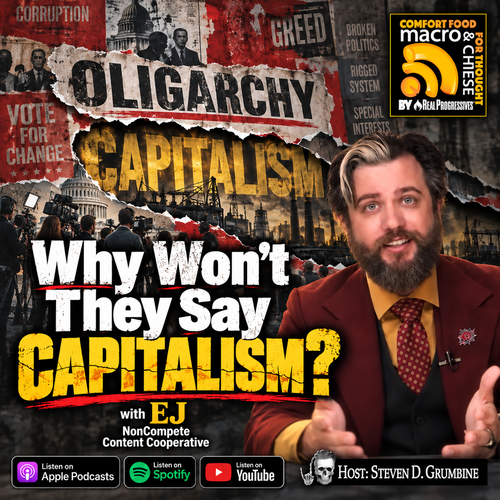
Episode 401 – Why Won’t They Say Capitalism? with EJ of NonCompete Coop
FOLLOW THE SHOW
Why do progressives say oligarchy instead of capitalism? EJ of NonCompete explains why the word matters and what class-conscious organizing looks like.
**Don’t forget Macro ‘n Chill, the Zoom gathering where we’ll discuss this episode of the podcast and build our community. Tuesday, October 20th at 8pm ET / 5pm PT. Use this link to register
Steve is joined by EJ, host of the NonCompete YouTube channel, editor-in-chief at Banyan House Publishing and producer for Luna Oi [Nguyen]. EJ is an American expat in Vietnam, and this conversation grows out of his article, Why Won’t They Just Say Capitalism? The Progressive Fixation on Oligarchy is a Diversion from Class Struggle. Steve admits he uses the word “oligarchy” himself, as a carrot to pull people into conversation. But is oligarchy a handy on-ramp or a diversion? “Fight oligarchy” and “No Kings” get people fired up, but they don’t really collide with capital. It’s bad man vs good man politics. It’s band-aids on heart attacks.
EJ starts with method. Historical materialism defines things by their relationships, so the political and the economic are one system. It’s dialectically intertwined. The oligarchy is the capitalist class and its agents in the state; and the state is there to enforce class relations. Who owns the means of production? That’s the property question, and the ruling class wants workers to stop asking it.
Then they take on a familiar objection: words like capitalism and socialism scare people off. EJ points to Graham Platner and to Bernie Sanders, who rarely says capitalism without an adjective stuck on the front. But they’ll call us communists no matter what language we pick. After years in marketing, he’ll tell you people can smell deception a mile away. And the truth is on our side.
From there it’s reformism. EJ walks through Lenin’s Marxism and Reformism, Marx’s Critique of the Gotha Program and the long fight against economism. Reforms won under capitalism get snatched back if they don’t feed a class-conscious movement. Steve brings the MMT lens. A currency-issuing government faces no financial barrier to universal healthcare, free college or a Green New Deal. So why are workers begging for concessions? This all tells you who the state serves.
The last stretch is about what to build. EJ turns to the Vietnamese revolution and its red unions, including the 1945 uprising in Hanoi and the role of power plant workers. He looks at the strengths and failures of the IWW and at how US unions got captured, and he’s blunt in stating nobody can hand us a finished plan. We learn strategy through practice and mistakes. He and Steve get into the balance between tailism and commandism, and Lenin’s highway bandit analogy. When is compromise about survival and when is it selling out.
The takeaway: naming the system is the first step toward organizing against it. Theory and practice must be connected.
EJ is the host of the NonCompete YouTube channel, editor-in-chief at Banyan House Publishing, and producer for Luna Oi. A former marketing professional, he writes on dialectical and historical materialism from Vietnam. Find his work on his Substack, substack.com/@noncompetemedia and the NonCompete YouTube channel, youtube.com/@NonCompete
[00:00:42] Steve Grumbine: All right, folks, this is Steve with Macro N Cheese. You have heard me talk incessantly, and yes, it’s become a drinking game, about the Gilens and Page study in 2014 from Princeton. The, “hey, we’re not a democracy, we’re an oligarchy.” And there’s a reason for that. I talk about it all the time because I am trying to get regular Jane and Joe six-pack from the progressive movement especially, to stop thinking they’re going to somehow or another vote their way out of this.
It’s extremely challenging. And it’s like, you know, when you try and tell it from your own vantage point, it’s like, “What’s your credentials? How could you know this?” And so it’s like, well, you know, I take this Princeton study.
And Princeton is not my homies, right? This is not a… A place where I have friends and hang out and stuff like that. Princeton is the absolute epitome of the bourgeoisie. I mean, it is absolutely not. But it is something that the average person, just like the New York Times. I don’t value the New York Times, but I know most of you do.
And if they sometimes get something right, I’ve used it. Guilty as charged. But this term oligarchy is not really shorthand for the bigger problem. We try to use it as the catch-all because it helps us avoid facing head-on the real collision, and that is with capitalism. And some will say, “Hey, we don’t live in capitalism.
The government could choose to eliminate capital all day long.” Yes, it could. The government could do a bunch of things to stop these things. And you’re absolutely correct if it was in its class interest to do so. We’ve talked about Gramsci here. We’ve talked about a lot of things that show that the institutions of the state are all elite representations of the capital order, that they are there to manufacture consent and to create what we consider to be common sense.
And so the convenience of folks like Bernie Sanders and others using the word “fight oligarchy,” “No Kings,” all this stuff, it grabs people in the feels. It gets them excited. But it doesn’t have any teeth. It doesn’t have any real landing spot. It really comes down to bad man, good man, you’re bad, so we’re going to get the bad guy out of here.
And while all these things may be true, they’re not the real story. In fact, it’s like putting Band-Aids on heart attacks. So to discuss this. I brought on EJ of Non-Compete, and just so you all know who EJ is, most of you probably do know who EJ is, but EJ is the host of the Non-Compete YouTube channel, editor-in-chief at Banyan House Publishing, and producer for Luna Oi, who has been a guest on this program as well.
He’s an expat living in Vietnam. Very, very brilliant theoretical discourse that comes from his channel. In fact, I’ll go so far as to say probably one of the best discussions I’ve ever heard on understanding dialectical materialism came from him. So I asked him to come on to the show to talk about a very specific article that he wrote in his Substack that kind of corresponds to everything this lead-in brings up.
And it’s called, Why Won’t They Just Say Capitalism? The Progressive Fixation on Oligarchy is a Diversion from Class Struggle. So with that, let me bring on my guest, EJ. Welcome to the show, sir.
[00:04:14] EJ: Thank you so much for having me. I’ve been looking forward to this since you interviewed Luna, and I was so excited to hear that conversation you all had. And I think that the work you guys do here is really important. So thank you so much for having me. And I think this is an important discussion. And now is a very important time to be having it.
So yeah, I think that the time is great to have this conversation. I’m working on a video right now. Hopefully it’ll be out by the time the podcast goes out, but I’m working on the video version of the same blog post you were talking about, about why won’t they just say capitalism? And yeah, I’m ready to dig into that topic.
[00:04:52] Steve Grumbine: Well, you know, it makes me laugh to some degree because I am super guilty of this. I use it all the time, but it’s because it’s what the, you know, you know, that saying meeting people where they are kind of thing. This is what people are talking about. And so I use it as a carrot to bring them into the conversation.
Am I successful? I have no idea. I was on Jimmy Dore the other day, which is probably not the place most people think of Steve Grumbine showing up to talk about things. But I was on Jimmy Dore the other day talking not only about, you know, economics, but I also defended, you know, the revolution in Russia. And I defended quite a bit of tropes that he kind of threw out there regarding, you know, how communism and capitalism lead to the same, you know, evils, blah, blah, blah. [Horseshoe Theory]
And it drove me crazy. Yeah. I mean, like it was just sort of, I was like, why did you do that, man? But it gave me a chance, you know, and it was, you know, I want to be clear here.
I mean, I appreciate him giving me the platform. It was an opportunity to reach an awful lot of people. And, you know, the feedback has been overwhelmingly positive. But it is the standard narrative, right? I mean, a lot of these things that we talk about in everyday life are distractigons. They’re not really focused on class. They’re not really focused on the real battle that we’re facing.
And I felt like your article in particular really, really, you know, hit home some of these key points. I mean, you don’t deny that we’re an oligarchy. You don’t deny that these things are happening. You’re just saying they’re after the fact. They’re not the core. They’re not the primary thing. And I want you to explain, I guess, better.
I have an MBA, so this is not me saying I don’t understand capitalism. Sadly, I understand it from the other side as well. So let’s talk a little bit about capitalism. What is capitalism for the people out there that are wondering, and why does it matter that we center capitalism and class struggle in our conversations?
[00:07:00] EJ: Yeah, well, capitalism is an oligarchy. It’s not inaccurate to say that capitalism is an oligarchy. That’s accurate, but it doesn’t tell the whole story. It’s a form of class society, and class society has been developing continuously for thousands of years. And the current, we just capitalism is just the current stage of development that we are in now as far as the political economy of human society goes, right?
So what I try to say in the work that we’re doing at Non-Compete, what we try to say is that in our current society, capitalism is the oligarchy. The capitalists are the oligarchy and the oligarchy that we have is capitalism, right? They’re the same thing. And I get pushback from people in the audience sometimes who say, oh, well, oligarchy is a political term and then the capitalists are an economic class.
But one of the things that’s really important to wrap your head around if you’re new to the ideas of historical materialism, the Marxist interpretation of history, the materialist approach to studying history is that we call it a political economy because it’s one thing, it’s one system, right? And one of the first things that I think people need to learn, like, I don’t, I’m sure your audience is probably, you probably have some people in your audience that are very familiar with dialectical materialism.
I’m not trying to talk down to those people, but then a lot of people are new to it, right? Because we don’t get taught this stuff in school. So if you’re new to dialectical materialism and historical materialism, one of the first things I think you need to wrap your head around is that we define things by relationships, by internal and external relationships, right?
So as opposed to like the kind of more mainstream kind of philosophical ontological approach of metaphysical categorization and listing out characteristics, right? So, you know, a lot of people would I’m sure that when you were, you know, getting your MBA, you were probably taught a list of characteristics to define capitalism. That’s certainly, you know, what I was taught when I was in high school and college was that, like, you know, it has like certain features, and you can categorize it in certain ways, and that’s how we define capitalism.
But the way that we define capitalism in this historical materialist approach is by looking at the relationship, for instance, the relationship between the different classes, the different economic classes, right? So capitalism is defined by a relationship between the capitalist class and the working class.
And then there are some other classes like sort of transitory classes, like the petty bourgeoisie and the lumpenproletariat. That’s kind of getting in the weeds, but you know, looking at those relationships and also the relationships that those classes have with the means of production, right? So like the workers, the proletariat are a working class that operate the means of production.
The capitalists own the means of production. You probably heard, people probably heard this stuff. They’re probably at least familiar with it, but then. It’s also really important to understand the relationship between the political superstructure, the state, the politicians, all that stuff, the military, because the state exists basically to violently enforce the economic class society. So there’s a relationship between the political superstructure and the economic base, and that defines our current stage of development of human society.
So that’s a very long-winded way of explaining what I mean when I say that the oligarchy: the like super structural oligarchy, the elites, the Epstein class, whatever you want to call them, right? Those are all different terms for the capitalist ruling class and their agents, which they use to enforce the capitalist political economy. And really importantly, you know, very important to stress this, that to enforce the class relations of capitalism, the what Marx called the property question, right?
Like they don’t want us asking the property question, which is who should own and benefit the means of production, you know, and why should we as workers who operate the means of production, why should we allow the capitalist class to own and benefit from the means of production and exploit us through the wage system of capitalism, right?
They don’t want us asking those questions. And that’s precisely why there is this configuration. This, I guess you could call it, I mean, well, we can get into like, you know, Bernie Sanders and, you know, the reformists. I have a whole lot to say about that. I don’t want to get too far out there yet. But that’s, yeah, long story short, that’s what I mean when I say that the oligarchy is capitalism and capitalism…
That hasn’t always been the case, you know. So like hundreds of years ago under feudalism, the oligarchy was like the feudal lords and the religious, you know, the church and all that, you know, there were different. economic classes that compose the oligarchy under feudal times, right, but those classes have for the most part faded away and now the oligarchy is the capitalist class and the oligarchy benefits from cap… They are the capitalist class so you know it’s the same thing now where we are in time.
[00:12:19] Steve Grumbine: It brings me sort of to the Bernie Sanders question but I don’t, I want to be before Bernie real quickly. You know we have DSA and these other kind of wings of the Democratic Party because let’s be fair they’re not socialists and they are not fighting to end capitalism, um and they inform a lot of what many “would be” maybe even nascent socialists people that are taste testing the word socialist you know they kind of inform the belief system of many people and they’re not a monolith they have a bunch of different wings inside there but in the end, they ultimately aren’t a real threat to capitalism.
And there is, you know, wordsmithing. They’re quick to punt on maintaining the line on these principles. And one of the things that I guess jumps out is the kind of, you know, “hey, you know, we got to stop using words like capitalism, socialism, communism and class struggle because it alienates people that might otherwise support working class policies.”
You seem to reject that, which, thank you. Can you explain that?
[00:13:30] EJ: Yeah, well, I will quote the great theorist Graham Platner.
No, but when he was, you know, before his fall from grace, when he was out there being interviewed by, you know, mainstream press and that sort of thing, if you go back and look at the interviews that Graham Platner was making all the time, and Graham Platner… By all accounts, by all of these reformists’ accounts, it was doing everything right before the fall from grace.
What he said repeatedly, and that’s their position, by the way, it’s not my position. I was way ahead of the curve on not being a big fan of Graham Platner.
But there was this narrative that Graham Platner was doing what we’re supposed to be doing. And Graham Platner would say repeatedly that… Because, you know, people were calling Graham Platner a communist and a socialist, Graham Platner always repeatedly said he was not a communist. He was not a socialist. He would say flat out, like, I own a business.
I don’t want to lose my business. Like, why would I be a socialist? Right. But I think people put on blinders when they feel like they might have a savior or a hero who’s going to come, you know, rescue us, right? And so then they’ll ignore very crucial things. But anyway, I’m drifting off scope here. The point is that what Graham Platner would say constantly is they’re going to call us communists no matter what.
They’re going to call us socialists no matter what. And this is something Graham Platner said all the time. They called Hillary Clinton a communist. They call Barack Obama a communist. They call Joe Biden a communist. And that is true, right? No matter what we call ourselves, they’re going to call us communists, they’re going to call us socialists, and they’re going to…
demonize communism and socialism. And I think the idea that we can change people’s perceptions of us by using different language is, a) I think it’s a little silly and unrealistic, b) I think that, like, look at the word woke or look at DEI or look at, you know, the word “cancel” and the whole thing of “cancel culture,” right?
Whatever language we come up with, those are all words that had very valid. You know, it’s no coincidence that two of those three words come directly from, you know, the black community, you know, like woke. I actually just was researching the history of woke. I didn’t realize it goes all the way back to the 1920s, you know.
It’s only really recently that white folks have found out about the word. And then it’s, you know, and as soon as it started to become part of the general, you know, vocabulary where people were using it a lot to talk about systemic issues that are very much tied into capitalism, as soon as it became like this kind of powerful word in the in the zeitgeist it started to get demonized and attacked and run into the ground and the same thing happened with like “cancel culture” that’s like a whole that’s become this whole like buzzword on the right to kind of attack you know anybody and everybody.
And so, yeah, whatever word we come up with, I mean, you know, if we decide we want to call ourselves, well, you know, Bernie Sanders likes to play rhetorical games about, you know, how to describe capitalism, right? So, like, he always adds these caveats. I actually just went through, like, all of his fight oligarchy or, you know, stop oligarchy speeches.
I watched, like, all of them. I read two of his books. One of his books is called It’s Okay to be Angry About Capitalism. And in that entire book, He he never uses the word capitalism itself without attaching the adjective Uber, right? So he says we need to stop Uber capitalism. We need to stop. You know, he used to use different terms like back in the ’90s.
You could find clips of him talking about like crony capitalism or casino capitalism. Like he’s always caveating it. He’ll never just attack capitalism directly. And a funny thing is that. the two times that the word capitalism show up in the book, it’s okay to be angry about capitalism. He’s quoting actual like socialists, like communists. And one of those Eugene V. Debs,
who was like a real actual socialist who, you know, is quoted as saying like, I am a proud Bolshevik. I’m paraphrasing, but you know, but Bernie won’t use the word capitalism because capitalism is not what he really opposes, right? His whole conceit is that we can restrain capitalism but we don’t need to play those kinds of word games like you know the Bernie Sanders’ of the world because the truth is on our side and I think that’s really really vitally important. I totally recognize that there is resistance to the idea of communism and socialism, I totally get that. I mean I face it all the time and you should see some of the comments that I get on my channel.
Nobody said that it was going to be easy, but I don’t think that we can make progress by lying about who we are. I don’t think we can deceive people. My background before, funny enough, before I started my blog and my channel and all that stuff, I was in marketing for a long, long time.
And I did marketing and advertising. And one of the things that I learned doing market research and studying how people interact with brands and that sort of thing is that people are very sensitive to authenticity and they’re also very sensitive to deception, right? So people are drawn to authenticity or what they perceive as authenticity. And people are usually pretty good at telling when somebody is being like completely deceptive.
And I don’t think that it’s in our interest at all to be deceptive, especially because again, the truth is on our side and it might be an uphill battle kind of getting people to understand what we mean when we say communism. And to go up against all those, you know, many, many decades of propaganda against communism and Marx and socialism and all these, you know, words that might be…
These words used to scare me, by the way. You know, in all honesty, I started out as a you know, when I was like a teenager, I was like a right wing libertarian. And then…
[00:19:31] Steve Grumbine: Have you been reading my bio?
[00:19:34] EJ: Well, you have an MBA, so. [Say less, right?] There’s got to be some skeletons in that closet.
But yeah, no, but yeah, I guess, you know, the truth, like part of, well, no, I mean, the philosophical framework of dialectical materialism is a process of discovering and disseminating truth, right? And scientific socialism is about teaching our fellow workers the truth about capitalism and the truth about reality and the truth about the relationship between the economy and the super[structure], you know, all this stuff, we need to be able to teach people how things really work and we need to be dismantling false consciousness.
And we can’t do that by lying about ourselves or what we believe or about capitalism or use it, you know, trying to come up with new language. It’s just not going to work. And anything we come up with, they’re going to demonize and they’re just going to associate with communism. I mean, they associate DEI [Diversity, Inclusion, Equity] with communism and Marxism, you know, like Donald Trump will go on, you know, truth social or whatever, and write out a couple of incoherent paragraphs about how like wokeness and DEI are like Marxism.
And then, you know, there’s the whole cultural Marxism thing, you know, a few years back was a big trend, you know, whatever we come up with, they’re going to associate it with communism. So we might as well just tell the truth.
[00:20:53] Steve Grumbine: You know, it’s funny you say that. I’m going to go on a soapbox momentarily, [Go for it…] you know, Gabriel Rockhill wrote, you know really really good book on Who Paid the Pipers of Western Marxism and a lot of “academic marxists” have kind of treaded that liberal journey they kind of crossed over and eliminated class and things like DEI and stuff like that probably sound like the kind of identity politics many of them embraced. I mean and that’s not to say it’s bad you know, I mean it’s not to say you know struggles or what but they detached them clearly from class struggle.
And when I think about where I came from and so forth, I started off very, very heavily in the bad man theory. Bad man, good man. You’re bad, so therefore you’re good. Hey, if we just replace bad man with good man, everything’s better, right? And that underlying…
Literally, it is hegemony speaking in my ear, in my brain. It’s the cop in my head. It’s the all the other things that, you know, we are trained to believe. And this election stuff, you know, I had Breht [O’Shea] from Rev Left [Radio] come on here and we had a discussion about the infantile disorder book, right? We’re talking about left wing communism, you know, an infantile disorder.
And you see DSA-ers that Bernie represents in many ways, use that as just a cudgel against folks that are fighting about the essence and relationship of institutions like elections and like all the other vast complex of institutions that the ruling elite / capital order, whatever you want to call them, have put in place. I mean, all the laws on our books, every single one of them are there to protect private property.
They’re there to protect these relationships that enable capitalism to thrive. And, you know, as I think about it, it’s like Breht made the distinction that, you know, Lenin would have never told us to participate with a capitalist class party, a capital party. But yet at the same time, though, in the US, they’ve kind of got you narrowed down to this duopoly thing.
So you’ve got all these little teeny third parties cropping up and splinters everywhere and so forth. I find elections in the United States in particular, and yes, this is the imperial course, so yes, I’m focusing on it, but it really is, in my opinion, and you can take my Gilens and Page study from the beginning of the conversation and you can look at it and you can clearly see that
nothing we say or do through these elections bears any fruit whatsoever. And I’m 57, so I can look back a number of years and I see zero. Add in. And this is probably a point of contention with a lot of Marxists in our work, because we understand Modern Monetary Theory and we focus on teaching people how fiat systems work.
And you add the state and its nature as a capitalist entity, and then you add in the way that the monetary system works, which is: they create the money. It’s not like they’re borrowing this money. All these debt and deficits are there for the little people to panic over, you know, not the big people who are spending like drunken sailors on whatever they want, okay?
So when I think about all this, I think to myself, it’s one big, huge theatrical production meant to manufacture consent. However, I know that there is this, “Hey, you must be an ultra. You’re saying bad elections or this and that and the other.” Help me understand, when does reform stop being real? When does it become just another shortcut like oligarchy and so forth?
Where is the line there? Because I don’t see value in campaigning for candidates, door knocking. Now, I understand there’s a revolutionary potential, there’s struggle. I mean, you got health care and all these things. At what point does that just bolster capitalism versus actually create revolutionary potential?
[00:25:16] EJ: Funny you should say that because I just finished reading Marxism and Reformism by Lenin, which was written in 1913. Have you read that before?
[00:25:25] Steve Grumbine: I have. Please go. Your interpretation would be much better than mine.
[00:25:30] EJ: Actually, I just read it for the first time like a couple days ago doing research for that video. I think I got a paragraph here.
I’m just trying to find exactly where I should start reading it. Basically, what Lenin says is “workers who have assimilated Marxist theory, in other words, realize the inevitability of wage slavery so long as capitalism remains, will not be fooled by any bourgeois reforms. Understanding that where capitalism continued to exist, reforms cannot be either enduring or far reaching.”
That’s a really important point. I’m interjecting here. This isn’t Lenin, but that’s really important to understand. Whatever reforms we will win through like the struggling within the system or whatever, they’ll eventually be revoked, right? I mean, and that’s exactly what we’ve seen in the last couple of decades, right.? I mean, there were workers who spent a century fighting to build unions and to get the eight hour workday and all this stuff.
And it’s all just being taken away, you know, at the end of the day, because we never seized control of the means of production or built a worker state or any of the stuff that you need to protect those gains, right? But anyway, OK, Lenin continues. “The workers fight for better conditions and use them. (This is Marxist workers, right?)
Workers who understand Marxist theory fight for better conditions and use them to intensify the fight against wage slavery. The reformists try to divide and deceive the workers to divert them from the class struggle by petty concessions. But the workers, having seen through the falsity of reformism, utilize reform. (This is really key) utilize the reforms to develop and broaden class struggle.”
So, you know, Lenin is not saying that reformism… Or not. OK, let me put it this way. Not reformism, but Lenin is not saying that reforms are completely useless, but they have to be part of a project of class struggle. They have to be part of a class conscious movement that understands the property issue, that understands the structure of capitalism and understands the historic mission of the working class which is to have social revolution, overcome capitalism, and build a stateless, classless society and end class society once and for all.
If workers don’t have that understanding, then it’s just like a never-ending, infinite game of whack-a-mole where you might get some concessions here, one year, a couple years later, they take them away. And it’s just this constant, it’s a treadmill, right?
It’s not part of a bigger project to have economic liberation, right? That’s the real problem with this kind of pure reformist, non-class conscious sort of like pseudo-socialism, whatever you want to call it. And, you know, this is not new at all. Marx struggled with this stuff with like the La Sallians. If you, you know, I’m sure you’ve read Critique of the Gotha Program.
You probably read Critique of the Gotha program like in your business school, you know, because it’s such a pivotal, you know… Marx was talking about this stuff in the… mid 19th century because he was watching people, you know, workers get fooled by this stuff. And it was really worrying Marx and Engels because they had seen it happen, you know, time and time again, where people were just trying.
So, so one of the things that happened was like back in those days in the 1800s in Germany, class society was a lot more complicated because they were still kind of in this transition period, right? So there wasn’t just the capitalist class and the working class and the petty bourgeoisie. There were also remnant classes and some of them very powerful, like the monarchy, the feudal lords were still there, the Junkers in Germany who were like these militaristic landlord feudalists.
And there were still peasants, right? So there was a guy named LaSalle who he wanted to work out a deal with the Junkers, with that landlord class to where… In exchange for letting them maintain their land holdings and their power over the peasants, the Junkers and the monarch would give the workers a lot of concessions. This is what LaSalle was trying to work out, this deal.
They would give the workers concessions where they would basically be able to have worker-owned co-ops and better working conditions and higher wages.
LaSalle was trying to ally with the nobles against the capitalist class. And it was really just this program for concessions. And so that’s why when, uh, fast forward, it was like long after LaSalle died, I believe, there was an attempt to build a new party, which ended up becoming the SDP [Social Democratic Party], which still exists today and still relevant in Germany.
But, uh, they, they had a program, the Gotha program and the whole thing was basically saying our mission is to get more concessions from, from the ruling class and better working conditions for workers. And Lenin called this mindset, economism, where it’s like, we’re just trying to get higher wages, better conditions for workers. We’re worried about like the economic, you know, getting economic perks and benefits for workers instead of actually being class conscious and struggling for an actual revolution against capitalism, right?
And Marx was, you know, very, very acerbically critical of, of this Gotha program. And, you know, just railed again and again, just basically beating the drum that you have to put the property question first in everything you do. And it says that in the Communist Manifesto too. So this is like an argument that Marx was having with these reformists for decades in his time.
Lenin was struggling against it in his time. You know, we’re still struggling against it today. It’s a very powerful sort of… I don’t like to call it controlled opposition necessarily, because I don’t think that most people, especially like at the ground level, like the grassroots level, I don’t think most people who are into reformism realize that they are being controlled or realize that, you know, I think that their heart’s in the right place probably, but you know, attention doesn’t matter.
But what’s really, it’s this very attractive thing. Cause it’s like, it seems very immediately attainable. And it seems kind of like more we are conditioned to believe that it’s more reasonable, like a compromise position. And there’s all this propaganda about how, oh, well, you know, the best economies are mixed economies where you have a little socialism and a little capitalism and you get the best of both worlds.
And it’s like this position comes from a fundamental misunderstanding of the nature of capitalism and class society. And that, you know, again, that’s why it’s our job as people who understand it, who understand political economy of capitalism more deeply to not, okay. Like what we don’t want to do is be like arrogant. I’m going to try not to cuss here, jerks and like talk down to people and be like, you know, cause there are a lot of, you know “influencers” who make that their whole personality.
[I’m guilty of it sometimes. I have fallen into that. I want to be clear.] It gets frustrating, right?
[00:32:13] Steve Grumbine: Yes. Yes. [No, it does.] We’ll let you get back to it, but I want to let you know when we get to the next question I’m going to give you, it’s not going to be arrogance because it’s not, but I’m going to frame some things that maybe fall outside of the catechism, and I want to get your feedback on it because I think it’s really important.
But keep going. Sorry, I didn’t mean to.
[00:32:33] EJ: Sure. No, no. I mean, I kind of said, I think as far as that goes, yeah, we don’t want to talk down to people. I really like the Ho Chi Minh talked about it a lot, and it’s something Vietnamese communists talk about a lot. the balance between tailism and commandism. That’s a very important thing. And that’s something that we from the “West,” especially from the USA need to really wrap our heads around.
We don’t want to be commandists where we’re like, basically like ordering the, our fellow workers around and browbeating them and talking down to them and that sort of thing. But we also don’t want to be tailists where we’re like just following along behind the most reactionary tendencies, the most reactionary segment of the working class, right? So, the way I like to put it is we’re walking and teaching alongside our fellow workers, right?
You know, so we might be a little bit ahead because we just happen to be lucky enough to have been exposed to, and it’s really just luck, you know? If I had never moved to Vietnam, I would still probably be completely enamored with capitalism, you know? But it was like living here and especially living through COVID here and seeing how they used a lot of like scientific socialist theory and practice to like tackle COVID.
And that was like really, you know, a huge impression on me. But, you know, it’s like I really can’t take credit for knowing a little bit more about capitalism than most workers because I was very fortunate and I wasn’t like that for most of my life, the vast majority of my adult life.
[00:33:52] Steve Grumbine: That’s brilliantly said, because here’s the thing, right? Like for me, my journey is a little different. Obviously, I jokingly said I came from the right and I did come from the right, far right, actually. And my baptism to this stuff really started with Modern Monetary Theory, passed through the Bernie Sanders movement, part one and part two and part one kind of ended a lot of the emotional belief part two was, “gosh I don’t think I can face what the alternative is” so I went with it still again even though I knew something was wrong and then simultaneously when that went exactly as it probably knew in our hearts it would go anyway.
It became very real to me. And then I started digging into theory, really digging in and learning. I had already started, but I was a babe. I’m still a babe. I don’t want to pretend to be more than I am here. [Same here.] But when it comes to MMT, I’m not a babe.
And I have been on this kick for a long time. And I want to say some things that for the people that listen to our podcast, they’ll probably say, “yeah, Steve, I know.” But just for the purposes of making this point, MMT demonstrates that a currency-issuing government like the US isn’t financially constrained the way households or businesses are.
[Yes]. So if you know that the country itself can provide literally every single thing, we could have a Green New Deal. We could have universal health care. We could have free college. We could have all the basket of programs that progressivism typically ponies up for. Every one of them is 1 million percent possible. We have the ability to create currency when we spend it into existence through Congress, if Congress represented the people, which it does not.
And we have the ability to do all these things. So at the end of the day, people are playing this game, this electoral game where they’re going to win these concessions. But in reality, why do they have to win these concessions? You know what I mean? Why is it that we have to win these concessions? If this is possible, it tells you you’re up against, your government isn’t serving you.
Your government isn’t your friend. These institutions don’t represent the needs of the people. If you know that there’s literally no financial reason whatsoever that we can’t ensure [that] everyone has a good life. It comes down to asking those questions. And the questions are the motives behind capitalism. When I say motives, it’s really the system because the people, yes, there’s going to be bad people, corrupt people, all these different kinds of people, brutal dictators, murderers, blah, blah, blah, all these horrible bad guys.
But the system itself will not reward doing for the people, because capitalism requires a permanent underclass to do the work. And at the end of the day, we’re in a new era, a new epoch. I think Lenin talked about Imperialism as the Highest Stage of Capitalism. And a lot of what he wrote in that very book, pamphlet, whatever you want to call it, pointed to a time where finance capital is doing exactly what it’s doing today.
It’s not some out-of-date thing that didn’t understand. It knew back then this was coming. To me, I think I want my listeners anyway to understand. Hey, listen, we’ve talked about MMT all this time, but you’ve never questioned. You just think we just got to vote for a few more progressives. Maybe if we can teach the oligarchs or the capital order how the money system works, which they used to great precision for austerity and interest rate hikes that give money to the rich while simultaneously raising cost of living for the poor.
I mean, hello. I mean, what about that represents your class interest? What about that represents anything that any of us would want? I bring this to you, EJ, because I know theoretically you have a much deeper, broader perspective of this. But I need the MMT story as part of this, because if you believe that the government just needs a few more tax dollars to afford, you know, giving food to the poor or even just providing a stable economy for all, you’re missing it because, what, imperialism is required to extract from outside so that the imperial core can feed the people.
Help me better understand why capitalism doesn’t allow for these things.
[00:38:27] EJ: Well, I can speculate that a big part of it is that they want us to be precarious. They want us to be unstable and they don’t want workers to become too comfortable because the more unstable we are, the easier it is to control us, right? And when we talk about these things, now we know from the Epstein files that actually there are some smoky back rooms where people are like actually having these discussions, right?
But that’s not necessarily like we don’t want to drift into great man theory and think that this is all just like the will of the capitalists. I mean, the fact is that whether they’re conscious of it or not, whether they’re doing it with intention or not, it’s just it’s in their class interest for workers to be unstable so they can pay us less and so that we’re less likely to have the time and the wherewithal and the means to cause problems, right?
And the biggest problem for them, of course, would be revolution. So you talk about Gramsci earlier in the introduction. I mean, this is something Gramsci talked about a lot is that the biggest disadvantage we have as workers is that we have to work for a living and we don’t have people to work for us, right?
So when the capitalists are waging class warfare, they can hire employees to do their propaganda. And they have the whole apparatus of the state. They have the violence of the police and the military to attack us. We have to spend so much time working. We have to spend time taking care of our family. We don’t have nannies for our kids.
We don’t have all this army of servants to take care of our laundry and our chores and that sort of thing. It’s a lot harder for us to… If you’ve ever talked to organizers and activists and that sort of thing, it’s like they’re just… The time commitment is very difficult. It’s difficult to take time off work to…
to build something, right? So, you know, that’s a big part of it. And then another part of it is just that like, they have all the power, right? So like, this is the nature of class society. This is why class society is such a terrible thing for humanity because it alienates us from each other. You know, I think one of the things that, you know, everyone should understand about the vision of communism is that first of all, we don’t discount the individual, right?
Like a lot of, uh, you know, the big talking point is that we want to like, you know, put everybody in gray jumpsuits and get rid of everyone’s individual freedom or whatever, but that’s not true. Like Marx was super concerned with the individual and he defined communism essentially as uniting into a harmonious relationship, human society, the human individual who cannot have real freedom without social freedom, right?
Like if society is not free, the individual can’t be free. And then also uniting human society and the individual with nature and Marx and Engels were like naturalists. They were talking all the time about how this, you know, the Victorian idea of how we’re going to like conquer nature to struggle against nature and we would overcome nature or whatever.
They were saying that that’s, you know, BS in the 1800s. They were talking about how every time humans try to conquer nature, there’s these like catastrophic results that we shouldn’t be trying to like have a battle with nature. We need to understand that we are of nature, you know humans are natural animals but class society severs us off from each other and capitalists are super severed off from us, I mean you know there’s that uh one famous psychological study where they were having um oh my gosh I’m going back and way back in my memory but there you know it was like it was about empathy and people playing board games and people that are like very wealthy tend to have less empathy when playing games and that sort of thing and um that’s a symptom of alienation.
And it’s a symptom of how we’re severed off from each other along these class lines, right? So, you know, if you are in the ruling class, the natural tendency is for you to fight for your own class interests.
And, you know, the big struggle of history is the struggle to benefit from the means of production, right? That’s, that’s what it all really boils down to. It’s like, we have all these tools. We have this land that we use to grow our food. We have these machines and all this stuff, right? And the big question of class society throughout history has been which economic classes will benefit from the means of production, right? And that is the, that’s the nature of class struggle and capitalists have class consciousness. They develop class consciousness when they were the revolutionary class. [Ahhh]. So, you know, back in the 1600s and 1700s, they developed a theory of revolution. They realized their historical mission was to seize the means of production from the feudal class. The feudal class was holding society back.
Over time… Technology tends to develop. The productive forces tend to develop. We get better ways of making things. And we had this industrial revolution. And the feudal superstructure of society was incompatible with those new means of production. And the capitalist class, which at the time was embryonic, very new, they realized that. And they said, we could do a much better job running things.
If we only, you know, seize power. And that’s why they had this big wave of bourgeois revolutions. And that’s how they seize power. And that’s why they have class consciousness now. And believe me, they, you know, you could see they use class struggle all the time. They’re constantly engaging in class struggle. And the problem is that, yeah, we don’t.
[00:43:44] Intermission: You are listening to Macro N Cheese, a podcast by Real Progressives. We are a 501c3 nonprofit organization. All donations are tax deductible. Please consider becoming a monthly donor on Patreon, Substack, or our website, realprogressives.org. Now back to the podcast.
[00:44:07] Steve Grumbine: Well, exactly. And I guess that brings me to the next question, right? Obviously, we’ve talked a lot about capitalism and we’ve talked a lot about kind of the reformism that is inherent in jumping away from the essence of capitalism and the class struggle that is inherent to it. I guess my question is this. So let’s say we convince millions of workers that oligarchy isn’t an aberration from healthy capitalism, but an expression instead of that capitalist class power.
What do you think comes next? I mean, everybody always says, and I’m sure you’ve heard this, “what’s your plan?” And so it’s like, well, you know, we may not see this in my lifetime, but we need to educate, educate, educate. But it’s like what institutions, organizations and forms of political education have to exist for class consciousness to actually become working class power?
[00:45:09] EJ: Well, just looking at the Vietnam Revolution, because that’s the revolution I’m most familiar with, right? Because I’ve been living here for so long and I’ve talked to a lot of Vietnamese communists and I’m fortunate enough to have like one of the best translators alive right now. She was actively translating Marxist literature, Luna, into English, you know. She’s taught me a heck of a lot about the revolution here and their revolution was successful in the… Okay, everyone thinks about the war. Everyone thinks about the war – most people just think about like 1965 to 1975 which was the chapter where the USA was involved with the war, but before that they were fighting the French and before that they were fighting the Vietnamese [Japanese] and before that they had decades of colonial occupation. There were decades between the time that Ho Chi Minh and the earliest Vietnamese communists developed class consciousness, say around 1920, right?
In the Declaration of Independence in 1945, that was a 25-year period of time.
And then until they actually won the revolution in 1975, I mean, that’s decades, right? That they were having to build a revolution. And it started in the 1920s with really the first real institutions that were built were the Communist Party. I think it was called like the Communist Party of Indochina at the time because it was encompassing Laos and Cambodia as well.
And then the other really important institution was the Red Union. There were these red unions that they were building that were like class conscious workers unions that were really important. These were not just unions that were like struggling for, you know, again, like we were talking about earlier, higher wages and that sort of thing. They had a understanding of the historical mission of the working class.
They were struggling, you know, of course, they were trying to get better wages and that sort of stuff is like part of it. But that was like in service to the guiding mission of class struggle. And these Red Unionists were like some of the first kind of militia forces. There’s a really fantastic museum in Ho Chi Minh City that most people don’t go to.
It’s the Ho Chi Minh City Museum. If anyone ever comes to Vietnam, I highly recommend you go there because you’re going to see stuff that you just, you know, there’s nowhere else to find this information in English, right? And they have these exhibits where they’re showing like photographs of these union members. Okay, this is one of my favorite stories about just Vietnamese class struggle.
So when they decided to declare independence in 1945, you know, they were being occupied by Japan and France and they were trying to figure out what to do. And in Hanoi, they had to do this like mass uprising. And everyone had to coordinate, and everyone had to rise up at the exact same time. So how do you do that when you don’t have walkie-talkies, you don’t have telephones, you don’t have any kind of way of mass communication, right?
Well, what they did was the workers’ unions at the power plants, they all cut the power at the exact same time. So the signal to the whole city was when the power goes out, that’s when we all rise up and have the revolution and declare independence and all that kind of stuff, right? I think that’s a really interesting, fascinating story.
But you look at the pictures of the union members and they’re wearing, you know, they all have like uniforms and these little hats, you know, it’s like really cool, like example of revolutionary discipline and organization and unity. And then if you go to like the… I’ve been to a couple of the prisons where they kept communists, like the French have one on Fukuoka Island, there’s one.
And you read the stories about how even when they were in prison, they had like really strongly developed revolutionary discipline. They all worked together. They took care of each other. And there’s a lot of really, you know, sad stories, of course. And then there’s a lot of really inspiring stories that took place in those prisons. Like they would all, you know, work together to like help one person escape or they would, you know, they had all these different… they were working together even in prison.
And they had this oath that they would take, the revolution. This is like, you know, again, before the wars, before the Battle of Dien Bien Phu and all the stuff that you might be familiar with before the USA even got involved there, they would swear oath to never commit suicide because they needed every comrade they could have.
So they had an understanding of just how important the class struggle was and how precious every participant in the class struggle was, and they had this solidarity. So I guess to answer your question, I would say… We need class conscious union activity that goes well beyond the sort of… If you look at the history of unionism in the US, by the way, I recommend everybody study the early days of the IWW [Industrial Workers of the World] in like the 1910s because they were militant unionists.
They were studying Marx and they were really, really successful to an extent in uniting black and white workers, even in the south where I’m from, right? I’m from South Carolina.
[00:49:46] Steve Grumbine: Is that the Wobblies?
[00:49:47] EJ: Yeah, that’s the Wobblies. Yeah. They had the idea of industrial unionism, which is where everybody, you know, the one big union where everybody, no matter what trade you’re in, you’re part of this one big union.
And their goal, their explicit goal was overthrowing capitalism, like ending the wage system of capitalism is the way they put it. But then they weren’t perfect, you know, like there were some problems they had, especially when it came to like trying to work with black folks. They basically told black folks like not to engage in political struggle for like, you know, liberation from racial oppression, because they said the only thing to worry about is the general strike.
And they wanted to like kind of myopically focus on that. That was a big problem. But then the real big problem was they opposed World War I. Rightfully so. And they advocated for revolutionary defeatism. But when they did that, they all, all the leadership got arrested by, you know, the ruling class.
And so they just basically got wiped out. And then in the 1920s, that’s when trade unionism, as we have today in the US, really just basically took over. And that’s what we have now. And I mean, believe me, I mean, I’ve been a member of unions many times in my life. And I have a lot of really good comrades who are in unions who are dedicated revolutionary, you know, Marxists.
So, you know, and I know there are like, some unions are a lot more militant than others, etc. But by and large, you know, unionism in the USA has become quite captured by the ruling class. And it has become this sort of reformist economist, as Lenin would say, kind of thing. So we need red unions. We need unions that are class conscious.
We need people in unions who are class conscious. Now there’s a problem with that, which is the, to my knowledge, it’s actually illegal for communists to have like leadership positions. I don’t know if it’s illegal or if it’s just against like the policies of a lot of unions or whatever, but I’ve been told by a lot of my comrades in unions that they have to like kind of keep it on the down low that they’re members because they could get barred from leadership positions and that sort of thing.
So that’s one problem we have to overcome and figure out. But then, you know, we need our communist party or parties. And that’s a tough question. Cause you know, the USA is such a, I’m talking about the USA right now. I know.
[00:51:45] Steve Grumbine: Sure.
[00:51:46] EJ: You probably have folks all over the world listening to this, but the USA has a problem of scale, you know, cause the USA is not really one nation.
It’s a prison of nations. And you know, the question of whether we’re going to have like one party or whether we could have one party, you know, that’s not for me or you to decide. And we can’t… I want to go back to one of the things you were talking about, which is like, well, what’s the whole plan?
Don’t you have like the whole plan laid out? And it’s like, you know, that’s something that Marx and Engels cautioned us against. They call that utopianism. And they said, you can only really find out what works and what doesn’t work through practice. It’s just like any kind of science, right? Like you’re not going to know what tactics work effectively until you try them.
This is something Fred Hampton talked about quite a lot. You know, one of the great leaders of the black Panther party who was assassinated by the, by the US government way too early, very young age. But he talked a lot about how we have to practice and we have to make mistakes and we learn from making mistakes.
And it’s going to be hard. We’re going to have to struggle. And that’s how we learn, by failing and learning from the failure. So that’s a big part of the process.
[00:52:48] Steve Grumbine: I really appreciated the way you broke that down. We had a gentleman on here who is one of the labor lawyers within the airline union and beyond. Works with Sara Nelson, who is very much a Bernie person. But she had Joe Burns. And Joe Burns wrote a book called Class Struggle Unionism and I thought it was incredibly important at the time. It was as edgy as I was able to get to at that point, and even that though just so you’re aware we talked to the folks at some of the the bigger unions the AFL-CIO and on and on. And to be fair they’re so far from that. I mean we are talking about like “Whoa, way far away from that.”
And so just saying some of these things is spicy on its own, you know, on its own, right? But one of the things that you said at the end, and I want to say this, we have to endure and live in capitalism.
And, you know, we all have jobs and hopefully, you know, most of us have jobs and so forth. And it doesn’t mean we should hate our lives. We have to struggle here and things are not going to happen instantaneously. And I think that that’s tough for people to get their head wrapped around. It’s also the same ploy that’s used by electoralists when they’re trying to talk about economism and so forth.
So having that defined understanding, the theoretical understanding of these class structures, even though we don’t have that same industrial kind of playground that a lot of this stuff was written during. That people often say, “Oh it’s outdated it’s not relevant, it’s just we don’t live in that world anymore. You know we’re a service economy, we’re whatever.” The power relations are still the same. The same essence of class domination is still there whether or not they’re there because of finance capital, whether they’re because they’ve been gambling on bitcoin. Whatever it is that got this divide here, this class divide. I think it’s important because there’s a lot of people out there that when we talk to them, they’re a little too comfortable, even though they’re a worker.
They still work for a paycheck. They still collect the check. They’re still labor. But they’re too comfortable to envision any of this. And, you know, it’s not necessary for you to hate your employer, hate your job, hate whatever.
The point is, is that this is a structural issue, right? I mean, this is not just a personality conflict. I think that’s probably… It’s not just because your boss is mean and so forth, because I like where I work, you know, in the grand scheme of having to have a job, I really enjoy it. So, you know, I want people to really take a step back and think about what has been said in this conversation and kind of reflect upon how it impacts them.
You know, I want to take us also to the last, second to last paragraph anyway, of your article, which I think is really important. I want to end on this note. It’ll let you respond, but I want to… This will be the final talk here. “Class consciousness is the realization that workers can, should, and must seize command of the means of production.
A leader who cannot articulate this directly, not by definition, a leader of the working class struggle against capitalism. The oligarchy is our capitalist political economy is the capitalist class. The oligarchy is the capitalist class. And the capitalist class is the oligarchy. This must be made explicit and communicated openly and boldly to the masses.” Finish off with that, man.
That’s some powerful stuff. And I probably butchered it trying to read it in cadence. But, you know, it really is important.
[00:56:30] EJ: Well, it’s just I mean, it’s really just. I’m basically just paraphrasing the same stuff that Marx was saying over and over again, and that Engels was saying, that Ho Chi Minh was saying. I think it’s remarkable that we’re still having this conversation, and I think it’s remarkable that the ruling class has done such a good job concealing this pattern, because it’s such an obvious pattern once you are able to step back and have this materialist view of history and understand how, over and over again, we keep…
They keep, you know, it’s like Lucy pulling the football back on Charlie Brown. You know, it’s like we fall for it generation after generation. You know, I love to go back and watch videos from the ’60s because I feel like there’s a lot of parallels between what was happening in the ’60s and ’70s and today. And it’s like a lot of the conversations that the college kids were having, you know, and some of these… They filmed and recorded a lot of these protest movements and sit-ins and stuff like that.
And they were like having the same conversations. And they were also being misled in a lot of the same ways that we’re being misled today by reformists. And I think one of the questions you asked earlier that I didn’t answer yet, I think I’d like to end by answering that question as well as I can, because I’ve been thinking about it a lot lately.
You asked, what do we do when it comes to working with reformists and liberals, or how do we engage with political leaders who are reformists and that sort of thing? And I think that Lenin, again, had some really good, strong advice for dealing with that. And I have two sources I’ll hit real quick. One of them is his bank robber analogy, which is basically like, you know, if you’re driving alone at night and you have a pistol and you have some money and you have a car and you get pulled over, it’s not bank robbers, it’s highway bandits, right?
Yeah. If you get pulled over by highway bandits and they rob you, right? Like no one’s going to say that you’re compromising your principles or whatever if you like give them your gun and your car and your money to like survive and live to fight another day, right? But they will judge you if you like say, “Hey I have a gun I’ll go help you rob other people” right? And you join them. So that’s when… So the first example of like just giving them your stuff, that’s like a compromise where you’re compromising but you’re not compromising your principles. The second example where you join them
and you start robbing other people with them, that’s where you’re compromising your principles. And so you know when we’re engaging with and interacting with people who are not class conscious and especially like political movements and leaders that are reformist or liberal or not where we are… There are certain situations where we have to have like tactical unity with them and we will have to work across lines.
I mean, especially when you talk about things like, for instance, the situation in Palestine, right? As of right now, there’s no way that communists alone can do anything about the situation in Palestine, right? We will have to work with people who are progressive and maybe not where we are in terms of class consciousness to build a movement to actually like try to help move the needle on ending that genocide, right? That’s a place where tactical unity is very important. We’re going to have to build like a coalition and work really hard, you know, across lines. And then another thing Lenin wrote that I think not a lot of people have read. I didn’t read it until recently. It’s called On the Significance of Militant Materialism. He wrote it in 1922.
And it’s basically like Lenin talking about how we as communists should form a coalition with other kinds of materialists to build like a broader materialist movement that encourages the masses to think more materialistically. So like one example was we should work more with atheists who have like this materialist understanding of, you know spirituality or whatever.
And then we should also work with like scientists and build alliances with scientists who tend to have a more materialist conception, right? And just build out associations and alliances with other materialists so that it’s not just communists alone, right? And work across lines in those ways. So yeah, I think that we can find all kinds of ways and it’s not always gonna be political, right?
Like I think right now, for instance, artists are really looking for answers. You know, I’m an artist myself. I have a lot of friends that are artists that are not even really that politically minded, right? They haven’t thought about politics much. They think about art all the time, but they’re so worried right now because of AI, because of the economy, because of all this, you know, uncertainty.
And they feel threatened. They feel like their art is being threatened. They feel like their livelihood is being threatened, right? So that’s one great example, I think, of a place where communists, people who are class conscious, should be like extending invitation to the art community to try to like build an alliance and maybe learn from them and teach them things as well so that we can have like this ideological and practical exchange and support each other and build kind of like a working class art movement.
You know, a Marxist humanist kind of art movement would be a really wonderful thing to build, I think. There’s all, and there’s, you know, infinite other… I know gamers are like super pissed off right now because of all the stuff like you know RAM is incredibly expensive right now, video cards are incredibly expensive. The triple A game companies are like really being exploitative and abusive. So, you know, I mean I know that there are a lot of… The reactionaries have made a big inroad into like the “gaming community” or whatever you want to call it, but I think that there’s opportunities to foster class consciousness there and to like form alliances there.
You know, there’s all kinds of, you know, whatever your hobby might be, whatever your interests might be, you should be looking for connections and trying to build dialogue and teach your fellow workers, you know, the role that capitalism plays in whatever struggles that they’re having. Because I can guarantee you that capitalism is going to be the ultimate source of their frustrations.
[01:02:21] Steve Grumbine: Very well said, man. I still struggle with this because we end up being tailists way too often with electoralism. And this is where that division, that dividing line kicks in, right? And it’s a fundamental lack of class consciousness focused on where the power lies. The power isn’t in the political. The power is in the economic. And the power is in ownership.
And the power is who gets to make decisions. And if you’re not threatening that, if that isn’t the goal, then you just end up with economism like what you raised earlier. And I think that for me, that’s a really important distinction here. And I’m struggling with this. I want you to be aware. I am struggling mightily with this.
I struggled with Brett as we went through, you know, the Left-wing Communism an Infantile Disorder. I struggled with it with a number of people. I’ve asked people when they’re talking about anti-imperialism, it’s like, how do you vote away colonialism? They laugh. You can’t. It’s like, well, then how do we vote..? You know what I mean? Like the point is, is that if-then statements are really important to me, you know what I mean?
Like these, if you’re a developer of circuits, you have and gates and you have or gates. That means that and gate means both can be true. Or gates means either or. And it’s very important to know which gate you’re at. If you’re at a gate where both can survive, you know, then fine. But when you’re in an or gate, you’ve got to be willing to take a stand.
You’ve got to be willing to stay true to that. And I think that we lack the kind of “what is to be done” revolutionary discipline, the kind of, and I’m guilty, man. I am still learning. And I think that’s part of the problem is the chasm, the lift to learn and become “sufficiently theoretically proper,” you know. There’s a lot of scolds out there.
[01:04:20] EJ: Yeah. But listen, like you, not just you, all of us, we have to… Individualism is like the number one problem that’s holding us back in, in the USA, right? Individualism is, is fully ingrained into like our psyche on a very deep level. I count myself with that. I don’t think there’s a single person who could be born in the USA without being influenced by individualism.
We have to join organizations, communist parties, whatever you’re, whatever… And again, because the USA is such a huge corporation, which is true, but it’s such a huge, the USA is such a huge nation that…nation state, prison of nations. That I can’t tell you, like people always ask me like, what org should I join? What party should I join?
It’s like, you know, I don’t know what’s happening where you live, right? And that’s just a fact. I don’t know what the people are like in whatever orgs where you are. You have to go to some meetings, to some different groups, see if you find people that you vibe with. Maybe if you don’t have any groups in your area, maybe start like a book club or something.
You know what I mean? But like, you got to find other people to study with, to work with, to practice with. You have to, you cannot do this alone. And like so many people make the mistake of like… Probably one of the biggest problems that people have is they think that like consuming content and reading books is practice.
Ho Chi Minh said, “If you know all the theory, but you never do any practice, you’re just a living bookshelf.” You know, you have to have practice that – you have to have practice combined with your theory because they, again, they dialectically define each other. You can’t have one without the other. And you absolutely must engage in practice to understand the theory.
Like that’s something Ho Chi Minh talked about a lot as well. It’s like, you know, one thing that Ho Chi Minh recommended is you go back and you read stuff that you’ve already read before. Because if you’re doing practice, then every time you read it again, it’s going to have new context in your brain because now you’re thinking of it in terms of what you’re doing right now.
So join an organization. And by the way, whatever org you might be thinking about joining, I’m sure that it’s imperfect. I’m sure that there’s all kinds of things that they’re doing that you don’t like. You probably differ with their platform, you know, whatever org you’re considering joining, but don’t let that like… If it’s a class conscious organization and they’re not like reactionary, like crypto fascists or whatever, like give them a chance and you can impact them as well, right?
Like, I mean, you got to meet people where they are. You can’t expect things to be perfect, but it’s like a lot of people want to just fall into like a perfect, you know, 100% perfect organization. That’s not going to happen.
[01:06:54] Steve Grumbine: I couldn’t agree with you more. We are a small organization and we do a lot of webinars and community building. It’s virtual because a lot of us are either too old or are incapable of getting out and about. And we’re all so spread out. So we’re a virtual organization in many ways. But you said something really important. And I think this is good insight for my own organization.
A lot of people are like pinkies. They want to do it their own way. They want to be off on the side, you know, soloist, you know, doing their own thing. And they forsake the important getting together and talking about this stuff because they have other things on their minds or whatever. And I think that I’ve been beating this drum and I feel like I’m just
a scold at this point almost. And i don’t feel like it’s productive, but I’m at my wits end at times too, right? Like we all are struggling to figure out how do we fit in to make this work and so forth. But i think you made the really important point it’s got to be with people. It can’t just be the guy sitting there riding around listening to ebook after ebook after ebook or audiobook and “Well I read a book this week” you know? I mean that’s great, but there has to be the praxis side of this.
And I think that our book clubs that we’ve been doing, which, by the way, we would love to work with you guys and get some of your content. The things you’ve all been doing have been amazing. And we’re learning. We’re trying to grow that kind of class consciousness together. So any way that we can partner with you all would be a blessing from our perspective.
We would love to be engaged in any of that. But I really love what you said though, because it really, out of everything we said, and there was a lot of good points today, but the one that really is going to impact me the most as I hang up and we go away from this is within my own organization.
The fact that people won’t get together and talk through these things, we got to make a point of doing that. It’s not because it’s good or bad. It’s because it’s necessary. It really is fundamentally necessary. So I appreciate you saying that. I mean, it’s not validation so much as it is just putting the foot on the gas pedal a little bit more to say, hey, this thing that you’re trying to do, this thing that you want to do, it requires these things to be productive, to bear fruit, or you’re just a walking library. You’re not a book… you know, whatever, bookshelf.
Anyway, listen, EJ, tell everybody where we can find more of your work.
[01:09:32] EJ: Well, you could find the videos that we produce. I host them and the YouTube channel is youtube.com/non-compete. We are also on means TV means.tv is where you can find a lot of other channels in addition to our own. They’re all pretty much anti-capitalist. You can read the books that Luna translates, I’m the editor.
Right now we have parts one and part two of the Vietnamese curriculum on Marxism- Leninism. The first one’s on dialectical materialism and the second one’s on historical materialism. You can get those at banyanhouse.org. That’s B-A-N-Y-A-N house.org/shop. Their eBooks are completely free. You can just click the link in the description of the eBook item and you can download them directly.
You can also donate a little bit if you want to support the work or you can buy the print copies. And Luna also just finished illustrating a little picture book for grownups, we’re calling it I wrote the words. It’s basically taking one paragraph of Marx and there’s like a kind of a little poem story about Glue the workhorse, investing in the stock market and learning that is not designed to help workers move ahead in the world.
And then we have a little lesson in the back that kind of breaks down that Marxism lesson that’s pre-order technically right now, but hopefully we’ll start shipping those this week. And, of course, you can read our blogs on our Substack, which is noncompetemedia.substack.com.
[01:10:55] Steve Grumbine: EJ, thank you so much for this. I hope I can have you back on. We’re thirsty for theory. We’re thirsty for growing in knowledge. And what you gave us today was amazing. I really appreciate it so much.
[01:11:09] EJ: I can’t wait to come back. Yeah, this is fantastic.
[01:11:12] Steve Grumbine: Awesome. All right. So I’m going to take us out. Folks, my name is Steve Grumbine.
I am the host of this podcast, Macro N Cheese. I’m also the founder of the nonprofit Real Progressives, unfortunately named, that sponsors this program. If you consider the work we’re doing worthwhile and supporting, of course, please support EJ’s work as well, by all means. But for us to continue, we need your support as well. Please consider becoming a monthly donor.
You can go to realprogressives.org, become a monthly donor there. You can go to our Substack as well, Real Progressives, and become a monthly donor. You can also go to patreon.com/realprogressives and become a donor there as well. We’re always looking for volunteers. So if you consider the work we’re doing worthwhile, please consider becoming a volunteer also.
In conjunction with this podcast on Tuesday evenings, New York City Eastern Time at 8 PM, we have on Tuesday nights a webinar of this very podcast where we sit down, break it down into 15-minute segments. You get to read along with the transcript on the screen, some funny jokes and good community building. Every Tuesday night we have, it’s called Macro N Chill.
If you know this stuff already, please come and join us and help share your knowledge. If you don’t know this stuff, please come and join us and learn this stuff with us. We are wide open to all comers, and we want you to be empowered, and we are hoping we’re making a difference. So if you consider all that, please consider supporting us.
With that, on behalf of my guest EJ of Non-Compete, myself, Steve Grumbine, the podcast Macro N Cheese, we are out of here.
[01:13:02] End Credits: Production, transcripts, graphics, sound engineering, extras, and show notes for Macro N Cheese are done by our volunteer team at Real Progressives, serving in solidarity with the working class since 2015. To become a donor please go to patreon.com/realprogressives, realprogressives.substack.com, or realprogressives.org
Extras links are included in the transcript.
Related Podcast Episodes
Related Articles
The Truth About “Printing Money”
The Strategic Activist


Leave a Comment
You must be logged in to post a comment.