
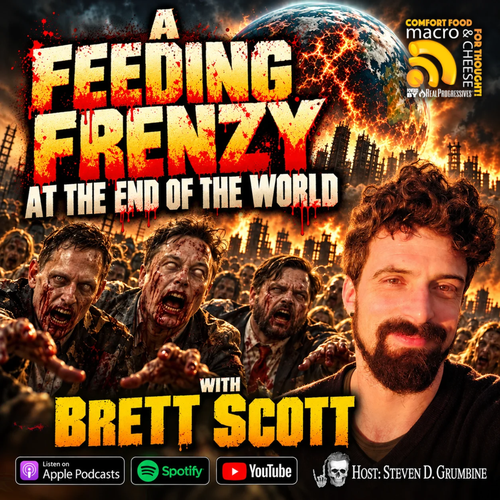
Episode 402 – A Feeding Frenzy at the End of the World with Brett Scott
FOLLOW THE SHOW
Brett Scott talks with Steve about the Nerd Reich and the threat posed by the big tech oligarchy. Are they puppet masters or products of a system built on insecurity? Or both?
** Mark your calendar for Tuesday, October 27. Macro ‘n Chill begins at 8pm ET / 5pm PT. Join our community-building gathering by registering here: https://us06web.zoom.us/meeting/register/S8jsoNLnQhaPukiAFkYc2w
Are the tech oligarchs a new kind of power, or just another face of an old one? Well, if you think big oil or big finance represent the greatest threat to civilization, think again. Steve invites friend of the pod Brett Scott, writer, campaigner and self-described neo-Luddite, to unravel the jockeying among the capitalist class. Steve begins by mentioning The Nerd Reich, a book by Gil Durant, which argues that Silicon Valley billionaires like Peter Thiel and Elon Musk are pushing to replace bourgeois democratic government with corporate authoritarianism. The book itself isn’t the point of this discussion; it’s a springboard into what technology becomes under concentrated ownership, and whether the mask has finally slipped.
Brett is the author of Cloudmoney: Cash, Cards, Crypto, and the War for Our Wallets. He sees the tech owners as the latest faction of the capitalist class to seize a political organ. It’s old news to say that the state under capitalism serves the interests of property against unions and socialist movements. What is new is the open display of power by tech oligarchs. Trump barely hides his service to the data center builders.
Listeners to this podcast already know how we feel about the “great man” version of history. Ditto the “bad man”. If you remove one bad man, another is waiting. Brett argues that Thiel, Musk and even Epstein are products and mediums of the system, more puppeted than puppeteering, like a weather system moving through billions of people. Brett also reads the elite fixation on Mars, immortality and network states as escape fantasies, a feeding frenzy at the end of the world. (It’s as if they’re worried about an apocalypse while they’re in the process of creating it.)
The engine, Brett says, is chronic insecurity. Workers, firms and countries are all told they will be left behind in the AI race, and he breaks down the racing metaphor into leaders, followers and laggards. He adds that progress resets to zero, because every new gadget becomes a baseline requirement for survival. Technology makes our lives faster, not easier. Many of us – families, workers, students – continually face debt and obsolescence.
Brett addresses security as a political question. At the international level, he ties anti-communist roll-back, from Southern Africa to Chile, to the effort to reintroduce insecurity.
The takeaway? Technology will never save us while an elite few own the assets.
Brett Scott is a writer, campaigner and self-described neo-Luddite, author of Cloudmoney and a longtime advocate for protecting cash. Find his work on the ASOMO (Altered States of Monetary Consciousness) on Substack and his YouTube channel on monetary history and technology.
Substack: https://www.asomo.co/
YouTube: youtube.com/@BrettScott
X: @Suitpossum
[00:00:42] Steve Grumbine: All right, folks, this is Steve with Macro N Cheese. There’s been a recent book that’s come out that a lot of people talk about. And this conversation is going to be loosely related to some of the things that are tied to this book. And the book is called The Nerd Reich. Now, again, this is not a book report.
We’re not talking. It’s not a book review. But the subjects that come up in this. are broader. I think that they are things that are on a lot of people’s minds. And quite frankly, this podcast has tried to explore things, maybe sometimes a little out of step with the rest of the folks out there, just so that we can break new ground, find things that maybe are important to people that maybe aren’t being addressed.
So with that, I’m going to bring on my guest, Brett Scott, who many of you all know from the [Altered States of Money Consciousness] ASOMOCO Substack, some of his great videos that he’s done. He’s been on this podcast many times, an advocate for cash, talked about cloud money, get his book. But his work on Substack is absolutely must-read. His videos are must-see.
And with that, I’m so grateful to have him join me today. Brett, welcome to the show, sir. Thank you.
[00:01:54] Brett Scott: Hey, Steve. Great to be back again. It’s been a little while.
[00:01:57] Steve Grumbine: It has been a little while. It has been a little while. And folks, a preemptive apology. I’m asking Brett to riff, if you will, to some degree. But these are subjects that he is extremely competent and well considered in his writing. So the merger of the thoughts from The Nerd Reich and Brett’s own work, I think, are going to come to play here.
And so for those of you who are not familiar with The Nerd Reich, it was written by a gentleman named Gil Duran, and he argues that influential Silicon Valley billionaires, including Peter Thiel, Elon Musk, all the typical baddies, are advancing a political project that threatens to replace democratic governments, which I would argue we’ve never had, with corporate authoritarianism, which I believe we always have had, with the exception of they’ve kind of pulled back the mask, the veneer, the pleasantries, and it’s kind of just,
sort of showing its ugly visage as we’re coming to grips with a world that maybe none of us thought was there, but maybe really kind of is there. And we’re going to explore that, whether it is or isn’t. And we’re going to talk about some of the central themes that are held within. But the book’s central point, whether you agree with it or not, we’ll get to it.
But the book’s central warning is that technology is not inherently liberating, which my guest says frequently all the time, actually. Under concentrated capitalist ownership, it is definitely, definitely a problem. But it’s become an extraordinary instrument for class domination, social control, and political repression, which I don’t think there’s any question. You can look at Flock. You can look at various things that we’ve witnessed, them taste testing in Gaza with AI weapons.
There’s so much going on right now at our expense and, quite frankly, not benefiting our lives. Brett, you touch on this in your own writings. I don’t want to get too generic, but since this is not your book, what are your thoughts on his basic premise that tech oligarchs and so forth are consolidating power and merging it with the government?
And is this benefiting society if it exists at all?
[00:04:18] Brett Scott: I mean, it sounds pretty spot on. Well, yeah, I mean, I guess this is the kind of latest version of a particular fraction of the capitalist class, kind of taking control of a political, political organ and this has been something that’s been happening for a very very long time in our world, right? So there’s nothing particularly new about that but this is certainly the latest incarnation of it and it definitely seems to be a feeling that the tech elite is almost breaking away from some of the other parts of the capitalist elite I mean, this language I’m using here has sort of got that sort of feeling of old school Marxism about it, where, you know, you talk about capital versus labor and so on.
But, you know, the capitalist class is basically, you know, people who own the majority of assets in society. And that capitalist class is a very diverse range of different groups, right? It’s not a singular, coherent group necessarily, albeit at a class level, they do have a certain coherent set of interests that
do tend to be aligned with each other. But of course, the oil industry and the auto industry and so on, they all have slightly different compositions. And right now, of course, the tech industry is probably the most powerful new set of capitalists that we’ve seen emerging. I say the tech industry, I mean, rather the people who own the tech industry are the most powerful set of capitalists that have emerged, I guess, since the finance bros.
For a while, it was kind of like big oil and big finance were the two big, most powerful classes of capitalists.
But now, of course, it’s the tech oligarchs, right? And there is a feeling that they have their own sort of agendas and the stuff that they are building poses real threats to the overarching kind of capitalist order in the sense that they are building automation technology on a scale that we’ve never really seen before.
And they could potentially undermine the entire structure of the economic system. And there is a bit of a feeling that they’re almost trying to metaphorically reach some kind of escape velocity to try and escape from society before everything breaks down. So I think The Nerd Reich book maybe has some of this kind of reflection on this slightly apocalyptic/utopian/sci-fi visions that these guys have, which I think emerge from the fact that they sort of realize at some level that they are breaking away from the rest of humanity.
[00:06:48] Steve Grumbine: It’s terrifying, quite frankly. I mean, I want to say this up front. We started the work we do here based on an idea that we could vote our way to the promised land, very naive, but shared by vast majority of society. And, you know, studies that perhaps didn’t mean as much when they were published suddenly are showing
we didn’t really have a democracy here to begin with in the imperial core of the United States. And really, I believe probably most capitalist societies, the veneer of democracy has always been a bit of an illusion. But right here, right now, we are witnessing the naked display of power, of control, of, you know, really, I don’t even know how to put it in terms that don’t sound far-fetched.
But they are building systems to control, to surveil, to monitor, to track. I mean, all the privacy advocates of yesterday, I mean, it’s like hold my beer. We’re way beyond that now. I mean, things that, you know, are just completely in the realm of sci-fi. I mean, what are your thoughts in terms of the relationship of the state, as it were, and these tech companies, these tech oligarchs, these Silicon Valley oligarchs that we hear so much about?
[00:08:13] Brett Scott: Yeah, sure. I mean, I can make some generic comments about that. I mean, one of the problems we have in society when people are thinking about “capitalism” is it’s generally, especially in the US, it’s spoken of as if it were simply the presence of markets in society. So people often think that capitalism is just commerce or trade or markets, the presence of
these sort of fluid relations where you can break away from each other and, you know, buy somewhere else or get a new job in different places. So a market system is a very kind of fluid, modular kind of system, right? And people imagine that often that that is the essence of a capitalist system. Whereas the real essence of a capitalist system is actually that it’s a series of relations between different groups, all right?
Most notably the capitalist class and the working classes and everything in between that, a whole spectrum of people between that, but also with the state, and it always has been. So capitalists have always had a relationship to the state and have often used the state in their quest to suppress, for example, labor unions or militant working groups or socialist movements that threaten their property.
So there’s been a long, long history between capitalists i.e., the owners of big assets in society and state authorities and originally in many ways the state has often been an instrument of or sort of co, coexists alongside capitalist interest, right, so there’s a long long history of that and then there’s moments when it sort of goes against the interests of of the kind of ownership class of the capitalist class to have too much state involvement in the economy. So the sort of neoliberal era, there’s lots of pushback against the involvement of state authorities, at least at a rhetorical level, because, of course, the state was heavily involved in pushing neoliberal things.
But we are sort of going back to a moment now where there’s this naked revealing of the relationship between the capitalist class and the state. And we see it particularly with the tech oligarchs, right? I mean, Trump barely makes any effort right now to conceal how utterly beholden he is to the tech oligarchs, right, he’s just like, “oh you know if you don’t like the data centers that they’re going to build you’re going to be stuck in the past and destroyed and you’re useless and a waste of time to society,” you know like that’s he’s basically just openly promoting their interests now. So yeah in a sense there’s nothing necessarily new I mean even during the neoliberal era of course we had the official ideology of the state retreating when in reality, companies have always been lobbying the state, working with the state in many ways.
But yeah, as you sort of say, what’s happening right now seems to be the sort of tearing away of the veneer that there is any distinction.
And yeah, I mean, there are moments when you think of capitalism as being a series of relationships between different classes and different players. You can see that at certain moments, the market element just gets removed. So you don’t necessarily need free markets in order for those relations to be maintained. So the relationship of power between people who own large amounts of assets and those who have to operate those assets, i.e. the people who work for those companies, that’s a relationship of power that exists regardless of whether there’s a market in between those players or regardless of whether the state is necessarily there. But of course, the capitalist class can draw upon the state to maintain that relationship of power. Now, I’m putting this in slightly crude terms, but we’re definitely seeing a strong resurgence of this close connection between the state and the billionaire class.
[00:12:00] Steve Grumbine: I think it was really interesting because you brought up the old school Marxist capital versus labor paradigm. And we’ve talked frequently about how capitalism isn’t static. It morphs and changes different epochs, different angles, different strategies, but still a dominant and a dominated class exists in each epoch. But the difference is that the consolidation of the number of elites, if you will, at the top that get to partake in the dominating shifts and changes, perhaps who they are, shifts and changes.
But nonetheless, it is still a series of relationships, as you say. How would you, like, obviously, you know, not throwing away necessarily the old version, if you will, or the older paradigm of labor versus capital in terms of production, but how would you classify the power dynamics today?
What do you think is different today than how you categorize it as, you know, kind of like the old Marxist paradigm?
[00:13:07] Brett Scott: I don’t know, you should probably speak to a kind of like a hard dyed-in-the-wool type Marxist person. But, you know, on the one hand, we don’t have as rigid an economy anymore. There’s, you know, if you think, if you go back to the sort of 1920s, 1930s, you have these very sort of almost militaristic economies, right?
People, the relationship. between your capitalist class and the working class is very sort of, um, domineering in a sense what’s quite like you know stay in your place be a cog in the machine do your job for your family in the factory and you know in the 1960s and stuff you have this kind of post-war period, you kind of have this almost accommodation between the capitalist elites and the workers to say you know you’ll get decent enough salary that you can support a wife and have a family and your white picket fence and so on but there’s still this quite rigid relationship between, between that class right whereas what we start to see in our more modern forms of capitalism is that it gets much looser and much more ideologically entrepreneurial should we say? So people back in the 1930s aren’t being asked to think about themselves as being entrepreneurs. Whereas nowadays, everybody is told you’re an entrepreneur.
When you’re at school, you’re being told this.
When you’re in the workplace, you’re being told this, right? Everyone’s trying to have an Instagram profile. Everyone’s constantly trying to hustle. You have the gig economy world where you essentially are a worker, but you’re encouraged to imagine yourself as being an entrepreneur who owns your own little business. So there’s much more of this ideology and in many ways, reality of fluidity.
But also another big difference is, you know, old school Marxist stuff tends to have this hard line between, you know, the capitalists and the workers or the ones who own stuff and the ones who operate that stuff. And of course, nowadays, you know, over the last many decades, that type of rigid boundary has shifted in many ways.
For example, you know, widespread share ownership among people who work for companies, you know, turns them into part owners of those companies. And so you have these hybridized types of relationships. So the middle class often is sort of in this hybrid position where they partly own things and partly operate things. And so, you know, there’s been, I use this sort of old school Marxist language with a bit of, you know, I am wary of using it.
But at the same time, in the end, when you zoom out and look at people like Elon Musk and Peter Thiel, and you look at yourself, you can make a pretty big distinction. These are the people who own gigantic data centers, which will be the largest assets in society. And we are the people who own a smartphone, all right?
A tiny asset in relative terms. So in terms of concentration of ownership of assets, we can very distinctly see a particular class of people. And this is what historically would just be called the capitalist class. The people who own the largest chunk of the slice of societal assets that is used to produce stuff that we all use to produce stuff in our society.
And the ones who take the biggest cut from the results and stuff that’s outputted by those assets. And so in some ways, some old school Marxist stuff is probably making a comeback because it’s so obvious now that these guys don’t make their money through work. They make their money through vast ownership of stuff.
[00:16:42] Steve Grumbine: Yes. I mean, I am a Marxist. And when I think about this stuff, I’m trying to figure out what that means today, right? Like when I think about this, I don’t see the system. It’s not, I don’t think of it as markets, by the way. I don’t think of it as I’m selling something, you’re buying something. I really do think of it as
one group owns the structural system that we depend on. You brought up the phones. I consider that to almost be a leash because, think about it, none of us want to put our phone down. I mean, we may want to put our phone down, but we’ve all become somewhat addicted to these phones. We are trapped in them and they capture every bit of behavior that we do.
They listen to our phone calls. They watch our browsing habits. They know exactly the types of things we buy. They know where we are because they have GPS baked into the phone. They follow our movement. They track these. They build algorithms based on those things. And to some degree, it is a little bit of a chicken and the egg, but who controls who?
And is there already a soft control baked into there? Because there’s so many things that I have done, that just using me anecdotally, of course, where I probably wouldn’t have done it, but somehow or another, something popped up on my phone. I clicked and voila I’m in some other place now doing something that maybe really wasn’t even important to me five minutes ago, but now all of a sudden they caught me right in the feels, whatever that is.
And I’m doing something. I’m curious because you spend an awful lot of time talking about that medium that the, the actual, uh, process of eliminating our social relations and society that have been kind of taken over by these tech oligarchs and their systems and their platforms and so forth. And especially with the advent and the ongoing development and this insane race for AI, we’ve witnessed that happening as well.
Your own work talks about this. What are you seeing? What does your work say about this kind of state that we’re in right now?
[00:18:46] Brett Scott: Well, you know, a lot of my work on technology actually comes from my work on protecting cash, which I sort of started doing back in, I guess, 2015 or so. I started writing and even getting involved in campaigning around protecting cash systems. And so when you get involved in doing something like that, you automatically get classed as being some kind of reactionary or behind the times, Luddite who’s anti-progress.
I mean, I’m a proud neo-Luddite. I have no problems with being a Luddite. I’ve actually been a Luddite since I was about six years old. I’ve always been skeptical of technology since I was very, very, very young. So it’s nothing new to me, really. But my work on cash really exposed me to lots of the progress ideologies, the stories we tell about progress and what progress means.
Also, I was forced to argue with lots of people, encounter lots of people having these arguments. So I’d be in a fintech scene and be encountering the way they would understand the world. And I’d get into the broader tech scene as well and sort of see how they would understand progress. So, you know, I started doing lots of this work around, on the one hand, protecting cash.
And on the other hand, decoding the progress ideologies that the digital accelerationists use when arguing that protecting something like cash is futile, and a lot of those same types of arguments will be used for any automation process so it’s not unique to digital payments for example, you’ll find exactly the same set of progress ideologies emerging and stuff like AI. And there’s an interesting you know you use this term race because there’s a very interesting ambiguous dynamic around races, and I’ve written about this quite a lot because in my work around cash, there’s always a story about the race to cashlessness and who is leading the race towards cashlessness and who is lagging in the race.
And so there’s always this metaphor used of the societal race towards this thing. And racing imagery in many ways, on the one hand, it can imply freedom and choice. It can imply that there’s this desirous movement of humanity trying to get somewhere, trying to move forward into some future that they want to get to.
On the other hand, there’s a very strong coercive element to a lot of racing metaphors, right? So if you say things like, well, “I don’t want to run in this particular race” what will tend to happen in the ideological sphere is that they’ll say, well, “you will be left behind and destroyed if you do not take part.”
So there’s this narrative about essentially in the racing metaphor, there’s always three components to it. There’s an imagination of the leaders and the leaders are always imagined to be like the guys on the front of Wired magazine, right? Elon Musk or the fintech companies or whoever it is. These innovative go-getters, the kind of people who are supposed to be inspiring leadership figures in our society.
Then there’s imagined to be the middle of the race, which is the sort of people who are expected to follow. And each of these sections has its own story, its own narrative, and its own way of being presented. So as I said, the leadership section of the race is always imagined to be the realm of inspiring go-getter stories.
Then there’s the sort of middle part of the race, which is all these stories about how do you adapt to stuff. So if you opened up your newspaper and it says, “are you ready for the transition to AI? Have you future-proofed your business?” Blah, blah, blah. These are all stories about are you keeping up with the imagined race towards this future?
And a lot of the political class, for example, in Europe here where I am, will often position themselves as these people on the sidelines. encouraging those in the middle to keep up with the leaders. They say, we don’t want to be left behind. And then there’s a third part of the story, which is those who are going to be left behind.
And that is always imagined to be this catastrophic thing that needs to be avoided through inclusion initiatives. So you say, “if people get left behind, they’re going to be shafted out of society and dumped in the dust heap of history. Therefore, they need to be saved.” And interestingly, in stuff like digital payments, how this manifests. is big companies like Visa and MasterCard, the “leaders” of the race towards cashlessness, saying, “oh, we’ll go and rescue those who are being left behind through digital financial inclusion initiatives.
So we’ll onboard people into our systems.” And you’ll then find these governments get on board with these companies to say, “oh, yes, that’s a good public service you’re offering. We will get involved too to subsidize your digital financial inclusion initiatives.” And so the UN will suddenly be involved with Visa and MasterCard in trying to promote digital payments in rural India, for example, all right?
So there’s a story about the leaders will go back and save these laggards. And you’re finding exactly the same narratives with AI. So the leaders, the followers, and the laggards. But with AI, we’re also seeing this real sort of turn towards the coercive version of the racing story, to say there is no choice you just have to do this and you’ll be destroyed if you don’t. So a lot of these guys are dropping the story that the race towards the apparently desirable future is driven by human desire at all, all right, and this is quite an interesting thing and I suspect in The Nerd Reich
book this is one of the themes too is that a lot of the tech billionaires are getting this nihilistic almost kind of like death drive feeling to their rhetoric. It’s not like 1980s capitalism where it’s like oh you know capitalism is a system that a rising tide that lifts all boats you know a lot of their narrative right now is like there will be a select group of winners and you better try to be at the front of the race in order to be part of that group and then if you’re not, you’ll be destroyed, you’ll be a loser, right and you know you even see this winners and losers language very permeating the whole kind of Trump world and the crypto world, where it’s starting to imagine that actually capitalism is like a zero-sum game and you’ve got to fight your way through it.
And I think that’s also been a sort of a shift from say the 1950s or the 1980s as well.
There’s increasingly this sort of nihilistic feeling to the rhetoric around capitalism.
[00:25:02] Steve Grumbine: It’s funny you say that. Peter Thiel has basically named most of the systems they’ve done after like biblical end times, Lord of the Rings kind of framing. And there is a real in their head, or at least the way they pronounce it, kind of like they’re working toward end times. I mean, even JD Vance and others who are part of this cabal, you know, have said things along the lines of, “hey, you know, if it brings about end of times, so be it” right?
The religious freak part of this really, really shows its ugly head. But there is an end of times kind of commentary associated with this. And I think the way you started the beginning out with there’s kind of a, where’s the escape hatch? We got to run from the coming destruction and Elon Musk’s fetish with Mars and other such things.
They know how bad things are out there and they’re doing everything they can to make sure that the elites can separate themselves. I hate to use movie references, but for goodness sakes, Elysium, the Matt Damon movie comes to mind. It was a good movie. I mean, scary movie, but I didn’t feel in any way, shape or form pangs of, oh, this feels completely absurd.
This is completely out of realm. I mean the very idea that they see us as you know matter for soylent green for grinding us up and turning us some in the bio waste or something I mean they this is the kinds of stuff that has been said I mean they’re they have said these things now whether or not there’s any merit to whatever you know I don’t want to be the guy laughing at it and yet it turned out to be true but at the same time though it does feel a little hyperbolic But they’re saying this stuff.
They’re not like hiding from it.
[00:26:52] Brett Scott: Well, I think one of the things also to maybe consider is that at some level, we can get caught up in the particular stories that the Silicon Valley people tell, all right? But also remember that they occupy a very similar position to many other types of elites throughout history. And elites, in general, always harbor an anxiety that actually they might be the parasites.
They always harbor this sense of paranoia that actually they are maybe not the good guy in the story and that maybe actually they’re the ones that society doesn’t need. So that underlying, let’s maybe call it subconscious sense of, I don’t know if it’s guilt or sneaking suspicion that maybe they’re not the person that they imagine themselves to be, can actually, I think, in a sort of almost inverse way, mirror itself in these imaginations of escape from humanity.
So, for example, the fixation on space travel, the fixation on the metaverse, which is a sort of space travel in cyberspace, fantasies about islands and network states and other zones of escape from the typical ordinary plebs of society, fixation upon immortality, which is escaping from everybody else and their petty lives.
In a weird way, these all look like things that unhinged people imagine, but it can also be a potentially a sort of shadow of their own sort of anxiety about that maybe they’re actually the ones who are the most expendable in society, right? Because if you think about who actually forms the base of society, wow, one it’s ecological systems and two it’s agricultural workers right and like people on the ground right like it’s not the person sitting in the headquarters of the Silicon Valley tech firm, right, albeit they control many of the assets from the top. So I do think they’re sort of throwing themselves into these visions of oblivion/like transcendence partly out of some form of self-loathing potentially, although I doubt they’re conscious of that thing.
But, you know, Grace Blakely, going back to the earlier point, she had a really good way of putting some of the sort of vibe of these guys right now. She said, “it feels like there’s a feeding frenzy at the end of the world.”
They have this sort of sense that the system can’t go on and they just got to try and grab as much as they can while they can before it all falls apart. So when I said that thing around, you know, them trying to reach escape velocity. It was actually a sort of space metaphor, right? Trying to escape the atmosphere.
I think that it takes a literal form in their heads as imaginations of space. But it also is a sort of metaphorical thing around can they somehow secure enough power and wealth to protect themselves from the resultant backlash that’s going to occur when people realize that the sheer concentration of ownership of assets is totally unsustainable. Incidentally, though, I have stories about space travel from being
in Silicon Valley. I mean I’ve taught at this place called Singularity University where a lot of these longevity people obsessed with immortality and space travel hang out, and it was really really interesting seeing this dichotomy between the reality of those things versus the ideology. I mean the reality of something like space travel is really really far away, all right, just getting to a single star is like a very very very distant dream in actual technical communities And yet it forms such a big part of the imagination of these people.
And I think there’s a reason why they project so much onto those escape stories.
[00:30:39] Steve Grumbine: That makes sense. It really does feel like they’ve created their own kind of reality. And they figure, I mean, we used to say this, that, you know, what does somebody that has everything want? They want immortality. They want to be gods of the earth and I imagine when you don’t want for the normal things that regular people have to live with you know I can’t pay my electricity, can’t eat whatever, when you don’t have to worry about any of those things you’re probably thinking about something entirely different. And I guess that brings me back to another point you brought up earlier I don’t believe in the great man theory and I do agree very very much with you that like we kind of get wrapped up in these whataboutisms with individuals and their stories and stuff.
I’m really looking fundamentally more at the system usually. And I want to go back to the system here. You know, obviously things have changed and you are very, very right to point out the fact that they’ve kind of poisoned the well with a taste of ownership.
Here’s a stock for you. You don’t really have any say, but your wealth, your ability to make money is intrinsically tied to our ability to continue to make money. So naturally you’re not going to fight against the cash cow that, you know, is paying your salary or paying your, your retirement fund or whatever. So systemically, as opposed or systematically or systemically, I’m not sure which one is the right word here, but what do you see as the driving force of the current system?
I mean, if it’s not just old school capitalism where you’ve got labor over here and the industrial revolution over there, what do you see as the system today? What constitutes the system today?
[00:32:30] Brett Scott: That’s a big question. [It is, but I don’t even know how to frame that. But it makes me think, you know, if it was so simple and it’s not simple, but if it was able to say, you know, class relations]I tend to personally be, to your point about great man theory, I can’t stand heroic great man stories that try to account for elites through stories of their own brilliance or deviance. For example, actually, let’s take the Epstein files. Lots of people saw the Epstein files as this revealing of the elite networks underneath the system. It’s like, oh, this is proof of these puppet masters who pull the strings behind the scenes and they’re on these private islands and in a sense they “maybe cause capitalism”. But I would swing it the other way around I’d say those people are outcomes of capitalism they are products of the system, right? Jeffrey Epstein was always going to be produced by the capitalist system his private island was going to be produced by the system it’s not the origin point of these systems. So in fact, it would be unusual if those people didn’t exist, all right?
It’s like, and this kind of thinking is quite counterintuitive to lots of people because, you know, most of us are taught as human beings, we like stories. We do storytelling to often make sense of our world. And storytelling often has heroes and villains and these sort of human scale figures in many ways, charismatic kind of figures.
And so we like to imagine that that’s how our system is working to these charismatic individuals. Whereas, you know, systemic thinking is often the opposite. These charismatic individuals themselves often produced by systems. But doing storytelling about systems-style thinking is very, very hard. It’s like trying to tell a story about why a weather storm, hurricane system is forming.
You know, you could say, well… “There’s various impersonal atmospheric forces that are colliding with each other to produce the storm.” Or if you wanted to give a charismatic account of the storm, you could say, “oh, you know, there’s witches who are brewing it up. And there’s a guy down in the lighthouse there who’s a sorcerer. And he is conjuring the storm through the sheer force of his evil intent.”
And so we’re often asked to think about people like Peter Thiel like that right now, for example. He’s like Saruman in his dark tower conjuring these sort of evil storms of capitalism, whereas I think actually it’s well, one, inaccurate but also politically more problematic when we position these people like that because actually we grant them more power in our imaginations than they deserve I think. In the end people like Peter Thiel are puppets of a system that’s much bigger than them. So rather than being puppet masters, they are the ones who are being puppeted the most, which is a very hard thing for people to understand.
But if you are thinking about capitalism as a system that moves through people, a bit like a weather system, you could imagine almost that its most seemingly most powerful people within it are often the ones who have the weakest or the least resistance to it. The ones who are most prepared to act as kind of mediums for that system.
The ones who’ve given up their souls, essentially, to channel that system, all right? The ones who didn’t have any willpower to not do that. I know that’s a bit of an abstract thing to say, but in many senses, you can actually see billionaires and these types of people as being weak points in the system that have allowed themselves to be exploited and have totally given themselves up to the capitalist system to act as its priests, essentially.
And when I say capitalist system here, when I’m thinking about capitalism, on the one hand, I said, you know, I’m imagining these relationships between all these big classes of players, but I’m also imagining as a sort of gigantic entangled network with no beginning and no end that constitutes billions of people. So that’s why I sort of use the metaphor of a weather system.
It has these dynamics that are chaotic and very hard to pinpoint. But yeah, the reason why I’m sort of, I think it’s important to draw up this kind of metaphor is that I think it’s important to position these apparent superhuman elites as being themselves almost enslaved by the system that they serve.
[00:36:45] Steve Grumbine: I love that because I’m sorry if I interrupted you. That is so important to me because the system itself, it’s like, play that out, role play that out. He’s a horrible man. He’s a bad man. Okay, so you get rid of the bad man. Well, there’s another bad man waiting to happen because there’s always going to be another bad man.
There’s always going to be these bad actors, period. It’s a system that we need to focus on. I’m informed, if you will, by early 20th century geopolitical struggles and revolutionary movements, but I’m looking at today differently. I’m trying to see how today looks in its own. In its own situation, you know, situating what we’re living in and trying to make heads or tails of it, right?
Because everything is new under the sun and yet it isn’t. Some of these things are tried and true, the same story, different abstraction. And I love what you do because you live in the abstract, Brett. I mean, so much of what you do is about creating beautiful analogies that kind of help very, very challenging. system-wide kind of outcomes, you know, so people can process them.
And I love the way you do that, which is why I asked you on this program for this subject, even though this isn’t exactly… I think that’s both the horror and the beauty of what we’re trying to talk about here is that some of it is speculation, but some of it is based on hardened societal norms and seeing how things change, seeing how they start, seeing how they finish, seeing how they came to be.
And it really isn’t one person. You’re right. It’s billions of people. Yeah. So it’s not individual.
[00:38:31] Intermission: You are listening to Macro N Cheese, a podcast by Real Progressives. We are a 501c3 nonprofit organization. All donations are tax deductible. Please consider becoming a monthly donor on Patreon, Substack, or our website, realprogressives.org. Now back to the podcast.
[00:38:53] Brett Scott: I think there’s, you know, as I said before, it’s really very hard to speak in the public domain about systemic level processes. So I use that weather system metaphor because back in the 17th century, there was a case of, I think it was maybe 12 women who were burnt at the stake in Denmark for apparently causing a storm that drowned a bunch of men in the harbor in a Danish town.
You know, and at the time, an account like that, to people would make sense right or apparently it did make sense for various reasons they had these charismatic accounts of why this weather has emerged and why it’s doing what it’s doing. Nowadays of course, people understand systemic accounts of weather they understand that like no no the reason why those guys were drowned in the harbor was because of a series of impersonal forces that didn’t involve any witches conjuring anything, right? But in the economic realm we still really, really struggle to understand that concept.
We still always go towards these charismatic accounts of why things are happening. And sometimes that’s important, right? I don’t want to say that there aren’t actors in our system who have agendas, but you should always try to remember that those actors themselves are subject to a whole bunch of forces beyond their control, right? Which is why I’m saying, you know, often these apparent puppet masters themselves are heavily puppeted.
And I think if you start to look then at what is the underlying structure of the system that’s puppeting people, it’s very, very hard to give simple, catchy accounts of that system. But one thing I would say, though, in a super large-scale capitalist system is it’s this vast system held together by money. And money is one of the topics that I often like to sort of geek out on a lot.
But in many ways, the monetary system is a very, very, very crucial element of our lived experience of the economy day to day. And it is true that one of the characteristics of a capitalist system is that it’s highly insecure and fluid in the sense that at any moment in time, you can be detached from your means of survival.
So if you look at any human society over time, it’s always an interdependent network of people who collaborate to survive. But in our modern systems, we’re looking at vast, vast networks of people. So simply to eat your breakfast cereal, you’re relying upon people on the other side of the world who you’ll never see. So we have these vast systems of impersonal collaboration, as it were, held together by the monetary system.
But the so-called market forces or market processes are these systems where you can constantly break away or people can break away from you. So there’s this chronic insecurity in capitalist systems. You’re always on edge. You’re always potentially about to lose your job. You’re always potentially going to lose access to things. And this is what the sort of capitalist elites will say is a good thing.
They’ll say “this drives dynamism, keeps people on their toes, stops them from stagnating, keeps them competitive.” It’s this constant drive forward to constantly out-compete others to stay in the system, to not get ejected from the system. And I would argue that when you start to analyze capitalist systems, that insecurity is one of the prime drivers of everything.
So for example, if you look at AI right now and these stories about racing, everybody in the system at some level is scared of being out-competed by somebody else. And that’s why they’re susceptible to these stories about you’re potentially going to lose this race. So at a personal level, you’re told, if you don’t adopt this technology, you’ll be outcompeted by somebody else who will.
At a firm level, you’re being told that. If you don’t adopt this, some other firm is going to do it. At a country level, you have the same thing. If we don’t do this, the other country is going to do it. So you have this kind of fractal system of endless insecurity. And when you look at the sort of systemic outcomes of that, it creates these kind of default processes that just always play out like clockwork.
So when I’m seeing the rhetoric coming out of the mouth of some company CEO, where he’s saying something like, “oh, you know, in these modern times, we must keep up with the AI thing.” That’s just the same old default shit coming out of his mouth that would have come out, that would be generated by this position in the system, right?
And so what’s quite interesting about all the rhetoric around AI and everything is it’s presented as being this highly innovative, highly dynamic thing. And yet all the responses to it is exactly what you would expect. It’s like the system playing out like clockwork. And I think that’s this kind of systemic level default process playing out. And then we fixate upon the charismatic sort of figureheads of that process.
[00:43:44] Steve Grumbine: You know, when I hear that, I obviously I use, we all, I think at some level have almost very little choice, but to accidentally bump into AI because it’s been planted into our search engines. Unless you completely don’t use search engines, you’ll be using AI. You do a search on Google, you’re using AI. There’s a million ways that it’s being introduced into society.
And whether you’re a Luddite or not, this is the world that we’re now in and all the points that you made about motivations and “we just have to keep up or whatever.” Notwithstanding, there is a, I don’t know if the right word is peer pressure, but there is that kind of fear factor that if I don’t get on the bus, I’ll be left behind exactly as you said.
But what does being left behind mean, right? I mean, when I, as an individual, as a dad, you know, which is probably my most important job, you know, I think to myself, oh my God, that means I’ll be out of a job. That means that I won’t be able to feed my family. I won’t be able to make sure that my children are taken care of and are healthy and have health care and things like that, especially in the United States where our entire existence is at will.
But then you look around the world and you realize the impact of US empire, you know, behavior where we have basically created a giant vacuum to suck up the resources of the Global South while simultaneously filling the pockets of the wealthy Global North, you know. How do you, how do you process that? I mean, it’s quite clear.
I mean, guys like Fadhel Kaboub who are working with Africa to try and remind them, hey, guys, you don’t have to be the bottom of the food chain anymore. You don’t have to be there just to serve the ruling elite of the North. You can create a bloc, create power and create your own terms. It feels like people are terrified to fight back or they’re terrified to resist, because what is the impact of resistance? What does resistance even mean in your mind? Because I know you know… Self-described luddite, what does resistance mean in this world? What would you tell somebody who feels the need to resist but maybe is terrified of the results?
[00:46:08] Brett Scott: Yeah, well I mean there’s a few things I wanted to comment on there maybe, but like one of the things I’d say is that remember that you know even though capitalism has these sort of default processes that play out: So, you know, acceleration, automation, this like endless of expansion drive. That doesn’t mean it can actually succeed in doing that.
It often does break. So, you know, the mere fact that there is a systemic force, going back to my weather metaphor, there is a systemic, you know, hurricane or something. It doesn’t mean it just has endless ability to reproduce itself. And of course, there’s not many sort of cracks in the system. There’s many… you know subsystem so there’s lots of opportunities for people to carve out stuff right? So when I’m in that kind of meta mode of talking about the big, big broad processes of capitalism, that doesn’t necessarily always mean that that’s equally distributed and of course for example, in the Global South and the final you know lots of these countries will be subjected to the same sort of meta forces but they can carve out alternative ways to get there So the BRICS country is trying to forge new agreements for how they can form…
A simple example, Brazil forms the PIX payment system. It’s still a digital payment system. It’s still going in the direction of automation and digitization and acceleration, just like the overarching capitalist system.
But, it’s also trying to carve out sovereignty and autonomy from Visa and MasterCard. So at a geopolitical level, here you have a country that’s trying to take a different path. And so for the people who don’t know, the PIX system in Brazil is a digital payment system that bypasses the card networks, the American card networks. And it’s very unpopular with Trump, who’s tried to punish Brazil with tariffs, for example, the PIX system.
But there’s lots of examples of people who can sort of forge these alternatives that are going with the general grain of how the system operates, but which are pushing it in their own way. You know, I think it’s always important to remember that there’s always scope for resistance and counter movements. And, you know, I said one of the ways to think about a capitalist system is to imagine it as this thing that has sort of these default drives that almost like a weather system.
But that doesn’t mean you can’t form other counter power systems on the side. So, for example, the democratic process where, you know, say true democratic processes where people get together and say, “hey, let’s collectively decide upon something rather than just going with the default process that a market says.” That’s an attempt to create a counterpower to that “weather system.”
Say, actually, “we’re going to do something different. We’re going to put regulations. We’re going to put limits. We’re going to, you know, act against the dynamism of the sort of free market as it were”, right? So there’s plenty of opportunities for people to make interventions. So that’s at one level. Can I also comment maybe on your point about these sort of stories about the having to go along with AI and stuff?
[Yes!] I think it’s also quite important to understand some of the ideology of, again, going back to these sort of progress stories that are told more generally in economic systems, you know, in Silicon Valley, but also in the corporate sector more generally, they often have this, what I would say is a high score vision of history. So they imagine history is almost like a video game that humanity plays, you know, where you start on level one and you have a score of zero and this tiny little inventory when you’re a prehistoric being.
And then you eventually move forward into some sort of futuristic future where you have this massive score and a massive inventory, like a sort of character who’s reached the sort of advanced levels of some futuristic video game. And so, in lots of progress stories, what they say essentially is that economic growth and technological innovation are increasing humanity’s high score and our inventory of things.
So whether it’s digital payments or AI or whatever, you know, humanoid robots, the story is always going to be what’s happening here is that our score as a human species is increasing, right? We’re getting more and more advanced. And so we’re encouraged to imagine this kind of additive view of history where there’s this ever increasing number going upwards.
But what people fail to recognize is that actually what rarely happens in a human society is that the score constantly rebases to zero as you go upwards. So it’s like playing a video game where every single time you get to the next level, your score just resets to zero. And that’s because we live in a competitive capitalist system nowadays, where as new things are built, they become then required as the new baseline needs for your survival.
So when people are talking about economic growth, they’re often imagining this output of stuff from society. They’re saying, “oh, we’re producing all this new stuff. We’re outputting stuff.” What they seldom talk about is the fact that that stuff then becomes the new inputs to your ongoing survival.
Fine, we produce smartphones, but that means now, from now on, you have to have a smartphone to continue surviving. So your society is constantly resetting itself as you go upwards, which is why in a modern society where we have huge amounts of stuff, you still find extreme insecurity and poverty and precarity. Because it’s not like we’re getting further away from precarity by having more stuff, because our needs are constantly expanding as that stuff goes up too.
And so this is the great lie of these economic systems. And for example, with AI right now, they’ll be telling all these stories like, “oh, some wondrous future of abundance awaits us.” And then the real story is actually AI will become the new baseline thing you’ll be required to have before you can start competing on a market.
And if you don’t have it, you’ll be destroyed, all right? So I think we really need to help people to understand that this imagined progress is largely illusory, as I sort of often say, technology doesn’t make our lives easier, it makes our lives faster. Sorry, that’s a very long answer. Sorry, Steve.
[00:52:11] Steve Grumbine: No, no, you hit it out of the park. I want to touch on that for a minute, though. This whole idea that technology doesn’t necessarily improve our lives, it makes it faster. I know as a person of a certain age, 57, that I have several epochs of my own in my own personal life where I remember, you know, calling girls on a Friday night and all of a sudden hearing the beep in the background for call waiting.
It’s like, “whoa, wait a minute. What’s that?” Right? And the idea of caller ID and having little caller ID boxes and then Atari 2600 and Apple and all these things. And so I’ve experienced a number of fairly large leaps. I was around doing IT work during Y2K when they were worried about the date bringing about the end of the world and so forth.
But so I’ve watched this stuff happen, but this go around, right? It feels like, why am I even going to college? What degree could I possibly get that will strap me with a hundred thousand in student debt that is going to actually pay for itself? You know, how in the world can I ensure employment? How can I, and you know, I’ve been in the workforce, you know, for 40 years.
And in that time period, that has been radically different, radically different. I used to celebrate the fact that I had two master’s degrees. Now it’s just like, so what? It’s like having a 55-volume master reference paper library, you know, the Encyclopedia Britannica or whatever. And it’s like now it’s a paperweight because they’re already outdated and they don’t really serve any purpose.
What are your thoughts on that? Because that is a real fear. That’s the material reality at the individual level, at the family level. And I imagine that keeps reproducing itself on up.
[00:54:06] Brett Scott: This is that endless insecurity that I mentioned in a modern capitalist system, right? If you look at older economic systems, and I don’t want to try and romanticize or essentialize older economic systems, but lots of older economic systems have higher levels of security. Even a feudal system, for example, which we imagine the feudal system as sort of all these old brutal lords and stuff.
But actually, you had a lot more protections of place in a feudal system in many ways, depending on where you were in that society. You kind of had this… you know lords would often have actual obligations to their to the sort of peasant class and vice versa so there’s much more these fixed relations in a feudal system but of course you know in many older tribal systems and even old hunter-gatherer systems there’s much more sense that actually you have a guaranteed place in society there’s you know so these stories about I think this is in David Graeber and David Wenger’s book where there’s sort of um… [The Dawn of Everything?].
Yeah, yeah. You know, stories from Native Americans, for example, coming to Europe and being like, visiting places and being like, “why do you have all these, allow people to be homeless on your streets?”, right? And of course, some of these stories have been invented for various political… they can be sort of warped in that context because a lot of these like European enlightenment thinkers were using some of these stories to make critiques of their society but there is a reality to these stories where people say, you know, “how is it that you’ve created this society where people don’t have a place they can fall off the society?” In our societies you know we’ll ensure that a person has a place of some sort, right? So one of these defining features of modern capitalist systems is that you’re not guaranteed a place. You’re not guaranteed to stay in the society.
You’re constantly in this potential position of being thrown out of the society.
That’s what, for example, unemployment is. Unemployment is the process of being thrown out of your source of survival. And historically, what we try to do is we try to create these side systems to create more security. So, for example, unemployment programs of the government are supposed to deal with that insecurity that naturally inhabits a capitalist marketplace. And also you’ll find this historic battle where the capitalist class constantly fights back against that to try and reintroduce the insecurity under the name of dynamism, all right? So you know if you look at the attacks on the welfare state systems or you look on attacks on attempts to instill you know national health care systems, they often have these stories that these will create stagnation. They will slow things down.
They will reduce dynamism. Basically, what they’re saying is that in order to maintain a dynamic economy, you need to keep insecurity in place. You need people to be insecure. Otherwise, they won’t have this constant drive to compete and innovate and constantly try to stay ahead of other people.
And so, my dad is actually a former Special Forces soldier. And when he was a teenager, he and his friends were basically told that their job was to destroy communist systems in Southern Africa. And if you think about the whole ideology of anti-communism emerging, a large part of what the story is, is that what communist systems often were trying to do, and I don’t want to romanticize communist systems, but they’re often trying to deal with the insecurity that comes with a capitalist marketplace to say, “we’re going to fix in place relations.
We’re going to solidify the relations so you’re not under this constant state of insecurity.” Now in doing that they would often introduce their own issues but lots of this sort of communist-busting language is all about let’s reintroduce the insecurity into these systems you know and this is the kind of language that would be used when for example the CIA was helping to take down Salvador Allende in places like Chile and stuff is to say “we’re reintroducing the market into the society where these socialists are trying to increase the security.
And this will save the society by increasing the competitive pressures upon people.” And so yeah, you know, when you get looking at this thing about, you know, why do we all feel so insecure, despite the fact that we have all this technology that should theoretically give us abundance, the reality is that we’re living in a system where the technology will be weaponized to increase competition, rather than to increase security, and ease and leisure.
So there’s nothing about adopting AI, for example, that will ever make your life any more secure unless you happen to be in the very top echelon of society where you’re gaining all the share returns from the process of everybody else adopting it, right? Which is what people like the tech elites try to do. They try to secure their own position by
owning the assets. So yeah I think we need to have a societal recognition that the technology itself will never actually save us and what we really need to be focusing our attention on is distribution issues, right, you know ensuring equitable access ensuring security for people because that is what in turn actually really increases security and increases our well-being but of course this is goes directly against the interest of those who currently own those concentrations of assets.
[00:59:25] Steve Grumbine: Indeed. I don’t believe we’ve ever seen a communist society before. I believe we’ve seen socialism birthing things, and I think we’ve seen efforts to deal with counter-revolution and external forces and so forth. But I don’t think we’ve ever actually seen communism occur. And one of the things that I’m concerned about is that I don’t think we really know what tomorrow looks like.
The conditions of today are radically different than the early 20th century, for sure. And I think that striving to find some path out of this, because whatever this is, and people can haggle over, you know, their belief of whether it’s markets, whether it’s capitalism, whether it’s labor versus capital or the haves versus the have-nots, whatever it is, the system is only working for a very, very small group of people.
The systems that we reproduce and the systems that we’re forced to engage in are not really helping us. To one of your larger points, that I think is really key to thinking about this technology push is that, you know, whose interests are being served even? Can’t we do better than this? And so whether or not, you know, the old socialists got it right or wrong, I’m going to say that I give them props for
at least seeing a problem and trying to fix a problem, even if the way that they thought it might work, you know, I mean, I think about Russia all the time and I think about coming from czarist, peasant, kind of backwoods, backwater kind of living to what they ended up becoming, you know, in a sort of sense is a miracle in its own right.
But yet at the same time, you’re not sure, you don’t probably want to reproduce that. But how do you not? What do you study? How do you figure out how to avoid the pitfalls? One of the challenges is that what we’re living in today, I mean, if I had my say in it, we wouldn’t be living in it at all.
It would be something very, very different, much more of a mutualist, collectivist kind of world where we take care of each other, you know, however that would play out. I don’t think it’s wrong to hate what we’re feeling right now, you know, is I guess my point.
[01:01:34] Brett Scott: I always find it fascinating when you see these like, you know, I sometimes listen to these tech billionaire podcasts and things like the All In podcast. I don’t know if you listen to that one, which has a lot of the kind of Silicon Valley elite who turns up and increasingly the MAGA elite as well, right? They’re very politically connected.
But there’s always this sort of hand-wringing and angst about the rise of socialist feelings in the youth.
And I always think to myself, what do you expect? Why would people not want to romanticize socialism in the context that we find ourselves in nowadays? Why would you expect that young people somehow look up to these middle-aged guys who basically own half the world? Why would that be an appealing vision to large numbers of people?
In many ways, there’s always this constant… pendulum swings where things are generating their counterparts, right and it’s natural that you’ll see people starting to look for ways to make a more collaborative, less competitive world because you know you’re constantly subjected to this endless rhetoric about competition and so it makes total sense to me that people would be going that direction and the same time when you’re looking for example right now at the rise in fascist tendencies I think it’s you know related to a similar thing. In many ways when there’s this kind of collapse in belief in the system, on the one hand it’s generating
yearnings for an alternative system. On the other hand it can generate yearnings for a return to some kind of illusory past of some sort, right? So a lot of the reason why I think the Silicon Valley billionaires are leaning into fascist stuff right now is they realize it forms a potential escape valve for people who otherwise might be heading down a more socialist path. So they spin stories about, on the one hand, sort of demonized minorities, but then also these stories about a lost glory of some old past and reviving something or restoring something that’s been taken away from them by some kind of nefarious force, whether that’s the deep state or Marxists or trans people or something.
So I think there’s this big connection. This rise of fascism right now, I think, is linked to this decline in belief in the sort of that 1980s story that capitalism somehow is the system that brings everybody in society up.
[01:04:06] Steve Grumbine: Yeah, it’s definitely a false promise. All right, Brett, I could talk to you for hours. Let me give you the final word on our conversation today. [The final word?] The closing.
[01:04:22] Brett Scott: Well. The closing word I’m going to say is that I have also recently been grounding myself by doing woodcraft and making boomerangs. And it’s a very interesting process because I’ve discovered that by getting back to doing handcraft work, it taps into a totally different part of my being. I actually weirdly think… This is going to maybe sound a little bit politically shallow, but I think there’s a real political need right now to actually, rather than getting people to sort of form these digital alternatives to the sort of tech oligarchs, to actually return and just experience some of these analog things and just touch some things.
This is actually a meme as you find it in sort of Gen Z world around touching grass, but it’s a really real thing. We really are so disconnected from our bodies increasingly nowadays and just doing some simple things, simple acts of handiwork I actually think is becoming a strangely political act.
[01:05:22] Steve Grumbine: Oh my god, I’m so sorry I gave you the last word but I’m gonna add to it I have become, I don’t want to say obsessed, because that’s really not the proper word in this case, but I have really, really grown to love woodworking. I have been working for several years now to make my garage a wood shop And my tools and everything.
I have really the feeling of building things of crafting things with my hands to everything you were just saying I’m sitting there laughing inside I’m like oh my god this is what I do. My lunch break I run down to the garage to work. I break out my chisels just so I can create a a tenon and mortise I I do and I don’t for no reason, just because I want to do it.
[01:06:09] Brett Scott: And I also think it’s actually something that transcends political boundaries you know. We, we increasingly like live in this hyper-digital world where we have these imagined like mortal political animosities but in reality when you take people out of that context and you put them in a workshop somewhere you realize actually we’re not that different you know there’s we have many similar things like human beings we enjoy engaging with like simple stuff.
[01:06:34] Steve Grumbine: That’s too insane that you said that. I’m not even joking. If we talked more often, you would be already well aware of this. I’m just like obsessed. My YouTube playlist doesn’t look the way it used to. A lot of it is techniques on joining wood. Anyway, Brett, you are a master of these kind of things. I really appreciate you coming on.
Folks, Brett’s Substack ASOMOCO is absolutely worth your time. Brett, where is that your primary place where you’re writing? Do you have other work else… I think you’ve got your YouTube channel as well.
[01:07:09] Brett Scott: My YouTube channel is actually the thing I’m, I’m trying to also get um going now it’s because doing it’s the last video did pretty well there actually. It’s on the myth of barter for people who are interested in sort of the stuff around monetary history and that’s just Brett Scott on YouTube and then there’s ASOMOCO, my Substack, which yeah is also something I really enjoy doing.
So both of those are two places you can find my work.
[01:07:36] Steve Grumbine: And it’s fantastic work too. All right, Brett, I’m going to take us out. Folks, my name is Steve Grumbine. I’m the host of this podcast, Macro N Cheese. I’m also the founder of the Real Progressives nonprofit. It’s a 501(c)3. That means your donations are tax deductible. If you find the work that we do worthwhile and worth supporting, please consider becoming a monthly donor.
Small donations, large donations, it really doesn’t matter. We just are a volunteer-led group. We’ve been going for 10 years, more than 10 years. And if you think about it, it’s kind of crazy that this group of people have believed in doing this stuff and we’ve stuck it out. In fact, on Tuesday evenings, after every one of our podcasts, we have something called Macro N Chill where we get together.
We listen to the podcast and short segments. We watch it. We do a video of it so you can read along and then we discuss it and build community. Talk to people, right? Weird, right? Talk to people. So Macro N Chill Tuesday nights, you can find the links to that for our Tuesday webinars on our website, realprogressives.org.
You can go to patreon.com, become a donor there as well. And of course, we have our own Substack and YouTube and all the other fun things. But please consider supporting our work and also please go right now and support Brett Scott. Everything he does is worth checking out he’s very thoughtful and a great guest and a good friend and I appreciate you dealing with me, sir, because I’m a handful and I’m a rascal and I appreciate the time you give me thank you so much.
[01:09:09] Brett Scott: Fun as normal, so thanks so much and great! Congrats on going for over 10 years. That’s amazing.
[01:09:19] Steve Grumbine: Isn’t it insane? All right. Take care, everybody. Thanks, Brett. We’re out of here.
[01:09:29] End Credits: Production, transcripts, graphics, sound engineering, extras, and show notes for Macro N Cheese are done by our volunteer team at Real Progressives, serving in solidarity with the working class since 2015. To become a donor please go to patreon.com/realprogressives, realprogressives.substack.com, or realprogressives.org
Extras links are included in the transcript.
Related Podcast Episodes

Related Articles
The Truth About “Printing Money”
The Strategic Activist


Leave a Comment
You must be logged in to post a comment.