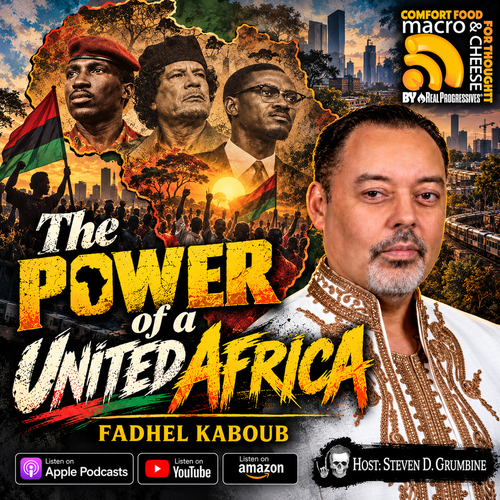
Episode 400 – The Power of a United Africa with Fadhel Kaboub
FOLLOW THE SHOW
Fadhel Kaboub lays out how Africa can industrialize as a bloc: technology transfer instead of debt, national currencies, and a security pact against blowback.
** Come to Macro ‘n Chill next Tuesday. We’ll be discussing this, the 400th episode of our podcast! October 13th at 8pm ET / 5pm PT. Register here: https://us06web.zoom.us/meeting/register/MKAXG1OQTIq2ly3Pu7B2sQ
This is our 19th episode featuring Fadhel Kaboub, so who better to bring back for our 400th? He joins Steve to explore whether the countries of the Global South can industrialize on their own terms now that the old order of debt conditionality, export dependence, and fragmented production is breaking apart? Fadhel walks us through the report, One Voice, One Strategy: A Continental Blueprint for African Strategic Minerals, Joint Industrial Policies, and Diplomacy, published by Southern Africa Resource Watch.
Fadhel begins with the moment itself, a structural rupture in the global economic order that opens a short window for the Global South to reposition. He explains why the usual development model of borrowing, exporting and courting foreign investment keeps countries at the bottom of global value chains, and why scale matters. From there he sketches a different way to finance transformation, built on cooperation across borders instead of debt. He also takes on the idea that working together costs a nation its sovereignty, tracing it to the neocolonial politics that followed independence and the fate of Kwame Nkrumah’s vision of a united Africa. Along the way, MMT’s understanding of currency-issuing governments is used to challenge the myth that Africa is simply short of money.
Steve presses on the hard questions. How does a bloc avoid building a new hierarchy of its own? Fadhel says ownership, profit and wage shares, labor protections, land rights, and environmental safeguards must be pre-negotiated, with trade unions and frontline communities at the table from day one. Majority ownership stays with governments, and profits flow into a joint sovereign wealth fund that evens out inequities between members. Along the way he traces how the African Union’s emphasis on national sovereignty undercut Nkrumah’s vision of a united Africa.
Then comes the question of blowback, from sanctions and false narratives to assassinations and invasions. Fadhel answers with broad public ownership of the vision, guaranteed food, fuel, and medical supply lines for vulnerable members, and a collective security pact with a BRICS bloc that includes China, a counterweight to NATO that does not exist today.
This is a conversation about what solidarity looks like at the scale of a continent, and why a plan has to be designed around working people from the start. It is a positive vision for an exhausted generation.
Fadhel Kaboub is an associate professor of economics at Denison University, president of the Global Institute for Sustainable Prosperity, and author of Global South Perspectives on Substack. He serves on the United Nations High-Level Advisory Board of Economic and Social Affairs and is an expert on designing public policies to enhance monetary and economic sovereignty in the Global South.
Find Fadhel’s work on Substack at Global South Perspectives, which is free and open, and on LinkedIn.
[00:00:42] Steve Grumbine: All right, folks, this is Steve with Macro N Cheese. It has been a long time, but we’ve got Fadhel Kaboub coming back here, folks. And for those of you who are not familiar with Fadhel. Fadhel is an associate professor of economics at Denison University, president of Global Institute for Sustainable Prosperity, and the author of Global South Perspectives on Substack.
Dr. Kaboub was recognized by the New African Magazine and the top 100 most influential Africans under the thinkers and opinion shapers category. He currently serves a two-year term on the United Nations High-Level Advisory Board of Economic and Social Affairs at UNDESA. Dr. Kaboub is an expert on designing public policies to enhance monetary and economic sovereignty in the Global South, build resilience, and promote equitable and sustainable prosperity.
His recent work provides a comprehensive policy framework on debt, development, climate, energy, food, industrialization, and geopolitics for a strategic repositioning of Africa and the rest of the Global South at the center of a new international economic order of peace, justice, and sustainable prosperity. Today, we’re going to discuss a paper, excuse me, a report. I jokingly will call a tome because it’s over 70 pages long and it’s really, really important in my opinion.
And I think you’ll find it to be important as well. One of the cores of the report that I think is particularly of interest to listeners of this podcast is as many times as you’ve heard us talking about not being a bunch of pinkies, but being a fist, the need for solidarity, the need for collective action is going to be on full display today.
The report came out in September of 2026, South Africa Resource Watch Report, One voice, One Strategy. A Continental Blueprint for African Strategic Minerals, Joint Industrial Policies, and Diplomacy. And the lead author is none other than our friend and our guest, Dr. Fadhel Kaboub. So with that, Fadhel, welcome. Thank you so much for coming back, sir.
[00:02:59] Fadhel Kaboub: Thank you, Steve. Thanks for having me back. It’s a pleasure to be with you today.
[00:03:03] Steve Grumbine: I appreciate that. Listen, so, you know, obviously my intro talked about… being a fist instead of a bunch of pinkies. And we frequently see folks, especially in the United States and the imperial core, you know, they act as individuals, they’re rugged individualism. So most people in our country listen to this stuff and they’re always thinking about it from an individualist perspective.
The idea of collective work, the collective prosperity, it’s almost too much to fathom. The mechanisms for that in the United States in particular, simply not there. Not like they are elsewhere, where the opportunities are brimming. The opportunity to make real meaningful change is right there at the precipice. And you went to the trouble of putting this together.
And I’d like to, I guess, first off, can you give us a concise overview of what this report entailed?
[00:04:03] Fadhel Kaboub: Absolutely. So I think the context for this report is the current geopolitical moment that we’re in. We’re not in a sort of a temporary cyclical type of crisis. There’s clearly a rupture in the international economic system and the geopolitical landscape. And when you have something of that kind happening, the cracks in the system allow you to think of opportunities for pivoting, for repositioning yourself as countries of the Global South.
But that window of opportunity is really small. And when I present this report, I think of it as something like three to five years worth of opportunity to quickly reposition yourself, hopefully in a slightly more favorable position. So what is the crack in the system? As I said, it’s not just a cyclical instability, it’s a structural rupture in the global economic order.
The old system is broken. That is, the trade dependency, the debt conditionality, the fragmented industrial capacity that dominated the system in the past is broken in a good way. You know, it’s not a bad thing to redesign the system. But the question is, who’s going to redesign it on whose terms? That’s the challenge. So we see convergence of crises, geopolitical fragmentation, supply chains are being reconfigured by the US, Europe and others.
There’s obviously climate disruption, the financial volatility, which is probably going to get worse with this AI bubble that we’re experiencing. So for Africa, this is not just a risky moment to navigate and muddle through. This is a moment of strategic repositioning and structural transformation. So that’s really the context in which I wanted to write this report, because major economic blocks are building strategic industrial alliances.
They’re repositioning themselves. And trade is no longer about efficiency. It’s about security. It’s about resilience, sovereignty, and control over strategic value chains. And when you think of the value chains for the 21st century, I’m talking about the industries, the products, the technologies that will dominate the economy of the 21st century. All of those value chains start in Africa with…
critical minerals or strategic minerals. So that gives the African continent an opportunity to leverage at least its minerals. But I also argue in this report that minerals alone are not enough to create a leverage for repositioning. So there are basically three strategic pivots in terms of how we think about, for example, development finance in particular for structural transformation.
So if you want to think about the architecture of Africa’s structural transformation, the first pivot is to move from infrastructure finance to productive capacity transformation. The second pivot is to move from project bankability, which is what everybody talks about, to development viability. The third pivot when it comes to the structural transformation and financing development, is to move from crowding-in capital and bringing in foreign direct investment and all of that to coordinating transformation on a continental scale, which is really Africa’s biggest opportunity.
And moving away from debt-financed development. So you can’t borrow your way into development. You can’t export your way into development and sovereignty. All of this has been tried for the last several decades and clearly failed. You can’t industrialize without coordination at scale because individual countries in Africa and the rest of the Global South, with the exception of China and India, are too small, which means the economics of industrialization doesn’t work.
You don’t have the economies of scale. But blocks of countries have the economies of scale. and the collective economic and geopolitical weight to industrialize and to set the terms of development and the terms of trade that are more fair and equitable. But with the right institutional leadership, Africa can develop, acquire a higher degree of economic and monetary sovereignty, and industrialize on new terms, meaning, you know, moving away from the old industrialization of the past, the extractivism, the accumulation of wealth at the top and all of that.
So it’s what we might call another approach to development. So that’s overall the context. And now I give you a few numbers to kind of highlight why this is a unique opportunity. Africa has the youngest labor force on the planet.
The median age is 20. Today, it’s a continent of about 1.5 billion people. By the end of the century, in the year 2100, Africa will be the largest market on the planet with 4 billion people. So when you’re looking at the demographics of the world, with the demographics declining in Europe, in the US, in China also, everywhere else, with the exception of the African continent, if you’re going to be competitive as an industry in the US or in Canada or in Australia or in Japan, your eyes will be on the largest market on the planet because that’s where your consumers live.
And now globally, if we do this the right way, which means if Africa actually develops and industrializes on terms that are favorable to the African continent. within the ecological limits and all of that, then we’re looking at the largest market on the planet with rising purchasing power, which means everybody wants to have access to that market. It’s also the continent that has all the strategic minerals that the world wants for the 21st century.
The building blocks of every supply chain starts in the Global South and the African continent in general. And it’s the continent that has the largest potential for renewable energy in the world: for solar, for wind, for geothermal, for everything else. So you have all the ingredients for a real industrial revolution. Hopefully an industrial revolution that doesn’t replicate the injustice and ecological destruction of the past.
Because we do have certain guardrails that we can put in place so we can have industrialization that doesn’t throw frontline communities under the bus, and labor, under the bus, and working class people, under the bus. That can be designed and that can be put in place. And that’s kind of what is outlined in this report is how do we pre-negotiate the distribution of the value chain, pre-negotiate the distribution of the profit and wage share pre-negotiate the ownership structure, pre-negotiate the protection of labor rights, frontline communities, land rights, natural ecosystem, pre-negotiate cooperation on research and development to continue and to sustain a model of economic development that allows us to stay within the planetary boundaries.
That’s part of the design. It shouldn’t be an afterthought, so to speak. So you put all of these things on the table and it looks like you have everything for an industrial revolution, except two things.
And that’s what the report emphasizes. Number one, you need political coordination at the highest level, meaning heads of state, that recognize that no country can industrialize alone, small developing countries, because you try to industrialize alone and you don’t have economies of scale. you end up manufacturing a small component in somebody else’s industrial policy. So you remain locked at the bottom of the hierarchy, at the bottom of the global value chain.
But as a block, you have the complementarity of resources and capabilities, the economies of scale, and you have all the advantages that I just listed earlier for the African continent. So it has to be a political commitment. It has to be political leaders who have the courage to think and act differently. Because unfortunately, there is this colonial, actually, neo-colonial, mentality that was introduced immediately after independence by former colonial authorities, that as soon as you become independent, in the African continent in particular, you were told immediately that you need to protect your national sovereignty, that you should think in a selfish, national interest way.
And that’s where the culture of nationalism and patriotism and all of that, which is a lot of it is actually pretty good. Of course, you want people to love their country and their flag and be proud of everything. But also the colonial and neocolonial seeds that were embedded in that national sovereignty is that if you cross your border and cooperate with your neighbors, with the hope of building something bigger, then you’re sort of betraying your national sovereignty.
Because if you’re giving more to your neighbor, you’re diminishing your national sovereignty, which is a lie. Because cooperation, South-South cooperation, actually enhances national economic and monetary sovereignty. That’s kind of the message of South-South cooperation that by cooperating and building economic relations to form joint industrial policies, you enhance individual national sovereignty. But if you do industrial policy at the national level because you want to protect your national sovereignty, you end up locking yourself at the bottom of the global hierarchy, just like your neighbor.
And as a result, you weaken your economic and monetary sovereignty. This is where the MMT analysis really breaks the colonial mindset about national sovereignty. And that’s what this report is trying to push. So that’s obstacle number one is getting political leaders to recognize that by cooperating in joint industrial policies, joint diplomatic efforts to reposition the continent economically and, of course, geopolitically, you’re actually strengthening your national sovereignty or not diminishing or sacrificing your national sovereignty.
So that’s obstacle number one. And that’s a major thing. So it will take leadership that has the courage to think and act differently to move in that direction.
Obstacle number two is access to the manufacturing technology. Sometimes I refer to it as the life-saving technologies to manufacture and deploy the solar infrastructure, the renewable energy infrastructure, wind, geothermal, and so on. The high-speed rail infrastructure, the irrigation infrastructure, the clean cooking infrastructure for the one billion people in Africa today, mostly women and children who are inhaling toxic fumes from the lack of clean cooking infrastructure. So these are the industrial priorities. The manufacturing technology is available. In Europe and the US and Japan and China and other places, the question is the model of development that dominates the thinking today is that you should borrow foreign currencies in order to import the technology.
And that’s how you finance development. The problem with that model is that as soon as you borrow in dollars, for example, then you’ve committed to paying back that debt plus interest in dollars, which means somehow the economic activity that you need to prioritize in your country needs to be export-oriented so that you can service the debt.
And by doing that, you’ve already agreed basically to neglect the manufacturing and deployment of the building blocks of development and prosperity that you need, which means if you’re investing in producing clean electricity, for example, that clean electricity needs to feed into a manufacturing unit that is export oriented. So you dedicate your energy resources, your labor resources, everything to produce something for somebody else to consume abroad rather than producing the building blocks of development that you need.
Same thing if you’re investing in agriculture, it has to be export oriented so you can’t produce to feed the local population. You have to produce cash crops for exports. So you’re essentially agreeing to reproduce the extractive colonial and neocolonial systems that extract your labor, extract your wealth, extract your resources, and you have to pay for it with foreign currencies, with interest on the debt, and you never get to build the building blocks of your own development.
So the puzzle that I address in this report is, how do you then finance your structural transformation without relying on external financing that pushes you, constantly pushes you on these traps? And the key here is, again, with South-South cooperation, meaning if you have a large enough of an economic block that has the complementarity of resources and capabilities, you build also the geopolitical weight to negotiate not for a loan, not for external financing, but now you negotiate for transfer of technology, in-kind contribution to these joint ventures.
So the countries that have the technology, let’s say it’s for solar manufacturing, for example, they come in as a joint venture partner. With in-kind contribution, which means they bring the manufacturing technology as part of their contribution to the joint venture.
So transfer of technology, know-how, research and development cooperation, technical and vocational training cooperation. That’s sort of your in-kind contribution to the joint venture. So not loans, not debt traps, not charity, not aid, but real partnership.
Why would anyone do that? Because they don’t do it today with individual countries. But when you negotiate as a bloc, this is what I call the geopolitical bargain of the century. You go to countries and say, look, if you agree to our terms of development and industrialization, here’s what you get in return. You get privileged access to the largest market on the planet by the end of the century.
4 billion consumers. You get privileged access to these strategic minerals that everybody’s panicking about today. You get the opportunity to substantially increase your industrial and economic and geopolitical footprint globally by becoming a partner of the largest market on the planet, the youngest population on the planet with rising purchasing power, because as you do this development and industrialization, you’ll have access to a market with rising purchasing power.
So anybody would want to have privileged access to that market. Now, no African country can bargain in that way, but a continent or at least a sub-block of the continent can actually bargain in that way. So the idea here is to go to a potential first mover, meaning a major economic bloc, China, the US, Europe, Japan, whatever it is, and say, would you be the first mover to take advantage of this geopolitical offer, geopolitical and economic bargain?
And if they do, the idea here is not to position that particular first mover at the top of the global hierarchy. It’s actually not at all. The idea is when you trigger the first mover, agreement, you’re essentially sending a signal to everybody else that, hey, this is your opportunity to join as well, because otherwise you’re self-isolating from the global economy of the future.
Because all other countries in the Global South will want to join the African continent in this effort, because the global majority is 80% of the world population. That’s the Global South. So the global minority then, so to speak, will become the isolated 20%. And the isolated 20% has shrinking populations, limited access to natural resources, but they do have, in this current moment, strategic advantage in terms of technological capabilities that they can contribute.
That’s their contribution to joining the world majority in this new international economic order on non-colonial terms. So the idea of the geopolitical bargain of the century is to reposition Africa and the rest of the Global South at the center of a new international economic order of peace, justice, and sustainable prosperity, rather than positioning anybody at the top
of a hierarchy and if we do this successfully this is the amazing thing about an idea like this and it’s technically possible, but we can discuss the potential obstacles, this would be the first time in history where a major repositioning literally taking billions of people from the bottom of the economic hierarchy and uplifting billions of people into decent quality of life and prosperity.
And doing this without invading any other country, without enslaving any other people, without inflicting revenge on any other economic bloc that caused all the pain and damage of the last several decades and centuries. So it’s an invitation, inviting the rest of the world to co-create this new international economic order and rewrite the rules of the global economy, the rules of trade and finance and investment and taxation on non-colonial, non-hierarchical, non-extractive, non-abusive terms.
That’s really the vision of this report. And I’ll close by saying no country or no economic bloc in the world is able to develop this or execute this vision other than the African continent. Why? Because if you’re a country at the top of the hierarchy or close to the top of the hierarchy, why would you trigger a process that brings people from the bottom of the hierarchy to the top and may undermine your dominance?
You wouldn’t do it. So it’s not going to be the US or China or Europe. or Russia, or Japan, or Canada, or Australia that will do this for the global majority. The question is, which part of the global majority will do it? The African continent is positioned in a way that gives it enough economic and geopolitical weight to lead the Global South in this effort.
It doesn’t mean that Latin America doesn’t count, or Asia doesn’t count, though. Of course, South-South cooperation and solidarity is extremely important. But the leadership, the first movers of forming this economic bloc, has to start from the African continent because of its strategic assets, as I said, in terms of its demographics, its natural resources, its geographic positioning.
It’s just the most privileged when it comes to being able to create this opportunity for the rest of the world. So that’s really the vision of this report.
[00:26:09] Steve Grumbine: It is very well said. I want to question you on a couple things I think are jumping out at me right now. You talk frequently about not recreating the hierarchies of the old order. And you’re talking specifically about creating a unified Africa, a one Africa operating as a bloc as opposed to a bunch of individual countries looking out for themselves.
How do you go from just proposing national sovereignty and these groups operating in that space and ensuring popular sovereignty, ensuring the people are not buried under a new hierarchy made within their own order?
[00:26:52] Fadhel Kaboub: Yeah, so. A vision like this is, as I sometimes joke, is not something you whisper into presidents and prime ministers’ ears as a secret. It’s something that you socialize from the bottom up, meaning civil society groups, think tanks, media, people from all walks of life and from the entire spectrum, political spectrum and so on. Because I’m not describing something here that belongs to a particular
political party or particular ideology other than something that will be universally beneficial to the people of the continent. I’m talking about the masses here. Of course, there’ll be a few billionaires who will not like some of the details of this vision. So I’m not talking about those individuals. They’ll still have pretty nice life under this vision. They’re not going to be disadvantaged, so to speak.
Here’s where you want to start with something concrete and deliver real results almost immediately to give people a taste of what this will look like. And I guarantee you, this can be done within a few months to give people a taste of how good this vision can be. And I’m talking immediate results: cash benefits immediately. And guess who can start this?
If you think of the most conservative finance ministers in the Global South, I mean, people who are trained basically by the IMF, who want austerity, who want to balance the budget, who want all the traditional mainstream ways of inflicting financial pain. Think of the most conservative of them. And you take their side, so to speak, for just one minute to kind of walk them into this strategy from where they sit.
Here’s how I would do it. I would have 25, 30, 50 of them in one room and say, look, I have a strategy that will immediately reduce the cost of imports for the continent, and for each one of your countries. Let’s say by 5%. But it requires cooperation. And I’ll say, I want you to call your staff and tell them to create a big Excel sheet or database of all the things that the country imports.
Pick the top 100 items. And let’s do a matching exercise. Let’s see which items are imported basically by everybody. And let’s say for the sake of argument, let’s say all countries are importing toilet paper for the sake of argument. And you realize all of them are importing toilet paper more or less from the same supplier. You realize, okay, so each country is buying individually from the same supplier and paying the sticker price.
And you start comparing the prices and you realize they’re not all paying the same price because the supplier is price gouging them, which is typical. So that’s one piece of information. The second piece of information is to say, look, how about we sign an MOU right now so that we vote to elect a committee of three to five representatives that will be the executive committee on behalf of the 50 countries that will negotiate a bulk purchase program.
Let’s call it a collective procurement program, with this supplier for the entire bloc of countries. And when you do that, you can actually negotiate a bulk price, a much lower price than that. And you find out that within a couple of weeks, you’re able to negotiate a 5% or a 10% cost reduction. So you’ve just saved 5% on the import cost of, say, toilet papers.
And then you do that for irrigation equipment, and you do that for fertilizers, and you do that for computer software, and you do that for pharmaceuticals, for medical equipment, for everything the bloc of countries does. And you’re essentially doing some cost-cutting and cost savings for the most conservative finance ministers. And you tally up the savings, and you realize…
You have billions of dollars worth of foreign currency reserves that you’re not borrowing and you’re not struggling to pay interest on that debt. And now you’ve trained the bureaucracy, the most conservative bureaucracy, to think and act collectively. And none of this is diminishing the national sovereignty. In fact, your national economic and monetary sovereignty is immediately enhanced with this exercise of cooperation.
So Pan-Africanism, if you’re using the African continent, is the economics of enhancing economic sovereignty and monetary sovereignty at the national level. So then you continue with that same exercise and you say, look, turns out we’re all importing the same irrigation equipment from everybody. And it looks like we do have all the materials to produce this stuff here.
And the technology is not that complicated. We don’t even have to, you know, ask for help. We have engineering schools and all of that. It looks like we’re able actually not only to create a joint venture between the 50 countries to manufacture this irrigation equipment so that we can prioritize our food sovereignty and internal development, but it looks like we can actually create five manufacturing units to produce these for the African continent, and maybe another three or five to export to the rest of the Global South, to export irrigation equipment.
And now you’re moving from a collective procurement program to joint industrial policy. These are the baby steps that you take. But let me step back for a second. The cost reduction from your collective procurement. Now that is immediately publicized in each country. And this is where civil society comes in, think tanks come in and say, okay, you’re able to reduce the import costs by X.
Now we want to make sure, this is where transparency comes in. We want to make sure that those resources are now invested in health or education or in building blocks of development and prosperity. So you start pushing the most conservative wing of your government into the most progressive end of the spectrum of economic cooperation to enhance economic and monetary sovereignty.
And that shouldn’t take 50 years. When you start with the procurement program the results should be immediate. The economic impact is immediate and felt by every person in each country. And you start training the mind, decolonizing the mind by emphasizing that Pan-African cooperation, South-South cooperation does not reduce your economic sovereignty or national sovereignty. It’s actually the main lever of enhancing economic and monetary, and as a result, national sovereignty.
And that will undo the very beginning of neocolonial ideology that was introduced as soon as the African continent started to gain independence. When the independence leader of Ghana, [Kwame] Nkrumah, when he wanted to create the United States of Africa as one economic bloc, as one political entity, that was the biggest threat to Europe. That was the biggest threat to old colonial powers.
That’s what led to his assassination eventually. But before his assassination, as soon as the idea emerged, the Europeans started to support an alternative idea that will encourage the newly independent African countries to hold on for dear life, to hold on to their national sovereignty and convince them that, look, you fought so hard for this independence, for your national sovereignty.
Don’t give it away for this big African state that you want to create, this dream of African unity. That’s nonsense. So instead, what you should do is create an African Union. And one of the most important core principles of the African Union is to protect national sovereignty, not a Pan-African unity, to protect national sovereignty. So to embed in the African Union the principle of no unity, to kill Nkrumah’s idea of an African state of a united economic and geopolitical bloc.
So that’s what we’re talking about here.
[00:36:57] Intermission: You are listening to Macro N Cheese, a podcast by Real Progressives. We are a 501c3 nonprofit organization. All donations are tax deductible. Please consider becoming a monthly donor on Patreon, Substack, or our website, realprogressives.org. Now back to the podcast.
[00:37:20] Steve Grumbine: So, you know, with that in mind, give me a moment here. You know, obviously, we’ve seen some of the horrible outcomes of what happened in Europe with the EU and the euro and the sort of recreation of some of the horrors that we’ve seen in the United States with the states being currency users and the national being the currency issuer and states being kind of hamstrung by that very thing.
But in your proposal, you allow participating countries to pay domestic labor and resources in their national currency. So you’re not recreating that euro kind of scenario here. You’re still maintaining national. However, the central banks are able to manage the various imbalances through swap lines and settlement arrangements, which we’ve talked about many times how China could possibly help other countries get rid of their debt by swap lines and providing kind of relief through that as well.
How much Africa’s perceived financing constraint is really a shortage of money and how much of it is actually a shortage of real productive resources, foreign exchange, technology and energy?
[00:38:31] Fadhel Kaboub: Yeah. I mean, clearly the African continent is rich in terms of natural resources. What’s lacking is the productive capacity, the technology to leverage those resources or transform them into productive capacity that creates the consumable items that you need for development and prosperity. Every African sovereign country issues its own currency, taxes its own population in its own national currency, issues debt denominated in the national currency, but then is trapped into a situation where they’re issuing debt denominated in dollars and euros.
Because they’re trapped in a scenario where they have to import food, import fuel, import technology. And that’s what keeps reproducing that trap. So when I talk about these joint industrial policies, sometimes I refer to it as the zero dollar joint industrial policy, because instead of borrowing dollars, you invite a major economic bloc to contribute in kind with the technology.
And then, as you just mentioned, every country pays for its labor in the national currency, for its natural resources in its national currency. And central banks can offset any imbalances, but also you create a mechanism now, because once you have joint industrial policies, you create mechanisms so that you’re actually anticipating inflation pressure points and exchange rate instability or imbalances between countries within the bloc.
And you start designing economic policies and prioritizing economic policies and strategic investments in order to target the root causes of inflation, to target the root causes of these imbalances. So if you realize that you’re part of this industrial bloc, joint industrial policies, and you’re still having, you know, an inflation pressure because your agricultural
system is still relying heavily on imports, then that becomes the next piece of the cooperation is a joint industrial policy is not the only thing you cooperate on. The next thing is joint common agricultural policies, kind of the equivalent of the European Union’s common agricultural policy, which was introduced in 1962 and is still a major pillar of the European Union to this day.
So you realize that no country can produce everything by itself. But on a regional level, at least, you can create a mechanism of collective self-reliance. And that’s where the imbalances start to disappear. So again, it’s a question of design and strategic investments. There’s no inherent situation in which you can say, oh, African countries lack external financing and they can never develop.
That’s kind of the myth that this type of work is trying to get rid of.
[00:41:45] Steve Grumbine: There’s some other myths out there, too. I don’t want to spend too much time on them, but a lot of tropism about corruption and the African leaders are the reason why this is happening, not because of neocolonialism. I hear some people chuckle about it like they’re in the know, and it’s rather off-putting, to be honest with you.
But I think you said something earlier in this that I think I want to zero in on. And that is, you know, ultimately, people have been assassinated trying to make Africa united. People, I mean, we’ve heard so many names throughout history. I don’t know all the details, but we’ve seen [former Libyan President Muammar] Gaddafi. We’ve seen Thomas Sankara. We’ve seen others who have tried to resist the colonial powers of empire and have fallen prey to this.
So I guess my question to you is this. You stated up front that you would be anticipating blowback. I mean, in the paper, you talk about blowback as well, that you’re anticipating political, financial trade, even sanctions, et cetera. And we’ve seen this with Iran. We’ve seen this all over the world. It is the go-to policy against any country that smells socialist, that looks socialist, that doesn’t abide the empire’s desires to extract.
How in the world does Africa build enough political power and defense, quite frankly? Let’s be fair. Let’s be fair. We’re not talking about a group of kind people that walk in and just say, well, we have a difference of opinion. So sorry, curtsy and walk away. There is frequently met with bombs, frequently met with false narratives that give the ability for the hegemon to manufacture consent for invasions.
We’ve seen it all over the world. I mean, we just saw it happen in Venezuela. What is it that you would propose or how do you plan? As you say, you guys have thought through this. This is not something that’s absent of the conversation. How would you all defend yourselves against this?
[00:43:53] Fadhel Kaboub: Yeah, I mean, it would be naive to assume that, you know, organizing a geopolitical bargain of this scale that will literally flatten the global economic hierarchy, in a good way, flatten it, would be sort of met with peace and love by countries and elites that sit at the top of the hierarchy. It would be naive to assume that.
So you should anticipate and expect to see what we’ve seen in the past, including assassinations, overthrowing governments, introducing kind of false narratives, as you said, to manufacture consent for disrupting this process and sanctions and isolations of all kinds. So there’s a couple of things that you need to take into account to try to protect this vision as much as possible.
One is to socialize the hell out of it everywhere, domestically in the Global South, across the entire spectrum, including the political spectrum, and socialize it in the Global North too, because this is a global vision. This is not just a vision for Africa or the Global South. So that’s one way to be able to deal with the false narratives that will eventually be spread about this vision.
So that’s a collective effort, obviously, that everybody needs to: first, absorb and digest and kind of own this vision and co-create its details and just empower people with the knowledge and with the capacity to dream this into existence. That’s one important thing. But that doesn’t necessarily, that’s necessary, but not sufficient. The other part is how do you literally protect countries
from being pressured to split away from the unity of this bloc, especially the most vulnerable countries. Vulnerable because you can cut off their food supplies. They have so many pressure points: food, fuel, medicine, debt payments, internal security, regional security. So on the economic front, this bloc of countries have to truly commit. to collective self-reliance and support, which means if a smaller vulnerable country is told to split away because country X is offering some financial crumbs or else they’ll face isolation and will struggle to import food or fuel, then the economic bloc that’s leading this vision will have to guarantee food and fuel and medical supply lines no matter what.
So not to succumb to the pressure. But then comes the question of national security. How do you do this with very limited national security capabilities to withstand actual security pressure from major economic powers? This is where a collective security pact is important. And a security pact that involves not just the group of first movers of the Global South bloc, but a security pact that involves the first major economic partner that will join this joint industrial policy.
And when you scan the horizon for which major economic bloc in the world is likely to fit the profile of having all the technology, having the right mentality of cooperation with the Global South and having enough of the technological and military capabilities to actually offer something useful in terms of a security pact, that would be China, by far.
So imagine we have an economic bloc of the Global South that includes African countries, including South Africa. That includes some Latin American and Asian countries. So when you think Latin America, let’s say it includes Brazil, a major player. So now you have South Africa, Brazil, and the rest of the Global South bloc entering into this joint venture technology transfer deal with China.
And China, Brazil, South Africa are the core of BRICS. So now not only you’ve rewired the BRICS thinking. in terms of economic priorities, because BRICS is a mercantilist bloc currently. So now you’re rewiring it into a Global South, decolonizing and repositioning and rewriting the rules of the international system, global majority bloc. Now we’re talking about a different dynamic of BRICS.
And now you have South Africa, Brazil and China and the rest of BRICS, which includes Russia, by the way, in India, and BRICS Plus with the other countries that are joining, Algeria and Ethiopia. Now you’re talking about signing a security pact with an economic bloc like BRICS that includes China. You’re essentially creating the counterweight to NATO, which doesn’t exist today.
So now you’re giving yourself an opportunity for real self-protection with the intent of, you know, none of this is intended for confrontation. None of this is intended. Remember, this is about repositioning the global majority from the bottom of the hierarchy in the most peaceful way without enslaving, without invading, without colonizing or inflicting pain on any other block.
But because you can’t do this in a naive way, you have to have a security umbrella because we know the track record of interference with any attempt to create a better world for the global majority. That has to be done. Of course, it’s not something that’s not my pay grade. So this is once you talk about geopolitical agreements at that level, it’s of course in the hands of heads of state.
So I have no control over how those deals are made. But our responsibility as thinkers, as civil society people, as academics, is to design carefully a vision that is technically possible and then to shine a bright light on that pathway that you’re showing and to anticipate all the potential obstacles, because there are obstacles throughout this whole thing, and then take it piece by piece and think of what can be done to mitigate every little obstacle all the way up to the national security obstacles, including the corruption obstacles and all of that.
Once you do that and you socialize the vision, the pathway, shining the bright light, identifying the obstacles, and a long list of practical steps to undo and deal with every little obstacle, then you’re giving people not just empty hope, you’re giving people a blueprint for action, an action plan to actually do it. And this is the kind of stuff that young people
really need. Because, you know, the young people, especially the young generation today, I mean, you talk to young people, they’re just exhausted about all the negative thinking about the world, the climate crisis, the energy crisis, the corruption in the system, the oligarchy, the techno-fascism. I mean, they’re born in a world that’s designed to keep them down.
And as young people, all young people have this inner force, usually at a young age, that wants to do something, right? That wants to build a life, that wants to contribute to something bigger than them. But this particular generation, I mean, I feel for them, they’re facing an impossible world. And when you share a vision that says, here’s an action plan for practical steps, something to believe in, not as an empty hope, but something that to work towards, then you’re unleashing a force of nature that can actually turn those visions into reality.
[00:53:12] Steve Grumbine: Fadhel, this is amazing. I do have one major concern that keeps riding through this. And obviously, you have external pressures that you have to keep away. And you look to Pan-Africanism as a means of preventing that kind of predation through uniting the African continent. How do you, and this may be beyond your pay grade as well, but I want to ask the question, I kind of intimated it earlier, how do you prevent the kind of hierarchical predation that occurs through extraction through neocolonial arrangements and empire today how do you prevent that from just being pushed down to the continent level through Pan-Africanism where you create yet again another hierarchy reproducing kind of the bourgeois state of the United States or whatever, how do you make it so that once again there is a people-supported, and when I say people-supported, I don’t just mean, yes, we’re happy with this plan.
I mean, how do you prevent recreating yet again another class antagonism?
[00:54:27] Fadhel Kaboub: Yeah. I mean, this is exactly the first step of designing this geopolitical bargain of the century. This is what I call the prep work for it, which is where, before you even move, with any geopolitical bargain, you want to pre-negotiate and co-create the ownership structure. So let’s say for the sake of argument, you have joint industrial policy that includes a bunch of African countries, including South Africa and Mozambique, for example.
South Africa is much more advanced in terms of industrial capacity and research and development and infrastructure compared to Mozambique or Malawi. In order for us to co-design a successful joint industrial policy that will actually stick and move for decades, you have to pre-design it in a way where a country like Malawi, a country like Mozambique, will see itself rising in terms of economic capabilities, quality of life over the next 30 years, rather than
co-designing a joint industrial policy in which South Africa moves to the top of the hierarchy and Malawi and Mozambique remain at the bottom of the hierarchy. Nobody will sign up for that and say, what’s in it for me? So you have to co-design it by pre-negotiating the distribution of the value chain, the distribution of the profit and wage share.
We can, of course, design a joint industrial policy that will create the next 500 billionaires on the African continent. We can certainly do that. It’s doable. But is that what we want? Or we can pre-design a joint industrial policy with pre-negotiated distribution of the profit and wage share that builds a strong middle class, right? With decent wages and benefits and social protection for workers.
All of that has to be pre-negotiated. It’s not going to come as an afterthought. So that’s what’s going to keep everybody united within the bloc is that they see a different pathway to development that doesn’t exacerbate inequality, socioeconomic exclusion, and doesn’t extract wealth to a small group of elites within those countries. So that has to be baked into the process from day one.
That’s why you want trade unions at the design table from the beginning. Frontline communities, people who live near mining areas where they see the wealth leaving and they’re left with polluted water, polluted air, polluted soil, no schools, no infrastructure, no jobs. They need to be at the table from the beginning, not as an afterthought. By the way, we’re building this industry.
We’re going to destroy your forest and extract minerals from your land and you get nothing. We’re also dealing with a climate and a biodiversity crisis. So we have to think about green industrialization without the greenwashing part, which means how do we protect ecosystems knowing that we will need some minerals? And then how do we design an entire economy around that
where we’re not obsessed with consumerism and growth for its own sake and design a truly circular economy and move away from planned obsolescence and consumerism and all of that stuff? Because it’s going to recreate the same misery that we have today. So all of that has to be part of the design from the beginning. And if people see it and believe it from the beginning and you socialize it as part of
the core vision, and you show that this can technically be done, then it’s going to be really hard for somebody from the outside to come in and say, oh, this is really a bad thing for you guys. You should stick with the current model. That’s where wealth and prosperity is going to come from.
[00:58:48] Steve Grumbine: Are we looking at national ownership or are we looking at private corporations owning things? What do you think is the best path? I mean, from my vantage point, I think we’ve experienced what private industry does and private industry’s mode of operation. Are you looking at Africa being the owner of it and allowing, kind of like China does, allow these things to happen as long as it benefits the continent and the people?
Or is this a situation where it’s like allowing private interests to start building their own.
[00:59:21] Fadhel Kaboub: Yeah, this can’t, this can’t be done. At least the core of this vision can’t be done with private ownership. [Amen] So when you’re talking about a geopolitical bargain, the majority ownership, at least majority ownership has to be in the hands of national governments. And you have to have joint ownership actually of the value chain so that even if a manufacturing unit should optimally be positioned or placed geographically in South Africa because today South Africa has the industrial capacity to pick up that piece of the industrial policy.
The weakest countries in the economic bloc, I’m again using the example of Malawi or Mozambique, the poorest in the region, they should be part owners of that manufacturing unit that is positioned in South Africa, because that’s where today, optimally, it should operate with an eye towards creating industrial units in Malawi and South Africa once the energy infrastructure is built in Malawi, because today you don’t have enough energy to actually feed an industrial development.
And then you should pre-design the financing of the rest of the industrial policies so that the profits generated by the joint industrial policy are actually going into a joint sovereign wealth fund that’s managed by the bloc with the mandate to invest strategically to even out the inequities within the economic bloc. You have to pre-design a system in which you strategically invest in vocational training in countries where today, the labor force is not prepared to take advantage of particular industrial opportunities, but you want to create the pipeline of educational, vocational training in order to staff the industrial vision that you have for the next 10, 20, 30 years.
That’s why all of that has to be pre-negotiated, pre-designed in order to enhance the unity of the bloc. None of that will be done by the private sector. Now, does that mean private investors can’t join in this? Of course they can, but majority ownership has to be in the hands of governments.
With industrialists, real industrialists, not speculators, contributing their part under the new rules of profit and wage share distribution, knowing full well that they’ll be part of the industrial revolution of the 21st century, but they will not be the absentee owners and the oligarchs and the techno-fascists of the continent. If they’re interested in that, they should go somewhere else.
[01:02:28] Steve Grumbine: They already got them here in the US, baby. [Exactly] We don’t need that. All right, Fadhel, this was amazing. I really appreciate it. You did some amazing work here. Tell folks where they can find more of your work.
[01:02:38] Fadhel Kaboub: You can follow my work. I post on LinkedIn, everything I do and on Substack. My Substack is free and open and it’s called Global South Perspectives.
[01:02:51] Steve Grumbine: Awesome. And by the way, I want to let you know any information that is essential should never be paywalled. So I so appreciate the fact that you make it open and available. With that, Fadhel, I want to thank you so much for joining me today. It’s been too long. This was amazing. I really appreciate the work you’re doing.
[Thank you.] I want to once again, thank you as always. I mean, I don’t know the exact number, but this has got to be close to our 15th episode of having you on and each one builds on more and more quality information. I think about how much of working class people have atrophied in terms of their ability to resist and unite and coordinate action and build because it’s just been so ruthless, the nature of the way the empire deals with itself in the core as well as the periphery.
And you’re right, people are exhausted. They are tired. So it’s always nice to be able to hear someone with a positive vision that both shows shared ownership and starts eliminating the hierarchy and starts building towards, dare I say, proletariat, but people-centered policies. Hopefully the power dynamic allows for this to flourish because that seems to always be the delta, right?
That always seems to be the real barrier. So I really appreciate this. It was amazing.
[01:04:13] Fadhel Kaboub: Thank you. And again, I really appreciate all the work and effort that you and the rest of the team Macro N Cheese and Real Progressives have put into this movement over the last several years. So congratulations on all the good work. It’s making a difference. I see it and I hear it from people all over.
And congratulations on what this is almost 400 episodes now.
[01:04:40] Steve Grumbine: Yes, you are the 400th episode. We were going to bring that up. But yeah, you are number 400. And it’s very exciting because we literally release one every single Saturday. And every Tuesday night, we do something called Macro N Chill where we review and we discuss the week’s podcast. So when this comes out, we’d love to have you as a guest to be able to talk about it if your schedule allows.
[01:05:06] Fadhel Kaboub: Thank you. Wonderful. Looking forward to it.
[01:05:09] Steve Grumbine: All right. All right, folks, I’m going to take us out. My name is Steve Grumbine. I am the host of Macro N Cheese and the founder of this nonprofit, Real Progressives, that runs this. We are, as I said, a nonprofit, a 501c3. And that means all of our work is funded by you, tax deductible.
We don’t paywall anything. And I appreciate that about Fadhel, my guest here. This information to us is vital for creating a new way of thinking for people to be exposed to information that maybe they wouldn’t have otherwise been exposed to. So if you value what we do, if you think what we’re doing is worthwhile, please consider becoming a monthly donor.
You can go to patreon.com/realprogressives. You can go to our Substack, which is Real Progressives. And you can also go to our website, which is realprogressives.org to become a monthly donor or one-time donor. All donations are indeed tax deductible. So please, as we enter into the final quarter of the year, please consider that for your own tax write-offs.
We would desperately love to have you consider donating. So with that, on behalf of my guest, Fadhel Kaboub, myself, Steve Grumbine, the podcast, Macro N Cheese, we are out of here.
[01:06:30] End Credits: Production, transcripts, graphics, sound engineering, extras, and show notes for Macro N Cheese are done by our volunteer team at Real Progressives, serving in solidarity with the working class since 2015. To become a donor please go to patreon.com/realprogressives, realprogressives.substack.com, or realprogressives.org
Extras links are included in the transcript.
Related Podcast Episodes
Related Articles
The Truth About “Printing Money”



Leave a Comment
You must be logged in to post a comment.