
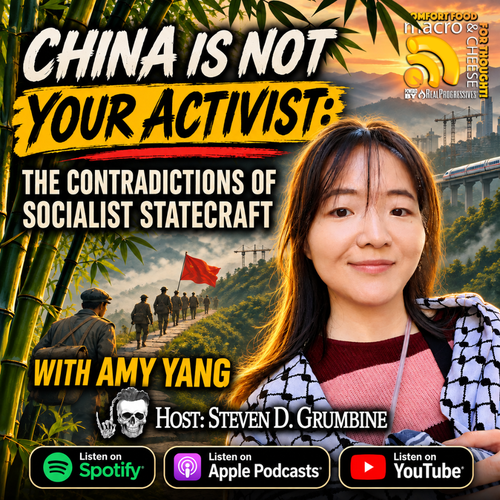
Episode 404 – China Is Not Your Activist: The Contradictions of Socialist Statecraft with Amy Yang
FOLLOW THE SHOW
Is China an “activist”? Amy Yang says western Marxists are making moral judgments when they should consider its specific historical conditions and ask what is owed from inside the imperial core.
** Discuss this episode with us in Macro ‘n Chill, an online gathering for the community. Tuesday, November 10, 8pm ET / 5pm PT. Click here to register
Why do so many of us expect China to behave like an activist, cutting ties with Israel or denouncing the West at the top of its lungs? Steve takes up that tension with Amy Yang who argues the demand is moral rather than materialist, and asks what changes when we look at China as a state with its own history, contradictions and material limits.
Amy is a Chinese student and writer based in Sweden. Her Substack articles focus on actually existing socialist countries and anti-imperialist struggles in the Third World, and she challenges Eurocentric Western Marxist narratives. She co-hosts the podcasts Resistance is for Tao and For the Masses. Amy admits she once shared the frustration, being an activist herself, until conversations with comrades and family pushed her to read the history. She traces Mao’s turn from the hard anti-imperialist rhetoric of the 1960s to trade and technology transfer in the 1970s, a response to neoliberal finance subjugating the Third World through debt and the IMF. China holds one fifth of humanity and is still a Third World country by per capita measures, so it needs peace and a multipolar order to build the productive forces that a later stage of socialism requires. Steve adds the lessons China drew from the Soviet Union, and Amy reads the Long March as a long retreat toward the goal.
Steve and Amy then take on Western Marxists and Trotskyists who aim their fire at actually existing socialism instead of their own empires. Amy separates tactical compromise from principle with the image of bamboo, which bends without breaking. Private firms can make toys and phones, but land, banks, energy, water, telecommunications and public services stay under state control, and non-interference anchors foreign policy. Steve brings in Fadhel Kaboub’s emphasis on productive, technological and energy sovereignty and asks about ownership and class power. Amy describes the shift since 2012 toward state and collective enterprise, and argues that Chinese workers still produce value for richer Western workers. Their class struggle therefore runs on two fronts, one at home against capital and one globally against imperial value transfer. They also discuss how China prepares for confrontation while playing a long game.
The last stretch turns to the imperial core. Amy argues that voting and symbolic protest will not do the work, and that every disruption of the ruling class, like the revolt in France, gives Third World nations room to breathe. She points to the Black Panther Party’s parallel institutions, to speaking with workers in their own language, and to accepting sacrifice. Steve warns against both adventurism and tailism and recalls Luxemburg on the elected socialist becoming a minister of capital rather than vice versa.
Amy Yang is a Chinese student temporarily based in Europe, whose articles mainly focus on actually existing socialist countries and anti-imperialist struggles in the third world. She seeks to challenge Western Marxist narratives and contribute a Chinese Marxist and anti-imperialist perspective to debates on global politics.
Find Amy on Substack and Instagram under her name, and find her podcasts Resistance is for Tao and For the Masses on Substack.
[00:00:41] Steve Grumbine: All right, folks, this is Steve with Macro N Cheese, and today’s guest is a new guest. You know, we’ve covered so many countries, so many philosophies, so many issues, and China is so important for us to understand. And previously, before I had any history in understanding what was going on in China, you know, I probably had a lot of the same misperceptions that many Americans have and many people not living in China have, many people that are not Marxists have, who listen to Western narratives and even some of the leftist narratives about China.
And it’s quite frustrating. But I do a lot of reading, as you all know, who follow this podcast. And a particular paper came up, an article came up that I was fascinated with because it spoke to something really important to me. And that is this concept that China is supposed to be an act as an activist, like all of us out here who are screaming and yelling at the top of our lungs to end the genocide in Gaza or to stop funding Israel or to do any number of things that are within the right anti-imperialist framework, the right anti-colonial framework, and quite honestly, from a materialist perspective.
But I ran into an activist, a writer, someone who I feel is brilliant, and she’s a Chinese student, temporarily based in Europe, whose articles mainly focus on actually existing socialist countries and anti-imperialist struggles in the Third World, drawing on her experience in Europe.
She has become aware of the misconception of Eurocentric narratives surrounding non-aligned countries in the Third World. Through her article, she seeks to challenge Western Marxist narratives and contribute to a Chinese Marxist and anti-imperialist perspective to the debates on global politics. Her name is Amy Yang. And with that, I would like to welcome you to the show, Amy.
Thank you so much for doing this.
[00:02:55] Amy Yang: Hi, thank you so much for having me on. It is literally my great pleasure to be on this show. And thank you for all these beautiful words about my articles. I want to firstly talk a little bit about the motivation, why I wrote this specific article on China is not activist. In the past, I would say at least two years, I have heard lots of criticisms or questions about China, about China’s foreign policy in West Asia.
Why is China not cutting ties with Israel? Why is China not supporting Iran as much as it can? In the beginning, I would say my understanding about China’s foreign policy was a bit similar. I was also frustrated because I am an activist myself. So I expected my country to behave like me, right? Like, you know, to go on the street, to shout “Free Palestine”, to say we should boycott Israel and to also boycott Israel.
But then I talked with lots of comrades inside China. I talked with my parents, with my families.
I suddenly realized that China is a country, right? China is not an activist. And then I think, firstly, the perception that China should do something from a moral understanding, from a moral perspective, is not materialist. Some comrades in China told me you should analyze China’s foreign policy from a dialectical material perspective, which means that you have to understand the background.
Like, where does all this policy come from? So I started reading lots of history because I’m not from a social science background. So I wasn’t aware of lots of China’s history before the reform and opening up because I grew up around 2000. So I grew up in the most neoliberal period of China. I wasn’t aware that in China, there are actually two periods, two main periods.
So one is before 1970s, and one is after 1970s. It has something to do with reform and opening up, but the change of China’s foreign policy happened before the reform and opening up. I started to realize that it was actually related to the global situation. So before 1970s, there was a huge wave of decolonization of anti-imperialism.
So people were really hopeful. People thought that there could be a world revolution. And that was all the communists in China thought about. That was why Chinese government at that time, before 1970s, especially during 1960s, was really anti-imperialist, really hard on its words, on its languages. And for example, Mao could directly criticize what the West was doing, right?
It called imperialism paper tiger. But after the 1970s, it’s Mao himself who decided to change his policy. And why? I was asking myself. And then if you look at the global situation, the situation changed. People realized that there wouldn’t be a world revolution. The West or the populism didn’t die. But rather, it changed its form. It became neoliberalism.
It started to export financial capital around the whole world. It started to subjugate the third world by financial means, not by weapons, also by weapons, but both weapons and financial means. When Mao realized that the world revolution wasn’t possible and we have to counter the wave of IMF [International Monetary Fund], counter the wave of neoliberalism, we have to develop. Mao started changing the foreign policy and started to open the door towards the West, not by making compromise, not by saying, OK, now we will have to abandon all these socialist principles, but by saying, OK, we can, we have to make friends with each other, but friends are not friends.
We know some people are real friends, some people are just fake friends, but we have to just trade with each other, trade with everyone, and be neutral friends with everyone. That was the firm policy change, and it brought lots of benefits to China, I would say, especially technology transfer.
It gave China the necessary technologies to develop its own indigenous technologies. It helped China to develop productive forces. But then with all these benefits, there are lots of problems. Because when you start making friends with everyone, there will be people who you hate, people you genuinely like, because as a socialist country, China doesn’t treat everyone… China knows who is the real friends, right? China knows like the US or the Israel are not really its friends, but you have to maintain the good relations with them because…
How do you say? Because of your foreign policy. It’s like you cannot say like I just pick some Western countries, I trade with them, but not with others. Once you decide to change your foreign policy to trade with everyone, you have to trade everyone equally, even though you don’t want to do it. And this is the historical perspective.
And then we come to the current period. So now China has entered a very critical historical period that China has finished, let’s say, first stage of improvement of productive forces. But China hasn’t entered the next stage of socialism, which means that there are still lots of internal contradictions inside China. There are huge regional and social inequalities in China, which is both because of the neoliberal influences.
Because of what China sacrificed for technology transfer, China sacrificed the environment, China sacrificed the Chinese labor to get technology transfer from the West, to get investment from the West, to develop its product forces. That is one reason. Another is because China is still a third world country. China’s GDP is second largest, but China has one fifth of the world population.
If you divide the GDP with world population, China is not rich. So which means that China still needs a long period of development. And to develop, you need peace. So which means that you cannot just be like, OK, I support justice. I want to, you know, design my foreign policy surrounding morality, surrounding justice. No, as a country,
you cannot do that. You have to say, “I have to design a foreign policy to serve the interests of my people.” Because as a socialist country, the goal of Chinese government is to serve Chinese people. That is why China’s foreign policy now is like before. Let’s say like around 2000, it’s always we trade with each other. We will trade with everyone.
And now it’s like peace and mutual respect and multilateral world order. It is because China sees that it needs this new world order to develop its productive forces in order to enter into the next stage of socialism.
[00:10:43] Steve Grumbine: I think it’s fair to say that China learned from the Soviet Union. I think it’s fair to say that they took a lot of the lessons, you know, forced collectivization that happened under Mao, that happened under Stalin, forced industrialization to meet warring times. I mean, Russia was born out of World War I, the revolution that Lenin led was born out of the ashes of World War I, and then Stalin through World War II.
They both got to experience millions and millions of deaths and destruction and the Battle of Stalingrad with the Nazi army coming across and the Red Army’s ability to crush Nazi Germany. The Americans will tend to put that flag up and pretend they did it. But I think that China watched this and they took lessons. They studied. They said, “How do we make Marxism-Leninism work where the Soviet Union maybe, did not?”
And there was a rupture there, correct?
[00:11:48] Amy Yang: Yes, I think, yeah, you’re 100% correct that China has learned a lot from Soviet Union. I think one thing it learned is that you need advanced technologies to protect yourself. Another thing China learned is that you have to compete with the West in their terms. Because how did the West make the people inside Soviet Union think that communism didn’t work was that there wasn’t trade, there wasn’t consumer goods that are as fantastic as in the West.
And I think these two lessons China learned is that firstly, you need to develop your productive forces. Secondly, you need to, how to say, you need to have a consumer market. You need to have certain level of consumerism, even though that is bad for socialism you know as a Marxist-Leninist you don’t want consumerism. But in a global capitalist world you have to allow your people to enjoy certain consumer goods certain treats, in order to make them satisfied, you know, with their own life, because they will be exposed to Western infiltration, to Western propaganda, like all the films, you know, from Hollywood.
They will see that, you know. So I think China has learned a lesson and China is so good at both technologies and also the trades, the consumer goods now. And I think that is why the West has realized that it cannot contain China anymore. But I want to mention another thing. Even though China has developed a high level of producing the consumer goods now, China is gradually returning back to Maoist era, to the socialist spirit.
So I would say when I grew up during, 2000, 2010, around that period, there was a really deep culture of consumerism. There was, you know, like everyone wants new car, wants to be rich. But now, like the Chinese government started promoting the socialist values, which means that you don’t really need, you know, consumer goods because it’s not good for the environment.
What you need is real well-being. So your mental well-being, what you need is a higher value. The socialist value is, you know, community value. And all this is, I think, a good sign, a positive sign that China is going towards socialism, not by a strict rule. Like you don’t go there just from A to B.
You go there through A to C to D to E. You make lots of turns and twists and eventually you go back to socialism. And today is actually a special day. It’s the 90th anniversary of the Long March. From my point of view, the whole process of China’s Maoist era and then the reform and opening up, and now the Xi’s, you know, the ecological governance, all of these are actually a long retreat, a long, long march.
So it looks like you are making compromise, but actually you are marching towards your goal, which is socialism.
[00:15:11] Steve Grumbine: That is so amazing. I love the way you said that. I think this is one of the challenges in dealing with friends who fall outside of the Marxist-Leninist world, like some of our anarchist friends who wonder, hey, well, how come the state hasn’t withered away? And others who, you know, kind of mock the Soviet Union, actually existing socialism, right?
Who mock these things, they don’t realize that the counter-revolutionary forces that these organizations, these states encounter after their revolution. And as they’re trying to assert power and they’re trying to establish order for all, that there is a transition. There is, and there’s always going to be a form of counter-revolutionary insurgency, even within the country, especially outside the country, because there’s nothing that piques the interest of capitalist nations than nations that are not following a capitalist protocol.
But, you know, one of the things that I thought was fascinating, and I don’t really have a deep historical understanding of this, but obviously within the United States and China, there’s been a lot of back and forth over the years. You see it every day. Joe Biden a few years back called China our number one enemy. And I was like, what?
What are you even saying? Right? Like, but there was a lot of shitlibs out there who bought it hook, line and sinker. And that became the narrative. And now you see Trump kind of carried that through with his tariffs and everything else. But it didn’t really faze China. China had developed itself in such a way that it could withstand and deal with, just sort of be still and honor its code without reacting, you know, without reactionary kind of treatment.
They just smiled and kept building, kept developing, kept building relationships through BRICS and through other non-military style incursions like the US does. They didn’t do any kind of, dare I say, financial prisons like the IMF. They didn’t issue unpayable loans. I’m not here to glaze China. Like you said, China has plenty of problems. It’s in transition. It’s got lots to work out, lots of contradictions.
But when you think about you know, the US tactic of using the World Bank, the IMF, the World Trade Organization, the power of NATO, the power of the US military, the CIA kind of incursions that destabilize regions, the coups, all the rest of it. China doesn’t do that stuff. China works for a cooperative approach. They are the big dog.
They are definitely huge, but they’re not doing it in an antagonistic way, which I think throws everybody off. They’re not quite sure what to make of it.
[00:18:01] Amy Yang: Yeah, I think exactly as you say, people are not sure how to understand China. I think that is the problem, you know, because we are used to this Western hegemony. There is a huge country, huge power to tell us, you know, to dictate the world order, to tell other countries what they should do, right? And I think, firstly, as you said, China’s foreign policy, China’s like BRI or like BRICs, they are not imperialists.
And of course, China are massively benefiting from all these initiatives, but it’s not because China wants to colonize or imperialize these countries, but because China is just larger. If China does trade with Pakistan, for example, China is bigger than Pakistan. And of course, a larger country will always benefit proportionally a bit more than the countries that are smaller and maybe hasn’t developed to the same level as China.
Then you see, for example, like Pakistan, like China’s trading partners in the Third World, they are also massively benefiting from it because China has all these trading relationships with them. They don’t need to back the West to get the investment. They have an alternative to structural adjustments through the IMF programs. They have alternatives to back the West, to back the aid, the financial aid from the West.
So I think that opens up windows of opportunities for third world countries to develop. It doesn’t solve problems inside these countries. These countries can still have, you know, class contradictions between comprador class and the working class and the peasants. They have to solve this problem themselves. China is not going to solve this problem for them because China is not US, right?
China is not a hegemon. It’s not a white savior. China doesn’t see itself like that, like activists see themselves like that. Like, I think that that is why I can feel frustrated about, like, lots of Western activists, because I think activism and white saviorism are somehow connected, because people think we are there to protest or to, you know, take actions to save others who are oppressed, because those people cannot save themselves.
And I don’t think China sees itself in that role. China thinks every country can stand up, fight against imperialism, can really save themselves because they are able to do so as China has done itself.
[00:20:50] Steve Grumbine: It’s funny you say that. Real quick, it’s funny you say that because I think that, in the US, and I know you’re not from the US, so this is going to be fun, we have a lot of what we call performative outrage, performative displays where we have these political figures wearing kente cloths and kneeling down and doing catered sit-ins and all kinds of other things that are just nonsense.
And unfortunately, we are filled with people that, to steal [Italian anti-fascist Antonio] Gramsci here, been hit with the cultural hegemony, right? The pop culture, the nonsense, these veneer surface level things that have no substance whatsoever. And so when I think about many Trotskyist organizations and Western Marxists, et cetera, I see them frequently going to the performative. really lambasting China for not doing X, Y, Z, really lambasting Russia for defending themselves against the proxy war in Ukraine.
It’s an odd relationship with imperialism they’ve taken on. And they expect China, in all of this nonsense where they pretend like they’re anti-imperialist, acting like China should become imperialist. This is, I think, goes back to some of Trotsky’s writings where they just imagine this global revolution where, you know, China’s failing the revolution by not, you know, because, oh, my God, we can’t have socialism in one country.
But what you’re watching is, hey, I’ve got to take care of here first. I’ve got to start somewhere. And China is building itself up and creating such a thing as it develops allies. I find it troubling that so many supposed socialists come down on them in such a way. I mean, they’re not beyond critique, but I find it fascinating that actually existing socialism is where they put their ire, instead of the capitalist nations that are surrounding them attempting to destroy them.
Yeah, anyway, I just wanted to interject that.
[00:22:59] Amy Yang: Yeah, I think you have brought up really good point that I think in the West, especially among Western Marxists, the focus is always on actually existing socialist countries like China or non-aligned countries like China, Russia, Iran, sometimes also Vietnam or DPRK. Like, why don’t they do this? Or, you know, they’re so bad. But then they don’t really focus on criticizing their own governments.
They don’t really reflect on you know, the country’s military bases around these countries, right? For example, there is a long discussion here, like where I live in Sweden, about why isn’t China cutting the trade relations with Israel? The thing is, however, first thing you have to see, China is literally surrounded by all the military bases of the US, and China is still facing threats…
economic threats from Europe about overproduction, overcapacity. And from the US, there are still like lots of hostilities against China. And that is what China should focus first, because China’s government, again, is firstly responsible for its people before taking responsibility for others.
[00:24:22] Steve Grumbine: Going back to something you just said a few minutes ago, you had said that Mao’s diplomatic opening to the US, right? You basically showed that as evidence of revolutionary governments needing to adapt. And I want you to keep going with what you were saying, but I want to interject this before we go further.
How should Marxist-Leninists understand the relationship between tactical compromise and ideological consistency? Like I said, I have a very good friend who’s an anarchist. And he and I talked and, you know, he said, “So tell me when this withering is going to happen because I don’t see it. You know, it’s never happened. So we’ve got to, you know, destroy or ignore the victory of overthrowing the bourgeoisie, of overthrowing capital and not realizing that, hey, you got to start somewhere.”
And now you’ve got to build a different way. And you’re going to have attacks coming from a thousand different places. I guess my question to you is even Lenin allowed some capitalism and the folks who don’t realize Lenin, you know, who is, you know, the absolute standard bearer of Marxist-Leninism, you know, even he allowed some in at that time because there was a need for development.
However, even he seized control of the central bank and he understood the use of a fiat system at that time, which is kind of shocking because most people don’t, I don’t think, think about that. But China is adapting. And I know that you’ve spoken to some of this, but I think it’s really important for folks to not take China in a vacuum, but take China in its material conditions and the reality of the world systems that are surrounding it.
What is the difference between tactical compromise and ideological consistency for the purists out there?
[00:26:11] Amy Yang: Yes. I think you can understand it by watching the bamboo and by watching maybe something different from a bamboo, like a stick. When there is wind, there is strong wind, the bamboo doesn’t break. It bends. And it’s a good thing. Don’t think because it bends, so, you know, it will break. It will never break because it bends.
This is the tactical compromise without compromising your principle. So, for example, about China, about the foreign policy, we can make concessions. We can say we will start diplomatic and economic ties with America, with Israel, for example. But we don’t compromise our principle. What is our principle? So Chinese foreign policy, like the most important foundation is this five no interference, like coexistence principles [Five Principles of Peaceful Coexistence], like mutual respect, non-interference.
You can look it up, but the main message is that we don’t act as a hegemon. We don’t go to other countries to tell them what they should do. We treat everyone equally. We treat everyone with full respect in a good world, we should collaborate with everyone.
We should collaborate with everyone and we should, you know, like mutual benefit. So the collaboration will benefit everyone. That is China’s foundational foreign policy. It has never made any compromise on this point. And about China’s economic policy, it’s more obvious. So all the commanding heights of the economy, the land, the bank, the energy, the water, the telecommunication, internet, all of this, like all of this most important thing, also public transport, public school, all these things are controlled tightly by the state it will never be owned privately.
And that is the key principle. That is the principle we don’t compromise. What we can compromise is the consumer goods, right? You can allow private companies to manufacture clothes or manufacture like toys or computers or like your phone, whatever. And those can be compromised. That is like you can bend down, but you will never break.
But I think from Western Marxist perspective, they never understand it because they haven’t entered into a stage that they need to think about this. Because in the West, you don’t need to make compromise because you’re still in a very privileged class position, I would say, even for working class people, especially in Europe, I think. They have a very
idealistic, very utopian image of socialism because they don’t understand these challenges that third world countries face.
[00:29:11] Steve Grumbine: I think that’s on purpose, right? I think there’s an entire intelligentsia guys like Gabriel Rockhill have spent extensive time documenting. I want to say this real quick. I’m going to bundle two questions in one because I think that they kind of go hand-in-hand. And I’m also going to monologue for a minute because we have a gentleman that is a big part of our program here named Fadhel Kaboub, who is a institutionalist economist that works in Africa.
And he always talks about how you’ve got to have a plan or you’ll become part of someone else’s plan. And before you can decolonize your country, you’ve got to decolonize your mind.
One of the things that jumps out at me he talks frequently about is not just monetary sovereignty, which China has and the US has and Canada has and Australia has and the EU does not have, but UK has. But we talk extensively about productive sovereignty, technological sovereignty, energy sovereignty. All these things are what allows a country to function regardless of what’s going on beyond its borders.
And I guess the question is, while China engages heavily in capitalism right now on the global stage, quietly behind the scenes, everything I see is it’s building and building and building wonderful things for society. A friend of mine talked about how going and getting health care was like didn’t hurt him at all. It was cheap. It was free, pretty much. You know, there was a nominal fee, I guess, just for whatever reason, right? And when you think about that, I want to cap the little statement I made there with a question. It’s like you argue with that technological sovereignty and the development productive forces are essential for China’s socialist future, but productive forces alone do not define socialism.
How do ownership, class power, and workers’ control fit into your understanding of China’s development strategy?
[00:31:14] Amy Yang: Yeah, I think that is a really good question. Of course, improving level of product forces is not socialism, but it’s a prerequisite of socialism. We can see there are different stages in China’s recent development. So firstly, it focused on only developing product forces by literally sacrificing its labor. So actually making the relations of production worse. So literally making the wage labor even worse, like worse than the labor working conditions.
I would say between 2000 and 2005, you can see there are lots of labor rights violations, especially by the Western multinational companies. And you can see like the environmental pollutions, everything. And that is a period China mainly focused on improving the product forces. And after that, you can see that China started changing, especially after 2012. China started to, how do you say, focus more on how to decrease the percentage of private companies and increase the state-owned enterprises, increase the collective corporations.
[00:32:35] Intermission: You are listening to Macro N Cheese, a podcast by Real Progressives. We are a 501c3 nonprofit organization. All donations are tax deductible. Please consider becoming a monthly donor on Patreon, Substack, or our website, realprogressives.org. Now back to the podcast.
[00:32:57] Amy Yang: So that is a trend that we have to now focus more on the relations of production, because the end goal will be to abolish the wage labor 100%. But then I think, for example, like workers’ rights, we cannot analyze these questions inside China, like only by looking at China, because China is in a world dominated by a global capitalist imperialist system.
So if you put China in the whole world, you can see that China is firstly a semi-periphery country based on the definition of Jason Hickel. It’s a very accurate definition because if you see like China’s development, if you just go to China, you don’t go to Shanghai, you go to like the Henan or like Hunan, those villages, you see that China is a third world country still.
If you put China into this global stage, you see that workers’ rights, for example, China has to improve workers’ rights not only by setting all the laws or the regulations, by regulated capital. That is very important. Like anti-corruption or setting all the legislations, also the China’s labor union. All these measures are very important to improve Chinese workers’ rights.
But that is not enough. Because you have to understand, you have to firstly solve the global primary contradiction, which is China’s wage level is still very low compared to European wage level. So Chinese workers are still creating values for free for European workers. Not only workers, of course, European bourgeoisie, but also workers like all the Europeans and also people in US or Australia.
So that is why China has to engage in two fronts of the class struggle. One is inside China, like Chinese government has to regulate capital, has to, you know, the Chinese labor union has to do active class struggle. But that is more non-antagonistic. That is not to say we have to, you know, it’s different from like the class struggle in the West.
But on the other front, China has to fight against the West in the way that China has to improve productive forces, improve its technology to such a level that China can improve its reach level. China can go from the semi-periphery to a more equal position with the West, or like actually in that case, actually it’s more like the West is declining, right?
So the global imperial system is declining in the way that China, the value transfer from Chinese workers to the Europeans or to the Western countries will decrease. And I think we have to understand China’s workers’ rights or relations of production from a more global level, not only inside China, but also globally. So I think that is why anti-imperialism for Chinese workers is really important.
[00:36:05] Steve Grumbine: I think you’re absolutely right. I had like my questions here that I had written down. You’re like answering a lot of those. We got… I love it. I don’t even have to ask them. But I do want to say this. In the emergence of a multipolar world, there’s always power vacuums when things change. And to some degree, not participating in those events leaves them open to fascist elements.
And one of the reasons why this program, even though I call myself a Marxist-Leninist, is that I focus on Modern Monetary Theory is because the material conditions of those countries could improve if the government serve the people and the governments. This is the sad thing in a capitalist society. The governments do not serve the people. And even those that want to serve the people, they have the imposition of imperial forces, you know, anti-communism, anti-socialism, anti-workers, anti-labor.
The entire world system is against these countries, even when they try to do good. Leaders are assassinated.
Voices are silenced. Colonialism still lives on, even if they don’t have the funny little British hats and riding through on camels. They are still coming in and using finance capitalism to destroy and destabilize these countries. In the emergence of a multipolar world, I guess the question is, let me roll that back. You know, you talked about Lenin, you talked about imperialism so much, and I think this is really important.
Obviously, China is trying its best to walk the line. They’re trying to walk both in the world where the world is capitalist, so they try to have an external facing element there. But internally, though, I guess the question is, how does China’s strategy confront the underlying economic relationships rather than merely challenging American geopolitical dominance? Because, like I said, the power vacuum of, you know, when the Western hegemony starts to shrink a little bit, we say like a wounded dog is really dangerous, right?
And, you know, snapping around and being irrational. I wonder, you know, how does China function in that space knowing those things, you know? I mean, like, are they developing military capabilities? It feels like everything they’re doing is really more a matter of just pushing out and letting time be its friend to allow these things to occur naturally outside as they continue to build and build and build.
[00:38:44] Amy Yang: Yes and no. I think China does more than it says. And I think, firstly, we shouldn’t be naive that multiple [multi-polar] world is not the end of the world. It’s just the very beginning of a new world, I would say. So, of course, now we can see the imperialist West is declining. That is why it has started so many wars.
It has literally bombed so many countries simultaneously. I would say we have to be aware that eventually there must be a confrontation between socialist China or like actually socialism and, or I will say not only that, like this small group of transnational financial class, like actually the Epstein class, I would say. The question will be, should China be more confrontative?
Should China just confront them with, you know, say, I’m not afraid of you. I think China is saying that. I think China is preparing for the worst. I’m not sure whether China has openly said it, but inside China, everyone knows it. We are building more military capacities. We are preparing if, in case, that Japan will be more aggressive on us in the question of Taiwan province, and we will definitely not be afraid, but we will fight back.
I think the principle of Chinese government and Chinese people is we will not shoot first. But if you do something against us, if you shoot us first, we will definitely shoot you back and we will beat you. I think that is the attitude in general about this more confrontative situation. But let’s say a better situation will be that
time is on China’s side. And when the West is declining, it also loses its productive forces. It loses its capacity to build weapons. It doesn’t have like rare earth minerals. Maybe if it can take control of Brazil, probably it could get rare earth minerals. But I doubt that because, for example, like Brazil. You have the real earth, but you don’t have the capacity to refine it.
You don’t have the capacity to really process it. And that is actually the main problem why there is only China who, you know, most real earth minerals are from China because China has invested in education massively for decades, like for decades. So that is why China is playing a long game. China is now saying, you know, peace.
I’m not trying to be against the US I’m, you know, trying to maintain this more friendly relationship with the West. We try to say, let’s collaborate instead of fighting against each other. But China understands that there will be confrontation. But if at the point of confrontation, the West has already lost this capacity to do anything. So even if they try, there won’t be a major war, because now the problem is that China is nuclear power, and Russia is also, and the US is of course also.
So if there is any major confrontation, that will be very disastrous for the whole humanity. And from a more ecological perspective, that is also catastrophic. Because if there is a war, I think we don’t need to think about climate change because that will be the end of human history.
[00:42:31] Steve Grumbine: The end of history. Yeah. All right. That’s horrible. I’m not laughing. I’m laughing out of discomfort, not out of actual humor there. Listen, I want to ask you one final question to take us out before we get to the close. You argue that China’s socialist development cannot ultimately be separated from revolutionary transformation elsewhere. We’ve kind of talked about this a little bit.
What responsibility does that place on Marxist-Leninists and other leftists who are sharing in the same kind of awakening, the same kind of struggle? What does that place on us organizing inside the imperial core, particularly the United States? What responsibility do you see lying with those who, I mean, I think Che Guevara said, hey, I envy you guys.
You guys are in the belly of the beast or something like that. But what do you see as the role of people that are aware and are fighting for socialism?
[00:43:33] Amy Yang: Yes, that’s a really good question, because here now in Europe, we can see a wave of revolt or wave of anger from Paris to Italy to Albania. And in the US specifically, I don’t even see the anger. From my point of view, I’m not sure whether I’m correct or not. Maybe I hope I’m not, because I don’t see any possibility for investing countries to start a socialist revolution.
But it doesn’t mean that people inside the belly of the beast should just sit down and do nothing. I think it’s very important for people to take concrete actions against their own government, not because they will win. I think people here, because of lack of organization, lack of the class consciousness, lack of experiences in class struggle, lack of discipline, it will be very difficult for people in the belly of beast to really alter their ruling class.
But I think that is, as long as they fight against the ruling class, it will be very helpful for the third world countries who are more capable of taking down the beast, to do their own struggle. Like, for example, because people in Paris are literally fighting against their ruling class on the street by sacrificing their safety. And the French, French ruling class now has literally no time to instigate terrorism in Sahel states.
So the people in Sahel states can grasp this window of opportunities to develop, to be more independent, to take back their sovereignty. So I think that is more important. So I always say, for example, people in the United States are the rearguards of the rearguards. But if they can learn from, for example, people in France, which I would say are like the vanguard among the rearguards, and the rearguards have really
important responsibilities to make the ruling class panic, to make the ruling class have no time to oppress others in the Third World. I think that is very important. Another message I want to give to all the comrades in America or all the people is that voting doesn’t solve any problems. I think here, I think you talk a lot about this in your podcast.
Just want to emphasize that. Both the blue and the red or like Democrats, even Mamdani, like all of them are inside the empire, inside this global imperialist system. What Americans should do is not, you know, do this like No King protests. You can use No King protests to connect with other comrades, to build relationships, to know more people, to organize more people.
But the real actions should be more like what is happening now in Paris. You have to literally do some sacrifice because as far as I can see, throughout the history, real changes only come from real sacrifices, and that is very uncomfortable, and that is very difficult, but we have to face the difficulties and start to take actions.
[00:47:03] Steve Grumbine: Well, speaking of that, I guess this will be the last question. I struggle with this, right, because there is a cross-section of what I would call adventurism, where people just go off half-cocked without discipline, without theory, without understanding. And I think a lot of people probably would roll their eyes at this, but I think of Che Guevara in Guerrilla Warfare.
And he talked about how he was nothing without the people. And these people were backwoods. They didn’t have deep theory. They weren’t anything like that. But he understood and he felt it was his responsibility, as do most revolutionaries throughout history. You think of Ho Chi Minh and others that literally are among the people, of the people, with the people, for the people.
And when you think about the US, a lot of these things are led by bourgeoisie, led by rich people. They’re organized by capitalist parties. So you already know that they’re no threat or they wouldn’t be organizing them. They wouldn’t be funding them. It is an attempt to bleed off energy. So in the United States, there may be some revolutionary spirit there.
By revolution, I want to be clear. I’m not talking about picking up a gun, but I’m not saying not to. I’m just saying, in general, resisting a system that predates upon us, that creates these control systems that don’t allow people to live free, that don’t allow people to be healthy, happy, and whole, that don’t allow people to own their own labor, that don’t allow people to
live without the kind of oppression that comes with the system we’re under. I think that what will really happen will be the capital order will crack down on people trying to be free, as opposed to people that are trying to be free, suddenly bringing out the violent revolution, which some knuckleheads say. It just makes me sick in my stomach when I hear…
I know that they’re misguided. And so I try really hard. It’s very hard because I want to yell and scream and cuss them out and call them all sorts of horrible names. The reality is, is that they have been conditioned. And I think the hardest part, I think we all struggle with this, right? Taking risks and thoughtful risks, you know, in a way where you’re working within discipline and you’re not an adventurist, you’re not, you know, a tailist either, where you’re going with reactionary forces, et cetera.
It takes a lot. And, you know, having revolutionary, I mean, Bernie Sanders for all his faults. talked about a political revolution. And he didn’t really deliver that. He kept putting us back into an imperial capitalist party that led the genocide, that funded the genocide in Gaza, et cetera. And people don’t want to hear that because they have hero worship.
They have great man theories and bad man theories because look at Donald, blah, blah, blah. But in reality, the people in the US are so propagandized. And as part of the imperial core, we all live a very… Even the worst situation is better than some of the best situations elsewhere because of the extra that we get as part of the imperial core.
You know, being able to separate yourself from the fruits of empire and being able to see how it is that you are in fact getting those fruits of empire and making changes, I think is really hard because nobody’s teaching that. They’re not going to school learning if they’re being taught in school to go make as much money as you can.
If people didn’t do good, that’s because they’re lazy and they’re worthless and they’re useless and they made bad choices. There’s some other trash argument that capitalists use to keep us under control. But your thoughts, because the US empire, the people within it, they’re still working class people, even though they’re benefiting from the imperial core. How do we bring about revolutionary consciousness?
And again, I want to be crystal clear by saying revolutionary consciousness. I’m not talking about they’re picking up an AK[-47] or anything crazy like that. I am literally saying to resist this mind control, if you will, through hegemony, through the narratives that are forced down their throats and to just care about people, be part of the. the people, really, really be part of that, not above it, not punch down.
Your final thoughts. I’m sorry to take us that far out.
[00:51:33] Amy Yang: No worries. I think it’s a good point that, firstly, actions like Luigi [Mangione], that is not revolution at all. Because for revolution, revolution is a massive revolution. So, for example, here, again, in France, all these riots, all this revolt, right? This is not because people just suddenly think they should go to the street to burn down everything. It’s actually because there was a decades-long class war, which by the French bourgeois ruling class against the students, against the immigrant families.
That is why people are so desperate. People tried everything nonviolent, until people realize that all the means are exhausted. And now it’s the final choice. I have to go to the street to directly fight against you. And so on this thought about America, I think, firstly, I do see that most working class people in America have already realized that this electoral politics is a lie.
I think especially among working class people who vote for Trump, I think it’s a bit similar to working class people who vote for AfD in Germany. So they actually understand that the electoral democracy is not democratic at all. It’s not for the people. It’s just true of the same thing. That is why they are so desperate.
They want something new. And I think there is a great opportunity for real communist parties, for example, or real anti-imperialist parties to organize these working class people by talking to them in their own languages. You don’t talk about theory in this very academic language, you know, because actually all the working class people understand that they are exploited.
All the working class people understand capital is bad and capital needs to be regulated and eventually abolished. I think everyone understands it. What they don’t understand is how to abolish capitalism, how to fight back. So that is what the communist parties or, you know, the vanguard should do. The vanguard should give people a tool, for example, by building parallel systems.
You don’t need to take up guns. But what is more effective than guns is you build what the Black Panther Party did, right? You build a parallel system. You don’t rely on their capitalist system. You have your own grocery stores. You offer food to the working class families whose children are literally starving every day. So you build your own system that is actually threatening the ruling class.
And I think Mamdani, like before his election, this movement has mobilized so many working class people. But the problem is that because the movement was led by him and he is actually one of the ruling class. So that is why the momentum among the working class people was lost or was wasted, because he literally utilized this momentum to get into the office.
And then he abandoned the working class people, of course, because he’s not one of the working class Americans. He’s the bourgeois ruling class.
[00:55:02] Steve Grumbine: You know, it’s funny you say that because I don’t think people realize this. People place the power in the political instead of the economic, the means of production. The real power is not in these puppets and these institutions as they stand are representations of the ruling class. And I work with a lot of institutionalists that would like to take over those institutions.
And I do believe that even Lenin talked about taking over the institutions, that they wouldn’t wither away, that they would need to be around until such a time came that class domination was over and that it would wither away. I think that it’s really important to realize, though, that the performative nature of so-called socialism in the US as, you know, I don’t want to get into the politics of it all because I don’t tend to really care about the political candidates in the work that I do.
That’s not really the focus of what we do. But understanding the systems and understanding the hegemony and understanding where the power lies, I think is really crucial to living a sober life, a materialist life, where you’re seeing things, how they come to be, and why they are the way they are and understanding the contradictions.
And I’m sure there’s always somebody out there that’s got some critique of why this is wrong or this, that, and the other. And so put your inner philosopher away for a minute and just think about what’s happening here. Rosa Luxemburg, who I know was critical of Lenin for a lot of times, she also had some really powerful things to say.
And one of them was that “a socialist entering into a capitalist bourgeois government does not transform the government into a socialist government. They become a minister of capital.” And so this concept that they’re going to win the day electorally, I just think it fundamentally misses the point that every single law on the books is there to protect private property, to protect capitalism, to protect the very system that they claim to be against.
But when they get in there, they’re sworn to protect and serve that very thing. And if they don’t, they can be censored. They can be removed from office, et cetera. Again, I don’t want to come off as a crackpot, but I think what I’m saying is visible. It doesn’t require some deep ideological understanding, though ideological understanding, a theoretical understanding of the system is really important to pulling it down.
All right. With that, Amy, you have been utterly amazing. I am so glad. I’m always glad to meet new guests. I’m always glad to build bridges with new people. I really hope that you’ll be a part of what we do. We can have you back on in the future because you were amazing. Tell people where they can find your writing.
[00:57:51] Amy Yang: Thank you so much for having me on. It’s my great pleasure to be here. And I really enjoyed the conversation and I learned a lot. I publish like most of my articles on Substack. So you just Google, like in Substack, you just search my name, Amy Yang, and it will pop up. Or I have an Instagram account.
It’s the same name, Amy Yang, and you can find me there. Next year, probably I will move back to China and I will probably mainly use Substack. I’m actually one of the co-hosts of a podcast called Resistance is for Tao. And the podcast is actually censored by the YouTube or is completely nuked by the YouTube. So because we support the access or resistance, we have our podcast on Substack and you can also find us there.
And also, I forgot another podcast I recently started, actually just last week. It’s a podcast called For the Masses. It’s everywhere. It’s, I think, on the Spotify also, although I recommend you not to use Spotify because it’s a Zionist platform. But we do have it there and we have it on Substack, on the Instagram. And yes. Those are the works I do.
[00:59:15] Steve Grumbine: Very good. I really appreciate this. All right. With that, I’m going to go ahead and take us out. Folks, my name is Steve Grumbine. I’m the host of this podcast, Macro N Cheese, and the founder of the nonprofit Real Progressives, which sponsors this podcast. We are a volunteer organization and we survive on your contributions. So if you consider the work we do informative and valuable and would like to see us keep doing it.
No donations too small, no donations too great. You can go ahead and reach us on patreon.com/realprogressives and become a monthly donor or a one-time donor. You can also go to our Substack, which is Real Progressives. Look us up there and become a donor. Or you can go to our website, realprogressives.org
and become a donor. On behalf of my guest Amy Yang and myself Steve Grumbine and the podcast Macro N Cheese,we are almost out of here because I forgot one important thing. Amy, we do a Tuesday night–and it’d be late for you because you’re out there in Sweden, right? But we do a webinar each week after the podcast is released, It’s 8 PM ET, so it’ll be a little late for you.
But if you find a way to change your sleep habits for a night and you want to join us, by all means, it would be great. Every Tuesday night at 8 PM ET, 5 PM PT, we do Macro N Chill, where we listen to the episode together as a community.
And we’ve had some really, really wonderful experiences. And I understand it’s really late for you, so I’m not expecting it. But if you can, it would be great to have you. So with that, [I will try] that’s awesome. With that, folks, a totally different outro than usual. But let me just say the tagline. We are out of here.
[01:01:14] End Credits: Production, transcripts, graphics, sound engineering, extras, and show notes for Macro N Cheese are done by our volunteer team at Real Progressives, serving in solidarity with the working class since 2015. To become a donor please go to patreon.com/realprogressives, realprogressives.substack.com, or realprogressives.org
Extras links are included in the transcript.
Related Podcast Episodes

Related Articles

Why Didn’t the Chicken Cross the Road?
The High Intellectual Barrier to Socialist Consciousness

Lightsabers, Camera, Action

Leave a Comment
You must be logged in to post a comment.