
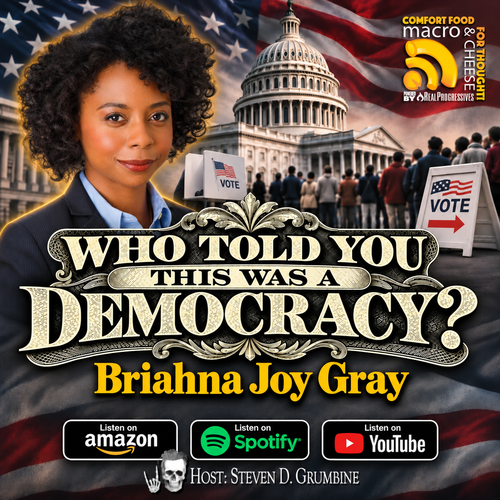
Episode 405 – Who Told You This Was a Democracy? with Briahna Joy Gray
FOLLOW THE SHOW
Why has the electoral “left” never spoken publicly about how money works? Briahna Joy Gray and Steve discuss the reality of self-described socialist Dems being folded into a corporate, Zionist, imperial party.
** Don’t miss Tuesday’s Macro ‘n Chill. We’ll have lots of provocative stuff to discuss. November 17 at 8pm ET / 5pm PT. Use this LINK to register
A decade after the Sanders “insurgency” began, why has the electoral left never taught the public how money works? Steve takes up that question with Briahna Joy Gray, host of the Bad Faith podcast. In case you’ve been living under a rock, Briahna is a former attorney and Intercept senior politics editor who served as national press secretary for Bernie’s 2020 campaign.
The two podcast hosts trade stories of how the 2016 campaign radicalized them, Steve from the MMT world and Briahna from the racial cudgel used against Bernie. She then asks why Bernie, with nothing left to lose, still won’t explain Modern Monetary Theory. Steve admits he once believed Bernie was playing a long game, and recalls MMT economists who were plugged into progressive candidates… who still wouldn’t touch it.
The middle of the conversation is a working session in framing. Steve lays out the MMT basics: money is a public monopoly, a creature of law. The government spends it into existence and taxes it out. Inflation, he explains isn’t “too much money”; it’s about monopoly pricing power. He points to Isabella Weber on sellers’ inflation and the pandemic profit surges. Briahna pushes him (relentlessly!) for something a candidate could say on 60 Minutes. They land on this: we pay for Medicare for All the way we pay for the bombs, and when prices rise it is because corporations raise them. That shifts the blame from working people and relief checks to abusive use of corporate power. Steve brings in Clara Mattei’s work on austerity as a tool to save capitalism.
The talk turns to electoralism itself – not surprising given their Bernie connection. Both argue that Democrats, including self-described socialists, are folded into a corporate, Zionist, and imperial party that cannot be pulled left. Briahna says the only use of leftists inside it is to expose it, as in the coming fight over Hakeem Jeffries and the speakership, and she points to the UK Greens and Labour’s response. Steve says real socialism has to be anti-capitalist and anti-imperialist, and that capital keeps us broke and divided, from Bacon’s Rebellion to today’s scapegoating.
Briahna closes with an inside account of a campaign that never workshopped its message with the person who had to deliver it.
Lies are sticky because the truth takes longer to tell.
Briahna Joy Gray is host of the Bad Faith podcast. A graduate of both Harvard and Harvard Law School, she worked as a corporate litigator before becoming a journalist and political commentator. She has been a contributing editor at Current Affairs, Senior Politics Editor at The Intercept. Briahna was co-host of – and then censored by – The Hill’s Rising. She served as National Press Secretary for the Bernie Sanders 2020 presidential campaign.
Find her work: X @briebriejoy, patreon.com/badfaithpodcast, youtube.com/@BadFaithPodcast
[00:00:42] Steve Grumbine: All right, folks, this is Steve with Macro N Cheese. I am so excited. I have a guest today that I have never had on the show before, though our paths seem to cross frequently with the various guests we have on and stuff. So it’s really exciting to be able to bring on Briahna Joy Gray.
Briahna, for those of you who don’t know, she was the national press secretary for Bernie Sanders, and she’s also the host of the Bad Faith podcast, which I’m sure most of you have heard. If not, it’s very exciting to have her join me, and you’ll get to hear all about her today. And we’re going to kind of go through some of the greatest hits, and we’re going to get into some deeper weeds as we wade into the electoral season and a host of other things that come with it. So with that, I would like to welcome my guest, Briahna Joy Gray. Welcome to the show.
[00:01:31] Briahna Joy Gray: Thank you so much for having me. It’s been long overdue.
[00:01:35] Steve Grumbine: Indeed it has. Indeed it has. I’m so glad that we were able to make it work. So for those that haven’t heard the stories or maybe aren’t familiar with your work, can you just kind of give a little background for how you got involved in the Bernie Sanders campaign? Kind of what that whole scene looked like.
[00:01:57] Briahna Joy Gray: Sure. So I was practicing law in New York during 2016 when so many of us, I think, were radicalized by Bernie’s first run and was very frustrated that the sort of narratives that I saw circulating in the media about who liked Bernie and why were so out of touch and inaccurate. And these days I would characterize it as straight up sort of intentionally misleading propaganda.
I found myself wanting to have some influence on that discourse. And a friend of mine at the time, we started our own little podcast, which very few people ever listened to, called Spody. And then I thought, well, what else could I do? I started trying to write. I was cold calling magazines, not getting a lot of response, wanting to publish.
And eventually I realized that I had a friend from law school who wrote for Current Affairs, was able to put me in touch with Nathan Robinson. I got two articles published in the summer of 2017 that went sort of viral. And then that was sort of the start of my career as an op-ed writer. And so I was doing that while practicing for about another 10 months before Ryan Grim at The Intercept reached out asking if I would be interested in coming on full time as a senior politics editor.
I went through that interview process and was hired. And I was very glad to work at The Intercept for another year approximately before the Bernie campaign reached out to me asking if I would be interested in coming on board as national press secretary.
[00:03:23] Steve Grumbine: That’s pretty awesome. I mean, like when we got involved in the Bernie Sanders stuff, you know, we had really came as MMTers. We didn’t, I didn’t, I’m guilty. I did not know even who Bernie Sanders was at the time. I had been a right winger. I had been a Ron Paul bot for a long time. I had actually worked campaigning for George W., if you can imagine, pre 9 -11.
Not very proud moment, but that is history and that is the way it went down. So when we first started catching on to Bernie, we had latched on to Stephanie Kelton, who had become his, well, she had been his advisor, you know, in Congress and in the Senate. And then became his economic advisor during the campaign. And so, you know, I was learning about Bernie because I knew MMT way back in the day.
And so, you know, we kind of created Real Progressives as an outgrowth of the MMT space and then kind of latching it into that Bernie Sanders wave. That’s how all of our work began back in 2015, 2016. And yes, that was when many of us, including myself, became radicalized. I remember that spicy feeling of saying, “I’m not going to vote for Hillary.”
And that kind of feeling that made me feel like an outcast, like, you’re weird. You’re not going to vote for Hillary? It’s like, no, I’m not going to vote for Hillary.
[00:04:52] Briahna Joy Gray: Yeah, it was particularly bad. I feel like, so I was the only Black associate at my law firm at the time. And I remember the only non-White associate at my law firm at the time. Period. And I remember having these debates with my cohort about Bernie, where they would say to me, like, “You can’t like Bernie, you’re Black.”
I mean, like, for me, it was like the identity politics angle that really got me. It’s interesting for you, it was MMT. But for me, it was like this weird psychosis the world was under. I mean, it’s hard to go back because we have this whole intervening 2020 cycle that’s interrupting our memories sometimes, but how explicit, the sort of racial cudgel was against Bernie at the time and how ironic it was since he was, of course, running against a white woman as well.
But there was this idea that, like, somehow Hillary’s whiteness was something different. She was doing the stuff about, like, I’m your abuela. Like, it was, like, really bizarre, funky time narratives in the media. They were throwing at Bernie to discredit the fact that he obviously had tapped into this left-wing populism that people were really craving in the wake of, you know, Occupy Wall Street and the financial crisis.
So, yeah, we all got here our own ways. It’s also interesting to hear you say that MMT led you there because I’ve been thinking about this recently as we were watching, you know, these progressive candidates were recorded on Election Day and watching how they respond to some of the bad faith questioning they get from the corporate media about how they’re going to fund Medicare for All or what have you.
And it has been frustrating to me that all these years after 2016 and 2020, that there has never in the intervening cycles between elections been an effort to familiarize the public with MMT such that they can get to the answers to those questions so much easier and so much more simply. And that we’re still having these same round and round, merry-go-round conversations about how we’re going to pay for it that we’ve been having for a decade.
And I do wonder how you, as someone who’s more embedded in the MMT world feel about the unwillingness of someone like Bernie, for instance, to really make the effort to explain it to the public now that he’s not even running for office? You know, like, what’s the harm to try to familiarize people with it so that it’s an easier sell when it actually matters during election season?
[00:07:15] Steve Grumbine: You’re such a good host. You flipped it right around and put me in the spotlight. I think a pretty stealth move right there. But you know what? It’s funny you say that because there’s like, you know, the many faces of Steve through this process. There was a period of time where I bought into the, “No, Bernie’s just playing 87 dimensional checkers, man.
You don’t understand Steve. He’s got the strategy.” And I bought that for a long time. And then, you know, just listening to it, it was like. How in the hell can you have Stephanie Kelton as your economic advisor? You sound like such an economically illiterate old fool. And like at the time, I didn’t feel that way. At the time, I would have screamed at someone for daring to slander St. Bernard. It would have absolutely burned me up because I was like, “No, we’re we’re the ones out here building the movement for him. He’s going to he’ll come around. Honest, he will.” Right? Well, Larry Sanders has, ironically, you know, at some level. But Bernie no, and I think even Jane Sanders sort of picked up on it a little bit as well.
I think she positioned Stephanie Kelton with the Sanders Institute and stuff like that back in the day. But no, Bernie still to this day with nothing whatsoever to lose, refuses to do it. And it brings me, you know, I don’t want to jump too far into the middle of what we’re going to be talking about, but just as a teaser, you know, it starts making you wonder, right?
Like, if you know the truth, why won’t you say the truth? And, you know, the brand new Congress, I don’t know if, I’m sure you remember them, but, that whole brand new Congress push, a little group of folks that were out there, you know, bringing up this group of, you know, progressive blah, blah, blah. Well, guys like Fadhel Kaboub, who you’ve spoken to in the past, you know, talk to these people like they did tons of these little seminars and teaching them how it works.
And, you know, all the other big MMTers are plugged into different candidates and different power structures through Jamie Galbraith and others. I mean, Ro Khanna is on the friends list over there at Levy Institute. So, I mean, there’s a lot of these folks that are plugged in, but they still won’t do it. They still won’t touch it.
They won’t talk about it. And I remember at the March for Medicare for All in DC, it was a “Millions for Medicare” [event] at the time. We spoke on the, I don’t know whether it was a South Lawn or whatever, but we had a big thing set up. Nina Turner was there. Margaret Flowers was there. A number of us were there.
And I spoke about MMT and, you know, Medicare for All at the time. And Ro Khanna was there. And I talked to him and he said, “Oh, I can’t say that, you know, basically, you know. Oh, I know MMT, but, you know, if we print too much…” He said the normal standard Jimmy Dore, not quite right, you know, framework of what it was.
And I’m like, “No, Ro, that you don’t know MMT if that’s what you think it is.” And so I genuinely started questioning everything because it’s like, you guys, you’re around these people. They show you, they could show you the ledger entries. They can literally show it to you with a forensic accounting. It’s not hard to get. Why?
Why? So anyway, to make matters worse, I would say that I have developed a bit of unwillingness to hear the lies anymore. I can’t even like I’ve stopped paying attention to the Jimmys and Joes and a focus purely on the the system. And I’ve largely given up on it because they do know, but they won’t do better.
They refuse to do better.
[00:10:58] Briahna Joy Gray: What, in your view, is the sort of like almost right but not right version that you hear frequently? What would be the corrective? Because I’m listening to you and I’m like, oh gosh, maybe I’m getting it wrong too. So what would be the corrective that you would offer to say Jimmy Dore as he explains what MMT is?
[00:11:16] Steve Grumbine: Well, if you think about it, you know, MMT shows that money is a public monopoly. It’s a monopoly of the government. The government creates the laws that create the framework, the regulatory environment, etc. that enable business to happen and to allow an economy to happen. It’s not like some, you know, random thing that just pops up out of nowhere.
It’s like capitalism wouldn’t survive without laws on the books to protect private property. None of this stuff would survive without the state building the framework for it to exist. So MMT demonstrates that the framework of all this stuff is government created. It is state created. And so the currency is a creature of the state. It’s a creature of law.
And as a lawyer, the money itself, the actual unit of account is a creature of law. So when the government spends money, it spends money into existence. It never prints money. It spends it into existence and then it taxes it out of existence. So, you know, Jimmy would say, “Well, you know, if they print too much money, there’s going to be inflation.”
I say, “Well, you just had Isabella Weber on your show and she coined the term seller’s inflation and she showed that pricing is really about monopoly power. It’s about pricing power. And the government is the money monopolist. So it is by default the nominal price setter for the country because when it spends money onto something, it’s setting a price by what it spent to purchase it, to move those resources.”
But when you look at the secondary spending that all these companies do and the way that they price their products and services and so forth, it has nothing to do with the amount of money in circulation because you could have $1 trillion, I could have $1, and what does that mean? What does that do to pricing? You’ve got the same amount of money in there.
It’s really a distribution issue, and it really is a pricing function. So if you think about where inflation comes from, usually the standard narrative is “They’re printing too much money against too few services.” You know, they’ve got these kind of tropisms that come from Milton Friedman and various libertarian type thinking. But the reality is, is that what we’re talking about is the government spends money into existence and taxes it out of existence.
And I think that’s fundamentally, you know, where it comes from. And the other thing that I think that the guys like Jimmy Dore and maybe yourself, I’ve never heard you say this, so I’m not talking to you. But it’s the idea that somehow or another bonds finance the government. “Well, if they stop buying our bonds, it’s going to be helter skelter for the US.”
Well, they sell bonds after the fact, for a safe savings, an interest bearing savings account. So in reality, we could stop selling bonds tomorrow and it wouldn’t mean anything. What it does, I think the key here is, is that bonds are a way of getting people to be more invested in your currency, more invested in your unit of account.
And I think that’s probably one of the tethers that keeps it globally… I don’t know, it’s not really a matter of acceptance because people don’t typically use dollars in their own home country. They use whatever the currency is. But dollars do settle, you know, international balances. I don’t really think it’s a big deal. In fact, I think a lot of people, the bond vigilantes that we hear so much about, which in some ways do affect like Europe because of the European Union, the Euro-using countries are not monetarily sovereign like the US is.
Maybe it has some impact over there. But in any event, the bottom line is that MMT is just really kind of that money is a creature of the state. It’s a public monopoly.
[00:15:11] Briahna Joy Gray: How would you respond… because I saw Abdul El-Sayed asked about this recently. Apologies to your audience, by the way, if I sound a little under the weather, because I am. I am very interested and energetic. Even if it’s not coming out of my voice, I’m very engaged. I just want you to know. Well, it might sound like apathy.
It’s just me being sick. It is not actual apathy. I apologize. But how would you, I saw Abdul being asked about this, and I don’t want to misquote him, but. And we started talking about how we don’t ask this question when it comes to military spending and how I just want those dollars to be spent domestically and not on war, right?
Like that’s a reframe that you get a lot. And so on my show, I’ve been interested. I asked Isabella about this. It would be to me, rhetorically, just from a commons perspective, useful to be able to talk more concretely about, well, if we’re spending all this on the military and there’s never an inflation question, can military spending be inflationary?
And if it’s not, then why not? So I can make a neater argument about why all of that spending domestically also wouldn’t drive inflation. And I don’t know that I’ve ever gotten like such a clear answer on that. So maybe I’ll ask it to you a different way. You know, how would you respond to someone? OK, here’s the thing.
While I disagree with Bernie et al.’s unwillingness to discuss MMT more broadly, I can see the argument that everything that you just said doesn’t necessarily fit so neatly in the context of like a campaign season, right? So there’s like that answer that you just gave, but then there’s like more of a campaign season answer to make the public understand why they should just get on board with your program without having to genuinely understand the topic because most people generally don’t understand most topics.
There’s a lot going on in life. I mean, I don’t mean that patronizingly. I just mean there’s a lot to know and most people don’t devote themselves professionally to knowing it. So what would you say, you know, you’re Abdul and you’re being asked on 60 Minutes, how are we going to pay for it? Medicare for All, let’s say.
[00:17:11] Steve Grumbine: I would say we’re going to pay for it the exact same way that we pay for the bombs, the helicopters, the tanks, the planes, the boats, the AI investment, you name it. Whatever it is that you didn’t worry about tax dollars for before. It’s the same thing you’re not worrying about here either because the country creates money when it spends, period.
That’s it. The country spends money into existence, period. That’s it.
[00:17:38] Briahna Joy Gray: I think Fadhel once said something to me about how like inflation isn’t like the money. It’s when prices go up. Like it’s when the prices are up. I’m thinking about it more as, you know, he identifies these various sectors, healthcare, transportation, housing costs, education, food costs, you know that are related to some of those other costs that are driving inflation, meaning those are the areas where prices have gone up.
And to think of that as like the first order thing. So, okay, during COVID, when there’s high, you know, demand and low supply, they can raise prices in an exploitative way, but that’s not some feature of magic, like, what do you call them? COVID relief checks or anything like that. It was a supply and demand issue.
[00:18:27] Steve Grumbine: It could be right. Like, so I use this as my [also price gouging… you know, it was just, yes.] Yeah… bigly, right? But if you think about this, right? You know, when you go to school and you’re taking business classes, they teach you about the four P’s of marketing, right? And one of the things is pricing. Do you want to be the low cost provider? Do you want to be exclusive so that the bourgeois think they’ve got the grand thing?
Or do you want to be kind of like that middle of the road, not the lowest price, not the highest price? It’s all about positioning your product. So companies, they create false scarcity a lot of times. I don’t know, you’re younger, way younger than me. But if you think about the [Sony] PlayStation when it came out, I remember being parked in the parking lot because my kids wanted a PlayStation for Christmas.
Not PlayStation 5, but PlayStation 1. And I remember sitting in the Best Buy parking lot at like 5 AM waiting to get a ticket to be able to buy one of them. And the line was insane. People were practically beating each other up to try and get a PlayStation. But this was a decision, right? They wanted people to be rabid for it.
They wanted a few people to have the thing that everybody else couldn’t have so that it would generate demand, new demand, like, oh my God, FOMO [Fear of Missing Out] kind of demand.
That was a decision. It wasn’t that they didn’t have the ability to crank out more and more and more. It was that they made a decision to see if they could create a pricing structure that created this dynamic they were seeking. You think about what COVID, I mean. A lot of that stuff was intentional. I mean, The Guardian had a great article that showed, and Isabella Weber, ironically, coming back to her again, showed there were companies that were profiting over 1,000% based on this false scarcity, based on the fact that they were ginning up the supply chain breakdowns that maybe didn’t have anything to do with them at all.
And so their profit was over 1,000% increased during that time. And so I think at the end of the day, it’s really more important to understand, yes, you can have a scarcity. Yes, that will create competition for a scarce amount of goods and services. But in an MMT world, MMT might spend money to create the kinds of production, whether it be enhancing the supply chain or whether it be direct investment and creating more of the thing whatever, to offset that kind of thing, to bring prices down.
It could subsidize them like we’ve done with fuel and petroleum forever, right? I mean, there’s a million ways that the government can use its hand to control all those outcomes versus the invisible hand and markets and all the other things. So, you know, one of the other things, I hate to keep bringing her [Weber] up, but my goodness, she talked about price controls in her new book.
I mean, people get freaked out over that. Oh, my God. It’s like communism or something. But no, it’s just good business practice, man. You should not take the necessities like what Fadhel was trying to say. You know, we have energy sovereignty. We have, what do you call it, productive- value added goods sovereignty. We have employment sovereignty. We have all these different components of what, you know, health care.
We have, you know, the intellectual property rights and we have the capability of exploiting them. We have labor available to us etc. So I think a lot of this comes down to having nothing to do with money and having absolutely everything to do with the availability of real goods and services, real resources. But in terms of like inflation which is where everybody tends to focus, really is conflict theory that really is about monopoly pricing power.
I think that the old tropes are not really where you answer that one.
[00:22:27] Briahna Joy Gray: Well, I think for me, from a communications perspective, the problem is everyone is so indoctrinated. I don’t know if it’s because of the lived experience of the ’70s, but the kind of traditional messaging is very clear. It’s when there’s too much money circulating, prices go up, right? Like that’s it. That’s the whole that’s the whole thing. And then we spend 45 minutes trying to explain why that’s wrong without giving an alternative case.
And I think that part of what for me would be useful is not to like deny inflation. It feels like a kind of inflation denialism. The way people kind of like characterize MMT is to say, you guys aren’t accounting for inflation. You’re just acting like you can spend money into… I know. I know.
You’re like. reacting to be saying, spend money into oblivion. But like, that’s what the people say, right? They say you’re acting like you can spend money into oblivion, but we all know inflation is real. We’ve all lived through, we all know it exists. And you guys aren’t telling a story about that. So what I’m always trying to get people to explain is like, okay, so when, why does inflation happen when it is happening?
Like, what is the cause of it? Because then we can tell a story about why what we’re doing isn’t going to cause it and why it happened in those other instances that people are so afraid of repeating.
[00:23:40] Steve Grumbine: Well, let’s start with one thing right now. You see the Fed raising interest rates. Interest rates are going up because they’re trying to “stop inflation.” But you haven’t seen inflation go down, have you? But you’ve seen interest rates go up. Interest rates are brand spanking new money being given to people who already have money. So the rich are getting richer.
They’re “printing money” by raising interest rates. So if you think about it, all the… The stories that we’re told are really figments of our imagination. They’re really almost exclusively lies because when it comes down to it, it comes down to monopoly pricing power. Fuel. Think about this. Petroleum products. We live and die on them. Plastics, medical supplies, lubricants, fuel, heating, you name it.
Everything comes from that. If that price goes up, then every other thing that’s tied to that is going to go up. So there is an element of the kind of ubiquity of a given, you know, staple, in this case, fuel, that has a direct impact on just about everything. The cost of goods sold.
[00:24:54] Briahna Joy Gray: So this is why… I know…this sounds so pedantic, but this is why when Fadhel goes, “inflation is when things, the prices go up…” I know that sounds like “obviously Briahna,” but I’m telling you, like the way inflation is conceptualized by people like me that did not take a single economics class in the history of their lives.
I’m just trying to be so honest. With my show, I always hope that my ignorance is helpful. I’m asking this question. Many other people are probably asking this question because I’m not stupid, but I do have these gaps, so I’m trying to fill them in. The way it is conceptualized, I feel like I’ve seen Sesame Street-style cartoons illustrating, or let’s say, you know, the famous images of people burning dollar bills and bonfires or whatever Soviet currency and Eastern European currency and bonfires.
[Yep.] As a cautionary tale, like there’s just literally too much money is the argument. There’s literally too much money. And if somehow we get rid of this money, then the prices will come down.
[00:25:55] Steve Grumbine: So let me throw something at you. And it’s going to be an analogous type thing, right? I really got infuriated with my local community. I don’t live there anymore, but I still think of the Wash-Met region as my home place, right? DC is where I’m from. And when I listen to people talking about how they don’t want to go to a Washington Wizards game or they don’t want to go to a Caps game or whatever, forget the fact that the price of tickets is stupid to begin with, but just in general, they don’t want to go there because there’s so much crime, right?
And then through innuendo, they somehow or another managed to pull the race component. And because they see black people, because black people make up a huge number of individuals in the Wash-Met region, and they say, “Oh, see?” And they got their quick Trumpian answer that, “Oh, it’s because those ne ‘er-do-goods, those black folk over there that are creating a crime” or whatever.
So all of a sudden, they’ve got their quick, easy answer. But to explain all the factors that went into it from austerity, you name it, the person’s already moved on. They don’t even want to hear the rest of the story. They’re already gone. But it doesn’t change the fact that that is the truth. The truth is that it has nothing to do with their race.
[00:27:11] Briahna Joy Gray: I understand. I understand. But we do need a story, right? Like I could appreciate. Oh, absolutely. So what I’m asking you, what I’m trying to get at, what I’m trying to get at, there is a thing that I would say to your person in the games. I would say, “Yeah, crime is a problem. I’m sorry that you’re afraid.
Unfortunately, there’s no relationship between police funding and bringing down crime. If you want to bring down crime, you have to do it through funding social programs.” [Amen.] That’s not like a big mystery. And it is frustrating to me, by the way, that a lot of the left is not interested in telling that story either. They’re just leaning in, you know, Anna Kasparian style to fund the police harder.
But that’s a whole other story. But like with MMT, like when Fadhel says inflation is when corporations raise their prices, when prices go up because the corporations are raising their prices. To me, that reframe is in and of itself incredibly important. And sometimes I don’t know if economists, because you’re so in it, can hear how that is an important starting point.
Because it puts the onus not on some ephemeral number of dollars floating, and it shifts the blame away from a government who might have tried to give a COVID relief check, for instance, and on poor people having too much money [I think that’s great] to a narrative about corporations raising prices, and then we can interrogate whether they’re doing so because the cost of goods has actually gone up and there’s actually some kind of supply chain issue, or whether it’s price gouging.
And then we could also have a conversation about whether or not the government should set price controls as a consequence of locating the onus as being on the corporatists.
[00:28:41] Steve Grumbine: Look at you. For somebody that sits there and says they don’t know anything about economics, you’re doing a damn good job.
[00:28:47] Briahna Joy Gray: Well, I mean, this is, this is like the problem. I don’t know what I’m talking about, but I can hear. I mean, I do comms [communications] and sometimes it is. So, like, for instance, on the Bernie campaign, yeah, there was this unwillingness to talk about MMT. And to be clear, like the reason I said, “Oh, I’m not a Bernie advisor.
I was national press secretary” because there was no Bernie advisor. There was no giving advice to Bernie. Bernie wasn’t listening to anybody, right? So like. But like there were people, you know, many people within the campaign that had thoughts and feelings about how he should have stuck the landing on some of this stuff. I mean, we’re watching Zohran [Mamdani] and a lot of these new folks be so much more unapologetic about certain things, not all things, but certain things.
And it’s like, yeah, I had confidence in our agenda back then and wish he had gone balls to the wall and he refused. I mean, he wouldn’t even really stand by socialism that hard. And so all of these opportunities to teach the public, right? But when you spend the last decade with your tail between your legs, afraid to say the true thing, then it compounds and it makes it feel like you’re lying.
Like the public, it looks like you’re lying when you avoid the straight answers to some of these questions. And then it just kicks the ball down the field so that now today, Abdul and everybody else has to, you know, fumble their way through these questions because nobody, nobody at one time said. “Inflation is when corporations raise their prices.”
So if you want to deal with inflation, that’s what you got to do. You know what I mean? Like, I don’t know if we’re simplifying, but.
[00:30:15] Steve Grumbine: No, I think, I mean, that may not be exact, but it’s good enough because at the end of the day, here’s what I think is the problem. Because we always focus on this stuff during election season. So you’ve got some rando running for office. And again, they’re going to be held to the laws of the land, which are all about private property and protecting capital.
So there’s going to be very little of anything that comes from bourgeois elections, et cetera. But even with that in mind, between election cycles, there is a chasm of lack of willingness to discuss these things. [Yes.] And it’s because we don’t talk about them in between election cycles. And again, I put 0.0% brainpower into believing that we’re going to vote our way out of this for so many reasons, which maybe we can get into here in a little bit.
But one of the things that is really challenging is, and this is why I’m grateful for you, because you have a huge platform. And you do bring a Bill Mitchell on. You do bring a Fadhel Kaboub on. You did bring various people on. And you did give them an opportunity to say these things, to talk about them.
But there’s so few that do that. Okay. Hey, there’s no harm. You don’t have to know everything, but can you let the people that do at least talk and then get the conversation going? Because with people out there, you’re right. It is so much easier to tell a lie that just sticks than it is to take the extra five minutes to explain a subject that is more challenging, that you don’t have a meme level soundbite for, right?
We do live in a TikTok culture where it’s very, very meme oriented, you know, very Twitter character oriented. And it’s extremely challenging to get these broader, more important points across because the truth has a weird, you know, thing that’s not as easy as just saying X, Y, Z.
That doesn’t mean that you couldn’t have a marketing person such as yourself. I mean, you just walked through the door here just now. And in no time at all, you came up with some really nice framing, really nice buzzwords that can make the case. Because ultimately, at the end of the day, your idea of the wheelbarrows of money and burning the money.
I mean, it takes so much more effort to say, well, you know.
Germany, with the Treaty of Versailles, was being held to debt denominated [oh, no, no, no, no] in a foreign currency. And the industrial sector, right? And the industrial sector, it all went out on strike. So the productive capacity of the Weimar Republic plummeted. [No, no, no] And there was political corruption.
[00:33:00] Briahna Joy Gray: But Steve, let me tell you, like, I’m not trying to, obviously, I’m not trying to tell you anything, but like, what would be so helpful for me, like from people like you who know, is like, and even I felt this when I was talking to Isabella a little bit, I was like, I need us to all get on the same page.
I need our game knowers to also be able to deliver the knowledge in a way that like is politically helpful. I kind of do need that. So here’s what would be helpful. Does it have you here? I should just have you on the show and get this out of your show. [Anytime.] Comandearing your podcast. I apologize, but I’m so curious.
[No, I love it. I’m happy.] So for me, here’s what I want to say. And you tell me if it’s correct. What I want to say, if you ask me on 60 Minutes and I’m Abdul El-Sayed. You know, how are we going to pay for Medicare for All? I want to be able to say, how do we pay for however many trillion dollars a year we spend on military?
I don’t know what the number is off the top of my head. But how do we spend, you know, $800 billion every year on military spending and write a blank check for a war with Iran and there never be inflationary consequences?
[00:34:06] Intermission: You are listening to Macro N Cheese, a podcast by Real Progressives. We are a 501c3 nonprofit organization. All donations are tax deductible. Please consider becoming a monthly donor on Patreon, Substack, or our website, realprogressives.org. Now back to the podcast.
[00:34:32] Steve Grumbine: You could say that and that’s a gotcha. And hopefully the person doesn’t have an answer for it, right? But let me tell you the funny thing. Can I give you the long version? Short, quick, but the long version of that.
[00:34:43] Briahna Joy Gray: Well, what is it? Is it true that there’s no… This, keep trying to tease out, because I want to be able to say that. But I also don’t want someone to come back to me and say, well, sometimes military spending can drive inflation.
[00:34:52] Steve Grumbine: You know what? None of this drives inflation. It’s all monopoly power. If the prices the government pays are higher or the prices that monopolies charge are higher, it really comes down to pricing power. There’s no magical inflation fairy that, “Oh, you got more money in the economy, so it’s going to cost more now.”
[00:35:10] Briahna Joy Gray: Steve, can we kind of challenge us to talk about this without saying words like pricing power? Just like regular words, like no concepts. Like, so for example, is the fact like… And you’re saying monopoly, okay? Are you saying that because America is the only one buying military weapons, right? Like, you know, there’s not like a market for military weapons.
It’s just the country buys them from, you know, it makes it and it sells them to overseas or uses them. That that is different and has different economic consequences than something else? And would healthcare, if it’s government healthcare, operate similarly as the military in terms of it causing or not causing inflation?
[00:35:48] Steve Grumbine: Well, there is. Very little that can be done in a quick soundbite, but I’ll do my best to try.
[00:35:54] Briahna Joy Gray: Thank you. Thank you for appeasing me. I’m sorry. I know.
[00:35:58] Steve Grumbine: No, I’m desperate to try. Like what you’re asking for is the million dollar question, right? It’s like, how do you say this thing? And it’s like, look, some corporations decided to charge more, right? That’s it. Period. Full stop, right? That really is the ending of the story. But when it comes to the military stuff, right? This is the challenge.
And again, this is a little bit longer. It’s not like they don’t understand. The people that run this stuff know exactly how the system works. Clara Mattei, who you, I believe you’ve had her on your show as well. She talks about how economists invented austerity to save capitalism. It’s a part of fascism, okay? So the whole nature of needing to drive prices up and make, you know, unemployment go up is a direct result of creating a shitty situation for working people, to make them not be able to have time to think through things, not have choices, but to have to do as they are ordered, sir.
And so as a result of this combination, it’s a big bite, right?
Like the idea that we can reform this, that, “Oh, if we just understand how MMT works, suddenly we can fix it.” Or that Abdul [El-]Sayed or whatever is going to somehow or another fix this. It’s not real. It’s fairy dust, right? But within this space, if you understand that the government itself makes decisions on how much it’s going to spend.
You know, Boeing comes to them. I don’t know if you remember that. I’m sure you covered this. But how Boeing basically wasn’t creating weapons because they were like, “Hey, there’s not enough money in it for us.” And so they basically forced the government to fund even more for them to even care about innovating. There’s a relationship where they understand the “printer goes brr.”
They understand where money comes from and they can tell the government, do this. Now, the government could choose to nationalize their business right away and eliminate that profit motive right now. There would be no issue whatsoever, but they won’t. Why? Because government and corporation are tied together. This is fascism. This is really the deal. And I think it’s really, really challenging because there’s different elements of the corporate oligarchy, if you will.
They have different interests, different factions, and so forth. But ultimately, their ability to create policy, their ability to craft spending bills targeted for them to create regulations, to eliminate any up and comers, to create the conditions that allow them to flourish. I mean, this is baked in, unfortunately, and it’s so much to take in. Like Jane and Joe Public are like, “I’m going to work.
I got a paycheck. Price of bread just went up, fuck, what do I do? I don’t know what to do with this” right? And so that’s the beginning and the ending of most of their analysis. And unfortunately, it’s deeper than that. How do you unwind that thing in a soundbite? I don’t know…
[00:39:00] Briahna Joy Gray: Well, from what I’m hearing you say, it would be beneficial if, first of all, we need, I would argue that our left politicians need to be destigmatizing nationalization and price controls. And we have half of these people running around saying, I’m a capitalist, I’m not a socialist. You know, like. Angie Nixon’s talking about, like, Cuba is bad.
So I know this is a tall order, but this is what I’m saying. Like, we’re 10 years into this Bernie phenomenon. We can’t have DSA candidates making snide remarks about how it’s authoritarianism to have, like, a nationalized resource. [Well,] … go ahead.
[00:39:35] Steve Grumbine: Stop for a second. DSA is not socialist. They should be called democratic capitalists. I mean, [apparently… apparently.] I mean. They are not. I’m as angry at these people as you can imagine, because, first of all, they’re not serving us, right? Obviously, they’re not serving us at all. And when you go into this whole thing, going in with the idea that they’re there to serve us, you fundamentally don’t understand that they serve corporate interests.
You know, there is a guy who is a North Carolina congressman named Brad Miller. And I didn’t know him from anyone, but he showed up at an Economist for Peace thing in Georgetown. I went there with a bunch of the other economists to listen. He said something that you probably can verify pretty readily. It’s like none of these people are ideologically held.
They don’t really know what they’re talking about. The laws aren’t written by them. They’re written by K Street. They’re written by, you know, these various lobbying groups and leaders of industry and the lawyers that hold them. And they just go from one meeting to the next with a little piece of paper on their hand that basically tells them what to say.
They don’t have an ideological pulse in their body because they have no idea what they’re even voting on half the time. And it kind of blew me away. I was such a naive noob. And when I heard that, I was like, what? I mean, it’s like you have to get deeper, man. You know, these candidates. To me, the only value a candidate really brings at this point is to reveal the empire, reveal imperialism, reveal, you know, the fascism undergirding the capitalist society that we live in and really pull the wool off because you’re not voting it away.
That’s the sad part. You’re not voting that away. There’s nothing about our electoral system that in any way, shape or form takes this knowledge of Modern Monetary Theory or anything else and says, “Hey, oh, my God, people, here’s look what we found.” They’re not doing that. They’re marching to the beat of some other drummer. And it ain’t a drummer for the people.
And you have to dig deeper and deeper and deeper. And you’ve been close to the belly of the beast. You see who in the world is in their ear? Who is the one telling them what to say and what to do? I mean, I remember with the whole force the vote thing. What a crock of shit. Grow a spine!
What are you doing? And it was all because I thought they were there to serve me. I thought that they were there. But instead, we got this word salad of bullshit.
[00:42:05] Briahna Joy Gray: We know it’s worse, right? You know, we’re about to do it again. [I know.] You know. [I know.] So what’s so frustrating is so Palestine has been this incredibly galvanizing issue for obvious reasons. It’s been horrible for three years. And we’ve seen it impact, obviously, first and foremost, the humanitarian horror of the genocide. And secondly, all of the authoritarian speech crackdowns, people losing their jobs, you know, people not being able to speak in public.
It’s absolutely horrible. And it’s touched people in so many ways. And it’s been galvanizing people politically. And it’s a bipartisan issue, not wanting to fund Israel. OK, great. But much like Medicare for All is an overwhelmingly popular bipartisan issue that people are in favor of. It’s so blatantly obvious to me that Gaza is going to get folded in in the same way, [yep] especially because you have people like Abdul El-Sayed who are willing to stand there and campaign with genocide, Holocaust terrorists, and Barack Obama and the rest of them who haven’t said a mumbling word about this crisis the entire time and who have blood on their hands personally.
So I recently had Mikko Pellett, who I really appreciate and respect on the show, who is a pro-Palestinian advocate who is Israeli American and whose like grandfather literally signed the declaration of independence for Israel but who had like a very interesting life story and broke hard from his indoctrination and has been a pro-Palestinian advocate and has his organization on the hill where he’s lobbying these leftists to do x, y and z in congress and it’s like okay. What’s the ask? What’s the demand? And there’s this belief that people like the new flank the Zohrans, the Abduls, because their hearts are in the right place.
And I believe on some level, sure, but it’s irrelevant what their hearts are doing because they have folded themselves into a party that is definitionally a corporate Zionist, imperialist party. And so the question is, what can you do? How can you heighten the contradictions? How can you either use your position to expose the party for what it is with the hopes of tearing it down or getting people to defect into something else or to focus their energy elsewhere?
You know, like that’s the only purpose of you because you obviously aren’t going to change the party. Anybody who thinks they’re going to pull the party to the left is absolutely delusional and deranged. So we have another force the vote opportunity, which is an opportunity to expose the Democrats over Palestine. So if you’re wondering why Zohran Mamdani, who was not in Congress, will come out months ago saying he supports Hakeem Jeffries, if you’re wondering why AOC, who is in Congress, did the same, it’s because they are very afraid that any handful of these progressives could withhold the speakership gavel from Hakeem Jeffries, one of the most vocal and well-AIPAC-funded Zionists in the entire country, who, for some reason, AOC and Zohran want to be the leader of the House.
They want them to set the Democrats’ agenda in the House. One of the biggest Zionists that ever happened, right?
And if you bring this up, there’s a certain cohort of the left that acts like you’re being like a spoiler and you don’t want to enjoy the win. What wins? What wins? How can you be pro-Palestine and say that you want the person who leads your entire caucus to be a virulent Zionist? It makes no sense and so again this force of opportunity is coming up and you’re about to see in like four months, at the start of next year, January this coming January, two months, you’re gonna see AOC and a bunch of these other people say that they support Hakeem Jeffries to be speaker.
And maybe there’ll be a few who don’t vote because they’ll have the, you know, if they have the votes to lose, they’ll let you do the rotating villain and not everybody has to go down with the ship. [Right on.] But, you know, I’m watching this Green Party stuff. Have you been following the UK Greens?
[00:45:40] Steve Grumbine: A little bit. I again, I’ve got a different critique of it, which we can get into here before we get too far down the road. But I’m interested in hearing what you have to say on this one.
[00:45:49] Briahna Joy Gray: Well, it’s the same thing about like using the… They’re doing what should be done to expose, you know, the establishment party, the Labor Party for what it is. So they had this resolution to say that Zionism is racism and everyone lost their mind. Everyone’s like, “Oh no.” So one of the Labor Party… basically has said like it’s broken its, like, relationship with 11 different… I don’t know exactly how it works, but they pulled out of 11 council coalition agreements with the Green Party over this basically saying like, so like in 11 different councils, they’re not going to get basic like trash services because of this resolution saying Zionism is racism. So what you’re getting is this really explicit signal from the mainstream corporate party [Labor] that says, we would rather let you suffer.
We would rather let your trash pile up. We would rather let your social services degrade than cut ties with a genocidal, Zionist ethno-supremacist state. And then the people realize, like when we were talking about force the vote back then, all of the squad members were like, well, we’ll get blamed for this. We’ll get blamed. People will be mad at us, not Nancy Pelosi.
No, everyone’s gonna be mad at the people who decided not to pick up trash because they didn’t like to call Zionism out for what it is. They don’t care. They care about whoever, who is responsible for not putting up their trash, the Labor Party. You know, and who is going to be responsible for government riding to a halt because they can’t get a speaker chosen?
It’s going to be the people who insist that Hakeem Jeffries, who is not some beloved, well-liked figure, neither was Nancy Pelosi, by the way. She’s one of the most disliked politicians in America.
No one’s going to be like, “Oh, no, we have to stop the country from working until Nancy Pelosi gets her gavel back, until Hakeem Jeffries gets their gavel back.” No. They’ll say, “Get over it. Pick someone else. Let’s keep it pushing. Pick someone else who doesn’t take any AIPAC money.” That should be the demand. Pick someone who doesn’t take any AIPAC money and let the Democratic Party establishment argue as to why that shouldn’t be the case.
[00:47:39] Steve Grumbine: You know, I’m going to say this and you probably think I’m crazy, but I think really when push comes to shove, the more you push, the more you realize that they are not there to serve us. They’re there to be a buffer between us and whatever consent manufacturing apparatus they’re part of. And, you know, when you think about all of the stuff, literally… I remember when Joe Biden did his last State of the Union address and he called people illegals.
He was calling people, you know, saying China was our number one enemy. He was saying everything minus the Trump method of speaking. He sounded like Trump. They were indistinguishable, in my mind. And I remember there were some leading voices in the MMT community who said, “I guess Biden stuck the landing” which set my teeth on edge. And what I came to realize, and this has been brewing for some time, and I think this is kind of where I want to pivot to, is I think the reason why DSA is not socialist, in my opinion, is because they are not anti-capitalist. They are not anti-imperialist. [That’s a big one] They are a bunch of basket of policies. They are a basket of policies for YIMBYism. They are a basket of policies for a host of things. But they are not in any way, shape or form actual socialists.
And when I think of socialism, you know, I have really, really decided, in my efforts. I have an MBA, means absolutely nothing in the end, but I have an MBA. So I should be a good capitalist, right? But what I have learned is that all of this stuff is in the service of capitalism. And people are like, that’s such a big word.
It doesn’t mean anything. What do you mean by capitalism? You mean markets? What do you mean, Steve? And what I mean is a system of ownership that makes decisions that have nothing to do with you and I. It is a system that requires us to be broke. It requires us to be just above poverty level here and there so that we don’t fight back, so we don’t resist, so we don’t revolt.
It requires a system of predation. And then as the contradictions ratchet up, as capital goes in crisis or whatever, you see the scapegoating, you see the anti-immigration, you see very much the racism, the institutionalized racism, et cetera. And, you know, I bring this up frequently because I think it’s important. I want people to really dig into this.
But Michelle Alexander, in her book, The New Jim Crow, brought up Bacon’s Rebellion. It is such an important piece of history that doesn’t feel that important, does it? But it shows how all it takes is the slightest bit of preference for a different group to be able to splinter solidarity, to be able to splinter movements, to be able to splinter whatever it is that we need.
All it takes is the slightest bit of, here, we’ll give you a little extra, and everybody falls apart. And you see this as capital’s way of maintaining its power over us through the electoral system, through manufacturing consent. I mean, look at what’s happening in Ukraine. I mean, how long has it been going on? And all we heard was “Putin puppets.”
Everybody had yellow and blue profile pictures. You name it, you name it, you name it. And reality is, is that we’re watching a Nazi organization basically right outside of Kiev, literally torturing kids. I mean, at the end of the day, all of this stuff is meant to keep us from ever uniting as working class people, as a class.
And when I look at DSA. All DSA is, is maintaining capitalism, maintaining the very order that is creating all this stuff and pretending that somehow or another, like a good union steward, somehow or another, they can negotiate a better pee break or 15 cents more an hour. They have no vision of what it means about bringing capitalism out of existence to literally bringing about a worker state, really changing the dynamic.
And it’s such a huge lift because people haven’t attributed capitalism to the causes of Gaza, to the causes of what’s going on in the Middle East and Africa and South America. I mean, look what we did with freaking Venezuela, snatching up Maduro. And now they’re selling off all the state run services that had been fought for in revolution, had been fought for for years.
And now they’re selling them off to private interests again. This is all capitalism. Every single bit of this is capitalism. [Yep] And so the idea of trying to vote away this Leviathan, I think, is like almost childlike faith that that’s a real thing, that the institutions which represent the capital order, that represent the elite, are somehow or another there for us.
You know, I think about all the shit they teach my kids in school, our kids in school, all of our kids in school to create a compliant child, not a child that knows how to think and solve problems and live life full, but literally to become compliant. And so much of what we’ve been programmed from the minute we’ve been out of the chute, up through adulthood are lies and deceitful histories, things that just ain’t so.
And, you know, I want to touch on one thing and I want to get your thoughts on this, but you look back at the Medicare for All conversation and the long story is that Medicare actually would be a tax cut. Because it’s literally going to destroy the service denial business and all the marketing required to maintain the service denial business.
So all of a sudden, you’re going to have fewer jobs because they’re going to get rid of all that insurance shit that we don’t need anyway. So at the end of the day, it will require a tax cut. But that’s another lie. All these lies are meant to maintain the need for private corporations to gouge us, to destroy us, to eat us like…
fricking a parasite. And we have no answer to it because we keep going back to the well of electoralism where we pretend that every two to four years, somehow or another, we’re going to vote in a different master that’s going to somehow or another do things. I mean, you remember AOC standing on Pelosi’s desk bringing the ruckus?
What a crock of fucking shit, excuse my French. I mean, I hate to dumb it down like that, but if you’re a socialist and you really meaningfully want to change the world, you’ve got to start with understanding what capitalism is and what it does. And you cannot just hand wave at that. And it’s challenging because you do.
You have those DSAers. “I’m a capitalist to my bones” like Elizabeth Warren said. You’ve got all that nonsense going on. All the right is left and left is right and up is down and down is up. I mean. What you’re talking about with so much of what you’ve said to me today is deprogramming people from the lies that we’ve been told.
And what an insane challenge that is just for something as simple as wouldn’t you like to have health care? [Yeah.] Wouldn’t we like to get rid of student debt? Wouldn’t we like to have, you know, the ability to stay home with our newborn or take care of an elderly parent without worrying about going bankrupt. I mean, some basic shit that we would all like to have is just so far beyond the pale because capitalism has been so embedded into our brains and it’s codified into our laws.
And all of these talking heads go out there in the defense and furtherance of that. I mean, it’s almost, it’s a Herculean task to get any one person to think of anything other than the programming. Your thoughts. I’m sorry I went on a rant. [No, I obviously agree.] Well, with that, I want to thank you for joining me today.
I have so many things I would love to talk to you about, and hopefully I’ll get another shot to have you on again. Hopefully we can talk in the future because this was amazing.
[00:55:51] Briahna Joy Gray: Absolutely, and I’d love to have you on Bad Faith Podcast as well.
[00:55:55] Steve Grumbine: Anytime. For real, I would love to. And you made me think about things that I haven’t really put in my brain pan in a while. I mean, we obviously always try to meme-ify what we’re saying, but just hearing you who are open to the conversation, you’re open to it. And you say, I hear you, but dude, can you, I can’t sell that.
That’s hard to position. How do I, how do I do that?
[00:56:21] Briahna Joy Gray: Yeah. Can I tell you, [You’re not wrong] by the way, that’s what I thought being national press secretary was going to be. I thought, you know, I had never had a political job. I had barely had a job in journalism at that point. And I thought, well, they’re hiring me because they respect my ability to frame things, despite not having a lot of experience here. So I thought I was going to join the campaign.
It was going to be like some political TV show where I was in the room with the policy people. And I was like going back and forth the way that we just went back and forth and said, “OK, well, say it to me again. And can I say it this way? And what, you know, is this what messaging works best and that we were going to plot these things out?”
And then I was going to go on the news and it was going to be, you know, a real collaborative effort where we were really workshopping language in the theory of the case. And that never happened a single time. And when I used to go to the policy people and ask, “Hey, can you help me understand why we made this decision and not that one?”
I once got in a knockdown screaming match with one of them who thought I was somehow trying to undermine his authority simply because I asked. But he literally told me this is on a need to know basis. And I said, well, I’m the National Press Secretary. So I feel like I need to know how to answer this question.
[00:57:28] Steve Grumbine: No shit. All right. So with that in mind, I want to give you the final word here. Obviously, this is to be continued because I’ve got so much more meat on the bone that I want to cover with you. But our time is up. So I’ll give you the final word.
[00:57:43] Briahna Joy Gray: Now, you’ll have me back when I’m a little pluckier and my throat hurts a little bit less. I really apologize. I never get sick anymore. I don’t know what happened. I guess I went too hard over Halloween. But I just am so appreciative of you. There’s so few sort of ideologically like-minded people here who aren’t in the business of just sort of glazing DSA electeds.
And there’s this narrative that says, you know, don’t you care about winning? Don’t you want to win? And I’m like, yeah, I want to win change and policy changes. I don’t want to just win people sitting in chairs in office buildings who don’t do anything, especially if they’re not even using their platform to create the rhetorical space for greater change in the future.
They’re sitting there saying, I’m a capitalist. They’re not explaining MMT. You know, they’re not explaining anything. They’re not telling people to be activists or be in the street. Instead, they’re signing off on nearly million dollar contracts with Israeli surveillance firms in New York City. That’s all to say I’m just so grateful for the handful, the elite few like yourself, who not only have their eye on the ball in terms of the limits of electoralism, but who are so deeply informed and knowledgeable about the economic underpinnings that are going to drive our political project and lend such incredible credibility to the arguments that we’re making from a policy perspective.
So thank you. I really do appreciate you. I listened to this show. I have Jonathan [Kadmon, RP writer] in my ear all the time. I feel like you’re a North Star of sorts. And I really do hope to be able to talk to you on Bad Faith soon.
[00:59:17] Steve Grumbine: Thank you so much. I’m like almost in tears over that one. Thank you very much. That was a great outro there.
I don’t have much to say other than our outro. So Briahna, thank you so much for joining me today. Folks, my name is Steve Grumbine. I’m the host of this podcast, Macro N Cheese, and the founder of the nonprofit Real Progressives. We are a 501c3 not-for-profit organization, volunteer-driven, that lives and dies on your contributions.
So if you consider the work that we’re doing worthwhile, please consider becoming a monthly donor. You can go to patreon.com/realprogressives. You can go to our Substack at Real Progressives and become a donor. Or you can go to our website, realprogressives.org and become a donor there as well. We have a Tuesday night, 8 PM ET, 5 PM PT webinar on Tuesday evenings called Macro N Chill.
You get a few people there, quite a few people, actually, and it’s been building and it’s been a nice community building opportunity. Sometimes we have our guests join us. Hint, hint, Briahna, if you would join us, that would be great. But on Tuesday nights, we do listen to the podcast together in 15 minute increments.
And, you know, you all can find that link on our website or we post it all over the place. So please consider joining us. And with that. On behalf of my guest, Briahna Joy Gray, myself, Steve Grumbine, the podcast, Macro N Cheese, we are out of here.
[01:00:52] End Credits: Production, transcripts, graphics, sound engineering, extras, and show notes for Macro N Cheese are done by our volunteer team at Real Progressives, serving in solidarity with the working class since 2015. To become a donor please go to patreon.com/realprogressives, realprogressives.substack.com, or realprogressives.org
Extras links are included in the transcript.
Related Podcast Episodes

Related Articles

Why Didn’t the Chicken Cross the Road?
The SupraState That Saved the Lying Ancap Messiah
A (belated) Look at Finding the Money

Leave a Comment
You must be logged in to post a comment.