
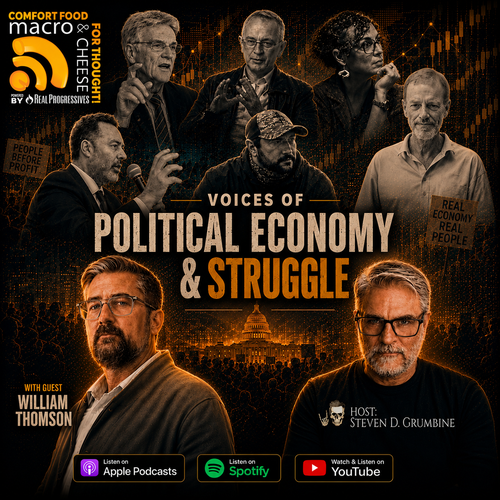
Episode 389 – Voices of Political Economy & Struggle with William Thomson
FOLLOW THE SHOW
A special crossover episode where Scotland Political Economy’s host William Thomson and Steve Grumbine reflect on their favorite interviews, intellectual evolutions, and shared journey from MMT mechanics to a revolutionary class-struggle lens.
This week we’re releasing an episode from Scotland‘s Political Economy podcast. Host William Thomson invited Steve to join him to compare and reflect on their favorite interviews and the thinkers who most shaped their worldviews – from Clara Mattei and Fadhel Kaboub to Bill Mitchell, Jason Hickel, and Marxist-Leninist thinkers. They explore the limits of MMT without class analysis, the capture of academic and political institutions by oligarchic interests, and the importance of historical materialism, Gramsci, and Lenin in understanding how power truly operates.
The episode looks at the evolution of the two independent podcasters, their intellectual awakenings, and their shared conviction that the fight is not for better policy within capitalism, but for a fundamental transformation of the system itself. And for listeners to Macro N Cheese, it provides insight into Steve’ seven-year journey, taking the podcast from a strict MMT focus to a broader political economic analysis rooted in class struggle, revolutionary theory, and a critical view of electoral politics.
William Thomson is a political economist focused on the political economy of Scotland. His work considers how the economy actually operates, how decisions are made, and how power, institutions, and policy shape outcomes across Scotland.
Support his work at patreon.com/Scotlandspoliticaleconomy
@Williamgallus on X
Steve Grumbine:
All right, folks, this is Steve with Macro N Cheese. I am doing something a little bit different this week. We are putting up a conversation I had with Willie [William] Thomson of the Scotland Political Economy.
And one of the things that I found fascinating about this is how, you know, Willie’s focus has been on political economy.
Ours has always been MMT and shifted towards political economy and understanding the nature, if you will, of fiat currency mixing with class analysis. So our discussion today is a little different than usual.
We’re comparing and contrasting interviews that we’ve done over the years and who had the biggest influences on us.
Obviously, none of these are extensive because, to be honest with you, I’ve done almost 400 interviews on this alone, and you can imagine probably every one of them has had an impact on me. But with that, Willie and I try to compare our top 10 with some honorable mentions. Here you go with this week’s episode of Macro N Cheese.
William Thomson:
All right, Steve, well, I’ve been looking forward to doing this for ages with you. You have been someone I’ve looked up to in the podcast scene, especially within economics, for quite a while.
So it’s going to be great hearing about your favorite episodes, your favorite interviews.
I’ve got something similar I hope to share with the audience, but why don’t we just start with you telling us a little bit about you and the success you’ve had and how much you’ve enjoyed your Macro N Cheese podcast.
Steve Grumbine:
Yeah, thank you. We’ve been doing Macro N Cheese now for a very, very long time. We’re coming up on our 400th episode of weekly episodes. We’ve done seven plus years.
It has been a labor of love.
We started out strictly focusing on MMT, and as we worked with the various economists, we realized that just understanding ledgers was not nearly enough. It was not nearly the silver bullet. We had to bring more to the table. We had to bring the other intersections in.
And so Macro N Cheese has expanded and has really taken on a revolutionary class struggle element to it, recognizing the limitations, if you want to call it that, of electoral politics, parliamentary politics, which we’ve discovered both empirically and through our own observations, was largely a placebo. So that’s what we’ve been focusing on.
William Thomson:
Yeah, and that’s kind of reflected almost exactly your personal journey, hasn’t it?
I mean, as the host, you know, driving the show and considering the topics to cover and the people to interview, I’ve definitely seen your political position change over that period of time and it being reflected in the podcast.
Steve Grumbine:
Yeah, it’s been, you know, it’s difficult because, you know, we have strongholds just like the MMT epiphany that we all had when we first crossed over to understanding that taxes don’t finance a currency-issuing government. And then you start realizing, well, the people that actually run the system understand these things.
It’s not like we’re bringing something new to them. They actually run the system. And you start asking yourself, well, then how come we don’t have these things? Why aren’t these things happening?
And that goes beyond the ledger, doesn’t it? I mean, that takes us into a whole new category.
So I had a lot of guilt, to be honest with you, as part of my journey, feeling like I was a normie, that I was spreading electoral cheer and that we can do these great things at the ballot box.
And as I started doing more research, and I’m not talking about hot takes on social media research, I’m talking about with academics and practitioners and people that have done tremendous amounts of research and coming to find that, you know, in 2014, there’s a study that was presented to us a long time ago that we didn’t think much about from Gilens and Page from Princeton University that demonstrated that working class interests, desires, legislative hopes and dreams have precisely zero percent impact on legislative anything. And that took me into Gramsci and other things, where I started realizing, who do institutions serve? They serve the ruling elite.
So my institutionalist background took a major hit as well in understanding, “Well, it’s not really about us. The institutions that serve us didn’t become the ‘hegemonic idea’ without violence.”
And they weren’t curtsying and saying “please.” They were literally using violence to get what they wanted.
And so these thoughts and ideas really have colored, you know, our journey, my journey in particular. But it hasn’t been like, you know, I see hot takes out there. I see conspiracy theorists that just, you know, say things.
And it makes me crazy because it’s such an intricate web that has been woven and… and it’s not new. That’s the thing, the hardest part was to realize it wasn’t new, that things that we had come to point to.
Like, “Look, it’s possible.” You start realizing these were never like real victories for the working class. They were capitulations from capital at a moment in time for specific purposes, to maintain the hegemonic control of the capitalist system.
And so once we got the whole celebrating FDR out of the way, once we stopped, you know, spooning up with Keynes and everything, we started realizing at the end of the day, these people were elitists. They were very much part and parcel with the ruling elite and that their goals were not to make us and our lives better.
Their goals were to prevent a revolution, to prevent people from discovering that there are alternative ways of living. And that fundamental awakening has been every bit as powerful, if not more so.
William Thomson:
That’s a long period of time, isn’t it? That’s seven years. And, you know, you can take your learning, obviously before that as well as a kind of extended period.
And certainly some of the shows that you’ve done over the last year has helped me broaden my economic understanding as well. When we set up Scotonomics, and I’ve not had the capacity to do as many shows as you had.
And I’ve finished doing the Scotonomics podcast now, so we managed around about 140 over just over three years. And I’m sure there’s people who are listening or watching who will have done their own podcast.
But if you haven’t, it’s a lot of work and it’s not just rocking up and chatting to someone, it is doing the research to find them reading the books. I’ve got about 15 books from people we’ve had on the Scotonomics show in the background here.
And for every person that you interview, you’ve got to read one of those, you know, to properly get an understanding. So there is a lot of effort, but, you know, it’s a great thing to do. It’s really expands your learning.
But it was becoming just a little bit difficult for me to keep kind of keep doing these interviews consistently, like in the way you have, considering I’m getting into a little bit more in policy work. When we started Scotonomics, we didn’t have an MMT lens to start with.
It was something we were aware of and engaged with, and we wanted to interview some MMT, but it was more a kind of stepping back and saying, “If Scotland became an independent country, how could the economy be different from what it is now?” That was their position. It was kind of like, we know what we’ve got. Let’s investigate why we’ve got this type of economy that we’ve got.
And then let’s bring in lots of thoughts and understanding from other people to say, “Hey, things can be a little bit different.” Or as you’ve just explained, things won’t be different. You know, you’ve just got that you maybe think they will be.
And you and I disagree slightly on some of that. But it was a whole kind of encapsulation of what would a new economy look like?
And I think that’s what I was really excited about because that allowed us to interview, you know, an American academic who’d done some work on banking deserts in the southern states. You know, this was so. It’s so interesting, but so far removed from what you’d be looking at on a normal economics podcast.
But because we were kind of envisaging this whole new world, we were able to say, “Hey, what if you start charging and making money from water? Let’s do an episode on that.” And I think I really, really enjoyed our Small Nation series. We looked.
We got economists from other small countries that were independent at the moment.
So we had someone from Iceland, from Ireland, we had people from Catalonia and also Wales to kind of principalities or small regions of larger countries to kind of extend our ideas and see what they were doing. So it was a wonderful way of seeing so much. And it’s just great, isn’t it, being able to say to people, yeah, I love what you did.
Come in, let me ask you the questions about it. And they tend to just say, “Yes” and come on the show, don’t they, Steve?
Steve Grumbine:
Yeah, it has been fun. I mean, we’ve interviewed people around the world.
And so a lot of the times, the time zones, I mean, Bill Mitchell being 13 hours ahead of us, you know, I mean, that’s quite challenging. People we’ve interviewed in Thailand and Taiwan and China and just the time zones, in New Zealand even.
I mean, we’ve had tremendous reach around the world.
You know, one of the things that really has impressed me is, you know, a lot of folks don’t understand that there is a career out there for some folks. And those careers, like my career, like your. I don’t know what you do for a living personally, but for me, I’m a project manager, okay?
And I have to do certain things to maintain my employment. And so academics are no different.
You know, if they don’t have tenure backing them and they don’t have guarantees, they’ve got to stay within a certain guideline as well. So understanding when they would butt up against that.
I can’t say that moment, right, made me crazy because I don’t have those problems with going in places that are outside of where it keeps their careers in check.
William Thomson:
Yeah.
Steve Grumbine:
And so as you start really understanding the prison many academics are in today just to be able to maintain their profession, you only see a handful of them, you don’t see a million of them. Most of them are kept at bay. And really, at the end of the day, you understand that there is a capture of sorts.
There is a real price to pay for stepping outside of the catechism of the orthodoxy, whatever that is. And, you know, we’ve paid a heavy price for that as well.
There’s a lot of people out there that if our podcast doesn’t say, you know, MMT specifically, people will ignore it sometimes. And it’s like, “Wow, you don’t understand how important these interrelated things are to your MMT story.”
William Thomson:
Yeah. And I mean, the MMT story is just a chapter, isn’t it?
You know, if you think [it is. Yes.] You know, and we really do.
And I think we’ve both broadened our understanding and I would hope, and I’m pretty sure we both have, maybe you to a greater extent than I have, but we’ve extended our audiences awareness of that as well. But I wanted to pick up your point about kind of people being able to say stuff that they probably feel, but they don’t feel comfortable.
And I’ve noticed quite a few older academics who are orthodoxy have now maybe retired and they’ve said, “Actually, oh, actually we were doing this and yeah, we probably said something wrong.” Right? And Angus Deaton, who wrote an article for the IMF, are basically kind of like mea culpa. And it’s a wonderful short paper.
He’s a Scot, he’s a Scottish guy, but he’s based in America. And he just said, “Yeah, we probably have been a little bit too influenced by power. And yeah, maybe we got it wrong on globalization.”
And he’s saying all this and you’re like, “Yeah, maybe, but you’re 70 now and you’ve retired in Scotland.” There’s a chap called- this is a real name, by the way- he’s called Ronald McDonald, right? That’s his name. And he’s a lovely guy.
And I saw him at an event just a couple of weeks ago and he’s retired now from Glasgow University, the Adam Smith Business School. And he was on stage at an event and he was saying, “I think since 2008, we’ve clearly got things wrong. And we’re starting to look at things.
And I’m here talking about Adam Smith because I’m interested in morals and ethics.” And he said, “There’s now a study of… It’s called ethical economics.
And it’s looking at economics to say, “Hey, maybe we just shouldn’t be focusing on price and an allocation based on price.” And he said, “This is fascinating and I’m spending my work and it’s completely blown my mind.”
So at the end of it, I said to him, “Ronald, you do realize you’ve just been describing heterodox economics, right? And we’ve been doing that for 100 years, looking at how the economy works through a class perspective and a power perspective.”
He was kind of like, “Oh, yeah, yeah, I suppose so.”
And I just found it just so kind of like, mind blowing that even an economist like that who was speaking out against some of the orthodoxy was still stuck in this mind or this kind of framing of the orthodox economics still being the only place that you can look for, for insight. But I wanted to ask you a direct question of that. Have you had many orthodox economists or thinkers on the show?
Steve Grumbine:
I guess it all depends on what you call orthodox, right?
I know that we’re talking about neoclassical when we say that, but when I think of orthodox, I think about people that are acceptable to the establishment, people that are cozy with the establishment. I’ve changed what I view in that range as what we would call orthodox, okay?
Because when you understand MMT, and this was one of my first real major epiphanies, is that money is a creature of the state, okay? And so political economy begins the minute that a bill is passed. That’s no longer MMT, if you will.
MMT is describing the mechanisms, the ledgers, this, that, and the other about the plumbing. And it is a lens for describing what happens.
But you are really entering into political economy the minute, like in the United States Congress passes a bill. Well, back to that Gilens and Page study that I explained. It’s a Princeton study. That’s not some random Facebook, you know, thing.
That’s a legitimate Ivy League study showing that the United States. And I believe this goes beyond that. I believe this is all modern capitalist economies and governments, okay?
I don’t believe that capitalism can be voted away. I don’t believe that oligarchy can be voted away.
And so when you start thinking about the Pollyanna version of, “Well, just get a few more progressives in, everything be okay” right? That was where we started from. And that naivete led me to start questioning what I consider to be heterodox and orthodox.
Because if you’re still playing within the system, if you’re still cosplaying and pretending that a system built for capitalists by oligarchs that shows 0% interest in what the working people want other than in, you know, campaign season, they say things, but it’s just meant to manufacture consent. If you read your Noam Chomsky, and Chomsky’s gotten a black eye recently with his Jeffrey Epstein connections.
But that doesn’t change the fact that manufacturing consent is a huge part of the picture.
So when I think about orthodoxy, I think about people that are complacent and compliant within the system, that are not rebellious, that will fall in line, will vote for the nominee, will fight like heck during the primaries.
When the United States- and this is an important part of why I’m saying this- the Democratic National Committee was taken to court in Florida after Bernie Sanders first run at the presidency. People had not yet figured out that we lived in an oligarchy.
And when they went to court, the court had the DNC literally say, “We have no responsibility to run a primary. We have no responsibility to honor the outcomes of a primary.
We are a private corporation that has no accountability whatsoever to Main Street” or whatever. And they also have superdelegates to block the will of anybody else.
So the people that continue to push that forward, I consider them to be orthodox, whether they have heterodox economic minds or not. If they play in that system, if they cosplay and pretend that they. That “we the people” can impact that, then I consider them to be orthodoxy.
Because we’re not fighting just the ledger. We’re fighting the entire system that gives the legitimacy to the currency, that allows the currency to be spent into existence to begin with.
It starts with that fake government, that fake idea that we have agency within it. So, to me, have I interviewed a lot? I’ve interviewed a huge number of them.
William Thomson:
99% of your guests depending on that. Well, when we started, I was always keen to. To definitely have an orthodox and a neoclassical input into the show.
And I think more of it was around kind of understanding. I was always at that point, and even when I’m interviewing for my Economics Festival in Edinburgh, I still feel myself like someone.
I’m not asking the questions that I really want to ask because I’ve got someone up on stage or work, and it’s like, you know, this is your opportunity to tell me what you think about things. And I’m going to ask maybe a few challenging questions, but I’m not going to be this kind of aggressive interviewer.
I just felt rude doing that and I still do. So I was always keen to get someone on.
And we had a fairly orthodox economist called Mark Blyth, who’s based at Brown [University], and we’ve had nearly 20,000 views of our interview with Mark. And Mark hates MMT and he’s very outspoken against it in the interview.
And I’ve just said, let’s have this conversation a little bit another time, because you’re on the show to kind of tell us what you think about things. And a few people were like, oh, you didn’t argue with him because, you know, you would have lost.
And I’m saying, well, if Stephanie Kelton can, you know, he’s really good friends with Stephanie Kelton, if she can’t persuade him that MMT makes sense and will work, there’s not much chance of me doing it, right? But he was on my show hearing from it, so I’ve always been keen and I kind of wanted to just say that the orthodox voices that we’ve had.
I wanted to give an honorable mention to Russell Jones, who’s written a brilliant book which I found absolutely fascinating about the treasury in UK and why it made some decisions. He’s written a book about Japan, which I really enjoyed.
And I wanted to find out that phrase that you said, because I wanted to say it to him because he’s a good friend now. So he gets a mention.
He’s written a book about Japan and basically, almost in every third page it talks about how terrible it is to have this massive public debt. And he’s talking about the Taylor Rule. And he’s a proper orthodox economist who’s invited me out for dinner next time we go down to London.
Really nice guy. We got on really, really well.
But I remember you said a line, something like, it’s a thick book, but if you take out all the economic nonsense, it’s a pamphlet. Can you remember what it was?
Steve Grumbine:
Yes. Michael Parenti. Michael Parenti. And it was really his depiction on capitalism.
And I don’t have the title of the book in front of me right now, but… Michael Parenti and I can get you it offline. But it was painful to read, you know, at least the economic part of it. I believe he understands the power dynamics just fine.
But you know as well as I do that if you’re in a maze and you take a wrong turn, no matter how many right turns you make after that, you’re still not getting out of the maze. So you got to get off on the right foot in the maze to get out of the maze, you know, or you got to backtrack and reconsider some things.
And I want to say something about Mark Blyth here real quickly too, because I think this is interesting. Mark was one of my first.
I wouldn’t call it a hostile interview, but he was one of my first interviews that wasn’t just, “Hey, we all see eye-to-eye kind of thing, right?” And so the first one we had some good jokes and stuff like that and he took it easy on me.
The second one, we talked about his Angrynomics book and that was less collegial.
But then because I was so desperate, and this was years ago, probably a couple years before you did your conversations with him, I had reached out to him and I set up a meeting with him, Rohan Grey and Nathan Tankus. And we did the zoom from my back deck, private zoom. I mean, I’m not going to get into all the particulars of it.
I do have it saved somewhere in the archives.
But, in that interview, Mark Blythe flat out acknowledged because Nathan addressed every one of his concerns about inflation, about third countries that are not the US dollar kind of thing. He had all the normal, close to heterodox pushbacks, right? But Nathan and Rohan absolutely answered every one of his questions.
But his response, which I don’t think is right to hide from, was, “Yeah, that may be, but good luck making everybody believe it.”
You have a better chance of just going with the flow than actually trying to get every single person in the world to realize that they have it all wrong. And so I, I found that to be, well, weak. I didn’t like that. That bothered me a great deal.
I haven’t had him back on since and he probably wouldn’t want to come back on either. But to be fair, you know, now people have a double whammy for not wanting to come on.
Because I’m not just going to talk, you know, “Hey, yeah, let’s go ahead and do a Green New Deal. We’ll vote it right on through.” I understand a little bit more about the power dynamics that a lot of folks just hand wave.
And now I’m going to be challenging that because I feel a tremendous amount of responsibility. Once you know something, you don’t go backwards. You have to take the knowledge you have and move forward and integrate it.
And to me, that was one of the most attractive things about MMT.
At the very first MMT conference out at UMKC back, and I think it was 2017, you know, it became very, very obvious, okay, that MMT had to do more work than anybody else because they had to learn what everybody else knew and explain why it was wrong to reverse engineer and back through it.
William Thomson:
That’s where you got to start knowing as much as everyone else in terms of their understanding of, you know, things like loanable funds and fractional reserve banking. And you’ve kind of got to learn that to unlearn it and then add on the MMT.
Steve Grumbine:
That’s right. And I came from a Austrian, gold standard, kind of libertarian approach years ago. I mean, I was a far right wing guy.
And then I did a drive by, you know, through libertarianism, and then I moved for a fleeting moment through the Democratic Party, and then I went through the progressive Bernie era and realized the extreme shortcomings of that ideology and that approach and that, what I consider to be naive mindset. And then I’ve kept going left, and now I’m integrating a lot of theory. Ironically.
I don’t want to get too far into this, but ironically, one of the things that came out of one of my interviews with another European, Carlos Garcia Hernandez, you know, I didn’t know this, but Lenin had written a paper on the fact that the Russian Revolution would not have even been possible to do half of what they did without their seizing of the central bank. So they understood MMT even then, even though it kind of gets muddled and lost in the sauce.
They understood the power of being able to issue the currency.
And so I think that, you know, there’s a lot to be learned from history and a lot to be learned from understanding class struggle and how we got to where we are. Dialectical and historical materialism, I think, is a very important frame also to go with your MMT lens.
William Thomson:
Yeah, absolutely. I think the historical element, for sure, and that comes through a lot of your podcasts.
I think that the Gramscian stuff was absolutely fascinating and how you pushed it into Lenin, it was great. I also do think there is, and I have learned a lot, and I’ve got some good kind of anecdotes and stories from kind of orthodox interviews as well.
And one of the ones I wanted to highlight was Russell [Jones], who wrote a story about the UK treasury in the 1970s. And they were all kind of sitting around, so this is the Treasury Department of the UK government.
And they were like, “How do we make this country work?” Right? You know, they hadn’t quite discovered Thatcher’s wonderful ideas yet.
And you can just picture all these middle class or upper class white men, tags, bowler hats, you know, sitting around the Treasury and like, “What do we do with the economy?” And then someone says, “I know, why don’t we make the economy like Wimbledon?” And they went, “Well, what do you mean?”
And said, “Well, we’ll just create this kind of wonderful playing surface and then we’ll invite all these brilliant industries to come and kind of strut their stuff and we’ll have this great brand and then there’ll be enough of everything else coming in and it’ll be great and it’ll generate some money for us and then they’ll kind of disappear.” And then everyone around the table went, “Yeah, that’s a brilliant idea.” Right?
So their whole framing was this idea of how wonderful Wimbledon was, let’s make the economy like that.
And it seems a bit of a joke, but this just turned into this idea that we need foreign direct investment and you can’t use your own currency because, you know, that’s not what we do at Wimbledon. We just provide a platform and people.
And I just found these kind of was like openings into the mind of people who are making decisions at the higher echelon. And we need to kind of understand, to be able to describe these kind of cultural impacts that things have.
And that’s still an understanding 40, 50 years into the UK economy.
And it’s why we’re a rentier economy, it’s why we’ve got so much foreign direct investment and we’re not spending enough money to address any of the problems we have in our society. And it just comes back to these kind of stories. And I don’t think I would have heard that from any other heterodox economist.
It had to be from someone who was kind of there and who understood it. So I do think there’s loads to be learned from extending the lens way past MMT, way past heterodox economics. And also, as you said, way back as well.
But how do you cover all that and still keep it consistent for the listener? That’s a big challenge, isn’t it?
Steve Grumbine:
Not for me. And it’s probably because I’m on the spectrum, right? So for me, I live and die by connections.
I am a project manager by trade, as I said, and one of the most important aspects of that is understanding inputs, outputs, tools and techniques, systems, flows, processes, okay?
And so when you understand power, for example, and then you start understanding institutions, and again, we came from an institutionalist background, understanding most of the MMT community comes from that, then I didn’t fully understand the nature of institutions. And, you know, I’ve got a lot to learn. I know. I don’t anybody think that I’m coming here saying, I got it down. I don’t.
I’m on a continuous journey, okay, but you’re right to bring into the Gramscian-like lens.
I think that between him, Rosa Luxemburg and some others, providing that kind of insight has fundamentally changed who I am and kind of things that I, when I integrate all these different topics, I keep those threads alive.
When I have somebody coming to talk about AI, I talk about how the federal government is the currency issuer and it’s funding these things. It’s. It’s making decisions.
When I hear people talking about Gaza and things like that and the genocide that some in our community have denied even exists, you know that right there.
I talk about the fact that the federal government has unique powers to not only fund all the slaughter they’re funding over there, but they also have the ability to provide food for everybody back home as well.
So don’t allow them to put this on you, the individual, as they try to give you agency and pretend like you voted for this, when in fact you did not vote for this. This is not reality. This is them manufacturing consent, using the power of the purse to exact whatever oligarchy decides, not the people.
Because again, this is how I keep them together. I never, ever let go of Gilens and Page.
I don’t allow anyone that I talk to to get away from Gilens and Page either, because when they start putting out that, “Well, I just vote for a few of my progressives.” I’m like, “But look, this is not about the people.”
I think that’s one of the Rosa Luxemburg quotes that I felt was super powerful to my weaving these things together was the fact that “a socialist entering to the government doesn’t change the government into a socialist government, but instead transform the socialist into a minister of capital.” And when you understand that, you stop lying and faking and pretending. And so for me, I think my.
If I have a superpower at all, it’s the ability to hold on to all those ends and not let them unravel, but to continue to create the weave and bring those things together.
And for me, I think, you know, when I learned, I’ll go back when I read Randy Wray’s, I think it’s like 53 blog posts in New Economic Perspectives that made up what turned out to be his book, Modern Money Primer. Okay? When I read those things, my epiphany came.
I mean, I had a bunch of epiphanies with Warren Mosler, Soft Currency Economics, and also his Seven Deadly Innocent Frauds, which I still think is one of the best books anybody can read to really get a feel for MMT.
But, when I started going back through that stuff, understanding that taxes literally drive the economy, they don’t actually pay for things, that was a really big deal. And then I had to sit back and say, “How does this connect to everything else that I know?” Like, this is too big. This is almost too big.
So I had to, like, pull back.
And so now, as you integrate those things, when you interview somebody that’s outside of the frame or outside, like, I’ll give you an example, you know, since we’re talking about some of our primary interviews that we’ve done. Many years ago, before Macro N Cheese even started, I used to do shows as Real Progressives and the Rogue Scholar and other things.
And I had Warren Mosler battling Steve Keen on my channel. And it was an epic brouhaha. It was. But it was horrible. Warren had the worst Internet connection known to mankind.
You couldn’t hear half of his words, like, 2016, 2017, time frame. It was very early on. It was before we started Macro N Cheese. It may even been 20… as, like, probably 2016, okay?
But during that time period, you start realizing, wait a minute, hold on. What is this clash between these two? I didn’t know anything. I’m sitting there, like, listening to Warren and Steve.
I mean, it was like just actual fisticuffs, you know? And Warren kept dropping off because a bad signal. And he’d come back and then he would talk over Steve, and Steve would talk over Steve would throw his hands. It was crazy.
And so one of the guys over there in the UK put it through his garage band, I guess, and tried to fix the audio. So there’s an episode out there somewhere floating around in the YouTubes of Steve Keen and Warren Mosler doing battle for about an hour and a half.
And it’s quite epic. But that was one of my first awakenings to the kind of ruptures within the heterodox space.
And a lot of it had to do with this silly notion of imports and exports. Imports are a benefit. Exports are a cost. So years later, fast forward to this. I had an interview with both Michael Hudson and Steve Keen.
Took a huge swipe at Warren right up front. And really, at the end of the day, I’m not going to sit there and do battle with them.
Kind of like what you said, it’s like, “Hey, they said what they said” and so forth. But Warren very much, he hasn’t been back on since then. I’ll leave it at that.
That was one of those moments where he didn’t forgive me for letting them take him to the woodshed about imports and exports, but it was really just letting them have their moment to speak about it. So anyway, neither here nor there. There’s been quite a few of those kinds of moments.
And Mark Blyth another one, like I said before that those were quite interesting. But at the end of the day, nobody has got this down, right? There’s not one of them that integrates everything.
There’s not one of them that stays true. They get the frigging ledgers down like you wouldn’t believe.
But then they go all Pollyanna with “We’re going to vote for a few more progressives” and it’s like, “What in the world are we talking about here?” Right?
And so I think that integrating these things and maintaining the flows and is really about you integrating it yourself as a, as a host and doing all the reading. And I am a voracious reader. My eyes are terrible. So I listen to a lot of audiobooks.
But it is to me the single most important thing is to not flush old information that you know to be true and to find ways to integrate them into everything you do. And you be, you as the host, feel the responsibility of being the integrator of those things.
And that way I can talk to people that maybe don’t have a clue about macroeconomics, but they’ve got a lot of other really important things to say. You know, I found it to be challenging, but I found it to be kind of something that I, I feel called to do. So yeah.
Intermission:
You are listening to Macro N Cheese, a podcast by Real Progressives. We are a 501c3 nonprofit organization. All donations are tax deductible. Please consider becoming a monthly donor on Patreon, Substack, or our website, realprogressives.org. Now back to the podcast.
William Thomson:
No, that’s, that’s certainly different from my approach and I would say you’re much more- have much more depth and I think that kind of consistent tone and that message you take across has certainly been, been different from what I’ve done.
Well, I wanted to mention I’ll just because I do want to name check them. Okay. So I said Russell Jones.
I also interviewed James Meadway who is kind of like Dr. Death or I know who to MMT in the UK because he’s probably the most outspoken person in MMT in the UK. And I spoke to him a couple of years ago and I just wanted to interview him because he’d advised the Shadow Chancellor at the time.
So it was quite interesting. And I can remember saying to him, “Yeah, but we don’t use taxes to spend for stuff.” And he went, “Yeah.”
And I’ve got a nice little quote of him saying, and I’ve shared it a few times, so he’s kind of aware and understanding. But I did want to say I enjoyed that interview and I’m still in touch with James despite us been able to basically disagree on almost everything.
Steve Grumbine:
Everything.
William Thomson:
But he. But so. And I also wanted to mention David McWilliams. Have you come across David McWilliams? He’s. He’s fantastic. You would hate him.
He’s absolutely, he’s absolutely brilliant. He’s a, a fairly orthodox, but he’s a bit like Mark Blyth and, and I kind of describe these people and I’m sure you’ve got something similar.
It’s kind of like I can kind of stretch across and I can grab them. He’s close enough for me to say, “Hey, can we chat about this? And can we agree?” And he’s a brilliant Irish economist, very, very orthodox.
Doesn’t really rate MMT, but you can see he’s got the same goals. He wants the type of society that I want and he’s really good, but again, solidly, solidly orthodox.
But one of his interviews I really enjoyed and did quite well. So 140 odd episodes. I did want to shout out to some of our orthodox economists and before we looked at our top ten.
Okay, right, well, why don’t you give me a few of your kind of honorable mentions and before we do, a firm top five. So looking back, five people that you’ve enjoyed, you’ve got lots from, but don’t quite meet your top five.
Steve Grumbine:
You know, I go back to the beginning.
We did a lot of interviews with people who were kind of squishy on the politics and stuff, but they had really important things to say as it came to, like private debt. Emma Caterine, I think is her name, she was part of DSA and she was very proud of her DSA relationship and stuff. In fact, at the time, before I.
William Thomson:
What’s DSA? What’s DSA?
Steve Grumbine:
Democratic Socialists of America. It’s what Bernie Sanders and Zohran Mamdani and the rest of them fall under. But ultimately, you know, Emma was definitely one of the ones.
She’s done several interviews, older interviews that I felt were really good. Then I would say probably…
I don’t know if I like making them honorable mentions, but we had quite a few MMT’ers that were maybe the third generation type MMT’ers like Alexander [Ólafur Margeirsson] and I’m screwing his name up too. My goodness. He was Icelandic.
We had an Icelandic, you know, and we had Pakistani, [Aqdas Afzal] you know, economist who is an MMT’er who was from, you know, these are gentlemen who spoke, you know, about incredible things in their own countries, right? So, you know, they probably are like in that sweet spot.
Daniel Conceicao, who is one of my favorite people who I interview frequently is definitely he’s Brazilian, talks to me about the Global South quite a bit and he is right there on the verge of revolutionary-mindedness. So he and I have a good vibe together because he sees the system closely to how I see it.
But he pivots back sometimes where he, he sometimes forgets how captured the system is.
But Daniel and I, I get on with him well and we’ve got quite a few episodes with Daniel, whom I love immensely and probably, you know, the entire Modern Money Network.
One of my, I, I don’t even know how to put this into terms, but one of my favorite episodes ever was with Rohan Grey on the history of the Federal Reserve. That was incredibly detailed and excellent. And then I would probably say Carl Zha, who is my go-to-guy, next to China.
Anything about China, anything about the East in general. He’s really good on history, but really bad on economics and he’s really good.
And we did a three part series on Mao and kind of the Chinese Revolution and all the different elements going back to when Japan had kind of control of China. It was amazing. So definitely those. Yeah, we’ve done some incredibly long three-part series on the Russian Revolution. C. Derick Varn.
It probably fits into this bucket as well where we did the entire lineage of leftist traditions. It was two parts and it felt like we were reading the Book of Numbers or the Book of Exodus.
We just kept going and going and going with all the splinter groups. It was very, very fascinating. Yes.
William Thomson:
Well, I need to delve into your back catalog for sure, because I don’t, I don’t think I’ve gone back more than 100 episodes. So I’m sure there’s some, I’m sure there’s some classic ones there. Okay, right. Well, I’ve got a few, I’ve got my kind of honorable mentions.
One of the first ones we did was with a young academic called Ben Franta and he. It was a kind of climate-related episode.
And he’s now, I just checked him up, but he’s now associate professor of Climate Litigation in Oxford University. So he’s done incredibly well. And his thesis, or I think it was his PhD was just to see, “Hey, hold on a minute.
This avoidance and this denial that the fossil fuels companies have been doing for the last 30, 40 years, this just didn’t come out of nowhere. This is what the tobacco industry was doing since the ’50s.”
So he kind of draws these connections between the initial research, the lobbying, the astroturfing organization and it’s a wonderful paper and I think it was maybe our seventh or eighth episode and Karen, who was my co-host for quite a lot of the episode, we were just like, “This is amazing, there’s just so much depth here!” It was. And the way that he explained it, it was like some of those movies that have been made about that type of thing since then.
But it was absolutely fascinating. So I definitely had him in there.
We had a wonderful session from Nancy Fraser on Capital Cannibalism and she’s a proper Marxist academic and that was a wonderful.
I really enjoyed her short book, which I think in my stack there, yes, a fairly short book, but it was one of those ones and I was like, I get it now. I realize how captured the whole system is and how many tentacles and how deep the tentacles of capitalism go and where they came from. So that was a really good interview.
Timothy Mitchell, who I think is an English academic, but he’s based at Columbia, he wrote a book about carbon democracy, which again was a history book and he was actually good on the economics, but he was talking about what impact coal had had in terms of the labor movement and it gave them loads of strength. But as soon as oil came into the United Kingdom, then the labor movement had no control over the main fossil fuel.
So it was a great historical discussion around the impact and the power of energy. And he’s in his 70s now, but he’s very climate aware as well. So that was a fascinating reading. I thoroughly recommend that book.
Carbon Democracy was great. I wanted to mention Steve Keen because he’s been on the show a few times and there’s no one who is as eminently quotable as Steve Keen.
And for sure he can be truculent and cantankerous, as is his, as is the want of every man, I think who’s over 60. So you and I are going to be exactly like him and Warren, in a few years yet.
But I’ve got a huge amount of time and respect for Steve.
And again, we don’t agree on everything, but I really like the interviews and he’s always so generous with his time for me, as is Warren, who also gets to mention. I actually spoke to Warren this morning on Google Meet. He’s someone who’s just happy to just answer a question. And I think that’s incredible.
And that’s come through at my work on Scotonomics. And then the last one is a wonderful Australian female economist called Katherine Trebek. And I would love you to interview her.
But she’s very much of the orthodoxy and thinking that the establishment will change. She’s one of the founders of the Wellbeing Alliance and the Wellbeing Alliance government organization, and she’s a wonderful economist.
I used one of her stories quite often and someone said to her, “What should we have instead of GDP?” And she said, “We should measure how many young girls are able to cycle to school every morning. That’s one of the things that we should measure.”
And I just remember a bit like that kind of epiphany. I was just like, that’s how you measure the success of a fucking economy. It’s not about how much do we produce. Think of the levels there.
You know, you kind of just blow off on how much more we have to do for road safety. How safe does a young girl need to feel? How much money does her family have to have?
You know, all of these things kind of explode when you look at that idea of, well, what is the economy for? Surely it’s not just that we produce stuff, what actually comes out of it? So they’re my five honorable.
I might have even gone six with Warren in there. But those are the people I’ve really, really enjoyed who didn’t make my top five.
Steve Grumbine:
I understand.
You know, when I think about, like, assigning outcomes, assigning rationale for outcomes, you know, we always, I guess we’re egotistical in our own right, all of us, where we just assume that, of course, the point of the economy is to make everyone’s lives better, right? That’s what we want to believe. That’s what we think.
But when you understand capitalism, and, you know, unfortunately my academic career took me through a Master of Business Administration, so I learned to be a proper capitalist, okay?
And in that space, you understand that the modus operandi is to maximize shareholder value, not maximize society, not maximize your household happiness, not maximize schoolgirls making it to school. And as a result of that, not assigning the appropriate understanding of who’s in control and what their motivations are, right?
And who is served by whom.
I think that’s a real major point of contention that people have to wrestle with, because, you know, people say, “How come they have money for war but not the poor?” Do you really have to ask that question? They need markets open. This is capitalism at play here. This is not, you know, for your freedoms.
They don’t hate you for your free… They hate you because your capitalist oligarchs that run your government are busy bombing black and brown people in Gaza right now.
You know, I mean, that’s why they hate you. It’s not because of your freedoms. You know, it’s preposterous.
William Thomson:
So do you want to give me one of you from your top five? We’ve got 10 minutes, so let’s try and do this. One of your top five, and then I’ll give you one of mine.
Steve Grumbine:
I would say Jason Hickel is one of my top five. Jason Hickel is a beautiful soul. He’s a guy who, when I read his books Less Is More and The Divide, he was still a positive money guy.
He had not pivoted to the MMT frame. He was still peddling. This is one of my gripes with Steve Keen still peddling the UBI, [Universal Basic Income] okay?
When in reality, Jason Hickel has moved away from a UBI and has moved directly to Universal Basic Services to de-commodify our existence. So Jason Hickel would probably be in my top five.
William Thomson:
I think Jason supports a job guarantee as well.
Steve Grumbine:
Yes, he does.
William Thomson:
Yeah, yeah, yeah. Okay. Brilliant. Good call. I’ve never met Jason, but he’s on my hit list.
My number five is a guy called Danny Blanchflower who was a member of the Monetary Policy Committee at the Bank of England, right? And so you would expect him to be very orthodox, very neoclassical. No, he’s just some kind of…
He was put on the board by Gordon Brown, who was our kind of labor Prime Minister after Tony Blair. And he just said, “I got into the Bank of England for the first time and thought, what the fuck am I doing here? I am completely the wrong person.”
And he said, basically, I think he did one term, which I think is four or five years. And he was like, “At no point did anyone listen to me or agree with anything I said.”
So his story is another one of those from the inside are absolutely fascinating. He writes and researches a lot about the impact of social media on young kids now and teenagers. So he’s kind of pivoted away from that.
But the interview that we did with him and his kind of understanding. And that person who was there just going, what are you all talking about?
You all got the same accent, you all went to the same school, and you’re saying things like, this is best for the country, you know, so he was challenging like that. So that’s a brilliant interview and he definitely made it into my top five. All right, go for it. Number four.
Steve Grumbine:
Number four would be Clara Mattei. Clara has written the book The Capital Order, How Economists Invented Austerity Basically to Save Capitalism, right? So she is one of my favorites.
And she’s somebody who we have done extensive discussions with, both in the podcast and in what we call RP Lives, which are webinars where we have people come and talk about subjects, right? What impressed me most about Clara is that she’s a Marxist, number one, but she was open to hearing about Modern Monetary Theory, okay?
And that openness to me, really spoke to me because there’s a lot of folks that aren’t open to hearing about Marxism, but they’re okay hearing about MMT. And to me, I found her willingness to talk about that to be fascinating.
But she opened my eyes personally to the history, the historical elements of the great overreaction to the Bolshevik Revolution in 1917. The October Revolution changed the world and it radically shifted politics in the United States and every other country.
Because, what happened? They realized that there was a real honest to God battle against capitalism, that capitalism was not inevitable, that it wasn’t the end of history.
William Thomson:
There was an alternative.
Steve Grumbine:
Yeah, that’s right.
William Thomson:
Brilliant.
Steve Grumbine:
So Clara Mattei is definitely in that top five.
William Thomson:
Brilliant. Well, Clara Mattei is my number one. So you’ve properly stolen my thunder, which I’m not very happy about, right? Okay, so I’ll give you…
I’ll give you my number four, Claudia Sahm, who’s an American economist who worked at the Fed, and she came up with something called the Sahm Rule, which is still used by the Fed that kind of points to when there’s a recession coming. And she’s a wonderful. I really, really enjoyed. And the two or three interviews I did with her. She also spoke at our Scotonomics Festival as well.
And again, someone who was just incredibly generous with her time. I remember she got up at 4 o’ clock in the morning from Hong Kong to do an interview. And I didn’t know this. I would never have asked her to do this.
And I was like, oh, where are you? It doesn’t look like, you know, Washington. She went on, it’s Hong Kong. What time’s it there? But fascinating.
I really, really enjoyed our talks with her. And again, I think she was something, someone similar.
She was at the Fed, but someone who was saying, why are we not worried about unemployment anymore? Why is no one looking at this? You know, so someone from the inside who had that kind of progressive lens and that progressive bench.
So she’s my number four. Okay, I’m going to hit you. Well, I want you to hit me with your number three.
Steve Grumbine:
Number three is going to be a cheat because I’m going to add a number of names.
I’m going to put Vijay Prashad, Gabriel Rockhill, and of course, you know, the entirety, Ali Kadri of you know who, Fadhel Kaboub, who is going to be mentioned momentarily recommended. So these three are Marxists who in my opinion represent a body of thinking that loves the people, that absolutely worships the people, that, that places life, liberty and happiness first and foremost, not access politics.
And some of the things that they brought out to me that were really important was really taking a hard look at academics who hide their real feelings because they want to play access, they want to maintain acceptability. And these guys called them out specifically.
And to me they’re heroes for that reason because we’re living and dying, we’re watching genocides occur and having safe politics, in my opinion, is antithetical to survival. So from my vantage point, they represented a true breaking for me, a real epiphany, a real concrete way of understanding what we’re up against.
William Thomson:
Well, I definitely want to listen to all those episodes then because that’s an incredible introduction you’ve given to them there. And also you’ve almost done it. Fadhel Kaboub’s my number three, so we’re similar there.
I had a really interesting interview with him where he was explaining what a colony was. And obviously he was talking about North Africa and was also some of the southern states in Africa.
And as he was talking, I was just thinking I was starting to feel a little bit uncomfortable because I’m a reasonably wealthy white guy sitting in Scotland, right? And I’m thinking, hold on a minute, this sounds a bit like someone describing Scotland, right? But do I say that?
Because he’s talking about brown and black people who are dirt poor and who’ve been, who’ve had families murdered and stuff. And I thought I just felt really uncomfortable.
And I do, even saying it now to say things like Scotland’s a colony, right? When it just seems so ridiculous when you look at what the British Empire has done to other parts of the world.
But as he was talking, I was like, hold on a minute, Fadhel. We’ve kept. Scotland’s got that, Scotland’s got that, Scotland’s got that. Could Scotland be a colony? When almost a- “if it walks like a duck, quacks like a duck, it’s a duck.” So he kind of gave me almost. He gave me agency to speak about my
nation in a different way than I hadn’t felt comfortable before.
And that was incredibly powerful. And I got to meet him at the Levy Institute last year and he’s a wonderful guy and is kind of warm in person as he is when you speak to him.
So he’s there in my top three. And it’s good to see you calling him out as well. But yeah, he’s a wonderful communicator.
He speaks about MMT in a way that connects so many of the dots that I think that you do well as well. And he is a wonderful voice for MMT. He’s a wonderful voice for the Global South.
Steve Grumbine:
Yeah, I. I’m Fadhel is going to be tied for my number one because I’m cheating because I. I’ve done almost 400 of them. It’s very hard for me to bunch like that.
William Thomson:
I was going to say that. Yeah, I was going to say to you this is at least half as easy for me than it is for you because I’ve done some other, right? Okay, so.
So who’s your number two then?
Steve Grumbine:
So my number two. I’m going to bundle this together as well. Jeremy from Proles Pod and Breht O’Shea from Rev Left Radio. They are not academics.
They are what we would call organic intellectuals.
And they are people that spoke to me at a point of time where my faith in the work that I’m doing, the faith as a father looking at the country and looking at the world and feeling hopeless and so forth.
They gave me the strength in those interviews to really, really dig into theory, really, really understand that maybe we don’t have the agency to do what we need to do today, but if we keep training people up in the ways that the next generation hopefully will have not been forsaken, the way our generation was because our folks were normies and they freaking peddled lies and stuff because that’s what was told to them, right?
So we’re breaking a cycle and being able to build revolutionary strength, be able to build working-class knowledge and struggle and being able to have a real class analysis of the society. I mean, imagine if the entirety of the working class united together. What we could do, and I mean outside of the electoral system.
So these gentlemen, and there are many others I could dump in there as well. But those two in particular, Breht O’ Shea will be coming out here in the next couple weeks. You haven’t even heard it yet.
It’s my first time speaking to him and it was incredibly powerful. So those two make up my number two.
William Thomson:
Yeah, okay, great. That just remind me a very short aside.
We interviewed two English secondary school economics teachers fairly early on who had a podcast when we were just getting going. And I remember at the end of it thinking, thank fuck people like that are teachers, you know, so much heart, so much energy.
They were economics teachers, but they were like, we don’t need to teach orthodoxy. We can go outside of it if we, you know, if we still kind of like tick the boxes. And I just remember thinking, it’s not that bad.
Maybe it’s not that bad if you’ve got people like that who are teaching or future generations.
But I’m going to come back to my number two is, and I think it might be the only MMT economist on here, although we can kind of call Fadhel Kaboub that, John Harvey, “the cowboy economist”. So John is a wonderful communicator as, or has been a stand up comedian.
He’s done shows, he came over to speak at our festival, he’s written some fantastic books, he’s given me a really clear understanding. He’s had some great moments because he was my lecturer, one of my professors when I was doing my master’s degree.
And I remember him saying to me, “It’s not the private sector’s job to give everyone a job” you know, and just these little moments that just help you, this idea that, yeah, the government can just spend loads of money and all of a sudden the companies will just employ loads of people and aggregate, you know, the argument for aggregate demand and everything will be fine. And he’s still saying, no, there’s still people that the private sector doesn’t want to employ and they don’t want to employ people for the cost.
And that’s when I got the epiphany on a job guarantee, which has become kind of central to my policy work in Scotland. So I put that down to John. He’s as entertaining and kind of informative and equal measures. So that’s my number two.
Steve Grumbine:
John was the one that got me set up with Steve Keen many years ago. So I’ve had John on many, many times. Well, I’ve had him on several times. It’s been a few years, but we’ve had him on quite a few times.
I would say we’re to number one now. Tie. It’s not a tie. I mean, there’s a bunch of people. But the two people that really stand out most to me are Fadhel Kaboub and Bill Mitchell.
The two of them together.
Bill Mitchell was our episode number one, Putting the T in MMT and Bill Mitchell, we’re going to have another episode with him coming up here shortly that’ll be probably released sometime around the time when this goes out, maybe a week or two from now.
And the thing that I like about both Bill and Fadhel are they don’t lie, they don’t sugarcoat things, they don’t curtsy and, you know, shame people for being angry. There’s people in this community that spend a lot of time trying to wag their finger telling people to be polite and stuff like that.
To me, that’s just completely counterrevolutionary, counterproductive, honestly, because it is not, in my opinion, an acceptable way. Politeness, I mean, civility is a real… What’s the word I’m looking for? It is a cruel weapon against the struggling.
And it is years and years of research that shows that civility itself is a way of shutting down struggle, shutting down the voices of the oppressed. And so Fadhel really, really helped me understand the global system.
He really, really helped me understand the struggle of oppressed people, the Global South. He really helped me understand colonialism.
And so if you listen to our podcast, at the very beginning of the podcast, he makes a quote, we cut a snippet of him, he goes, “We have no time for incremental change” basically, you know, we, we there, we don’t have it. And he’s right. And Bill Mitchell. Let me, let me tell you about Bill Mitchell.
Bill Mitchell, there’s been fractures and there’s been schisms in the community for years.
And, you know, it’s always challenging when you’re in the middle of it because people pick sides and they do all kinds of weird tribal nonsense that creates problems for an already small group of folks, right?
But what Bill Mitchell does, to me anyway, is he alone really brings in folks like Michal Kalecki and he takes that class struggle within his analysis. And when Bill talks and Fadhel talks
William Thomson:
He has a Marxist.
Steve Grumbine:
He has a Marxist background.
William Thomson:
Yeah, yeah, yeah.
Steve Grumbine:
So I, for me, I don’t have a lot of camaraderie with capitalists, people who are okay with capital. I don’t, I don’t really have a lot in common with them, and I don’t really value the insights. I’ve got an MBA, I already know how evil it is.
I don’t need to sugarcoat it and make it sweet and kind.
William Thomson:
Well, my top one, which I’ve alluded to already, is Clara Mattei.
And I think that I had an epiphany reading her book, because the biggest issue that I’ve kind of grown into my political awareness was austerity, because it’s austerity that shaped the UK from the period when I was most politically active, apart from my teenage years. And I thought I knew about austerity and I thought I knew where it came from.
And I thought I knew how it was observed in society, because I’d read a lot of, you know, I’d read Austerity by Mark Blyth, and I’d read some other books showing about the pain of austerity, but she just completely opened this world, this historic lens on it, but also started to speak about fiscal austerity and monetary austerity and industrial austerity, and she just completely widened that. And after reading that book and doing the interviews with her, I kind of thought, I need to talk about this.
I need to say to people that as soon as you think you’ve fixed austerity because the government’s spending a little bit more money on welfare, all that’s happening is someone is just redirecting your anger to something that they’re willing you to control. But this is a structural issue. This is a class issue, austerity. And that’s what I got so much from her.
One of them, maybe a dozen people who’ve just kind of had that moment where the window just extends. And also, you know, you’ve spoken to her quite a few times, just a wonderfully passionate person.
And when I’ve interviewed her, I’ve come off feeling drained, but excited to the same, to the same extent. I know a few Italians and she is absolutely the stereotypical Italian as well.
So much passion, so much to say, and you really need to listen to every word that comes out of her. So Clara is definitely my number one.
Steve Grumbine:
I agree with that. Bravo, bravo.
William Thomson:
Brilliant. So why don’t you just finish then? Just seeing the journey that you’ve had, where you’ve started and where you’ve ended.
Steve Grumbine:
So for me, overthrowing a capitalist state, overthrowing a capitalist system and doing whatever I can to make life better, ala Che Guevara and others, I don’t in any way shape or form support that electoral strategy. I believe that it is screaming into a pillow or plugging an extension cord into itself and saying, we’ve got electricity.
It is, to me, the single greatest lie that keeps us from recognizing they’re not there to serve us. They’re not there to serve us. And so Bill Mitchell is as close of an MMT voice as I’ve ever had that has explained those things.
Even though I’m sure Bill, you know, is. He’s been an academic for a long time. He’s written a lot of books. I mean, Bill is doing well in life.
But Bill does remember what that struggle looks like. Bill remembers what that is all about. And Fadhel lives it being going through Africa, explaining colonial processes and the IMF.
All of the understanding of all these IMF and World Bank and World Trade Organization and the structural adjustments, they fundamentally shaped so much of how I view the world. Along with other Marxist thinkers that I do follow. I do not consider myself a progressive in any way, shape or form any longer.
We are a unfortunately titled organization, Real Progressives, and it is not representative of who we are. Who I am. I consider myself to be an MMT-informed Marxist. I would even go so far as to say I’m a Marxist-Leninist.
And I believe very strongly that without a dictatorship of the proletariat, the people, working class people, until it is us controlling society and not elite oligarchs, there is no policy that is not a, an act of, you know, here’s some crumbs. Now stop bothering me. I. I don’t want to live in a world like that. And I won’t accommodate a world like that.
I will fight to the very last breath I have to end a world like that in whatever way I can.
Through education, through podcasts, through interviews, whatever I can do to help eradicate that system, I’m here for it.
William Thomson:
Well, that is amazing. Absolutely incredible. To get that, Steve, we’ve done an hour and ten minutes.
Steve Grumbine:
Amazing.
William Thomson:
Yeah. Yeah.
And I’ve got to finish by saying I’m really disappointed that I wasn’t on your top 10 because you interviewed me for the podcast about six months ago, so I should just cut this episode short. I had a wonderful time doing the interview with you. We got really good feedback. It’d be great to come on and chat about things now.
I’m sure if people like this, we’ll do this again on another topic, so. So please do. I hope you’ve enjoyed this.
We’re going to put all the links to our best shows and stuff so you can see it and if you follow me, please do make sure that you follow Steve’s work. Real Progressives and Macro and Cheese. And I would hope Steve would say something similar about the work that we’re doing. Thanks very much mate.
It’s been great spending the time with you. I’ll speak to you soon. Bye everyone.
Steve Grumbine:
Yes, take care.
End Credits:
Production, transcripts, graphics, sound engineering, extras, and show notes for Macro N Cheese are done by our volunteer team at Real Progressives, serving in solidarity with the working class since 2015. To become a donor please go to patreon.com/realprogressives, realprogressives.substack.com, or realprogressives.org.
Extras links are included in the transcript.
Related Podcast Episodes
Related Articles
The Truth About “Printing Money”

The Strategic Activist


Leave a Comment
You must be logged in to post a comment.