
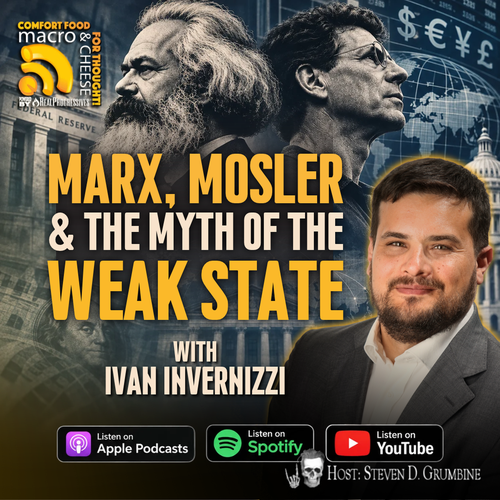
Episode 407 – Marx, Mosler & the Myth of the Weak State with Ivan Invernizzi
FOLLOW THE SHOW
Does MMT have a theory of value? Ivan Invernizzi says the state comes before the market, while Steve brings a Marxist approach. They find common ground in some basic monetary truths.
** Every Tuesday evening, we gather on Zoom to discuss the most recent episode of the podcast. Join us for this one. December 1st at 8pm ET / 5pm PT. Use this link to register
Does Modern Monetary Theory have a theory of value, and why would any Marxists shut the door on it? Steve takes up that tension with Ivan Invernizzi, an Italian economist and co-founder of Rete MMT in Italy who collaborates with MMT networks in Spain and France. With Robert Cauneau he co-authored the French-language book Vive la Dette Publique, and his dissertation proposes an integral social science with MMT at its core.
Ivan begins with the classical economists, Smith, Ricardo, and Marx, who accounted for relative value, meaning why one good costs more than another. For Marx that rests on socially necessary labor time. MMT picks up where they leave off and explains how relative value becomes a nominal price. The state, as monopoly issuer, taxes a population and so creates demand for its currency. The terms on which the private sector can earn that currency anchor all prices. Ivan’s position is that markets are an epiphenomenon of the state and not its foundation.
He and Steve discuss why some Marxists reject basic tenets of modern monetary theory, Ivan says Marxism turned Hegel over, holding that material reality shapes ideas; the mode of production comes first, with the state following from class relations. MMT puts the state and its currency before both. Steve counters that Marx’s real insight was the ruling class’s grip on the state, and that anyone claiming scientific materialism needs to know how the monetary system actually works. He ties the imperial core to IMF structural adjustment, a tax by another name, and recalls Lenin’s grasp of the need to control the central bank. Ivan names Wallerstein’s world-system analysis as another complement.
The conversation then turns to what is possible when history opens a window. Ivan brings up Italy during COVID, when austerity became politically unsustainable and the Maastricht deficit limit was suspended. MMT advocates already had a proposal for drastic fiscal expansion ready, and Ivan describes some of the results, including tax credits and low unemployment. Steve speaks of rate hikes as free money for people who already hold wealth, and reminds us that the government does not borrow but spends first and sells bonds after. Ivan also explains the Lost-inspired island allegory in his book.
Ivan closes with the point that left and right alike picture the state as dependent on markets, so they accept a policy space far narrower than the real one. Unemployment, he argues, is a political choice, not a natural fact of capitalism. The takeaway: knowing how the currency issuer operates is not a replacement for class analysis, but it exposes how much fiscal space the ruling class has been hiding from us.
Ivan Invernizzi is an Italian economist by training and an advocate of Modern Monetary Theory (MMT) in Europe. He is a co-founder of Rete MMT in Italy, playing an active role in expanding the movement across borders by collaborating with networks like Red MMT in Spain and MMT France. Together with French MMT advocate Robert Cauneau, he co-authored Vive la Dette Publique ! Renverser les dogmes économiques (Éditions Textuel), a book dedicated to dismantling conventional fiscal austerity narratives.
[00:00:42] Steve Grumbine: All right, folks, this is Steve with Macro N Cheese. I have not spoken to my next guest in a number of years. I met him at the second MMT conference at the New School in New York City. He was a great guy. We took some great pictures. It was a lot of fun. I met Daniela Corda. And I can’t remember the other gentleman’s name.
I probably will remember it afterwards, and I feel so bad that I can’t remember it. But the person who I’m speaking today with is Ivan Invernizzi. He is an Italian economist by training and an advocate of Modern Monetary Theory in Europe. He is the co-founder of Rete MMT in Italy, playing an active role in expanding the movement across borders by collaborating with networks like Red MMT in Spain and MMT France.
Together with French MMT advocate Robert Cauneau, he authored Vive La Dette Publique!: Renverser les dogmes économiques. Boy, oh boy, I’m just going to screw all that French up. So I’m just going to jump straight to welcoming my guest, Ivan Invernizzi. Welcome to the show, sir.
[00:01:53] Ivan Invernizzi: Nice to have me in the show. It’s very nice to come back to your platform, Steve.
[00:01:58] Steve Grumbine: Absolutely. And it has been a while. It is so nice to have you back. And what I want to talk about, because our organization has been working very, very hard in our own way to work within the socialist spaces, as many of them reject MMT outright. And our desire is to integrate an understanding of the social conditions and the class dynamics that take up so much space that we see play out on a daily basis within the system that is present today, while simultaneously integrating a knowledge and understanding of Modern Monetary Theory. And so one of the things that came up was the concept of what is the theory of value within Modern Monetary Theory? And Warren Mosler wrote a paper which he stood on the back of works that you had done as well.
He mentioned you in this as well. And I figure, why not have you come on to discuss the general theory of value summary, basically, that I’m looking to get a hold of to start this conversation? Really, does MMT have a theory of value based on your work?
[00:03:15] Ivan Invernizzi: Yeah, well, I didn’t know about the interest of yours in, let’s say, the socialist movement and these, so to speak, difficulties you had. So let me make a premises on this that I think can help. Because when you try to combine, let’s say, different approach, I think you need to understand not just the conclusion, but really the line of reasoning, the framework.
Okay. Because science… Social science is about frameworks, first of all, and you need to be honest and recognize where there is complementarity and where there is, let’s say, where the framework clenches, where there is incompatibility, okay? So, talking about left-wing approaches, let’s say, influenced by the Marxian approach. And in general, the classical economics, because Marx is a classic economist.
He stood on the same, let’s say, premises of Adam Smith and [David] Ricardo. And then he had some key concepts that, you know, had some very deep consequences. But anyway, actually Marxist and, so to speak, mainstream economics in a very different way. They start from the same starting point, okay, which is different than the starting point of MMT.
And these have to be very clear. So they both, basically everybody does so. Just Warren Mosler doesn’t do so. And the starting point is the private sector. The starting point is the private economics. So that’s true for Marx. That’s true for Smith. That’s true for… There’s no Milton Friedman for everybody. And then they do so in a very different way.
Of course, Marx starts with the relation, social class and relation with the means of production. Mainstream economists, they do so with the concept of a representative individual, so representative agent, and they don’t have social classes. But they all start from the interaction within the private world. The interaction within the private mode of production, okay, so private market.
So you have products on the mainstream side of economics. You have demand and supply and market. Markets start with worker and employers or capitalists and the process of production. But they all start from, you know, private economics. MMT does something very different. Because it doesn’t start from there. It starts before. It starts from the premises that are necessary for a monetary economics economy to exist.
So basically, MMT explains what the other approaches, so to speak, just assume.
So this is a key element, and that’s actually the reason why MMT is rejected. Because maybe it provides solution that have a very nice flavor also for left-wing or for many, many approaches. But going deeper, people realize that they are in contradiction with the real assumption that they always had. And this is very frustrating or, you know, you need to be very elastic mentally to accept it.
Okay, so just to say that, of course, I’m absolutely in favor to combine Marx, to some extent, Marx’s contribution with MMT contribution. I do see a complementarity to some extent, but we need to be aware that some of the postulates of Marxism are incompatible. And the postulate is that you first have the economic reality, that you first have the material relation of production, the mode of production, and then you have the state, which is built up from there.
So like in Marxism, it’s like that you are first social classes, and then the state is an expression of social classes, okay? In MMT, it’s exactly the opposite. And that’s backed by anthropology, by archaeology, by history.
So, be[ing] aware of that, I think could help in confronting or dealing with other approaches. Then also, of course, I learned MMT from Warren. I did in, so to speak, express explicitly something that was implicit in Warren’s writing and in what he was saying. I did, so to speak, develop it in the sense that starting from Warren’s framework, I did express explicitly some of the logical consequences of his theoretical nucleus.
I don’t think I really provided so much purely original material, me, myself, in the sense that I just, you know, maybe name some, a couple of concepts. But I don’t think it is right to say that Warren has been writing the paper starting from what I wrote by myself. I think that maybe he was influenced in touching specific points, like the way maybe he touches on socialism, capitalism, the way maybe he touches somewhere on labor theory of value.
He resonated a little bit with my work, my attempt to explicitly express what was in consequence of this work, but just, I mean, I think that is a little bit too much and too flattering to say that Warren wrote on the basis of my writings. This being said, you, okay. What MMT has to say about theory of value and what is a theory of value?
Okay? So theory of value is basically an attempt that has been done by what are called the classic economists. So again, we have [Francois] Quesnay, which is a physiocrat. Then we have Adam Smith, [David] Ricardo, and then Marx. So these kind of economists is, let’s say, a side of their framework to try to explain where the value of goods comes from, okay?
And at the end of the day, I don’t know if they realize or not, but actually what they were trying to do, it was just to express relative value. So why something is more costly than something else. So it was not about the nominal value, okay? And long story short, you get to Marx and Marx says, look, you have that products as they all have a social necessary labor stock, okay?
So to be produced, an average time, they need to be put it into production in order to have a quantity of that good given an average technological solution to produce, okay? And of course the social necessary labor time changes with time and every product have one of this time. That’s a time of abstract labor. So it’s, it’s abstract because it’s an average, so to speak and is the foundation of relative value of goods and services.
Okay. What does MMT say about that? And what’s the paper of Warren says about that? Well, it says that basically you are just expressing relative value and the step to get nominal value. So the value expressing money depends from what the state does. It depends from what we call the term of the exchange of the currency.
And to understand the term of exchange of the currency, you need to understand that currency is a monopoly. And so the value of money in terms of goods is a function of what the state does. More specifically, it depends from, let’s say, what the private sector needs to provide in order to get the next unique occurrence. So all of this basically sounds very complicated.
Maybe it’s easier to read it than to explain it in word. But just to say that you have that the classic economists provide a solution to understand how the different goods, what is the relative value between the different goods. And MMT provides a solution to explain how do you transfer relative value into nominal value, so into actual price.
So what’s the connection with mine, okay? Just to provide, if I may, I would provide like a foundation because in order to understand this contribution of MMT, you need to understand where MMT comes from. So I will try to, to provide an overview of MMT very fast in order to, and then to get to this question of yours.
Basically MMT start explaining the monetary system as a mechanism, okay, a mechanism that has a specific purpose and other design, okay? So it’s not something that emerges bottom up, but is an architecture. And the role of the monetary system is first of all, to provision the state of real resources. How does it work? Of course, the state can impose a taxation on a population.
And the fact that it imposes this taxation creates a supply of goods and services for its currency, because the taxation creates the need to get the currency. And this creates, induces a supply of goods in exchange for, and price, or sell in exchange for the currency of the state. Then the state can spend its currency and provide itself of a part of the economic production, which is spread across the territory.
Okay. Then, or it does provide its currency to us, let’s say a fraction of the population that actually is under the taxation. So the population that is taxed is larger than the population who’s receiving the currency from the state. And this situation imposes to a large part of the private sector, a large part of the population to get the currency from other private individual or entity.
So this situation imposes what we call a generic system of exchange of currency within the private sector. And that’s what we call markets, okay? So basically the state creates the first commodity, the first things which is exchanged, which is currency. And this system of this generic system of currency exchange, exchange of currency is what we call market.
And collaterally, it became a generic system of exchange of goods and services. Okay. This is the framework. But once you understand that, you understand that first there is the currency. And then collaterally, there is the exchange of goods. And with this overview, you understand where the, so to speak, the term of exchange of the currency is the premises.
And the currency is the premises of market. And that the market is, so to speak, a native phenomenon of the state. So basically, MMT provides a clear view of what’s the role of the state in relation with the currency, in relation of the term of exchange, and therefore in relation with the nominal price and value of goods and services.
And this is complementary with classical economics. This is actually complementary. Rather than when you, if you read the classical economics, and I’m talking about Marx, Smith, and Ricardo, not talking about mainstream nowadays economists. You don’t have an exact role in the state because they start from the private sector and they basically see the state as something which is on the side, okay?
So I will finish with a conclusion. In this paper, if you read this paper, you can understand that MMT is really something different. It’s really something original. And it’s really not post-Keynesian because it starts from postulates that are not there in Keynes at all. And then it provides maybe some solution, which are very close to what Keynes said, but the line of reasoning is pretty different.
And I think MMT could be very much the cornerstone for some kind of, you know, integral social ties because it really provides the link between the dimension of the state, the dimension of politics, and the dimension of the private sector economics of capitalism, but also other systems. And with this link, then you have a different way to see history and to see society in general.
That’s my answer, so to speak.
[00:17:53] Steve Grumbine: Well, let me jump in real quick because I’ve been an MMTer for a while. I’m not an economist, but I play one on this podcast occasionally. And one of the things that jumps out, one of the things that I think is core to why we want Marxists to understand MMT, as opposed to just slamming the door shut on them is because where Marx did not understand the origination of money as a creature of the state, what Marx did understand, and I believe [Antonio] Gramsci understood as well, was the state is typically an expression of ruling class power.
It is an expression of that capital order, if you will. In the United States, we’ve had recent studies that look back 30 or 40 years to show that the people have absolutely zero impact on the policies that are instituted in their name. And so part of my growing up in the MMT space, because I learned MMT before I learned Marxism, was that I had always been like, oh my God, if we just understood that taxes don’t fund spending, that the state itself is doing this, imposing a tax to create demand for its currency, and that I believe Warren would also say that the nominal price anchor is the cost that government chooses to pay for any good or service. And so within a capitalist society, within a capitalist framework, MMT describes what is happening perfectly. It is unassailable, where it becomes problematic. And it’s not MMT is problematic. What is problematic is for Marxists, they, you know, we, I don’t want to say they, I would say we would look for a different relationship between the state and the people.
In a further instance, maybe even withering away, so to speak, of the state. But in current order, for Marxists who claim to be scientific, for Marxists who claim to be materialists, understanding the nature of Modern Monetary Theory should be very key to their understanding of the world as it exists today. You’re right to say, looking back, because when I read [Das] Capital, it was like, no, no, no, no, no, because he did not start with the state spending money into existence, even though that was what was happening even during his time.
So there is a gap there in the understanding of Marxism and understanding how currency comes to be. So these are key things that I found challenging to bridge in my own mind. You know, I say, think about the world as it exists today. Now, I may not want capitalists to run the world. I may not want the rich and powerful to have the kind of footprint and power and desires that they have to rule over what regular people want.
And I think this is where people confuse what they would like to see, how they would like their relationships to be, et cetera, with how the state actually is. And I think that, you know, if you look back, I think that the key insights to MMT help illuminate what is happening in the world. You don’t have to look at this like, oh, okay, well, now that I know MMT, now I can do a Green New Deal because you still have to get past the point that elections do not net out popular policies.
They net out just whoever the elites threw up there and you get to choose your ruler for the next four years. They don’t actually provide people… MMT is not a theory of everything. It’s not a political theory. It’s not a theory of elections. It’s not a theory of democracy. It’s a theory of the monetary system and the public monopoly that the state has over the currency.
So I think that where I’m trying to take this, at least for the benefit of those who maybe are wary of MMT and don’t understand MMT and maybe would ignore it because you know, Marx said in Capital, something that was not true about the way currency worked. I don’t think Marx’s key insights were about how currency works.
I think Marx’s key insights were about the relationship between the ruling class and the working class. And I think for me, that is, we’re seeing that on display today with people like Elon Musk and Peter Thiel and these other oligarchs who have undue influence over our lives and MMT doesn’t give us a pathway to dethroning them or eliminating their power.
It just shows us what’s happening. And so I think that’s why I wanted to understand or have us discuss what represents the MMT framework for value in a capitalist system that we live under, even if we would like to change that relationship. We need to know how it works today, I think is a better way of framing that.
For me, anyway.
[00:23:02] Ivan Invernizzi: Yeah, so I will try, first of all, to try to explain better, in my opinion, what’s the problem with Marxism and why they reject MMT. And then I will try to explain, let’s say, how MMT can provide a foundation for an understanding of reality that includes a contribution from Marxism.
So, first of all, why Marxists do not like MMT? And that’s very deep, and that’s very foundational, and that’s very philosophical, if you want. It’s really a problem of cultural ethos. It’s a cultural direction. And Marxism is basically the reverse of Hegel, okay? And basically, Hegel said, thought, long story short, that ideas shape the world, ideas. Marxism is exactly the opposite in the sense that worlds shape ideas.
So to say that in Hegel you have ideas and the ideas transform themselves in material reality. And in Marxism it’s the opposite. It’s that material reality shapes ideas, expresses itself in ideas. And with material reality, they meant the mode of production. So they start from production with relation of production and mode of production and source of production.
And that’s the starting point, okay? And that’s basically what they assume, what they see as something evident. They perceive like it is evident that we need to start from there, okay, to understand the world in which we live, okay? And basically there is the idea that because these forces of production constrain what is possible, okay? And constrain therefore, is there.
Okay. So that’s their starting point. And that’s very deep. Many of them, they may not realize it, but it’s ingrained into them. It’s really an ethos. It’s really like the framework in which they see it. And they basically, when they look at society, they try to become more and more better in understanding those dynamics: force of production, mode of production, relation of production.
They see themselves as the expert of those things, okay? You arrive with MMT. With MMT, you explain something which is before that. You straightforward explain something which is extremely arid, extremely ingenuistic, that explain the force of production, the mode of production, and the relation of production that they seem to be expert, comes from and you basically turn upside down their world.
Because on top of that, you, they look, you are the state and the state logically create, let’s say, the premises for the arising, for the formation of social class and therefore the consequential mode of production. So, you’re really actually turning their world upside down. And that’s hard to take. So you understand it’s not just about, oh, look, MMT rationally explained this.
It is useful to make a policy proposal. No, no, it goes way deeper. It goes way deeper. And it is more, let’s say, it is more relevant for their psychology than the actual contribution that MMT can do. So if you just push and try to explain then why MMT could be useful for the progress of society to make policies that well, you are actually pushing a little bit in the wrong direction because the problem is deeper than that.
Okay. So that’s the way I see, I mean, the change of paradigm in history of science, it’s not due to the fact that you have a new framework that explains stuff better. You don’t have a change of paradigm when a new paradigm shows up and it works better. That’s not how philosophy of knowledge, I mean, history of knowledge and history of science works.
In general, to have a change of paradigm, you need to have an insatisfaction of the old paradigm and a need for something else. This is the premises. Just to give you an idea, just to give you an idea. At this time, I told you that there have been basically classical economists. So there have been phyisiocrats, then there have been Ricardo, Smith, Ricardo, and then there have been Marx.
After Marx, the economical framework completely shifted. There has been what is called the marginal revolution, the marginalistic revolution, okay? Why there has been the marginalistic revolution exactly at that point? Because they could not go on with the same idea that Marx based his analysis on. They need to completely change economics because there was a need for a new framework as a response to Marx’s ideas.
And the idea they picked up, marginalism, has been there, has been around since the time of Adam Smith. So the people who invented the idea of marginalism lived 150 years earlier than when the actual revolution, scientific revolution has been made, okay? So again, just to tell you that there is the psychological side of scientific interaction of dialogue which is very important.
And then there is the rational side, let’s say, just let’s talk about science and what does it work. Those are two separate things. And with Marxism, there is a very deep problem from a psychological side, which involves what are their premises, basically. Because when it comes to MMT, we are basically asking to make an enormous, you know, paradigm shift, an enormous change of premises, postulates, and go back to postulates and basically turn them upside down and do a step back, which is not something that people are, you know, they usually do and that you usually are open to. This being said, again, just to give you an idea, what does MMT say? MMT says that, as I told you, just say so an organization that has the monopoly of violence, basically create taxes, these create a generic system of exchange of currency, of money.
And within this system, you could have different social economic system. So slavery can be a monetary economy. Capitalism is a monetary, necessarily a monetary economy, but also socialism can be a monetary economy. So basically you, you first have the state and the state creates money and monitor the kind of society we should live in.
And it also puts the premises for the kind of social structure you have. And this is very different from what Marx’s basic understanding of reality. So this is basically the problem.
[00:31:13] Intermission: You are listening to Macro N Cheese, a podcast by Real Progressives. We are a 501c3 nonprofit organization. All donations are tax deductible. Please consider becoming a monthly donor on Patreon, Substack, or our website, realprogressives.org. Now back to the podcast.
[00:31:37] Steve Grumbine: Well, let me jump in there real quick. Let’s remove money from the equation momentarily. And I know MMT is a theory of money, right? It’s a theory of currency. So let’s remove money for a minute. There is a situation where a very, very small number of people own and control the vast production of the world that creates a bunch of people that have to beg, borrow, and steal to stay employed, that have to beg, borrow, and steal to survive.
And they are treated in this society, which has nothing to do with MMT or money, as losers or lazy or worthless or whatever, because they are not appealing to the capitalist apple of their eye. The apple of their eye. They did not somehow or another prove worthy of having enough money to come in to live, to survive, to have a house.
And so obviously the concept of money, we bring that into the mix. And now you’re dealing with where does the money come from? Well, we know the money comes from the state. So he who controls the state controls the purse because that’s where it comes from. It’s not big banks. It’s the state itself. But unfortunately, and I think this is the part where as an avid supporter of MMT, I struggle with the political framework that is posited, because it’s all too often like, yeah, you know, well, the state could change that if we just had enough votes.
If we could just source the vote. Well, like I said, like in the United States, and I’m using the, because the United States is an empire. We’ve vassalized Europe. Guys like Thomas Fazi have written extensively about the vassalization of Europe, the EU, the insane currency regime over there, the neoliberal structure. And we look at the United States and we realize that the United States leverages a series of tactics, if you will, frameworks, not having anything to do with MMT, but having to do with power and domination, which is not a monetary thing.
It really is really functional to the structure of the state as it’s constructed. And we look in the imperial core, the United States, which is the dominant empire right now, the dominant player around the world.
And it literally creates the conditions in poor countries where they extract and kill and take all in the name of, hey, we can provide cheaper prices at home by extracting in a very, very unfair, unequal, really immoral approach to provisioning itself. Yes, they’re using state currency, but the tax creates the imposition through the domestic side. But on the international side, things like the IMF that use their structural adjustment, it’s the same tether, right?
It’s a tax by another name. So this, I think, is where the social description of Marxism, coupled with the insights of the monetary system through MMT, I feel are very complementary. And this is what has attracted me. I don’t look for Marx to teach me how to operate accounting or monetary systems. I don’t think he ever figured it out.
That said, Carlos Garcia Hernandez, who runs Lola Books, who’s also an MMT-er, he showed that when the Soviet Union in their Bolshevik revolution, he showed that Lenin grasped the need for controlling the central bank. And so I think there was some understanding that without the central bank, without the power of the state to spend money on the public purpose, that there was no socialism.
Lenin, I think that’s almost verbatim his quote. So I think there’s room here, man. I think that like a dogmatic view of capital where people get the neoclassical version, and you are exactly correct. I mean, this has been very frustrating for me over the years is breaking people from, you know, they say they’re scientific socialists. And I say, if you’re a scientific socialist, then that means you can examine the material conditions and you can see the way the monetary system works, which is part of that system.
So to not recognize the state as the monopoly issuer of that currency and not represent the power dynamics with it, I think MMT does that very well. I think where some maybe MMTer’s political angles come awry is when they fundamentally skip the part of Marx that actually gets it right. And I think that the relationship of the capital order, which is deeply interwoven in state operations.
In the United States, we have a revolving door of leaders of industry running the government, running the various institutions that we have. And so from that vantage point, I see them as complementary. I see them as MMT is not invalidated, but there is, Marx changed as things changed. He didn’t stay dogmatic. So if he would have sat down maybe with Warren Mosler or yourself back when he was writing Capital and would have learned about how state currency worked, he probably would have written it differently because he did change as new information came to him.
He didn’t just stay dogmatically stuck. And that’s not to make excuse. I’m just making the point that I think there’s a huge number of people out there, vast army of people that are ready for change, but they don’t understand MMT. And I hate to see them miss MMT because they have a dogmatic view of the world. And this is an opportunity to maybe help bridge that gap.
[Yeah.] Right? That’s my take on it. I’m interested in your thoughts because you’ve done a very good job of explaining.
[00:37:37] Ivan Invernizzi: So, yeah, for sure that there are complementarity. And let’s say, for example. I see myself, of course, an MMTer, like very, very pure wine, very, very Mosler-ian wine stuff. This being said, I see, for example, the work of [Immanuel] Wallerstein. So world system analysis. I don’t know if you ever heard about world system analysis. [Oh yeah, yep.]
Okay. Well, world system analysis, and there is a very nice little book, easy to read, which is a world system analysis and introduction from Wallerstein. It’s complementary to MMT. So it does explain how the interaction between states can be organized. And of course, you are the state, you have society, and then you have influence between states. And then you have dependency between states.
And then you have states that have some degree of hegemony or influence on other states, which could be technological, could be military, could be institutional, could be cultural. Okay, so, of course, the states are organizations that have a purpose, and they have interests, and they’re organized, let’s say, they influence each other in function of interest and power.
And this is absolutely complementary with MMT. There’s no doubt about that. Then also understanding how these relations of power are organized from an economical, but also cultural, military standpoint is non-contradictional with MMT. I think there is a lot of complementarity there, and of course, and that’s why when I wrote my dissertation, I actually, I wrote a dissertation that basically is called Transdisciplinary Approach or a Transdisciplinary Method for Industrial Policy Design and Implementation.
And the starting point that I created, that I tried to create, it was this, so to speak, integral social science in which you have MMT at the center, as a cornerstone, as a backbone, and then coherently linked with a complementary contribution in industrial economics, in geopolitics, in historical sociology, in order to understand in an integral and complete way society.
Because at the end of the day, economics, sociology, history, social science, they all start in the same thing, which is society, okay, which is the same object. And you don’t have a physical or historical division between the political side and the economic side and the social side and the cultural side. You know, you need to have an overall understanding at national but also international level.
So I think that, yes, you can build these integral social sides to understand relation of power, to understand what are the basic building blocks, the basic dynamics, the general dynamics that build the historical path of capitalism, okay? And this helps you, of course, a lot to understand, to make policy proposal and policy implementation in a historically sound way.
Yeah. So this has been said, once you understand all of that, you can also see or, you know, what are the obstacles, the practical obstacles for a society in which people can express themselves and have serenity? So, full employment, you know, the generic secure state, socially safe environment. And of course, you cannot just look at the engineering of MMT and see that, okay, we have the solution, then we just go out and explain it. And then all of a sudden there will be policy implementation in this sense. I mean, that’s for sure that that’s not how history works. But at least to create the cultural material that can be useful for policy sound design is useful. So then, you know, you mentioned Lenin. Lenin is the guy that said something like there are decades in which nothing happened and then there are days in which decade happens. [Yes] And the point is that when you have these alignments of planets in which you could have decade happening in days, you need to be ready. You need to be ready with the tools which are ready. And that has been the case in Italy some years ago.
So basically what happened some years ago in Italy, there has been a political anomaly, which was like that a very, so to speak, populist or anyway, bottom up or anyway, innovative or breakthrough or anyway, a different, a newborn or a young political movement emerged with all sorts of ideas, you know, without a clear ideology, but just with the generic ethos to change stuff and some social sensibility.
And after that, there has been COVID. COVID shifted the balance of power and the balance in Europe because basically all of a sudden austerity wasn’t politically sustainable, okay? Because if they would have imposed austerity when COVID was there, specifically in Italy. It is in Italy where COVID basically exploded first in Europe. It is very likely that Italy would have left Europe.
That’s because there wasn’t the will, neither of the capitalist class, I would say, neither of the mainstream media or middle class to accept austerity in the context of COVID. And in this context, they suspended at a European level the Maastricht Treaty- so the limit on the deficit. And in this context, there has been some MMT that were already ready with a proposal done one year earlier for a very drastic fiscal expansion in order to organize a very drastic fiscal expansion, which has caused 110%.
Basically, there was the tax credit for the renovation of blocks of houses that went in the direction of, you know, sustainability. So if you wanted to do renovation in the sustainability direction, the green direction, or your block or your house, you would have a support from the state that’s 110% with tax credit. And then there is a very interesting way because basically tax credit, like re-tax credit are accounted not when they are created, but when they are collected.
So basically the Italian state were creating these tax credits, okay, and they were providing these tax credit to people that they could sell them to firm or bank. But then they were accounting them just when those tax credits were used to pay taxes. So the deficit was done before, but it was accounted later on.
And this is because that was the accounting rule at the European level. Of course, when they figured out this, they changed the rule at the European level. But the deficit was already done. The deficit was already done, so the fiscal stimulus was already done. And we came out from COVID with very high employment. And still now, we have very, very high employment.
Also because of that, in Bergamo, where I studied, which is also where I worked, and where COVID, by the way, exploded. In Bergamo now, there is 1.4% unemployment. Okay, so in the history of capitalism, you never touch a lower level of employment. And a part of this has been possible because somebody was ready with actual proposal, with an actual plan, in the right position.
Behind the curtains, okay, at the right moment. Okay, so you don’t, the plan, the idea are not enough. We need to have the right historical scenario. But within the right historical scenario, if you don’t have the idea and the plan ready, nothing will change, or at least you will not have a mistake on history and sequence.
Okay, so this is a little bit how I see it. You’re right. Ideas themselves are not enough. And there is policy, there is history, there is, you know, structure, interest. But then the point is try to sneak, so to speak, to contaminate, so to speak.
[00:46:52] Steve Grumbine: Become a rogue strain of truth.
[00:46:57] Ivan Invernizzi: Well, so yeah, I’ve been here a little bit long, but I see what you mean. I see what you mean. And I understand it. And yes, you have the theoretical work and then there’s need to be work on the field need to be done. Both things are right. And we need to be aware of that.
[00:47:15] Steve Grumbine: Yes. So I cannot thank you enough for doing this discussion with me, Ivan. And I love talking to you and it’s been far too long. I want to give you kind of like the parting shot on value to let us have the MMT final word on this subject.
[00:47:34] Ivan Invernizzi: Yeah, well, basically you have the state provide the unit of measurement. The state provide the relative value of currency towards what the state buys, basically. So the state says what the private sector need to do in order to get the next unit of currency, both from the public spending, so with the public spending, but also through the banking system, because the banking system operates within the framework that state provides, the central bank provider regulation provides, which is public, okay?
So, and it’s called CAMELS, Capital Assets Liability Security Margin. So, you have the term of exchange between goods, some goods, goods and money. And then you have the private sector that takes this information and use it to build, so to speak, the price for the other goods and the relation between themselves, you know, between each other.
They use these exogenous meter of value, which is provided by the state. And then it use it to price its goods and services in the private exchange within the market. So basically the idea is that the state created all the premises for markets. The market is an epiphenomenon of the state and also prices are possible and are created on a state foundation.
Yes, this is the overview. And then value theory and I think that the most interesting value theory is the one from Anwar Shaikh. It’s called real competition within the framework of real competition.
Provide a complementary approach to understand the markets, okay? And so this is my overview.
[00:49:35] Steve Grumbine: Thank you so much, man. I appreciate it. Ivan, tell everybody you’ve got a new book coming out. And I tried to say it in the beginning. I probably messed it up terribly because it was French. I’ll let you go ahead and plug your book.
[00:49:48] Ivan Invernizzi: Thanks. So basically with Robert Cauneau, we have a website, which is called MMT France. And we just published with Textuel, Edition Textuel, our book, which is called Vive La Dette Publique. And you can find it. If you are a French reader, you can find it. And it’s very, very, let’s say, approachable and divulgative. So you don’t need to be, you know an economist to read it.
I actually try to use some new metaphors, so to speak, to explain MMT in the most intuitive way possible. And this is funny because basically I was inspired by an American series, which I’m pretty sure you know, which is Lost. Do you know Lost, the series? [No.] The people that were on the plane, then the plane crashed on the island.
[00:50:43] Steve Grumbine: Oh, yes, yes, yes, yes, yes, yes. I’m so sorry. Yes, yes. Okay. I got you. Yes, I got you.
[00:50:49] Ivan Invernizzi: Basically, I was inspired by Lost in the writing of the book in the sense that I created an allegory, a metaphor, in order to explain MMT. So there is the island and the idea that on the island there is an organization.
And without using money explicitly, I try to explain the underlying mechanism using a mystery. So maybe it was more easy for people to follow and not stopping, let’s say, the judgment and just looking at the other line of reason. And yeah, so there is this island and in the island there are different territories. And so people can also a little bit picture what’s going on.
It’s from a visual standpoint. And then there is a factory of water in the center of the island. And then there’s people who are more close to this factory and others which are more far away. And there is all a chain of passage for this water to get to the coast. And with this history, I mean, try to picture what is the overview in a simple and maybe more interesting way.
I hope some of you would appreciate it.
[00:52:03] Steve Grumbine: Absolutely. You know, I did leave one thing out that I wanted to touch on very quickly. And that is, I think that one of the beautiful things that’s complimentary for MMT and those who are Marxists is understanding one of the key things that Warren [Mosler] talks about, and I believe you talk about, and everyone in the MMT space talks about, and that is the perversion of rising interest rates as a means of inflation control when really it’s just free money to people who already have money. I mean, to me, one of the things that I think a Marxist would gain from this also is not just the positivist MMT, but understanding what they’re doing to us by understanding the flows, the stocks and flows, stock-flow consistent modeling, the whole accounting identities and understanding what actually constitutes bonds and debt and things like that and knowing the game.
If they understand the game, that is a huge win for people that are resistant to the way the system operates. They at least understand what is being done. I wanted to bring that up because I felt like this was one of the things that plays into so much of the faulty thinking.
I hear a lot of even post-Keynesians, not just Marxist, but post-Keynesians even talking about government borrow. Oh, the interest rates are good, so it’s a better time for the government to borrow. And it’s like, what are you even talking about? You’re completely, you don’t get it. That’s a choice the government’s making to pay interest at that rate.
It’s not something that is like, oh, it’s a good time to borrow. The government doesn’t borrow. It spends money into existence. It sells bonds after the fact. The bond vigilantes can go pound sand. Can you touch on that real quick before we part?
[00:53:51] Ivan Invernizzi: Yeah, I think that the third issue of understanding society as first of all economy, first of all capitalism, first of all markets, and then state built up on top of that, one of the pernicious consequences of that that everybody has, also in the left, is first thing, the state is, at the end, in the current state, is actually dependent upon market forces, is dependent upon financial forces, is actually dependent and weaker than, so to speak, capitalism, which is seen as this immaterial historical force which goes above and beyond all state power.
And of course, you can be as Marxist as you want, but if you have this idea, then you get to power, and then you feel that the space of action that you have is extremely limited. One thing that does is to recognize what is the actual space of action, the actual policy space that the state has, which is way bigger than the space that any left wing or right wing or any thing the state has.
Everybody thinks that the state depends on banks, on market approval, on, I don’t know, international investment approval. No, when you know MMT, you know that the state doesn’t depend upon any of that. Also in Europe, with the Eurozone, the state, from a monetary perspective, is the Eurozone itself.
And the Eurozone itself doesn’t depend on anybody from a financial standpoint. In fact, well, then we can talk about what happened. It’s like when there was COVID, they just erased the 3% Maastricht Treaty limits and everybody started spending in deficit and there hasn’t been any problem. And then they start financing Ukraine during the war. There wasn’t any spread, any interest rate on bonds and stuff in the province.
And they did it because there was the political will to do so. So what I mean is that, to answer your point, is that the problem with everybody is that they all start from the market. They all start from the private sector. And they think that capitalism is this super powerful international source, which is way, way, way above and beyond any state.
And so they actually don’t know exactly what to do. And they don’t recognize the state is their responsibility. They don’t see unemployment as a fault of the state, as a responsibility of the state. They think that everything is endogenous, everything comes from capitalism. And so unemployment is intrinsic in our economy. And that’s not like that at all.
But these four, this vision that they have, that there is first economy, first capitalism, first market, and then the state can just try to adjust, try to run after things are done, to try to fix a little bit. They don’t see actually the state as the actual foundation of all the system, as the actual responsible of everything.
You know, the capital is there because state design property in a certain way that they create money and create all the premises for capitalism to exist. And in fact, it’s the state that decides if you are in a slavery system, if you are in a capitalist system or if you are in a socialist system, okay? Then this is the historical, let’s say, the historical power, the historical potential that MMT has to actually present the actual policy space that is there.
And the problem is that all the discussion nowadays is within a policy space, which is extremely restricted. You know, a perceived policy space is way more restricted than what is actually possible. And just for us, just for that, you know, it’s important to support MMT. And I’m pretty sure that at one point in history, maybe, I don’t know, 50 years, 500 years, 5,000 years, MMT would be able somewhere in the world to highlight, you know, the discussion and the policy process and to, you know, provide humanity and the human project with a better historical past. That’s my hope. And I see an enormous potential there. You know, I mean, anyways, yes.
I can carry on when I speak about this.
[00:58:53] Steve Grumbine: No, I appreciate it immensely. I mean, I have so many thoughts in my head that I want to, but we’re going to go ahead and end it right here because we’re way past time. But thank you. Ivan, thank you once again for agreeing to do this. With that, I’m going to go ahead and take us out. My name is Steve Grumbine.
I am the host of this podcast, Macro N Cheese, and the founder of the nonprofit Real Progressives. We are a 501c3 not-for-profit. That means that we live and die on your donations. And it also means at this time of year, you should start thinking about end-of-year tax write-offs. Your donations are tax deductible.
So please, please, please consider becoming a monthly donor to help us continue to reach as many people as we can to teach and educate and organize. And every Tuesday night, we have a webinar that we do. Number of people show up. We enjoy talking with them a couple hours long. It starts at 8 PM ET, 5 PM PT, and we sit down and we listen to the interviews in 15-minute segments, and we discuss each segment collectively.
If you’re interested in supporting this, please come. We publish the link to that webinar on our website, realprogressives.org. In fact, that’s where you can also become a monthly donor. You can go to realprogressives.org, hit the drop-down box, become a donor there.
You can go to our Substack, which is Real Progressives, and become a donor there as well. And you can go to patreon.com/realprogressives and become a monthly donor as well. We need your support. Please, the right time of year, consider becoming a donor. And with that, on behalf of my guest, Ivan Invernizzi. And myself, Steve Grumbine, the podcast Macro N Cheese.
We are outta here.
[01:00:55] End Credits: Production, transcripts, graphics, sound engineering, extras, and show notes for Macro N Cheese are done by our volunteer team at Real Progressives, serving in solidarity with the working class since 2015. To become a donor please go to patreon.com/realprogressives, realprogressives.substack.com, or realprogressives.org
Extras links are included in the transcript.
Books mentioned in this episode
- vive la dette publique
Buy from www.amazon.fr · Find in a library - World System Analysis by Immanuel Wallerstein
Buy from Bookshop.org · Find in a library
Real Progressives is a Bookshop.org affiliate and earns a small commission on books bought through these links, which also supports independent bookstores.
Related Podcast Episodes



Related Articles
The Truth About “Printing Money”



Leave a Comment
You must be logged in to post a comment.